Greater Manchester PSAT Case Study
Published 10 September 2026

© Crown copyright 2026
This publication is licensed under the terms of the Open Government Licence v3.0 except where otherwise stated. To view this licence, visit nationalarchives.gov.uk/doc/open-government-licence/version/3 or write to the Information Policy Team, The National Archives, Kew, London TW9 4DU, or email: psi@nationalarchives.gov.uk.
Where we have identified any third party copyright information you will need to obtain permission from the copyright holders concerned.
This publication is available at https://www.gov.uk/government/publications/local-full-fibre-networks-evaluation-work-package-three-report/greater-manchester-psat-case-study
1. Overview of the Greater Manchester LFFN project
The Greater Manchester project was a Public Sector Anchor Tenancy (PSAT) project which created a region-wide full-fibre backbone linking public-sector sites across Greater Manchester Combined Authority, Transport for Greater Manchester and 7 of the 10 Local Authorities (Bury, Bolton, Oldham, Rochdale, Stockport, Trafford, Wigan). The project had a total value of £23.8 million, including £18.8m in Local Full Fibre Network(LFFN) programme funding, making it the largest funded project in the programme. The contract was awarded to Virgin Media Business, who were commissioned to design and build the network, with all work completed by 2022.
Delivery involved laying approximately 2,700 km of new fibre-optic cable, creating a dark-fibre network that connected around 1,600 sites across the city-region. These included a mix of staffed public-sector buildings, such as council offices, schools, libraries, community buildings and children’s centres, as well as “unmanned sites” (technical infrastructure such as roadside cabinets and other network assets).
2. Focus of the case study
Although the Greater Manchester LFFN project connected a large number of public sector sites, this case study focuses primarily on the organisational and strategic benefits that have emerged. In particular, it examines the GM One Network, a shared public sector digital infrastructure platform initially delivering Wide Area Network (WAN) services built on the infrastructure installed through LFFN. This has replaced a series of separate local WANs and internet connections, and brought together digital connectivity across multiple local authorities and agencies in the city region, delivering significant financial and strategic benefits for its members.
The case study explores:
-
The cost savings and operational efficiencies arising from the move to a regional platform
-
The strategic benefits of operating a shared platform, including improved collaboration and service delivery
-
The influence of LFFN and the GM One Network on digital strategy and planning across Greater Manchester
-
Early use cases of the platform and initial evidence of benefits for public services
-
Social value activity delivered through the LFFN and GM One contracts, and its contribution to regional objectives
-
Ongoing investment in and expansion of the GM One Network
This focus was agreed with the Greater Manchester Combined Authority (GMCA) during an initial scoping discussion, where strategic and organisational impacts were identified as the most significant outcomes of the project. Site‑level benefits were explored as part of this scoping, but many of the connected site types (including schools and libraries) have been examined extensively in previous LFFN and related evaluations, and were therefore not prioritised in this case study. In addition, the scale of the Greater Manchester project, and the absence of comprehensive contact information for many connected sites, meant that identifying and engaging relevant site‑level contacts would be challenging.
The case study draws on five qualitative interviews with stakeholders across Greater Manchester, including representatives from GMCA, Stockport Council and Transport for Greater Manchester (TfGM).
3. Overview of the GM One Network
The GM One Network is a shared, region-wide public sector platform built on the fibre infrastructure delivered through LFFN. LFFN provided an extensive dark fibre footprint across Greater Manchester, connecting around 1,600 public sector sites. However, fibre on its own does not provide a usable service. Each organisation would still need to install active equipment and network services to “light” that fibre. The GM One Network platform was developed to do this collectively, initially creating a single, jointly managed WAN that allows partners to make full use of the LFFN investment.
The network was conceived as a response to fragmentation. Before the GM One Network, each local authority and agency operated its own separate digital infrastructure, including WAN and internet services. This led to duplication of infrastructure and costs, and made it harder to share data or deliver joint services across organisational boundaries. By developing one unified platform, partners aimed to reduce duplication, lower costs and create a common connectivity platform to support collaboration and modern service delivery.
Cisco was awarded the contract to build and operate the network. The build was completed in late 2024, and the network is now live. As of January 2026, the founding partners are GMCA (including Greater Manchester Fire and Rescue Service), TfGM, and the metropolitan borough councils of Stockport, Bury, Oldham and Rochdale. Other Greater Manchester districts are not yet connected, largely due to existing contractual arrangements. In some cases, this includes authorities with existing LFFN‑funded connectivity solutions delivered through other projects, which may affect the timing or feasibility of joining the shared network. The design of GM One nevertheless allows additional councils and agencies to join in future.
The network is owned collectively by the participating organisations under a formal collaboration agreement. Governance is provided through a GM One Network Collaboration Board, with representatives from each partner. GMCA acts as the lead contracting authority, holding the contracts with suppliers on behalf of the partnership, while each organisation draws services under an agreed cost-sharing model.
The network is self-funded by its members. In practice, partners combine money they were already planning to spend on connectivity and related services and invest it together in the shared regional network. By buying and designing services at regional scale, they can secure better value and a higher standard of service than acting alone. Partners commit to using the shared service for an agreed period, which provides certainty for investment and allows savings and service improvements to be realised over time.
3.1 Attribution to LFFN
Interviewees were clear that the GM One Network is fundamentally dependent on the fibre infrastructure delivered through LFFN. The relationship between LFFN and GM One is sequential and necessary. LFFN provided the physical infrastructure; GM One was then developed to light that infrastructure and turn it into a usable service. Partners consistently described LFFN as the “foundational infrastructure” without which the regional-scale network and the collaborative initiatives it supports “would not have been possible.”
The GM One Programme Manager emphasised that “we couldn’t have delivered that service layer and that service layer benefit without having the fibre in place.” When discussing the range of collaborative services the network now enables, he stated clearly that “bringing new services on board, we wouldn’t have been able to do without having the full fibre in place and then building the GM One network.”
No other central government funding contributed to the development of GM One. The network was self-funded by partners capitalising future IT expenditure savings. However, this funding model was only viable because the LFFN fibre infrastructure was already in place, providing the physical backbone on which the shared network could be built.
4. Cost savings and efficiencies
All interviewees were clear that a key driver for the GM One Network was the significant financial savings that the model offered for member authorities. As the interviewee from Stockport Council noted: “We wanted to get a better service for less… that was the main driver”. Similarly, GMCA noted that many of the benefits on which the business case was based were “predominantly financial”.
While none of the interviewees were able to robustly estimate the scale of savings, Stockport Council said the move to the GM One Network had saved the council “hundreds of thousands of pounds annually”. The GM One Network programme manager also confirmed that the network is “well within the envelope of what we set out” over the ten-year modelling period, indicating they are on course to meet the financial savings set out in the business case.
Interviewees identified a range of financial benefits from the model that are discussed below.
4.1 Reduced connectivity and network service costs
A central feature of the GM One Network model was the replacement of separate WAN contracts with a single shared regional platform. Previously, each organisation procured and managed its own connectivity. Under the GM One Network, this was consolidated into one shared platform serving multiple partners, resulting in significant cost savings.
A key cost saving enabled by LFFN was that it eliminated recurring WAN charges that members previously had to pay suppliers for leased services on an annual basis. Because LFFN funded capital investment in dark fibre, they no longer had to pay these connectivity costs. As one interviewee described “those recurring costs disappeared… so there’s year on year significant savings.”
4.2 Economies of scale
Interviewees also described a set of efficiencies that arise from operating a single regional platform rather than multiple separate networks. These efficiencies were described as both financial (e.g. stronger procurement outcomes) and organisational (e.g. reduced duplication of infrastructure and oversight):
Stronger commercial leverage in procurement. By aggregating demand across multiple authorities and agencies, the GM One Network increases buying power and improves negotiating leverage with suppliers. Interviewees identified multiple examples of where this greater leverage had resulted in cost savings for members of the network, including a new Local Area Network in Stockport, and a contract with Vodafone to extend connectivity to non-LFFN sites via a Software‑Defined Wide Area Network(SD-WAN). This is a way of using existing fibre infrastructure to extend secure network connectivity to additional sites without laying new physical fibre.
Consolidation of infrastructure. The shared model allows partners to rationalise technical infrastructure that previously existed in duplicate across organisations. As one interviewee explained: “if you imagine that six organisations with six lots of Internet connections, six lots of firewalls, we have consolidated all that”. This consolidation was described as reducing overheads associated with maintaining separate network estates.
Consolidation of IT management functions. As well as reducing duplication of IT infrastructure, the shared network reduces duplication of management and oversight functions. Under previous arrangements, each organisation would typically maintain its own contracts, service management and technical oversight of the network. GM One centralises these activities, meaning there is a single shared IT management function operating at regional level. This also means IT teams in local authorities can spend less time managing the network and more on service delivery. The interviewee from Stockport Council said that the network has enabled them “to refocus our staff away from that into delivering the real value stuff”.
Interviewees also noted that once the core network is built and managed, additional partners can join without significantly increasing fixed costs. This means that, if other GM local authorities chose to join in the future, the costs will be spread even more widely. This strengthens the financial case as participation grows and would entitle the original members to a rebate on part of their initial investment.
4.3 Operational efficiencies and cost avoidance
In addition to direct financial savings, interviewees identified operational efficiencies. TfGM reported a “dramatic reduction” in network faults and outages after consolidation onto the shared network. They also described lower marginal costs when deploying CCTV and other digital assets where backbone connectivity is already in place. This reduces the need for additional fibre installation for each scheme and avoids associated costs.
5. Collaboration and regional scale
A central strategic benefit of the GM One Network has been the shift from organisational working to regional working. The network is not simply shared infrastructure. Operating at Greater Manchester scale has reduced both technical and organisational barriers between partners, making collaboration easier in practice and creating new mechanisms for joint working. Interview evidence suggests that this operates at several levels: through shared technical standards, formalised governance arrangements, improved access to expertise, and the creation of dedicated regional capacity to develop the network.
5.1 A common technical foundation
The development of a single shared platform has created a common technical foundation across participating organisations. Partners have agreed shared standards, configurations and policies, meaning that the network now operates as one system rather than a series of interconnected but distinct environments. As one interviewee explained:
“From a blueprint and a standards perspective [it] is common across those organisations. So when they want to build collaborative public sector services, it’s a lot easier to do. Whereas in the past you had to fuse different networks and different vendors and different partners and different organisations together, now it actually is one physical network.”
This common technical ground reduces friction when information needs to be shared, when systems need to interoperate, or when staff from one GM organisation need to access services at another site. It also lowers the complexity of planning and delivering joint initiatives and services, as partners no longer need to reconcile incompatible network environments.
“It makes the provision of multi-agency, multi authority services, which is increasing more and more, much easier because by design it’s multi-agency, multi authority.”
5.2 Governance and joint planning
The GM One Network has also institutionalised new forms of collaboration. The Collaboration Board, with representation from each member organisation, provides formal governance for the platform. However, interviewees emphasised that its value goes beyond oversight. It acts as a forum to explore how the network can be used to address shared challenges, share ideas and identify opportunities to maximise value. This was described as a key benefit of the network by a number of the interviewees.
“when I go to the collaboration board meetings, it is that sort of sense of exploration of what can we do next. We’ve got this incredible asset, but what can we do with it… that collaboration is a definite strength to come out of the network.”
GMCA
“It gives us the governance mechanisms to build additional collaborative services on top of [the network]… That’s a real benefit we wouldn’t have [without the network] that’s often lost – that we have got six organisations that have built this vehicle that allows them to collaborate on shared infrastructure initiatives”
GM One Network programme manager
“The work that we’re doing in GM One Network is a bit of a jewel in the crown, I think, about how partnerships and joint investment can actually work at scale and produce outcomes for all the partners”
Stockport Council
Specific examples of uses of the network that have emerged from these collaborative activities are discussed below in the “Early use cases” sub-section..
5.3 Access to shared capability
Operating at regional scale has also widened access to capability and expertise. Interview evidence suggests that smaller authorities, in particular, benefit from being part of a shared model. As one interviewee explained, without the network they would “have to do their own thing and use their own resources,” whereas under the GM One Network “those resources collaborate and share ideas and share thinking.” They described this as ‘levelling the playing field’ by reducing disparities in technical capacity between authorities and enabling all partners to benefit from shared expertise:
“it doesn’t matter how small they are or much money comes into the local authority, they all have access to the best in class infrastructure capabilities.”
Dedicated resource for network development and exploitation
Finally, operating at regional scale has enabled the creation of a dedicated product management function for the GM One Network. This team is governed by the Collaboration Board but has a clear remit to develop the network and maximise the value derived from it.
Prior to GM One, individual authorities were responsible for managing and developing their own digital infrastructure services. In practice, this sat within local IT teams whose primary focus was operational delivery, meaning they lacked the scale and the capacity to think strategically about network development. The regional product management team provides that additional capacity and expertise. Because it operates at GM scale, it is able to take a longer-term and more strategic view of how the network should evolve.
One interviewee described this as one of the most significant strategic benefits to have emerged from the shared network:
“the game changer for us is the scale of it and the fact that we’ve created this entity that is [at arms length from] each organisation, but it doesn’t consume their resource and their time. It’s there to develop and grow the GM One Network”
One example of a joint initiative to have emerged from the product management function is the development of a SD-WAN which is providing connectivity to 250 additional sites that were not connected via LFFN. This is discussed in more detail below in the “Building on the network” section.
6. Supporting the Connected Places agenda
The Connected Places agenda is a GMCA initiative focused on using digital technology, data, and infrastructure to make places better connected, smarter, and easier to live and work in. This includes expanding full-fibre broadband and 5G, using smart technologies in homes and public services, and building digital networks into new housing and regeneration projects. The aim is to help people access jobs and services more easily, support businesses, reduce inequalities in digital access, and create sustainable, well-connected communities across the city region.
Interview evidence indicates that LFFN was instrumental in the emergence of Greater Manchester’s Connected Places agenda. As the interviewee from GMCA stated, “there wasn’t a connected places agenda in Greater Manchester until [LFFN] happened.” While digital connectivity had previously been recognised as important, there was no clear regional mechanism for driving it.
Stakeholders reported that LFFN had provided that regional mechanism. It brought partners together around a shared infrastructure programme and created a structured way of working at Greater Manchester level. This provided a focal point for coordinating connectivity activity that had previously been undertaken separately at local authority level. As the interviewee reflected, prior to LFFN activity was “fragmented… done at a local level,” whereas there is now “a way of working which we are trying to scale”. This includes the development of digital place plans throughout Greater Manchester to address local connectivity challenges.
The programme has also strengthened regional capability. Those involved in LFFN and the development of the GM One Network describe themselves as “digital place-makers” and are “driving the digital placemaking agenda off the back of the work that we’ve had from LFFN and the expertise from that”.
On this theme, an interviewee from VMO2, which delivered the LFFN contract in Greater Manchester, identified this shift as one of the programme’s key lasting legacies. They cited Greater Manchester as an example of an area that now has both a clear digital strategy and, importantly, a defined structure and mechanism for delivering it. In their view, effective delivery depends on having “digital champions who are plugged in to their local areas and can work in partnership with suppliers” to address connectivity challenges and progress joint initiatives, including digital inclusion. They saw LFFN as playing a key role in this development because it “brought focus” and elevated digital connectivity as a regional priority.
There is also anecdotal evidence that this strengthened regional focus has raised the profile of digital connectivity within GMCA’s wider strategic agenda, with influence extending to the highest levels of regional leadership. As the GMCA interviewee noted:
“I get to speak to the Mayor (of Greater Manchester) quite regularly,.. on digital infrastructure rollout and connectivity. He (the Mayor) has recently met BT/EE, Virgin Media O2, and has met the Group Director of Infrastructure and Connectivity at Ofcom to discuss improving connectivity in Greater Manchester. It’s a big deal now because it’s understood that the connectivity enables everything else, whether it’s access to health services, housing, education or transport, it’s a fundamental layer.”
7. Early use cases and benefits
The GM One Network has only been live for nearly two years, meaning many of the uses of the network are at an early stage of development or are still at planning stage. As a result, the evidence presented below focuses primarily on pilot and early stage activities rather than longer term outcomes. These early use cases nevertheless provide important insight into how the LFFN backbone and GM One platform are beginning to be applied in practice and the types of benefits that are emerging.
7.1 Digital Roads
The Digital Roads project forms part of a wider programme to modernise how Greater Manchester manages its highway network. The project includes
-
the deployment of roadside sensors and video analytics to monitor vehicle movements, pedestrian and cyclist flows, and congestion levels.
-
the development of a digital twin pilot, which uses real-time and historic data to model traffic conditions and test potential interventions before they are implemented on the ground.
The Digital Roads activity was funded through the 5G Innovation Region (5GIR) programme. However, the initiative is underpinned by the fixed fibre backbone delivered through LFFN and activated by the GM One Network. The LFFN infrastructure provides high-capacity, resilient connectivity linking roadside assets, control systems and data platforms across multiple districts. This backbone enables data transmission at regional scale. 5G plays a complementary role in supporting specific wireless applications, but relies on the underlying fibre network for backhaul.
The Smart Junction pilots have shown how the network can be used to manage traffic more effectively. According to an impact report produced by GMCA, using AI to adjust signal timings in response to live conditions has improved traffic flow at pilot sites and helped make bus journeys more reliable. The new sensors have also provided clearer insight into how roads are being used, including movements by pedestrians and cyclists. This has strengthened TfGM’s ability to spot congestion or emerging issues earlier and respond more quickly.
The digital twin pilot has added a further benefit by allowing TfGM to model traffic conditions before making changes in the real world. By combining live and historic data, the system enables different scenarios to be tested and compared in advance. This reduces the risk of unintended consequences and supports more informed decision-making. The pilot was reported to be highly successful and has won a number of industry awards, and there are now plans to scale the pilot across the region.
While still being developed, the pilots have laid the groundwork for a region-wide approach to using data and modelling to manage congestion and plan improvements more effectively.
7.2 Drone-in-a-Box
The Drone in a Box initiative was also funded through the 5GIR programme. The GMCA impact report notes that TfGM had previously explored the use of drones to support transport operations, but that their deployment had been constrained by “time and connectivity limitations”, which acted “as a barrier to consistent deployment and operations”.
Under the pilot, a drone installation was deployed on the roof of TfGM and connected to the LFFN/GM One Network. The impact report states that the “deployment of a drone in this project demonstrated their feasibility as a replacement of CCTV highway cameras, presenting a cost saving average of £60k per camera location”. This highlights the potential for drones to provide a more flexible and lower-cost alternative to fixed roadside cameras. An interviewee from TfGM also noted that approximately 95% of signal junctions are connected to LFFN. This means that these locations could serve as future deployment points, creating a scalable platform for wider rollout.
In addition to highways monitoring, they identified potential cross-sector uses, including support for police operations and thermal analysis of buildings, which are at an early stage of exploration.
7.3 CCTV expansion and integration
The interview with TfGM showed that LFFN/GM One has made it much easier to expand CCTV across the highway network. Before LFFN, TfGM had around 80 highway cameras. Installing a new camera usually meant putting in a new fibre connection at the roadside, which added cost and made projects more complex.
With fibre now available at more than 700 signalised junctions due to LFFN, TfGM already has the core network in place. This means new cameras can be added more easily, without needing separate connectivity each time. As a result, the cost and time involved in installing cameras has significantly reduced.
As a result TfGM has since increased its CCTV estate to more than 200 cameras, focusing on key hotspots across the network. This wider coverage supports better day-to-day traffic management, particularly as TfGM has assumed greater control over the bus network through the creation of the Bee Network. Having clearer visibility of junctions and corridors allows teams to adjust signal timings more quickly, respond to incidents, and coordinate with partners such as Greater Manchester Police.
7.4 Smart energy applications
The 5GIR programme also funded a smart energy pilot, which tested how improved connectivity could enhance the performance of low-carbon heating systems in social housing and support the city region’s net zero ambitions. With domestic energy use a major source of emissions, the pilots focused on connecting heat pumps in social housing to improve efficiency, reduce faults and give residents greater control over their heating.
Across three locations in Manchester and Wigan, more than 125 air source and ground source heat pumps were connected to enable real-time monitoring. Heat pumps were connected via 5G but used the fibre backbone provided by LFFN. Housing providers could identify faults early, diagnose issues remotely and move from reactive to more proactive maintenance. Residents were able to monitor and adjust their heating more easily, helping improve comfort and energy awareness.
GMCA’s impact report notes that the main benefits were improved heating performance, faster fault resolution and fewer unnecessary maintenance visits. Housing providers gained better data to inform future retrofit and investment decisions, while residents reported warmer homes and greater confidence in their systems. The pilots also showed that once this connectivity is in place, further services can be added, increasing the long-term value of the infrastructure.
7.5 Other use cases
In addition to the energy and transport-related applications above, interviews identified a small number of emerging use cases that are still at an early stage of development. These illustrate how partners are beginning to explore how the network can support wider place-based and social objectives.
-
Public Wi-Fi – Interviewees referred to ongoing and planned expansion of public Wi-Fi across council buildings and potentially into public spaces. This is seen as a way to improve digital inclusion, provide a more consistent user experience across Greater Manchester, and make visible use of the shared regional infrastructure.
-
Work with Stockport Homes – Early discussions are taking place about using the network to support housing-related initiatives, including in-home environmental sensing (e.g. monitoring issues such as damp and mould). These initiatives are exploratory but demonstrate how the network could support preventative approaches in housing and public health.
8. Summary of benefits and attribution to LFFN
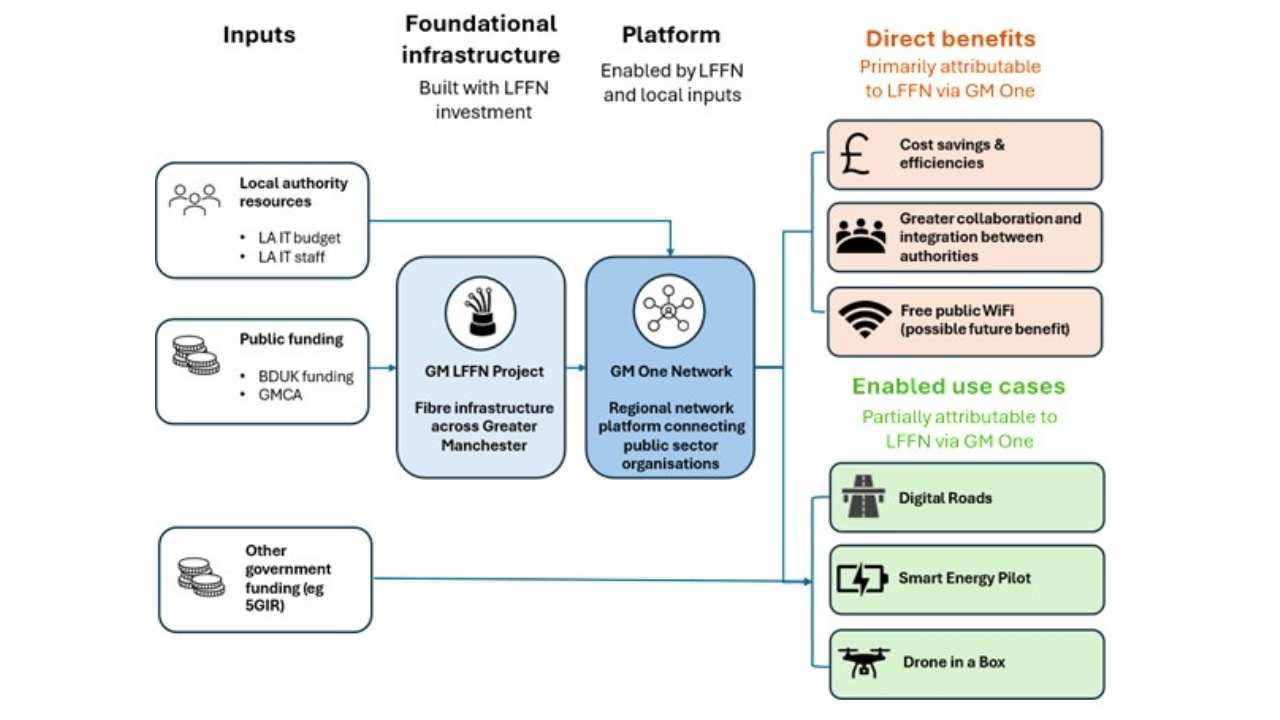
The diagram below illustrates how the Greater Manchester LFFN project provided the foundational infrastructure for the GM One Network and, through it, a range of benefits for public sector partners. Interviewees emphasised that GM One was built on the LFFN fibre network and would not have been possible without it. As a result, many of the direct benefits, such as WAN cost savings, reduced duplication, and greater integration between local authorities, can be directly attributed to the LFFN investment.
Other initiatives, including the Drone-in-a-Box project, the Smart Energy Pilot, and Digital Roads, were supported by additional government funding but rely on the GM One Network to operate. Because these projects depend on the network, their benefits are partially attributable to LFFN.
The diagram also shows that GM One was made possible not only by LFFN but also by local authority resources, including IT staff and budgets. Together, these inputs enabled the creation of a regional network platform that supports both direct operational benefits and the wider, partially enabled use cases shown.
Diagram illustrating the role of LFFN in enabling GM One Network benefits
9. Social value benefits
Greater Manchester’s LFFN project was the largest contract awarded under the programme and, as such, created significant opportunities to deliver social value alongside core infrastructure. While the direct social impacts of these activities are more relevant to Work Package 5, Socio-economic and Environmental Impacts, they are included here because they have also supported GMCA in delivering its Digital Blueprint objectives, particularly in relation to digital inclusion and community connectivity.
Social value has been delivered through both the LFFN contract with VMO2 and subsequent GM One Network contracts with partners including Cisco and Vodafone. Across these contracts, activity has focused on three main areas: local employment and skills, community connectivity and digital inclusion, and wider partnership-led innovation.
In practice, this has included the creation of apprenticeships and work experience opportunities across the region, a strong emphasis on using local labour during rollout, and structured volunteering and skills programmes linked to schools and community organisations. A significant strand of activity has focused on providing free connectivity and support to community sites and residents at risk of digital exclusion, alongside targeted funding to improve access to devices and connectivity. The GM One programme has also supported early-stage innovation activity, including initiatives designed to help local start-ups and Small and Medium Enterprises(SMEs) test and demonstrate digital solutions aligned with Greater Manchester’s health and climate priorities.
Interview evidence suggests that the most significant public sector benefit has been the scale of digital inclusion activity enabled through these social value commitments. As one interviewee noted, the digital inclusion work supported through LFFN social value “would have to be in the hundreds of thousands of pounds if not more” in terms of impact. They emphasised that, without LFFN-related resource, activity would have been “a much, much smaller scale”, with fewer community hubs connected and fewer properties reached through inclusion programmes.
The social value model in Greater Manchester has also influenced supplier behaviour beyond the region. The digital inclusion volunteering programme developed under the GMCA contract has since been adopted nationally by VMO2, extending its impact beyond Greater Manchester. Interviewees from both GMCA and VMO2 pointed to the partnership approach in Greater Manchester as an exemplar of joint working, with a stronger shared understanding of priorities and a more coordinated approach to tackling digital exclusion.
10. Building on the network
The GM One Network was established as a regional connectivity platform built on the fibre infrastructure delivered through LFFN. LFFN provided the fibre footprint, while GM One introduced the active, SD-WAN layer that allows sites across multiple organisations to operate as part of a single, shared regional platform.
Building on this, the partnership has recently contracted with Vodafone to create an SD-WAN service to connect around 250 additional public sector sites that were not included in the original LFFN footprint. This has enabled a wider range of buildings to benefit from the shared governance, security and management framework already in place, and improved consistency of service across local authorities’ estates.
The GM One programme lead attributed this expansion to the regional product management function, which was created to actively develop the network. The expansion was funded by participating partners through the GM One funding model by capitalising future IT expenditure and investing it collectively in extending the shared network.
The extension demonstrates how the network is evolving beyond its initial build phase, increasing coverage and reinforcing the regional model.
11. Challenges and barriers to benefit realisation
While interviewees were broadly positive about the benefits of LFFN and the GM One Network, several factors were identified that have limited the pace or scale of benefit realisation.
First, not all Greater Manchester districts are currently members of the GM One Network. This means that the full region is not yet operating on a single shared platform. In practice, this limits the ability to standardise services, aggregate demand or develop initiatives consistently across all ten authorities. It also reduces the potential scale of financial and strategic benefits that could arise from a fully region-wide network. Two interviewees noted that broader participation would increase the overall value of the model.
Interviewees indicated that existing connectivity and WAN contractual arrangements currently limit some authorities’ ability to join the network in the short term. In practice, this may also include authorities with connectivity arrangements delivered through other LFFN projects (e.g. in Tameside, Manchester and Salford), although this was not explicitly mentioned by interviewees.
Second, the development of use cases takes time. Aside from those initiatives supported through dedicated 5GIR funding, most applications of the network remain at an exploratory or early stage. This suggests that fully exploiting the infrastructure depends on additional funding, organisational capacity and alignment with local priorities. As one interviewee reflected, having connectivity in place does not automatically generate service transformation: “it’s not just plug it in, then we get the data right, then what do you do with the data?”
While governance arrangements provide a forum for collaboration, one interviewee suggested that there is not currently a dedicated group focused solely on maximising the long-term value of the network. This view was not widely shared, but it highlights that moving from infrastructure to sustained service innovation requires continued focus and coordination.
Finally, one interviewee identified commercial and ownership arrangements as a structural constraint. In Greater Manchester, the LFFN fibre is owned and managed by a commercial supplier. This means that extending or adapting the network requires commercial negotiation, and proposals may be subject to pricing discussions. As described in interview, if partners wish to do something new, the supplier will “give us a price”. While this does not prevent development, it can introduce negotiation time and reduce flexibility compared to models where the public sector directly owns and controls the infrastructure, such as Colchester, North Isles and North Yorkshire.
12. Future plans and priorities for the network
Interviewees stated that a central long-term ambition for the GM One Network is broader participation across Greater Manchester. The network was deliberately designed to allow additional organisations to join over time. Interviewees referred not only to the remaining GM districts, but also to other public sector bodies such as health partners and potentially blue light services. The model was described as scalable, with the financial and strategic case strengthening as participation increases. Bringing additional partners on board would spread fixed costs more widely, increase commercial leverage and extend the benefits of standardisation. It would also enable more consistent connectivity across public services, reducing fragmentation and supporting multi-agency service delivery.
Alongside expansion of membership, there are plans to build on the transport use cases that have emerged in the first phase of operation. TfGM described ambitions to scale the Digital Roads approach beyond pilot corridors, expand the use of digital twin modelling, and continue rolling out CCTV where fibre is already available. While scaling depends on funding and operational integration, the intention is to move from pilots to more systematic, region-wide deployment.
Interviewees also highlighted opportunities to leverage the network more widely across public services. Public Wi-Fi was identified as an area for continued expansion, particularly within council buildings and potentially into public spaces, supporting digital inclusion and a more consistent user experience across the city region. In housing, there are early discussions about using connected infrastructure to support environmental sensing and remote monitoring, including applications linked to energy efficiency and property conditions. Although these initiatives remain at an exploratory stage, they reflect a broader ambition to embed the network within place-based planning and service reform agendas.
13. Conclusions
In Greater Manchester, the evidence suggests that the most significant impacts were not limited to site connectivity. Instead, the key benefits were realised through the creation of the GM One Network, a shared regional connectivity platform built on the LFFN fibre backbone. LFFN provided the physical infrastructure. The GM One Network provided the governance, financial model and organisational framework needed to turn that infrastructure into sustained public sector value.
13.1 Local authority actions and building on LFFN
Following delivery of LFFN, participating authorities chose to replace separate local WANs with a single regional connectivity platform. This was a strategic decision to operate at Greater Manchester scale rather than organisational scale. It required long-term commitment, pooled investment and formal collaboration.
Importantly, the network has continued to evolve. The recent extension of the SD-WAN to approximately 250 additional sites demonstrates that partners are actively building on the original LFFN footprint. This expansion was self-funded collectively through the GM One model by capitalising future IT expenditure, rather than relying on further grant funding.
13.2 Applications beyond fixed connectivity
LFFN infrastructure has supported a range of applications beyond basic connectivity. In transport, it underpins smart junction pilots, digital twin modelling and expanded CCTV deployment. In housing and energy, it has supported pilots linking connected heat pumps and enabling remote monitoring. Other uses, including public Wi-Fi and housing-related sensing, remain at an early stage.
The most advanced applications were supported by dedicated 5G Innovation Region funding. This suggests that, while fibre has reduced the cost and complexity of deploying digital services, all of the initial early use cases have been dependent on additional external funding.
Overall, LFFN has created a resilient regional backbone that makes smart applications feasible at scale, even though many remain at pilot stage.
13.3 Influence on digital strategy
Interview evidence indicates that LFFN played a catalytic role in strengthening Greater Manchester’s regional digital agenda. It created a shared infrastructure programme that brought partners together and raised the profile of connectivity within GMCA’s strategic priorities.
The subsequent development of the GM One Network provided a mechanism for coordinating digital infrastructure at regional level. The programme has supported the Connected Places agenda by embedding connectivity within transport reform, digital inclusion and place-based planning. In this respect, LFFN contributed not only to physical infrastructure, but also to institutional capability and strategic focus.
13.4 Financial and organisational benefits
Financial savings were a primary driver of the GM One Network and remain one of its clearest benefits. Authorities reported substantial reductions in WAN and connectivity costs, including the removal of recurring leased-line expenditure. One authority estimated savings in the “hundreds of thousands of pounds” annually. The network is reported to be performing within the financial assumptions of its business case.
Operating at regional scale has also generated efficiencies through aggregated procurement, consolidated infrastructure and shared management functions. Operational benefits include improved resilience, fewer faults and lower marginal costs when deploying new digital assets where fibre is already present.
13.5 How benefits were realised
The case study demonstrates that benefits were not automatic outcomes of fibre deployment. They were enabled by a combination of organisational, financial and contextual factors.
Organisationally, Greater Manchester has a strong Combined Authority structure and established culture of partnership working. The Collaboration Board provided formal governance, while the creation of a dedicated regional product management function ensured the network is actively developed rather than simply maintained.
Financially, the GM One Network funding model, based on capitalising future IT expenditure and investing collectively, has enabled expansion and improvement without further central grant. Complementary funding streams, such as 5GIR have also accelerated specific use cases.
The scale of the Greater Manchester contract was an important contextual factor. As the largest LFFN award, it enabled significant social value commitments, including dedicated resource for digital inclusion activity. Interview evidence suggests this made a tangible contribution to advancing the region’s digital inclusion agenda. This scale of social value provision appears to have been distinctive to Greater Manchester and is unlikely to be replicable in smaller projects.
At the same time, constraints remain. Not all districts are currently members of the GM One Network, limiting full regional scale. Many use cases are still at pilot stage. Commercial ownership arrangements mean that further development requires negotiation with the supplier. This indicates that benefit realisation is ongoing.