Synthesis of evidence and conclusions
Published 10 September 2026

© Crown copyright 2026
This publication is licensed under the terms of the Open Government Licence v3.0 except where otherwise stated. To view this licence, visit nationalarchives.gov.uk/doc/open-government-licence/version/3 or write to the Information Policy Team, The National Archives, Kew, London TW9 4DU, or email: psi@nationalarchives.gov.uk.
Where we have identified any third party copyright information you will need to obtain permission from the copyright holders concerned.
This publication is available at https://www.gov.uk/government/publications/local-full-fibre-networks-evaluation-work-package-one-report/synthesis-of-evidence-and-conclusions
This chapter synthesises the evidence from case studies and provides our conclusions in relation to each of the contribution claims used to assess LFFN’s market impacts.
1. Assessment of contribution claims
1.1 Claim 1: LFFN enabled new suppliers to enter local broadband markets
Across the case studies, the evidence shows that LFFN did contribute to supplier entry in some locations, but this effect was highly variable across suppliers and areas and was strongest where LFFN aligned with commercial interest but removed key barriers to entry. The clearest evidence comes from the CityFibre case study, where LFFN funding directly enabled the company to enter multiple local markets (Highlands, Portsmouth, Suffolk and Wolverhampton) by unlocking anchor-tenancy projects that councils and CityFibre had been discussing for some time. While CityFibre may eventually have reached these areas through its commercial programme, LFFN brought entry forward, in some cases substantially.
Evidence from the Cooperative Network Infrastructure (CNI) case study is more mixed. ITS reported that its entry into Blackpool was a direct consequence of CNI infrastructure being available, as this substantially lowered rollout costs and made the area commercially viable when it otherwise would not have been. CityFibre similarly noted that access to CNI infrastructure accelerated their entry. However, in Mid Sussex, F&W Networks had already decided to enter the market for commercial reasons; CNI infrastructure simply made delivery faster and easier, rather than influencing the entry decision itself.
In Northern Ireland, LFFN did not influence entry: Fibrus was already active in the market before the Full Fibre Northern Ireland (FFNI) project and had begun its commercial rollout independently of the programme.
A consistent finding across the case studies is that private investment was the primary driver of supplier entry. All alt-nets examined (CityFibre, ITS, F&W Networks and Fibrus) had secured substantial private capital prior to LFFN, which underpinned their expansion plans. For F&W Networks and Fibrus, this investment was tied to a clear geographical focus (Sussex and Northern Ireland respectively) and pre-existing rollout strategies; LFFN supported but did not determine entry decisions in these areas. In contrast, CityFibre and ITS, as national operators with many competing rollout options, were more responsive to LFFN, with the programme making specific locations more attractive and, in some cases, commercially viable to enter sooner.
Overall, LFFN did enable new suppliers to enter some local broadband markets, but this effect was strongest where suppliers were not already committed to a particular geography and where public funding reduced risks or accelerated deployment. In other areas, LFFN played a supportive but not decisive role.
1.2 Claim 2: LFFN enabled suppliers to expand coverage and accelerate deployment
This claim has been assessed only for suppliers that already had a presence in the LFFN areas: Fibrus, Openreach and Virgin Media O2 (VMO2) in Northern Ireland, and Openreach in Tay Cities. Across these suppliers, the evidence indicates that LFFN generally made an enabling contribution, helping to accelerate or slightly extend rollout, rather than fundamentally changing investment plans or delivering large-scale coverage uplift.
For VMO2 in Belfast, Point Topic data shows no change in network footprint as a result of LFFN. Although all premises on its cable network gained access to gigabit-capable speeds following a national upgrade programme independent of LFFN. As such, there is no evidence that LFFN contributed to expanded coverage or accelerated deployment for VMO2.
In contrast, for other suppliers the evidence suggests that LFFN provided some incremental benefits. This was clearest in the Northern Ireland case study, where both Fibrus and Openreach NI indicated that FFNI allowed them to serve additional premises by leveraging the new connections to public-sector sites and extend their networks beyond its original commercial footprint. The scale of these additional connections is uncertain, and therefore the contribution could be seen as either enabling or, at most, substantial,.
The interviewee from Openreach in Tay Cities reported that LFFN accelerated deployment in some locations, particularly in Perth, where the programme aligned closely with the company’s existing commercial rollout plans. They also noted that connecting public-sector sites may have enabled onward extension to nearby premises, either through commercial investment or the use of voucher schemes, although they were unable to confirm the extent of this.
Overall, the evidence suggests that LFFN did not change suppliers’ underlying strategies, but it helped bring forward some deployment activity and enabled modest extensions to existing plans. These effects appear to be real but limited, reflecting the fact that the principal drivers of network expansion, particularly private investment and other major public programmes such as Project Stratum, sat outside LFFN.
1.3 Claim 3: LFFN contributed to the growth and financial stability of alternative network providers (alt-nets) by enabling them to expand their customer base and revenue streams in project areas
Across the case studies, the evidence for Claim 3 is mixed. In most cases, the direct impact of LFFN on revenues is likely to have been modest, as the scale of additional premises connected through the programme was relatively small compared to the much larger commercial rollouts undertaken by alt-nets during the same period. While some suppliers, most notably ITS and CityFibre, reported that LFFN areas accounted for a noticeable share of their revenues at certain points in time, both companies were expanding rapidly and could have grown by targeting other locations. This makes it difficult to establish a clear counterfactual or to isolate LFFN’s direct revenue effect.
For other alt-nets, such as F&W Networks and Fibrus, the contribution of LFFN to revenue growth appears to be limited to those incremental premises that were reached specifically because of the programme; for example, where public-sector connections allowed the network to be extended slightly further into nearby areas. As these volumes are small relative to the size of their wider footprints, the financial effect is correspondingly limited.
However, the evidence indicates that LFFN may have had a more substantial indirect effect on alt-net growth. For some suppliers, participation in LFFN provided an early opportunity to deliver large-scale public-sector contracts, helping them to build a demonstrable track record and strengthen their credibility with both government and investors. This effect was cited by both CityFibre, which subsequently secured numerous Project Gigabit contracts, and Fibrus, whose experience with FFNI preceded major contract wins such as Project Stratum and Project Gigabit in Cumbria. In these cases, LFFN’s role in enhancing organisational capability, demonstrating delivery competence, and improving perceived reliability may have supported wider growth even where the direct revenue effect was small.
Overall, LFFN’s contribution to alt-net financial growth is primarily indirect. While the programme generated some additional revenues in specific areas, its more important effect appears to have been in building credibility and strengthening the foundations for future expansion, rather than materially altering short-term growth rates.
1.4 Claim 4: LFFN acted as a market signal, influencing broadband operators to modify their strategic investment decisions by accelerating, expanding, or reprioritising their network expansion plans
There is no evidence that LFFN acted as a wider market signal that influenced operators’ strategic investment decisions. Interviewees consistently reported that their organisations already had established strategies and long-term rollout plans for fibre deployment, and that these were not altered in response to the programme. Where operators accelerated or expanded their networks, this reflected broader commercial drivers and private investment cycles rather than any signalling effect from LFFN.
1.5 Claim 5: LFFN enabled smaller broadband providers to attract private investment for expansion by increasing their market credibility and lowering perceived investment risk
The evidence for Claim 5 varies substantially across suppliers. For the CNI alt-nets (F&W Networks and ITS) there is no evidence that access to LFFN-funded CNI infrastructure helped them attract private investment. In fact, some interview evidence suggested that investors may initially view the CNI model as less favourable, preferring operators that own their underlying infrastructure. Although this concern can be mitigated once the model is understood, there is no indication that LFFN materially improved either firm’s ability to secure finance.
For CityFibre, there is some theoretical support for the claim, based on their early practice of borrowing against long-term public-sector contracts to fund build activity. Anchor-tenancy agreements, including those associated with early LFFN Wave 1 projects, helped provide lenders with confidence and unlock working capital. However, by the time Wave 2 and 3 LFFN projects were awarded, CityFibre had already secured substantial backing through its partnership with Vodafone and subsequent acquisition by Bidco, giving it access to substantial private capital. As a result, LFFN contracts in later years were unlikely to have played a material role in securing further investment, even if the earlier reliance on government contracts provides indirect support for the underlying mechanism.
The clearest evidence comes from Fibrus, which reported that delivering the FFNI contract at an early stage of its development substantially strengthened investor confidence. The company believed that successful delivery improved its credibility with both public and private funders, helping it to raise further equity and debt finance and supporting subsequent expansion. This suggests that LFFN made a substantial contribution to Fibrus’s ability to attract investment.
Overall, the evidence for Claim 5 is mixed: LFFN played an important role for Fibrus, had limited or no effect for most CNI suppliers, and likely made only a minor contribution for CityFibre once its major private-sector backing was secured.
1.6 Claim 6: LFFN increased competition in local broadband markets, prompting traditional providers (e.g. Openreach and Virgin Media) to respond by accelerating their fibre rollout or upgrading their networks.
This claim was always expected to be challenging to evidence. A robust assessment would require Openreach and VMO2 to confirm directly that their activity in specific areas was a response to LFFN-funded suppliers, but interviews with these incumbents proved difficult to secure. As a result, the evaluation relies on the perceptions of LFFN suppliers, alongside analysis of rollout data and the relative timing of expansion by incumbents and alt-nets.
There is only limited evidence from case studies that LFFN provoked a competitive response from incumbents, with effects varying substantially by area. The clearest indication of a competitive response comes from Wolverhampton, where both CityFibre and the local council reported that other providers accelerated their rollout immediately following CityFibre’s LFFN-supported entry. This interpretation is supported by Point Topic data, which shows a marked increase in Openreach’s coverage coinciding with CityFibre’s deployment.
In other LFFN areas, however, the evidence is much weaker. CityFibre believed that incumbents reacted to their presence in several locations, but the rollout data generally shows either very limited expansion by Openreach, or that Openreach’s footprint was already growing before CityFibre entered the market, continuing on the same trajectory afterwards. This pattern suggests that any acceleration was more likely driven by wider commercial plans rather than a direct response to LFFN activity.
For VMO2, the evidence is even clearer. In most areas, the VMO2 footprint has remained largely unchanged, and while the company has undertaken substantial upgrades and begun a migration to full fibre, these are part of national upgrade programmes, with no indication that they were triggered by LFFN-funded competition.
Overall, the evidence indicates that while LFFN may have prompted a competitive response in a small number of cases, particularly in Wolverhampton, there is no strong or consistent pattern across the case studies. In most areas, incumbent activity appears to have been shaped by existing commercial strategies rather than the presence of LFFN-funded networks.
1.7 Claim 7: LFFN increased competition and choices of packages in local broadband markets by enabling more Internet Service Providers (ISPs) to offer services over gigabit-capable networks
There is consistent evidence that LFFN increased ISP choice in areas where it facilitated CityFibre’s entry into the market. As a wholesale operator, CityFibre enables multiple ISPs to deliver services over its network, and in all five LFFN areas where it entered (Blackpool, Highlands, Portsmouth, Suffolk and Wolverhampton) its presence led to the availability of packages from Zen Fibre and Vodafone. This has expanded the range of gigabit-capable packages available to consumers in each location, particularly at higher speed tiers where CityFibre-based ISPs often account for a substantial share of available deals. In these areas, the contribution of LFFN to increasing choice is clear.
In Northern Ireland, both Fibrus and Openreach operate as wholesale providers, allowing multiple ISPs to offer broadband services over their networks. However, most of this choice would have been available regardless of LFFN, as both operators were already undertaking major expansion programmes. As a result, LFFN’s contribution to increasing ISP choice is limited to the incremental footprints created through FFNI - principally, the additional premises reached where public-sector connections enabled local extensions of the network.
A similar pattern is observed in Tay Cities, where Openreach’s wholesale model provides widespread choice but where most network expansion reflects its ongoing commercial plans rather than LFFN. Any LFFN-driven improvement in ISP choice is therefore confined to the small number of areas that may have benefited from limited incremental extensions around public-sector sites.
Overall, LFFN did increase consumer choice in areas where it enabled CityFibre to enter the market, but in most other locations its effect was small and geographically limited, reflecting the modest scale of incremental coverage delivered by the programme. However the presence of multiple wholesale networks in some LFFN areas may create conditions for increased price competition over time, should market dynamics and demand support this in future.
1.8 Claim 8: LFFN influenced broadband pricing by increasing competition in local markets, leading to changes in the cost of broadband subscriptions
There is strong evidence from the CNI and CityFibre case studies that LFFN has helped make broadband more affordable in the areas where it supported the early entry of gigabit-capable networks. In Blackpool, ISPs using CityFibre consistently offered the lowest-cost packages at a range of speed thresholds, and because CityFibre’s entry was directly enabled by LFFN, these reductions in price can be attributed to the programme. In Mid Sussex, Hey Broadband (the retail arm of F&W Networks) offered the cheapest deals on the market for most speed ranges. Although F&W Networks would have entered the area regardless of CNI, the supplier reported that CNI enabled them to deliver higher-capacity services at lower cost, suggesting that LFFN contributed to more affordable pricing.
Similar patterns were observed in the CityFibre case study areas, where ISPs using CityFibre’s network were consistently the most affordable options available. In these locations, LFFN helped introduce an alternative wholesale network offering competitively priced packages, thereby increasing price competition and expanding access to lower-cost gigabit services.
In Northern Ireland, Fibrus also offers the cheapest deals on the market at various speed thresholds. Most households would have benefited from these offers irrespective of LFFN, given Fibrus’s commercial and publicly funded rollout. However, for the subset of premises that gained access specifically through FFNI, LFFN has directly increased the availability of affordable full-fibre options.
2. Other findings
2.1 New commercial models
LFFN supported the use and wider awareness of two delivery models (the anchor tenancy model and the CNI shared-infrastructure model) both of which pre-dated the programme but were used more extensively or visibly through LFFN-funded projects. CityFibre had already adopted an anchor-tenancy approach in earlier partnerships with local authorities, but LFFN helped to formalise its use across multiple areas and provided other councils with greater confidence to adopt the model. The case studies demonstrate that this approach has been effective in facilitating the entry of new suppliers, diversifying local markets and increasing consumer choice.
Similarly, although the CNI model had been developed elsewhere (e.g. Tameside, supported in Wave 1), the programme played an important role in raising its profile and encouraging uptake by local authorities in Blackpool and Mid Sussex. The case studies show that shared passive infrastructure can help to lower barriers to entry and support new market participants; most clearly in Blackpool, where ITS and CityFibre entered the market as a direct result of CNI access. In both areas, the model has contributed to more competition and a wider range of affordable broadband offers, particularly from smaller providers.
However, the broader market-shaping ambitions of CNI, such as enabling a more coordinated and efficient approach to network deployment, have been realised only to a limited degree. This reflects a combination of factors, including limited visibility of CNI infrastructure among some market participants and a continued preference among many alt-nets to deploy their own networks, rather than widespread take-up of shared assets. Even so, the case studies show that both the anchor tenancy and CNI approaches have demonstrated clear strengths in supporting supplier entry and improving consumer outcomes, and LFFN has played a role in giving local authorities confidence to use these models.
2.2 Sustainability of alt-nets and market changes
The case studies indicate that most of the alt-nets supported through LFFN are in a relatively strong long-term position, with continued access to private investment, active growth strategies and ambitions to expand further. ITS reported substantial recent growth supported by strategic acquisitions, substantial funding rounds, and the expansion of its UK full-fibre network. The company aims to pass 50% of UK commercial business premises and is investing in new network technologies, suggesting a clear long-term commercial trajectory. CityFibre, now the largest alt-net in the UK, maintains its ambition to reach 8 million premises and has strengthened its market position through a series of acquisitions (e.g. Connexin, Lit Fibre). Fibrus has raised several rounds of investment, consolidated its position as a major operator in Northern Ireland, and is now extending its activities into Great Britain with support from its investors.
The picture is more uncertain for F&W Networks, reflecting wider consolidation pressures in the alt-net sector. Nonetheless, the company has recently announced a strategic partnership with Fusion Fibre Group, which may provide additional operational and financial resilience.
Taken together, these developments suggest that many of the market changes facilitated by LFFN are likely to be sustained, particularly where the programme supported suppliers that already had strong backing and scalable business models. In areas where LFFN stimulated supplier entry or expanded wholesale access (e.g. CityFibre and ITS locations), the resulting increases in choice and affordability are also likely to persist
3. Overall conclusions
The evidence from the case studies provides a mixed picture of LFFN’s influence on broadband markets. Several elements of the theory of change are supported, while others show limited or no evidence.
3.1 Elements of the theory of change that are supported:
-
LFFN enabled supplier entry in specific areas, most clearly where it facilitated CityFibre’s or ITS’s entry through anchor tenancy and CNI models. In these locations, LFFN brought forward deployment and created conditions for new competition.
-
LFFN enabled modest extensions or acceleration of network build for suppliers already active in the area (e.g. Fibrus and Openreach), particularly where public-sector connections allowed networks to reach nearby premises.
-
LFFN contributed to improved affordability and consumer choice in areas where it enabled the entry of competitive wholesale networks. ISPs using CityFibre and F&W Networks typically offered some of the cheapest deals on the market.
-
LFFN strengthened the credibility of some alt-nets, providing a platform that helped certain suppliers (notably Fibrus) to secure further private investment and larger public contracts.
3.2 Elements with limited, mixed or no evidence:
-
Wider market signalling effects were not observed. Operators consistently reported that their strategic plans were unaffected by LFFN.
-
Competitive responses from incumbents were limited. Evidence of accelerated rollout was found only in Wolverhampton; elsewhere, incumbent activity reflected broader national programmes rather than reactions to LFFN-funded suppliers.
-
CNI’s intended role in creating a more coordinated or efficient market was only partially realised. While it lowered barriers to entry for some suppliers, uptake was limited and did not lead to widespread infrastructure sharing.
-
Effects on alt-net revenues were generally modest, with growth driven primarily by commercial expansion and larger public programmes rather than LFFN-funded activity.
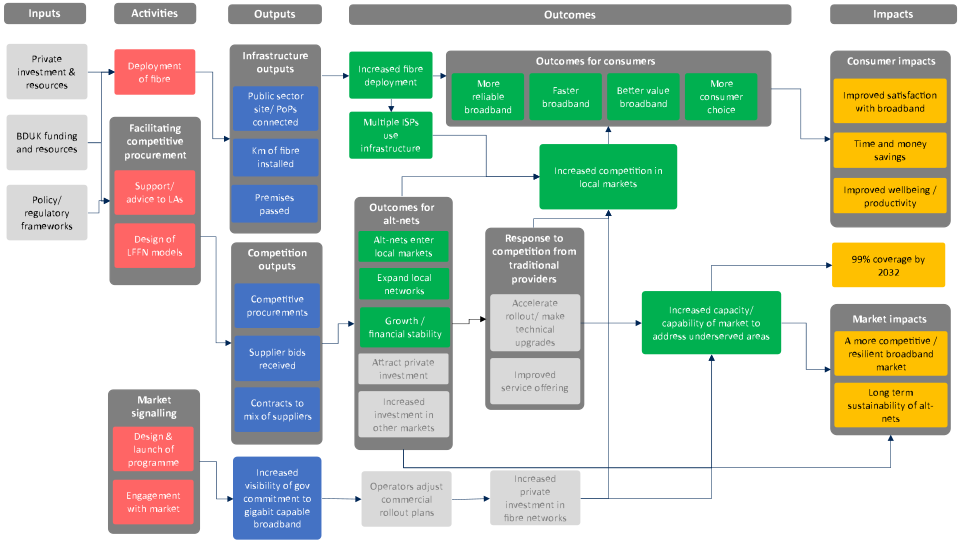
The diagram below shows the theory of change, with outcomes where the evidence was limited, mixed or absent shown in grey. It provides a visual summary of where the evaluation found clear support for the expected causal pathways, and where the evidence was weaker or more variable.
The diagram should be interpreted with care. Many of the outcomes in the theory of change depend heavily on local context, including the delivery model used, the type of supplier involved and local market conditions. As a result, the strength of evidence varies across case studies and cannot always be represented clearly in a single diagram. In several cases, outcomes shown in grey reflect partial or uneven evidence, rather than no impact at all. For example, competitive responses from incumbents were observed in Wolverhampton but not in other case study areas, and LFFN contributed to improved credibility with private investors for some suppliers (notably Fibrus), but not across the programme as a whole.
The only causal pathway that can be consistently ruled out across all case studies relates to wider market-signalling effects, where no supporting evidence was found. For other outcomes, the grey shading indicates that impacts were not consistent or generalisable, rather than that they did not occur. The diagram should therefore be read alongside the narrative findings, which explain how and where LFFN contributed to outcomes in practice.
3.3 Revised theory of change diagram