Introduction and Methodology
Published 10 September 2026

© Crown copyright 2026
This publication is licensed under the terms of the Open Government Licence v3.0 except where otherwise stated. To view this licence, visit nationalarchives.gov.uk/doc/open-government-licence/version/3 or write to the Information Policy Team, The National Archives, Kew, London TW9 4DU, or email: psi@nationalarchives.gov.uk.
Where we have identified any third party copyright information you will need to obtain permission from the copyright holders concerned.
This publication is available at https://www.gov.uk/government/publications/local-full-fibre-networks-evaluation-work-package-one-report/introduction-and-methodology
1. Overview of LFFN
The Local Full Fibre Networks (LFFN) programme, launched by the Department for Culture, Media and Sport in 2017, was a £200 million programme designed to accelerate the deployment of full-fibre and gigabit-capable broadband at a time when national coverage was still limited and uneven. The programme sought to improve connectivity for public-sector organisations, extend access to high-quality digital infrastructure for residents and businesses, and stimulate wider investment in full-fibre networks by providing funding for local authority led projects to connect public sector buildings and assets, which in turn would reduce the costs and risks associated with early deployment. By using public-sector connectivity as a catalyst, LFFN aimed to generate local benefits while also supporting long-term improvements in digital capability and economic resilience.
LFFN operated through 3 delivery models:
-
Public Sector Anchor Tenancy (PSAT) – procuring long-term connectivity for public-sector sites, providing suppliers with guaranteed demand that could help unlock or accelerate commercial rollout.
-
Public Sector Asset Reuse (PSAR) – enabling suppliers to make use of existing public-sector infrastructure (e.g. ducting or fibre) to reduce build costs and extend full-fibre networks.
-
Public Sector Building Upgrades (PSBU) – upgrading connections to public buildings and facilities, improving service quality for frontline organisations while creating opportunities for suppliers to deploy fibre more widely.
Together, these models aimed to demonstrate more efficient ways of deploying fibre, enhance public-sector service delivery, and support the transition to a gigabit-capable UK.
1.1 Purpose of this report
This report forms part of the independent evaluation of LFFN, delivered by GC Insight, Darren Kilburn and Belmana. The evaluation is structured around 6 work packages:
-
Work package 1 – Broadband market impacts. Assesses how LFFN has influenced local and national broadband markets, including supplier entry, diversification, commercial models and competition.
-
Work package 2 – Scalability and learning. Examines what LFFN taught Building Digital UK(BDUK) and others, how learning has been applied in subsequent programmes, and the extent to which LFFN approaches can be scaled or replicated.
-
Work package 3 – Benefits to hubs and local authorities. Investigates site-level benefits, local authority cost savings, wider digital ambitions, and how LFFN infrastructure is being used to support broader connectivity and digital strategies.
-
Work package 4 – Additional use of gigabit infrastructure. Explores how LFFN-built infrastructure has been used for further commercial build, additional coverage, mobile connectivity, and the medium- to long-term value of dark fibre or passive assets.
-
Work package 5 – Social, economic and environmental impacts. Identifies emerging socio-economic and environmental changes linked to LFFN, producing evidence and case studies in areas where impacts are observable.
-
Work package 6 – Programme-level synthesis and VfM. Synthesises findings from all work packages to assess overall LFFN impact, value for money, and implications for future BDUK programme design.
The focus of this report is work package one, which examines LFFN’s contribution to market outcomes. This element of the evaluation is of particular interest to BDUK, as it explores whether the programme helped to stimulate competition, support supplier entry and growth, encourage more efficient models of delivery, and influence the broader development of the UK broadband market.
The research questions addressed in this report cover 4 main themes:
-
Supplier entry and diversification, including whether LFFN encouraged new operators to enter local markets and use subsidised infrastructure to offer new or enhanced services.
-
Delivery and commercial models, exploring whether LFFN supported the adoption of new approaches such as anchor tenancy or asset reuse.
-
Market health and competitive dynamics, examining how LFFN influenced competition, pricing and local market conditions, and whether it affected the national strategies of major operators.
-
Sustainability and long-term viability, considering the prospects of alt-nets supported through LFFN and whether market changes are likely to endure.
The analysis uses a contribution analysis approach, assessing the extent to which observed outcomes can reasonably be linked to LFFN in the presence of other drivers of market change. The evidence draws on 4 detailed case studies: CityFibre, Cooperative Network Infrastructure (CNI), Northern Ireland and Tay Cities, selected to reflect different delivery models, market contexts and supplier types. Together, these provide a robust basis for assessing LFFN’s contribution to market outcomes.
2. Theory of change for market impacts
This chapter sets out the theory of change underpinning work package one, which focuses on understanding the impact of LFFN on local and national broadband markets. The theory of change provides a structured framework for identifying the expected causal pathways through which LFFN activities were intended to influence market outcomes. It highlights the assumptions behind these pathways, the contextual factors that could affect them, and the types of outcomes that the programme aimed to achieve.
The theory of change helps to guide the contribution analysis by clarifying how LFFN was expected to stimulate supplier investment, encourage market entry and expansion, and improve the overall health and competitiveness of broadband markets.
The theory of change is presented diagrammatically at the end of the chapter, showing the relationships between inputs, activities, outputs, outcomes, and impacts. Each of these core components is described in more detail below. Key assumptions underpinning the theory of change are not included in the diagram to keep it clear and accessible, but are discussed in detail throughout the chapter.
2.1 Rationale
At the time LFFN was launched in 2017, the UK’s broadband infrastructure lagged substantially behind that of other countries. According to Ofcom Connected Nations reports only 3% of premises had access to full fibre connections in 2017, placing the UK among the lowest-ranked nations in Europe for fibre coverage. This limited availability of gigabit-capable infrastructure was seen as a potential constraint on productivity and innovation as the range of data-heavy applications grows.
The broadband market was dominated by a small number of large infrastructure providers, particularly BT/Openreach and Virgin Media. These firms had invested heavily in part-fibre networks (e.g. fibre-to-the-cabinet) but had limited commercial incentives to extend full fibre connectivity, particularly in areas where returns were uncertain. As a result, there was insufficient competition and underinvestment in gigabit-capable networks, especially in areas with less attractive commercial cases.
LFFN was introduced as part of a wider set of government interventions aimed at addressing this market failure and accelerating the UK’s transition to full fibre. Other measures included the rollout of voucher schemes.
2.2 Inputs
Inputs are the resources, funding, and expertise that underpin the delivery of the LFFN programme. These include:
-
BDUK funding and resources: £200 million in capital funding was made available through the LFFN programme. BDUK also provided staff time and programme management expertise, drawing on prior experience from delivering the Super Connected Cities programme.
-
Private investment and resources (LFFN suppliers): Suppliers contributed commercial investment, technical expertise, and delivery capacity to build and operate gigabit-capable infrastructure alongside public funding.
-
Local authority staff time: Local authorities committed internal resources to develop business cases, manage procurements, and coordinate delivery of LFFN projects within their areas.
-
Policy and regulatory frameworks: Projects were designed in alignment with state aid rules and existing regulatory frameworks, including Ofcom’s Physical Infrastructure Access (PIA) regime, which enabled suppliers to access Openreach’s ducts and poles.
2.3 Activities
Programme activities relevant to work package one centred around 2 main strands: the deployment of infrastructure and BDUK’s role in facilitating competitive procurement.
Deployment of fibre
At the core of the LFFN programme was the physical deployment of gigabit-capable infrastructure. This included extending full fibre networks to public sector buildings, developing new backhaul routes, and enabling the re-use of public sector assets. The deployment aimed to reduce the cost and risk of further commercial rollout, creating a foundation for wider market investment in high-speed connectivity.
Facilitating competitive procurement
Alongside infrastructure delivery, BDUK played a central role in enabling competitive procurement processes. This was achieved through 2 main activities:
-
Design of LFFN models: BDUK developed 3 delivery models: PSAT, PSBU and PSAR to provide flexible mechanisms that could suit a range of market contexts and attract a diverse set of suppliers. These models were specifically designed to lower barriers to entry and support competition, including participation from smaller alternative network providers (alt-nets).
-
Support and advice to local authorities: BDUK provided guidance to local authorities throughout the procurement process, including advice on supplier engagement, commercial design, and compliance with state aid requirements. This support was particularly important in shaping procurement scopes, ensuring legal compliance, and enabling local bodies to run open and effective competitions that could stimulate broader market interest.
While not a core focus of the programme, the design and launch of LFFN, and the associated awareness-raising and engagement activities with suppliers, may also have had important market signalling effects. By announcing a dedicated fund for full fibre infrastructure and engaging early with industry, BDUK helped to demonstrate clear government intent and commitment to accelerating gigabit-capable broadband.
2.4 Outputs
The activities delivered through the LFFN programme led to 2 distinct categories of outputs
Infrastructure outputs are the tangible physical and technical deliverables resulting from the delivery of LFFN projects that directly contribute to enhanced connectivity. They include:
-
Public sector buildings connected
-
Kilometres of fibre installed or ducting installed/refurbished
-
Points of presence: establishment of network access points that can act as hubs for providing onward connectivity
-
Premises passed: the number of premises that have access to broadband infrastructure, meaning they are within reach of the network and can be connected without substantial build work (LFFN monitored premises passed within 50m and 200m of infrastructure)
BDUK’s efforts to facilitate competitive procurement led to measurable competition outputs in terms of market engagement and diversity of supply:
-
Competitive procurements (run by local authorities with support from BDUK)
-
Supplier bids received: These processes attracted bids from a range of market participants, including both national incumbents and smaller alt-nets.
-
Contracts to mix of suppliers: Contracts were ultimately awarded to a varied set of delivery organisations. In many cases, these included altnets and larger telecoms firms. In other instances, contracts were awarded to intermediary organisations, such as Redcentric and Capita, who managed the infrastructure works and subcontracted the actual connection services to telecoms providers.
Key assumptions: Activities to outputs
The successful translation of activities into the outputs above rests on the following key assumptions:
-
Guidance and support provided to local authorities addresses any challenges or barriers for running competitive procurement processes
-
Procurement processes are transparent and accessible for a broad range of suppliers
-
LFFN delivery models reduce barriers to entry (e.g. by separating infrastructure from service contracts and leveraging shared public assets to lower costs and risks), making procurement opportunities more attractive for alt-nets
2.5 Outcomes
The LFFN programme was designed to strengthen competition in local and national broadband markets, with the ultimate aim of delivering better outcomes for consumers. This could occur through 2 impact pathways: one focused on the retail market and the other on the wholesale market. In addition, the programme may have contributed to market outcomes more indirectly through its signalling effects.
Retail market pathway: expanding coverage and enabling multiple ISPs to use new infrastructure
The first pathway begins with the deployment of fibre infrastructure, which expands the network reach of LFFN supplier, whether altnets or incumbents. In areas where this new infrastructure is available on an open access basis, it can be used by multiple internet service providers (ISPs). This creates a more competitive retail environment by giving consumers access to services from a greater number of ISPs operating over the same network.
This impact pathway rests on the following key assumptions:
-
Connecting public sector sites or reuse of public sector assets improves the commercial viability of further network expansion due to reduced deployment costs.
-
The infrastructure is genuinely open access and offered on commercially viable terms.
-
There is sufficient demand from ISPs to use the newly deployed infrastructure.
Wholesale market pathway: entry, expansion, and competitive pressure
The second pathway operates at the level of the wholesale market. LFFN funding was intended to reduce barriers to market entry and expansion for altnets, enabling them to gain a foothold in new local areas. Once established, these providers can:
-
Expand their local network presence
-
Achieve greater financial sustainability
-
Leverage their growth to enter new markets
This market entry and expansion has the potential to trigger a competitive response from traditional providers, such as BT/Openreach and VMO2. These responses may include accelerating their own fibre rollouts, upgrading networks, and improving the quality or value of their service offerings.
As more suppliers become active in more areas, and as both altnets and incumbents respond to competitive pressure, the overall capacity and capability of the broadband market to serve previously underserved areas increases. This effect contributes to a broader shift toward a more competitive and resilient broadband market across the UK.
This impact pathway rests on the following key assumptions:
-
LFFN support meaningfully lowers barriers to entry or expansion for altnets
-
LFFN contracts are won by new entrants into local markets, or the infrastructure is available for new entrants to use (e.g. through a cooperative model), which facilitates their entry
-
Initial entry enables altnets to build a stable customer base and income streams, justifying further investment.
-
Alt-nets can use their early success to attract private investment, leverage further funding or secure new contracts – all contributing to their sustainability.
-
Established providers perceive competition as a substantial enough incentive to accelerate their own investments.
Consumer outcomes
Both pathways ultimately contribute to the same set of consumer outcomes. As competition increases, whether through greater retail choice or improved wholesale market dynamics, consumers benefit from:
-
More reliable broadband, supported by high-capacity fibre infrastructure
-
Faster broadband speeds
-
Better value broadband, as competition places downward pressure on prices
-
More consumer choice, with a broader range of providers and service packages available
These outcomes rest on the following key assumptions:
-
Providers using infrastructure offer a range of broadband packages tailored to varying customer needs
-
Increased competition (in wholesale and retail markets) drives down prices for broadband services
-
New infrastructure meets technical standards for increased speed and reliability
Market signalling
The main outcomes associated with the market signalling pathway include changes in supplier behaviour in response to perceived government priorities. In particular, some operators may have adjusted their commercial rollout plans, by accelerating, expanding or reprioritising investments. This has the potential to result in increased private investment in fibre networks, including in areas not directly supported by the programme. These shifts would also be expected to contribute to greater competition in broadband markets and enhance the capacity and capability of the market to serve underserved areas.
These outcomes rest on the following key assumptions
-
Suppliers are aware of LFFN and interpret the programme as a genuine indication of long-term policy direction and support for full fibre.
-
The existence of the programme and its signal about government intent alters operators’ perceptions of risk and the viability of further investment.
-
The visibility of government backing for full fibre infrastructure improves investor confidence, making it easier for suppliers (particularly altnets) to secure funding for network expansion.
2.6 Impacts
The intended long-term impacts of the LFFN programme can be grouped into 3 areas, all aligning with BDUK objectives: consumer impacts, broadband market conditions, and national coverage goals.
Consumer impacts
As gigabit-capable broadband becomes more widely available and competition improves, consumers are expected to experience a range of long-term benefits. These include:
-
Improved satisfaction with broadband: Greater reliability, faster speeds, and increased choice are expected to lead to higher satisfaction levels among users, particularly those in areas that were previously underserved or poorly connected.
-
Time and money savings: Enhanced connectivity enables more efficient use of digital services, such as remote working, online education, and access to digital healthcare, while increased competition can help reduce the cost of broadband for households and businesses.
Both impacts ultimately contribute to improved wellbeing for consumers and productivity improvements for businesses.
These impacts rest on the following key assumptions:
-
Consumers and businesses take up gigabit capable services once available
-
Price competition in the market translates into lower costs for end users
-
Households and businesses adopt new applications that save them time and money
Market impacts
LFFN also aims to contribute to structural improvements in the broadband market, particularly through encouraging the growth and diversification of the supplier base. Key market-level impacts include:
-
A more competitive and resilient broadband market: By enabling new entrants, LFFN helps to increase competition in the market, increasing the market’s ability to adapt and innovate.
-
Long-term sustainability of altnets: By facilitating their entry into local markets and supporting network expansion, the programme strengthens the commercial viability of smaller alternative network providers. This increases their capacity to operate at scale and remain active players in the market over time.
These impacts rest on the following key assumptions:
-
Regulatory and market conditions remain favourable to alt-net expansion and sustainability.
-
Alt-nets continue to secure investment and adapt to changing market demands
-
Alt-nets can maintain and scale operations beyond initial LFFN funded activity
Contribution to national coverage objectives
The LFFN programme forms part of the UK Government’s broader ambition to achieve 99% coverage of gigabit-capable broadband by 2032. By increasing competition and capacity in the market, LFFN contributes to this long-term goal, particularly in areas where commercial delivery would otherwise be slow or unlikely.
Theory of change for market impacts
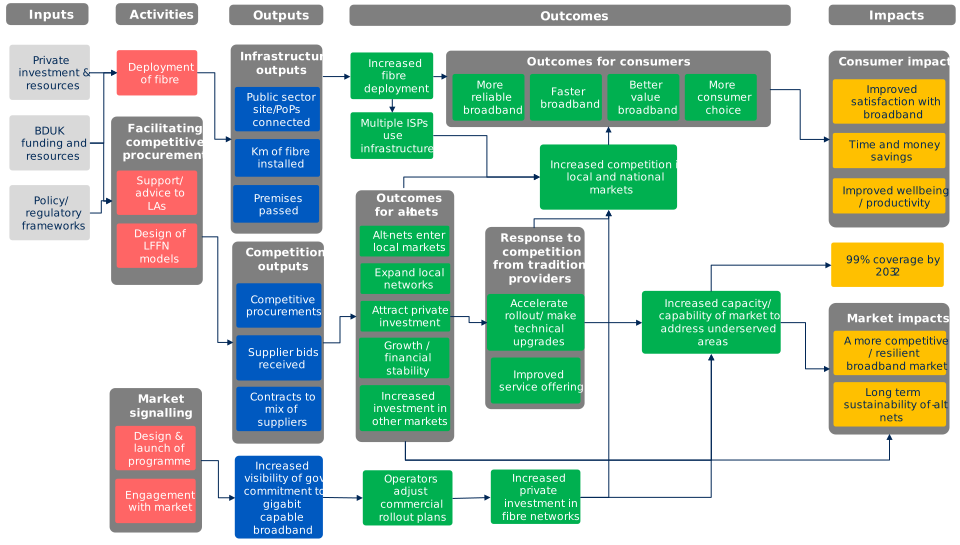
3. Methodology for evaluating market impacts
3.1 Approach
Work Package One uses contribution analysis to assess the extent to which the LFFN programme influenced local and national broadband market outcomes. This approach is well suited to a complex market environment in which multiple factors were shaping investment decisions and market behaviour at the same time as LFFN was being delivered.
Rather than seeking to establish direct attribution, contribution analysis examines whether observed changes are consistent with LFFN’s theory of change, assesses the plausibility of the programme’s influence, and considers alternative explanations. The focus is therefore on understanding the nature and strength of LFFN’s contribution to market developments, rather than isolating a single causal effect.
Further detail on the contribution analysis framework, evidence tests and assessment criteria is provided in the Annex.
3.2 Contribution claims
To guide the analysis, a set of contribution claims was developed, each linked directly to the programme’s theory of change and representing a specific pathway through which LFFN may have influenced the market. These claims are:
-
Claim 1: LFFN funding enabled new suppliers to enter local broadband markets by reducing risks and barriers to entry, and making entry more viable.
-
Claim 2: LFFN enabled suppliers to expand their network coverage and investment at a greater scale or speed than they would have otherwise.
-
Claim 3: LFFN contributed to the growth and financial stability of alternative network providers (alt-nets) by enabling them to expand their customer base and revenue streams in project areas.
-
Claim 4: LFFN acted as a market signal, influencing broadband operators to modify their strategic investment decisions by accelerating, expanding, or reprioritising their network expansion plans.
-
Claim 5: LFFN enabled smaller broadband providers to attract private investment for expansion by increasing their market credibility and lowering perceived investment risk.
-
Claim 6: LFFN increased competition in local broadband markets, prompting traditional providers (e.g. Openreach and Virgin Media) to respond by accelerating their fibre rollout or upgrading their networks.
-
Claim 7: LFFN increased competition and choices of packages in local broadband markets by enabling more ISPs to offer services over gigabit-capable networks.
-
Claim 8: LFFN influenced broadband pricing by increasing competition in local markets, leading to reductions in the cost of broadband subscriptions.
These claims provide the structure for the evaluation, enabling a systematic assessment of the strength and nature of LFFN’s contribution across different aspects of market behaviour and outcomes.
Assessing the strength of contribution
For each contribution claim, the evaluation assigns a contribution category to summarise the strength of evidence that LFFN influenced the observed outcome. These categories range from cases where LFFN was a primary or substantial contributor, through enabling or marginal contribution, to no observable contribution.
Assigning contribution categories provides a consistent way of comparing findings across claims and case studies, and underpins the assessment presented in the sections that follow. Further detail on the categories and evidence tests is provided in the Annex.
Evidence base
The contribution analysis draws on a combination of qualitative and quantitative evidence, including supplier interviews, market datasets and published sources. This evidence is used to test each contribution claim and assess the strength of LFFN’s influence relative to other factors shaping the market. Full details of data sources and analytical methods are set out in the Annex.
3.3 Case study approach
A case study approach was used to support the contribution analysis, recognising that market impacts cannot be fully understood through quantitative indicators alone. These case studies enabled a more detailed examination of supplier behaviour, investment decisions and local market dynamics, informed by qualitative evidence from suppliers and other stakeholders.
4 case studies were selected to reflect different delivery models, supplier types and market contexts:
-
CNI – a model-based case study covering 2 PSAR projects (Blackpool and Mid Sussex). These projects made fibre infrastructure available to multiple suppliers through a cooperative model, with the aim of encouraging a more diverse and competitive marketplace.
-
CityFibre – a supplier-based case study examining the role of a large alt-net that delivered several LFFN contracts (primarily PSAT projects) and has also utilised LFFN-funded infrastructure in areas where it was not the contract holder. This provided an opportunity to assess LFFN’s contribution both to CityFibre’s national expansion as well as local market outcomes.
-
Northern Ireland – an area-based case study covering the whole of Northern Ireland, which had 3 LFFN projects: one in Armagh, Banbridge and Craigavon; one in Belfast; and the Full Fibre Northern Ireland programme covering all areas outside Belfast. This case study enabled analysis of LFFN’s contribution in a region with distinctive market characteristics and a range of different interventions.
-
Tay Cities – an area-based case study including 2 LFFN projects: a PSAR project delivered by Neos Networks and a PSBU project delivered by Openreach. This area was selected specifically to explore market impacts where an incumbent, rather than an alt-net, secured one of the LFFN contracts. It allowed the evaluation to examine whether LFFN supported expansion in areas that improved consumer choice and strengthened retail competition.
Together, these 4 case studies represent a broad cross-section of LFFN activity and provide a robust basis for assessing the programme’s contribution to market outcomes across different delivery contexts.
4. UK broadband market trends
Understanding how the UK broadband market has evolved over the past decade is essential for assessing the extent to which the LFFN programme has contributed to changes in network deployment, supplier behaviour and competition. The programme operated during a period of substantial market transformation, shaped by shifts in regulation, investment conditions, commercial strategies, and consumer demand. These wider forces influenced the incentives, decisions and capabilities of network operators, including both incumbents and the rapidly expanding group of alt-nets.
This chapter therefore draws together evidence from a literature review, market data, BDUK intelligence, supplier interviews, and insights provided by collaborators. Taken together, these sources provide a rounded picture of the environment in which LFFN was implemented and the external developments that could also explain observed outcomes.
4.1 Growth of alt-nets
Until the late 2010s, the UK’s fixed broadband market was dominated by 2 incumbent infrastructure operators, Openreach and Virgin Media. Openreach provided the country’s main copper and fibre-to-the-cabinet (FTTC) network, used wholesale by a number of ISPs, while Virgin Media operated a national cable network offering higher speeds but available to around only 24% of premises. These 2 companies operated the largest networks and accounted for the vast majority of broadband connections in the UK. Availability of full-fibre or gigabit capable download speeds was also very low. In 2016, only about 2% of UK premises had access to full-fibre broadband, which was among the lowest in Europe
From 2017 onwards, the market began to change substantially, with the entry of a number of alternative network providers (alt-nets). These ranged from well-funded nationwide ventures (e.g. CityFibre, Hyperoptic) to regional and community-based providers. This was enabled by several converging factors that reduced barriers to entry for alt-nets and allowed them to better compete with incumbents
Regulatory reform. In 2019, Ofcom made a number of changes to the Physical Infrastructure Access (PIA) regime, allowing competitors to use Openreach’s ducts and poles on regulated terms. This substantially reduced deployment costs and levelled the playing field by reducing one of the largest advantages held by incumbents (their ubiquitous access to infrastructure).
Influx of private investment. The late 2010s saw a surge of capital investment into fibre ventures. Attracted by government targets and the potential of stable, utility-like returns, infrastructure funds and private equity committed billions of pounds to UK alt-nets. By 2025, total committed investment in independent fibre operators was estimated at around £25 billion (INCA, 2025). This access to large amount of capital enabled alt-nets to build networks at an unprecedented scale and rate.
Government policy and subsidies: The UK government actively intervened to stimulate fibre expansion, creating a more favourable environment for alt-nets. In 2017, the UK Digital Strategy set out a vision to improve broadband infrastructure by fostering competition, leading to the development of LFFN and the Gigabit Broadband Voucher Scheme, which subsidised installation of fibre to homes and businesses, making it easier for alt-nets to enter new markets. This was followed by the Future Telecoms Infrastructure Review (FTIR, 2018) which set ambitious goals for nationwide gigabit coverage by 2025 and prioritised investment in rural areas. Key initiatives included Rural Gigabit Connectivity (2019), and Project Gigabit (2021) which subsidised large scale fibre deployments.
Growth in demand: By the early 2020s, there was also growing demand for high-speed broadband, driven by new applications and changing consumer habits (e.g. streaming services, online gaming, remote work and cloud services). The Covid-19 pandemic (2020-21) also underscored the need for reliable, high-capacity home broadband, creating a demand for high-speed broadband that had been lacking a few years before.
As a result of these factors, alt-nets have grown substantially to become major contributors to UK full-fibre coverage in a short amount of time, Their networks grew from close to zero to passing roughly 16.4 million premises by the end of 2024 (INCA, 2025), equivalent to roughly half of all full-fibre coverage in the UK.
4.2 Response of incumbents
Having dominated the market for many years with legacy copper and cable networks, both Openreach and VMO2 have expanded and accelerated their full-fibre plans in response to growing competitive pressure and a changing regulatory and commercial environment.
Openreach began to pivot towards large-scale FTTP deployment from around 2018 onwards, with BT setting a target to deliver full fibre to 25 million premises by 2026. To support this, Openreach increased its annual build rate to around 3 million premises per year. By Q2 2025 it had reached around 18.7 million FTTP premises (Point Topic, 2025), close to 56% of all UK premises, representing a major expansion from the very limited fibre footprint it had prior to 2017.
VMO2 also made substantial changes to its network strategy. The company completed a nationwide upgrade of its cable network in 2021, enabling gigabit-capable download speeds across its entire footprint of around 15.5 million premises. Following this upgrade, VMO2 announced plans to transition its network to full fibre by 2028. In 2022, its parent companies (Liberty Global and Telefónica), together with external investors, established Nexfibre, a joint venture aimed at extending full-fibre coverage to around a further 5 million premises, primarily in areas not previously served by Virgin’s cable network.
Incumbents have also adjusted their commercial strategies in response to enhanced infrastructure competition. Openreach introduced new wholesale pricing structures, including its Equinox discounts, designed to retain ISP customers and discourage migration to alt-nets. VMO2, for its part, has sought to make efficient use of its existing extensive network and construction capabilities to roll out fibre at scale and at relatively low marginal cost.
These developments mean the incumbents continue to play a central role in the UK broadband market. Despite the growth of alt-nets, Openreach and VMO2 still serve the majority of broadband customers and have access to substantial financial resources, engineering capacity and established relationships with ISPs. Their expanded investment programmes have contributed substantially to the pace of national full-fibre rollout. According to Ofcom, by the end of 2024 around 69% of homes had access to full-fibre broadband and 84% had access to gigabit-capable broadband.
4.3 Recent developments
Market consolidation
After several years of rapid expansion, the UK broadband market has recently entered a period of consolidation. The number of alt-nets grew quickly during the late 2010s and early 2020s, reaching well over 100 operators at one point. As deployments scaled up, it became clear that many networks were targeting the same areas, leading to overlapping build (“overbuild”) and limiting the commercial viability of some operators. Competing for the same premises reduces the revenue potential for each network and increases the likelihood that only a proportion of providers can sustain long-term operations.
These pressures have led to a wave of mergers and acquisitions. Recent examples include the merger of Netomnia and Brsk in 2024, creating an entity passing around 1.6 million premises, and CityFibre’s acquisition of both FibreNation (2020) and Lit Fibre (2024). Other operators have also combined to achieve scale, such as the merger between Zzoomm and Glide (FullFibre Ltd) in early 2025. These developments point towards a market with fewer, larger alt-nets and a shift away from the fragmented landscape seen during the initial build-out phase.
Shifting investor sentiment
Changing investment conditions have reinforced these consolidation dynamics. The period of strong investor enthusiasm seen between 2018 and 2021 has given way to a more cautious climate. Rising interest rates in 2022–23 increased the cost of borrowing, while slower-than-expected customer migration to full-fibre networks meant that some business models took longer to generate positive cashflow. In areas where multiple networks are competing for the same households, the prospect of securing sufficient take-up has become more uncertain.
These factors have made investors more selective. Funding remains available, but it is more likely to flow towards operators with established scale, strong balance sheets or strategic backing. Smaller or more geographically concentrated alt-nets have found it harder to raise new capital and, in some cases, have scaled back their build plans in favour of focusing on increasing take-up in areas already passed. The more challenging environment is reflected by the fact that access to finance has been the leading concern among alt-nets in both of the 2 most recent sector reports produced for INCA.
This shift has strengthened incentives for operators to combine or collaborate, as mergers can improve financial resilience and reduce the risks created when multiple networks target the same areas. Investors are now placing greater emphasis on sustainable business models, meaning operators are expected to demonstrate how their build plans will translate into sufficient customer take-up and long-term profitability. Although some major alt-nets continue to attract substantial investment, funding is generally subject to closer scrutiny than in earlier years.
Government gigabit subsidies also remain an important source of finance for some operators, particularly in rural or hard-to-reach areas where commercial returns are less certain.
4.4 Implications for Contribution Analysis
The recent evolution of the broadband market has important implications for interpreting the influence of LFFN. The scale of change driven by market forces and overlapping public investments in digital infrastructure creates inherent challenges for attributing outcomes solely to programme activity. Any assessment of LFFN’s contribution must therefore account for the fact that supplier behaviour is shaped by a combination of programme-specific incentives and wider industry dynamics.
For the case studies in particular, it is important to recognise that decisions to enter or expand in an area may be partly explained by commercial strategies, access to finance, competition dynamics, and national regulatory developments. LFFN may have played a role in influencing these decisions, but it did so alongside a broader set of market drivers. The contribution analysis therefore needs to consider the relative weight of these wider factors, identify where LFFN acted as an enabler or accelerator, and avoid over-attributing changes that align with sector-wide trends.
In addition, the contribution analysis needs to take account of how success was understood at the time LFFN was designed and delivered, as well as how outcomes may be judged with the benefit of hindsight. LFFN was implemented at a point when full-fibre coverage was extremely limited, investor confidence in large-scale deployment was uncertain, and the future pace and structure of market expansion were not yet clear. Some outcomes that appear limited or transitional when viewed from today’s market context may therefore have represented meaningful progress or learning at the time. Equally, some challenges that have since become more apparent (e.g. overbuild or market consolidation) were not fully foreseeable when the programme was developed. This temporal context is important for interpreting LFFN’s contribution and for avoiding retrospective judgements that apply current market expectations to earlier programme objectives.