Case study 4: Tay Cities
Published 10 September 2026

© Crown copyright 2026
This publication is licensed under the terms of the Open Government Licence v3.0 except where otherwise stated. To view this licence, visit nationalarchives.gov.uk/doc/open-government-licence/version/3 or write to the Information Policy Team, The National Archives, Kew, London TW9 4DU, or email: psi@nationalarchives.gov.uk.
Where we have identified any third party copyright information you will need to obtain permission from the copyright holders concerned.
This publication is available at https://www.gov.uk/government/publications/local-full-fibre-networks-evaluation-work-package-one-report/case-study-4-tay-cities
1. LFFN Projects in Tay Cities
Two LFFN projects were delivered in the Tay Cities region. The first was a Public Sector Building Upgrade project to connect 154 public sector buildings across Perth and Kinross and Angus. The contract was awarded to Openreach in 2021 and completed by March 2022. Openreach is the incumbent provider and operates the largest broadband network in the UK.
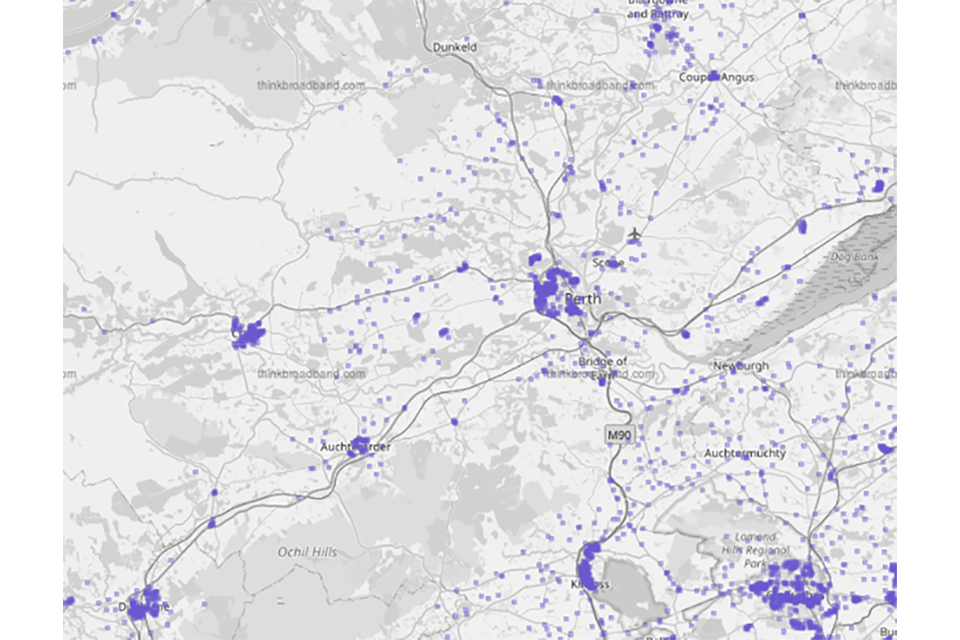
The map below shows current Openreach coverage in the area (source: ThinkBroadband).
1.1 Map of Openreach’s coverage in Tay Cities area
Source: ThinkBroadband – accessed November 2026
The second project was a Public Sector Anchor Tenancy (PSAT) scheme to create a 19.5 km full-fibre network in the city of Perth, using 10 km of existing council-owned ducting, supplemented by the supplier’s own duct and new ducting where required. This contract was awarded to Neos Networks and completed in August 2021.
Neos Networks is a UK-based wholesale telecoms infrastructure provider, operating one of the country’s largest business fibre networks. It does not offer broadband directly to consumers; instead, it provides dark fibre, Ethernet, wavelength and other high-capacity services that underpin retail broadband delivered by other ISPs.
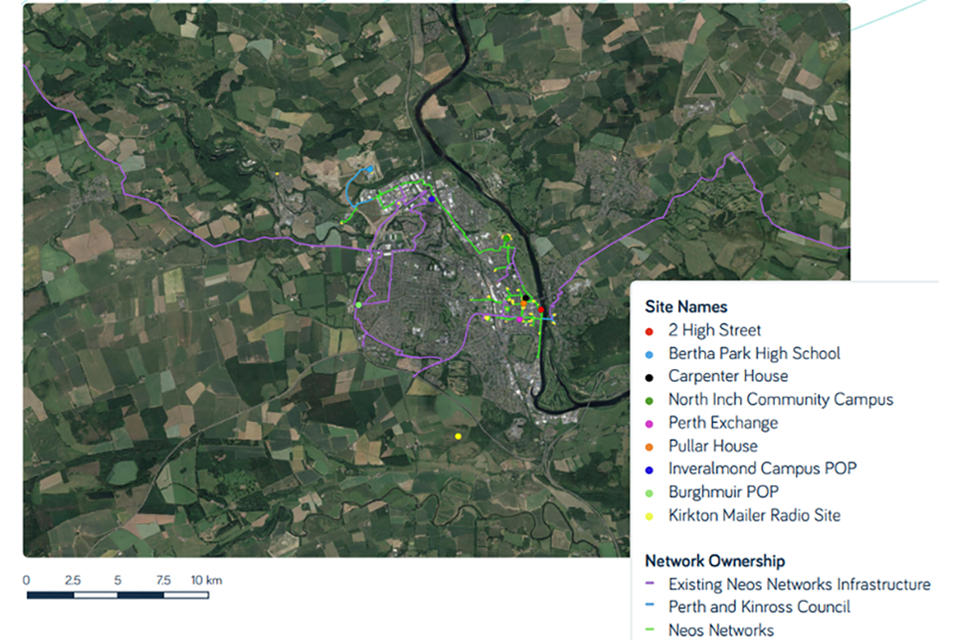
Neos Networks’ coverage is not shown in ThinkBroadband maps. However a map from a brochure downloaded from the company’s website shows the extent of its network in Perth, including the existing Neos Networks infrastructure (shown in purple) and the new infrastructure supported by LFFN (shown in blue and green, with green lines showing council owned infrastructure and blue lines showing Neos Networks owned infrastructure).
1.2 Map showing LFFN funded infrastructure and existing infrastructure in Perth
Source: neosnetworks.com
2. Supplier entry and expansion
2.1 Openreach
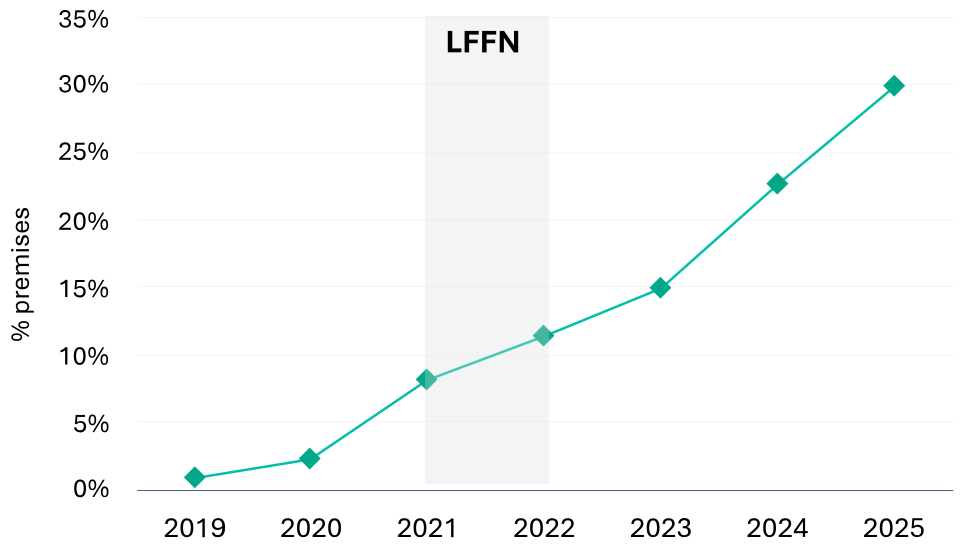
The chart below shows how Openreach’s FTTP coverage in Perth and Kinross has changed between 2019 and 2025. This does not include coverage of its ADSL and FTTC networks which already covered over 99% of premises in the authority area. Over this period, Openreach’s full fibre coverage increased from around 1% in 2019 to 30% by 2025, indicating substantial network expansion.
2.2 Percentage of premises in Perth and Kinross with access to Openreach’s full-fibre network, 2019-2025
Source: Point Topic
Openreach was already an established telecoms operator in Perth and Kinross, meaning that LFFN did not influence its initial market entry. The chart above also shows that Openreach’s full-fibre network was expanding before the LFFN contract was delivered, suggesting that the company already had plans in place to extend its network in the area.
This was confirmed by the Openreach interviewee, who explained that the company’s plans to expand in the city of Perth predated LFFN, but that there was a high degree of overlap between these plans and the LFFN contract. They noted that this alignment enabled Openreach to accelerate rollout in several areas:
“…the city of Perth was already in our commercial plans and LFFN was delivered in many places ahead of the commercial build more generally, but it [LFFN] was a precursor and obviously it was a targeted location.”
The impact of LFFN on the overall scale of Openreach’s expansion in Perth and Kinross is less certain. The interviewee was unable to confirm whether the programme directly led to additional build beyond what had already been planned commercially, but suggested that this may have occurred to a limited extent, particularly where voucher schemes were available to extend coverage:
“…I’d have to look at every single site and the reviews to be fair, but I think you can assume that if we are bringing network infrastructure, we would have automatically reviewed the opportunity…[and] considered whether that opened a new door that we could then utilise in a different way.”
They went on to explain that Openreach explores opportunities to combine commercial investment with public funding, using programmes such as Building Digital UK’s (BDUK) voucher schemes or the Scottish Broadband Voucher Scheme (SBVS) to expand the reach of network infrastructure where possible:
“I’m aware of some examples where they considered whether we could then use vouchers through what we would define [as] the fibre community partnerships approach, but with BDUK or in this case even SBVS, the Scottish Broadband Voucher scheme, to see whether we could dovetail and expand network capability. So I think any network infrastructure being brought into locations does create opportunities, whether that’s commercial, or through additional funding to expand the remit of that network infrastructure, and yeah, we would always look at all of those options depending on the location.”
Taken together, the evidence suggests that LFFN did not change Openreach’s underlying commercial strategy or its plans to roll out fibre in Perth and Kinross. However, the programme appears to have accelerated build in some locations and created opportunities to extend coverage through alignment with other funding streams. The scale of any additional coverage is uncertain but likely to be limited.
2.3 Neos Networks
It has not been possible to estimate changes in Neos Networks’ coverage using Point Topic data. Neos’s network is not shown directly in either Point Topic or ThinkBroadband datasets. It operates as a wholesale provider, meaning its coverage could be inferred from the activity of ISPs that use its network; however, it was not possible to establish which ISPs currently use the network.
The interviewee from Neos Networks confirmed that the LFFN-funded network is in use, albeit on a modest scale. This includes use by one large national ISP, which is using the network for backhaul to a large data centre, as well as a small number of niche ISPs using the network in specific local contexts. The identities of these organisations could not be disclosed for commercial reasons. The interviewee also noted that Neos has recently begun working with housebuilders, primarily to explore how demand from new sites could be aggregated and connected via backhaul to the wider network where the LFFN infrastructure provides a cost-effective route.
The interviewee explained that Neos already had network infrastructure in place in Perth prior to LFFN, but that the contract enabled this to be extended through a combination of Neos infrastructure and council-owned ducting, as illustrated in the map above. As the interviewee noted:
“Neos Networks already had an established network footprint around Perth, supported by strong backhaul connectivity across Scotland. This existing infrastructure was a key factor in our decision.”
The interviewee also explained that LFFN had not led to any onward build or prompted immediate plans for further network expansion within the city beyond the initial project infrastructure, reflecting the current level of commercial demand. They noted that any future expansion would be undertaken on a project-by-project basis:
“At present, there are no plans for a metro‑wide rollout or standardised build programme. Any future network expansion will be undertaken on a project‑by‑project basis, in response to identified customer demand.”
2.4 Conclusions for Claim 1: LFFN funding enabled new suppliers to enter local broadband markets by reducing risks and barriers to entry, and making entry more viable
| Supplier | Contribution | Justification |
|---|---|---|
| Openreach | No contribution | Openreach was the incumbent telecoms providers in Perth and Kinross |
| Neos | No contribution | Neos already had existing network infrastructure in Perth and Kinross |
2.5 Conclusions for Claim 2: LFFN enabled suppliers to expand their network coverage and investment at a greater scale or speed than they would have otherwise
| Supplier | Contribution | Justification |
|---|---|---|
| Openreach | Enabling contribution | Openreach had existing commercial rollout plans, but LFFN accelerated some deployment (e.g. in Perth) and may have enabled limited additional coverage, though the scale is uncertain. |
| Neos | Enabling contribution | LFFN enabled Neos to extend their existing network to cover the PSAT sites within Perth, but there has been no further expansion of the network. |
3. Impacts on growth and attracting investment
Impacts on supplier growth and investment have not been assessed for this case study. Both Openreach and Neos operate as national wholesale infrastructure providers with extensive networks and substantial turnover. In this context, the LFFN contracts delivered in Tay Cities were small in scale relative to the size of each organisation. As a result, any effects on company growth or private investment decisions would be expected to be negligible.
4. Competition in local broadband markets
4.1 Wholesale market
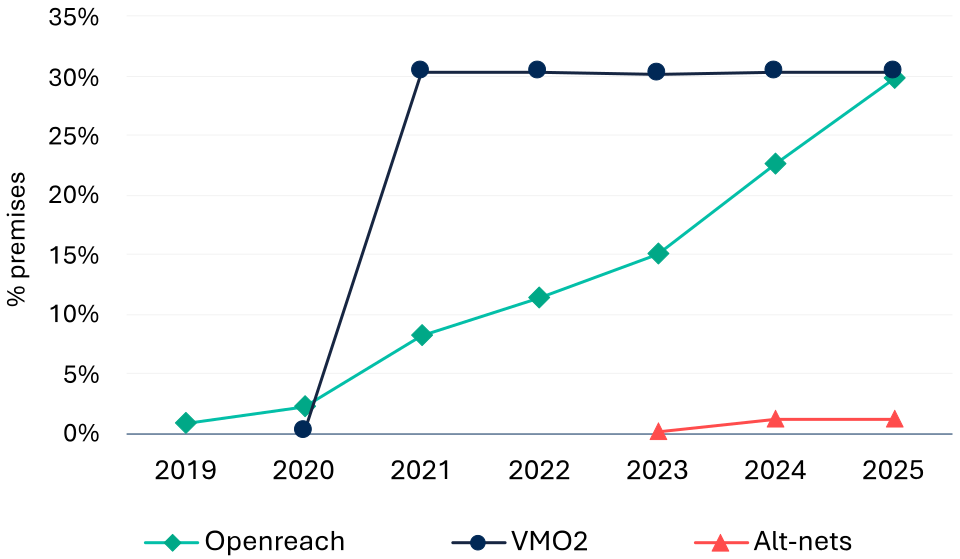
The chart below shows that Perth and Kinross’s gigabit-capable broadband market is largely dominated by Virgin Media O2 (VMO2) and Openreach, with each providing access to around 30% of premises. In contrast, alt-nets collectively cover only around 1% of premises (mainly CityFibre).
Most of VMO2’s coverage is delivered through its legacy cable network, which became gigabit-capable in 2021 following upgrades (accounting for the sharp increase in coverage shown between 2020 and 2021). There is also a small amount of coverage via RFoG, which extends fibre directly to the premises.
4.2 Percentage of premises able to access gigabit capable broadband through different providers in Perth and Kinross, 2019-2025
Source: Point Topic
The interviewee from Openreach reported a general perception that they are seeing greater use of their infrastructure by alt-nets in many of the areas where they are building nationwide. However, they could not say whether this had occurred in the Tay Cities area, and the chart above suggests this has been very limited.
“From an Openreach point of view, whether it’s in the Scotland area or UK wide, we’re seeing quite high usage of our duct and so the more that we build, the more others are either going to areas for the first time or indeed expanding their own network infrastructure. Whether they’re a big operator or indeed a slightly smaller operator bringing in their customer market.”
Taking a broader market view, the interviewee believed LFFN may have contributed to a more diverse marketplace, but noted it was just one of many public interventions, which makes it hard to isolate its impact.
“More widely, Neos, VMO2, City Fibre, all of the network operators are more active than ever before. So I’ll say from a positive point of view and as we outlined, it’s a hugely competitive market. I’m sure some of the LFFN element has helped, but more widely, we’ve got local body procurements that [are] driving their own network infrastructure changes, [and] that’s also creating quite a lot of commercial opportunities for providers.”
4.3 Retail market
The chart below shows strong growth in the number of ISPs offering services in Perth and Kinross. By 2025, eight ISPs were active, although four of these are alt-nets (or operate on alt-net networks) with very limited coverage of less than 1%. Of the providers with meaningful coverage, BT, TalkTalk and Sky all operate on Openreach infrastructure, while Virgin Media provides the remaining large-scale coverage.
However, as most network expansion in the area would have occurred regardless of LFFN, the resulting increase in consumer choice cannot be attributed to the programme, except in the small number of locations that may have gained access specifically through LFFN delivery.
4.4 Number of ISPs offering residential broadband services in Perth and Kinross by download speed, 2019-2025

Source: Point Topic
Comparable analysis is not possible for the LFFN-funded network delivered by Neos,. Interview evidence confirms that the network is being used by ISPs, but the interviewee indicated that uptake to date has been modest. As the identities of the ISPs and the nature of any downstream service provision were not disclosed, it is not possible to determine whether this use has resulted in additional ISPs offering services to end users in Perth. As a result, no conclusions can be drawn about impacts on the number of ISPs active in the local retail market arising from the Neos-delivered LFFN infrastructure.
5. Market signal effects
The Openreach interviewee did not feel that LFFN had a wider market-signalling effect on their plans for the area, as the Tay Cities Contract was chosen for its complementarity with pre-existing plans for commercial build in the area.
“I don’t necessarily see the connection if I’m being really honest, but I think we were fundamentally already driven by a strategy that we had.”
As the interview was conducted with a regional representative, they were not in a position to comment on whether LFFN had any influence on Openreach’s corporate-level strategy or national fibre investment plans. For this reason, it is not possible to draw conclusions about whether LFFN acted as a wider market signal for Openreach.
6. Cost of broadband services
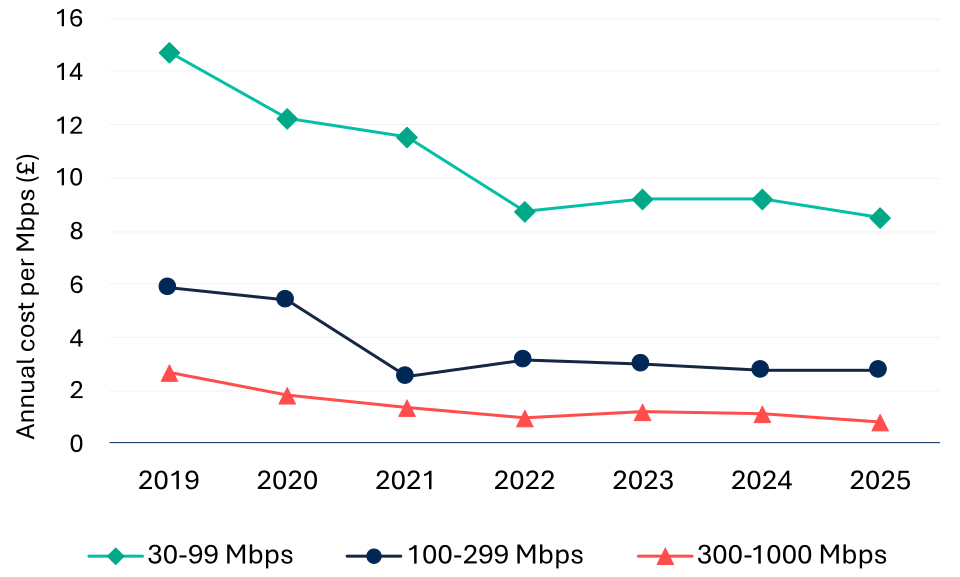
While the cost of broadband packages has decreased in Perth and Kinross, the consistency with other areas suggests this is a general market trend, and there is no evidence that this is linked to LFFN. In 2025, the cheapest deals in each speed band were all on alt-net networks rather than Openreach.
6.1 Average cost of broadband deals by Megabit per second in Perth and Kinross, 2019 to 2025
Source: Point Topic
7. Limitations or weaknesses of LFFN
The Openreach interviewee felt that one limitation of LFFN was that it was difficult for them to make use of infrastructure built by other operators under LFFN, and that such access would have the potential to speed up their subsequent commercial rollout:
“From an Openreach point of view, we would really like access to other network operators’ ducts and poles as well, because clearly from our end, there are locations where we have to build civils to help others, which is understood, but actually [it’s a location] where they [other providers] have built a network, and it would make sense to utilise it. We would like to see that being available more readily to save build, save cost and to improve the network infrastructure…one of the asks is around the other local full fibre networks build, is that other operators can readily get access to that network infrastructure too, where it has been publicly funded.”
8. Summary of conclusions
| Outcome area | Evaluation conclusions (including contribution categories where assigned) |
|---|---|
| Supplier entry (Claim 1) | Openreach – No contribution. Openreach was already the incumbent provider with an established network in Perth and Kinross, so LFFN did not affect supplier entry. Neos Networks – No contribution. Neos already had substantial network infrastructure in the local area surrounding Perth |
| Network expansion and coverage (Claim 2) | Openreach – Enabling contribution. Openreach had existing commercial plans for the area, but LFFN accelerated deployment in some locations (such as Perth) and may have enabled limited additional coverage, though the scale is uncertain. Neos Networks – Enabling contribution. LFFN enabled Neos to extend their existing network to cover the PSAT sites within Perth, but there has been no further expansion of the network. |
| Alt-net growth and financial performance (Claim 3) | Not assessed - Openreach and Neos are large national providers, and the LFFN contracts in Tay Cities were too small to plausibly affect their growth |
| Market signalling effects (Claim 4) | Insufficient evidence - The Tay Cities LFFN contract did not act as a market signal for Openreach locally, and the interview evidence was insufficient to assess any impact on corporate-level or national investment strategy. |
| Attracting private investment (Claim 5) | Not assessed - Openreach and Neos are large national providers, and the LFFN contracts in Tay Cities were too small to plausibly affect private investment |
| Consumer choice and Internet Service Provider (ISP) availability (Claim 7) | No contribution (or enabling contribution in a very small number of locations). ISP numbers increased in Perth and Kinross, but this reflects ongoing commercial rollout rather than LFFN. Any LFFN-driven improvement in consumer choice is limited to the small number of premises gaining access through the programme. |
| Broadband pricing (Claim 8) | No contribution. Broadband prices fell across all speed bands, but this mirrors wider market trends. There is no evidence that LFFN influenced pricing in Perth and Kinross. |