Case study 3: Northern Ireland
Published 10 September 2026

© Crown copyright 2026
This publication is licensed under the terms of the Open Government Licence v3.0 except where otherwise stated. To view this licence, visit nationalarchives.gov.uk/doc/open-government-licence/version/3 or write to the Information Policy Team, The National Archives, Kew, London TW9 4DU, or email: psi@nationalarchives.gov.uk.
Where we have identified any third party copyright information you will need to obtain permission from the copyright holders concerned.
This publication is available at https://www.gov.uk/government/publications/local-full-fibre-networks-evaluation-work-package-one-report/case-study-3-northern-ireland
Northern Ireland was selected as a case study because it includes multiple LFFN projects delivered by different suppliers, allowing assessment of how the programme influenced alt-net growth, incumbent behaviour and competition across a whole region.
1. LFFN projects and suppliers in Northern Ireland
Northern Ireland received 3 LFFN projects across Waves 2 and 3.
1.1 Armagh, Banbridge and Craigavon
Armagh, Banbridge and Craigavon (ABC) was a Wave 2 PSAT project, which received £2.9 million to provide gigabit connectivity to 71 public sites. The contract was awarded to eir evo UK, a subsidiary of eir, the incumbent telecommunications operator in the Republic of Ireland.
It was not possible to arrange an interview with eir evo UK for the evaluation. However, publicly available information indicates that the company is not a wholesale broadband network operator or an Internet Service Provider (ISP). Instead, it operates primarily as a business-to-business (B2B) communications and IT services provider, offering services such as managed connectivity, cloud hosting, cybersecurity, and managed IT infrastructure.
Given this business model, it is highly unlikely that the project delivered wider network benefits or had any material impact on Northern Ireland’s broadband market. For this reason, the ABC project has not been included within the scope of the case study.
1.2 Belfast
Belfast was a PSAT project that upgraded connectivity to over 200 public sector sites, including council offices, libraries, parks and tourist attractions. The contract was awarded to Virgin Media O2 (VMO2) in 2019. As one of the incumbent operators in Northern Ireland, VMO2 already had a substantial footprint in Belfast through its legacy cable network.
The map below shows VMO2’s current coverage in the city, distinguishing between its legacy cable network, sometimes called a hybrid fibre coaxial network (shown in red) and its Radio Frequency over Glass (RFoG) network (blue), which delivers fibre to the premises but retains coaxial cable within the home. It also shows the footprint of Project Mustang (brown), VMO2’s programme to replace its hybrid fibre coaxial network with full fibre. This upgrade in Belfast was announced only recently (August 2025) and is therefore not reflected in the Point Topic data used in this case study.
1.3 Coverage of VMO2 in Belfast
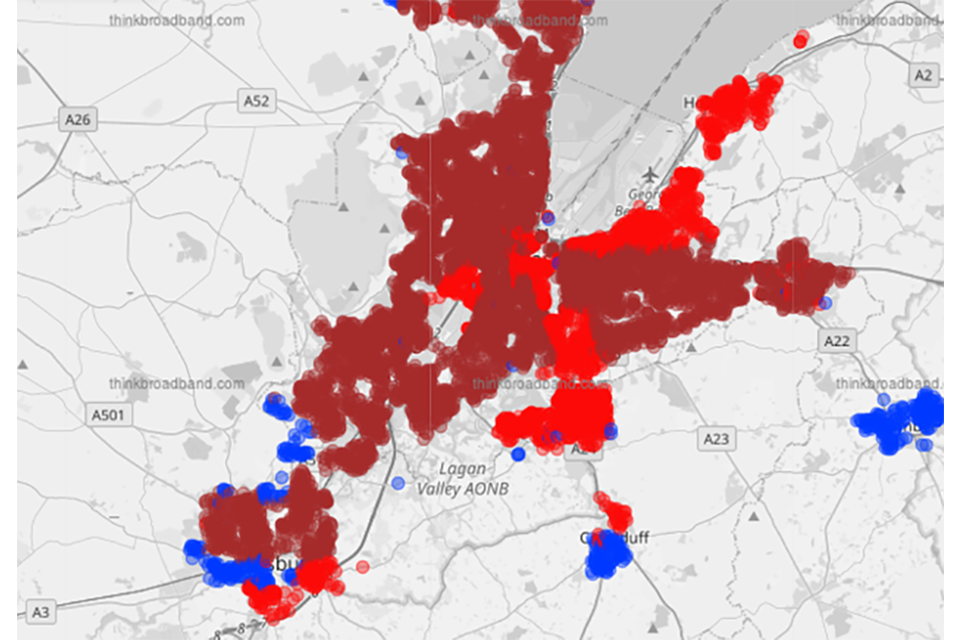
Source: ThinkBroadband – accurate as of November 2025
1.4 Full-fibre Northern Ireland
Full Fibre Northern Ireland (FFNI) was a PSAT project which connected over 800 public buildings across the whole of Northern Ireland excluding Belfast. It had a total contract value of £23m which included funding via LFFN and the Rural Gigabit Connectivity (RGC) programme.
The contract was won by Fibrus, an alt-net which was only established in 2019, but which had been acquired by Infracapital in 2020, giving it access to substantial capital to fund its network build. Fibrus delivered the FFNI contract using a hybrid approach. Where its own fibre network already passed near a public sector site, Fibrus connected the premises directly using its own infrastructure. This accounted for around 320 of the sites delivered.
For the remaining locations (600+), where building new Fibrus network would not have been commercially viable, the company met its contractual obligations by purchasing Openreach’s Fibre on Demand (FoD) product. FoD is a wholesale service that enables an ISP to request a bespoke full-fibre connection to a specific premises, even when no full-fibre network currently exists in that area. Openreach extends its network solely to reach that site, allowing the ISP to provide a gigabit-capable service without constructing its own infrastructure.
Therefore, while Openreach was not a formal delivery partner, in practice it did deliver a large number of the fibre connections to public buildings via FoD, meaning it could have facilitated incremental FTTP build to nearby premises. Therefore, for the purpose of this case study, Openreach is treated as an LFFN supplier for FFNI. Interviews were conducted with both Fibrus and Openreach.
1.5 Current coverage of Openreach and Fibrus full fibre networks in Northern Ireland

Source: ThinkBroadband – accurate as of October 2025
2. Supplier entry and expansion
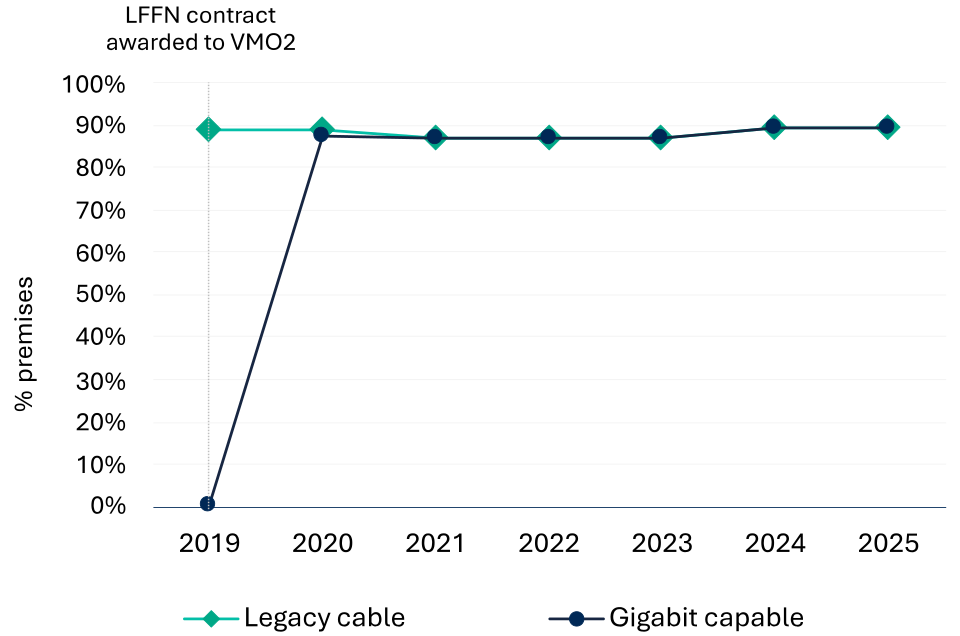
In Belfast, VMO2’s cable network already reached around 89% of premises in 2019, although only a small proportion (around 1,000 premises) could then access gigabit-capable speeds via its RFoG network. This changed in 2020, when virtually all premises on VMO2’s cable network were upgraded to Data Over Cable System Interface Specification (DOCSIS) 3.1, enabling gigabit-capable download speeds. Point Topic data shows that this upgrade occurred around 1 year earlier than in other LFFN areas. Since 2020, however, there has been no further expansion of VMO2’s network footprint in Belfast according to Point Topic (its RFoG network has also remained broadly the same as it was in 2019).
Evidence from the interview with VMO2 confirms that there has been no subsequent expansion of its network footprint in Belfast. However, VMO2 reported that coverage of its legacy cable network was already extremely high prior to the LFFN project (around 99% of residential premises), meaning there was very limited scope for further expansion. This suggests that Point Topic data may understate the true extent of VMO2’s coverage in Belfast.
Although the timing of the network wide upgrade coincided with VMO2 being awarded the Belfast LFFN contract, VMO2 confirmed that this was unrelated to LFFN and was part of its national DOCSIS 3.1 upgrade programme, rather than a result of LFFN investment.
While the Belfast project appears to have had limited impact on the wider broadband market, it did deliver benefits for public sector connectivity. In particular, LFFN funding supported requirement-led upgrades to public sector sites, securing long-term access to high-capacity infrastructure and increased network resilience at a number of strategic locations. These benefits relate to the quality and security of public sector connectivity rather than changes in market coverage or competition.
2.1 Percentage of premises in Belfast with access to VMO2 network, 2019-2025
Source: Point Topic
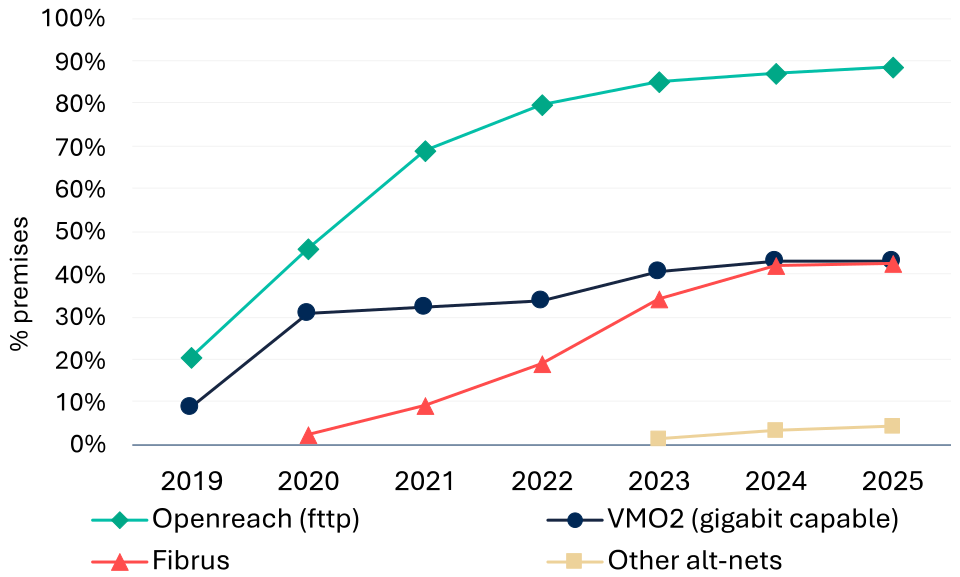
The FFNI project was delivered between 2021 and 2022. By this point, over 70% of premises in the rest of Northern Ireland could access Openreach’s full fibre network, and over 10% of premises could access Fibrus’s network. Both companies were therefore already active in the broadband market prior to LFFN, meaning the programme had no effect on the entry of new suppliers. Since 2022, both companies’ coverage has continued to increase, with Openreach now available to 89% of premises and Fibrus available to 42%.
2.2 Percentage of premises in the rest of Northern Ireland with access to Openreach and Fibrus full-fibre networks, 2019-2025

Source: Point Topic
The Fibrus interviewee explained that the company’s expansion across Northern Ireland was initially driven by its commercial rollout, which was privately funded by Infra Capital, following its acquisition of Fibrus in 2020. The company’s focus was described as providing full-fibre broadband to rural and underserved areas:
“…our whole focus was to provide broadband full fibre, high quality broadband services to what we would deem as underserved communities…typically communities that [were] small villages, really small towns that didn’t have good high quality broadband, [a] quite rural setting…and I as you know, it’s a quite a quite a rural country anyway in terms of its, makeup outside of Belfast, and our whole focus was…to basically provide high quality broadband to those communities, and that in itself, from a business case perspective, would allow us to get the penetration numbers that we need in order to make it work.”
They confirmed that construction of Fibrus’s commercial network began in early 2020, targeting areas outside Belfast that lacked high-speed connectivity:
So we would have started building out our commercial network in early 2020, and that would have been, as I say, focused on those underserved towns [and] that would have been on our own dime.
The interviewee explained that they decided to bid for the FFNI contract because it was seen as complementary to their existing commercial plans, and provided an opportunity to expand the network further:
“That was why Fibrus was interested in bidding for FFNI, because a lot of the locations basically overlap with our own commercial building… it also gave us the opportunity to springboard and utilise the FFNI funding for the build out of the backhaul network that would provide connectivity to those sites. But allow us then to leverage off that in order to provide additional connectivity to premises on the back of it.”
The interviewee clarified that the contract did not fundamentally alter Fibrus’s rollout strategy or decisions on which areas to target, but did allow the company to extend its network incrementally in these locations:
“At the very least [the FFNI contract] complemented [the commercial rollout]. Would it have changed where we would have built? Probably not, in terms of the towns that we would have targeted, but it might have changed how far we went outside those towns…I think we still would have delivered, but the fact that we basically were able to extend the network further out to deliver connectivity to those FFNI locations just meant that it probably allowed us to pick up some more premises as we went.”
The interviewee went on to say that, in the same year that Fibrus won the FFNI contract, they also won the much larger Project Stratum contract (£165m) to deliver full fibre broadband to 80,000 premises in rural areas. The first connections from this contract were made in Spring 2021 with the final connections made in 2025. This programme therefore also made a substantial contribution (roughly 33%) to Fibrus’s increased coverage from 2021 onwards.
The evidence therefore suggests that the main drivers of Fibrus’s expansion in Northern Ireland were its privately financed commercial rollout and the Project Stratum contract, with LFFN playing a smaller, complementary role.
Interviewees from Openreach indicated that the FFNI contract did not fundamentally alter their overall rollout strategy. At the time, Openreach was already expanding its FTTP network rapidly across Northern Ireland (as illustrated in the chart above) and had ambitions to extend fibre as widely as possible within its commercial constraints. As one interviewee explained:
“Ultimately our internal goal was to push as far as we can within our commercial envelope.”
However, interviewees noted that the FFNI contract did enable additional connectivity in some circumstances beyond what would have occurred through commercial rollout alone. This mainly occurred where connecting an FFNI site required substantial new network build, particularly in rural or remote locations. In those cases, the investment needed to reach the public sector site could make it commercially viable to connect nearby premises that might otherwise have remained unserved. One example cited was a rural community centre where the fibre infrastructure installed through FFNI subsequently enabled connections to a nearby hamlet that would likely not otherwise have been connected.
At the same time, interviewees emphasised that many FFNI sites were already located close to existing Openreach infrastructure. In those cases, the connection required little additional build and nearby premises would likely have been connected through the company’s commercial FTTP rollout regardless. As one interviewee explained:
“If it didn’t require significant build, it obviously didn’t enable very much additional build because we were nearby anyway. It’ll be the ones where we had to build a significant amount of network that will have enabled potential areas… It won’t have changed the optics on every single site because some sites would have been commercially viable anyway because we had network nearby. In other scenarios it may have changed the optics of an area.”
Interviewees also confirmed that, where additional coverage was enabled by the FFNI build, this was delivered through Openreach’s commercial rollout rather than through the use of voucher schemes.
Finally, interviewees noted that the FFNI contract enabled public sector sites to be connected more quickly than would normally have been possible. Because the programme was delivered through a centrally managed contract with dedicated project management, it helped streamline processes such as securing wayleaves, obtaining permissions, and identifying the appropriate contacts within public sector organisations. This reduced delays and made it easier to connect complex sites such as hospitals, campuses, leisure centres, or recycling facilities, where internal coordination and site safety requirements can make standard commercial orders more difficult to deliver.
2.3 Conclusion
The available evidence indicates that LFFN had no effect on the entry of new suppliers in Northern Ireland’s broadband market (Claim 1). All of the other suppliers who benefitted from LFFN contracts had an existing presence in Northern Ireland.
Our conclusions in relation to LFFN’s contribution to increased network coverage of suppliers (Claim 2) are shown in the table below.
2.4 Conclusions for Claim 2: LFFN enabled suppliers to expand their network coverage and investment at a greater scale or speed than they would have otherwise
| Supplier | Contribution | Justification |
|---|---|---|
| Fibrus (FFNI) | Enabling or substantial contribution | The increase in coverage from 2020 onwards was driven primarily by Fibrus’s commercial rollout and the Project Stratum contract, with FFNI playing a smaller, complementary role. Nevertheless, FFNI was seen as important, and allowed the company to connect more premises than would otherwise have been possible, though the scale of these benefits is unclear. |
| Openreach (FFNI) | Enabling or substantial contribution | Openreach was already expanding its fibre coverage, but LFFN did enable additional connectivity in many rural areas beyond what would have occurred through commercial rollout alone, though the scale of these benefits is unclear. |
| VMO2 (Belfast) | No contribution | VMO2 upgraded its cable network to new DOCSIS3.1 technology, ensuring that all premises could access gigabit capable speeds. However, this was independent of LFFN, and the very high levels of pre-existing coverage meant there was no further expansion of its network following the award of the LFFN contract. |
3. Impacts on growth and investment of Fibrus
Fibrus has experienced strong growth in recent years, with revenues increasing sharply as its full-fibre network expanded across Northern Ireland and northern England. By 2024/25, annual revenue had risen to around £30 million, representing year-on-year growth of nearly two thirds. The company achieved EBITDA positivity in 2025, marking a transition from a build-phase operator to one generating sustained commercial returns.
Since its acquisition by InfraCapital in 2020, Fibrus has attracted substantial private and public investment to support this expansion. InfraCapital’s equity commitment has grown to around £200 million, supplemented by debt financing of approximately £320 million. The company has also secured around £325 million in public sector contracts, including Project Stratum (initially valued at £165 million, later reported at around £200 million), FFNI (£23 million), and a Project Gigabit contract in Cumbria (£109 million) awarded in December 2022.
The interviewee from Fibrus was unable to comment on LFFN’s direct contribution to the company’s financial performance. As described earlier, early growth was driven mainly by the commercial rollout, with Project Stratum and the Cumbria contract accounting for a growing share of revenues in later years. While LFFN supported incremental network extensions around public sector sites, its financial contribution is likely to have been minor relative to these larger drivers of growth.
However, the interviewee believed that the FFNI contracted had contributed to growth indirectly by helping the company to build an initial track record of public sector contracts, which had helped the company build credibility in the eyes of public and private investors and provided a platform for further growth.
“The FFNI contract absolutely provided us with 2 things. I think it provided us with a foundation in which we could build our network out further. So that’s a positive, but it also provided confidence to our investors that they could go further because the Stratum contract came pretty much hot on the heels of the FFNI contract. So it was, it was good for confidence that that we were, we were a credible trusted provider in order to deliver something of this scale.”
The role of the FFNI contract in helping Fibrus secure the Project Stratum award is unclear. News articles indicate that the FFNI contract was formally announced in 2021, when Project Stratum was already in delivery. However, other sources from 2020 suggest that the outcome of the FFNI competition was known earlier, before Project Stratum was awarded.
The Fibrus interviewee explained that the procurement processes for both contracts took place during 2020, with FFNI preceding Project Stratum. They noted that participation in FFNI gave the company early engagement with government departments and helped to build credibility, which they believed strengthened their position when bidding for Project Stratum:
“FFNI was the first of that type of contract where we were in liaison with government, with DfE and the councils…So you know it was absolutely imperative that we put our best foot forward on that contract because we were then in liaison with government on … bidding for Project Stratum. It was between ourselves and Openreach in the end, so it was really important that we put our best foot forward and we created credibility and FFNI gave us credibility outside of our own commercial build when bidding for something as big as the Stratum contract.”
The interviewee also believed winning and delivering these contracts had also helped build confidence among private investors, which had helped the company to secure more equity and raise debt finance to fund further expansion.
“…from an FFNI perspective, it definitely paved the way for Fibrus’s future financial investment and growth. Both in the public and private sectors.”
“What that does is provide confidence for the investor to say whenever we bid something, we say we’re going to do it well. They’ve got confidence saying well, you know from a risk perspective, you guys are going to be able to do it and then that provided a springboard for us to start looking at the GB market.”
3.1 Conclusions for claims 3 and 5 relating to Fibrus’s growth and ability to attract private investment
| Claim | Contribution | Justification |
|---|---|---|
| 3. Growth and financial sustainability | Enabling contribution | LFFN enabled Fibrus to connect more properties which is likely to have contributed to increased revenues, but the majority of growth was due to other factors, including the privately funded rollout and Project Stratum. Though LFFN indirectly supported growth by improving public and private investor confidence. |
| 5. Attracting private investment | Substantial contribution | Supplier reported that delivery of public sector contracts (of which FFNI was the first) definitely improved investor confidence and helped the company raise finance. |
3.2 VMO2 and Openreach
In the theory of change, impacts on investment and financial performance are relevant primarily for alt-nets, reflecting LFFN’s objective to stimulate increased competition. In contrast, VMO2 and Openreach are large, well-established industry incumbents with substantial existing infrastructure and investment programmes. Given their scale, any financial effects arising from participation in LFFN-funded projects would be marginal in the context of their overall operations. For this reason, the evaluation has not assessed LFFN’s impact on the financial performance of these companies.
4. Competition in local broadband markets
4.1 Wholesale market
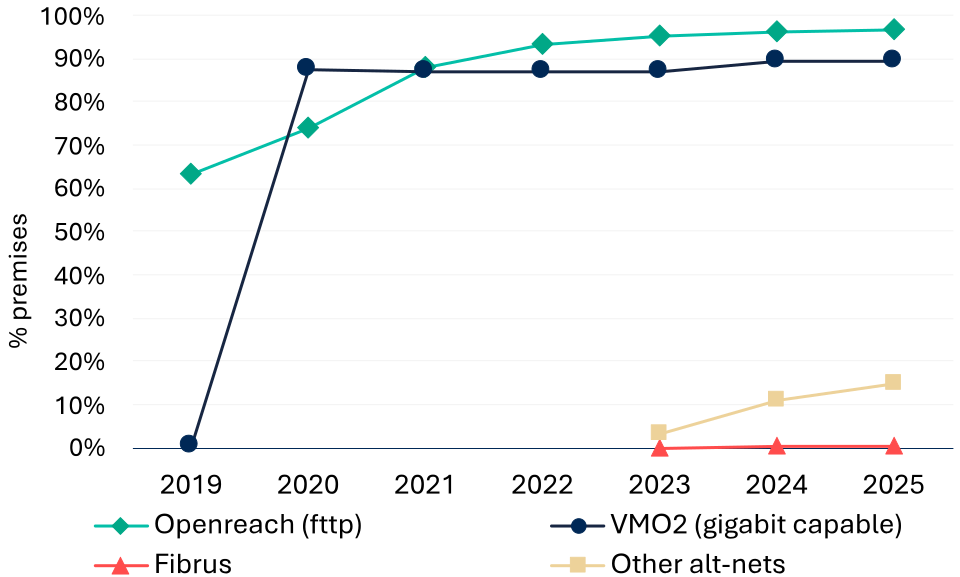
The chart below shows that Belfast’s wholesale full-fibre and gigabit-capable broadband market is dominated by the incumbent providers, VMO2 and Openreach, which cover around 89% and 96% of premises, respectively. New entrants, including Fibrus, have begun to establish a presence in the city but currently serve only a small share of premises. This suggests that LFFN has had little influence on market structure in Belfast, which remains highly concentrated among established providers.
4.2 Percentage of premises able to access full-fibre or gigabit capable broadband through different providers in Belfast, 2019-2025
Source: Point Topic
The broadband market across the rest of Northern Ireland is more competitive, with Fibrus now providing an additional alternative to Openreach and VMO2. LFFN has contributed to this increased competition by supporting Fibrus’s expansion, although the evidence indicates that its role has been secondary to the company’s commercial rollout and the much larger Project Stratum programme.
The chart shows that VMO2 has expanded its network in the rest of Northern Ireland. This is linked to “Project Lightning”, a £100 million programme of investment which was announced prior to LFFN. While the programme may have been a competitive response to Openreach’s and Fibrus’s growing coverage, there is no evidence that it was affected by LFFN.
4.3 Percentage of premises able to access full-fibre or gigabit capable broadband through different providers in the rest of Northern Ireland, 2019-2025
The Fibrus interviewee noted that in areas where the company delivered connections under FFNI, increased activity from traditional providers was evident only in urban locations. In contrast, rural areas had seen little change, with Fibrus’s own rollout representing the main source of new network activity.
4.4 Retail market
Our analysis of changes in ISP availability focuses on the rest of Northern Ireland, as LFFN did not affect VMO2’s coverage in Belfast and VMO2 does not offer wholesale access. Both Openreach and Fibrus operate on a wholesale basis, although Fibrus also provides retail services directly to consumers.
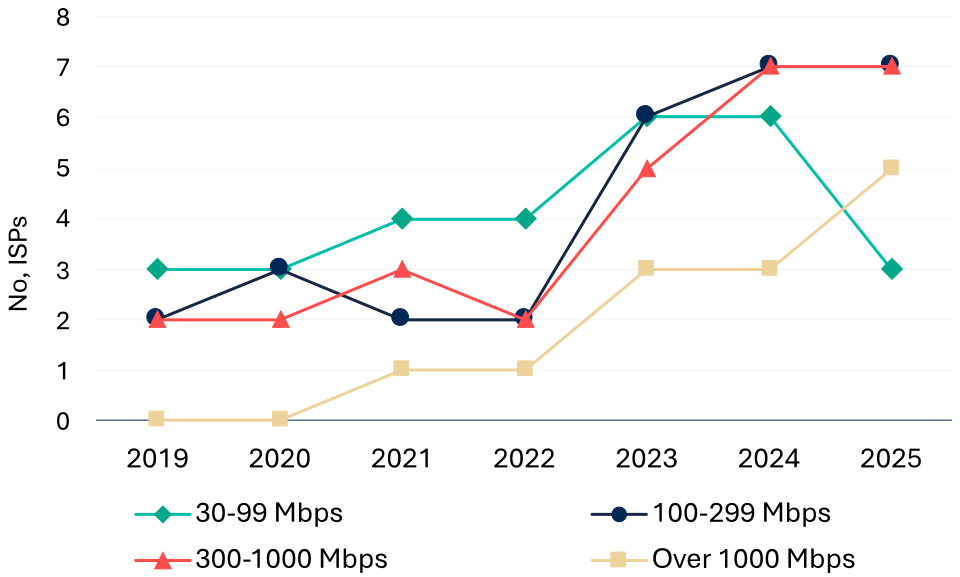
Point Topic data indicates that 7 companies offer retail broadband services in the rest of Northern Ireland, including VMO2 and Fibrus. Several ISPs operate on both the Fibrus and Openreach networks (e.g. Sky and Vodafone), while others rely solely on Openreach (e.g. TalkTalk).
This indicates that LFFN is likely to have increased ISP choice for some consumers, but only for those additional premises reached as a direct result of the programme. Most premises served by Fibrus and Openreach would have gained access through their commercial rollouts regardless of LFFN, meaning the programme did not affect the number or type of ISPs available in those areas. However, the case study found that the FFNI project did enable Fibrus to pass some additional premises, which would have increased ISP choice for those households. The number of such premises is unclear but is likely to represent only a small share of Fibrus’s overall footprint.
4.5 Number of ISPs offering residential broadband services in rest of Northern Ireland (excluding Belfast) by download speed, 2019-2025
Source: Point Topic
4.6 Conclusion
The evidence indicates that although Northern Ireland’s broadband market has become more competitive since the late 2010s, LFFN made only a modest contribution. The programme supported Fibrus’s growth and enabled additional premises to be connected, which increased competition for VMO2 and Openreach at the margin. However, broader market developments, particularly Infracapital’s acquisition of Fibrus and the commercially funded network rollout that followed, played a much larger role in shaping competition. LFFN and FFNI primarily delivered incremental extensions around public sector sites, contributing to a more diverse wholesale market and improving consumer choice only in the areas newly reached as a result of the programme.
In terms of the contribution claims:
-
While LFFN has made a small contribution to a more diverse wholesale market, there is no evidence that the programme caused a competitive response from incumbents (Claim 6).
-
The programme has contributed to greater consumer choice of ISPs (Claim 7), but this is likely to be on a small scale and applies only in those areas reached as a result of the programme.
5. Market signal effects
The interviewee from Fibrus did not believe LFFN had any wider effects on their investment plans. Their strategy had already been determined prior to LFFN, and remained unaffected by the policy announcement.
“We were always very clear in terms of our strategy. Our strategy was to not be the third or fourth network player… [Our build out] was always going to happen. We were always going to build out our commercial network either way.”
Similarly, interviewees from Openreach explained that its large‑scale commercial FTTP rollout had begun well before FFNI/LFFN and was already delivering at pace by the time the programme was active. They described 2020–2021 as some of their biggest build years in Northern Ireland, indicating that full‑fibre deployment was already a strategic priority independent of LFFN.
This means there is no evidence in support of Claim 4, that LFFN acted as a market signal that influenced broadband operators to change their investment strategies.
6. Cost of broadband services
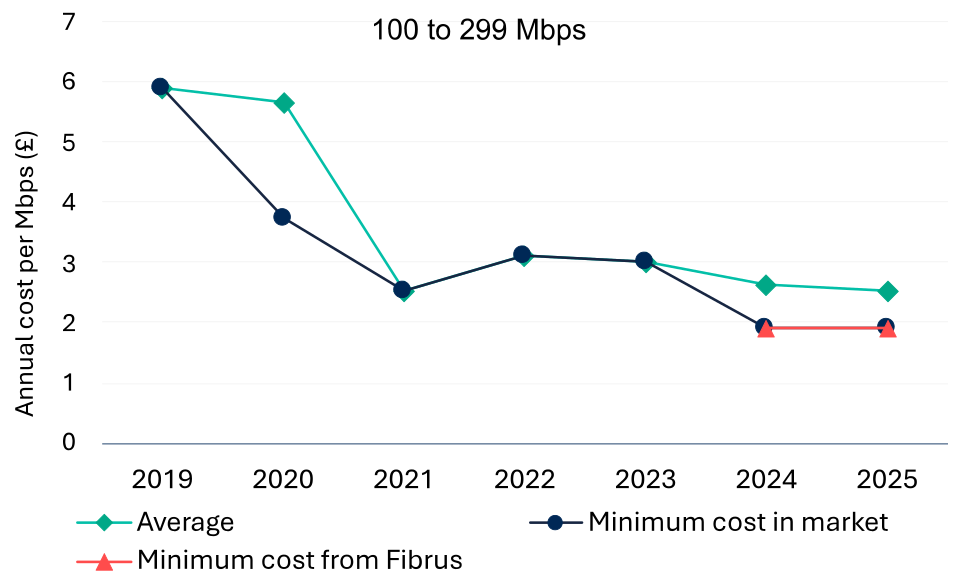
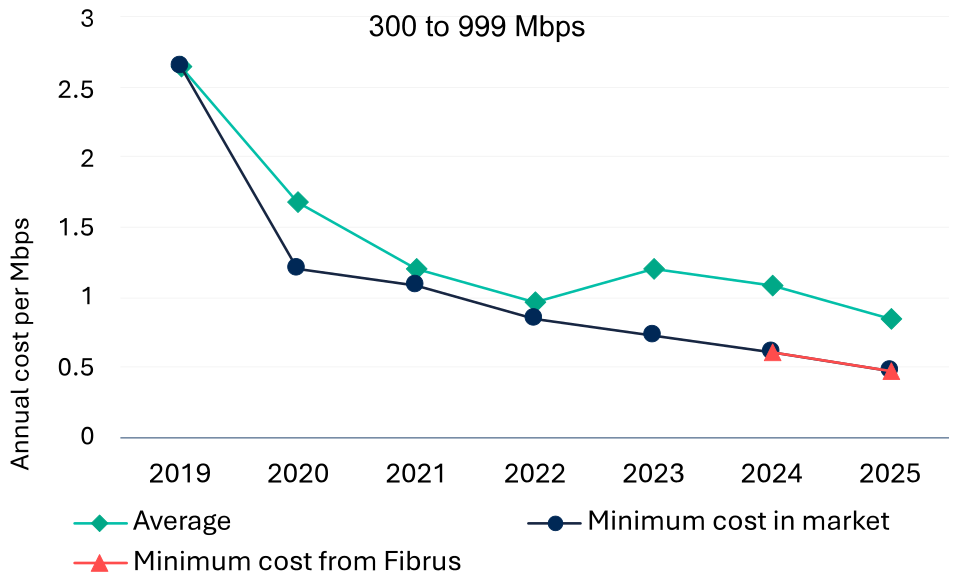
As in other case study areas, Point Topic data shows a general fall in broadband prices across all speed thresholds. Cost data for Fibrus is available only from 2024 onwards, but indicates that the company offers the cheapest deals on the market for packages in the 100–299 Megabits per second (Mbps) and 300–999 Mbps ranges. Fibrus is also the only operator offering a package with speeds above 1 Gigabit per second.
However, because Fibrus would have expanded in Northern Ireland regardless of LFFN, the price-related benefits attributable to LFFN are limited to households that gained access to Fibrus’s network specifically as a result of the programme.
Cost analysis has not been undertaken for VMO2 in Belfast since there has been no expansion of its network as a result of LFFN.
6.1 Annual cost per Mbps for residential broadband packages in the rest of Northern Ireland by download speed range, 2019-2025
Source: Point Topic
7. Other benefits of LFFN
Fibrus’s interview evidence suggests that securing the LFFN/FFNI contract at a relatively early stage of the company’s development played an important role in building its technical capability, organisational capacity and workforce. The programme gave the company practical experience of delivering large-scale fibre deployment for the public sector across a wide geographic area, including rural locations, and helped establish the skills and delivery processes that it later applied in subsequent contracts:
“Whenever we were building out FFNI… you’re honing your skills for building in rural locations… once you have the recipe for it… then it gives you confidence that whenever you look at a new geography, you understand how it works. You understand the pitfalls; you understand the problems you may come across… All the skills that we learned in FFNI and in Stratum we have taken to GB for the build out across Cumbria.”
“…whenever you’re building an FFNI contract, or subsequently a Statum contract, you’re employing lots of people to do that, and so the investment in FFNI, I suppose, initially supported the creation of jobs within Fibrus amongst our primary subcontractors such as Viberoptix…We’re now employing over 600 people across our group fibrus, broadband, hyperfast networks and vibreoptix as well.”
8. Summary of conclusions
| Outcome area | Evaluation conclusions |
|---|---|
| Supplier entry (Claim 1) | No contribution. All suppliers already had an existing presence in LFFN areas. |
| Network expansion and coverage (Claim 2) | Fibrus – Enabling/substantial contribution. Expansion from 2020 onwards was driven mainly by the commercial rollout and Project Stratum, but FFNI enabled incremental extensions around public sector sites, allowing some additional premises to be connected. Openreach – Enabling/substantial contribution. Openreach was already expanding its coverage prior to LFFN, but the FFNI contract did enable additional connectivity in some rural areas beyond what would have occurred through commercial rollout. VMO2 – No contribution. The DOCSIS 3.1 upgrade in Belfast formed part of a national programme and there was no further footprint expansion linked to LFFN. |
| Alt-net growth and financial performance (Claim 3) | Fibrus – Enabling contribution. LFFN supported additional premises and revenues at the margin but most growth in turnover was driven by the commercial rollout and Project Stratum. |
| Attracting private investment (Claim 5) | Fibrus – Substantial contribution. FFNI was reported to have helped establish delivery credibility with government and investors, improving confidence and supporting later equity and debt raises. |
| Competitive response from incumbents (Claim 6) | No contribution. There is no evidence that LFFN triggered a specific competitive response from Openreach or VMO2. Openreach’s and Fibrus’s expansion in the rest of Northern Ireland, and VMO2’s DOCSIS upgrade in Belfast, reflect wider commercial strategies rather than reactions to LFFN. |
| Consumer choice and ISP availability (Claim 7) | Enabling contribution (small scale). FFNI increased ISP choice only for the subset of premises newly reached by Fibrus as a result of the programme. In most areas, premises would have been served by Fibrus or Openreach through commercial rollout regardless of LFFN, so the effect on ISP choice is modest and geographically limited. |
| Broadband pricing (Claim 8) | Enabling contribution (small scale). Fibrus offers the lowest-cost packages in the region, but would have expanded without LFFN. LFFN therefore influenced pricing only for households newly connected through FFNI |