Case study 1: Cooperative Network Infrastructure
Published 10 September 2026

© Crown copyright 2026
This publication is licensed under the terms of the Open Government Licence v3.0 except where otherwise stated. To view this licence, visit nationalarchives.gov.uk/doc/open-government-licence/version/3 or write to the Information Policy Team, The National Archives, Kew, London TW9 4DU, or email: psi@nationalarchives.gov.uk.
Where we have identified any third party copyright information you will need to obtain permission from the copyright holders concerned.
This publication is available at https://www.gov.uk/government/publications/local-full-fibre-networks-evaluation-work-package-one-report/case-study-1-cooperative-network-infrastructure
The Cooperative Network Infrastructure (CNI) model brings together fibre networks owned by various public sector bodies (e.g. councils, NHS trusts) and makes them available for shared use through a cooperative structure. This case study was selected because it offers a distinctive approach compared with other LFFN projects. In particular, it explores whether this cooperative model has helped create a healthier and more competitive local broadband market, and whether the availability of shared infrastructure has lowered barriers to entry and supported the co-existence of multiple suppliers.
1. Overview of the CNI model
The CNI model was developed in response to concerns about how fibre networks were being deployed in the UK, and in particular the limitations of conventional market models.
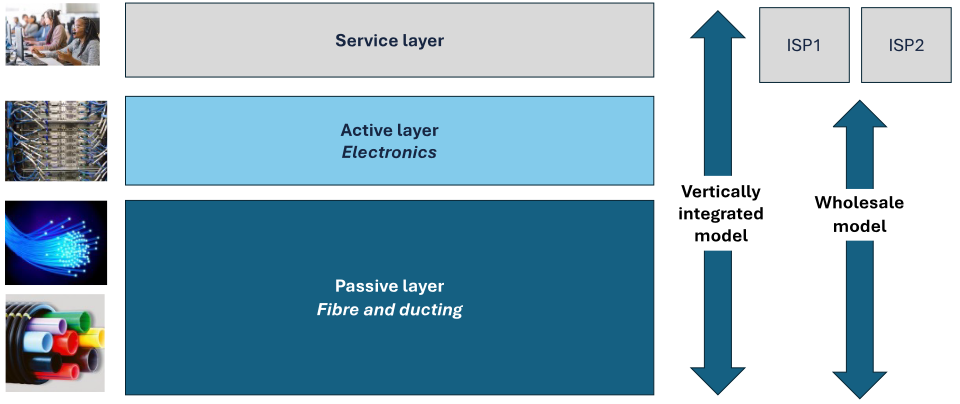
Fibre networks are generally understood as having 3 layers (see diagram below):
-
Passive layer – the physical infrastructure such as ducts, poles and fibre. This is the most expensive part of the network to build and requires long-term investment before generating a return
-
Active layer – the electronic equipment that lights the fibre and manages traffic.
-
Service layer – the retail offers sold to end users. This is where most competition takes place, with rapid product turnover and more speculative investment.
In the UK, 2 models have traditionally dominated the market. The vertically integrated model, used by operators such as Virgin Media O2 (VMO2), involves one company owning and running all 3 layers. The wholesale model, used by Openreach, allows multiple internet service providers (ISPs) to sell retail broadband services over the same physical network. However, control of the passive infrastructure and the active electronics remains with the wholesale operator, rather than the ISPs.
1.1 Layers and models in the fibre broadband market
According to an interviewee from CNI, while these models have enabled national rollout, they also created challenges for market development:
-
Limited opportunities for new entrants – smaller providers could not access the passive layer directly, where the main long-term value lies. It was reported that many alt-nets initially sought to build their own end-to-end networks, but had struggled to secure enough customers in areas where Openreach or Virgin were already present to justify the investment.
-
Inefficient duplication of infrastructure – with each provider seeking to own its own fibre, multiple networks were sometimes built to the same premises. This was described as wasteful by CNI, leading to higher costs, community disruption and unnecessary use of resources.
The CNI model was first applied in Tameside, where the local NHS Trust and Council identified it was cheaper to build their own fibre links than to lease services from incumbents. This led to the idea of joining different organisations’ networks and creating a cooperative framework.
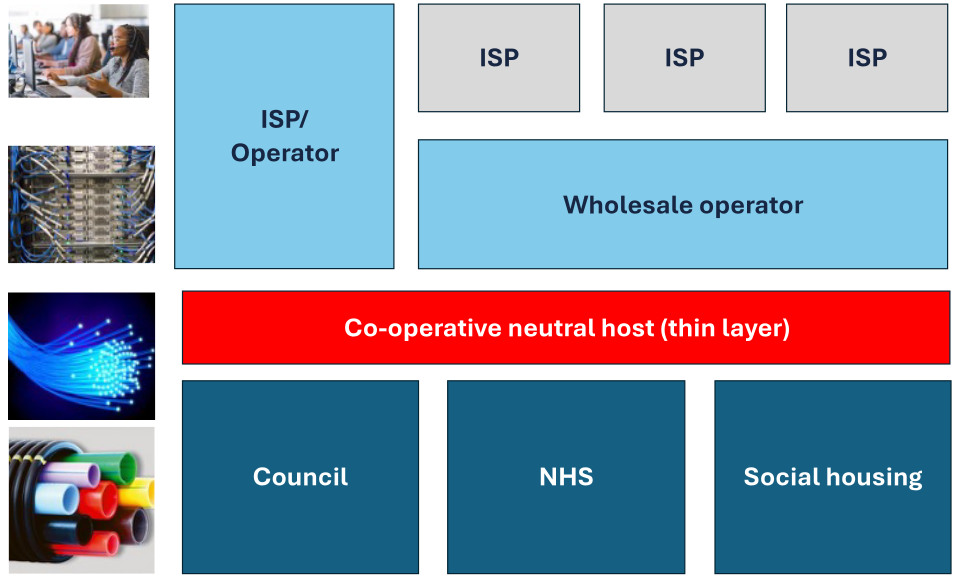
The result was the “thin layer” model. Each member, whether a council, NHS trust, housing provider or private operator, keeps ownership of its own fibre and ducts. CNI adds only a light coordinating layer that joins these assets together and presents them to the market as a single, open-access passive network (see diagram below). The cooperative charges standard market-rate access fees and acts as a neutral host, ensuring all members and commercial operators are treated equally.
This model is seen to offer several advantages:
-
Wider competition and innovation – by opening up access at the passive layer, smaller providers can connect to the network without the need to fund full end-to-end builds, lowering barriers to entry and supporting a more diverse market.
-
More efficient use of resources – shared access reduces the need for parallel fibre builds, helping to avoid wasted investment, unnecessary disruption to communities, and additional carbon impacts
1.2 Illustration of the CNI ‘thin layer’ model
2. LFFN funded CNI projects
The first use of the CNI model in Tameside was supported through Wave 1 of the LFFN programme. LFFN funding was used to extend the public sector fibre network by adding new spurs and connecting further public sector buildings, while also making the infrastructure available for sharing through the cooperative. An interviewee from CNI noted that, although the Tameside business case was commercially viable without subsidy, LFFN support was important in accelerating delivery and giving confidence to other areas to trial the model. This project has already been examined in detail through the Wave 1 evaluation and is not revisited here.
In Wave 2, LFFN funding enabled CNI to expand into new areas through 2 Public Sector Asset Reuse projects:
-
Blackpool – awarded £3.2 million, which was used to augment Blackpool Council’s existing fibre network by installing new duct and fibre spurs.
-
Mid Sussex – awarded £2.2 million. Funding was used to build a publicly owned “scaffold” duct and fibre network, making use of local authority infrastructure. This included new ducting installed through Dig Once schemes, where fibre ducts were laid at the same time as other construction works (such as new roads or housing developments)
The business cases for both projects specifically reference the Wave 1 Tameside project as the inspiration for their approach.
For this evaluation, the case study therefore focuses on the Blackpool and Mid Sussex projects, where LFFN funding has played a clearer role in demonstrating and testing the CNI model.
3. Suppliers using CNI infrastructure in LFFN areas
This section identifies the suppliers that have used CNI infrastructure in Blackpool and Mid Sussex, and provides brief details of the companies that contributed to the research. These were identified by cross-referencing the list of CNI members with the coverage of suppliers in Blackpool and Mid Sussex as shown in ThinkBroadband maps. However, this approach has not captured all suppliers using CNI infrastructure in these areas. CNI confirmed that additional companies are making use of the infrastructure, but their identities could not be disclosed for commercial reasons. This may be because some suppliers use CNI for middle-mile or backhaul connectivity rather than providing retail broadband services, meaning their use of the infrastructure may not be visible in public coverage datasets.
Although VMO2 is a member of CNI, and has coverage in both Blackpool and Mid Sussex, the company confirmed that it has not used CNI infrastructure in either area. VMO2 initially engaged with CNI several years ago and considered it an interesting model, but changes in their corporate structure and rollout strategy have since shaped a different approach.
2 major developments were cited as pivotal: the merger between Virgin Media and O2, and the company’s strategic agreement with Nexfibre. These shifts substantially altered how VMO2 approaches network deployment. In the early stages, they explored potential use cases for CNI infrastructure (including in Tameside), but found that the scale of available assets did not align with their requirements.
At the same time, VMO2 was also working to establish a viable approach to using Openreach’s PIA product. Although it took time to embed, they described this as now being “productionised” and fully integrated into their rollout model. Their current expansion programme, Project Lightning, is closely aligned with the national availability of PIA assets, making it less practical to adopt a different infrastructure approach in isolated areas.
In summary, while VMO2 was open to the CNI model in principle, they were ultimately unable to identify use cases where it made strategic or operational sense given their evolving business model and reliance on PIA.
3.1 Blackpool
ThinkBroadband data indicates that 2 CNI members provide full-fibre broadband services in Blackpool (excluding VMO2): ITS Technology Group (ITS) and CityFibre. Interviews were carried out with representatives from both companies for this case study.
CNI noted that there are 2 additional suppliers using CNI infrastructure in Blackpool, one of whom is using it for a “strategic purpose”, although further details could not be shared.
3.2 Gigabit-capable coverage of CNI members in Blackpool (from left to right: ITS, City Fibre)
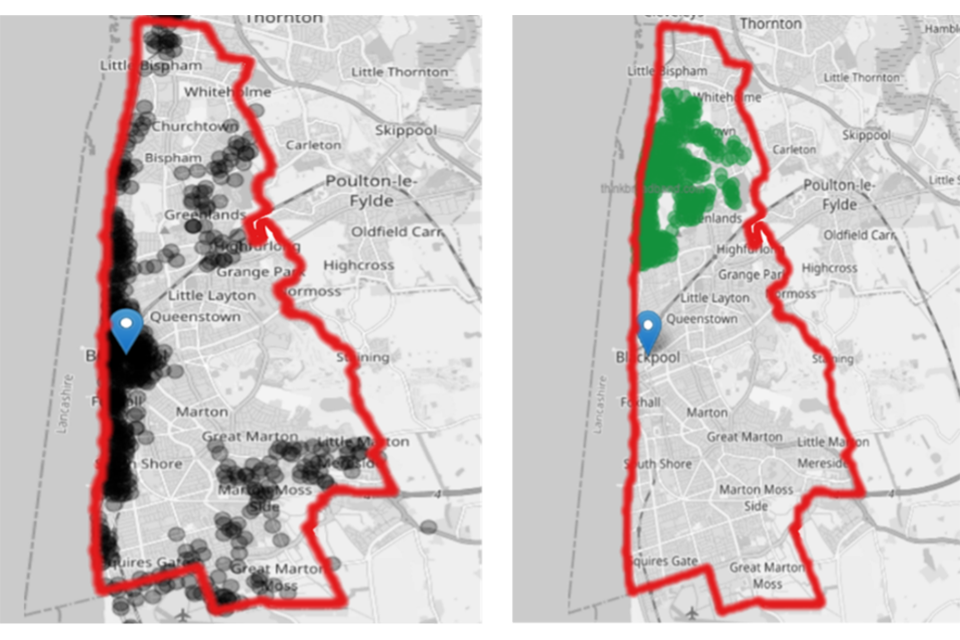
Source: ThinkBroadband – accurate as of October 2025. Note: Coverage of VMO2 is shown in 3 colours to reflect different technologies. Red indicates VMO2’s hybrid fibre coaxial cable networks, which can deliver gigabit-capable speeds. Dark blue indicates Radio Frequency over Glass; where fibre is used but services are still delivered over radio frequency signals. Light blue indicates XGS-PON (10-Gigabit Symmetrical Passive Optical Network), a full fibre technology capable of offering symmetrical speeds of up to 10 Gbps.
ITS is a rapidly expanding alt-net and wholesale full-fibre broadband provider. The company has grown from around 20 employees 5 years ago to a workforce of roughly 250 today. ITS operates nationwide but concentrates primarily on the business market, supplying connectivity to commercial premises via managed service provider (MSP) partners. Its network is currently estimated to cover about 25% of UK business premises, with the goal of extending this to around 50% in the coming years.
CityFibre was founded in 2011, and has since grown into the UK’s largest independent full-fibre infrastructure provider, employing several hundred people nationwide. The company first expanded through public sector contracts using an anchor tenancy model, before shifting its focus to large-scale residential rollout. CityFibre operates as a wholesale provider, building networks that are used by internet service providers. It has plans to extend its network to around 8 million premises in more than 50 towns and cities.
3.3 Mid Sussex
ThinkBroadband data indicates that 2 CNI members provide full-fibre broadband services in Mid Sussex: F&W Networks and Lightning Fibre. However, it appears that Lightning Fibre have a very limited presence in only a small number of postcodes. Therefore, only F&W Networks was interviewed for the case study.
CNI confirmed that this analysis has missed at least one supplier providing services to the residential market, though it is not clear why this CNI member does not appear in ThinkBroadband data.
3.4 Gigabit-capable coverage of F&W Networks in Mid Sussex
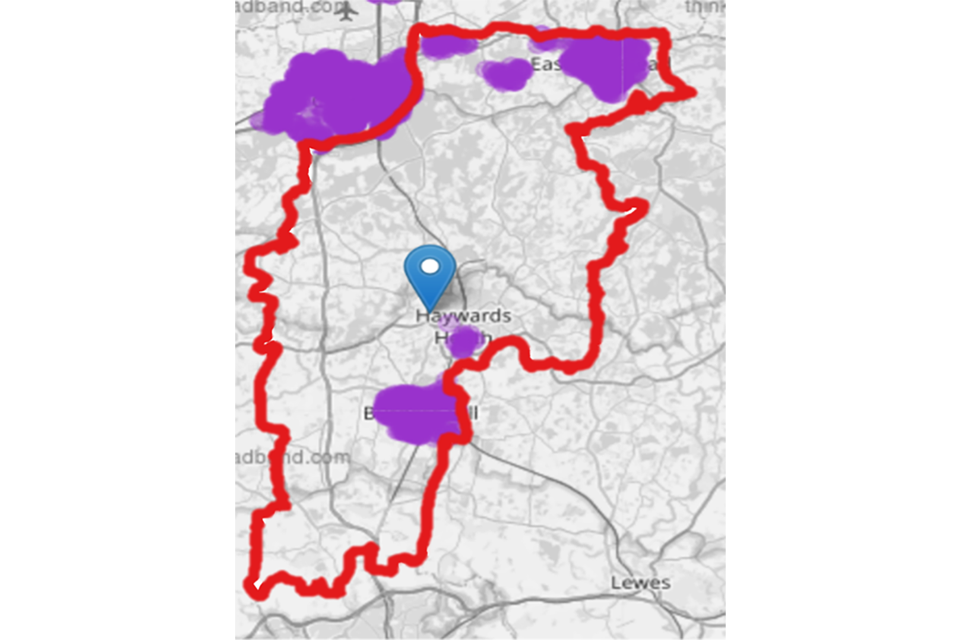
Source: ThinkBroadband - accurate as of October 2025
F&W Networks was founded in 2018 and began operations in 2019, initially building full-fibre networks in towns such as Horsham and Crawley. It has since expanded rapidly, with around 400,000 premises now ready for service, mainly in areas close to London but outside the M25. The company operates a wholesale model through its infrastructure arm, F&W Networks, while its retail services are delivered via its anchor ISP, Hey!Broadband. Its footprint is primarily residential, though it also serves some businesses.
4. Supplier entry and expansion
This section examines the role LFFN played in enabling new suppliers to enter local markets or supporting the expansion of existing suppliers. A later phase of the evaluation (work package 4) will assess the overall impact of LFFN on gigabit-capable broadband coverage using more robust counterfactual methods. For this report, the focus is on whether LFFN and CNI contributed to an increase in coverage by specific suppliers, rather than changes in overall area coverage.
4.1 Blackpool
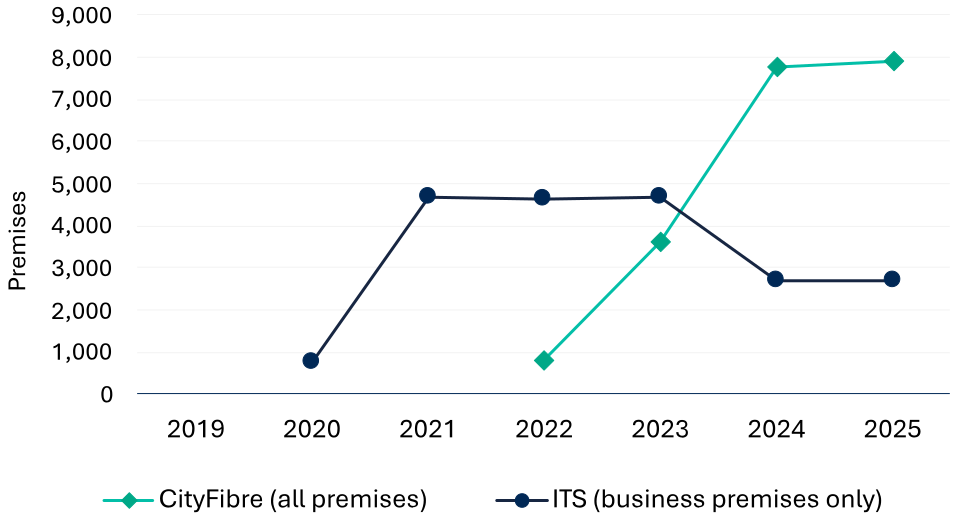
The chart below illustrates how the number of premises in Blackpool able to access broadband services from ITS and CityFibre has changed over time. ITS data covers only business premises, reflecting the company’s business-focused operations, while CityFibre data covers all premises.
The chart shows that neither ITS nor CityFibre had any presence in Blackpool before LFFN investment. ITS began providing coverage in 2021, followed by CityFibre in 2022. As of 2025, around 7,900 premises (11% of all premises) could access CityFibre’s network, while 2,700 business premises (57% of all business sites) could access ITS’s network.
An apparent decline in ITS coverage between 2023 and 2024 is due to a revision by Point Topic in its estimate of the total number of business premises in Blackpool. This methodological change reduced the number of business premises across all affected postcodes, rather than reflecting any real change in ITS’s network footprint. Consequently, the observed decrease does not indicate a reduction in ITS’s actual coverage.
4.2 Number of premises passed by ITS Technology Group and CityFibre in Blackpool, 2019-2025
Source: Point Topic.
Note: the data here and in all subsequent charts is for local authority areas
Interviews with suppliers were used to verify the data above and to understand the factors which affected their decision to enter the Blackpool market.
Interviewees from ITS and CityFibre both confirmed that they did not have existing coverage in Blackpool prior to LFFN, and stressed that access to the LFFN-funded CNI infrastructure was an important factor in their decision to enter the market when they did. For ITS, it was seen as the difference between entering or not:
“If we weren’t part [of] CNI in Blackpool, I don’t think Blackpool necessarily would have been… probably in our priorities… So it would be on a wish list, but we probably wouldn’t have got there by now.”
ITS interviewee
“There is a really good argument to say, well, you know, we wouldn’t have served businesses in Blackpool without CNI and I’m happy to stand behind that.”
ITS interviewee
By contrast, CityFibre felt they would eventually have entered Blackpool, but the presence of the CNI network brought forward their plans:
“I think we would have (entered the Blackpool market), yeah… But it definitely accelerated the deployment.”
CityFibre interviewee
The financial model behind CNI was also highlighted as a critical factor influencing their decision to enter the market, particularly for ITS. The cooperative’s shared infrastructure reduced upfront costs and allowed members to pay for access on a rental basis, which made market entry more attractive:
“The principle is great. It was a good expansion of our footprint for a lower investment, frankly, so there was a really good logic to it.”
ITS interviewee
“It’s somebody else’s cash that’s built it. So it’s then a rental model. So you know if cash is king and you’ve got other priorities, that’s great and it works… why wouldn’t you do that is my view.”
ITS interviewee
CityFibre similarly emphasised the value of re-using existing assets, both to avoid unnecessary duplication and to generate returns for public partners:
“There was no point in over building stuff they already had, so we made use of it. And we like to, to create revenue streams for councils. That’s one thing we like to do. So if we can use infrastructure that’s already been built or owned by the council we would always look to do that where we could.”
CityFibre interviewee
4.3 Mid Sussex
The chart below shows how coverage of F&W Networks in Mid Sussex has changed. Lightning Fibre is not shown, as its network covers only around 50 premises.
F&W Networks began offering services in 2021, coinciding with the availability of LFFN-funded CNI infrastructure. Since then, its footprint has expanded rapidly, reaching around 28,000 premises in 2025, equivalent to 36% of all premises in Mid Sussex.
4.4 Number of premises passed by F&W Networks in Mid-Sussex, 2021-2025

Source: Point Topic
The interviewee from F&W Networks made clear that they had pre-existing plans to expand in Mid Sussex and its decision to enter the market was not influenced by CNI, stating:
“CNI didn’t impact on our strategy of whether to go to market”
F&W Networks interviewee
Instead, its entry was driven by standard commercial considerations such as deployment costs, expected take-up, and the competitive environment at the time.
While CNI was not a determining factor in the decision to enter, it did allow them to accelerate their deployment, ensuring premises could access their services faster:
“CNI helped us to connect customers sooner because they were already present, they were already here and it was just about, you know, connecting and using the fibre.”
F&W Networks interviewee
The interviewee noted that access to the CNI network also enabled them to reach more premises than would otherwise have been possible, particularly in less dense or more isolated neighbourhoods, where CNI reduced costs and improved commercial viability:
“The number of units that we are serving right now is higher due to CNI, yes… I know that we connected some of these places thanks to them.”
F&W Networks interviewee
However they were not able to quantify the number of additional premises they have been able to reach as a result of CNI.
4.5 Conclusion
The table below shows that the impact of LFFN on supplier entry differed across areas and providers. In Blackpool, LFFN-funded CNI infrastructure was decisive for ITS and accelerated CityFibre’s entry, while in Mid Sussex it played only an enabling role for F&W Networks.
It is difficult to pinpoint the exact reasons for these differences, as suppliers were not asked to compare their experiences with others. However, they are likely to reflect differences in geographical growth strategies and the relative attractiveness of each area. ITS and CityFibre are national providers who must prioritise where to expand in order to maximise growth; in their case, the presence of CNI infrastructure meant that Blackpool moved up their list of priorities. F&W Networks, by contrast, is regionally focused on Sussex, where it already had a plan to expand coverage. CNI infrastructure allowed the company to connect customers more quickly and extend into less viable areas, but it did not influence the timing of its initial market entry.
4.6 Conclusions for Claim 1: LFFN funding enabled new suppliers to enter local broadband markets by reducing risks and barriers to entry, and making entry more viable
| Supplier | Contribution | Justification |
|---|---|---|
| ITS (Blackpool) | Primary contribution | Interview evidence indicates ITS would not have entered Blackpool without access to CNI infrastructure. |
| CityFibre (Blackpool) | Substantial contribution | CityFibre stated it would have entered Blackpool eventually, but CNI accelerated their deployment in the area |
| F&W Networks (Mid Sussex) | Enabling contribution | Entry decision was made independently of CNI, driven by commercial considerations, although F&W Networks did say LFFN had some benefits in terms of scale and speed of deployment. |
We have not assessed contribution claim 2 for this case study (expansion of supplier coverage) as this is focused on suppliers that had an existing presence in LFFN areas prior to the programme, which is not the case for any of the suppliers.
5. Alt-net growth and financial performance
ITS has grown quickly in recent years. Although turnover figures are only available from 2021 onwards, its accounts show revenues rising from £9.3 million in 2021 to £23.9 million in 2023. The company remains active and continues to expand its network footprint, suggesting a stable financial position.
The interviewee highlighted that CNI played a meaningful role in supporting this early expansion, even if its relative importance has diminished over time as the company has diversified into other areas:
“It probably had much more of an impact 5–6 years ago than it does now just because of our growth in other areas. So proportionately it’s going to be less important now than it was, but it was a significant part of our business at the time.”
ITS interviewee
At the same time, the interviewee stressed that it was difficult to judge how the company’s financial trajectory might have differed without CNI involvement, as alternative routes to growth may also have been possible.
F&W Networks has only reported turnover figures since 2022, with revenues rising from £487,000 in 2022 to £3.8 million in 2024. It is unlikely that LFFN’s investment in CNI infrastructure in Mid Sussex played a substantial role in this growth, as the company was already planning to expand into the area. This view was echoed by the interviewee, who believed that CNI had not influenced the company’s financial performance and, if it had, the effect was “very, very minor.”
The interview with CityFibre did not examine the specific impact of CNI in Blackpool on the company’s growth or financial performance. Given CityFibre’s size, any effect is likely to have been negligible. The wider impact of LFFN on the company is considered separately in the CityFibre case study.
5.1 Conclusion
The evidence suggests that LFFN-funded CNI infrastructure made a substantial contribution to ITS’s early growth, though the scale of the long-term impact is uncertain. For F&W Networks, turnover growth was primarily driven by independent expansion plans, with only marginal effects from CNI. For CityFibre, any impact on financial performance in Blackpool is likely to have been negligible given the size of its national operations.
5.2 Conclusions for Claim 3: LFFN contributed to the growth and financial performance of alt-nets by enabling them to expand their customer base and revenue streams in project areas
| Supplier | Contribution category | Justification |
|---|---|---|
| ITS | Substantial contribution | CNI was described as a “substantial part” of the business in its early years, supporting expansion. However, the interviewee could not say how financial performance would have differed without it, so this conclusion is subject to some uncertainty. |
| CityFibre | Negligible contribution | Any impact on financial performance is likely to have been negligible given its limited presence and the size of its national operations. |
| F&W Networks | Marginal contribution | The interviewee believed CNI had only had a “very minor” effect on financial performance (if at all). They also noted CNI enabled connections in some less viable areas, suggesting there may have been a small effect on turnover. |
6. Attracting private investment
The interviewee from ITS reported that participation in the LFFN-funded CNI model had not directly helped the company to secure private investment. They explained that the model, and its reliance on shared infrastructure that ITS does not own, can be perceived negatively by some investors:
“Investors seem to like the idea of you owning your infrastructure, the fibre infrastructure, which is interesting. So they will not quite understand the CNI model because it doesn’t really sit on a balance sheet.”
ITS interviewee
While he noted that investors could be reassured once the model was fully explained, he emphasised that, overall, CNI had not provided additional support in raising capital:
“Once explained it doesn’t seem to be a problem. But it doesn’t necessarily help attract it. It doesn’t necessarily hinder it, but it certainly doesn’t help it.”
ITS interviewee
The interviewee from F&W Networks was unable to identify specific factors influencing their success in attracting private investment, but was confident that their use of CNI infrastructure had “no effects whatsoever.”
The discussion with CityFibre did not focus on the impact of CNI in Blackpool on the company’s ability to raise finance. Given CityFibre’s larger scale, this is likely to have been negligible. The broader relationship between LFFN and CityFibre’s investment strategy is examined in the dedicated CityFibre case study.
6.1 Conclusion
There is no evidence that accessing LFFN-supported CNI infrastructure helped participating suppliers attract private investment (Claim 5). ITS and F&W Networks both stated it had no effect, and for CityFibre any impact would have been negligible given the company’s scale.
7. Competition and collaboration in the local broadband market
7.1 Wholesale market - Blackpool
The chart below shows how coverage of gigabit-capable or full-fibre services in Blackpool has changed over time, based on residential premises only (excluding ITS, which serves only business customers).
The sharp increase in VMO2 coverage between 2020 and 2021 reflects the company’s upgrade on its cable network, which raised maximum download speeds from around 600 Megabits per second (Mbps) to 1,130 Mbps from 2021 onwards.
By 2025, VMO2 and Openreach remain the dominant providers in Blackpool’s residential broadband market, with coverage of approximately 85% and 48% of premises respectively. In comparison, CityFibre reaches around 11%, and other alternative networks (Grain Connect and Full Fibre Ltd) cover around 7% of premises. Neither of the other alt-nets are CNI members.
Overall, the data indicates that LFFN has contributed to greater competition in Blackpool’s residential broadband market, though the market continues to be largely dominated by established providers. There is also no indication from this data that increased competition from new entrants led to a competitive response from incumbents in Blackpool. VMO2 already had a substantial presence, and Openreach’s expansion occurred in parallel with CityFibre.
The CityFibre interviewee noted that the presence of other networks and the rollout plans of VMO2 and Openreach are important factors influencing their investment decisions. As a result, the extensive VMO2 coverage in Blackpool may have discouraged CityFibre from pursuing a larger-scale rollout in the area.
7.2 Percentage of Blackpool residential premises able to access full-fibre or gigabit capable broadband through different providers, 2019-2025

Source: Point Topic
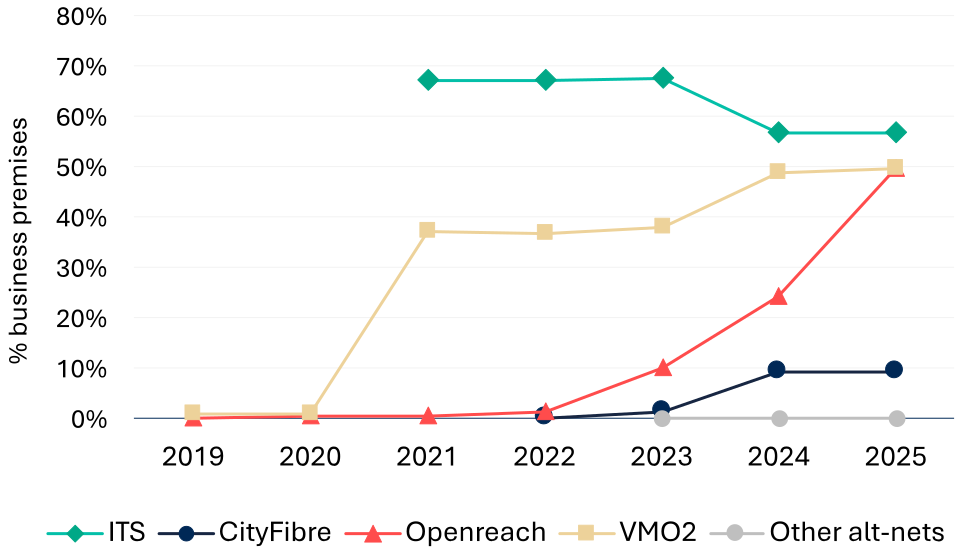
The chart below shows how competition in Blackpool’s business broadband market has changed among providers offering gigabit-capable or full-fibre services. It shows that ITS is the largest provider in the district, serving around 57% of business premises, compared with 50% for both Openreach and VMO2, and 9% for CityFibre. This suggests that LFFN has made a substantial contribution to increased competition in the business market.
While it is possible that ITS’s entry into the market was a factor influencing VMO2 and Openreach’s subsequent expansion, there is no evidence to prove this. The interviewee from ITS was largely unaware of who the company is in competition within Blackpool and could not comment on whether there had been a competitive response from incumbents.
7.3 Percentage of Blackpool business premises able to access full-fibre or gigabit capable broadband through different providers, 2019-2025
Source: Point Topic
As outlined above, the CNI model was intended to reduce duplication by minimising the need for multiple fibre builds in the same locations, while also encouraging collaboration through shared access to common infrastructure.
Point Topic data suggests that the 2 suppliers using CNI infrastructure in Blackpool (ITS and CityFibre) are largely operating in different areas and markets, with only 2% of postcodes served by both. However, there is no evidence that this separation was coordinated and could just reflect the fact that one is focused on the residential market while the other is focused on businesses. In interviews, the ITS representative indicated limited awareness of other CNI suppliers’ activities, and could not comment on whether CNI had led to more collaboration or co-ordination between members.
“I don’t know if it’s a more collaborative marketplace. I can’t say that objectively.”
ITS interviewee
Although there is a high level of overbuild in Blackpool, where multiple networks serve the same area, most of this reflects VMO2’s pre-existing cable network, which became gigabit-capable following an upgrade. According to Point Topic data, 56% of premises in Blackpool are now served by 2 or more gigabit-capable networks, and 11% by 3 or more. When limited to full-fibre networks (excluding VMO2 cable), the proportion of premises with access to 2 networks falls to 15%. 49% have access to one network and 36% do not have access to full fibre.
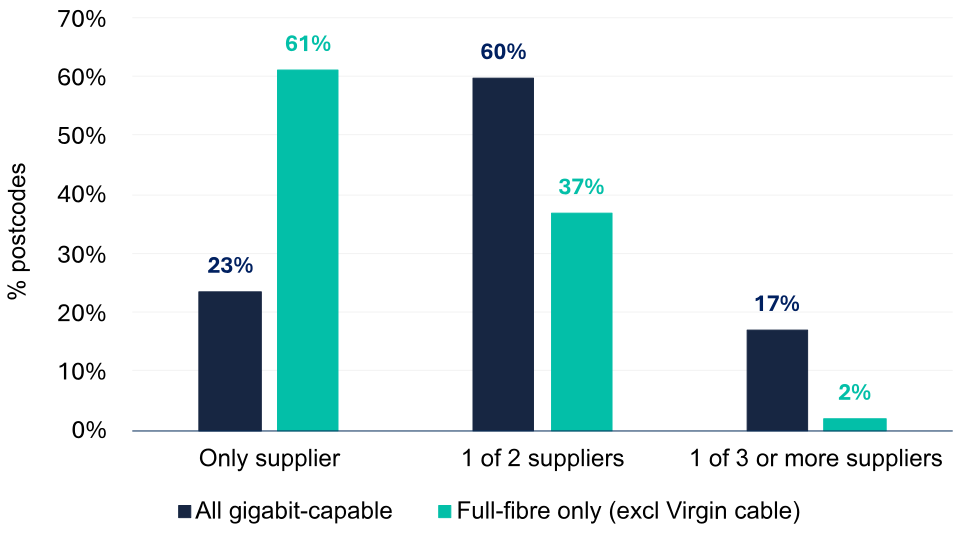
The chart below shows whether CNI suppliers are sole or competing operators within the postcodes they serve. It highlights that they are the only gigabit-capable provider in 23% of their areas, and face competition in the remaining 77%. However, when considering full-fibre networks only, they are the sole provider in 61% of postcodes.
7.4 Competition in postcodes where CNI suppliers operate in Blackpool
Source: Point Topic
7.5 Wholesale market – Mid Sussex
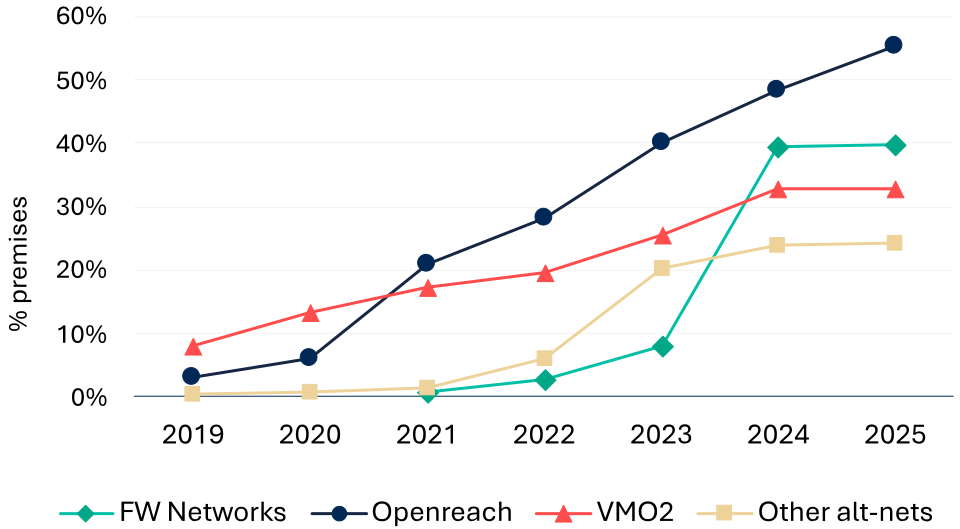
The chart below shows how Mid Sussex’s broadband market has evolved since 2019, focusing on suppliers offering gigabit-capable or full-fibre services across both business and residential premises.
It indicates that Openreach, VMO2 and other alternative networks were already expanding their networks before F&W Networks entered the market in 2021, and have continued to do so since. This suggests that F&W Networks’ entry to the market had no or very limited effect on incumbents’ rollout decisions.
Nevertheless, by mid-2025, Mid Sussex had developed a highly competitive broadband market, with Openreach reaching 55% of premises, F&W Networks 40%, VMO2 33%, and 5 other alt-nets collectively covering 24% of premises.
7.6 Percentage of premises able to access full-fibre or gigabit capable broadband through different providers in Mid Sussex, 2019-2025
Source: Point Topic
The interviewee from F&W Networks reported seeing greater competition in Mid Sussex in recent years and suggested that CNI infrastructure may have contributed by making it easier and cheaper for other providers to enter the market. At the same time, they emphasised that this could not be stated with certainty:
“We were the first ones deploying fibre to the home in [Mid Sussex]. Now I think that in the last couple of years we saw that in a couple of towns there is more competition. There were more people deploying more than one, sometimes 2 after us. So I’m not sure about what they are using, but I’m sure that CNI has basically helped them connect homes.”
F&W Networks interviewee
However, there is no indication that recent entrants to the Mid Sussex market (which include Community Fibre, Cuckoo Fibre, Hyperoptic, OFNL and Trooli) are using CNI infrastructure since none are members. The assertion that F&W Networks was the first company to deploy fibre to the home in Mid Sussex is also not consistent with Point Topic data.
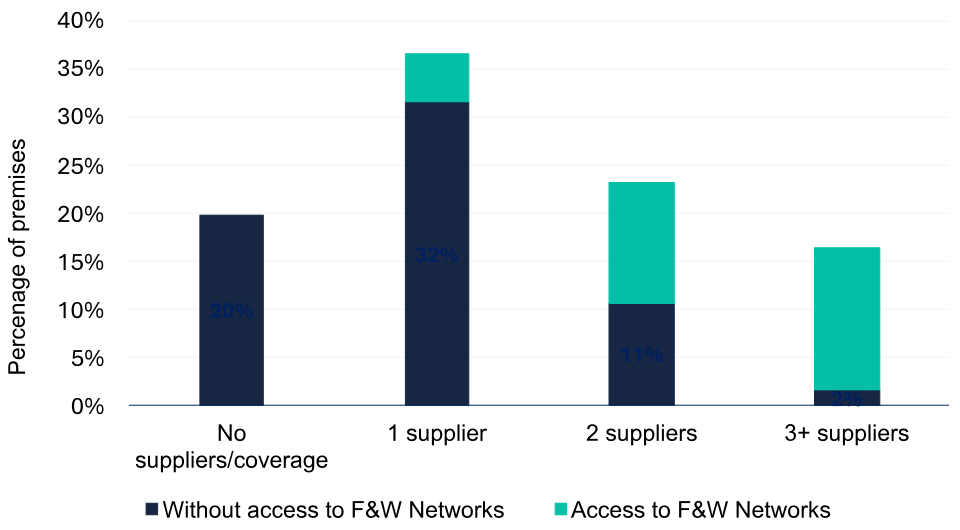
The chart below shows that, as of 2025, 20% of premises In Mid Sussex do not have access to gigabit capable networks. 37% have access to one network, 23% have access to 2 networks, and 17% have access to 3 or more networks. F&W Networks’ coverage is weighted more towards areas with 2 or more suppliers, indicating a high level of over-build.
The interviewee from F&W Networks was also not aware of any coordination or collaboration between their company and other CNI members.
7.7 Number of supplier networks available to premises in Mid Sussex
Source: Point Topic
7.8 Conclusions for competition in the wholesale market
The CNI model was designed to open access to fibre infrastructure, lower barriers to entry, and reduce duplication by encouraging operators to share assets. Evidence from Blackpool and Mid Sussex shows that while it has helped stimulate competition, particularly for smaller providers, there is limited evidence of co-operation between providers.
In Blackpool, the CNI-funded network enabled ITS to enter the business broadband market and quickly become the largest provider, marking LFFN’s clearest contribution to increased competition. The programme also supported greater diversity in the residential market, but this remains dominated by incumbents, with VMO2 and Openreach covering most premises and CityFibre reaching only around 11% of households.
In Mid Sussex, F&W Networks has achieved extensive coverage and contributed to a more competitive market overall. However, the evidence suggests that much of this expansion would have occurred even without CNI, and that most other alt-nets have built their own networks rather than using shared infrastructure. As a result, the area now has high levels of overbuild and limited collaboration between providers.
Across both areas, there is little evidence that the CNI model has created a more coordinated or efficient marketplace. While it has demonstrated how shared infrastructure can enable new entrants, parallel builds have constrained its wider impact on market structure and collaboration.
CNI acknowledged that the model has not consistently reduced overbuild, and that performance has varied by place. They noted that it has worked better in some locations than others, and that outcomes in Mid Sussex have been more limited than in areas such as Blackpool and Tameside. CNI attributed this mainly to lack of awareness among alt-nets in parts of Mid Sussex, rather than to active rejection of the model.
They also highlighted ongoing work with the Independents Network Cooperative Association to address this issue. This includes a new infrastructure sharing framework intended to improve visibility of alternative network assets and provide clearer mechanisms for operators to access and share infrastructure. CNI suggested that this initiative is expected to support greater asset sharing over time, particularly by making it easier for operators to identify existing infrastructure and potential collaboration opportunities.
CNI also recognised cultural and investor-related barriers to infrastructure sharing. They noted that some operators have historically preferred to own and control their own networks, and that investors have often encouraged continued asset build. However, they suggested that this position is beginning to change, with growing recognition that sharing infrastructure could create new revenue streams and improve returns by reducing unnecessary duplication.
Finally, CNI emphasised that its core offer has historically focused on middle-mile and backhaul infrastructure, rather than last-mile access networks. As a result, the use of CNI may not always be visible as reduced overbuild in residential access networks, even where it is helping to reduce duplication at the spine or backhaul level. This helps explain why the impact of CNI on coordination may not be fully reflected in measures focused on access-network coverage alone.
On a separate note, there is also limited evidence in either area that increased competition from alt-nets, facilitated by CNI, led to a competitive response from incumbents (Claim 6). With the exception of the business market in Blackpool, their rollout either happened in parallel with that of CNI suppliers, or was already well-advanced by the time CNI suppliers entered the market.
7.9 Retail market - Blackpool
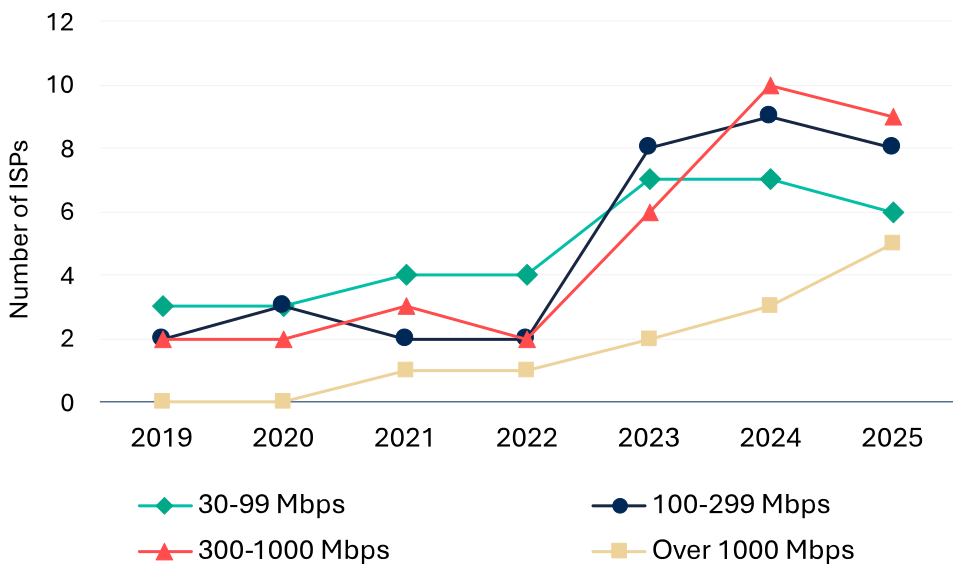
The chart below shows strong growth in the number of ISPs offering residential broadband services in Blackpool since 2022, across all speed thresholds. This indicates that residents now have a much wider choice of providers and deals.
CityFibre is a wholesale operator and makes its network available to ISPs. Currently, 2 ISPs use CNI infrastructure to deliver residential services in Blackpool: ZenFibre and Vodafone, which both operate on CityFibre’s network, and offer packages at various speed thresholds. By facilitating their entry into the Blackpool market, LFFN has therefore contributed to greater consumer choice. This is particularly the case for gigabit-capable broadband deals, where CityFibre ISPs make up 2 of the 5 operators offering deals in this threshold.
However, most of the growth in ISP numbers is due to the expansion of Openreach’s network from 2022 onwards. This follows a wholesale model used by multiple ISPs, including Sky and TalkTalk. This is particularly the case for deals below 1Gb.
7.10 Number of ISPs offering residential broadband services in Blackpool by download speed, 2019-2025
Source: Point Topic
7.11 Retail market – Mid Sussex
The chart for Mid Sussex shows very similar trends to Blackpool. There has been a large increase in the number of ISPs offering services in the area, particularly those offering packages for download speeds over 100 Mbps, indicating much greater consumer choice.
F&W Networks is also a wholesale operator, but works with a single ISP; its retail arm Hey Broadband. This offers deals at all speed thresholds, with the exception of 1Gb+. While F&W Networks has contributed to increased choice, most of the increase is due to other alt-nets entering the market, and ISPs using Openreach’s network.
7.12 Number of ISPs offering residential broadband services in Mid Sussex by download speed, 2019-2025

Source: Point Topic
7.13 Retail market – conclusions
Increased competition in the retail market is assessed through Claim 7: LFFN increased competition and choices of packages in local broadband markets by enabling more ISPs to offer services over gigabit-capable networks.
As set out in Appendix A, contribution categories were not considered appropriate for this claim because ISP competition depends directly on the availability of infrastructure. Where ISPs are using the networks of LFFN-backed suppliers, the core question is therefore: “Did ISPs enter the market as a direct result of LFFN?”
To assess this, 2 conditions must be satisfied:
-
LFFN must have expanded network coverage in the area. This relies on the findings for Claims 1 and 2; LFFN must have made at least an enabling contribution to supplier entry or local coverage expansion. If LFFN did not influence network build, it cannot have influenced ISP entry.
-
The LFFN-funded network must offer wholesale access, with more than one ISP using it. If the network is not wholesale-accessible, or only one ISP operates on it, LFFN will not have led to increased retail competition or consumer choice.
These conditions are met in Blackpool, where LFFN facilitated the early entry of CityFibre into the local market, increasing the choice of retail providers, albeit only to the 11% of households who can access their network. However the conditions are not met in Mid Sussex where F&W Networks’ network is only available to a single supplier.
8. Cost of broadband services
8.1 Blackpool
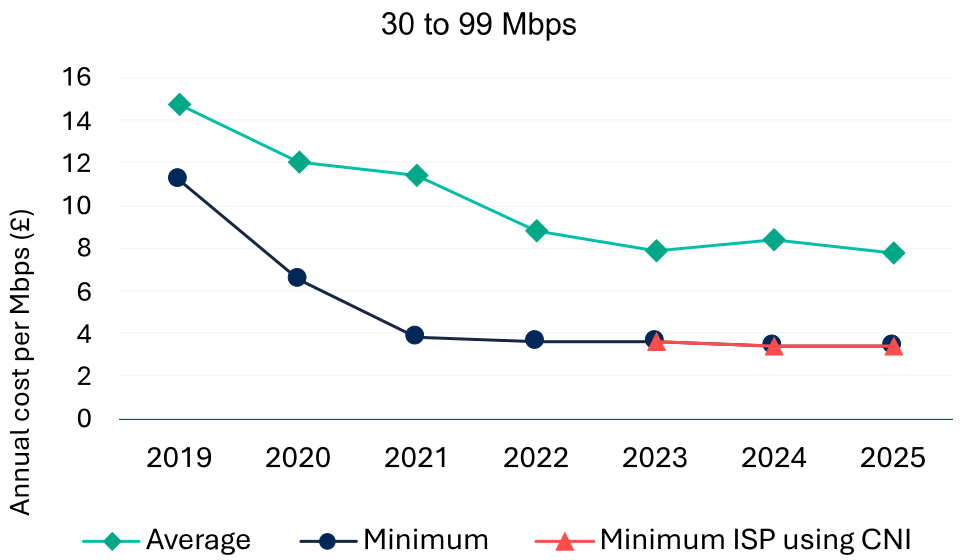
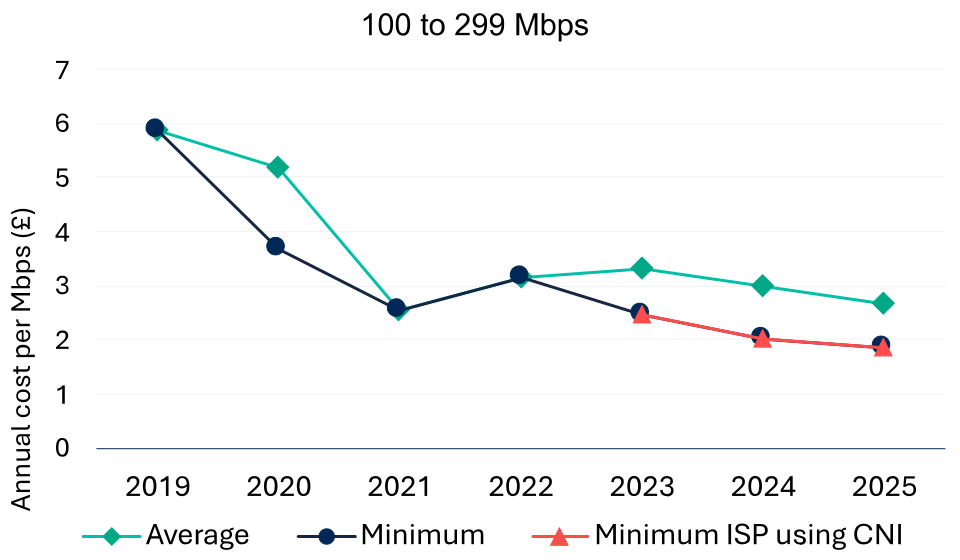
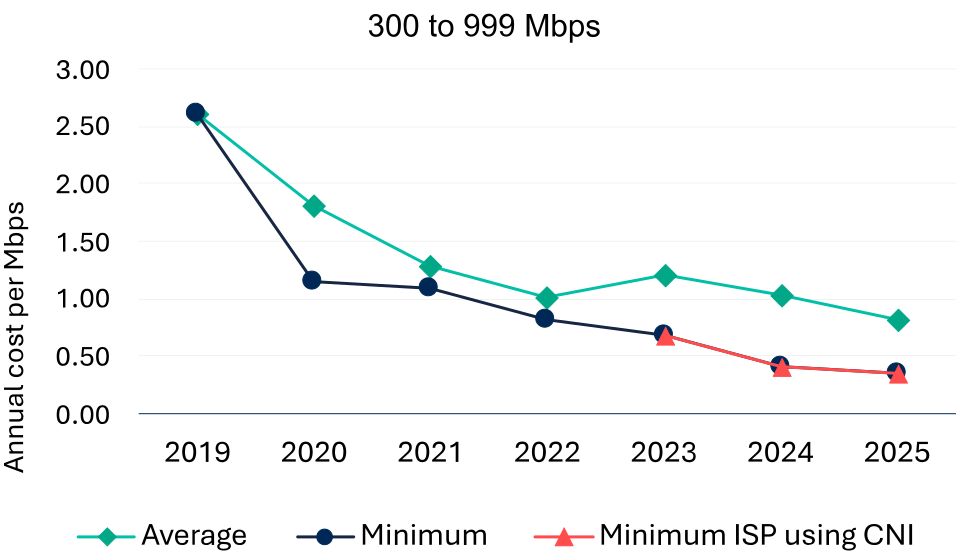
The charts below show how the cost of residential broadband packages in Blackpool has changed since 2019, measured as the annual cost per Mbps across different speed ranges. They present the average cost of all packages available, the minimum cost (the cheapest package on the market), and the minimum cost from ISPs known to use CNI infrastructure.
The analysis includes only deals where both the monthly subscription cost and set-up costs were reported, with set-up costs spread evenly over a 12-month period. It also focuses on standalone broadband deals rather than bundled packages combining multiple services. However, there is a discontinuity in the data: between 2019 and 2021, almost all standalone deals included fixed telephony, whereas from 2022 onwards, very few did. To allow for comparison over time, both types of deals are included, though data before and after 2022 are not fully comparable.
The charts show a clear reduction in broadband costs across all speed ranges, with the most substantial decrease occurring between 2019 and 2021. While part of this may be explained by the change in deal types, the scale of the fall suggests wider market factors were also at play. As this predated LFFN, the reduction cannot be attributed to the programme.
Data for ISPs using CNI infrastructure (in this case, ISPs operating on CityFibre’s network) are available only from 2023 onwards, but they show that these suppliers offered the lowest-cost packages at all speed thresholds. In addition, the continued decline in annual cost per Mbps after their market entry suggests that CNI-supported networks contributed to downward pressure on prices, improving affordability for consumers. Although it should be noted that this only applies to those households with access to CityFibre’s network (11% of premises in Blackpool).
8.2 Annual cost per Mbps for residential broadband packages in Blackpool by download speed range, 2019-2025
Source: Point Topic
The charts above do not include packages for download speeds above 1 Gigabit per second (Gbps). This is because these packages have only been available since 2024. However the data shows that ISPs using CNI infrastructure are also the most affordable in this category. In 2025, the minimum annual cost per Mbps available from a CNI ISP in this speed range was £0.29, compared to a market average of £0.45.
The chart below shows the minimum annual cost per Mbps available for business broadband packages in Blackpool. This highlights a general reduction in costs over time, with a particularly sharp fall between 2020 and 2021 for packages offering speeds over 100 Mbps. However, in this case, it is not possible to assess the impact of ITS’s entry into the market on pricing, as Point Topic data does not include any cost information for their services. This is likely explained by the fact that ITS does not sell directly to businesses and instead operates exclusively through managed service providers, whose retail pricing is not captured by Point Topic.
8.3 Annual cost per Mbps for business broadband packages in Blackpool by download speed range, 2019-2025

Source: Point Topic
8.4 Mid-Sussex
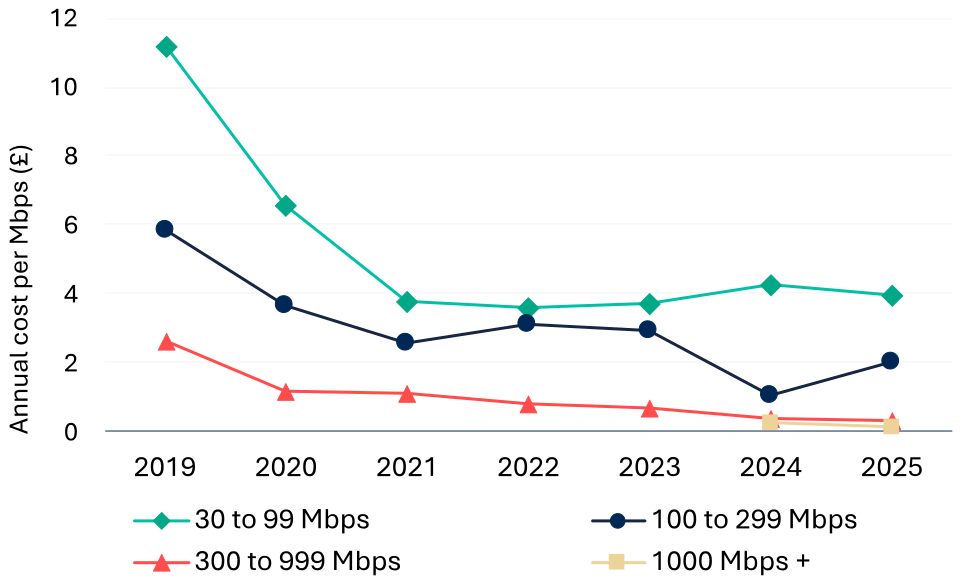
The chart below shows a very similar trend for broadband pricing in Mid Sussex, with a large fall in prices between 2019 and 2021, before prices stabilised for lower speed packages (30 to 99 Mbps) and continued to fall for higher speed packages, particularly for packages over 300 Mbps.
8.5 Annual cost per Mbps for residential broadband packages in Mid Sussex by download speed range, 2019-2025
Source: Point Topic
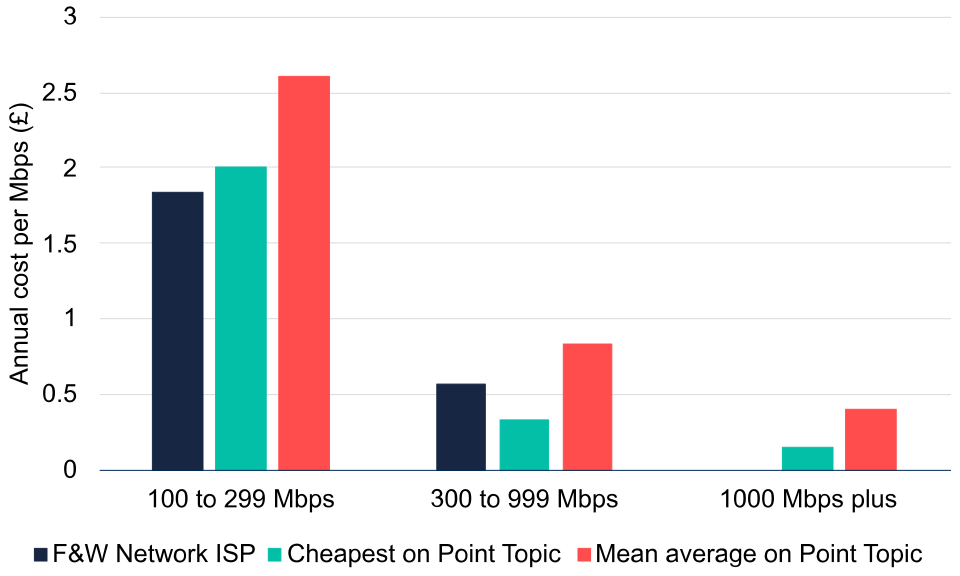
Point Topic does not report pricing data for F&W Networks or its partner ISP, Hey Broadband, so it is not possible to assess how their costs have changed over time or how they compare with historical market averages. However, based on information published on Hey Broadband’s website, the company currently offers the most affordable package on the market for speeds between 100 and 299 Mbps. For speeds between 300 and 999 Mbps, its prices are below the market average but not the lowest available. It does not offer packages above 1 Gbps. This indicates that suppliers using CNI infrastructure are among the best-value providers in the market.
The F&W Networks interviewee suggested that access to CNI infrastructure has enabled the company to deliver higher-capacity services at lower cost, which can be passed on to consumers:
“Technically speaking we were buying capacity services from Neos, TalkTalk, Openreach etcetera. So typically we were buying 10 Gigabit circuits. Now we are using dark fibre from CNI … (that means) we were able to improve the service that we are offering to our customers today due to the fact that we are using dark fibre…. As a business, we would buy the same product, or a worse product, from others, but paying more.”
F&W Networks interviewee
The interviewee further emphasised that CNI has contributed to better prices and services for households:
“I think that CNI helped [households] to get better prices and better services”
F&W Networks interviewee
8.6 Annual cost per Mbps for residential broadband packages in Mid Sussex, 2025
Point Topic and Hey Broadband website
8.7 Conclusions
Overall, the evidence indicates that LFFN made a substantial contribution to lowering broadband prices in areas served by CNI-supported networks (Claim 8). The sharp fall in prices between 2019 and 2021 occurred before LFFN infrastructure was operational and reflects wider market trends. However, from 2023 onwards, ISPs using CNI infrastructure consistently offered some of the lowest-cost packages in both Blackpool and Mid Sussex, including at higher speed tiers. Interview evidence also confirms that access to CNI dark fibre reduced wholesale costs for participating ISPs, allowing them to offer more competitively priced services. These effects are localised to premises reached by LFFN-funded networks but demonstrate that LFFN helped increase competitive pressure on prices where its infrastructure was in use.
9. Other benefits of CNI
Beyond the benefits discussed above, the interviewee from F&W Networks identified a number of additional benefits from using CNI infrastructure.
First, access to CNI improved the capacity, quality and resilience of services. By moving from fixed 10 Gbit/s circuits purchased from other providers to dark fibre links through CNI, the company was able to deliver higher-capacity services with greater flexibility at lower cost. This also provided better resilience by allowing full network back-up across deployment areas:
“It was really, really helpful, especially for instance, for having like backups in place. So technically speaking, our network during 2020–2021 was not fully backed-up, right? And now we use CNI in order to fully backup every area that we deployed.”
F&W Networks interviewee
Second, the interviewee emphasised the qualities of CNI as a partner organisation. They described CNI as highly flexible, open to innovation, transparent in communication, and responsive to problems such as fibre cuts, and compared them favourably to other infrastructure partners.
F&W Networks interviewee
For me, CNI is exactly what we are looking for as a partner because they are, they are quite close to us. They are open to like new opportunities and new products and new ways to do things.
“I can rely on them because it’s as if it was my network…. When there is something that I want to add, or something I want to change, they are always ready to help. So when there is a problem, they always react fast and are very, very communicative. And this is something that we really appreciate and we don’t see with other companies and other competitors.”
F&W Networks interviewee
10. Limitations or weaknesses of CNI
Overall, interview evidence suggested few inherent limitations to the CNI model. The only issue raised related to the perceptions of private investors who initially struggled to understand the model and how it could support long-term value (see above). However, this was not viewed as a lasting problem, as investors could be reassured once the model was explained. This view was reinforced by CNI, who suggested that investor attitudes are beginning to shift. They noted that while investors have historically encouraged operators to build and own infrastructure, there is growing emphasis on generating sustainable revenues and avoiding unnecessary duplication. In this context, sharing infrastructure is increasingly seen as a potential way to improve returns rather than a risk to long-term value.
Other limitations identified related less to the model and more to its scope and operation in practice. The interviewee from F&W Networks observed that the relatively limited reach of the network meant it could only be used in certain areas:
“Well, I mean the lack of granularity in the network, right. So the network is not extremely big. So we cannot use them everywhere, right. (We are making) very strategic usage of them because they are not present in many places.”
F&W Networks interviewee
The interview with CNI provides further context for this finding. CNI explained that the network was primarily developed around public sector assets and demand, with a focus on middle-mile and backhaul connectivity rather than comprehensive last-mile coverage. As a result, CNI infrastructure is not intended to be present everywhere and is used selectively where it aligns with suppliers’ routes and requirements.
The interviewee from ITS also reflected on their experience of service levels in the early years of engagement. They noted that, as a small cooperative rather than a large commercial operator, there were initial challenges in aligning with the expectations of business clients. However, they emphasised that this had improved substantially as the organisation gained experience:
“Service levels are tricky… you know, it’s a co-operative. It’s a not-for-profit, it doesn’t have the same scale as a big business…. I think the team have improved and learnt over time, and the people that are involved have become more familiar with what’s expected of them.”
ITS interviewee
Taken together with the evidence from F&W Networks above, these reflections highlight that while CNI was seen as highly supportive and flexible by its members, the organisation required a period of adjustment to business client expectations. The evidence indicates that this challenge has been addressed over time, with members reporting improvements in service delivery.
11. Summary of conclusions
| Outcome area | Evaluation conclusions |
|---|---|
| Supplier entry (Claim 1) | Blackpool: ITS – Primary contribution. ITS stated it would not have entered the market without LFFN-funded CNI infrastructure. CityFibre – Substantial contribution. CityFibre would have entered eventually but CNI brought forward investment. Mid Sussex: F&W Networks – Enabling contribution. Entry was based on independent commercial plans; CNI helped only with speed and reach of deployment. |
| Alt-net growth and financial performance (Claim 3) | ITS – Substantial contribution. CNI supported early commercial growth, though its relative importance diminished as the company expanded elsewhere. F&W Networks – Marginal contribution. Growth driven mainly by independent expansion; CNI played only a very small role. CityFibre – Negligible contribution. Impact in Blackpool too small to influence national performance. |
| Attracting private investment (Claim 5) | No observable contribution. Both ITS and F&W Networks stated that access to CNI did not help in securing investment; for CityFibre any effect would be negligible. |
| Wholesale competition (Claim 6) | Blackpool: LFFN/CNI increased competition in the business market (via ITS) and added diversity in the residential market (via CityFibre), though incumbents remained dominant. Mid Sussex: Market competitiveness increased, but almost entirely due to independent builds by Openreach, VMO2 and other alt-nets rather than CNI. There is no evidence of a competitive response from incumbents in either area |
| Retail competition / ISP choice (Claim 7) | Blackpool: CNI-enabled CityFibre to enter the market, which attracted 2 ISPs and increased choice for the 11% of premises on its network. Mid Sussex: CNI-supported network used by a single ISP (Hey!Broadband), so no contribution to retail competition. |
| Pricing impacts (Claim 8) | Localised substantial contribution. National price falls pre-date LFFN, but from 2023 onwards ISPs using CNI infrastructure consistently offered some of the lowest-cost packages in both areas, exerting downward pressure on prices within the footprint served by CNI-supported networks. |
| Coordination / reducing duplication | Limited impact. Little evidence that CNI reduced overbuild or increased coordination between operators. Expansion by most suppliers occurred independently, and providers often lacked awareness of each other’s plans. |
| Other operational benefits | Positive operational effects reported by suppliers (improved resilience, capacity and flexibility), but these relate to the CNI model itself rather than directly to LFFN. |