Land Open Systems Architecture (LOSA)
Land Open Systems Architecture (LOSA) is the Ministry of Defence’s approachs to support land capability integration.
Documents
Details
Land Open Systems Architecture (LOSA) is the Ministry of Defence’s approach to using open standards, common data models and defined interfaces to support land capability integration. It helps systems exchange information more consistently, reduces bespoke integration effort, and makes it easier to upgrade or replace digital capabilities throughout their service life.
LOSA is supported by a set of core products: the Land Data Model (LDM), Generic Vehicle Architecture (GVA), Generic Soldier Architecture (GSA) and Generic Base Architecture (GBA). The LDM acts as the parent data model from which the GVA and GSA data models are derived. The Generic Architectures provide more specific approaches for vehicles, soldier systems and base infrastructure.
What LOSA does
Although LOSA is rooted in the land environment, its principles may support wider defence integration where common data models, open standards and defined interfaces are needed. It gives programmes, suppliers and integrators a consistent way to design digital and data elements so that systems can exchange information with shared meaning, rather than relying on bespoke project-by-project integration.
By promoting common architecture and reusable integration patterns, LOSA helps defence platforms work together more effectively and makes future upgrades easier. It supports interoperability across platforms, soldier systems and base infrastructure, while also helping UK land capabilities align more easily with NATO, allies and industry partners.
Who should use LOSA
You should use LOSA if you are working on systems, services or equipment that need to exchange data or integrate with other MOD, allied or industry systems.
LOSA is intended for MOD delivery teams, suppliers and systems integrators involved in the design, procurement, development or integration of defence capability. Although LOSA has strong roots in the land environment, its principles can also support wider defence integration where systems need to share information, use common data models or apply open standards.
This may include vehicles, soldier systems, sensors, communications equipment, command-and-control applications, software services and deployable or fixed infrastructure. LOSA is most relevant where systems need to work together, share information with common meaning, or remain adaptable as technology changes.
Why LOSA is relevant
Modern land capabilities are increasingly data-centric: sensors, communications, platforms, soldier systems, software services and command-and-control applications all need to share information quickly and consistently. Without a common approach, each programme can end up creating bespoke interfaces and data mappings, making systems harder to integrate, upgrade and reuse across the land environment.
LOSA is relevant because it provides the open architecture principles, common data models and defined interfaces needed to manage this complexity. By separating data and integration approaches from individual proprietary solutions, LOSA helps reduce vendor lock-in, gives MOD greater freedom to upgrade or replace components over time, and enables a wider range of suppliers to deliver compatible capability. In doing so, it supports the Land Industrial Strategy’s focus on innovation, competition and interoperability, while helping enable the Defence Investment Plan’s ambition for a more integrated, digitally enabled and adaptable force.
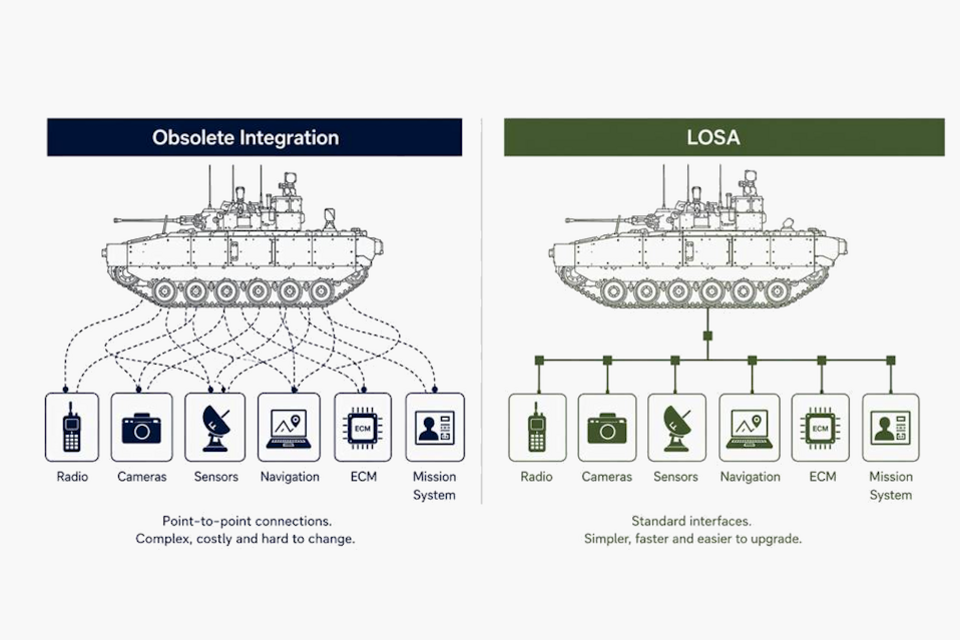
Diagram comparing traditional point-to-point vehicle system integration with LOSA standard interfaces, showing how LOSA simplifies connections and makes systems easier to upgrade
International collaboration
The LOSA approach and the LDM are actively used to enable interoperability between NATO members by providing a common way to describe, structure and exchange data. This helps different nations’ platforms, sensors, soldier systems and command applications share information with consistent meaning, reducing the need for bespoke integration work between individual systems.
This is particularly important for coalition operations, joint experimentation and multinational capability development, where UK systems must be able to work alongside allied systems. By promoting open standards, shared data models and reusable integration approaches, LOSA helps the UK collaborate more effectively with NATO partners and supports a more coherent approach to future capability integration.
Benefits
| Benefit | What this means |
|---|---|
| Improved interoperability | Helps systems exchange information using common data models, standards and interfaces. |
| Reduces bespoke integration effort | Encourages reusable approaches rather than creating new interfaces for every project. |
| Enables wider supplier participation | Gives different suppliers a clearer route to develop compatible products and services. |
| Easier upgrades | Allows components, services and systems to be refreshed or replaced more easily over time. |
| Supports data-centric capability | Helps platforms, sensors, soldier systems and command applications share information with consistent meaning. |
| Reduces vendor lock-in | Makes it easier for MOD to avoid being tied to a single supplier’s proprietary solution and allows other suppliers to compete for future upgrades. |
The LOSA products
LOSA is supported by four key products. These provide the foundations for common architecture, interfaces and data exchange in the land environment.
| Product | Full name | Description | Related Defence Standard |
|---|---|---|---|
| LDM | Land Data Model | A common information model that helps land systems use and exchange data with shared meaning. | The LDM does not have a separate Defence Standard because it acts as the parent land data model from which the GVA and GSA data models are derived. |
| GVA | Generic Vehicle Architecture | An architecture approach for integrating electronic and digital systems on military vehicles. | 23-009 |
| GSA | Generic Soldier Architecture | An architecture approach for integrating dismounted soldier systems, equipment and information services. | 23-012 |
| GBA | Generic Base Architecture | An architecture approach for deployable and fixed base infrastructure, including digital and communications services. | 23-013 |
LOSA booklet
The LOSA booklet provides a short, accessible introduction for users who need to understand LOSA before accessing more detailed material. The booklet can be found at the top of this page.
Contact
Contact the LOSA team if you need access to LOSA guidance, standards or supporting material.