International approaches to recording corruption and monitoring intervention outcomes at the national level
Published 8 December 2025

© Crown copyright 2025
This publication is licensed under the terms of the Open Government Licence v3.0 except where otherwise stated. To view this licence, visit nationalarchives.gov.uk/doc/open-government-licence/version/3 or write to the Information Policy Team, The National Archives, Kew, London TW9 4DU, or email: psi@nationalarchives.gov.uk.
Where we have identified any third party copyright information you will need to obtain permission from the copyright holders concerned.
This publication is available at https://www.gov.uk/government/publications/international-approaches-to-recording-and-monitoring-corruption/international-approaches-to-recording-corruption-and-monitoring-intervention-outcomes-at-the-national-level
Authors
Tom Shipley, Elizabeth Dávid-Barrett, Robert Barrington, Rebecca Dobson Phillips and Georgia Garrod (University of Sussex’s Centre for the Study of Corruption)
Acknowledgements
The authors would like to thank Ipsos, the Home Office’s Homeland Security Analysis and Insight corruption research team, and the UK government’s Joint Anti-Corruption Unit (JACU) for their project management and support during the research study.
Executive Summary
Overview
This report was commissioned by the UK Home Office from the University of Sussex’s Centre for the Study of Corruption. The research looked at how countries record corruption-related data, and how they monitor and evaluate their national anti-corruption strategies. The research was completed in May 2022, with references reviewed and updated in November 2023. Developments in international approaches since that time are not therefore reflected in this report.
Key findings include:
-
designing and implementing national anti-corruption strategies, together with how to evaluate their success and how to assess levels of corruption, is a rapidly-developing field
-
good practice is more commonly found outside G7 countries than amongst the G7
-
the UK already does well in a number of areas and this report highlights a number of opportunities to incorporate and learn from good practice from the other countries reviewed
This report reviews international practice in 2 important areas of anti-corruption work: first, approaches to recording, estimating and proactively detecting corrupt behaviours, and second, approaches to monitoring and evaluation of national anti-corruption strategies. We assessed practices in 15 countries, selected either because they are peer countries to the UK or because they exhibit elements of good practice. All results relate to these countries.
Measurement of corruption
Many of the countries reviewed are investing in building evidence and improving estimates of the prevalence of corruption at national level. A key finding however is that this work tends to be at a relatively early stage in most G7 countries, while many of the more innovative approaches come from lower-income countries.
Among the countries reviewed, the main data sources available for estimating levels of corruption are national perception or experience surveys as well as law enforcement records of corruption cases – often disaggregated into investigations, prosecutions or convictions. These are valuable but need to be complemented with other forms of analysis to build an overall picture of corruption nationally.
Some countries are taking steps to develop and use additional data sources. We highlight recent initiatives in France and Italy as they have high relevance and potential for replication. The Agence Française Anticorruption (AFA) is developing a National Corruption Risk Map based on analysis of recorded cases. This runs in parallel to surveys assessing institutional defences against corruption. Italy requires national and local authorities to conduct corruption risk assessments, a process which is facilitating data collection as well as enhancing understanding of corruption risk across different levels of government.
There are many good options for measuring corruption which the countries reviewed have not to date pursued. Recent research on, for example, the use of proxy indicators for estimating corruption risks is only rarely applied in the countries reviewed, especially in developed countries. Other commonly used tools, such as perception or experience surveys, could be tailored to specific problems to generate more nuanced, actionable data. The lack of data sources focussed on specific sectors is another broad gap.
Our research finds a small number of examples of countries proactively analysing data to seek out undetected forms of corruption. Owing to their comparability to the UK, we highlight instructive examples from state-level anti-corruption agencies in Australia which have drawn on diverse data sources including political records to support enforcement action. Overall, however, the links between the production of data and the data’s application to anti-corruption work still need to be strengthened.
Monitoring and evaluation of national anti-corruption strategies
Deficiencies in measurement are apparent in the monitoring and evaluation of national anti-corruption strategies, which in theory present an opportunity to consolidate data sources for the purposes of monitoring progress. Some countries outside the G7, namely Indonesia and Mexico, have developed or are developing sophisticated monitoring systems. Others rely on international indices, such as Transparency International’s (TI) Corruption Perceptions Index (CPI), which in isolation is not a reliable indicator for assessing the success of a strategy. Some countries produce datasets which could readily be employed for strategy monitoring and evaluation but have not been used for this purpose to date.
The disconnection on data use coincides with our overarching finding that practices for monitoring and evaluation of national strategies generally have significant limitations against international frameworks setting out best practice. While most countries in our sample design and implement national anti-corruption strategies, detailed monitoring and evaluation is uncommon. Where it exists, in most cases it is limited to tracking progress against policy commitments, with far less attention paid to whether desired outcomes and impact are achieved. In many cases, expected outcomes and impact are not even clearly specified.
This is consistent with previous studies which highlight deficiencies in monitoring and evaluation practice - in particular, poor indicator selection and limited external engagement by governments with non-state actors, such as civil society organisations (CSOs), businesses and academia. These limitations may also reflect the fact that national anti-corruption strategies are themselves a relatively new area of public policy, and one where it is difficult to measure impact given the inherent challenges around measuring corruption and then attributing any changes to specific policy actions. There are nonetheless areas where some of the countries reviewed have made progress and the report collates examples of good practice.
While the context may be different to the UK, there are important lessons to be drawn from elements of monitoring and evaluation practice in Indonesia and Mexico. These include substantive commitment to problem analysis as a basis for strategy monitoring and evaluation, attempts to develop monitoring indicators which track specific issues and engagement with non-state actors to inform all of this work.
We did not find tangible examples of countries undertaking a detailed evaluation of their strategy, although this is planned in some countries and is recommended as good practice by organisations such as the Organisation for Economic Co-operation and Development (OECD). Evaluation is an exercise distinct from monitoring which should provide opportunity for reflection and learning.
In some countries reviewed, such as France, Indonesia, Italy and Lithuania, there is emerging evidence to suggest that national anti-corruption authorities have brought impetus to improved data collection and/or the organisation of monitoring and evaluation. Such well-resourced organisations with clear authority are well positioned to build systems for addressing corruption and understanding the effectiveness of efforts to address it; while there is no single model for the governance of anti-corruption work, this underlines the potential benefits of countries periodically reviewing their anti-corruption governance models.
Introduction
Background
This report presents the findings of a 2 phase project on international approaches to the recording and measurement of corruption as well as the monitoring of strategic anti-corruption outcomes. It follows from a project commissioned by the Joint Anti-Corruption Unit (JACU; The Joint Anti-Corruption Unit is a cross-government joint unit situated in the Home Office) in May 2021 from the Centre for the Study of Corruption (CSC) to develop a Conceptual Framework around JACU’s anti-corruption development work. As a result of this, the CSC proposed a definition of corruption for policy development purposes and an elaboration of its constituent parts, which was further developed with JACU officials (Dobson-Phillips et al, 2021). Additional consultation by JACU with CSC, other HMG officials and external stakeholders modified this to produce the following definition for UK-based anti-corruption policy work:
Corruption is the abuse of entrusted power for private benefit, that usually breaches laws, regulations, standards of integrity and/or standards of professional behaviour.
Source: Hansard HL Deb. Vol.824. Col.164GC, 13 October 2022
This Conceptual Framework underpins the objectives of this project.
The 2 principal objectives of the project are:
-
Measurement of corruption: To identify and assess best practices internationally for recording, estimating and proactively detecting corrupt behaviours which meet the conceptual framework for corruption established through previous research conducted by the CSC for JACU
-
Monitoring and evaluation of anti-corruption strategies: To identify and assess success indicators which are in use internationally to measure the impacts of national anti-corruption strategies
The research was conducted in February to May 2022 and is accurate as at May 2022. Following consultation with some interviewees, updates to select non-public information were made between September and November 2023.
Methodological approach
The research process was based principally on a desktop review of all relevant materials published by selected countries on corruption measurement and anti-corruption (AC) strategy monitoring (objectives 1 and 2). These materials included corruption surveys and assessments, estimates of corruption levels and forms, definitional documents, reporting mechanisms for corruption, national anti-corruption strategies, and any other source documentation deemed relevant to the project objectives. We analysed materials produced by governments and other relevant actors, such as academics and CSOs. A full list of the materials reviewed with reference numbers is provided link in Annex G.
This research was complemented by 13 interviews with 21 experts, who were typically government representatives involved in leading anti-corruption work, or other topical experts at CSOs and in academia. We held a workshop with 6 leading experts to test ideas and gather further insights into the monitoring and evaluation of national anti-corruption strategies.
In total, we reviewed materials in 15 countries across the 2 objectives. The countries are: Argentina, Australia, Canada, Czech Republic, Finland, France, Germany, Indonesia, Italy, Japan, Latvia, Lithuania, Mexico, Poland, US. Our country selection process was designed to identify peer countries to the UK and countries likely to have the most innovative approaches in these areas. The list of countries reviewed for objectives 1 and 2 was not identical but there was some overlap. Further details on the methodology, including country selection, are outlined in Annex B.
Limitations
Limitations to the research are summarised in Annex B. In particular, reflecting the short, 4 month timeframe for the research, we focus on highlighting examples of good and innovative approaches rather than presenting an exhaustive picture of country practices. Furthermore, while every effort has been made to present an accurate picture, the analysis may not capture the finer details of all practices. The research is up-to-date as at May 2022 and some country policies and approaches may have changed since this date.
1. Measurement of corruption
1.1 Key findings
1.2 Overview of country approaches to conceptualising corruption
1.3 Measuring corruption: framework of analysis
1.4 Analysis of country examples
Measurement of corruption is inherently challenging and this is a task with which academics and practitioners are continually grappling. Corruption is a phenomenon which is generally hidden from view and constantly evolving, making it difficult to observe directly and closely track changes. The conceptual differences around corruption also complicate measurement, leading to differences in the types of corruption issues prioritised for measurement.
Any one measure of corruption will only give a partial view but each has value in its own right to improve understanding of the problem. Countries are making progress in improving the sophistication of corruption measurement and increasing the range of methods in use. Measurement methods need to be adapted to country conditions and focussed on the most harmful forms of corruption apparent in that context.
1.1 Key findings
Government approaches to conceptualising corruption in the sample countries are largely consistent with the Conceptual Framework. Some countries take a broader view of the corrupt actor by incorporating any actor in society whereas the Conceptual Framework limits corrupt actors to those with some form of entrusted power. Another notable difference is that, as in the conceptual framework, some countries take harms to the public interest (and a private gain) as an abuse amounting to corruption whereas others require that a law, rule and/or integrity standard is breached rather than looking at public interest outcomes alone.
To assess country approaches to recording, estimating and proactively detecting corrupt behaviours, we developed a framework of analysis organised around 5 main categories of corruption data. Our research focussed on highlighting good practice and innovative approaches in each of these categories.
1.1.1 Recording cases of corruption
Data on corruption cases from law enforcement and administrative authorities is the most prevalent form of data. This tends to be collected according to a legal offence, but may also be aggregated into a bucket of offences collectively defined as corruption. As a measure of corruption prevalence, it suffers from several limitations, and hence should be contextualised or combined with other data to provide a more coherent overview. Countries with anti-corruption agencies at the national or state level tend to have the most rigorous approaches to collating this data. France has started to analyse information from cases to understand national corruption patterns.
1.1.2 Estimating prevalence of corruption through surveys
While the countries reviewed often draw on widely available surveys published by international organisations and non-governmental organisations, many have also invested in bespoke national surveys. Perception and experience surveys are equally common and we note below the drawbacks of both. The most effective examples we identified are those which combine perceptions and experience data from different groups of stakeholders. Experience or perception surveys which are tailored to examine corruption risks around specific processes are also valuable but are currently under-utilised by governments.
1.1.3 Estimating corruption risks through proxy indicators
This is an area where academic research and thinking appears to be running ahead of country practice. Audits and expenditure tracking surveys can be proactively employed to uncover corruption risks. Research has also highlighted the potential of proxy indicators to identify corruption risks in areas such as procurement and legislative processes. While we identified examples of the use of proxy indicators in Indonesia and Mexico, we found limited evidence of uptake of these types of tools by governments in advanced economies, although they are sometimes used by CSOs.
1.1.4 Assessments of institutional defences against corruption
This is an emerging area of practice which can take several forms, focusing on institutional integrity, compliance, or risk assessments. France and Italy are investing substantially in this form of data collection. It can have high value when combined with other measures, particularly for identifying relevant preventive measures, and there is potential for replication by other countries.
1.1.5 Proactive detection
This involves creating the right conditions for individuals to report corruption and proactively using data to uncover previously undetected corrupt behaviour. The report highlights work by subnational authorities in Australia which have taken proactive steps to detect corruption.
1.2 Overview of country approaches to conceptualising corruption
For the countries in our sample, we assessed to what extent their conceptualisation of corruption aligned with the Conceptual Framework outlined above. To do so, we reviewed a range of government documents such as national strategies and definitional documents. The full research findings are presented in Annex D and a summary is provided here.
1.2.1 Corrupt actors
The Conceptual Framework defines entrusted power as the power or duty vested in a trusted role. This includes public office or roles in the private or non-profit sectors (but excludes domestic settings) held by an individual or institution that exercises discretionary power in relation to another person or entity, or where the abuse of that role would undermine a system of integrity.
Consistent with the conceptual framework, the Czech Republic, Finland, Latvia, and Victoria (Australia) explicitly extend the label of corruption to actions of individuals that seek to influence the decisions of public officials (or those with entrusted power) (see Czech Republic, Document 2; Finland, Document 1; Latvia, Document 4; Australia, Document 7e links in Annex G: Reference materials).
There can be several types of actor involved in a corrupt scenario or transaction, and ideally a measurement or monitoring and evaluation approach will capture this nuance.
Those actors might include (i) the holder of entrusted power ii) a corrupting influence (a corruptor) (which would include the payer of a bribe) (iii) an enabler or facilitator of the corruption and (iv) a victim or victims. Some of these actors may therefore be integral to a corrupt scenario or transaction, but not themselves fall within the definition of being corrupt. A particularly problematic example is professional enablers of corruption who may claim that they neither have entrusted power nor act with abuse; for the purposes of a national anti-corruption strategy and its measurement, the key concept is that those who are facilitating or enabling the abuse of entrusted power may be reasonably considered as within the scope.
1.2.2 Corruption as an abuse
The Conceptual Framework of corruption defines an abuse as an improper exercise of power or violation of duties associated with the trusted role, either through action or inaction. The abuse does not necessarily have to be illegal to be corruption and can include a breach of regulations and/or integrity standards. This can also include a pattern or aggregation of activities which amount to a collective abuse.
‘Abuse’ is itself a complex concept and it is therefore unsurprising that few of the countries articulate clearly what is meant by abuse. This is in line with criticisms of the conceptualisation of corruption in which the abuse element is often left ‘empty’ – that is it is not explained or elaborated on (Rothstein, 2021).
The main distinction between accounts is whether the law or some other standard is used as the basis for identifying an abuse. Canada’s analysis recognises that corruption may be carried out by either commission or omission, which is in line with the CSC’s approach to action or inaction. Argentina, Canada, Finland, France, Indonesia, Italy, Mexico, and the United States either explicitly state or strongly imply through their use of corruption typologies that corruption does not necessarily involve illegality. Canada, Mexico, and the United States refer to the concept of state capture, which relates to improper influence over the formation of law and policy. It is commonly understood as ‘shaping the rules of the game’ for private or partisan gain and as such generally falls within legal conduct. (Dávid-Barrett, 2021; and see Country references: Argentina, Documents 1 and 5; Canada, Document 1; Finland, Document 1; France, Document 1; Indonesia, Document 4; Italy, Document 1; Mexico, Documents 1, 5 and 9; United States, Document 1 links in Annex G).
Indonesia offers the broadest interpretation of abusive behaviour, including “coming late or lying to colleagues”. Indonesia also suggests that acts are not always deliberately corrupt. (Indonesia, Document 4 link in Annex G). In isolation these kinds of petty abuse would not generally meet the criteria in the Conceptual Framework. However, as part of a pattern or aggregation of activities they could potentially fall within its remit.
1.2.3 What counts as private benefit?
The Conceptual Framework defines private benefit to include (financial and non-financial) personal gains that accrue to individual(s) or their personal acquaintance(s) and partisan gains that benefit a favoured group or individual; it may include the avoidance of losses, or gratification.
Private benefit is often interpreted as a direct personal benefit to corrupt individuals and/or their associates.
In line with the Conceptual Framework, most countries recognise that private benefits can take a variety of forms (both material and non-material) and can be directed towards to a broad range of individuals and groups.
The Czech Republic notes that both the corrupt and the corrupting agent are beneficiaries of a corrupt transaction (see Czech Republic, Document 2 link in Annex G); and Finland stipulates various potential beneficiaries, including family, friends, political parties, ethnic or religious groups or other reference groups (see Finland, Document 1 link in Annex G).
The United States’ reference to strategic corruption suggests that benefits accruing to the corrupting agent are not necessarily ‘private’, if that agent is another government or state; Strategic corruption is described in the US strategy as: “when a government weaponizes corrupt practices as a tenet of its foreign policy”. (United States, Document 1 link in Annex G); but as strategic corruption requires the corrupt agent to be induced to abuse their power for private gain, strategic corruption remains within the scope of the Conceptual Framework. [footnote 1] The limitations of “private benefit” as a dimension of corruption are also highlighted in situations where public institutions within a particular state are identified as the beneficiaries of the abuse of entrusted power; as exemplified in the Daniel Morgan Report (2021).
1.2.4 The role of public interest
A consideration of the public interest acts as a limit on the application of the Conceptual Framework in certain circumstances, for example where a petty misdemeanour by someone in an entrusted role does not meet the threshold for government interest. In the Czech Republic, public interest is used to elaborate on the range of actors that can be corrupt, extending beyond public decision-makers to include experts and others with responsibilities in society; for example, it includes “other activities designed to satisfy the public interest, so would include experts and even sports referees, but not the general activities of citizens related to their personal rights”. (Czech Republic, Document 2 link in Annex G). This is in line with the notion of entrusted power in the Conceptual Framework, which does not limit the ambit of entrusted power to those holding public office.
Canada, Germany, Italy, and Lithuania use public interest to elaborate the notion of abuse; in Canada, acting “without consideration for the public interest” constitutes the abuse when done for personal gain (see Canada, Document 1; Germany, Document 2; Italy, Document 1; Lithuania, Document 1 links in Annex G).
Where the abuse is identified in relation to the public interest, as in the Canada case, rather than as an additional consideration when “laws, regulations and or integrity standards” are breached, this becomes a noticeable differentiation from the Conceptual Framework .
This is because rather than limiting the notion of abuse, the use of public interest expands it to potentially include any activity which harms the public interest.
1.2.5 Engagement with corruption theory
Some of the countries reviewed appear to engage with corruption and anti-corruption theory, but strategy documents were not always clear on how this informs their overarching approach.
Several countries refer to the transnational nature of corruption in an important acknowledgment that corruption is not confined to national borders (see Argentina Documents 1 and 5, Finland Document 1, France Document 2, Poland Document 1 and the United States Document 1 links in Annex G). An overview of definitions in Canada notes that corruption can be systemic rather than purely transactional (Boisvert et al, 2014).
Mexico is the country which engages most comprehensively with theory, referring to the role of social norms and structural power in maintaining patterns of corrupt behaviour. This is the basis for the country’s problem analysis and Theory of Change (see Section 2.4.2.) (see Mullard, 2020). Argentina likewise recognises structural factors as driving corruption (see Argentina, Document 1 link in Annex G). The Finnish government additionally commissioned a research project to wrestle specifically with the challenge of measuring “structural corruption”, including developing indicators for conflicts of interest, favouritism, undue influence, and corruption in sport.The KORSI project developed 17 indicators for “structural corruption” addressing: conflicts of interest and dual roles; favouritism (including nepotism) and unethical mutual ‘assistance’; informal decision-making outside formal decision-making structures; undue influence in decision-making (including the drafting of legislation and decisions); unethical restrictions in tender specifications; unethical election and party funding; and match fixing, betting scandals and bribery of referees. (See Finland, Document 4, p.5 link in Annex G).
1.3 Measuring corruption: framework of analysis
Taking the research objectives set out in the Statement of Requirements (see Annex A), we developed a framework of analysis to structure our findings on country approaches to recording, estimating and proactively detecting corrupt behaviours. The framework combines the latest academic research on the measurement of corruption with our empirical review of practices.
The findings are organised into the following categories:
-
recording cases of corruption
-
estimating the prevalence of corruption
-
estimating corruption risks through proxy indicators
-
assessment of institutional defences against corruption
-
proactive detection of corrupt behaviour
1.4 Analysis of country examples
1.4.1 Recording cases of corruption
The most common form of data collected on corruption relates to the enforcement of criminal offences, sometimes disaggregated into investigations, prosecutions and convictions, and typically provided by ministries of justice or police records. As with any attempt to measure corruption, this method has limitations as a way of measuring the prevalence of corruption.
For example, there are many different criminal offences related to corruption. Most notably, bribery, embezzlement, misconduct in public office, and trading in influence. Although most countries collect data on prosecutions of criminal offences, this data is rarely collated to provide an overview of offences comprising or related to corruption.
Also, instances of corruption leading to convictions may be a poor proxy for the actual prevalence of corruption because convictions are at least partly a function of the quality of law enforcement and prosecutorial institutions [footnote 2]. A high number of convictions might indicate a high-quality enforcement system rather than a high prevalence of corruption. Overall, it is difficult to know how the number of investigations, prosecutions or convictions relates to the actual prevalence of corruption.
While almost all countries collect data about convictions, there is variation in the way that they make this data available, for example where it is published, how frequently it is published, and whether it is published in a way that makes it easy to collate corruption offences into one category.
In Germany, the Korruption: Bundeslagebild provides an annual overview of corruption-related crimes, including defining the range of offences that are labelled corrupt, and which offences came to the attention of the police. While these are limited to bribery offences and the acceptance of benefits, (see Germany, Document 2, p.6 link in Annex G) the analysis provided alongside the data is useful because:
-
time series data is provided from 2016, so that change over time can be clearly identified; data is also disaggregated by region and sector
-
data is organised according to bribe giver and taker and there is analysis of the quality (type) and quantity (amount) of benefits accrued by each party
-
data is also collected on the financial costs of the corruption offences identified, although it is acknowledged that damages are not always material
Countries with anti-corruption agencies, either at the national or regional levels, tend to provide the most detailed and contextualised data on cases of corruption.
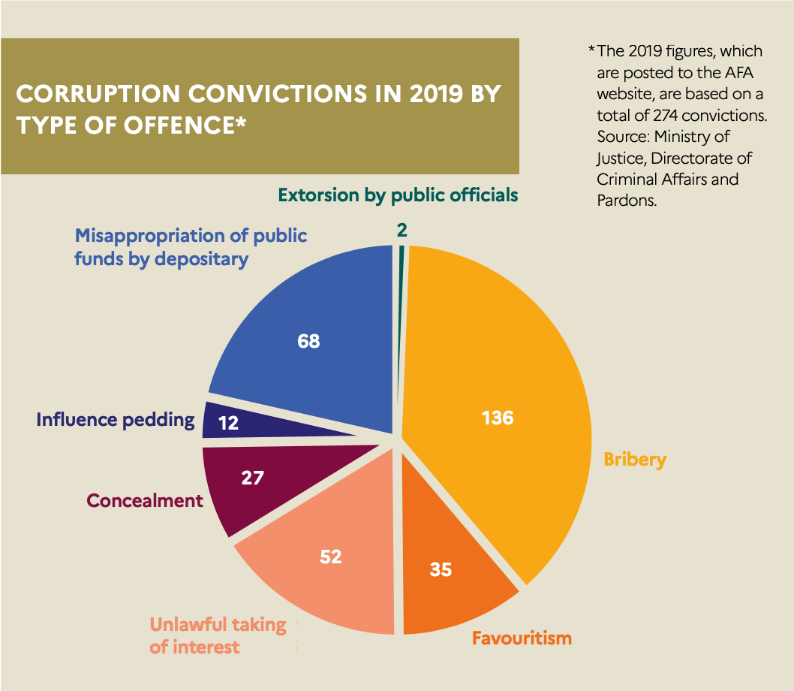
In France, the Sapin II law defines 7 offences and the Agence Française Anticorruption (AFC) collates data about all of them. This data is provided in the AFC’s annual report, which not only presents the breakdown of offences (illustrated in Figure 1), but also provides a regional distribution of cases. (see France, Document 5, pp.16 to 17 link in Annex G)
Figure 1: Agence Française Anticorruption representation of data on 7 corruption offences under the Sapin II legislation
Data about prosecutions can be complemented with data about corruption where administrative, as opposed to criminal, disciplinary mechanisms have been invoked.
This suffers from similar limitations to the law enforcement data in terms of being affected by definitions and the quality of systems for detecting and punishing violations. However, it broadens our understanding of the prevalence of corrupt behaviour.
Another way of estimating cases is to record the number of allegations and reports of corruption, which can then also be compared to conviction rates and other administrative sanctions. This is easier to do in places like Australia and Latvia, where anti-corruption agencies (at national or state level) are responsible for both receiving complaints and pursuing convictions. In Queensland (Australia), the Corruption Allegations Dashboard is a data visualisation tool that allows users to interrogate corruption allegations data across a variety of dimensions.
In France, the National Corruption Risk Map is an ongoing project in which cases of corruption (judicial cases and police investigations) are analysed with the aim of identifying common trends in corrupt activity at national level.
The analysis will also identify common characteristics of corruption as well as typical risk scenarios. As at November 2023, these findings do not appear to have been published. (See France, Document 8, p.14 link in Annex G).
Mexico has a particularly detailed approach to combining data sources through its Catalogue of Information on Corruption. [footnote 3] This is both a repository and a searchable database of nearly 3,000 variables, combining enforcement data with administrative data and surveys. The National Digital Platform also provides data on administrative sanctions of public servants to complement enforcement data.
1.4.2 Estimating prevalence of corruption through surveys
There are 2 types of survey that are commonly used for estimating the prevalence of corruption. The first measures individuals’ perceptions of corruption in a particular country, sector, or process and the second asks about individuals’ experiences of corruption; often a single survey will combine these approaches. Surveys can either be one-off and therefore provide a snapshot of prevalence at a particular time, or they can be repeated regularly to provide insight on trends over time.
In several countries, attempts have been made to repeat surveys: [footnote 4] the best example being Lithuania, where the Map of Corruption survey has been conducted regularly since 2001. (See Lithuania, Document 9, p.4 link in Annex G).
Perception surveys
Surveys of public or ‘expert’ perceptions of corruption are often criticised as being prone to biases. Perceptions can be highly subjective and easily influenced by high-profile scandals that may not be representative of broader patterns; they can be affected by individuals’ political preferences and partisanship, the nature of media coverage, and law enforcement effectiveness. Moreover, individuals may have perceptions about corruption prevalence despite never having experienced corruption themselves or interacted with relevant services.
Perceptions surveys can be useful where they are combined with experience, or where they ask about perceptions in a very specific process or environment. For example, in Victoria and New South Wales (Australia), perceptions surveys are focused on private sector suppliers that have participated in state procurement processes. In New South Wales these were compared to the perceptions of public authorities. (See Australia, Document 2c; Australia Document 7e link in Annex G).
In these more focused surveys, perceptions are more valuable as they are likely to be informed by experience and knowledge of others’ experiences of specific processes.
In addition, while the emphasis in these surveys is on perceptions, they also provide some insight into experience: for example, in Victoria 7% of suppliers report having been solicited for a gift by a public sector procurement official. (See Australia Document 7e link in Annex G).
Experience surveys
Surveys of experience are widely regarded to be methodologically sounder than surveys of perceptions.
They are less subjective and hence less prone to bias, although there may still be variation in interpretations of the same event – for example, a contractor who does not win a government contract may attribute this to favouritism (an experience of corruption) even when there is a lack of evidence that this is the case. Responses may also be affected by poor memories, misunderstandings, and partisan beliefs.
Experience surveys are an important tool for measuring reported prevalence of corruption and they usually allow for filters to be included such that those with no experience of a particular service are not asked to report on their experience of it. They can be tailored to assess the experience of different groups, such as:
Households, or the public
National statistical offices often run regular household surveys, therefore adding a module of questions about experiences of corruption can be a relatively efficient way of collecting data. These have the most value in countries where low-level bribe paying is a significant problem. On the other hand, national statistical offices may also shy away from including such questions if they fear that results will reflect badly on the government and potentially jeopardise their budget. Examples of household or public surveys were identified in Australia, Finland, Indonesia, Italy, Latvia, Lithuania, and Mexico. (See Australia, Document 2c; Finland, Document 5; Finland, Document 11; Indonesia, Document 6; Italy, Document 5; Latvia, Document 6; Lithuania, Document 9; Mexico, Document 10 links in Annex G).
In Italy for 2015/16, the National Statistical Office added a module on corruption to its regular crime victimisation survey, which was administered to a sample of 40,000 aged 18 to 80 in face-to-face interviews; the focus is on petty corruption, but it covers all key public service sectors, as well as the private sector. Participants are asked about indirect experience of corruption (such as if they know someone who has experienced corruption), but are also asked about whether they have experience of various sectors, to ensure validity of data particularly in sectors where contact is less common. (Italy, Document 5 link in Annex G). The survey included questions related to the public bodies and transactions most affected by corruption as well as the form of corrupt exchange.
In Finland, the University of Vaasa ran an e-survey to discover stories, experiences, and feelings about hidden corruption. The survey provided an open response space so that answers could be as full as respondents wished. In addition, the analysis of the survey included 34 email responses in which respondents provided further evidence by attaching additional documentation. (See Finland, Document 5 link in Annex G).
Businesses
It is also common for governments to survey businesses about their experience of the business environment. Moreover, some private-sector companies conduct surveys of business attitudes, although these should be treated with care as samples are often driven by client bases or marketing strategies rather than being wholly representative.
We identified surveys of business in Australia, France, Latvia, Lithuania, and Mexico. (See Australia, Document 2c; France, Document 4; Latvia, Document 10; Lithuania, Document 9;, Mexico, Document 11 links in Annex G) In Mexico, the National Survey of Regulatory Quality and Government Impact on Businesses (ENCRIGE), assesses both perceptions of corruption and the incidence of corruption experienced by companies. The data is not disaggregated according to corruption type, but it does indicate the most common types of interaction involving corruption. (See Mexico, Document 11 link in Annex G).
Civil servants
Surveys of civil servants can be a good way of collecting data about the prevalence of corruption in public administrations. Civil servants are often well-positioned to understand the prevalence of certain corrupt practices, or conditions conducive to corruption.
In Finland, a survey of civil servants collects data on corrupt and other unethical behaviours identified by participants. The survey report provides a useful graph combining responses on (1) the severity of unethical practices in terms of the perceived damage they cause and (2) the prevalence of these practices, which helps to prioritise and guide resource allocation. (Finland, Document 12., Figure 3, p.35 link in Annex G).
Combinations
For broad-based insights at national level, using a combination of experience surveys with different groups can enable a more nuanced picture to be developed. In Lithuania, the Map of Corruption combines and triangulates the results from 3 separate surveys including citizens, business, and civil servants – in some cases, offering 3 perspectives on the same types of transaction, thereby enhancing both data validity and understanding of how corruption is experienced. This survey enables detailed analysis of attitudes and experiences of corruption, as well as levels of awareness of anti-corruption work by the Special Investigative Service. (Lithuania, Document 9, p.4 link in Annex G).
1.4.3 Estimating corruption risks through proxy indicators
One of the main developments in corruption measurement in the past decade is the use of proxy indicators relating to the identification of corruption or corruption risks in particular government functions.
These measures can be used either to get an overview of vulnerability to corruption in a particular area or to identify specific areas for further investigation. As such, these can be used as a starting point for identifying areas for more proactive detection (see Section 1.4.5. for examples). The costs and timelines for collecting proxy indicator data vary substantially by measure, with OECD countries having to date principally used proxy indicators when monitoring and assessing procurement processes.
Public expenditure tracking surveys (PETS)
PETS are audits of financial flows that can be used to trace the share of government resources that reach their intended destination, in the context of certain sectors or projects. They are a way of identifying leakages of resources during the process of implementation. These are commonly used by international donors, particularly the World Bank, in their in-country work in developing countries.
Audit reports and analyses
Supreme Audit Institutions (SAIs) usually have a remit to conduct audits of a sample of institutions to check for misuse of public funds, and they may identify corruption as part of these investigations.
Some countries analyse the SAI reports to gather more information about systemic risks or new emerging patterns of risk. Good linkages between SAIs and anti-corruption agencies or ethics regulators can help to join up different parts of the system and allow for developing better risk assessments and strategic responses.
Legislative process indicators
Some academics and civil society organisations are developing indicators of corruption risks in legislative process - for example, the Global Corruption Observatory. [footnote 5] Such potential risk indicators may include: excessive use of emergency procedures; use of omnibus legislation (1 law which amends several others); use of framework or skeleton legislation (much is left to secondary legislation, beyond parliamentary scrutiny); laws that are modified within a few months of being passed; and laws that are frequently modified.
Asset declarations
Where countries require public officials and politicians to declare their assets, this data can be used to identify ownership of assets that does not match registered income, or to monitor large increases in assets over time.
Public procurement
Several scholars and civil society groups have developed so-called ‘red flag’ indicators of corruption risk by analysing large datasets detailing stages of the public procurement process: from planning through selection of procedure type, tender announcement, bids, selection, and post-award contracting. It is possible to measure the prevalence of different red flags and thereby identify agencies, contractors or practices that indicate corruption risk.
This method can be used to trigger investigation of individual cases, to isolate and respond to specific high-risk practices, or as a preliminary filter to select public organisations for audit.
These proxy indicators can also be linked to outcomes to estimate the costs of corruption (as in the Corruption Cost Tracker), (Fazekas et al, 2020) and as an advocacy tool to highlight the need for and potential benefits of change.
The method depends on the existence of high-quality public procurement data, but more governments now collect such data, particularly because of the introduction of e-procurement which automates certain aspects of data collection.
Grants and subsidies
Similar methods to the public procurement tools can be used to track the allocation of grants and subsidies and to look for evidence of favouritism.
Country specific approaches to estimating country risk
Much of the innovation in this area lies in linking up datasets, but few of the countries in our sample showed evidence of using proxy indicators to estimate corruption risk or identify corrupt entities and processes. From our wider research we are aware, for example, that the federal government in Brazil has very detailed and well-linked data on budget expenditure, public procurement, and company ownership in one integrated data management system, which allows for automatic identification of the source of overspending on a given budget line. [footnote 6]
While there appears to be progress in terms of collecting various forms of corruption-related data, we found little evidence of it being used to predict risk in the sample countries. Some exceptions are as follows:
In the Czech Republic, the ZIndex is a public procurement benchmarking tool, which uses assessments of accessibility, competition, and supervision of procurement processes to assess the transparency, efficiency, and corruption potential of the contracting authority.
In Indonesia, the Corruption Prevention Index tracks vulnerabilities to corruption at the local government level. A version of the index released in 2018 covered 8 main areas (Planning and budgeting; Procurement; Licensing; Supervision; State civil apparatus management; Local tax optimization; Regional property management and Village fund governance) , and tracked 44 sub-indicators which can serve as proxies for corruption. This information is used by the Ministry of Home Affairs to identify regions most at risk from corruption. (Murray and Dávid-Barrett, 2023)
In Mexico, the Mexican Institute for Competitiveness has used big data analysis of contracting procedures with 43 variables to identify corruption risks (red flags). They evaluated 700,000 federal public contracting procedures in terms of level of competition, transparency, and the presence of anomalies. (Mexico, Document 13, p.1 link in Annex G). [footnote 7]
Mexico also provides a useful example of how proxy data on corruption can be collated and made accessible to the public. The National Digital Platform is an intelligence tool which ensures that public data is “comparable, accessible and usable for the purpose of combatting acts of corruption”. The platform includes data on declarations, including assets and conflicts of interest; data on sanctions given to public servants; as well as data on public procurement.
1.4.4 Assessments of institutional defences against corruption
Another approach to measurement is to focus on a country’s defences against corruption.
This can include analysis of the anti-corruption laws, rules and institutions of a country and is sometimes complemented by analysis of the quality of implementation – hence de jure and de facto analysis of institutions. [footnote 8]
Integrity assessments
Transparency International’s National Integrity System (NIS) methodology, recently updated by Prof. AJ Brown for implementation in Australia, is a useful example of an expert assessment of institutional defences at a country level. This approach seeks to assess the extent and quality of a range of institutions designed to check and balance government power and facilitate accountability. [footnote 9]
In the United States, the Centre for Public Integrity ran a project between 2012 and 2015 to provide an annual expert assessment of state-level integrity. It used a range of data sources including 92 de jure indicators and 153 de facto indicators, covering 13 categories including access to information; executive, legislative and judicial accountability; procurement; lobbying; and ethics enforcement. (See United States, Document 4; United States, Document 5 link in Annex G).
Since 2007, the Indonesian Corruption Eradication Commission (KPK) has used an annual survey of public institutions—both perceptions and experiences—to provide an assessment of institutional integrity. It covers anti-corruption culture, HR management, budget management and anti-corruption systems. (See Indonesia, Document 4, pp.8, 11, 20 link in Annex G). Institutions are given an integrity score on a scale of 0 to 100. Scores are also marked down in response to incidents of corruption, although we note that an adverse consequence of this could be to discourage reporting.
Risk assessments
Italy has since 2013 initiated a national programme to conduct corruption risk assessments covering all national and local public administrations and public-sector bodies. Risk assessment is included in the integrity plan process for each individual public organisation in line with the country’s National Anti-Corruption Plan. (see Italy, Document 4 link in Annex G).
Mandatory areas for assessment are procurement, recruitment, authorisation of any kind to citizens, and use of public funds. Each public organisation can also include other areas in response to the specific typology of corruption issues it faces. Risk assessments are performed annually. Assessments are then reported to the national anti-corruption agency, allowing them to monitor performance, identify risk patterns across the system, and to collect data which can help to monitor progress over time. This informs the National Anti-Corruption Plan released every 3 years. [footnote 10]
Compliance assessments
Assessments of the extent to which institutions meet their compliance obligations can also provide insight into the effectiveness of institutional defences to corruption. In Tasmania (Australia), the Ethics and Integrity Snapshot is a survey of state departments and government businesses to assess whether they meet their ethical education obligations under the Integrity Commission Act 2009 (see Australia, Document 6a., 11, 20 link in Annex G).
Likewise, France imposes obligations on public sector organisations, including local government and national ministries, to self-report on the standard of their compliance controls. [footnote 11]
The AFA has the capacity to conduct compliance audits of those self-reporting public-sector bodies. (See France, Document 5, pp.19 to 29 link in Annex G).
1.4.5 Proactive detection
We understand proactive detection to encompass 2 main forms of activity: first, creating the right conditions to encourage individuals to report corruption, and second, using available data to proactively seek out previously undetected forms of corruption. Reporting is often hindered by individuals’ lack of knowledge about how or what to report, lack of trust that reporting will result in effective action, and fear of reprisals. Some surveys identified reluctance among both the public and civil servants to report apparently corrupt or suspicious behaviour. [footnote 12]
Making it easier for whistleblowers
The priorities are to ensure adequate legal protection for whistleblowers, penalise organisations which take unfair action against them and provide easily accessible mechanisms for reporting, such as a hotline.
Latvia has a dedicated website for civil servant whistleblowers who wish to anonymously report information about violations of harm to the public interest that have become known to them through the fulfilment of their official public duties. The website also provides data on reports, including which institutions they arise from and the main areas of concern.
Opportunities for encouraging public reporting
Similarly, the public should have opportunities to lodge concerns and complaints which can then be investigated or passed on to individual regulators.
In Lithuania, the Special Investigation Service operates a Trust Line on its website, a mobile application, hotline and access via email or post. It then triages the complaints and decides whether to transfer the case for further investigation (OECD, 2017).
In Australia the state-level anti-corruption agencies provide opportunities for direct reports of corruption or unethical practice from the public. In most cases they also provide detailed information about what corruption is and the kinds of complaints they can act on. In Victoria a public campaign informs citizens about corruption and encourages them to report their concerns. In Western Australia, there is a reporting line specifically for unexplained wealth.
The KPK in Indonesia has developed a mobile app (JAGA), which enables citizens to access government data, for example level of funding provided for school scholarships, and then verify whether the funds have reached their intended destination. The app includes a complaints channel for each of the sectors it covers: education, health, villages, regional, budgets and licencing.
Proactive data analysis
Many of the forms of data outlined above can be used as a source for proactive data analysis to uncover corrupt behaviour. We found some evidence of countries doing so and highlight 3 innovative examples below.
Romania [footnote 13] has developed an approach to proactively detect conflicts of interest in procurement processes. The system is innovative in that it compares Integrity Reports filled out by the contracting agency with information held in public procurement, personnel and trade databases, [footnote 14] and issues integrity warnings to both the authority and the individual or entity deemed to have a potential conflict of interest.
In Australia the state-level anti-corruption agencies have refined approaches to identifying emerging corruption trends and high-risk individuals and entities. The New South Wales Strategic Intelligence and Research Unit uses the Social Network Analysis application ‘Frontier’, to analyse all matters referred to the agency and identify corruption hotspots, red-flags and high-risk entities (ICAC, 2018). In 2020 to 2021, Queensland monitored several public data sources including the lobbyists contact register, ministerial diaries, media articles and electoral donations. When compared with other intelligence, the analysis identified several key people with strategic associations with both private entities and government agencies, including previous employment and engagement under contracts, and/or strong affiliations with one or both major political parties. (See Australia Document 4b link in Annex G).
2. Monitoring and evaluation of national anti-corruption strategies
2.1 Key findings
2.2 Monitoring and evaluation of strategies: framework of analysis
2.3 Previous reviews of country approaches
2.4 Comparative analysis of country approaches to monitoring and evaluation of national strategies
2.5 Measuring international drivers and facilitators of corruption
2.1 Key findings
Our research finds that monitoring and evaluation practice for national anti-corruption strategies leaves significant potential for improvement. This overall picture matches findings from previous cross-country reviews which have found that as an emerging area of good practice, monitoring and evaluation has not featured prominently in national strategies to date.
Our analysis is organised around 6 areas of internationally recognised standards in monitoring and evaluation of national strategies. We find a gap between these standards and practice; however, certain countries do exhibit elements of good practice which are highlighted in the report.
Oversight and coordination
Countries follow similar models of oversight and coordination for monitoring and evaluation of national strategies. Responsibilities tend to be split between inter-ministerial groups with overarching responsibility for the strategy, and technical implementation units. It is rare for countries to observe the separation of responsibility for (a) implementing the strategy and (b) monitoring its success. A minority of the countries reviewed involve non-state actors in monitoring.
Problem diagnosis and Theory of Change
Almost all the strategies reviewed conduct a problem analysis. However, these vary substantially in terms of detail, participation by state and non-state actors, and grounding in theories of corruption. Only France and Mexico formally incorporate a Theory of Change. Mexico is a good example of a country which conducted detailed problem analysis in consultation with academics, CSOs, businesses and governments at local and regional level. This analysis was the basis for developing a Theory of Change and a set of indicators which track progress on the strategy at a granular level.
SMART indicators
These are hard to develop in this field, and consequently countries have not generally developed outcome indicators to measure the effects of their anti-corruption efforts but tend instead to report outputs (such as activities). The outcome indicators which are used are often too far removed from the issues to meaningfully track progress. Indonesia, Latvia, Lithuania, and Mexico are nonetheless countries which have taken steps toward developing more appropriate indicators.
Data sources
Perception and experience surveys are the most common sources of data used for monitoring and evaluation purposes. Some countries also use enforcement data. However, there are opportunities in monitoring and evaluation to use diverse data sources from the categories set out in Section 1.3.
Consultation, participation and transparency
Many countries limit external consultation to strategy design and do not necessarily engage in ongoing consultation in monitoring and evaluation. Indonesia and Mexico are countries with notably high participation in monitoring and evaluation processes by non-state actors.
Learning and adaptation
We have not seen evidence of countries having conducted formal evaluations of outcomes at the end point of anti-corruption strategies, although this is planned in several countries.
In addition to the UK, 3 countries reviewed (France, Poland, and the United States) have an explicitly international dimension to their strategy. However, based on our review, none of these countries has developed substantive ways of measuring the impact of initiatives intended to tackle major international drivers and facilitators of corruption. This mirrors a lack of research and discussion in the academic community about how this might best be approached.
2.2 Monitoring and evaluation of strategies: framework of analysis
Monitoring and evaluation are closely related activities, but they are not synonymous.
As distinguished by the United Nations Office on Drugs and Crime (UNODC), “monitoring provides data on the strategy’s progress over time in achieving its objectives; evaluation uses these data to determine which elements are working, which ones are not, and what changes need to be made” (UNODC, 2015). The monitoring and evaluation of national anti-corruption strategies has a dual purpose:
-
to drive progress and ensure accountability for results; and
-
to develop learning which can be used to modify and enhance national efforts to counter corruption
International organisations including the G20, Organisation for Economic Co-operation and Development (OECD) and the UNODC have published standards and guidance on the monitoring and evaluation of national anti-corruption strategies which provide a framework through which to analyse country approaches and identify innovative practices (UNODC, 2015; OECD 2018; OECD, 2020; G20, 2020; UNODC & UNDP, 2013)
Based on these materials, as well as our wider research and consultations with experts (see in particular Annex C), we distil good practice in monitoring and evaluation of national anti-corruption strategies into 6 main elements:
-
oversight and coordination
-
problem diagnosis
-
SMART indicators
-
data sources
-
consultation, participation and transparency
-
learning and adaptation
In Section 2.4 we compare country practice across these areas and provide commentary on recommended good practices.
2.3 Previous reviews of country approaches
Previous cross-country reviews have consistently highlighted monitoring and evaluation as an area of weakness in national anti-corruption strategies. In 2007, the U4 Anti-Corruption Resource Centre concluded that “monitoring and evaluation has been almost entirely ignored” and strategies had “limited regard for performance and results” (Hussman, & Hechler, 2008). Similarly, a 2013 UNDP report found that monitoring and evaluation is “probably the most prevalent weakness of anti-corruption strategies”, emphasising that countries do not typically include a monitoring mechanism in the design phase, and tend to “roll out the next phase of their national anti-corruption strategies without assessing the impact of their previous strategy”. The UNDP further raised concerns that “corruption measurement efforts are not sufficiently feeding into the monitoring and evaluation of anti-corruption strategies” (Manandnar, 2014).
More recently, Pyman et al. found in a 2017 review of 41 strategies that less than one-third provided clear timelines or deadlines for each reform measure, and less than one-half included quantitative criteria or indicators for success.
The picture was worse in a subsequent 2018 review of the 26 top-ranked countries on Transparency International (TI)’s Corruption Perceptions Index (CPI). At the time, only 3 of these countries had a national anti-corruption strategy (Pyman,et al. 2018).
In the years since these reports, more examples of good practice have emerged, but they are generally found outside the high-ranked performers on the CPI; moreover, overall practice in the area of monitoring and evaluation remains weak.
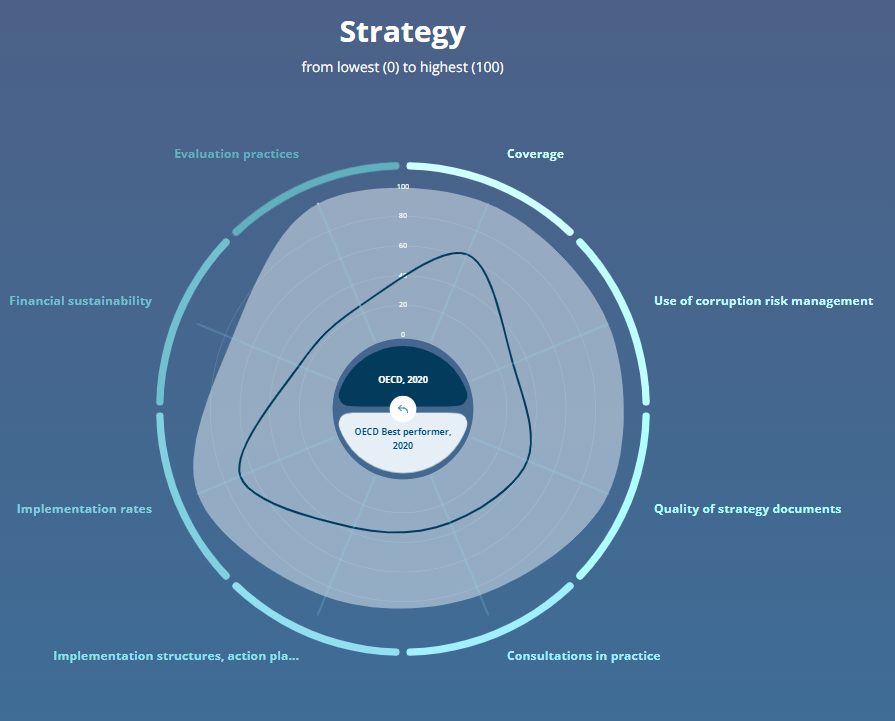
The recently released OECD Public Integrity Indicators support this perspective. Against core dimensions on the quality of anti-corruption strategies, OECD country scores are on average lowest for evaluation practices, alongside financial sustainability, as shown in Figure 2 (below).
Figure 2: OECD Public Integrity Indicators – OECD averages
Source: OECD Public Integrity Indicators
The figure shows the OECD average across several dimensions with ‘coverage’ and ‘implementation rates’ as the strongest areas.
2.4 Comparative analysis of country approaches to monitoring and evaluation of national strategies
In this section we look at how different countries perform in 6 different areas of monitoring and evaluation . The principal aim for objective 2 was to identify examples of innovative practice in approaches to outcome monitoring and establishing success indicators in national strategies. The methodology and criteria for country selection are summarised in Annex A. The full list of documents reviewed is provided link in Annex G.
Table 1 below summarises current practice on monitoring and evaluation of national strategies in our sample of countries.
Table 1: Summary of current practice on onitoring and evaluation of sample countries national strategies
| Country | Anti-corruption Strategy | Period covered | Monitoring and evaluation commitments | Monitoring reports published | Evaluation reports published |
|---|---|---|---|---|---|
| G7 countries | |||||
| Canada | N | - | - | - | - |
| France | Y | 2021 - 2030 | Y | Too early | Too early |
| Germany | N | - | - | - | - |
| Italy | Y | 2019 - 2022 | Y | Y | N |
| Japan | N | - | - | - | - |
| US | Y | 2021 – unspecified | Y | Too early | Too early |
| Selected additional countries | |||||
| Australia (subnational authorities) | Y | Varies | Y | Y | N |
| Argentina | Y | 2021 – unspecified | Y | Too early | Too early |
| Czech Republic | Y | 2018 - 2023 | Y | Y | N |
| Finland | Y | 2021 - 2024 | Y | N | N |
| Indonesia | Y | 2012 - 2025 | Y | Y | N |
| Latvia | Y | 2015 - 2020 | Y | Y | Y |
| Lithuania | Y | 2015 - 2025 | Y | Y | N |
| Mexico | Y | 2020 - 2030 | Y | Too early | Too early |
| Poland | Y | 2017 - 2020 | Y | N | Y |
2.4.1 Oversight and coordination
Recognised good practice
Clear lines of responsibility for the monitoring and evaluation of the national anti-corruption strategy are widely viewed as important.
The OECD and UNODC recommend a specific government body or unit be charged with this task and act as a central coordination function responsible for tracking activities and organising evaluations (OECD, 2018; UNODC, 2015.).
The UN’s Kuala Lumpur Statement (2013) emphasises the importance of distinguishing between implementation responsibilities, such as the activities and outputs of a strategy, and monitoring and oversight responsibilities (UNODC & UNDP, 2013.). The designated unit needs to have sufficient resources to fulfil this role and have a direct reporting line to senior political decision-makers responsible for the strategy.
Actual practice
Several countries in our sample follow similar oversight and coordination models for national strategies. Responsibilities are split between an inter-ministerial group with political responsibility for realising the strategy goals and technical implementation units at specific agencies or ministries (This is the model applied in France Document 1, p.11, Indonesia Document 2, p.14, Latvia Documents 1 and 2, Lithuania Document 1, p.28, Poland Document 2 links in Annex G). Countries which have a national anti-corruption agency often invest responsibility for implementation in this body (see France Document 1, Indonesia Document 1, Italy Document 1, Finland Document 1, Latvia Documents 1 and 2, Lithuania Document 1, and Poland Document 2 links in Annex G).
Based on reviews of strategy documentation, countries do not always distinguish between implementation and monitoring responsibilities.
It is common practice for implementing agencies to also collect monitoring data, reflecting a trade-off between efficiency of data collection against independence of evaluation. There are some notable exceptions: in Italy, Indonesia and Mexico, CSOs and/or academics play an important role in the provision and/or verification of corruption data (see ‘2.4.4 data sources’ and ‘2.4.5 consultation, participation and transparency’ below).
The Argentinian model is also distinct. It has an Advisory Council which reviews progress on the strategy and includes non-state actors, while a separate state agency, the National Integrity and Transparency Roundtable, formally collects and reviews monitoring and evaluation data (see Argentina, Document 4, pp.23 to 24 link in Annex G).
Further examples of good practice are summarised in Annex E.
2.4.2 Problem diagnosis and Theory of Change
Recognised good practice
Monitoring and evaluation should be grounded in sound problem diagnosis, which should be used not only to set priorities, but also, when repeated, to understand the effects of policy and any changes which have taken place. The OECD Public Integrity Indicators recommend all strategies include “situation analysis, including identification of existing public integrity risks” (OECD, 2022), while the OECD Public Integrity Handbook outlines steps for risk identification, analysis and mitigation. (OECD, 2018)
Problem diagnosis should feed into a Theory of Change, which can provide a basis against which a strategy’s success can be assessed. A Theory of Change is commonly understood as a “theory of how and why an initiative works” and can be used to test the underlying logic behind a strategy, the assumptions it is founded on, and risks to implementation (Johnson, 2012). In a CSC expert workshop conducted for this research, attendees broadly agreed that a Theory of Change can be useful for national strategies but needs to be adapted to different levels (see Annex C).
One participant suggested a model of having an overarching Theory of Change supplemented by theories of action in distinct areas.
The exact terminology used is less important than clearly setting out the logic behind the interventions chosen and connecting this to contextual analysis.
Actual practice
Almost all the strategies reviewed [footnote 15] conduct a problem diagnosis. However, these vary substantially across countries in terms of depth and sophistication, the diversity of data sources used, and the extent to which the analysis links to priority areas and activities. Some countries include short summary analysis but this appears quite divorced from the strategy’s focus areas. (See Argentina, Document 2, pp.7 to 8; Poland, Document 1, pp.12 to 14 links in Annex G). Latvia uses learnings from monitoring and evaluation of a previous strategy as part of problem analysis for their current strategy (see Latvia, Document 3 link in Annex G).
France and Mexico stand out as they formally incorporate a Theory of Change – an articulation of how and why initiatives included in a strategy might be expected to lead to results. France’s Anti-Corruption Strategy for International Cooperation (2021) includes a diagram labelled as a Theory of Change (see Annex E, Table 6; France, Document 1, p.19 link in Annex G). Such ToCs and illustrations can enhance their scope through incorporating contextual analysis, with a discussion of assumptions and risks, and with strongly defined success scenarios (Johnson, 2012).
In Mexico, the 2020 National Anti-Corruption Policy provides the most detailed problem diagnosis of the strategies reviewed, running to 114 pages in total, with the unusual level of detail supplemented by the scale of the exercise and the understanding of the potential for social norms to be a key driver of corruption risk (see Mexico, Document 1, pp.65 to 179 link in Annex G). The diagnosis leads to 4 strategic axes for the strategy and 10 specific objectives (see Figure 3 in Annex E). While not formally labelled a Theory of Change, the problem diagnosis and strategic axes are then combined into a single diagram linking problems to actions. (See Mexico, Document 1a, p.176 link in Annex G). This leads further to a ‘Problem Tree’ which illustrates different causes and dimensions to corruption issues in Mexico. (See Mexico, Document 1, pp.174 to 175 link in Annex G).
The diagnosis is based on official data generated by the Statistics Office (INEGI) and complemented with evidence presented by public and academic institutions, civil society and international organisations who participated in a consultation process (see Section 4.5). This provides a clear overarching framework for monitoring and evaluation of a strategy. The level of effort invested in problem analysis has resulted in a highly relevant set of objectives against which progress can be assessed.
The specificity also means that the indicators chosen for monitoring are more relevant to tracking and understanding progress in addressing the problems identified.
Mexico is also distinct in that this analysis is linked to corruption theory (see Section 1.2.5.) and a systemic understanding of corruption as a problem driven by social norms.
The orientation of the US to focus on transnational forms of corruption is also reflected in a section of its strategy on the impacts of corruption (see US, Document 1, pp.6 to 7 link in Annex G). This functions as a form of problem analysis although it is brief. It however defines key terms including kleptocracy, state capture and strategic corruption. This reflects an understanding of corruption as a deeper societal issue rather than a problem which is simply transactional.
In Finland, the problem diagnosis in the 2017 draft strategy brings together diverse data sources. These include law enforcement data, disaggregated into different characteristics of corrupt offences (see Annex E, Table 8); descriptions of select corruption cases investigated by the tax authorities, police and Parliamentary Ombudsman; reports to TI Finland of corruption; perception survey data; and findings of evaluation reports from international organisations including the European Commission and OECD (see Finland, Document 1, pp.18 to 46 link in Annex G). This informed the 2021 strategy and would provide a strong basis for assessing success if repeated in a later evaluation (see Finland, Document 3 link in Annex G).
Supporting diagrams for these examples are provided in Annex E.
2.4.3 SMART indicators
Recognised good practice
Guidance documents stress that good indicators should be SMART (specific, measurable, achievable, relevant, and time-bound) (UNODC, 2015)
Indicators need to be closely related to the issues which are being assessed and within the scope of a strategy’s meaningful influence.
Indicators can take qualitative or quantitative forms. There is an important distinction between output-level indicators (such as tracking activities against a workplan) and outcome-level indicators (tracking external changes). OECD guidance recommends countries structure monitoring around outcome-level indicators and our search for good practice focussed on this form of indicator (OECD, 2022).
Actual practice
With the exceptions of the United States, where the national strategy is premised on broad ‘lines of effort’ rather than specific indicators, and Argentina, where indicators were being developed at the time of research (see Argentina, Document 1 link in Annex G), all countries with national strategies include indicators of progress.
However, for the majority of countries, attention is focussed on tracking output indicators, essentially recording progress in meeting commitments; there is limited innovation in the design and choice of outcome indicators, reflecting the fact that this is a relatively new approach.
Table 2 below summarises country approaches to monitoring indicators.
Table 2: Country approaches to indicators
| Country | Indicators in the strategy | Output indicators | Outcome indicators | Form (quantitative/ qualitative/ mixed) |
|---|---|---|---|---|
| G7 countries | ||||
| Canada | No national strategy | |||
| France | Y | Y | Y | Quantitative |
| Germany | No national strategy | |||
| Italy | Y | Y | N | Mixed |
| Japan | No national strategy | |||
| US | N | N | N | N/A |
| Select additional countries | ||||
| Australia (subnational authorities) | Y | Y | N | Mixed |
| Argentina | Under development | N | N | N/A |
| Czech Republic | N | N | N | N |
| Finland | Y | Y | N | Mixed |
| Indonesia | Y | Y | Y | Mixed |
| Latvia | Y | Y | Y | Mixed |
| Lithuania | Y | Y | Y | Quantitative |
| Mexico | Y | Y | Y | Mixed |
| Poland | Y | Y | Y | Mixed |
We identified only 7 countries which include at least one outcome indicator. France, Poland, Latvia and Lithuania all use the CPI as the principal outcome indicator, sometimes alongside other survey data, in particular TI’s Global Corruption Barometer (GCB) (see Poland, Document 1; Lithuania, Document 1, Annex to the Strategy: Assessment Criteria of the Implementation of the Programme and their Values; Latvia, Document 1 links in Annex G). Given that the CPI is composed of multiple indicators, many of them comprising many variables and highly reliant on expert and public assessments, there is little direct link between the content of a national strategy and what is measured by the CPI.
It is apparent from this review and those completed by others (see Section 3) that countries struggle to develop appropriate outcome indicators to measure the effects of their anti-corruption efforts. This is partly due to inherent challenges in measuring corruption but is also a consequence of trying to measure change at a level which is too abstracted from the activities in a strategy.
The most relevant and actionable indicators are those tied to specific areas of action. Countries could also consider the opportunity to incorporate qualitative commentary on progress.
The commentary provided tends to be purely descriptive; even this, when combined with appropriate quantitative indicators, could be used more analytically to help explain changes observed. In Annex E we include an example from Lithuania where attempts have been made to combine qualitative and quantitative commentary.
Indonesia, Latvia, Lithuania, and Mexico are examples of countries which have taken certain steps to develop outcome indicators that are more closely related to the issues being tracked. Examples are summarised in Annex E and cover issues including beneficial ownership, political finance and procurement.
2.4.4 Data sources
Recognised good practice
Changes to corruption levels and forms in a national context are best understood by combining diverse sources of data, as corruption is a notably complex phenomenon.
Data sources need to allow for comparability over time and against a baseline, and data need to be closely related to the issues being tracked. Two guides recommend against relying exclusively on existing national indices of corruption perceptions due to their methodological limitations and the data being abstracted from the issues under study (UNODC 2015; OECD 2018).
As one expert emphasised in the workshop discussion, governments should think proactively about themselves as providers of information and not only passive users of data, but should not under-estimate the level of investment it takes to generate actionable data.
The OECD and UNODC recommend independent validation of corruption data provided by government agencies for monitoring and evaluation purposes (UNODC 2015; OECD 2018).
Actual practice
Table 3 shows the forms of data most commonly used for the monitoring and evaluation of national strategies. This is the data used for tracking and assessing progress on national strategies and does not encompass studies used for problem diagnostic purposes only, nor output tracking by countries.
Table 3: Forms of data used for strategy monitoring
| Forms of data used for strategy monitoring | Number of countries |
|---|---|
| Perception survey | 7 |
| Law enforcement | 5 |
| Experience survey | 4 |
| General governance data | 3 |
| Procurement | 3 |
| Political records | 2 |
| Audit | 1 |
Perception surveys are the most common form of data used, usually drawing on the public or aggregate indicators. 5 countries use TI’s CPI among other measures of outcomes (in France, Latvia, Lithuania, Poland and the UK). Argentina and Lithuania have additionally developed bespoke national perception surveys (see Argentina, Document 1, pp.34 to 35; Lithuania, Document 9 links in Annex G). As discussed in Section 1.4.2, one limitation of perception surveys as currently employed is that they are conducted principally at national level.
Where countries use law enforcement data for monitoring and evaluation , this tends to be output-orientated, for instance recording training figures for police officers, or changes to case handling procedures (Examples in this regard are Indonesia, Document 2, p.12 and Poland, Document 1, p.30 links in Annex G).
While countries report corruption case numbers, these are infrequently used for monitoring progress on the strategy, Latvia and the UK being exceptions (see Latvia, Document 1, p.85 ; HM Government, “United Kingdom Anti-Corruption Strategy 2017 to 2022. Year 3 Update – 2020”, p.27 link in Annex G).
More granular data on corruption cases, for instance broken down by type of corruption reported, reporting mechanism, location, and timelines from investigation to conviction, could be used as part of strategy monitoring and evaluation . In addition, knowledge testing can be used to understand training outcomes, allowing for evaluation beyond attendance rates.
Similarly, for 2 countries where procurement is a strategic priority, the data used for monitoring is narrow in scope, limited to the implementation of e-procurement systems rather than looking at proxy indicators for corruption risk (see Section 1.4.3.) (see Indonesia, Document 2, p.11; Lithuania, Document 1, p.11 links in Annex G).
In Annex E we include examples from Indonesia, Lithuania and Mexico where countries have sought to use more diverse data sources to monitor their national strategies.
2.4.5 Consultation, participation and transparency
Recognised good practice
Consultation with non-state actors, namely the public, CSOs, businesses and academics, their participation in monitoring and evaluation , and high levels of transparency around the process, are core principles which run across guidance documents and standards (UNODC 2015; OECD 2018). Good practice is that monitoring and evaluation reports should be published no later than 3 months after the defined reporting schedule (OECD 2022, in the work already cited). Consultation, participation and transparency both strengthen the credibility of monitoring and evaluation processes, and improve their quality by bringing different types of expertise into the process.
Actual practice
Where countries conduct monitoring and evaluation for a national strategy, it is common practice for these reports to be published. The frequency at which countries publish monitoring reports ranges from quarterly in the case of Indonesia to every 2 years in Finland and Latvia (see Indonesia Document 2; Finland Document 3; Latvia Documents 1 and 2 links in Annex G).
External consultation on strategy development with non-state actors is common but the level of participation varies. Some countries organise a consultation period to gather inputs whereas in others non-state actors have a more active role in the design of monitoring and evaluation frameworks.
In most countries, any consultation is largely limited to strategy design while in a few there is an ongoing role for non-state actors through periodic consultation or ongoing provision and/or verification of monitoring data. We summarise 4 examples of countries where there is ongoing consultation around monitoring and evaluation in Annex E.
2.4.6 Learning and adaptation
Recognised good practice
There is increasing recognition in the theoretical literature and practical guidance that the monitoring and evaluation of national strategies should inform continual learning and adaptation for country anti-corruption efforts. There is a balance to be struck between setting long-term objectives, which provide clear direction for a strategy, and having the flexibility to respond to changes in circumstance. Effective monitoring and evaluation can help countries in finding this balance, provide the learning needed to adapt programmes, while assessing progress against a long-term vision. The UNODC recommends that regular evaluations are conducted in order to make adjustments to the implementation process and generate learning which can be applied across multiple interventions organised under a national strategy (UNODC, 2015).
Actual practice
For the majority of strategies reviewed, implementation is at too early a stage to determine the extent to which this is taking place.
Three countries (Indonesia, Lithuania and Mexico) have designed strategies which have in-built flexibility.
All 3 work to 10-year strategy periods but have shorter policy cycles of 2 to 5 years during which priorities can be reset based on reviews of progress from previous periods (see Indonesia, Document 1; Lithuania, Document 1; Mexico, Document 1 links in Annex G).
There is some existing evidence from Indonesia of what might be labelled ‘action research’, where ongoing monitoring and research on corruption feed into setting national strategic priorities. This process is managed under the KPK which draws on various data sources as new priorities are set; (information provided in a key informant interview). In Mexico the strategy has only recently been launched meaning it is too early to assess how the process will work.
One expert interviewed for this research summarised 3 ways in which monitoring reports are used in Lithuania: i) to identify recurrent risk areas and suggest counter measures ii) to inform the drafting of new 2 year implementation plans and iii) to provide actionable data to parliament and political decision-makers. In comparison to other countries, monitoring reports in Lithuania are relatively detailed and include baseline data which has allowed the country to track progress over a near 10-year time period. The expert found the yearly review to be valuable in refocussing decision-makers around up-to-date priorities, but this frequency of review was time-consuming, and needed modernisation; (information provided in a key informant interview).
Two other highlighted examples of ongoing learning from Argentina, using an advisory council and Italy, on risk assessments specifically, are noted in Annex E.
From this review we have not seen evidence of countries having conducted formal evaluations of outcomes at the end point of anti-corruption strategies, although this is planned in several countries (see Argentina Document 2, Finland Document 1, p.65, France Document 1, p.11, Indonesia Document 2, p.4, Lithuania Document 1, p.29, and Mexico Document 1, p.199 links in Annex G).
Evaluation is an exercise which is distinct from a project completion report in that it seeks to establish what changes a national strategy and the activities organised beneath might have contributed to, providing lessons on what approaches have proven to be effective or ineffective in a particular context; Poland for example has conducted a strategy completion report (Document 9), while Latvia has completed a mid-term evaluation (Document 2). Good practice would be to involve expert external evaluators in this process and follow a clearly defined research methodology.
2.5 Measuring international drivers and facilitators of corruption
As part of our review of national strategies, we examined country approaches to monitoring and assessing the impact of initiatives intended to tackle the major international drivers and facilitators of corruption.
There are 3 strategies in our dataset which have an explicitly international dimension (France, Poland and the United States). However, good practice has yet to emerge on how to monitor and evaluate this aspect.
France’s Anti-Corruption Strategy for International Cooperation (2021 to 2030) has priorities relating to tackling corruption in the partner countries in which it works, with a specific objective on improving international law enforcement cooperation. The monitoring and evaluation framework for the strategy takes the CPI and GCB scores only in partner countries as its core measures, together with a narrow number of output activities (see Annex E Table 6 and See France, Document 1, p.19 link in Annex G). However, as the ability of a country to influence a partner country’s CPI and GCB scores is limited, attempting to effectively measure performance of the strategy on this basis may be challenging.
A strategic objective in the Poland strategy (2018 to 2022) is to “strengthen international cooperation in the field of counteracting and combating corruption”. The strategy lists actions to be implemented, for example exchanging experience and good practices with other countries, but does not attempt to measure outcome (Poland, Document 1, p.31 link in Annex G).
There is a strong international dimension to the US Strategy on Countering Corruption (2021)(see US, Document 1 link in Annex G). However, as at November 2023, US officials do not appear to have published a monitoring and evaluation framework for the strategy [footnote 16].
In addition to the review of strategies, we conducted research to identify relevant commentary by academics, CSOs, think tanks, international organisations and other experts on how countries might assess the impact of anti-corruption measures targeted at international drivers and facilitators of corruption.
Understanding impact and the effectiveness of anti-corruption interventions is a contentious subject in the academic literature, and there is no clear consensus on either what constitutes success, or how it should be evaluated.[footnote 17]
Our own analysis suggests that it may be helpful to disaggregate the overarching objective into different aspects including, for example:
-
addressing foreign bribery by international companies
-
improving cooperation in international law enforcement
-
hindering the work of professional enablers of corruption
-
implementing international corruption sanctions
-
reducing opportunities to launder the proceeds of corruption
-
enhancing asset recovery
These are topics on which several actors in the international anti-corruption community are working.[footnote 18] These organisations also produce data and country evaluation reports which could be employed as part of an assessment of impact on international forms of corruption. However, these focus on the effects and consequences of corruption; we have not found substantive commentary on the monitoring and evaluation of efforts to tackle international drivers and facilitators of corruption. Some organisations have published commitment trackers on related themes, but these do not help in understanding the outcomes and impact of counter measures.[footnote 19]
Identifying measurable indicators for these outcomes, and assessing the contribution of policy to achieve them, remains an area for further exploration.
3. Conclusion
This report has given an overview of the research into international practice in 2 important areas of anti-corruption work:
-
first, approaches to recording, estimating and proactively detecting corrupt behaviours; and
-
second, approaches to monitoring and evaluation of national anti-corruption strategies
We conclude that while there is no single country that demonstrates consistent best practice, across the 15 countries reviewed there is plenty of good practice on which countries can draw.
Acronyms
AFC: France Anti-Corruption Authority
ANAC: Italy Anti-Corruption Authority
CBA: Poland’s Central Anti-Corruption Bureau
CEU: Central European University
CPI: Corruption Perceptions Index
CSC: Centre for the Study of Corruption
CSOs: Civil society organisations
GCB: Global Corruption Barometer
KNAB: Latvia’s Corruption Prevention and Combating Bureau
KPK: Indonesian Corruption Eradication Commission
NIS: National Integrity System
OECD: Organisation for Economic Co-operation and Development
OIV: Independent Verification Body
PAM: Public Accountability Mechanism
PETS: Public Expenditure Tracking Survey
RUSI: Royal United Services Institute
SAI: Supreme Audit Institution
SIS: Lithuania’s Special Investigations Service
SESNA: Executive Secretariat of [Mexico’s] Anti-Corruption System
TI: Transparency International
UNCAC: United Nations Convention against Corruption
UNDP: United Nations Development Programme
UNODC: United Nations Office on Drugs and Crime
Annex A: Statement of requirements
Project objectives and research questions
Looking beyond the UK to international peers, there were 2 objectives to the research project:
-
to identify and assess best practices internationally for recording, estimating and proactively detecting corrupt behaviours which meet the conceptual framework for corruption established through previous research conducted by the CSC for the Home Office (Dobson et al, 2021)
-
to identify and assess success indicators which are in use internationally to measure the impacts of national anti-corruption strategies
Specific tasks under objective 1
- a broad assessment of the countries in scope to consider how closely their approach to corruption aligns with the conceptual framework developed in the first project
- identifying and assessing best practices used internationally for the reporting and recording of corruption (at the national level and for distinct forms of corruption)
- identifying and assessing best practices used internationally for estimating the prevalence of corruption (at the national level and for distinct forms of corruption) through experience-based approaches such as crime surveys
- identifying and assessing novel and alternative approaches used or proposed internationally to proactively detect corruption (at the national level and for distinct forms of corruption), for example through whistle-blower mechanisms
- explicit identification and discussion of the strengths, limitations, and potential wider application of different approaches would be required to assess potential best practices
Specific tasks under objective 2
- identify national anti-corruption strategies in comparable political economies to the UK
- identify and summarise different approaches to establishing success indicators and outcome monitoring at the strategic level; supplemented by an assessment of the potential strengths and limitations of the approaches to monitoring impact
- identify and summarise different approaches to measuring the impacts of key initiatives within national strategies intended to tackle the major international drivers and facilitators of corruption; supplemented by an assessment of the strengths and limitations of the approaches to monitoring impact
- identify, summarise, and assess novel approaches proposed by international experts on corruption for monitoring the impacts of Anti-Corruption initiatives in political economies comparable to the UK
Recognising that the broad challenges in using different approaches to measure corruption have been well documented, and that high level summaries of approaches used internationally have been conducted, we are specifically seeking the identification and assessment of examples of best practice or examples of the use or development of novel approaches.
Annex B: Methodology
Overview
There were 4 main components to our methodology:
-
literature review
-
in selected countries, reviews of relevant published documentation around anti-corruption strategies, reporting and measurement tools
-
expert workshop
-
expert interviews
The approach allowed for a rapid evidence assessment and triangulation of findings.
Literature review
Under the guidance of the Principal Investigator, the Senior Researchers conducted an initial literature review. The purpose was to identify and analyse available commentary from international experts on good practices in the monitoring and evaluation of anti-corruption strategies. The review also aimed to identify countries exhibiting good practices which could be selected for further research.
We structured the review around combinations of specific search terms, examples of which are shown in able 4 below.
Table 4: List of search terms used by category
| Corruption and related terms | Positive counterparts to corruption | M&E of national strategies | Measurement |
|---|---|---|---|
| Bribe | Integrity | Monitoring | Proxy indicator |
| Conflict of interest | Governance | Evaluation | Survey |
| Corrupt | Transparency | M&E | Risk assessment/analysis/review |
| Economic crime | Oversight | Integrity assessment/analysis/review | |
| Embezzle | Learning | Compliance assessment/analysis/review | |
| Fraud | Detect | ||
| Graft | |||
| Nepotism |
To identify relevant academic literature, we conducted searches using Google Scholar and Scopus. We additionally reviewed materials directly on the websites of relevant organisations working on the themes under study, including the Centre for International Private Enterprise (CIPE), G20, Global Integrity, OECD, Transparency International, the U4 Anti-Corruption Resource Site and UNODC.
We conducted the initial literature review in English only. For each country, we conducted targeted searches to identify relevant strategy and measurement materials. This started with a review of materials available at the most relevant national organisations, such as anti-corruption agencies, law enforcement bodies, equivalent ministries to the UK Home Office, judicial authorities and civil society organisations active in the country. We then conducted wider internet searches to identify any materials which might have been missed. For several countries, we also consulted interviewees to highlight relevant materials for further review.
We conducted these searches in English and the principal local language of the relevant country. Where required, we obtained support from researchers within the CSC network who are fluent in the local language. Some documents were also machine-translated with support obtained from a researcher fluent in the relevant language if clarifications were required.
Expert workshops
We held 2 expert workshops during the project. In a first meeting in February 2022, the core research team at the CSC and Home Office representatives met to clearly define the objectives under each research task, ensure consistency in the research approach, and finalise country selection.
For objective 2 on the monitoring and evaluation of anti-corruption strategies, we invited 6 external experts to a second workshop in March 2022, bringing together a group with a mix of thematic expertise in monitoring and evaluation of anti-corruption initiatives and/or drafting of national anti-corruption strategies. We tested ideas on good practice in monitoring and evaluation of anti-corruption strategies and questioned the group on whether there were additional examples of countries to research. Key points from the meeting are summarised in Annex C.
All of the expert participants signed consent forms ahead of participating in the workshop. In the consent form all participants agreed to the following statement:
“My words/data being used in the project outputs, including in publications and reports, and anonymised”.
They were also given the option of comments being attributed under a pseudonym but none chose to do so. None of the participants are directly quoted in the workshop notes provided in Annex C.
For objective 1, it was agreed between the project team and Home Office in March 2022 that we would conduct additional interviews in lieu of a dedicated workshop. We determined this was the more appropriate research method for learning about country practices than a group discussion.
Country-level reviews
We followed a set process for identifying countries for detailed review. This involved the following steps
-
taking the G7 as a group of directly comparable countries to the UK which would allow us to benchmark practice
-
using the OECD Public Indicators, and their review of the quality of national anti-corruption strategies, to identify the highest performing countries on monitoring and evaluation in the OECD; data from this review is presented below
-
using the literature review and consultations with experts in and outside of the CSC to identify any other high-performing countries outside of the OECD
In total, we reviewed materials for 15 countries, including sub-national authorities in Australia. Where necessary, we also worked with a native language speaker to guide us to relevant research materials and assist with translation.
Expert interviews
As part of our research we conducted 13 expert interviews. This was either with the aim of obtaining further details on a specific country approach or speaking to experts within our network to recommend additional countries exhibiting good practice. Those interviewed included government officials at 8 of the countries covered by the research as well as 5 experts with expertise on particular aspects of corruption measurement or monitoring and evaluation. We have anonymised the identities of the respondents in order to protect confidentiality.
All of the interviewees signed consent forms ahead of participating in an interview. In the consent form all interviewees agreed to the following statement:
“My words/data being used in the project outputs, including in publications and reports, and anonymised”.
They were also given the option of comments being attributed under a pseudonym but none chose to do so.
We thank all of the interviewees for their contribution to this research.
Limitations
The research covered wide ground within a short timeframe. We highlight the following limitations
The research principally consists of findings from desktop reviews of national strategies and other documentation on corruption measurement (references link in Annex G). While we have spoken to country representatives in many of the countries reviewed, we have not done so for all countries, and therefore may not have captured all elements of good practice.
Consistent with the findings from previous cross-country reviews (see Section 2.3.) and confirmed by consultations with experts, monitoring and evaluation remains a weak area of practice in national anti-corruption strategies. While we have highlighted relevant examples, the content of the report is limited by the reality that many countries, including leading peers of the UK, have demonstrated limited innovation in this area to date.
Similarly, in the time available, we have provided as complete and accurate as picture as possible of country practices, but it is possible that some details have changed since the majority of the research was completed in May 2022, or there may a misunderstanding of an approach, particularly when primary source materials are not in English. As described above, we used local language speakers to assist with searches and translation of materials when required. Indonesia was the most challenging jurisdiction to obtain local language support; however, we received support from an organisation in our network to identify materials and clarify translation points; we also offered interviewees the opportunity to provide further materials.
Table 5: OECD Public Integrity Indicators overlaid onto project objectives
| G7 country | Indicators | |||||||||||
|---|---|---|---|---|---|---|---|---|---|---|---|---|
| Corruption risk management | Quality of strategy | Implementation structures, actions plans and monitoring reports | Evaluation practices | |||||||||
| Each existing strategy refers to at least 4 out of the 8 specified sources of information. (Indicator related to objective 1) | All strategies contain outcome-level indicators for the public integrity objectives (Indicator related to objective 2) | All strategies set target values for all outcome-level indicators (Indicator related to objective 2) | All action plans include objectives with dedicated outcome-level indicators, baseline targets, and a list of activities (Indicator related to objective 2) | All action plans contain a section specifying the monitoring, reporting and evaluation arrangements (Indicator related to objective 2) | All action plans reference administrative data sources (Indicator related to objective 1) | At least one action plan includes data sources from staff, household, or business surveys (Indicator related to objective 1) | Monitoring reports are published for all action plans (Indicator related to objective 2) | All monitoring reports report on progress against pre-defined indicators (Indicator related to objective 2) | All monitoring reports draw conclusions and have a dedicated section with recommendations to management (Indicator related to objective 2) | An evaluation report exists for all predecessor strategies (Indicator related to objective 2) | Current strategies have all used evidence of predecessor strategies to inform their approach (Indicator related to objective 2) | |
| Canada | N | Y | Y | Y | N | N | N | Y | Y | N | Y | Y |
| France | Y | N | N | N | N | N | Y | N | N | N | Y | N |
| Germany | N | N | N | N | N | N | N | N | N | N | N | N |
| Italy | No strategic framework at government level | No strategic framework at government level | No strategic framework at government level | No strategic framework at government level | No strategic framework at government level | No strategic framework at government level | No strategic framework at government level | No strategic framework at government level | No strategic framework at government level | No strategic framework at government level | No strategic framework at government level | No strategic framework at government level |
| Japan | N | N | N | N | N | N | N | N | N | N | N | N |
| United States | Data validation pending | Data validation pending | Data validation pending | Data validation pending | Data validation pending | Data validation pending | Data validation pending | Data validation pending | Data validation pending | Data validation pending | Data validation pending | Data validation pending |
| Australia | N | N | N | N | N | N | N | N | N | N | N | N |
| New Zealand | No strategic framework at government level | No strategic framework at government level | No strategic framework at government level | No strategic framework at government level | No strategic framework at government level | No strategic framework at government level | No strategic framework at government level | No strategic framework at government level | No strategic framework at government level | No strategic framework at government level | No strategic framework at government level | No strategic framework at government level |
| Czech Republic | Y | Y | N | Y | Y | N | N | Y | Y | Y | Y | Y |
| Mexico | Y | Y | Y | Y | Y | Y | Y | Y | Y | N | N | N |
| Latvia | Y | Y | Y | Y | Y | Y | Y | N | Y | Y | Y | Y |
| Sweden | N | N | N | N | N | N | N | N | N | Y | N | N |
| Denmark | N | N | N | N | N | N | N | N | N | N | N | N |
| Argentina | Y | N | N | Y | N | Y | Y | N | N | Y | N | N |
| Lithuania | Y | Y | Y | Y | Y | N | Y | Y | Y | Y | Y | Y |
| Poland | Y | Y | Y | N | Y | Y | N | Y | Y | N | Y | Y |
| Peru | Y | Y | N | Y | N | Y | Y | N | N | N | Y | Y |
Source: OECD Public Integrity Indicators, 2022
Annex C: Expert workshop notes (monitoring and evaluation)
Background
The workshop brought together a small group of experts to discuss international approaches to the monitoring and evaluation of national anti-corruption strategies. The attendees were:
-
an expert on governance at a European think-tank
-
a researcher at an international NGO
-
a policy analyst at an intergovernmental organisation,
-
an independent monitoring and evaluation specialist
-
a Professor of Law at US university
-
an expert on integrity at an international NGO
Main findings
Main elements of good practice in the monitoring and evaluation of national anti-corruption strategies.
Practical considerations - timing
Monitoring and evaluation is often bolted on too late and so does not contribute to the iterative development and programming of the strategy
Practical considerations - responsibility
Those with monitoring and evaluation responsibility need to be identified and their roles mapped out
Resourcing and capacity for monitoring and evaluation
This should be considered for the whole cycle of the strategy
Conceptual considerations
Strategies often include goals that are broad and ambitious but also vague. It is necessary to identify the ultimate benefits for society – an anti-corruption strategy should not aim simply to reduce corruption.
The strategy needs to identify the ways in which corruption affects the country – and it is from here that you can develop a vision for change. There need to be clear goals beyond corruption. What are you fighting corruption for? For example, in Malawi, the ultimate aim of the strategy was to increase the quality of and accessibility to public services. Goals were determined through research, including a national level survey and multi-stakeholder consultations, which formed the evidence base for the prioritisation of problems to tackle.
Where monitoring and evaluation components are developed at the outset, they are often not picked up until the end of the process. Consideration needs to be made about how M&E can function as an iterative, live tool that facilitates critical reflection.
Strategies are political processes and require political will and participation
It is important to consider the interests of different departments and partners in the work – what are their incentives or interests in the process (look at sub-national and inter-agency levels).
Participation in the drafting of the NACs instils ownership, and monitoring and evaluation processes can mirror this. For example, in Romania business and CSO groups help to course correct, and in Palestine non-state groups are involved in monitoring.
Theory of Change
There can be an overarching Theory of Change (macro-level), but it is more useful to have theories of change for each stream of work (micro-/meso-level), also called theories of action.
A good Theory of Change explains ‘why’ the action should lead to the outcome (the hypothesis). This basically entails explaining the causal chain from action to outcome and ‘why’ it should work: “How will this initiative lead to change”?
It should be acknowledged that these are ‘theories’ and that they need to be corroborated and open for discussion. Experimentation and testing should be a pre-requisite.
It might be worth considering not using the language of Theory of Change, as this is primarily used in the development setting and not well known amongst UK civil servants.
Outcomes/goals/results
Goals need to be actionable and measurable, which means that there needs to be a baseline established for each.
It requires a strong evidence base and the fundamentals need to be established in advance – a situational analysis, corruption risk assessment and targets, and data collection mechanisms are key elements which lead to a good quality strategic document.
It uses results hierarchies – break down objectives and what wants to be achieved in terms of inputs and outputs, timeframes, and what is measured at each level.
It is difficult to attribute outcomes to a strategy when there is an international dimension.
Data/indicators
Many outcomes are difficult to measure directly, and they only become apparent in the long-term; in the short-term, proxies are required, and these are imperfect but need careful consideration.
It is important that the government sees itself not just as a data user, but also a data provider and takes the leap to collecting data and integrating it with diverse data sources.
Often instead of considering what we want to measure we look at what we have data about. In other words, we risk prioritising what is measurable over what is important. It is necessary to look at what the big problem is and then find indicators for that, rather than look at what’s measurable first.
At the operational level there are a greater diversity of indicators/data sources as you can look at what goes in (for example training) as well as what comes out (for example, increased knowledge).
There is a distinction between ‘input indicators’ (level of resources), ‘output indicators’ (charges brought against suspects), and ‘outcome indicators’ (number of successful prosecutions).
Consider the value of qualitative indicators and the use of narratives to trace when and how change happens – for example, case studies.
Appeal to different audiences/stakeholders who are in close proximity to the area being looked at. When conducting perception/experience surveys these could be focussed on a particular sector – for example, surveys of estate agents.
Annex D: Conceptual framework comparison
Country: Argentina
Definition in National Anti-corruption Strategy: Refers to World Bank and Transparency International definitions (p.5)
Approach to corruption: Does not provide its own interpretation of the definitions or its own adaptation. However, the Anti-corruption Office provides a fuller conceptual framework for its work:
- recognises that corruption has been seen narrowly as a problem in the public sphere, but that the private sector “has a crucial role in corrupt practices”
- recognises structural factors (historical, social, cultural, institutional, and economic), as well as individual behaviour.
- recognises conflicts of interest and revolving doors as corruption challenges.
- recognises the links between corruption and other illegal activities, including illicit financial flows, human trafficking etc
- recognises the “international” and globalised nature of corruption
- takes an anti-capitalist position
References: National Anti-corruption Plan 2019-23 (Document 1); Guidelines on Anti-corruption and Integrity 2021 (Document 5)
Country: Australia
Definition in National Anti-corruption Strategy: N/A (no strategy)
Approach to corruption: The New South Wales Independent Commission Against Corruption refers to the legal definition in the Independent Commission Against Corruption Act 1988 (Article 8). The pertinent elements in relation to scope include:
- corruption can be committed by any person “whether or not a public official”
- it can include misconduct, which does not necessarily lead to a personal benefit or is to benefit another person
- Queensland’s Crime and Corruption Commission refers to Transparency International’s definition of corruption, but elaborates on it (for a public audience).
- it makes a human rights connection - “complaints the CCC receives about alleged corruption may also be human rights complaints involving the acts or decisions of a public entity … although not all corruption complaints will be human rights complaints”
- Victoria’s Independent Broad-based Anti-Corruption Commission provides a list of activities that could be considered corruption and then suggests that - it can involve “actions of private individuals who try to improperly influence public sector functions or decisions.”
Note - corrupt conduct is:
(a) any conduct of any person (whether or not a public official) that adversely affects, or that could adversely affect, either directly or indirectly, the honest or impartial exercise of official functions by any public official, any group or body of public officials or any public authority, or
(b) any conduct of a public official that constitutes or involves the dishonest or partial exercise of any of his or her official functions, or
(c) any conduct of a public official or former public official that constitutes or involves a breach of public trust, or
(d) any conduct of a public official or former public official that involves the misuse of information or material that he or she has acquired in the course of his or her official functions, whether or not for his or her benefit or for the benefit of any other person
Corrupt conduct is also any conduct of any person (whether or not a public official) that adversely affects, or that could adversely affect, either directly or indirectly, the exercise of official functions by any public official, any group or body of public officials or any public authority and which could involve any of the following matters: [lists a range of activities]
Corrupt conduct is also any conduct of any person (whether or not a public official) that impairs, or that could impair, public confidence in public administration and which could involve any of the following matters: [lists the range of activities]
References: Queensland Crime and Corruption Commission; New South Wales Independent Commission Against Corruption; Victoria Independent Broad-based Anti-Corruption Commission
Country: Canada
Definition in National Anti-corruption Strategy: N/A (no strategy)
Approach to corruption: Public Safety Canada published a Research Brief on Definitions of corruption, which provides an “outline of how corruption is defined in Canada”:
- distinguishes between “conventional” corruption, which involves reciprocal relationship (that is, bribe situation and third party) and “unconventional” corruption where a public official acts without consideration for the public interest for personal gain.
- recognises state capture, reversed state capture and “influence corruption”
- recognises private-to-private corruption, including bribery, swindling and mafia-methods
- recognises systemic corruption, where corruption is pervasive or entrenched in society
- recognises corruption can be carried out by “commission” or “omission”
- recognises there may be a “degree of coercion” applied
- recognises benefits or gains might not be immediate but can instead result in a social obligation
References: “Definitions of Corruption”, Research Brief No. 48, Public Safety Canada, 2014 (Document 1)
Country: Czech Republic
Definition in National Anti-corruption Strategy: N/A (not elaborated in strategy)
Approach to corruption: No definition in the National Strategy. The Ministry of Justice provides a definition and elaboration:
- it locates the “corrupt environment” or the relationship in which corruption can occur “wherever persons are entrusted with the power to make decisions or influence matters of general interest in some way”
- recognises that “procurement of matters of general interest” [or matters of public interest] are not only related to the “decision-making of state authorities and administration”, but also other activities designed to satisfy the public interest, so would include experts and even sports referees, but not the general activities of citizens related to their personal rights
It recognises 5 features of corruption (necessary, that is, always present):
- relationship between 2 parties (but can be more than one entity in each party)
- in the context of the relationship one party violates its obligations, in particular abuses certain power, including power of position
- as a result, he or she obtains an unjustified advantage for him/herself or another
- either party can be the initiator
- the other party to this or another will also receive some undue advantage
Note unjustified advantage is:
- direct property enrichment (gift, funds, commissions)
- other benefits (promise of a better career, intercession with an influential person, sexual service, priority in the queue, obtaining publicly unavailable information, consideration, securing recreation, gaining a lucrative position, preferential rental)
References: “Material for Anti-corruption Trainers”, Department of Justice, Anti-corruption Department, 2019 (Document 2)
Country: Finland
Definition in National Anti-corruption Strategy: Corruption refers to the misuse of influence to gain an advantage.
Approach to corruption: The draft Anti-Corruption Strategy from 2017, which was used as a consultation document, contained a more elaborated version of the definition:
- corruption is an abuse of influence for the purpose of advantage
- recognises influence as “the power, ability or position to make decisions or to influence actions, behaviour, opinions of decision-making of another actor. Influence does not require formal authority or authority”
- as such, it is not limited to public office; indeed, it specifically recognises that abuses can be perpetrated by “those working in the economy”
- abuses can be illegal, against formal rules or simply “unethical activities”
- advantages can be direct or indirect improvements to position, status or situation of the recipient
- interest groups that can benefit include family members, friends, political party, ethnic or religious groups, or other reference groups
- notes that the giving, offering, receiving or soliciting of benefits directly or through a third party is also corruption if it is likely to influence the activities of another country or undermine trust
References: Draft Anti-corruption Strategy 2017 (Document 1)
Country: France
Definition in National Anti-corruption Strategy: French law defines corruption as the offer, promise, request or acceptance of an advantage, in order to act or refrain from acting in the performance of one’s duties, public or private.
Approach to corruption: For the purposes of the present strategy, the decision has been made to keep to a broad acceptance of the concept of corruption, by covering all forms of integrity breaches.
Corruption can be either passive or active - requesting an advantage or accepting it are both punished equally.
Including, among the most frequent breaches - bribery of a public official, influence peddling, abuse of office, misappropriation of public funds, corruption in the private sector, unlawful taking of interest, favouritism, obstruction of justice.
The Sapin II law defines 7 offences: extortion by public officials, bribery, favouritism, unlawful taking of interest, concealment, influence peddling, misappropriation of public funds.
References: Anti-corruption Strategy 2021 to 2030 (Document 1)
Country: Germany
Definition in National Anti-corruption Strategy: N/A (no strategy)
Approach to corruption: Reference found to an “academic definition” in the Federal Situation Picture by the Federal Criminal Police Office:
- it maintains corruption as an abuse of public office, the economy, or political mandate
- private benefits can be to the individual involved or to a third party
- includes damage to the public interest or potential public interest damage as a fundamental element of the act
Note: “The abuse of a public office, a function in the economy or a political mandate for the benefit of another person, at their instigation or on the initiative, to obtain an advantage for oneself or for a third party, with the occurrence or in expectation of the occurrence of damage or disadvantage for the general public (in an official or political capacity) or for an enterprise (concerning perpetrators as a functionary in the economy)”.
References: Corruption Federal Situation Picture 2020 (Document 2)
Country: Indonesia
Definition in National Anti-corruption Strategy: N/A (not elaborated in strategy)
Approach to corruption: The meaning of corruption is elaborated in guidance for integrity assessments takes a very broad approach:
- corruption can include “coming late or lying to colleagues”
- suggests that corruption is not necessarily “deliberate”, as it can be perpetrated at the more trivial end “without us knowing it”
Public opinion is not necessarily a good gauge of corruption - “The public began to think that taking the remaining funds related to procurement is not an issue and giving illegal tips when asking for administrative services in the government institutions is a normal thing, because they think there are much more serious matters related to corruption.”
References: KPK Guidebook: Integrity Assessment, 2017 (Document 4)
Country: Italy
Definition in National Anti-corruption Strategy: Improper subjective behaviour of a public official who, in order to treat a self-interest or a particular interest of third parties, assumes (or contributes to the adoption of) a public decision, deviating, in exchange for an advantage (economic or not), from its official duties, that is, from the impartial care of the public interest entrusted to him.
Approach to corruption: Note this is a definition that is offered, but doesn’t necessarily provide the limit of the scope. It is offered in the context of it being the underlying interpretations of the UN Convention, OECD and Council of Europe and applicable as Italy is party to these agreements. The narrative in the Strategy suggests that this “delimits the corruption phenomenon”, but it is not clear in which way.
The definition suggests that corruption is limited to the activities of public officials, however, in the preventative part of the “scope section” the Strategy considers private entities too - “The provisions concerning measures relating to the prevention of corruption and transparency apply to various categories of public and private entities”.
The Strategy continues to describe corruption in terms of the behaviour of “public officials”, with emphasis that it can occur in a range of settings, both political and administrative.
Prevention should consist of a wide range of measures, which reduce the risk of “public officials adopting acts of a corrupt nature (in the strict sense)” and should be both “objective” measures and “measures of a behavioural, subjective nature”.
- objective measures - prevent risk by “pre-establishing organisational and working conditions that make corrupt behaviour difficult”
- subjective measures - seek to prevent corruption by “aiming to avoid a wider range of deviant behaviours”, including other crimes but also contrary to the administrative rules including taking decisions contrary to the public interest and this can be judged in 2 ways (1) not taking impartial decisions; (2) not taking decisions from the point of view of good performance (functionality and cost effectiveness)
References: National Anti-corruption Strategy 2019 (Document 1)
Country: Japan
Definition in National Anti-corruption Strategy: N/A (no strategy)
Country: Latvia
Definition in National Anti-corruption Strategy: Bribery or any other action by a public official intended to gain an unmerited benefit for himself or herself or other persons through the use of his or her position, powers thereof or by exceeding them, therefore corruption is not limited to bribery, but also covers other criminal offenses related to abuse of office.
Approach to corruption: Uses the definition contained in the first paragraph of Section 1 of the Law on Corruption Prevention and Combating Bureau. The Strategy also recognises:
- corruption is not limited to public officials but can also involve “a broader range of persons … capable of influencing or promising to influence the actions of public officials, abettors and mediators of a bribe, persons misappropriating bribes and bribers”
- corruption is not only administrative but is also political - “corruption in direct administration authorities may occur not only at the administrative, but also at the management and political level”
References: Operational Strategy of the Corruption Prevention and Combating Bureau 2020 to 2022 (Document 4)
Country: Lithuania
Definition in National Anti-corruption Strategy: Corruption, defined as abuse of power for personal gain in both public and private sectors.
Approach to corruption: The strategy states that the definition “shall be interpreted in the Programme as it is interpreted in the Communication of 6 June 2011 from the Commission to the European Parliament, the Council and the European Economic and Social Committee Fighting Corruption in the EU (1,1)”. The Strategy recognises
Corruption as an administrative breach carried out by “a civil servant or equivalent person”, although not clear that this would include political roles - “Corruption is associated with excessive bureaucracy and regulation and the lack of balance between discretion in decision making and accountability”. In other words, limited analysis to the principle-agent relationship.
The gain may be direct or indirectly sought, or material or another form of personal gain “a gift, promise or privilege”
Abuses accepting this benefit, while:
- abusing official position
- exceeding power
- failing to perform duties
- violating the public interest
- any other criminal act “of a corruptive nature”
Impacts of corruption are not always apparent immediately “usually transpires later on”, and include “… dangerous social phenomena threatening human rights, democracy and the rule of law, distorting social justice, fair competition, business conditions, slowing down economic growth, posing a threat to state governance, the stability of state or municipal bodies and public morality”.
References: National Anti-corruption Programme 2015 to 2025 (Document 1)
Country: Mexico
Definition in National Anti-corruption Strategy: Refers to Transparency International’s definition, but elaborates on this in various documents.
Approach to corruption: The strategy uses Transparency International’s definition as a baseline and builds on this definition by including references to social norms - “It is important to point out that social order is understood as a stable set of formal and informal institutions, which leads to conceiving corruption as an institutional phenomenon characterised by rules of the game and social norms that together regulate the behaviour of social agents.”
The National Programme to Combat Corruption recognises both public and private abuses “generating undue benefit at the expense of collective or individual well-being” constitutes corruption, and the power dimension inherent in corruption whereby it is “a form of social domination based on a structural power differential in which abuse, impunity and the misappropriation of citizens’ resources predominate.”.
A White Paper consultation on the National Anti-corruption Strategy recognises:
- corruption as “the capture of state institutions, resources and decisions to use them for private purposes”
- corruption affects the ability of the state to function effectively
- the role of intermediaries, professionalisation and corrupt networks in providing a context for corruption
- the connections with citizen participation and human rights
- the causes of corruption result from “discretion”, suggesting the principle-agent relationship
References: National Anti-corruption Policy 2020 (Document 1); National Programme to Combat Corruption and Impunity, and to Improve Public Management 2019 to 2024 (Document 5); White Paper of the Consultation on the National Anti-Corruption Policy (Document 9)
Country: Poland
Definition in National Anti-corruption Strategy: Legally defined in the Act on the CBA
Approach to corruption: Corruption, as defined in the Act on the CBA
Note on approach - An act which:
- involves promising, proposing or giving, directly or indirectly, of any undue benefit by any person to a person performing a public function for themselves or any other person, in return for acting or omission to act in performing the person’s function
- involves demanding or accepting by a person performing a public function, directly or indirectly, of any undue benefit for themselves or any other person, or accepting an offer or promise of such benefit in return for acting or omission to act in performing the person’s function
- is perpetrated in the course of business activities, including the accomplishment of obligations towards the public authority (institution), involving promising, proposing or giving, directly or indirectly, of any undue benefit to a person who manages a unit which does not belong to the public finance sector, or who works for the benefit of such unit in any capacity, for themselves or any other person, in return for acting or omission to act, which breaches their obligations and constitutes a socially detrimental reciprocity
- is perpetrated in the course of business activities, including the accomplishment of obligations towards the public authority (institution), involving demanding or accepting, directly or indirectly, of any undue benefit by a person who manages a unit which does not belong to the public finance sector, or who works for the benefit of such unit in any capacity, for themselves or any other person, in return for acting or omission to act, which breaches their obligations and constitutes a socially detrimental reciprocity
It recognises:
- corruption can be initiated by either party (bribee or briber) either directly or indirectly, but is reciprocal
- an abuse can involve the commission of an act, or the omission
- corruption can take place “in the course of business activities”, although not clear whether that involves activities that do not involve the “accomplishment of obligations towards the public authority (institution)”
The Strategy also recognises:
- the multi-dimensionality of corruption, which is most often associated with bribes, and less often with “favouritism, nepotism or cronyism” (although these behaviours do not appear to be covered by the Act)
- lists the following specific offences: official venality, bribery, influence peddling, trading in influence, active paid favouritism, nepotism, cronyism
- the impacts of corruption are both economic and social: “corruption disturbs the flow of goods and services within the economic system and at the interface between the economy and the private sector”
Corruption has an international dimension:
- “It can be committed both on the territory of the Republic of Poland, as well as be of cross-border nature”
- Recognises the links between corruption and economic crime, including money laundering
References: Central Anti-Corruption Bureau, Government Programme for Countering Corruption 2018 to 2020 (Document 1)
Country: United States
Definition in National Anti-corruption Strategy: N/A (not elaborated in Strategy)
Approach to corruption: The Strategy does not include a definition, but does provide some sense of the scope of its interest by recognising:
- when government officials abuse public power for private gain, they do more than simply appropriate illicit wealth
- a range of forms of corruption: grand corruption, administrative corruption, kleptocracy, state capture, and strategic corruption
- the emphasis on strategic corruption, which is in line with the transnational dimension of the Strategy - strategic corruption is described as “when a government weaponizes corrupt practices as a tenet of its foreign policy”
References: United States Strategy on Countering Corruption 2021 (Document 1)
Annex E: Supplementary material for objective 2
Oversight and coordination
Examples of good practice to highlight are:
Argentina
A 20-member Advisory Council acts in an advisory capacity in reviewing progress on the strategy. The Council is distinct from other country approaches in that it is formed of a mix of representatives from civil society, the private sector and experts in the field. The Council is separate from a National Integrity and Transparency Roundtable formed of government agencies which is formally responsible for monitoring and evaluation. It is required to meet a minimum of 3 times per calendar year (see Argentina, Document 4, pp.23 to 24 link in Annex G).
Italy
The country’s National Anti-Corruption Strategy (2019) is focussed on supporting public-sector organisations (local and national) to put in place internal control mechanisms on corruption. As part of the rollout of this programme, the plan requires government authorities to establish independent verification bodies, OIVs (Organismo Indipendente di Valutazione), which verify performance management data on corruption prevention produced by public-sector agencies.
Romania
The country’s institutional monitoring set-up is highlighted by U4 as an example of good practice (Jenkins & Camacho, 2022). Of particular note is a process organised by a technical secretariat which entails sending multistakeholder groups composed of CSOs, local businesses and government officials to assess how public institutions are implementing the national strategy. Findings are published, injecting independent perspective and new evidence into the monitoring process, with the technical secretariat then responsible for addressing gaps.
Problem diagnosis
Supporting materials to the analysis.
a) France
Table 6: France monitoring and evaluation framework
| Rationale for action | Expected result | Objectively verifiable indicators | Success scenarios |
|---|---|---|---|
| Overall goal | There is less corruption in French cooperation partner countries | Corruption Perceptions Index in priority countries for French development aid identified by the CICID (average and number of countries improving) Global Corruption Barometer | Political Stability; Political will in partner countries |
| Thrust 1 | The French approach is reinforced | Pool of experts updated at least once a year, percentage of French actors (see the list in Section 1.4, p. x) which have finalized their procedures for the detection and prevention of integrity breaches | Availability of French expertise in very specific areas (police cooperation, transparency in public life); on-going availability of huma and financial resources for cooperation in this field |
| SO1 | Reinforcing the effectiveness of French cooperation work concerning the fight against corruption | ||
| SO2 | Limiting the risk that the work of French actors fuel corruption | ||
| Thrust 2 | Good governance and the fight against corruption are promoted in the context of international cooperation | Number of cooperation projects in the anticorruption field (by priority theme) | On-going availability of human and financial resources for cooperation in this field |
| SO3 | Promoting transparency and accountability in the public sector | ||
| SO4 | Reinforcing France’s cooperation in priority areas to combat corruption 1. Protecting whistle-blowers 2. Transparency in extractive industries 3. Public-private partnerships (PPPs) 4. Public procurement | ||
| SO5 | Encouraging law enforcement cooperation with a view to raising the competency level of the actors dedicated to combating corruption | ||
| Thrust 3 | There is support for the work of international organizations, non-state actors and local SAIs | Number of join activities carried out with IOs Number of contributions to CSOs Number of contributions to SAIs | Local SAIs act in a professional (and non-politicized) manner, operating as a counter-power Favourable momentum in the political economy of SAIs, with external contributions making for more political weight On-going availability of human and financial resources for cooperation in this field. |
| SO6 | Reinforcing collaboration with international organizations | ||
| SO7 | Reinforcing collaboration with non-state actors | ||
| SO8 | Drawing on local institutions and in particular on Supreme Audit Institutions (SAIs) |
Source: France, Document 1, p.19, link in Annex G
b) Mexico
Table 7: Mexico priority areas - strategic axes and specific objective of the National Anticorruption Policy
| Strategic axes | Specific objectives |
|---|---|
| 1. Fight corruption and impunity | 1. Promote the coordination mechanisms of the authorities competent for the improvement of the processes of prevention, denunciation, detection, investigation, substantiation and sanction of administrative offences and acts of corruption. |
| 2. Strengthen the institutional capacities for the investigation files and criminal cases in matters of crimes due to acts of corruption. | |
| 2. Combat arbitrariness and abuse of power | 3. Strengthen the public service through professional career services and integrity mechanisms on a national scales, under principles of merit, efficiency, structural consistency, functional capacity, ethics and integrity. |
| 4. Promote the development and application of standardized processes for planning, budgeting and executing expenses with a focus on maximum publicity and participation of society in risk management and the promotion of business integrity. | |
| 5. Strengthen the mechanisms for standardizing systems, principles, practices and capability for auditing, oversight, internal control and accountability at the national level. | |
| 3. Promote the improvement of public management and government-society contact points | 6. Promote the implementation of schemes that eradicate risk areas that foster corruption in the interactions that citizens and companies establish with the government when carrying out procedures, and accessing public programs and services. |
| 7. Promote the adoption and standardization of rules on public contracting, public-private partnerships and lobbying, which guarantee full and impartial interactions between the government and the private sector. | |
| 4. Involve society and private sector | 8. Promote the development of effective participation mechanisms that favour social involvement in the control of corruption principles, policies and programs in the private sector. |
| 9. Promote the adoption and application of integrity and anticorruption principles, policies and programs in the private sector. | |
| 10. Promote the socialisation and adoption of relevant practical values in society for the control of corruption. |
Source: Mexico, Document 1, Table 41, p.176 (translated) link in Annex G
Figure 3: Mexico strategic axes
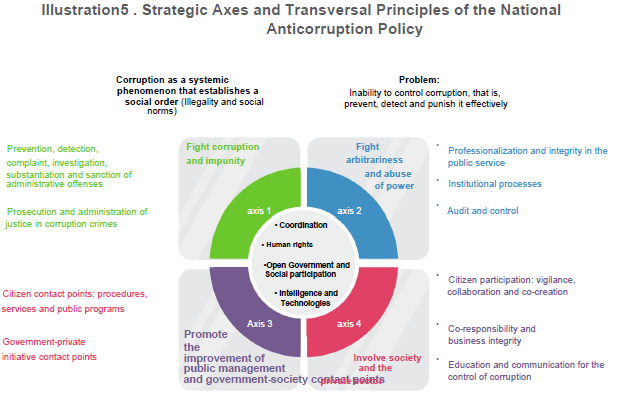
Source: Mexico, Document 1, p.177 (translated) link in Annex G
c) Finland
Table 8: Finland corruption reporting data - Crimes reported to the police that may contain corrupt features
| Crime reported to police throughout the country | 2010 | 2011 | 2012 | 2013 | 2014 | 2015 |
|---|---|---|---|---|---|---|
| Gifting | 14 | 4 | 4 | 6 | 3 | 5 |
| Important gifting | 0 | 2 | 6 | 2 | 0 | 2 |
| Taking a bribe | 17 | 3 | 3 | 6 | 2 | 4 |
| Important taking a bribe | 0 | 2 | 3 | 3 | 1 | 2 |
| Infringement | 2 | 0 | 2 | 1 | 0 | 4 |
| Bribery in business | 5 | 10 | 7 | 8 | 13 | 2 |
| Taking a bribery in business | 4 | 16 | 7 | 3 | 0 | 1 |
| Election corruption | 0 | 0 | 6 | 1 | 0 | 0 |
| Important taking a gift in business | 0 | 0 | 2 | 2 | 0 | 0 |
| Important bribery in business | 0 | 0 | 1 | 1 | 2 | 0 |
| Giving a bribe to a member | 1 | 0 | 0 | 0 | 0 | 0 |
| Taking a bribe as a a member | 0 | 0 | 0 | 0 | 1 | 0 |
| In total | 43 | 37 | 41 | 33 | 22 | 20 |
| Breach of confidentiality | 87 | 40 | 35 | 36 | 64 | 28 |
| Principle of confidentiality | 2 | 3 | 8 | 6 | 7 | 5 |
| Misuse of office | 53 | 62 | 38 | 42 | 47 | 40 |
| Important misuse of office | 12 | 10 | 7 | 16 | 22 | 11 |
| Breach of obligation | 386 | 420 | 536 | 700 | 942 | 481 |
| Manufacturing breach of official obligation | 62 | 61 | 64 | 74 | 57 | 41 |
| In total | 602 | 596 | 688 | 874 | 1139 | 606 |
| Breach of confidentiality | 45 | 33 | 38 | 37 | 32 | 35 |
| Misuse of business secret | 10 | 6 | 12 | 13 | 3 | 9 |
| Attempt to infringe trade confidentiality | 1 | 0 | 1 | 0 | 0 | 2 |
| Abuse of trust | 89 | 92 | 87 | 153 | 80 | 74 |
| Misuse of insider information | 0 | 2 | 0 | 2 | 0 | 2 |
| Important misuse of insider information | 1 | 0 | 0 | 0 | 0 | 4 |
| In total | 146 | 133 | 138 | 205 | 115 | 126 |
Source: Finland, Document 1, Table 1 on p.19 link in Annex G
SMART indicators
Some countries have taken steps to further develop outcome indicators, for example.
Indonesia
While the vast majority of indicators are output-orientated, strategy monitoring data in specific areas includes some indicators which can be classified as outcomes. For example, one strategic priority is to improve utilisation of beneficial ownership data. The country tracks the percentage of Indonesian companies which have declared their beneficial ownership, and the extent to which different government agencies use this information, such as in licencing processes or for law enforcement purposes (see Indonesia, Document 2, p.8, p.30 link in Annex G).
Latvia
Alongside national scores in global composite indices for corruption, Latvia uses a mix of survey and administrative data to monitor outcomes. These include indicators on public confidence in the rule of law and the integrity of political actors as well as experience of bribery. As on outcome of work with political parties, the strategy also tracks irregularities uncovered in party accounts and levels of compliance with expenditure laws (see Latvia, Document 1, pp.82 to 86 links in Annex G).
Lithuania
The Special Investigation Service (SIS), Lithuania’s anti-corruption body, commissions an annual experience and perception survey, the Lithuania Map of Corruption, which is used to monitor outcomes from the strategy. The SIS has chosen specific questions from this survey as indicators. As an example, one target is a “decrease in the average (in per cent) of Lithuanian residents, heads of undertakings, civil servants who have paid a bribe within the last 5 years”, and the survey findings are monitored annually. One assessment criterion also relates to procurement. The country monitors the share of public procurement procedures completed electronically, an outcome from efforts to make procurement more efficient and less discretionary undertaken as part of the strategy (see Lithuania, Document 1 link in Annex G).
While not included in the national strategy, annual reports produced by the SIS are example of an attempt to combine quantitative indicators with some qualitative commentary (see Lithuania, Document 10 link in Annex G). Similar to the UK approach of baskets of indicators, the SIS groups indicators into 3 areas: status of corruption; resilience to corruption and contextual factors. The comments made principally attempt to synthesis findings from surveys and indicators with some short descriptions of notable corruption cases. This could be strengthened through more description of changes to the political and business environment and the implications for corruption levels as well as factors which may have helped or hindered the government’s anti-corruption work.
Mexico
The country’s strategy committee ran a highly participatory process to choose appropriate indicators for monitoring. All the indicators chosen had to meet 5 criteria, namely to be relevant, economic, monitorable (subject to independent verification), suitable and provide marginal contribution compared to other data available (see Mexico, Document 2, p.105 link in Annex G). The indicators chosen are mainly outputs, but there are some exceptions, such as levels of compliance with administrative responsibility, procurement compliance (see Section 2.4.4 data sources), and changes in company policies and risk management processes (see Mexico, Document 2, pp.43, 73, 77, 95 to 102 link in Annex G).
Data sources
Examples of practice to highlight are the following.
Indonesia
Indonesia gathers extensive governance data at local and national level which is used as part of monitoring its anti-corruption strategy. The ‘JAGA’ app, launched in 2017 and coordinated by the Komisi Pemberantasan Korupsi (KPK), Indonesia’s anti-corruption agency, is key to this process. Citizens and local authorities input data into the app which is used to assess local government performance in areas such as budgeting, licencing, health and education. This generates a high volume of indirect data related to corruption risk, which can prompt further investigation and analysis; information provided in a key informant interview. One example is in forestry, a sector heavily afflicted by corruption in Indonesia, where authorities track rates of deforestation as an indicator of corruption risk in the sector (see Indonesia, Document 2, p.7 link in Annex G).
Lithuania
For 20 years, Lithuania has produced a ‘Map of Corruption’ which is commissioned annually by the SIS. The map surveys experience and perceptions of corruption across 3 groups: the general population, company managers and civil servants (see Lithuania, Document 9 link in Annex G). Specific questions in the survey are used as part of strategy monitoring (see Lithuania, Document 1 link in Annex G).
Mexico
A wide range of data sources are used to track output and outcome indicators in Mexico, including judicial records, transparency indices, budget data and asset declarations. As an example, having identified addressing corruption risks in procurement as a strategic priority, outcomes relate to levels of compliance by municipalities with procurement regulations, including minimum competency criteria for bidders, use of dispute resolution mechanisms, and publication of economic and technical criteria for tenders. Criteria such as these function as proxies for levels of corruption risk (see Mexico, Document 2, pp.169 to 171 link in Annex G).
Consultation, participation and transparency
Examples of practice to highlight are the following.
Indonesia
The KPK consulted 18 national CSOs at the drafting stage and up to 100 CSOs, media outlets and academics are involved in monitoring the strategy across regions. Their role includes verification of data provided by local governments and reporting of relevant data, including through the JAGA app (see Section 2.4.4). On transparency, Indonesia is distinctive in that the national strategy has a dedicated website. Monitoring reports additionally track Figures on public engagement with the strategy through the website, social media and a webinar series (see Indonesia, Document 2, p.6 link in Annex G). This does not appear to extend to tracking levels of engagement with monitoring reports specifically.
Latvia
In the design phase, the Korupcijas Novēršanas un Apkarošanas Birojs (KNAB), Latvia’s anti-corruption agency, structured consultation across government and with external stakeholders through 4 workshops organised on themes in the strategy: internal control systems, corruption risks in procurement, conflict of interest laws and money in politics (see Latvia, Document 1 link in Annex G). Proposals made in the meetings were included in draft guidelines which inform the design of the monitoring and evaluation framework. We did not find clear evidence that consultation continued into subsequent monitoring and evaluation , although please note that Latvia is not a country where we have conducted interviews.
Mexico
The Executive Secretariat of the National Anti-Corruption System (SESNA) organised a 3 stage consultation process on the strategy design: i) advisory board meetings with representatives from academia, CSOs, business and international organisations ii) citizen consultation involving over 14,000 participants and iii) holding 8 regional fora to discuss local corruption issues which involved 950 participants (see Mexico, Document 1, pp.30 to 39 link in Annex G).
Argentina
Argentina has a 20-member Advisory Council formed of representatives from civil society, the private sector and experts in the field. Its functions include regular monitoring of the national strategy (see Argentina, Document 4, p.24 link in Annex G).
Learning and adaptation
Examples of practice to highlight are the following.
Argentina
While not yet launched, Argentina plans to create a digital platform for the monitoring of anti-corruption initiatives under its strategy known as the Map for State Action (Mapa de la Acción del Estado). The aim of the map is to “allow the visualisation of public policies, their results and impact, facilitating process improvements, planning, follow up and evaluation of public policies, to achieve greater effectiveness and quality in the public administration”. The intended users are the Office of Cabinet Co-ordination, different public sector entities, and the general public. There will be different access points and visualisation for each audience (see Argentina, Document 1, pp.29 to 30 link in Annex G).
Italy
As part of annual updates on the implementation of its anti-corruption strategy the Autorità Nazionale AntiCorruzione*, the Italian National Anti-Corruption Agency, commissions the University of Rome to review levels of compliance with corruption prevention measures, in particular corruption risk assessments. In 2018 the university reviewed a sample of 536 local and national state authorities. It assessed processes and the extent to which authorities were following good practice guidelines on corruption risk assessment. The review identifies cross-cutting areas of weakness which feed into annual work plans for the agency (see Italy, Document 3, pp.3 to 10 link in Annex G).
Annex F: Bibliography
Please note a full list of the national strategy documents and other source materials reviewed are included in Annex G.
Boisvert, A., Dent, P. and Brunelle-Quraishi, O. (2014) Corruption in Canada: Definitions and Enforcement. Prepared by Deloitte LLP. Ottawa, ON: Public Safety Canada.
Dávid-Barrett, E. (2021) “State capture and inequality”. Research Paper. New York: Pathfinders. Link
Dávid-Barrett, E. et al. (2021) “Corruption in the UK. Sectoral deep dive”. Sussex: Centre for the Study of Corruption.
Dobson Phillips, R., Dávid-Barrett, E. and Barrington, R. (2021) “Defining corruption”. Centre for the Study of Corruption Working Paper 12. Brighton: University of Sussex.
Fazekas, M., Dávid-Barrett, E., Abdou, A., Basdevant, O. (2020) The Corruption Cost Tracker: Quantifying the costs of corrupt contracting and the savings to be made from reform. GTI-R/2020:02. Budapest: Government Transparency Institute.
G20 Anti-Corruption Working Group. (2021) “Annex 1: Selected Bibliography of Studies Regarding Corruption Indicators and Measurement”. The measurement of corruption in G20 countries: Overview and good practices. Link
G20 Anti-Corruption Working Group. (2021) The measurement of corruption in G20 countries: Overview and good practices. Link
G20. (2020) G20 High-Level Principles for the Development and Implementation of National Anti-Corruption Strategies. Link
Heywood, P. (2017) “Rethinking corruption: hocus-pocus, locus and focus”. Slavonic and East European Review. Vol.95 (1):21 to 48.
Hussman, K. and Hechler, H. (2008) “Anti-corruption policy making in practice: Implications for implementing UNCAC”. U4 Brief No. 1. Bergen: U4 Anti-Corruption Resource Centre, Chr. Michelsen Institute. Link
ICAC (2018) Corruption Matters. Issue 52. Link
Innovations for Successful Societies. (2018) Implementing National Anti-Corruption Strategies. Princeton: Princeton University. Link
Jenkins, M. and Camacho, G. (2022) “Core principles for the development of anti-corruption strategies: Good practice from around the world”. U4 Helpdesk Answer 2022. Bergen: U4 Anti-Corruption Resource Centre, Chr. Michelsen Institute (forthcoming).
Johnson, J. (2012) “Theories of change in anti-corruption work. A tool for programme design and evaluation”. U4 Anti-Corruption Resource Centre. Link
Manandhar, N. (2014) Anti-Corruption Strategies: Understanding what works, what doesn’t and why? Lessons learned from the Asia-Pacific region. Bangkok: UNDP Bangkok Regional Hub. Link
Martinez B. Kukutschka, R. (2016) “Latest Trends in Corruption Measurement and Analysis. Anti-Corruption Helpdesk. Berlin: Transparency International Knowledge Hub. Link
Martini, M. (2013) “Examples of National Anti-Corruption Strategies”. Anti-Corruption Helpdesk. Berlin: Transparency International Knowledge Hub. Link
Mason, P. (ed.) (2020) “Twenty years with anti-corruption. Part 4: Evidence on anti-corruption – the struggle to understand what works”. U4 Practitioner Experience Note 2020:1. Bergen: U4 Anti-Corruption Resource Centre, Chr Michelsen Institute. Link
Mugellini, G. (2018) Critical Review of Existing Practices to Measure the Experience of Corruption. Mexico City: UNODC-INEGI Center of Excellence in Statistical Information on Government, Crime, Victimization and Justice. Link
Mullard, S. (2020) “Corruption, informality and social norms. Introductory overview”. Bergen: U4 Anti-Corruption Resource Centre, Chr. Michelsen Institute
Murray, A. and Dávid-Barrett, E. (2023) “Country insights brief: Indonesia”. International Anti-Corruption Academy, Global Programme on Measuring Corruption, No.5. Link
OECD (2017) Phase 2 Report on Implementing the OECD Anti-bribery Convention in Lithuania, p.25
OECD (2020) OECD Public Integrity Handbook. Paris: OECD Publishing. Link.
OECD (2022) “OECD Public Integrity Indicators”. Link
Pyman, M., Eastwood, S., Hungerford, J., and Elliott, J. (2017) “Research comparing 41 national anti-corruption strategies: Insights and guidance for leaders”. London: Norton Rose Fulbright. Link
Pyman, M., Eastwood, S., Hungerford, J., and Elliott, J. (2018) “Analysing the anti-corruption approaches of the 26 top-ranked countries: An opportunity for a new generation of strategies”. London: Norton Rose Fulbright. Link.
Rothstein, B. (2021) Controlling Corruption: The social contract approach. Oxford: Oxford University Press
Stephenson, M. (2021) “Some Reflections on the Meaning of Anti-corruption ‘Success’”. Global Anti-Corruption Blog. Link
Trapnell, S. (2015) “User’s Guide to Measuring Corruption and Anti-Corruption”. United Nations Development Programme. Link
United Nations Development Programme and United Nations Office on Drugs and Crime. (2013) “Kuala Lumpur Statement on Anti-Corruption Strategies”. Link
United Nations Office on Drugs and Crime. (2015) National Anti-Corruption Strategies: A Practical Guide for Development and Implementation. Vienna: United Nations Office, Publishing and Library Section. Link
United Nations Office on Drugs and Crime. (2016) Guidance to filling in the revised draft self-assessment checklist on the implementation of chapters II (Preventive measures) and V (Asset recovery) of the United Nations Convention against Corruption. Vienna: UNODC. Link
United Nations Office on Drugs and Crime. (2018) Manual on Corruption Surveys: Methodological guidelines on the measurement of bribery and other forms of corruption through sample surveys. Vienna: UNODC, UNDP, and the UNODC-INEGI Center of Excellence in Statistical Information on Government, Crime, Victimization and Justice. Link
Annex G: Reference materials
| Country | Number | Publisher | Document title (English) | Language | Year | Link |
|---|---|---|---|---|---|---|
| Argentina | 1 | Argentinian Anti-Corruption Office | National Anti-Corruption Plan and Strategy 2019 to 2023. | Spanish | 2019 | Link |
| Argentina | 2 | Argentinian Anti-Corruption Office | Working document towards a National Integrity Strategy | Spanish | 2021 | Link |
| Argentina | 3 | Argentinian Anti-Corruption Office | Strategic Plan for National Integrity Policy | Spanish | 2021 | Link |
| Argentina | 4 | OECD | Follow up Report of the OECD Integrity Review: Argentina | English | 2021 | Link |
| Argentina | 5 | Astarita, M. | Guidelines on corruption and integrity: towards a new preventative focus | Spanish | 2021 | Link |
| Australia | 1a | ACT Integrity Commission | Annual Report 2020-21 | English | 2021 | Link |
| Australia | 2a | New South Wales Integrity Commission Against Corruption | Annual Report 2020-21 | English | 2021 | Link |
| Australia | 2b | New South Wales Integrity Commission Against Corruption | Community Attitudes to Corruption and to the ICAC | English | 2016 | Link |
| Australia | 2c | New South Wales Integrity Commission Against Corruption | Corruption Risks in NSW Procurement | English | 2011 | Link |
| Australia | 3a | Office of the Independent Commissioner Against Corruption Northern Territory | Annual Report 2020-21 | English | 2021 | Link |
| Australia | 4a | Crime and Corruption Commission Queensland | Annual Report 2020-21 | English | 2021 | Link |
| Australia | 4b | Crime and Corruption Commission Queensland | Perceptions of Corruption and Integrity in Queensland State Government Departments | English | 2021 | Link |
| Australia | 4c | Crime and Corruption Commission Queensland | Perceptions of Corruption and Integrity in Local Government | English | 2020 | Link |
| Australia | 4d | Crime and Corruption Commission Queensland | Reducing the Risk of Research Fraud: Summary Audit Report | English | 2020 | Link |
| Australia | 5a | Independent Commissioner Against Corruption and Office of Public Integrity South Australia | Annual Report 2020-21 | English | 2021 | Link |
| Australia | 5b | Independent Commissioner Against Corruption and Office of Public Integrity South Australia | ICAC University Integrity Survey | English | 2020 | Link |
| Australia | 5c | Independent Commissioner Against Corruption and Office of Public Integrity South Australia | ICAC Public Integrity Survey | English | 2018 | Link |
| Australia | 6a | Integrity Commission Tasmania | Annual Report 2020-21 | English | 2021 | Link |
| Australia | 7a | Independent Broad-based Anti-corruption Commission Victoria | Annual Report 2020-21 | English | 2021 | Link |
| Australia | 7b | Independent Broad-based Anti-corruption Commission Victoria | Corruption and Integrity: Perceptions of Victorian local government employees | English | 2021 | Link |
| Australia | 7c | Independent Broad-based Anti-corruption Commission Victoria | Perceptions of Corruption: Survey of the Victorian Community | English | 2018 | Link |
| Australia | 7d | Independent Broad-based Anti-corruption Commission Victoria | Corruption Risks Associated with Government Funded Human Services Delivered by Community Service Organisations | English | 2021 | Link |
| Australia | 7e | Independent Broad-based Anti-corruption Commission Victoria | Perceptions of Corruption: Survey of Victorian Government Suppliers | English | 2016 | Link |
| Australia | 7f | Independent Broad-based Anti-corruption Commission Victoria | Perceptions of Corruption: Survey of Victoria Police Employees | English | 2017 | Link |
| Australia | 7g | Parliament of Victoria | A Framework for Monitoring the Performance of the Independent Broad-Based Anti-Corruption Commission Victoria | English | 2017 | Link |
| Australia | 7h | Independent Broad-based Anti-corruption Commission Victoria | What is corruption’ | English | 2023 | Link |
| Australia | 8a | Corruption and Crime Commission Western Australia | Annual Report 2020-21 | English | 2021 | Link |
| Australia | 8b | Corruption and Crime Commission Western Australia | Integrity Snapshot | English | N/A | Link |
| Canada | 1 | Public Safety Canada | Definitions of Corruption. Research Brief 48 | English | 2014 | Link |
| Canada | 2 | Public Services and Procurement Canada | Integrity Regime Annual Report | English | 2019 | Link |
| Canada | 3 | Office of the Public Sector Integrity Commissioner of Canada | Annual Report 2020-21 | English | 2021 | Link |
| Czech Republic | 1 | Ministry of Justice | Government Concept Note for the Fight Against Corruption, 2018 – 2022 | Czech | 2018 | Link |
| Czech Republic | 2 | Ministry of Justice | Material for Anti-Corruption Trainers | Czech | 2019 | Link |
| Finland | 1 | Ministry of Justice | Draft Anti-corruption Strategy | Finnish | 2017 | Link |
| Finland | 2 | Ministry of Justice | Draft Anti-corruption Strategy: Summary of Opinions | Finnish | 2017 | Link |
| Finland | 3 | Government of Finland | Government Resolution on the National Anti-Corruption Strategy and Action Plan 2021–2023 | English | 2021 | Link |
| Finland | 4 | Natalia Ollus & Vesa Muttilainen | Indicators for Measuring Structural Corruption in Finland | English | 2021 | Link |
| Finland | 5 | University of Vaasa | Covert Corruption: What do citizens say? | Finnish | 2017 | Link |
| Finland | 6 | Ministry of the Interior | Police Barometer 2020 | Finnish | 2020 | Link |
| Finland | 7 | Prime Minister’s Office | KORSI Report 1: Immeasurable Corruption? | Finnish | 2020 | Link |
| Finland | 8 | Prime Minister’s Office | KORSI Report 2: Methods for Comprehensive monitoring of corurption | Finnish | 2020 | Link |
| Finland | 9 | Prime Minister’s Office | KORSI Report 3: Empirical review of corruption risk zones | Finnish | 2020 | Link |
| Finland | 10 | Municipal Sector Development Foundation (KAKS) | Citizens’ Assessment | Finnish | 2019 | Link |
| Finland | 11 | Ministry of Finance | State of civil servants’ ethics and morals in Finland- citizen survey results | English | 2017 | Link |
| Finland | 12 | Ministry of Finance | State of ethics of civil servants – A survey of the ethical values and principles of government officials | Finnish | 2017 | Link |
| France | 1 | French government (10 ministries) | France’s Anti-Corruption Strategy in Its Cooperation Action (2021-2030) | English | 2021 | Link |
| France | 2 | Agence Francaise Anticorruption | National multi-year plan to fight corruption 2020-2022 | English | 2020 | Link |
| France | 3 | Agence Francaise Anticorruption | Prevention et Detection des Atteintes A La Probite au Sein du Secteur Public Local | French | 2022 | Link |
| France | 4 | Agence Francaise Anticorruption | National Diagnostic Survey of Anti-Corruption Systems in Businesses | English | 2021 | Link |
| France | 5 | Agence Francaise Anticorruption | Annual Activity Report | English | 2020 | Link |
| France | 6 | Agence Francaise Anticorruption | Prevention et Detection des Atteintes A La Probite au Sein des Ministeres | French | 2022 | Link |
| France | 7 | Agence Francaise Anticorruption | 2022 Activity Report | French | 2022 | Link |
| Germany | 1 | Ministry of the Interior | Annual Report on Preventing Corruption in the Federal Administration | English | 2020 | Link |
| Germany | 2 | Federal Criminal Police Office | Corruption: Federal Situation Picture 2020 | German | 2020 | Link |
| Germany | 3 | Federal Ministry of Finance | National Risk Assessment (2018-2019) | English | 2020 | Link |
| Germany | 4 | Financial Intelligence Unit | Annual Report 2020 | English | 2020 | Link |
| Indonesia | 1 | Ministry of National Development Planning | National Strategy for Corruption Prevention and Eradication | English | 2013 | Link |
| Indonesia | 2 | KPK | Quarterly monitoring report on the national strategy | Indonesian | 2022 | Link |
| Indonesia | 3 | KPK | Integrity Survey (2017) | English | 2017 | Link no longer accessible |
| Indonesia | 4 | KPK | KPK Guidebook: Integrity Assessment | English | Unclear | Link no longer accessible |
| Indonesia | 5 | KPK | Integrity Survey (2018) | Indonesian | 2018 | Link no longer accessible |
| Indonesia | 6 | Badan Pusat Statistik | Anti-Corruption Behaviour Index | Indonesian | 2017 | Link |
| Italy | 1 | Autorita Nazionale Anticorruzione | National Anti-corruption Strategy 2019 | Italian | 2019 | Link |
| Italy | 2 | Autorita Nazionale Anticorruzione | Annex 1: methodological indications for the management of corruption risks | Italian | 2019 | Link |
| Italy | 3 | Autorita Nazionale Anticorruzione | 2018 update to the national anti-corruption plan | Italian | 2018 | Link |
| Italy | 4 | Autorita Nazionale Anticorruzione | National anti-corruption plan 2019 to 2021, illustrated report | Italian | 2019 | Link |
| Italy | 5 | ISTAT | Corruption in Italy | English | 2017 | Link |
| Italy | 6 | Autorita Nazionale Anticorruzione | Annual Report 2020 | Italian | 2020 | Link |
| Italy | 7 | Autorita Nazionale Anticorruzione | Measuring the risk of corruption at territorial level and promoting transparency | English | Unclear | Link |
| Japan | 1 | Ministry of Justice | White Paper on Crime 2020 | English | 2020 | Link |
| Japan | 2 | Ministry of Internal Affairs | Communication on Incidents of Corruption 2018-2019 | Japanese | 2020 | Link |
| Latvia | 1 | Cabinet of Ministers | Guideline for the Prevention and Combatting of Corruption 2015-2020 | Latvian | 2015 | Link |
| Latvia | 2 | Korupcijas novēršanas un apkarošanas birojs | On the Guidelines for the Prevention and Combating of Corruption 2015-2020 implementation of the 2015-2018 period mid-term evaluation. | Latvian | 2018 | Link |
| Latvia | 3 | Cabinet of Ministers | Prevention Against Corruption Plan 2021 to 2024 | Latvian | 2021 | Link |
| Latvia | 4 | Korupcijas novēršanas un apkarošanas birojs | Operational Strategy of the Corruption Prevention and Combating Bureau 2020-22 | English | 2019 | Link |
| Latvia | 5 | Korupcijas novēršanas un apkarošanas birojs | Public objections and proposals to the Action Plan 2021-24 | Latvian | 2021 | Link |
| Latvia | 6 | Korupcijas novēršanas un apkarošanas birojs | Opinion Poll of Public and Entrepreneurs | Latvian | 2022 | Link |
| Latvia | 7 | Korupcijas novēršanas un apkarošanas birojs | KNAB Annual Report 2021 | Latvian | 2021 | Link |
| Latvia | 8 | Korupcijas novēršanas un apkarošanas birojs | Evaluation of the Internal Anti-Corruption Control System in Public Institutions | Latvian | 2020 | Link |
| Latvia | 9 | PROVIDUS | Corruption Justice Statistics | Latvian | 2017 | Link |
| Latvia | 10 | Korupcijas novēršanas un apkarošanas birojs | View of Latvian Entrepreneurs on the Corruption Environment for Business | Latvian | 2016 | Link |
| Lithuania | 1 | Government of the Republic of Lithuania | National Anti-Corruption Programme (2015 - 2025) | English | 2015 | Link |
| Lithuania | 2 | Government of the Republic of Lithuania | Institutional Action Plan (2015 - 2019) | English | 2015 | Link |
| Lithuania | 3 | Special Investigation Service | 2021 Corruption Map of Lithuania | English | 2022 | Link |
| Lithuania | 4 | Special Investigation Service | 2022 Corruption Map of Lithuania | English | 2021 | Link |
| Lithuania | 5 | GRECO | Fourth evaluation report: second compliance report | English | 2019 | Link |
| Lithuania | 6 | OECD | Phase II report on implementing the OECD anti-bribery convention | English | 2017 | Link |
| Lithuania | 7 | UNCAC | UNCAC review: exec sum only | English | 2012 | Link |
| Lithuania | 8 | Government of the Republic of Lithuania | Institutional Action Plan (2020 - 2022) | English | 2020 | Link |
| Lithuania | 9 | Vilmorous | Map of corruption in Lithuania | Lithuanian/ English | 2021 | Link |
| Lithuania | 10 | Special Investigation Service | Annual Report | English | 2019 | Link |
| Mexico | 1 | Executive Secretariat of National Anti-Corruption System | National Anti-Corruption Policy | Spanish | 2020 | Link |
| Mexico | 2 | Executive Secretariat of National Anti-Corruption System | Implementation Program for National Anti-Corruption Policy | Spanish | 2022 | Link |
| Mexico | 3 | Anti-Corruption Network | Model for Monitoring and Evaluation of PNA | Spanish | 2021 | Link |
| Mexico | 4 | Executive Secretariat of National Anti-Corruption System and Citizen Participation Committee | Integration and Consultation Process for National Anti-Corruption Policy | Spanish | 2020 | Link |
| Mexico | 5 | Ministry of Finance and Public Spending; Ministry of Public Administration | National Programme to Combat Corruption and Impunity and Improve Public Management 2019 to 2024 | Spanish | 2019 | Link |
| Mexico | 6 | CONEVAL | Manual for Design and Construction on Indicators | Spanish | 2014 | Link |
| Mexico | 7 | CONEVAL | Guide for the development of the Matrix of Result Indicators | Spanish | 2013 | Link |
| Mexico | 8 | CONEVAL | Monitoring and Evaluation Background Sheet and Methodology | Spanish | 2014 | Link |
| Mexico | 9 | Citizen Participation Committee | White Paper on Consultation of PNA Proposals | Spanish | 2019 | Link |
| Mexico | 10 | Instituto Nacional de Estadística, Geografía e Informática | ENCIG 2019 main findings | Spanish | 2020 | Link |
| Mexico | 11 | Instituto Nacional de Estadística, Geografía e Informática | ENCRIGE 2020 main findings | Spanish | 2021 | Link |
| Mexico | 12 | Corruption and Impunity Observatory | Report on qualitative evidence on corruption | Spanish | 2020 | Link |
| Mexico | 13 | Mexican Institute on Competitiveness | Press release. Corruption risk index: Mexican public contracting system. | Spanish | 2018 | Link |
| Mexico | 14 | Transparencia Mexicana & Impunidad Cero | Transparency, Anti-Corruption and Impunity Coefficient | Spanish | 2017 | Link |
| Mexico | 15 | Executive Secretariat of National Anti-Corruption System | National Anti-Corruption Policy: Statistical Index | Spanish | 2020 | Link |
| Poland | 1 | Central Anti-Corruption Bureau | Central Anti-Corruption Bureau, Government Programme for Countering Corruption 2018 - 2020 | English | 2017 | Link |
| Poland | 2 | Monitor Polski. The Official Journal of the Republic of Poland | Order No.134 of the President of the Council of Ministers on 10 August 2018 on the Interministerial Team for Coordination and Monitoring of Implementation of the Government Programme for Counteracting Corruption for the years 2018 - 2020 | English | 2018 | Link |
| Poland | 3 | Central Anti-Corruption Bureau | Areas of Corruption Crime in Poland (2018 - 2019) | English | 2020 | Link |
| Poland | 4 | Central Anti-Corruption Bureau | Combating Corruption Crime in Poland (2018) | Polish | 2020 | Link |
| Poland | 5 | Central Anti-Corruption Bureau | Activity Report for the Central Anti-Corruption Bureau (2019) | Polish | 2019 | Link |
| Poland | 6 | Central Anti-Corruption Bureau | Anticipated Corruption Threats in Poland | English | 2013 | Link |
| Poland | 7 | CBOS Public Opinion Research Center | Poll on public opinion on corruption in Poland | English | 2021 | Link |
| Poland | 8 | Ministry of the Interior | Government Programme Counteracting Corruption (2014 - 2019) | Polish | 2014 | Link |
| Poland | 9 | Supreme Audit Institute | Review of the Government Programme Counteracting Corruption (2014 - 2019) | Polish | 2015 | Link |
| US | 1 | White House | US Strategy on Countering Corruption | English | 2021 | Link no longer accessible |
| US | 2 | Syracuse University | Transactional Records Access Clearinghouse | English | 2022 | Link |
| US | 3 | US Department of Justice, Public Integrity Section | Report to Congress on the Activities and Operations of the Public Integrity Section | English | 2020 | Link |
| US | 4 | Centre for Public Integrity | How we investigated state integrity | English | 2015 | Link |
| US | 5 | Centre for Public Integrity | State Integrity Investigation microsite | English | 2015 | Link |
| US | 6 | Dincer and Johnston | Corruption Reflections Index | English | 2014 | Link |
| US | 7 | Dincer and Johnston | Corruption issues in state and local politics: is political culture a deep determinant? | English | 2014 | Link |
-
If there were no corrupt inducement to private gain and the corrupt agent were working directly for the foreign state, then this activity would be more akin to treason than corruption. ↩
-
The outcomes are thus affected by several factors including the way that their mandate is defined, the resources at their disposal, the autonomy they exercise, their skill in conducting investigations and collecting evidence, and their prosecutorial expertise. ↩
-
See Link Most of the information is provided by the Mexican Statistics Office (INEGI), but other data comes from public bodies, academia, government agencies, the anti-corruption system, and business, international and civil society organisations. ↩
-
Including in Australia, Finland, France, Indonesia, Italy, Latvia, Lithuania, Mexico and Poland. ↩
-
A project of the CEU Democracy Institute. For details see: Brenner, D. and Fazekas, M. 2021. “Can impact assessments tame legislative drift? Event history analysis of modifications of laws across Europe”. Governance. Available at: Link ↩
-
Brazil was not selected as a country in this study, but from the literature review, it emerged as an example of good practice in this area. This system allows them to trace across from a budget line to a particular contract awarded as part of that budget spending, often with unit prices and quantities as well as the identity of the supplier, and payments made against the contract. For more information on Brazil’s approach see Murray, A., Dávid-Barrett, E., Camillo Ceballos, J. 2023. “Country insights brief: Brazil”. International Anti-Corruption Academy, Global Programme on Measuring Corruption, No.3. Available at: Link ↩
-
The CSC research team was unable to verify whether this analysis is ongoing or a one-off effort due to the IMCO’s firewall ↩
-
For example, the World Bank used to run an initiative called PAM (Public Accountability Mechanisms). This assessed countries’ practices on income and asset disclosure, conflict of interest rules, freedom of information and immunity for public officials. The exercise was conducted for 90 countries at one time but was then discontinued. The European Research Centre for Anticorruption Studies adopted the same methodology – adapting it slightly to remove immunity and add in public procurement and political finance – as the basis for its EUROPAM indicators. The OECD Public Integrity Indicators also partly take such an approach, for example, assessing countries’ national anti-corruption strategies according to a set of indicators (see objective 2 report). ↩
-
NIS assessments are usually undertaken by experts, but the methodology provides guidance on how to assess the quality of institutions and supporting evidence for judgements is required. ↩
-
Information provided in a key informant interview. ↩
-
The Sapin II also requires large private-sector companies to have compliance programmes, and the AFA assesses these for completeness. ↩
-
For example, Transparency International’s Global Corruption Barometer 2020 found that 45% of EU respondents feared retaliation for reporting corruption. Link ↩
-
Romania was not selected as a country in this study, but from the literature review, it emerged as an example of good practice for detecting corruption. Link ↩
-
SEAP (Public Procurement Electronic Service); DEPABD (Directorate for Personnel Records and Database Administration); and ONRC (National Trade Registry Office). ↩
-
The Italian national strategy does not include problem diagnosis, and nor does France. Italy’s, however, sets out plans for corruption risk assessment to be conducted at government agency level. ↩
-
In September 2023 the US Department of State released an implementation plan for the strategy but this does not specify any provisions for monitoring and evaluation. US Department of State, “Strategy on Countering Corruption: Implementation Plan”. 2023. Link ↩
-
See, for example, the discussion on the Global Anticorruption Blog Link ↩
-
Key organisations working on these themes include: Chatham House, Corruption Watch, Global Financial Integrity, the Financial Action Task Force, Open Ownership, the Royal United Services Institute (RUSI), the UK Anti-Corruption Coalition, the Open Government Partnership, TI, United Nations Office on Drugs and Crime and United Nations Development Programme, the United Nations Coalition Against Corruption and the World Bank. ↩
-
Examples include RUSI’s Economic Crime Plan Tracker and the UK Anti-Corruption Pledge Tracker. The report authors are also aware that the G20 Anti-Corruption Working Group is developing a country commitment tracker. ↩