Insolvency Service Annual Report and Accounts 2025-2026
Published 14 July 2026
Applies to England, Scotland and Wales

© Crown copyright 2026
This publication is licensed under the terms of the Open Government Licence v3.0 except where otherwise stated. To view this licence, visit nationalarchives.gov.uk/doc/open-government-licence/version/3 or write to the Information Policy Team, The National Archives, Kew, London TW9 4DU, or email: psi@nationalarchives.gov.uk.
Where we have identified any third party copyright information you will need to obtain permission from the copyright holders concerned.
This publication is available at https://www.gov.uk/government/publications/insolvency-service-annual-report-and-accounts-2025-to-2026/insolvency-service-annual-report-and-accounts-2025-2026
Performance report
Chief Executive’s foreword
Delivering progress that matters to our customers
As the Chief Executive of the Insolvency Service, I am pleased to present our Annual Report and Accounts for 2025 to 2026. Since joining the agency in January 2026, I have seen firsthand the professionalism and dedication of colleagues across our agency.
Our purpose is clear: to support people and businesses in financial difficulty, protect creditors and taxpayers, and uphold confidence in the UK’s insolvency and corporate systems. By doing so, we support the government’s number one mission to kickstart economic growth by safeguarding the foundations a stable economy needs. This reporting period marks the conclusion of our five-year agency strategy, during which we focused on improving the experience of those who rely on our services, simplifying processes and making it easier for customers to access our services.
We have continued to advance our digital-first strategy, improving user experience and establishing more consistent, intuitive customer journeys while building foundations for future transformation. Progress on the modernised Debt Relief Order service will enable integration with advice-sector partners, reducing administrative burden and supporting quicker, more effective outcomes for vulnerable users. The rollout of INSSight, our new case management system, proved more complex than expected resulting in delays to its launch and additional cost. However, the system is expected to be fully operational from June 2026 when we expect to see the benefits of stronger analytics and reduced manual processing.
Operationally, strong performance has been maintained across core services, underpinned by continued Customer Service Excellence accreditation. Official Receivers managed a high volume of insolvency cases, including complex national interest matters, safeguarding critical operations and returning significant value to the economy. The role of our Official Receivers remains vital. While overall case volumes have increased, reduced asset values, which are key drivers of funding, have resulted in a shortfall. We are addressing this through internal measures alongside work with our sponsor department, the Department for Business and Trade. The Redundancy Payments Service also demonstrated resilience, delivering timely financial support during challenging circumstances. The removal of the £90 applications fee for a Debt Relief Order has also removed a barrier for the most financially vulnerable people and led to an increase in those using it as a debt relief option.
We have strengthened our approach to tackling financial misconduct, supported by our 2025 Investigation and Enforcement Strategy and enhanced powers under Economic Crime and Corporate Transparency Act 2023 (ECCTA). Closer collaboration with Companies House has improved intelligence and early intervention, contributing to robust enforcement outcomes and reinforcing confidence in the UK’s financial system. Our growing success in enforcement activity was recognised by a commitment of £25 million in the 2025 Autumn Budget to fund an additional 50 posts to form a new Abusive Phoenixism Taskforce.
We implemented three annual pay awards (2023, 2024 and 2025) within a 12-month period, following a successful pay flexibility case submitted to HM Treasury. This enabled us to address long-standing pay competitiveness issues and reform of our pay structure. We also completed our Transforming Workplaces project in November 2025, consolidating our office network from 22 locations to 11 regional centres, saving £1.42 million per year.
As we look ahead to our new strategy launching in 2026, we will build on our progress, improving services to reinforce confidence, support economic stability and growth, and deliver real value for the public. Central to this is building a high performing organisation that consistently puts our customers first, ensuring their needs, and those of our stakeholders and colleagues, sit at the heart of how we work.

Duncan Beach, Chief Executive
Performance overview
This report is designed to give an overview of the activities and performance of the Insolvency Service during 2025 to 2026.
Who we are
The Insolvency Service is an Executive Agency of the Department for Business and Trade (DBT), based in 11 locations across Great Britain. DBT retains financial and operational supervision over the work we do and approves our strategies and budgets.
We are governed by the Insolvency Service Board. The Board is responsible for the long-term success of the agency, which includes setting strategic aims and objectives, making sure that leadership and other resources, including an effective risk management and assurance framework, are in place, challenging and supporting management performance, and reporting to DBT. Our Executive Committee, led by our Chief Executive, are responsible for providing collective leadership for the agency, overseeing delivery of strategy, performance, finances, people and governance, and ensuring effective risk management and value for money while leading organisational change.
Our Governance Statement provides further detail about our Board and committees.
What we do
We oversee and foster a world class insolvency regime. Our core objective is to deliver economic confidence by supporting those in financial distress, tackling financial wrongdoing and maximising returns to creditors.
In our regulatory role, we maintain and improve the insolvency framework to keep it fair, effective and trusted, working with stakeholders so that individuals and businesses can deal with financial difficulty efficiently.
Our Official Receivers handle bankruptcy and company liquidation cases, realising and distributing assets to creditors, supporting individuals to move forward from financial difficulty, and carrying out investigations that maintain integrity of the insolvency system.
Our investigators examine director and corporate conduct, seeking disqualifications of directors found unfit to manage companies and taking action to wind up companies operating against the public interest. We investigate and prosecute breaches of company and insolvency legislation on behalf of DBT. Under the Economic Crime and Corporate Transparency Act 2023, we are the primary enforcement partner supporting Companies House reform, taking civil and criminal action against those who misuse limited companies for fraud or economic crime.
The Redundancy Payments Service processes statutory redundancy and other employment-related payments for employees whose employers have become insolvent, drawing on the National Insurance Fund to ensure workers receive the entitlements they are owed.
Our Adjudicator, Debt Relief Order, and Breathing Space teams help to support individuals in serious financial difficulty to access debt relief and legal protections.
We also provide public information on insolvency and redundancy matters and advise DBT Ministers and other government departments on policy.
Performance highlights (1 April 2025 - 31 March 2026)
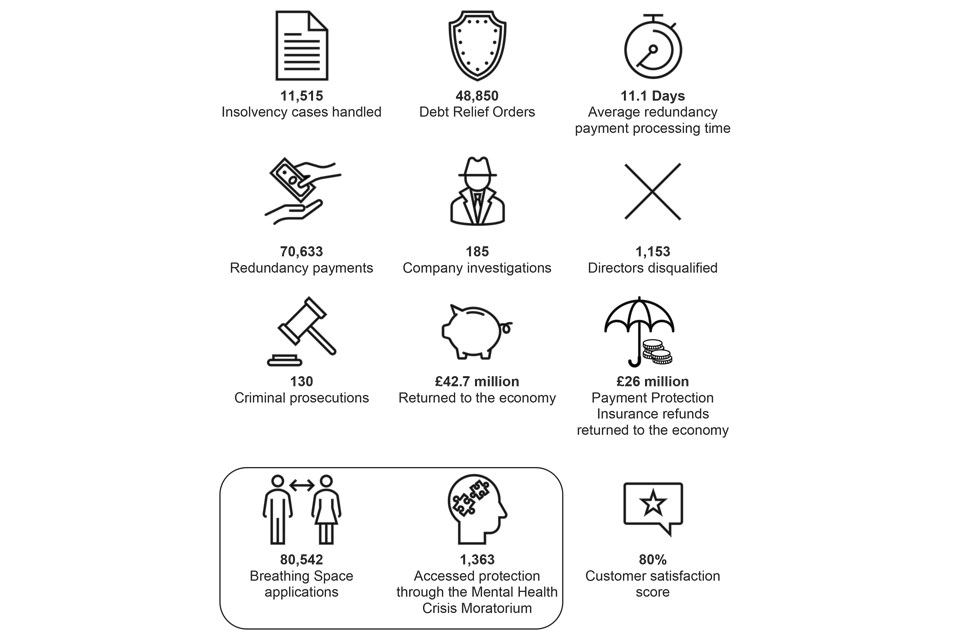
Performance analysis
This Annual Report and Accounts sets out the agency’s performance and achievements against the objectives in our Annual Plan 2025 to 2026. This is our final year reporting on our 2021 to 2026 Strategy. Future reports will reflect our strategic objectives for 2026 to 2031.
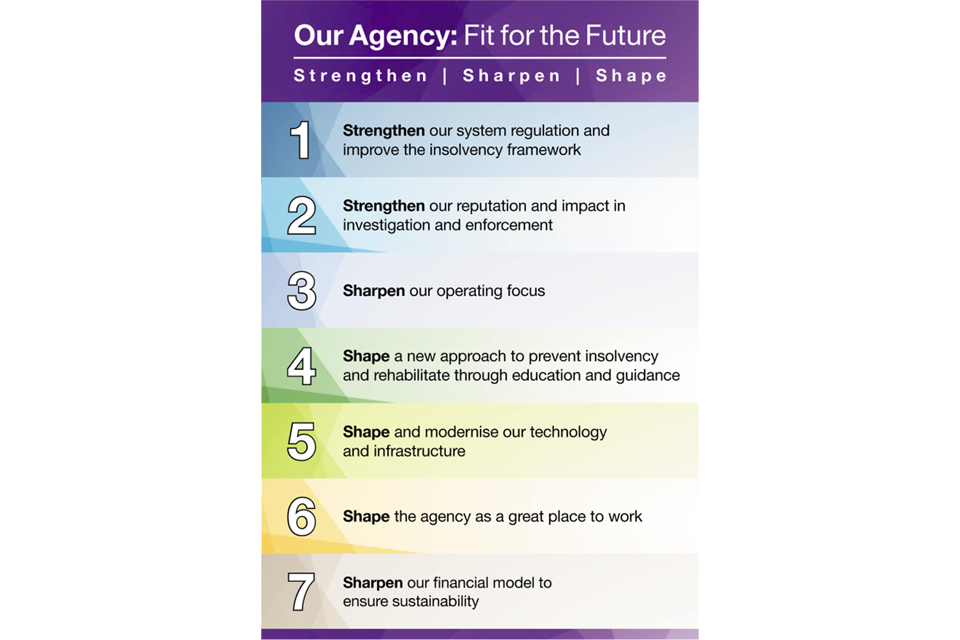
Theme 1: Strengthen our system regulation and improve the insolvency framework
A well-functioning insolvency framework supports economic stability by giving individuals and businesses the tools to resolve financial difficulty fairly and efficiently. Our role is to maintain and improve that framework, ensuring it remains fit for purpose, commands the confidence of those who use it, and is underpinned by a profession held to the highest standards.
Independent research commissioned by the agency due to be published in June 2026 found that confidence in the regime has strengthened over the course of the five-year strategy, particularly around personal insolvency reforms, with stakeholders viewing the regime as largely fair and effective. Restructuring processes introduced in 2020 continue to help viable businesses avoid insolvency, and we monitor how case law in this area develops. This year we advanced several significant reform programmes, working closely with stakeholders and ministers to ensure the regime keeps pace with changing needs, and that our customers’ needs are at the forefront of our decision-making.
Here is how we have delivered against our objectives:
| Objective | Status | Commentary |
|---|---|---|
| Work with stakeholders to develop reforms that will modernise the personal insolvency regime, improving access to appropriate debt relief for those who need it. | Ongoing | Stakeholder engagement completed with HM Treasury, the Money and Pensions Service, R3, and Citizens Advice. Analytical support brought in to evaluate options. Reform proposals now being developed for ministers’ consideration; any changes will be subject to public consultation. |
| Take forward the implementation of two UNCITRAL1 model laws into UK insolvency legislation which covers corporate group insolvencies and recognition of insolvency judgements from other jurisdictions. | Ongoing | Statutory instrument for corporate group insolvencies substantially drafted and devolved government engagement ongoing. Stakeholder engagement underway on the judgments model law to understand implications for established case law before implementation. |
| Work towards implementing the insolvency regulatory reforms outlined in the response to the “Future of Insolvency Regulation” consultation. | Complete | Policy work completed; ready to legislate once a suitable Bill is available. Engagement maintained with DBT and cross-government teams. Reforms feature in the Confidence in the Regime 2026 report. |
| Develop proposals to improve and modernise the civil enforcement regime with a view to providing the necessary tools to hold directors to account for corporate misconduct, protecting both the marketplace and the public, and to encourage better corporate behaviour. | Complete | Options developed and public consultation launched 25 March 2026. Responses will inform preferred options for implementation. |
1 United Nations Commission on International Trade Law
Personal insolvency review
The personal insolvency regime provides the legal framework through which individuals in serious financial difficulty can access debt relief. This year we completed a broad programme of stakeholder engagement to inform proposals for modernising the regime. Discussions included HM Treasury, the Money and Pensions Service, Citizens Advice and R3. Analytical support was brought in to evaluate reform options rigorously. That preparatory work is now complete, and options are being developed for ministers’ consideration in the first half of 2026. Any changes to the regime will be subject to public consultation.
International insolvency
In 2023, the UK Government committed to implement two UNCITRAL (United Nations Commission on International Trade Law) model laws, international frameworks that improve how cross-border insolvency cases are managed, making it easier for courts to co-operate and for creditors to achieve better outcomes.
Progress continued on both model laws during the year. Drafting of the statutory instrument for the Model Law on Enterprise Group Insolvency (which provides tools to manage and coordinate insolvencies within enterprise groups) advanced substantially, with engagement progressing with Scottish Government on required amendments to Scottish court rules. These devolved government complexities have affected the pace of work, though the UK is not out of step with other jurisdictions; no other country has yet implemented the model law.
Work on the Model Law on Recognition and Enforcement of Insolvency-Related Judgments (which deals with cross-border recognition of judgments that are associated with insolvency proceedings) continued through targeted stakeholder engagement in early 2026. This engagement is focused on understanding the implications of implementation for established case law, specifically a legal principle dating from 1890 (the rule in Gibbs) that governs how debts under contracts in one jurisdiction can be affected by proceedings in another.
Together these two model laws will complement the Model Law on Cross-Border Insolvency, which provides the foundations for international co-operation in insolvency proceedings, which the UK implemented in 2006 and 2007.
Insolvency practitioner regulatory reform
Our agency is committed to a regulatory regime that delivers proportionate, consistent, and trusted regulation of insolvency practitioners. This year we focused on preparing for legislation, evaluating the policy against the government’s objectives on growth and reducing regulatory burdens, and maintaining close engagement with DBT and cross-government teams. The proposed reforms feature in the Confidence in the Regime 2026 report, to be published in June 2026, which gathers stakeholder views on how the current regime operates in practice.
Separately, the updated bonding framework for insolvency practitioners came into effect on 31 December 2025, the first substantive update to the framework in nearly 40 years. The changes standardise the core features of bonds, increase protections for creditors, and provide more certainty for the parties to the bond.
Corporate civil enforcement
Our civil enforcement powers, including director disqualification and winding up companies operating against the public interest, provide essential tools for protecting the marketplace and the public. The current legislative framework has been in place for almost 40 years, and this year we concluded work to develop proposals for its modernisation.
A public consultation launched on 25 March 2026, to seek views on options to strengthen the regime and ensure directors can be held appropriately accountable for corporate misconduct. Responses will inform further policy development and shape the preferred options to be taken forward.
World Bank business insolvency rankings
The World Bank’s 2025 “Business Ready” report, a global assessment of the business and investment climate worldwide, included the UK for the first time. The UK ranked 20th out of 101 economies for business insolvency, with a score of 70.05.
The UK performed more strongly on its regulatory framework than on public service and operational delivery metrics. The report identifies one specific gap: the absence of specialised insolvency procedures for micro and small businesses, an area we will consider as part of future reform work.
Strengthening confidence in the Individual Voluntary Arrangement regime
Individual Voluntary Arrangements (IVAs) are a formal debt solution that allows individuals to repay what they can afford to creditors over a fixed period, as an alternative to bankruptcy. This year, updated guidance and supporting materials were put in place to strengthen the regime: a revised IVA Protocol, the new Key Facts Document, and an explanatory video to help people understand the process and what to expect.
These changes aim to improve consistency of practice, make the process easier to understand, and support better‑quality advice for people considering an IVA. Early findings on their effectiveness, alongside broader stakeholder views, are included in the Confidence in the Regime 2026 report, to be published in June 2026.
Theme 2: Strengthen our reputation and impact in investigation and enforcement
Tackling financial wrongdoing protects creditors, supports fair competition, and helps maintain the UK’s reputation as a safe and trusted place to do business. Our investigation and enforcement work deters misconduct by ensuring that people are aware of their legal duties and obligations and the implications of not following them, takes action against those who abuse the system, and recovers assets for those who have been harmed.
This year marked a significant step forward in our enforcement ambition. The publication of our first public facing Investigation and Enforcement Strategy in July 2025 marked a five-year commitment to more proactive, intelligence-led enforcement, supported by new powers and sustainable funding from the Economic Crime and Corporate Transparency Act 2023 (ECCTA). Our commitment to tackling COVID-19 financial support scheme misconduct continued, with 65% of our civil and criminal enforcement outcomes relating to this threat area. We have significantly increased the number of disqualifications obtained against directors who have run abusive phoenix companies or employ illegal workers.
Here is how we have delivered against our objectives:
| Objective | Status | Commentary |
|---|---|---|
| Finalise and publish a new Investigation and Enforcement Strategy, setting out our strategic enforcement objectives for the next 5 years in the context of growing demands and opportunities in the wake of the Economic Crime Acts. | Complete | Our first public facing Investigation and Enforcement Strategy was published in July 2025 setting out a five-year approach across three aims: enforcing the insolvency framework, upholding the Companies Act, and tackling economic crime perpetrated through companies. |
| Finalise and publish a more comprehensive Strategic Assessment and follow it with a robust prioritisation exercise to determine this year’s investigation and enforcement priorities, in line with the above strategy. | Complete | The fourth Strategic Assessment was published in May 2025, shaping changes to how investigation and enforcement activity is prioritised and resources directed. |
| Complete the work of the Economic Crime Reform Implementation Unit (ECRIU): | ||
| Establishment of a deeper partnership with Companies House with agreed ways of working, common objectives, and success metrics. Integration into the economic crime enforcement landscape at both strategic and tactical levels, and into HMG Economic Crime Plan performance monitoring. Agree and implement Companies Act investigation responsibilities in Northern Ireland. |
Ongoing | ECRIU is due to conclude in May 2026, with transition into business-as-usual underway. Shared enforcement objectives agreed with Companies House and progress on closer strategic alignment and intelligence sharing. Our agency is represented in all relevant cross-government and law enforcement networks. Agreement reached between the UK and Northern Ireland Governments to establish an Insolvency Service investigation team in Northern Ireland. |
| Extend commitment to tackling money laundering, working closely with partners to increase our ability to identify and disrupt illegal activity. We will further invest in dedicated resource to seize and forfeit illicit funds and enhance our ability to respond to rogue use of crypto assets. | Complete | Intelligence capacity expanded through the Anti-Money Laundering Intelligence Cell; Proceeds of Crime Team grew with new Accredited Financial Investigators and specialist roles. Civil recovery powers now include seizure of bank accounts and crypto assets. |
| Maintain our focus on COVID-19 loan abuse, working closely with the newly appointed Commissioner and partners across law enforcement. | Complete | Civil and criminal investigations continued throughout the year. The Commissioner’s report was published in December 2025; recommendations are under consideration. |
| Continue to manage the licencing regime and investigate potential breaches following the implementation of director disqualification sanctions. | Complete | Regime implemented in April 2025 and operating effectively. Six applications received: two granted, one rejected, one withdrawn, two under assessment. No breaches involving designated persons (individuals disqualified from acting as a director) reported. |
| Strengthen the enforcement response to employer-related misconduct. | Complete | Policy agreed for trade union and labour relations (TULCRA) cases following pilot; additional cases commenced using disqualification powers following Home Office investigations. |
| Enhance our response to ‘Phoenixism,’ working in close partnership with HM Revenue & Customs (HMRC) and Companies House to tackle the harm caused by those repeatedly dumping debts and/or involved in fraudulent conduct. | Complete | Cross‑government data‑sharing and threat assessment strengthened. £25 million allocated over five years in the 2025 Autumn Budget to fund 50 additional posts: recruitment underway. |
The following table summarises key investigation and enforcement activity relating to financial wrongdoing over the last four years, highlighting trends in criminal prosecutions, company investigations, director disqualifications, and bankruptcy restrictions across the reporting period:
| Investigation and Enforcement activity | 2025-26 | 2024-25 | 2023-24 | 2022-23 |
|---|---|---|---|---|
| Criminal prosecutions* | 130 | 169 | 114 | 117 |
| Live company investigations | 185 | 133 | 139 | 152 |
| Directors disqualified for misconduct | 1,153 | 1,037 | 1,222 | 942 |
| Directors disqualified for more than ten years1 | 20.3% | 20.6% | 25.3% | 19.7% |
| Bankruptcy restrictions2 | 93 | 131 | 134 | 250 |
*This data has been updated and may differ from previous versions of this report.
1 In previous editions of this report, directors disqualified for exactly 10 years were included in the more than 10 years category. In this and future editions these are no longer included.
2 The transition to our new case management system, INSSight, has introduced short‑term operational challenges, resulting in a temporary impact on performance. We expect performance to normalise during 2026-27.
Table 1: Tackling financial wrongdoing
Investigation and Enforcement Strategy
Our first public facing Investigation and Enforcement Strategy, published in July 2025, broadens its enforcement remit with objectives to uphold the insolvency framework, the Companies Acts and tackle economic crime facilitated through companies over the next five years. It is structured around four pillars (Powers and Capabilities, Technology and Data, Partnerships, and Our People) and marks a shift from reactive case-handling to a more proactive, intelligence-led model.
Ahead of publication, the strategy was presented to the Insolvency Service Board, cleared by ministers in June 2025, and shared with Recognised Professional Bodies representing insolvency practitioners and sector stakeholders at the UK Insolvency Services Forum.
Following publication, internal workshops with investigation, enforcement and legal functions translated the strategy’s commitments into structured five-year action plans, ready for an April 2026 implementation.
Supporting Companies House reform following the Economic Crime and Corporate Transparency Act 2023
The Economic Crime and Corporate Transparency Act 2023 (ECCTA) significantly expanded our role as a key enforcement partner for Companies House, providing both new powers and a sustainable funding model. Increased incorporation and annual fees (raised in February 2026 and subject to regular review) now fund our growing corporate investigation and enforcement work, providing greater financial sustainability and capacity to build our capability.
During the year, the relationship with Companies House evolved from a largely reactive, referral‑driven model to a more structured, intelligence‑led partnership. In 2025 to 2026 we received 169 ECCTA Intelligence Reports from Companies House, an increase from 138 in 2024 to 2025. Improved information sharing arrangements enable faster, more secure exchange of data on directors, addresses, and filings patterns, helping both organisations identify suspicious activity earlier. A dedicated intelligence cell within the Insolvency Service, shared intelligence products, and joint forums now support a more coherent pipeline from intelligence development to enforcement action.
The focus this year has been on establishing robust referral processes and evidential standards to ensure that cases entering the investigation process can be progressed effectively. We completed 14 ECCTA related investigations, with 20 investigations ongoing. Case volumes are incrementally increasing as additional powers come into effect at Companies House. Work continues to agree joint mechanisms for prioritisation of cases and how to best deploy the collective powers of the two agencies in order to achieve greatest impact.
Anti-money laundering
Economic Crime Levy funding has significantly strengthened our capacity to identify and disrupt the use of UK corporate for money laundering. In 2025 to 2026 there were 78 investigations and 55 enforcement outcomes involving money laundering.
The Anti‑Money Laundering Intelligence Cell (AMLIC) develops high‑quality intelligence on the illicit activity by rogue actors in the UK and overseas, sharing findings with partners such as the National Crime Agency, HM Revenue & Customs (HMRC) and Companies House to support timely action. Levy funding has also supported investigations into suspected money-laundering companies, resulting in several being wound up in the public interest.
The Proceeds of Crime Team expanded its capacity significantly this year, with new Accredited Financial Investigators and specialist legal roles supporting both criminal and civil recovery work. This implementation of civil recovery powers under Part 5 of the Proceeds of Crime Act has given investigators use of a broader set of tools, including the seizure and forfeiture of bank accounts and crypto assets, to dent criminals access to their proceeds.
Case study: Operation Hammerhead
Operation Hammerhead led to the removal of 11,500 companies from the Companies House register following intelligence work that identified around 41,000 entities with suspected links to organised crime, including fraud, illegal gambling and money laundering centred in south-east Asia. Many were dormant, had single directors and shared addresses, with some 10,000 registered at a single flat. Coordination with the National Crime Agency, HMRC, the Financial Conduct Authority, the Office for Professional Body Anti-Money Laundering Supervision, the Home Office and UK policing disrupted these networks, with investigations into a number of the companies continuing. This multi-agency response resulted in the removal of thousands of suspect entities and significant disruption to fraud and money laundering activity.
COVID-19 financial support scheme misconduct
We have continued to investigate misconduct in relation to COVID-19 financial support schemes throughout the year. Despite an anticipated decline in case volumes as the schemes recede, activity has remained consistent with previous years, reflecting sustained investigative effort and a continuing pipeline of complex cases.
During 2025 to 2026, there were 773 Section 6 director disqualification outcomes and 55 bankruptcy restrictions and debt relief restrictions linked to COVID-19 financial support scheme misconduct. In the same period there were 31 criminal convictions resulting in 25 custodial sentences. We took action to recover funds lost due to this type of misconduct, securing 125 civil compensation orders and undertakings with a combined value of £4.5 million.
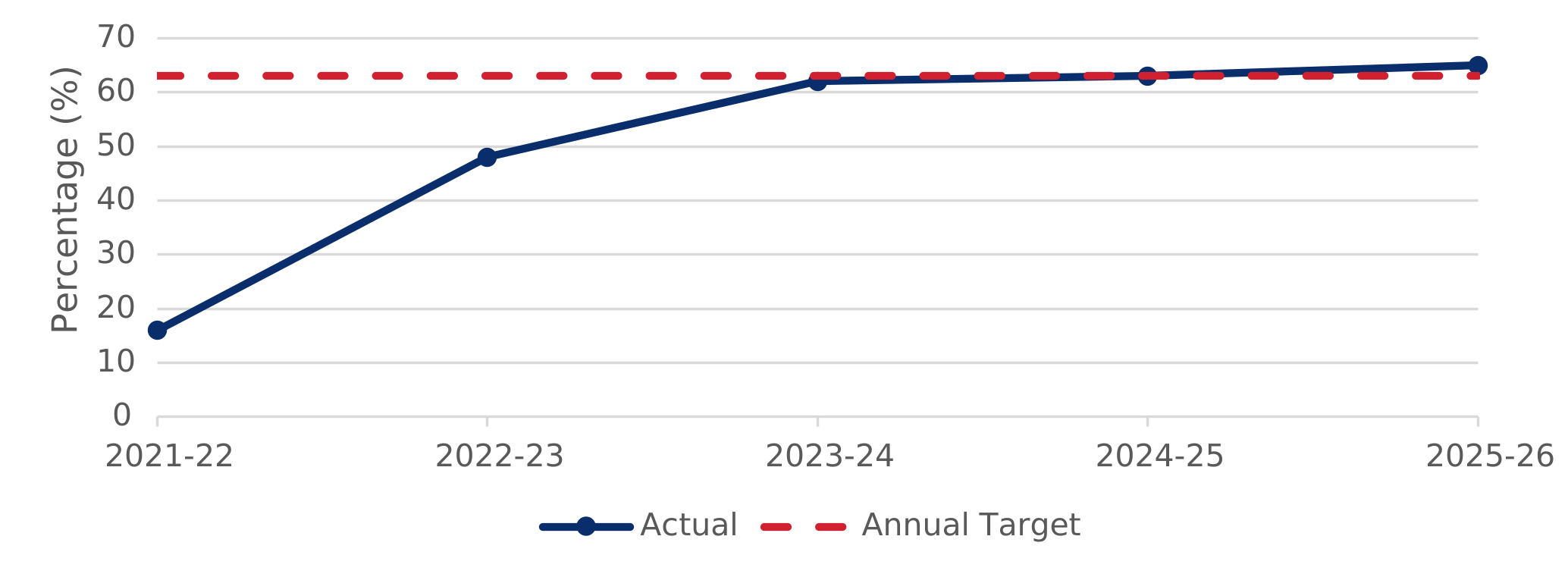
Figure 1: COVID-19 financial support scheme misconduct and fraud related outcomes as a percentage of all disqualification and criminal outcomes
(Figure 1 shows an upward trend reaching 65% in 2025-26, with activity rising from 63% in 2024-25, despite a predicted decrease, reflecting sustained investigative effort)
Phoenixism
Abusive phoenixism, where directors repeatedly abuse the dissolution or insolvency process to avoid paying creditors or for fraud, causes significant harm to creditors, honest businesses and public finances. Cross-government work to prevent and disrupt this activity continued this year, supported by strengthened data-sharing with HMRC and Companies House, a combined threat assessment, and improved operational processes.
In the 2025 Autumn Budget, our agency was allocated £25 million over five years to fund 50 additional posts dedicated to tackling director misconduct, including abusive phoenixism. Recruitment planning is underway, with the taskforce building over the coming months.
In 2025 to 2026 we completed 148 civil investigations into companies where we identified abusive phoenixism. At the year end, we were conducting civil or criminal investigations into a further 64 companies. As a result of our abusive phoenix investigations, 18 companies were shut down for trading against the public interest; 87 directors were disqualified; and five directors were convicted of criminal offences.
Employer-related misconduct
Our agency strengthened its response to director misconduct linked to employment law breaches this year. This year 107 disqualifications were secured against directors whose companies employed illegal workers. Following an initial pilot, a policy for acting in cases involving breaches of trade union and labour relations legislation has been agreed and implemented into companies where employees’ rights were breached.
Work on cases involving National Minimum Wage breaches, initially in development with HMRC, is now being taken forward with the newly established Fair Work Agency, which has assumed responsibility for this area.
Licensing regime
The director disqualification sanctions licensing regime, implemented on 9 April 2025, operates effectively and is now embedded as standard practice. During the year, six licence applications were received: two were granted, one was rejected, one was withdrawn, and two submitted in February 2026 are under assessment. To date, no breaches of director disqualification sanctions involving a designated person (where an individual who has been disqualified from holding office as a director continues to act as one) have been reported.
Strengthening operational capacity
To meet rising demand, both the Legal Services Directorate and Investigation and Enforcement Services expanded their workforces during the year. The Legal Services Directorate grew by 25%, including roles to lead knowledge management and training for criminal teams, with recruitment aligning lawyer and paralegal resources with increasing casework demand. Investigation and Enforcement Services expanded through targeted recruitment, apprenticeships, and training schemes, building a sustainable pipeline of skilled investigators while maintaining the specialist capability required for complex enforcement work.
National Investigation Service (NATIS)
In May 2025, our agency was asked by the Department for Business and Trade (DBT) to take over the COVID-19 financial support scheme investigation work previously carried out by the National Investigation Service. A project team reviewed the caseload, determined which cases should transfer, and developed proposals for migrating data, systems, and transfer of staff. A formal proposal was submitted to DBT in June 2025, with engagement ongoing with Thurrock Council on potential staff transfers. The work has now moved into a structured project phase, and we are now on track to transfer a significant number of cases and associated data, and to onboard more than 100 staff early in 2026 to 2027.
Enforcement case studies
Company director disqualification
A wedding entertainment company continued taking deposits and full payments from 43 customers, totalling £43,590, after its directors had already decided to place it into voluntary liquidation. Both directors were disqualified for eight years. The case was featured on BBC One’s Rip-Off Britain and BBC Radio 4’s You and Yours.
Director disqualification: COVID-19 fraud
A director falsified bank statements to show a balance of £7.6 million against a true figure of £3.2 million, using those documents to fraudulently obtain £150,000 through the government’s Recovery Loan Scheme, which was intended to support businesses following the pandemic. They also submitted false VAT returns to claim £180,000 and attempted to reclaim a further £4.3 million. At a hearing in December 2025, they received a 15-year disqualification, the maximum permitted.
Conviction and asset recovery: Bounce Back Loan fraud
A director fraudulently obtained two Bounce Back Loans totalling £100,000 by overstating turnover, one for a dormant company, diverting the money to other companies they controlled. After receiving a two‑year custodial sentence in July 2024 (suspended for 18 months), they later claimed in court to have no assets. Financial investigators subsequently identified £75,040 in a bank account in their name; a restraint order was granted, and they were ordered to repay £47,518, with a custodial sentence still possible if they fail to comply.
This was the first use of powers under section 22 of the Proceeds of Crime Act, which allow asset recovery where an individual’s financial circumstances change after a confiscation order is made, for example through inheritance, a lottery win or access to pension funds under rules introduced in 2015.
Victim protection: Solar equipment fraud
Two companies targeted pensioners through cold calls and uninvited visits, claiming they could secure government grants to cover solar equipment costs. Between May 2023 and January 2025, more than £3.1 million was paid to the companies, which repeatedly failed to deliver and ignored refund requests. Despite 80 complaints to Trading Standards and Action Fraud, and County Court Judgments totalling over £400,000, only £7,000 was returned to nine customers. Following our live company investigation, one company was wound up in October 2025 to stop any further harm, with the other entering liquidation.
Theme 3: Sharpen our operating focus
Supporting those in financial difficulty ensures that they can return to productive economic activity and contribute to society as fully as possible. The essential public services provided by our operational teams helped those in financial distress and facilitated the best possible outcomes for those impacted by insolvency, underpinned by a culture of continuous improvement. This year we continued to work on our commitments to make it easier for our customers to interact with us, laying foundations for new digital services using customer insight.
Here is how we have delivered against our objectives:
| Objective | Status | Commentary |
|---|---|---|
| Launch our new case management system ‘INSSight.’ | Complete | In November 2025, we launched the new INSSight case management system, supporting the work of our Official Receiver Services and Estate Accounts functions. INSSight will modernise processes, provide better data for analytics, reduce manual work, create efficiencies, and equip colleagues with better tools to support consistent services. |
| Commence discovery work on Debt Relief Order API with the money advice community. | Complete | Discovery work was completed in 2025-26, and the project has moved into testing and implementation ahead of the new digital application service launched with money advice sector partners in May 2026. |
| Finalise implementation plan arising out of recommendations following bankruptcy customer journey exercise. | Complete | The implementation plan was finalised in July 2025. In November 2025, we introduced an automated email acknowledgement for customer enquiries, setting clear response time expectations and signposting relevant guidance. More work is planned for 2026-27. |
| Undertake discovery work, and move into initial build phase, for improvements to processes within Redundancy Payments Service (RPS). | Ongoing | A delivery partner was appointed in January 2026, and discovery work is due to conclude in April 2026. Procurement delays meant the build phase could not begin within this reporting period, but the programme remains on course. |
| Improve stakeholder confidence with the insolvency profession by engagement at a local level through the Official Receiver network. | Complete | Confidence was maintained through a structured programme of local events and regular meetings with insolvency practitioners throughout the year, supporting effective working relationships across the profession. |
The table below sets out key volumes of insolvency cases and financial support interventions over the last four years, illustrating our role in supporting individuals and businesses in financial distress.
| Insolvency case and intervention volumes | 2025-26 | 2024-25 | 2023-24 | 2022-23 |
|---|---|---|---|---|
| New insolvency cases handled by our Official Receivers | 11,515 | 10,817 | 10,907 | 9,028 |
| Debtor’s application bankruptcy orders | 6,094 | 5,454 | 6,162 | 5,558 |
| Compulsory liquidations | 3,660 | 3,413 | 2,991 | 2,287 |
| Creditor petition bankruptcy orders | 1,924 | 1,925 | 1,759 | 1,194 |
| Volume of cases where a distribution is made1 | 8,023 | 12,001 | 16,545 | 16,420 |
| Debt relief orders | 48,850 | 45,917 | 32,514 | 24,267 |
| Redundancy payment claims | 70,633 | 69,237 | 85,592 | 59,234 |
| Breathing Space applications granted | 80,542 | 88,568 | 89,351 | 76,599 |
| Breathing Space applications granted for people in a mental health crisis* | 1,363 | 1,259 | 1,390 | 1,343 |
*This data has been updated and may differ from previous versions of this report.
1 Volumes were below expectation due to the impact of INSSight implementation and existing downward volume trends, with forecasts already indicating figures in the low 11,000 range prior to implementation.
Table 2: Supporting those in financial distress
Customer Service Excellence accreditation
In May 2025, we achieved 34 compliance plus ratings and 23 compliant ratings in its annual Customer Service Excellence assessment, an increase of three compliance plus ratings on the previous year, with no areas rated partially compliant. This independent assessment confirms that improvements to customer experience are embedded and delivering consistent, measurable results.
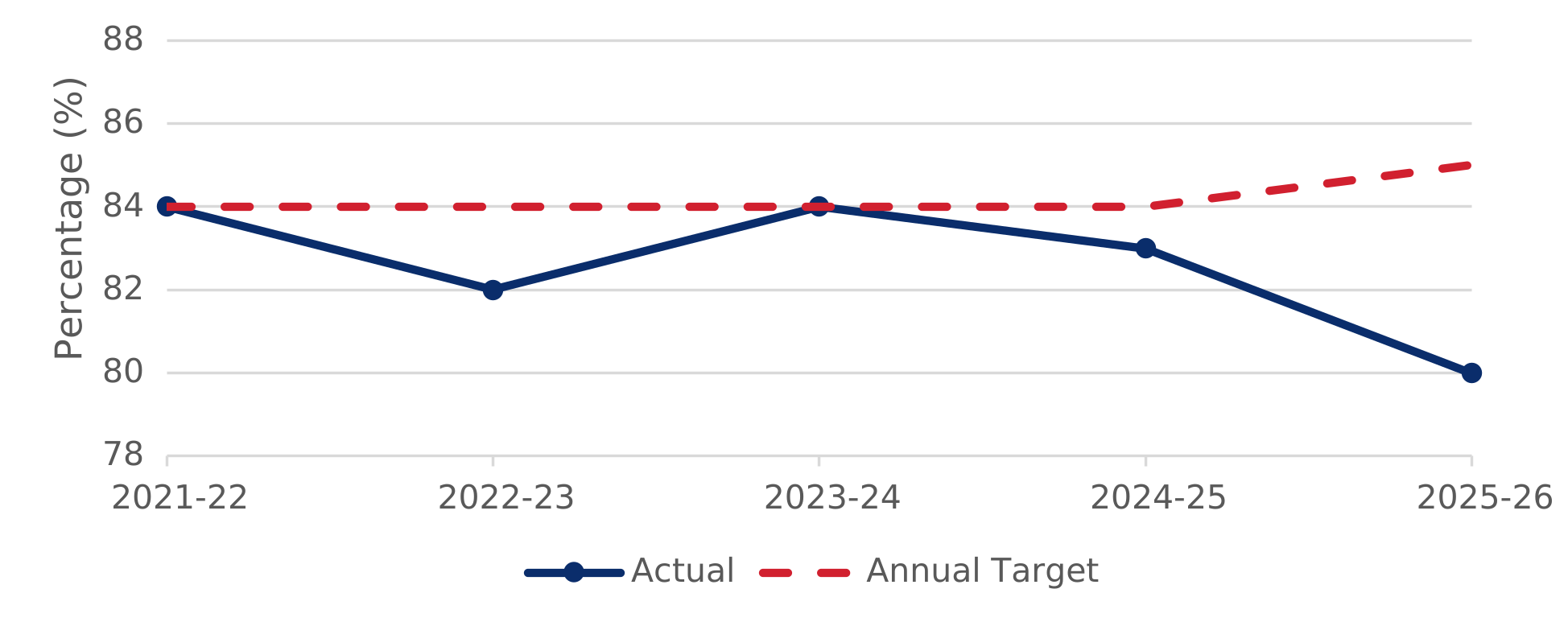
Figure 2: Customer satisfaction overall score
(Figure 2 shows a slight decrease from 83% in 2024-25 and reflects lower satisfaction scores among RPS claimants and creditor petition bankrupts, both below our agency average)
Equality of service provision
We are committed to delivering fair, accessible services to all service users, in line with our obligations under the Public Sector Equality Duty.
The 2026 Customer Satisfaction Survey showed broadly positive results, though customers who were not fluent in English, those with disabilities, and younger customers reported less positive experiences. These findings will inform targeted improvements to how we communicate and provide support across these groups.
Our customer-facing digital services are partially compliant with WCAG 2.1 AA standards. This is an internationally recognised standard for making websites and digital services accessible to people with disabilities, and AA is the level most organisations aim to meet. Known issues include form labelling, link descriptions, heading structure, and colour contrast, which will be addressed as part of ongoing accessibility improvement work in 2026 to 2027.
We do not yet consistently capture demographic data across all services, something which will be considered further in 2026 to 2027. A working group to review our agency’s current support for accessibility, and a group considering vulnerable customers, were initiated during the period and agreed actions will be confirmed in the coming year.
The Breathing Space scheme continues to provide critical support for vulnerable people, with 80,542 protections granted in 2025 to 2026, including 1,363 for individuals in mental health crisis, a group for whom the scheme provides a legally protected period free from creditor pressure.
Continuous improvement
Our staff ideas scheme encourages colleagues to identify problems and develop practical, evidence-based solutions. During the year, one idea led to the adoption of a more secure and efficient approach to document capture using existing mobile technology, reducing administrative effort, improving consistency, and supporting better information handling across a range of business areas.
Our Continuous Improvement Team also made a significant contribution to training and capability development. Working with Official Receiver Services and Capability colleagues, the team helped design and deliver a new training programme for examiners, with updated learning materials and a more structured curriculum. The programme is now maintained by a dedicated team and supported by an improved digital platform. These changes are reducing the time needed to reach full operational competence and improving resilience across frontline services.
The team also continued to deliver its two‑day Continuous Improvement Foundation Training, with 73 courses delivered this year and 269 colleagues completing the programme. Learner satisfaction remains high at 99%.
Modernising the Debt Relief Order service
We made substantial progress in modernising the Debt Relief Order (DRO) service during the period. A DRO provides a formal route to debt relief for people with low income and few assets, offering a way back to financial stability without the cost barrier of formal bankruptcy. DROs are administered by the Insolvency Service and can only be applied for through an approved debt adviser.
In April 2024, the government removed the £90 application fee for DROs, a change designed to ensure that the cost of applying was not a barrier to debt relief for the most financially vulnerable people. DRO volumes increased to 48,850 in 2025 to 2026, up from 45,917 the previous year, reflecting both the removal of the fee and continued high demand for debt relief services. This represents a 5% increase.
Following the removal of the fee, we identified approximately £500,000 in payments made by individuals who had paid the fee since 2016 but did not complete their application. Throughout 2025, we issued targeted letters to eligible customers and provided clear, accessible routes to claim refunds, supported by verification measures to prevent fraudulent claims. To date, this work has returned around £80,000 to customers. These actions have reinforced trust in our services and ensured that customers were not disadvantaged because of the policy change.
Alongside this, we completed the build and testing of a new digital service that will enable organisations in the money advice sector to submit DRO applications directly and securely. We are now working with advice sector partners to connect to the service from May 2026. This will remove the need to manually re‑enter applicant details, currently around 45 minutes per case across approximately 42,000 applications each year, freeing up adviser time to concentrate on supporting customers and delivering faster outcomes.
Strengthening the Redundancy Payments Service
We began a significant programme to modernise the Redundancy Payments Service (RPS), which processes claims from employees whose employers have become insolvent. Following a pre-discovery phase, a delivery partner was appointed in January 2026, and discovery work is due to conclude in April 2026. The programme will deliver a more accurate and resilient service with improved digital claim processes, reduced manual handling, full compliance with updated tax and National Insurance requirements, and a better experience for claimants and insolvency practitioners. The fall in customer satisfaction shown in Figure 2 was in part driven by declining satisfactions with service outcomes and communications and the programme will seek to also address these issues.
Alongside this modernisation work, the service maintained consistently strong operational performance throughout the year, including across several large and high‑profile insolvency appointments, including Prax Lindsey Oil Refinery and National Timber Group England Limited.
Average processing times across these cases ranged from 8 to 10 days, demonstrating our ability to maintain high service standards at scale.
The Accountability Report highlights an issue relating to the calculation of National Insurance Contributions on redundancy payments, and readers’ attention is drawn to the relevant sections where this is described in further detail.
Case study: Complex retail redundancy
The insolvency of Claire’s Accessories UK Ltd and Claire’s European Services Ltd, a major high street retailer with a geographically dispersed workforce, illustrates the complexity that Redundancy Payment Service (RPS) can encounter in large retail cases. While the business continued to operate in other jurisdictions, the redundancy assessment for RPS purposes focused solely on the UK-based workforce. The case involved complexity in determining employment status and assessing potential TUPE considerations under UK employment law.
Early collaboration between RPS and the administrators to obtain payroll information helped establish employment status and identify whether any employees had transferred to successor organisations. Claims were processed with an average turnaround of eight days.
Delivering returns to the economy
This year we returned £26 million to creditors and the wider economy through the continued closure of legacy mis-sold Payment Protection Insurance (PPI) cases held within bankruptcy estates. Under insolvency law, PPI compensation relating to pre-bankruptcy financial products is treated as an asset belonging to creditors, rather than the individual. This multi-year programme continues to deliver meaningful financial recoveries that benefit creditors directly.
We also strengthened how we manage the funds passing through our accounts. We made strong progress in reducing suspense account balances, including a £4.3 million reduction in the Redundancy Payments Service customer suspense account, achieved through new processes and closer working across Finance, the Redundancy Payments Service, and our Personal Insolvency teams, improving the speed and accuracy with which outstanding balances are identified and cleared. A new suspense account dashboard, shared monthly with stakeholders, has increased transparency and reduced the build‑up of unallocated items across Estate Account Services.
Figures 3 to 6 show our performance across key operational measures, including the processing of redundancy payment claims, distributions to creditors, and service timeliness.
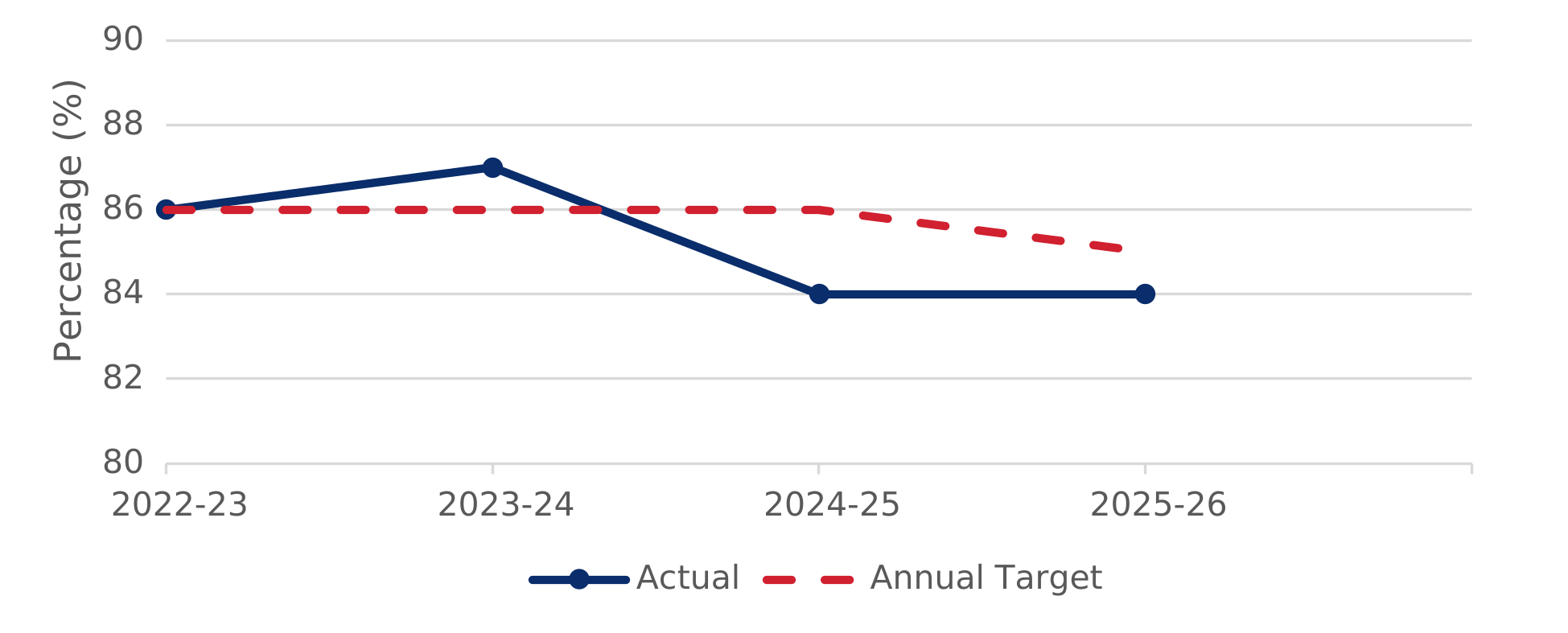
Figure 3: Percentage of Breathing Space statutory notices issued electronically
(Figure 3 shows volumes remained consistent with 2024-25 at 84%, with provider engagement contributing to a year end increase helping to slow the overall decline)
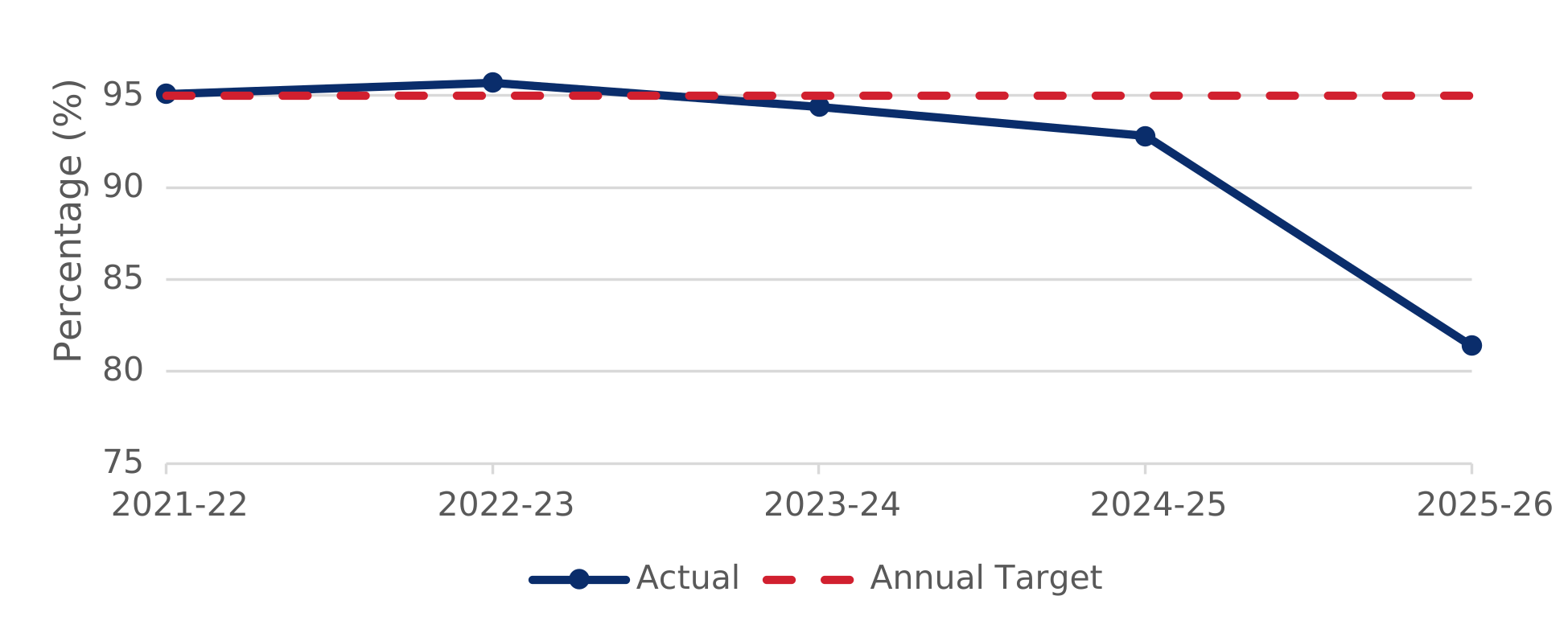
Figure 4: Percentage of reports to creditors issued within 15 days of interview (or a decision that no interview is required) in bankruptcy and liquidation cases
(Figure 4 shows an 11% drop in volumes from 2024-25 following the rollout of INSSight. Recovery is expected in 2026-27 after backlog clearance and data cleansing)
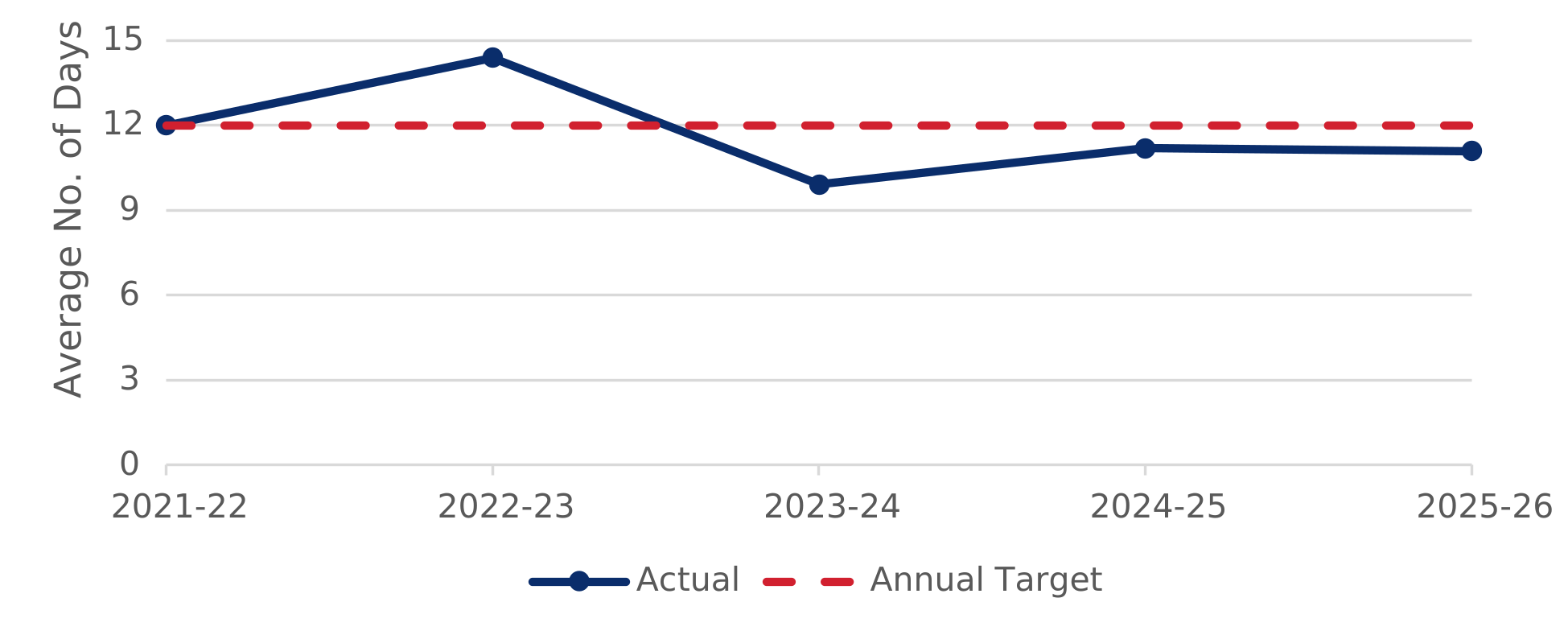
Figure 5: Average number of days to process redundancy payment claims
(Figure 5 shows consistent performance, with delivery at 11.1 days in 2025-26 compared with 11.2 days in 2024-25, continuing to exceed the annual target of 12 days)
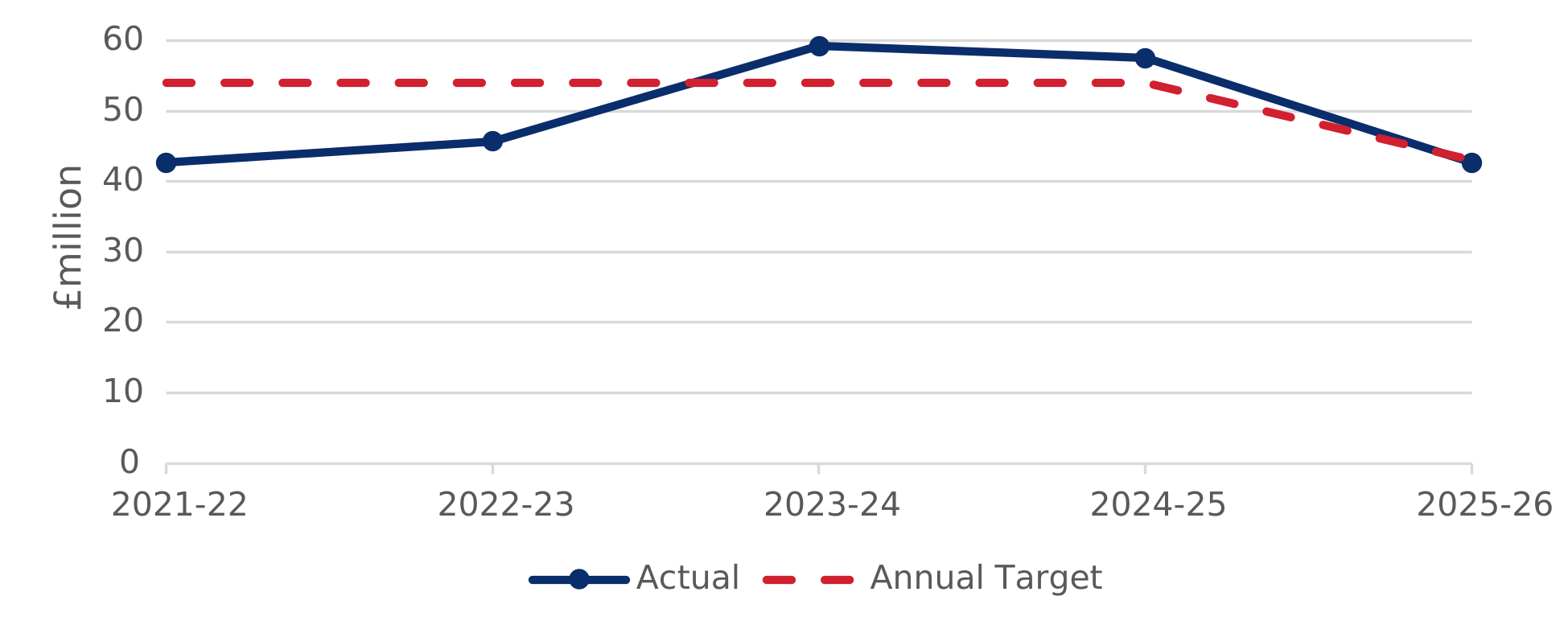
Figure 6: Value of distributions to creditors and debtors (excluding National Interest Cases)
(Figure 6 shows that distributions reduced to £42.7 million in 2025-26, closely aligning with the £43 million forecast. This reflects the phased implementation of INSSight and its impact on recruitment)
Official Receiver case studies
Bankruptcy
An individual continued to obtain money from members of the public while bankrupt, concealing their status and breaching legal restrictions on credit and trading. The Official Receiver identified false statements and hidden bank accounts. Evidence of ongoing misconduct was referred for criminal investigation, resulting in a prosecution and custodial sentence.
Bankruptcy Restrictions Order
The Official Receiver investigated the collapse of a GP practice whose manager deducted pension contributions from staff wages but failed to pay them into the relevant scheme. More than £75,000 in employee contributions had been withheld. A seven‑year Bankruptcy Restrictions Undertaking was obtained, limiting the individual’s ability to act as a company director or take on credit without declaring their status. The Official Receiver also worked with local healthcare partners to maintain continuity of patient care following the practice’s sudden closure.
National Interest Case: Prax Lindsey Oil Refinery
In summer 2025, the Official Receiver was appointed liquidator of the Prax Lindsey Oil Refinery group, a strategically significant fuel supplier providing around 10% of the UK fuel supply prior to its collapse. The appointment required fulfilling statutory duties while ensuring safe continued operation of a major regulated industrial site. The case drew extensive national and international media coverage and illustrates the scale and complexity of insolvencies our agency is equipped to manage.
Theme 4: Shape a new approach to prevent insolvency and rehabilitate through education and guidance
Ensuring that those who carry on a business are aware of their duties helps to minimise financial wrongdoing and create a level playing field in the corporate environment. Our aim is to increase the capability and knowledge of company directors, improve awareness of their legal duties and obligations, and how to avoid insolvency where possible or manage it properly if it is unavoidable.
Our confidence survey identified that directors’ awareness of their obligations and liabilities around corporate insolvency varied considerably. This year we continued to address that gap, improving both the content and accessibility of our Director Information Hub.
Here is how we have delivered against our objectives:
| Objective | Status | Commentary |
|---|---|---|
| Implement further developmental improvements to the Director Information Hub including improved access and HMRC and Companies House enhancing their signposting to the hub. | Ongoing | HMRC progressed embedding Hub links in relevant guidance and correspondence. Companies House committed to including Hub links in director email communications, with full implementation expected in 2026-27. Internal promotion of the Hub also increased awareness across relevant channels. |
| Revise the Director Information Hub to include more information on director duties and the enforcement framework. | Complete | New content was published covering phoenixism, enforcement, personal guarantees, and director duties. This included the first enforcement-related material on the Hub, developed in collaboration with Economic Crime Reform Implementation Unit (ECRIU). |
Director Information Hub
The Director Information Hub is a GOV.UK resource giving directors practical guidance on their legal duties, responsibilities, and options when their company faces financial difficulty. The Hub reached 26,364 page views this year, reflecting growing awareness of the resource among directors and their professional advisers.
New content was published on phoenixism, personal guarantees, director duties, as well as the first enforcement-related material to appear on the Hub. This work was developed in collaboration with our Economic Crime Reform Implementation Unit, strengthening the connection between our education and enforcement functions.
Progress was made with external partners in expanding signposting to the Hub.
HMRC embedded links to the Hub within relevant guidance and correspondence, and Companies House committed to including Hub links in its new director email communications in 2026 to 2027.
Theme 5: Shape and modernise our technology and infrastructure
Excellent delivery for UK citizens depends on modern, reliable technology and well-managed infrastructure. This year, we completed several significant programmes: launching the INSSight case management system, consolidating the office estate to 11 Regional Centres, and accelerating adoption of artificial intelligence tools. Alongside this, foundational work continued to strengthen digital services for customers and build the data capabilities we need for the future. However, we also delivered less than expected in our planned change portfolio for the year, with several significant projects now moved into 2026 to 2027.
Here is how we have delivered against our objectives:
| Objective | Status | Commentary |
|---|---|---|
| Launch our new case management system INSSight and embed across the business to improve our service for our people and our customers. | Ongoing | INSSight launched in November 2025, supporting Official Receiver Services and Estate Accounts, following delays due to the complexity of the data transfer required. An extended support period remains in place until May 2026 to address post‑launch challenges and achieve a stable operating position. |
| Seize opportunities for automation and AI to improve collaboration and efficiency both internally and externally. | Ongoing | M365 Copilot Chat rolled out, and a Copilot premium trial completed. In partnership with Great Wave AI, chatbot proofs of concept were tested and two chatbots moved into production. Work continues in 2026-27. |
| Finalise our office operating model. | Complete | A clear, consistent framework for how our office spaces operate across all locations has been agreed and implemented. |
| Implement a Combined Management System in line with International Standards ISO14001 (Environment) and ISO45001 (Occupational Health and Safety). | Complete | The new system is implemented, fully compliant with ISO standards, and provides a unified framework for managing environmental responsibilities and ensuring workforce health and safety. |
| Continue to strengthen our overall security posture, working with a range of partners and by adopting relevant tooling to secure our data and systems. | Complete | Microsoft Defender for Cloud adopted as the primary cloud security posture management tool, and an IT Health Check partner was onboarded, reducing the risk of cyberattack and improving protection of cloud environments and data. |
INSSight: A new foundation for case management
The launch of INSSight in November 2025 was one of the most technically complex programmes our agency has undertaken. The system replaced legacy platforms, migrating approximately 500 million records and 100 million financial transactions accumulated over 20 years of casework, to the new case management system. This data required comprehensive validation with almost no tolerance for error, and while the scale of this challenge was understood at the outset, its full complexity only became fully apparent during delivery, resulting in delays to the original launch timeline and additional cost and staff time beyond initial estimates.
Following launch, an extended support period is expected to run from January to May 2026 to resolve outstanding issues and stabilise the system. This affected some operational KPIs during the period, as colleague capacity was directed toward embedding the new system, and as some operational services were delayed while data was unavailable in the new system. We expect INSSight to reach full operational performance from June 2026.
The investment in the development and implementation of the INSSight case management system, reflects our long-term commitment to modern, reliable infrastructure. INSSight replaces legacy platforms that held back progress for efficiency and data use, creating a stronger foundation for analytics, reduced manual processing, and more consistent delivery across Official Receiver Services and Estate Accounts.
Data strategy
This year we commissioned an enterprise resource for analytics, master data management, data governance, and AI machine learning. An internal analytical capability was built alongside a dedicated business partnering service for operational teams, and a data governance model now enables us to catalogue and describe our data in business terms. Our agency also joined a cross-government initiative to align data models and support more efficient data sharing, with clear lines of ownership and accountability being established to support this work.
Modernising digital services for customers
Our agency continued improving the digital services through which customers access information and services. Using the GOV.UK Forms platform, priority forms have been digitised, making them clearer, more accessible, and easier to complete. This included the redundancy payment forms and the HR1 form, used by employers to notify of potential collective redundancies.
Foundational work also continued to standardise and simplify existing customer-facing digital services, creating more consistent journeys and reducing avoidable errors. This foundation work will enable faster, regular improvements informed by user feedback and analytics. We commenced preparatory work to adopt GOV.UK One Login, providing a consistent and secure approach to authentication in line with cross-government standards.
We also decided to shift our primary method of collecting user feedback from annual surveys, to embedding feedback collection into our services at the point they are used. We trialled this approach with the DRO service in December 2025, and have received over 400 responses per month, and plan to roll out these feedback loops into other services during 2026 to 2027.
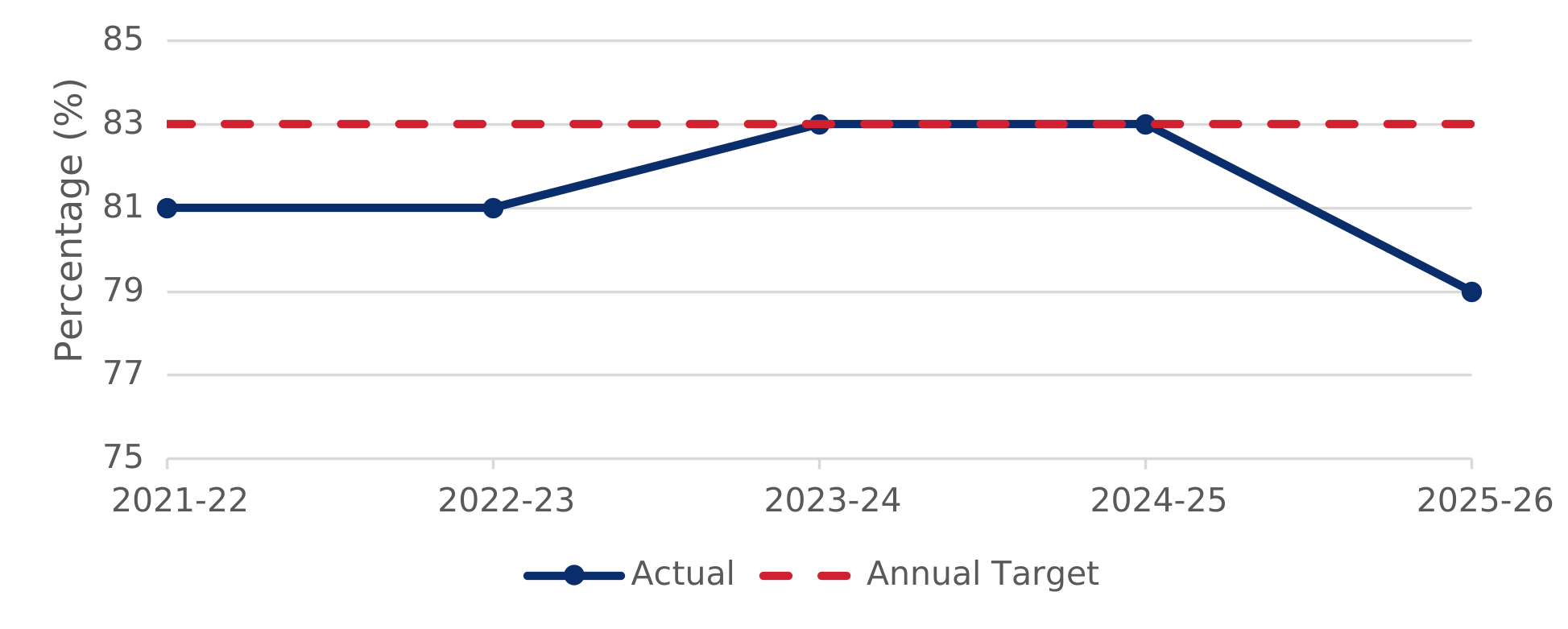
Figure 7: Net effort score - customer feedback on how easy it is to use our services
(Figure 7 shows a decrease from 83% to 79% in 2025-26. RPS customers accounted for 88% of respondents for the full year, with the lower score reflecting reduced satisfaction among RPS claimants which is being addressed)
Artificial Intelligence and automation
Our agency made strong progress on its AI roadmap during the year, moving from proof of concept to live services. The rollout of Microsoft 365 Copilot Chat has improved day-to-day efficiency for colleagues, while a successful trial of Copilot premium has informed decisions about future investment in 2026 to 2027. Two chatbots moved into production, and the Future Case Management Capability Training Agent was released ahead of the INSSight new case management system launch to support colleague readiness.
Discovery work on an external customer‑facing FAQ chatbot was completed and testing continued throughout the year. Further AI development included automating elements of the MG1 form, used by Investigation and Enforcement colleagues to record details related to police bail conditions. These initiatives are improving how our colleagues work and laying foundations for more scalable AI-enabled services.
Cyber security and IT value for money
Cyber security remains a key risk for our agency due to the growing prevalence of cyber threats facing organisations that deliver critical public services and handle sensitive information. A cyber incident could disrupt service delivery and internal operations, expose personal or case‑related data, and result in financial and reputational impacts.
We strengthened our security posture during the year through the adoption of Microsoft Defender for Cloud as our primary cloud security management tool, and by onboarding a new IT Health Check partner. Together these measures have improved protection of cloud environments, data, and systems, and reduced exposure to cyberattack.
We also identified further actions to strengthen cyber security, including keeping critical systems up to date, handling sensitive information securely, improving readiness to respond to incidents, setting clear security expectations for suppliers, and continuing regular staff training to reduce cyber and fraud risks.
Work to implement recommendations from an IT procurement review also progressed well, delivering initial savings of around £100,000 through improvements to one major contract. Further opportunities across other IT contracts are being pursued, supported by a strengthened Contract Management function with new team members and enhanced processes.
Rationalising our estate
The Transforming Workplaces project closed in November 2025, consolidating our office network from 22 locations to 11 Regional Centres, with the final two offices closing during the reporting period. The project reduced annual estate running costs from a projected £9.87 million to £8.45 million, a saving of £1.42 million per year and a potential saving of around £17.6 million in avoided business maintenance costs of our old estate. Of 300 colleagues affected by office changes, over 90% remained with the agency; voluntary exits totalled 15, compared with early projections of up to 57. Colleagues’ building user experience was measured at 65% in the annual survey, meeting the target for the year and suggesting that experiences remained broadly positive despite the scale and pace of estate transformation. Full onboarding with the Government Property Agency from February 2026 will further strengthen oversight of property costs and provide access to GPA’s supplier network and competitive procurement arrangements.
Project portfolio and transformation investment
Our project portfolio budget for 2025 to 2026 was originally set at £26.2 million, revised to £14.1 million after a mid-year review. Year-end outturn was £12.6 million, representing a £1.4 million underspend against the revised budget. The variance against the original budget reflects a combination of deliberate reprioritisation, external dependencies, and more efficient delivery than forecast rather than failure to progress transformation. Key factors included:
- delivery achieved at lower than expected cost, including fewer redundancies and significant procurement savings
- extended procurement timelines delayed the start of delivery into 2026 to 2027
- projects ending later than planned had knock-on impacts on dependent projects
- limited staff capacity delayed the start of some projects
- some projects were not initiated following reassessment of value and need
- some projects have been postponed pending enabling legislation
Following review of the 2025 to 2026 change activity, the Executive Committee agreed that a more rigorous approach to demand planning and prioritisation was required, with a strategic alignment process completed in April and May 2026 to improve forecasting accuracy across the portfolio in 2026 to 2027.
Theme 6: Shape our agency as a great place to work
A skilled, motivated workforce is the foundation of everything our agency delivers, ultimately strengthening our services and improving the customer experience. The people and leadership programmes delivered ensured colleagues had the development, support, and working environment needed to deliver high-quality public services throughout the year, underpinned by a fundamental reform of how our agency rewards its people. This year we concluded a significant programme of pay and structural change, while investing in leadership capability and completing the transition to modern, fit-for-purpose offices across our 11 Regional Centres (as described in Theme 5).
Here is how we have delivered against our objectives:
| Objective | Status | Commentary |
|---|---|---|
| Improve our employee value proposition focusing on outreach, career pathways, pay and benefits, accessibility, and candidate experience. | Complete | Due to extended HM Treasury approval timelines, three pay awards were implemented in one year, also facilitating reform of our grade structure. Annual leave purchase, a new employee assistance provider, and a revised attendance framework were also introduced. Staff satisfaction with the total benefits package rose to 47%, up 25 percentage points. |
| Promote a flexibility culture to support better career pathways and workload management. | Complete | Core hours were removed and the standard hybrid working model was reinstated. Work to improve access to job share arrangements and clearer career pathways continued throughout the year. |
| Continue to build our Brilliant Leadership community, through delivery of our Brilliant Leadership programme for all new leaders and continuing to integrate a Brilliant Leadership approach into our senior leadership events and our Regional Centres. | Complete | The programme was delivered on a rolling basis, reaching 143 senior leaders and 289 middle managers by year end. Learning was integrated into senior leadership events. |
Pay reform
Three annual pay awards (2023, 2024 and 2025) were implemented during the reporting period. While the process of securing HM Treasury approval for a pay flexibility business case was lengthy, it enabled us to address long-standing pay competitiveness issues and fundamentally reform its pay structure.
The previous bespoke grade framework was replaced with one fully aligned to standard Civil Service grades, reducing the number of grades by a third. This simplification makes career pathways clearer for staff, reduces administrative complexity, and makes it easier to attract candidates through cross-government recruitment. Staff satisfaction with the total benefits package increased to 47%, up 25 percentage points from the previous year and four percentage points above the Civil Service benchmark.
Flexibility and career development
Our approach to flexible working is one that balances individual needs with our shared responsibility to deliver for customers. During the reporting period, our agency increased office attendance in line with the government’s wider position that regular in-person working supports professional development, strengthens team cohesion, and helps colleagues (particularly those earlier in their careers) build the skills and relationships that remote working alone cannot replicate.
Alongside this, we removed core hours. Work also continued to improve access to job share opportunities and to develop clearer career pathways for colleagues across all grades.
These changes helped maintain a productive balance, offering flexibility that supports recruitment, retention, and wellbeing, while ensuring that working patterns remain consistent with delivering high-quality public services.
Recruitment
Our agency welcomed 369 new employees during the period, filling natural turnover (8.1%) and also recruiting to new priority posts, such as expanding our enforcement capability, to take our total FTE from 1776 to 1988 during the period.
Headcount is expected to increase further in 2026 to 2027, due to planned expansion in our enforcement, investigation, and legal functions, to increase our capability for anti-money laundering activity, target abusive phoenixism and to take on the COVID-19 financial support fraud casework from NATIS.
Following the implementation of the delayed 2023 and 2024 pay awards during the period, the number of unsuccessful recruitment campaigns fell significantly, helping us address our vacancy rate. Improvements to recruitment processes included revised advert standards in line with Civil Service Commission expectations, the introduction of a Recruitment Audit Framework, and a digital transfer form to support cross-government mobility. Average time-to-hire reduced by three days to 35 days.
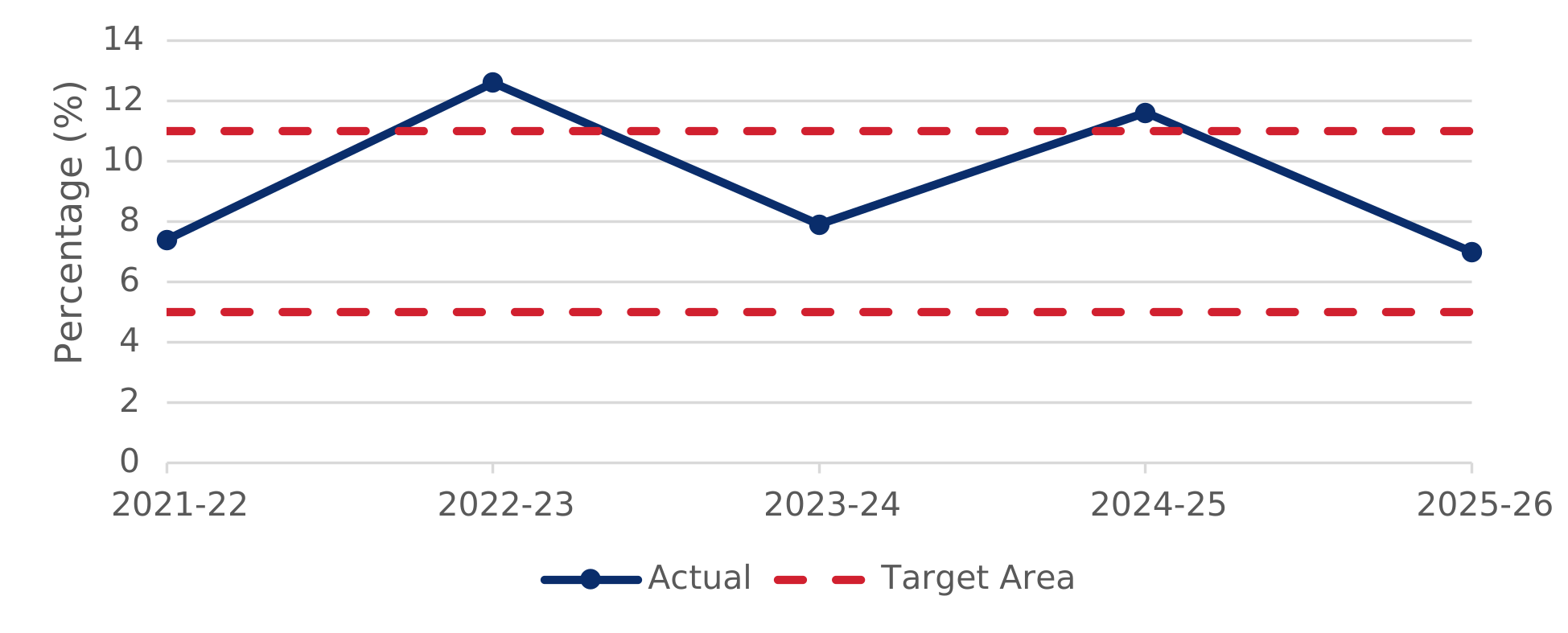
Figure 8: Percentage of internal promotions
(Figure 8 shows a 4% reduction in internal promotions compared with 2024-25; however, levels remain above the minimum target of 5%)
| 2025-26 | 2024-25 | 2023-24 | 2022-23 | |
|---|---|---|---|---|
| Number of internal moves to support the business need | 11 | 14 | 49 | 42 |
Table 3: Number of internal moves to support the business need
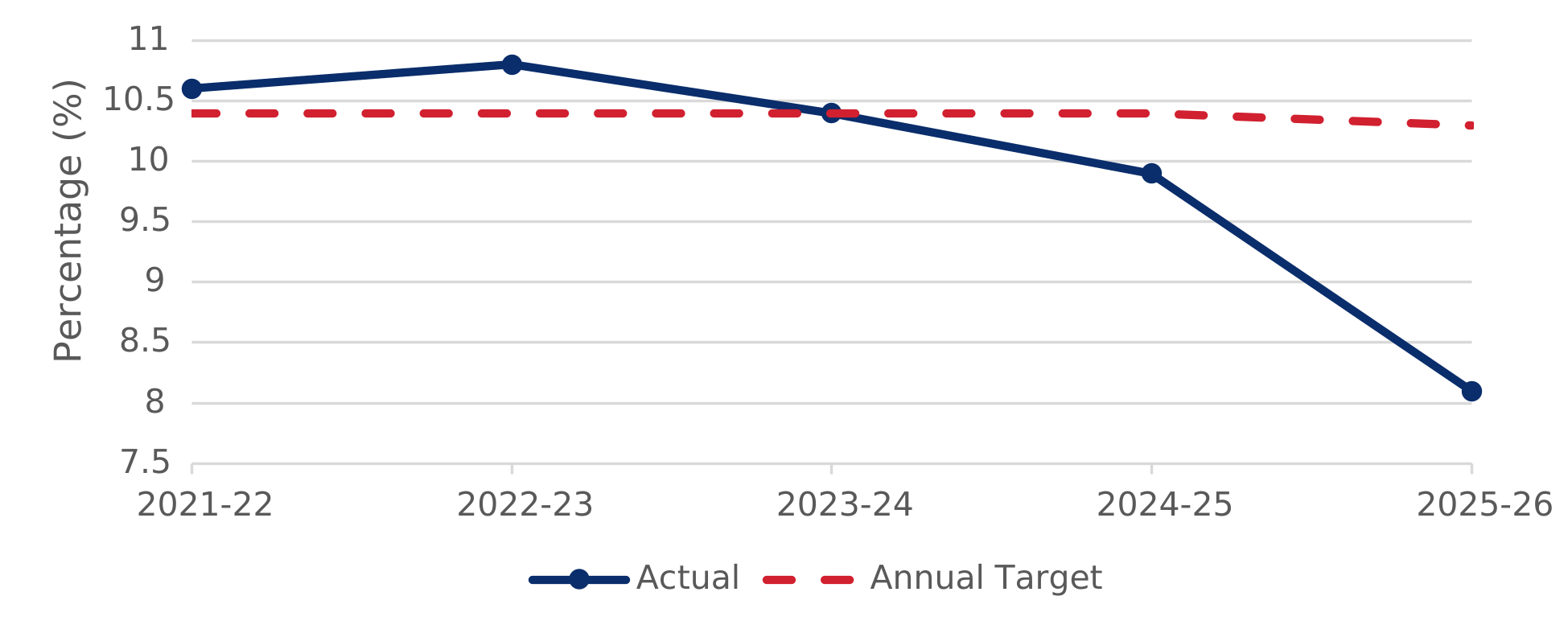
Figure 9: Staff attrition rate
(Figure 9 shows continuing recent downward trend reaching 8.1% in 2025-26 and remaining well below the annual target of 10.4%, demonstrating sustained improvement)
Leadership development
The Brilliant Leadership Programme was delivered on a rolling basis to 143 senior leaders and 289 middle managers. The programme equips our leaders at all levels to inspire and empower teams, built on the principles that leadership is a core skill as important as technical expertise.
People Survey results indicate a measurable benefit from this investment. The Leadership and Managing Change score increased to 57%, above the Civil Service benchmark of 53%. The My Manager score rose to 82%, below the Civil Service benchmark of 84% but representing continued progress.
Building on this progress, we will launch the Brilliant Manager Programme in 2026 to provide structured development for line managers at all stages of their careers, alongside a dedicated manager support space to improve access to learning materials.
More widely on employee engagement, our Employee Engagement Index increased from 59% to 63%, narrowing the gap to the 65% target. Our People Survey response rate of 74%, compared with 59% across the Civil Service, reflects a high level of staff engagement with the process.
Theme 7: Sharpen our financial model to ensure sustainability
Our Official Receivers provide an important public service, often stepping in when there is no viable commercial alternative. Their work is paid for through fees charged on cases, how much income we receive depends on the number and type of cases and whether fees are recoverable (for example, straightforward cases with few recoverable assets often generate less fee income than the work requires).
Both asset values and the number of bankruptcies remain lower than before the pandemic, creating a structural shortfall, which we are working to address. To help manage this, we have increased fees in line with inflation and are reducing costs by making our processes more efficient. Our new case management system will help with this, and we are also working with our sponsor Department (DBT) and HM Treasury to secure funding to cover any remaining gap as part of the Spending Review.
Our investigation and enforcement activity, by contrast, moved to a sustainable financial basis in February 2026 following the Economic Crime and Corporate Transparency Act 2023. Companies House fees now part fund increased enforcement demand as reforms continue to be implemented, placing this expanding work on a stable long-term footing.
Here is how we have delivered against our objectives:
| Objective | Status | Commentary |
|---|---|---|
| Continue implementation and monitoring of new and existing financial sustainability activity in relation to fees, process improvements, and commercial approach. | Ongoing | New Companies House fees funding investigation and enforcement were implemented in February 2026. Inflationary fee increases to Official Receiver Services fees continue to reduce the previously forecast shortfall. A new project is under way to identify a long-term solution to the remaining deficit. |
| Increase our in-house benefit management capacity and expertise and develop our benefit evaluation and benchmarking tools. | Complete | Consistent, benefit led evaluation processes are now in place across all change initiatives, improving our ability to evidence value for money. |
| Establish a structure for annual review of all fees. | Complete | The new Companies House Fee levels were implemented in February 2026. Resources and tools for delivering the Official Receiver related fee reviews are in place and the policy and timelines for reviews will be defined by the outcomes from the new ORS Deficit Project. |
| Undertake a feasibility assessment into joining the government Matrix programme to support broader government shared services strategy efficiencies. | Complete | The feasibility assessment concluded that our agency should not join the wave scheduled for November 2027, removing cost uncertainty risks to the funding regime. A further review is planned for 2028-29 to assess joining a later wave. |
| Explore opportunities for managing payments to customers, enabling faster payments, and reducing operational costs. | Complete | A feasibility assessment confirmed that reducing cheque usage is achievable. Implementation is planned to begin in 2026-27. |
| Establish a Working Capital Policy to support efficient use of cash surpluses. | Ongoing | Progress was delayed by the need to provide urgent support on an Asset Freeze Order bank account. The policy is now scheduled for completion in early 2026-27. |
Improved financial sustainability
New Companies House fees, introduced in February 2026 under the Economic Crime and Corporate Transparency Act, now provide dedicated funding for our investigation and enforcement activity. This shifts enforcement to a more sustainable basis aligned with demand generated by Companies House reform.
For Official Receiver Services, work continued to explore options for future fee changes to improve financial sustainability. A new project has been initiated and will begin in 2026 to 2027 to address the remaining Official Receiver Services deficit, bringing together a functional review of OR activity with the accounting treatment of fee income to build the evidence base for a sustainable funding settlement with DBT and HMT.
The Transforming Workplaces programme reduced our estate from 22 locations to 11 modern Regional Centres, which aligns with government standards, cutting annual estate costs from £9.87 million to £8.45 million, a saving of £1.42 million per year. This was achieved despite sharp increases in commercial rents and rates across the wider market, meaning the real-terms benefit is likely higher. Full onboarding with the Government Property Agency from February 2026 will improve cost transparency further and provide access to competitive rates through GPA’s established supplier network.
An IT procurement review delivered initial savings of around £100,000 through improvements to one major contract, with further opportunities across the IT contract portfolio under way. The IT Contract Management function has been strengthened with new oversight processes and additional team members.
Work to establish a Working Capital Policy, a framework for managing our agency’s cash and funds held on behalf of others, ensuring money is available when required and returned to the wider economy promptly, continued during the year, with draft requirements prepared for eight of the nine accounts.
Delivery was delayed due to the need to redirect resources to priority activities, including leading the cheque cessation pre-discovery project, developing a payment system access policy, and supporting our investigation and enforcement function through the opening of an Asset Freezing Order bank account. This work is now on track to conclude in spring 2026. Once complete, it will provide a clearer framework for managing working capital and strengthening financial controls across our agency.
Following a feasibility assessment confirming that reducing cheque payments is achievable, we are moving into design and preparation in Autumn 2026, followed by implementation in Spring 2027. This will enable faster payments, reduce processing costs, and improve customer experience for those receiving payments from our agency.
The data below shows progress against key financial sustainability measures, highlighting the impact of process improvements and fee reviews in delivering increased income against targets.
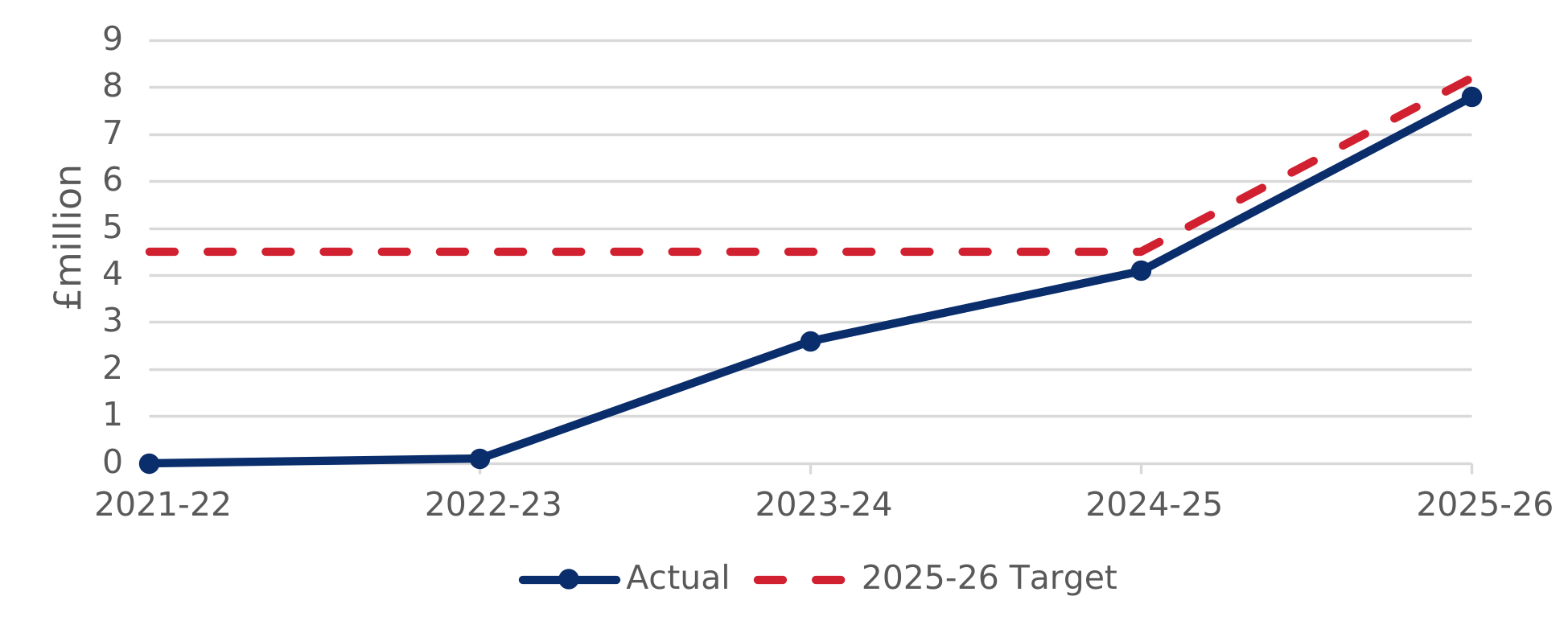
Figure 10: Financial sustainability - fees review
(Figure 10 shows a continued upward trend, reaching £7.8 million in 2025-26 against a target of £8.2 million. The small shortfall reflects a review of banking fees)
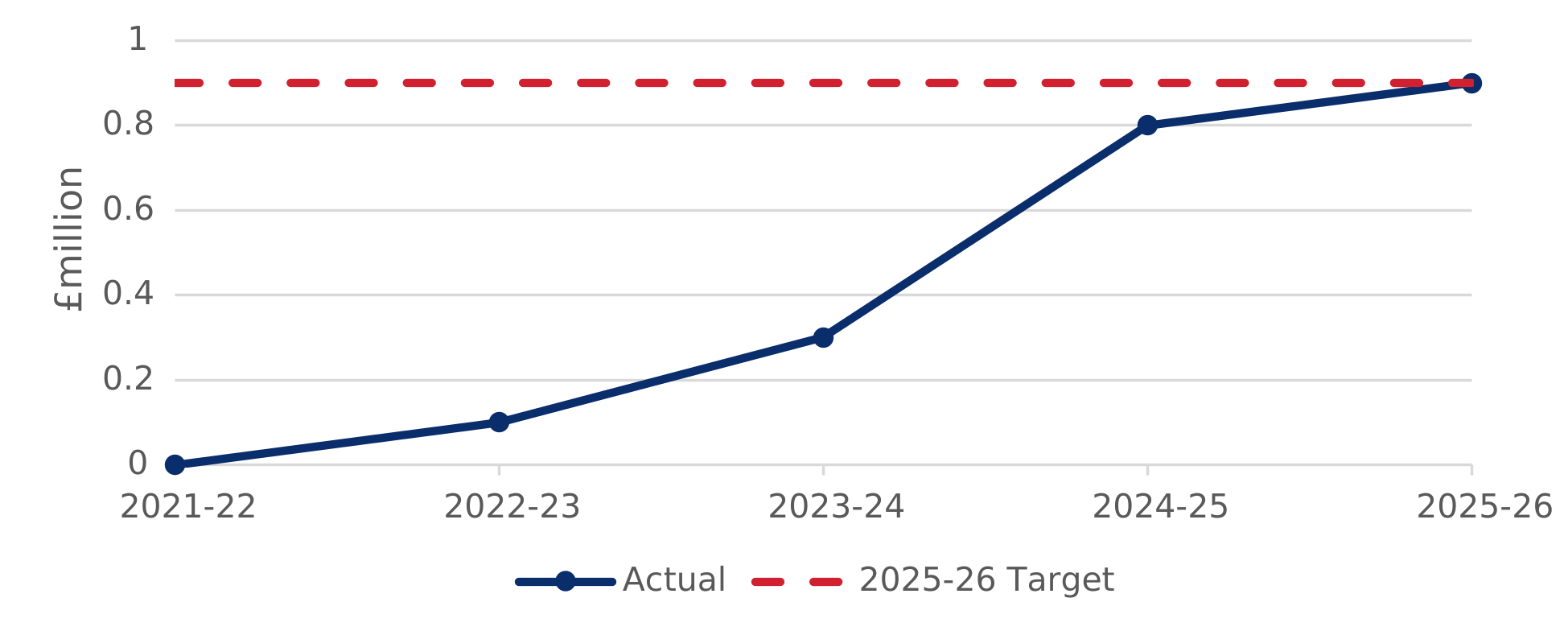
Figure 11: Financial sustainability - process improvement
(Figure 11 shows a steady upward trend, increasing from £0.8 million in 2024-25 to meet the £0.9 million target in 2025-26)
Strengthening fraud and error controls
Our agency’s counter fraud function completed a programme of maturity assessment and strategic evaluation during 2025 to 2026. A self-assessment has been completed against the cross‑government Continuous Improvement Assessment Framework, aligned to Functional Standard GovS013 and Public Sector Fraud Authority requirements. This provides a clear baseline from which to support ongoing and future development.
A refreshed Counter Fraud Strategy, adopted in January 2026, is supported by an annual Counter Fraud Action Plan setting out priorities for prevention, detection, and recovery.
The review identified that additional resource is needed to manage our current scale of fraud risk, and planning is underway to expand the function in 2026 to 2027 to build greater resilience.
Commercial and procurement
Our commercial function is committed to securing value for money across all procurement activity, delivering savings that consistently exceed the cost of the function itself. In 2025 to 2026, the team delivered £6.5 million in savings through improved contract negotiation and better supplier management, directly supporting our agency’s financial sustainability and freeing resource for frontline services.
Demand for procurement support has often proved difficult to predict precisely: around two in three procurements each year arise in-year rather than through advance planning. In 2025 to 2026, unplanned requests in the final quarter exceeded available commercial capacity, meaning some lower-priority work could not be progressed and a small number of purchases were made on an as-is basis to meet operational deadlines.
We are reviewing how procurement capacity and forward demand planning can be better aligned, with options being developed for 2026 to 2027.
We are committed to increasing spend with small and medium-sized enterprises (SMEs), recognising that doing so supports economic growth and innovation across the wider economy, consistent with our core mission. Spend with SMEs has exceeded the Cabinet Office’s 33% stretch target in every year reported, reaching 39% in 2025 to 2026.
This year, we introduced a new Social Value Procedure to standardise how social, environmental, and economic outcomes are evaluated in procurement, in line with Cabinet Office guidance. Sustainability criteria have been strengthened across contracts in line with Government Buying Standards, and commitments are embedded in our new Sustainability Strategy. All in-scope procurements continued to include a 10% evaluation weighting for social value and environmental sustainability, meeting this commitment in full across all reported years.
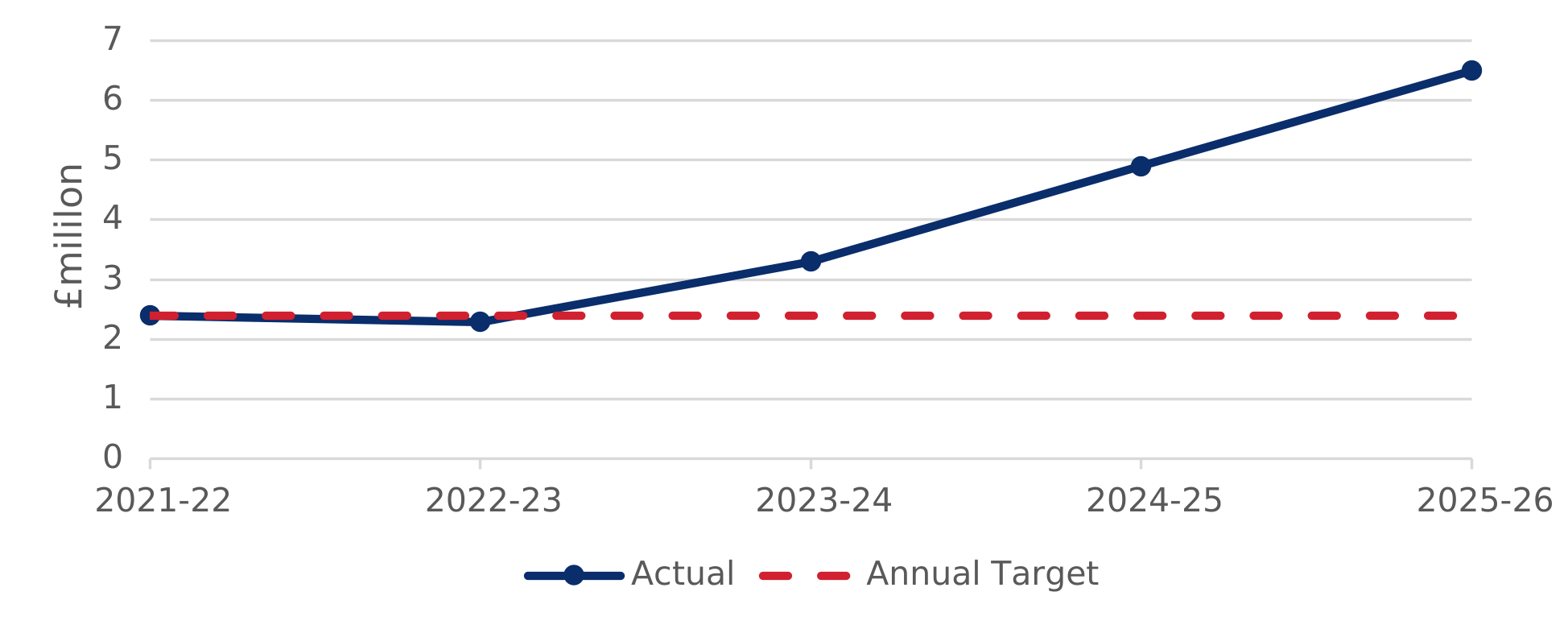
Figure 12: Minimum commercial savings
(Figure 12 shows a continuing upward trend, reaching £6.5 million in 2025-26 further exceeding the £2.4 million annual target)
| 2025-26 | 2024-25 | 2023-24 | 2022-23 | |
|---|---|---|---|---|
| All in-scope Procurements to include 10% Evaluation for Social Value and Environmental Sustainability | 100% | 100% | 100% | 100% |
Table 4: Procurement compliance with 10% social value weighting
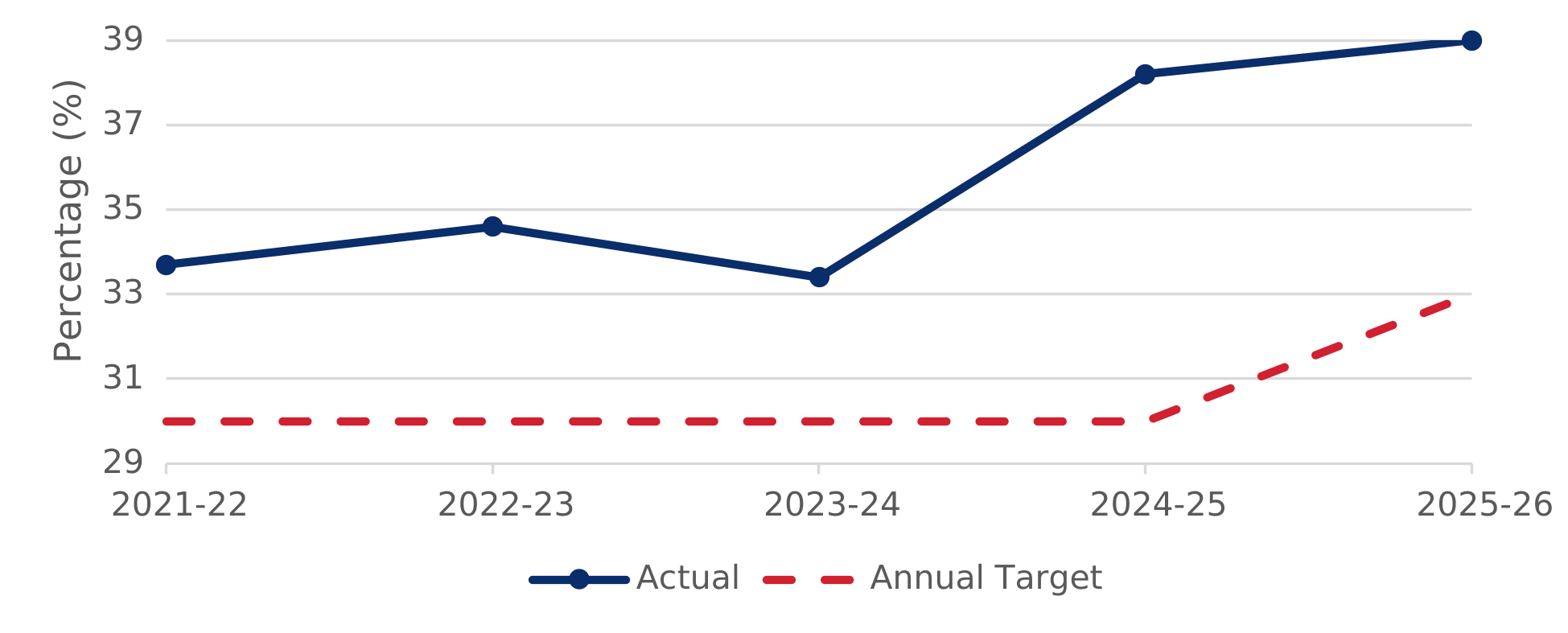
Figure 13: Spend with SMEs
(Figure 13 shows an increase to 39% in 2025-26, continuing to exceed the Cabinet Office’s 33% stretch target)
Sustainability
Our agency made significant progress on sustainability during 2025 to 2026, including launching a new five-year Sustainability Strategy aligned to the Greening Government Commitments (GGCs), the implementation of a new Combined Management System (CMS) aligned with International Standards for Environmental Management (ISO14001) and Occupational Health and Safety (ISO45001), and completing climate change risk workshops to assess our agency’s exposure to future climate scenarios. Our agency’s estate is now fully managed by the Government Property Agency (GPA), which holds responsibility for environmental compliance across our offices. No environmental incidents have been reported in 2025 to 2026.
The scope of our management system and our climate related disclosures cover all Insolvency Service office-related activities and off-site related work including customer site visits and court attendance.
Task force on climate-related financial disclosures (TCFD)
Compliance Statement
Our agency has reported on climate-related financial disclosures consistent with HM Treasury’s TCFD-aligned disclosure application guidance.
Our agency has complied with recommended disclosures on:
- governance - recommended disclosures a (Board oversight) and b (management’s role)
- risk management - recommended disclosures a (risk identification and assessment), b (risk management) and c (overall integration)
- metrics and targets - recommended disclosure b (emissions)
Our agency does not currently classify climate as a principal risk; this classification is under review following 2025 to 2026 climate risk workshops.
Our agency has progressed on Strategy recommended disclosure b (impacts) and plans to provide recommended disclosures for Strategy recommended disclosure c (scenario analysis) in future periods, in line with the central government implementation timetable.
Energy expenditure data is not reported in this Annual Report. Following our full onboarding with the GPA in February 2026, energy costs are managed and invoiced at whole-building level by GPA, making it impracticable to disaggregate expenditure attributable solely to the Insolvency Service at this time. We are working with GPA to establish a methodology for obtaining this data.
Governance
Sustainability governance is overseen by the Board. Day-to-day management is led by the Executive Committee, supported by the Environmental Strategy Group and working groups for sustainable procurement and paper reduction. The Executive Committee has a named member who leads on sustainability, and material issues are escalated for Board awareness. Together, these groups all support the implementation of our sustainability goals and future management of climate-related risks and opportunities. Staff climate awareness is supported through our Environmental Champions network, agency-wide communications on sustainability commitments and encouraging use of our volunteering policy.
Climate considerations are incorporated into our agency’s programme and project management process, where relevant, through our change management process. Further details on our agency’s governance and risk management arrangements are set out in the Governance Statement on page 65.
Climate-related risks and opportunities
Climate-related risks are captured in both the Combined Management System and Property Team Risk Registers. During 2025 to 2026, cross-directorate climate change workshops assessed physical, transition and public sector-specific risks across the short, medium, and long term horizons, using The Orange Book definitions of principal and emerging risks, and the Government’s Estates Adaptation Framework. Climate change was identified as a material, cross-cutting risk. Findings will be presented to the Executive Committee and the Board in 2026 to 2027 to determine whether climate change should also be classed as a principal risk for our agency. Emerging climate risks will be monitored through quarterly horizon scanning overseen by the Environmental Strategy Group. Climate-related drivers are also considered within broader risk discussions and escalated as needed.
Metrics and targets
As a government agency, we are committed to delivering the GGCs, which set the standard for how public bodies must reduce their environmental impact and demonstrate leadership in sustainable operations.
We have monitored our greenhouse gas emissions in accordance with the Greenhouse Gas Protocol. Using the Defra conversion factors for the correlating year, we have been able to disclose relevant Scope 1, 2 and 3 emissions where material to our agency:
- Scope 1 - natural gas (excluding fugitive emissions data, data awaited from third parties)
- Scope 2 - purchased energy
- Scope 3 - business travel, paper use, waste, and water
Waste managed through third‑party contracts has been fully accounted for within this report.
We submit reports of our emissions quarterly and annually to the Department of Business and Trade (DBT) as part of our GGC requirements. These are detailed below and where assumptions have been made, these are declared along with the data provided. In line with the new GGC Framework (2025 to 2026), this financial year will become the new baseline year for reporting.
Nine of our eleven Regional Centres are in scope for mandated GGC building related emissions reporting; our Regional Centres in Edinburgh, Cardiff, and Croydon are reported under HMRC’s GGC submissions. This is in line with Defra’s new GGC reporting requirements to improve the accuracy of building related emissions data. A single source of emissions reporting by the main occupier in government hubs will reduce the potential for over or inaccurate reporting.
Our total emissions for 2025 to 2026 were 487 tCO2e, this is comprised of 91 tonnes CO2e Scope 1 (natural gas), 86 tonnes CO2e Scope 2 (purchased energy) and 309 tonnes CO2e Scope 3 (business travel, hotels, waste (excluding ICT as reported separately), paper; and Well to Tank (WTT) and Travel and Distribution (relating to electricity use) conversion factors, of which 77 tonnes CO2e is from Well to Tank and Travel and Distribution.
Energy use
From 2022 until 2025 our agency collected data directly from landlords or facility management companies. GPA now provide us with our operational office data.
| Mains Standard grid electricity [1] | Natural Gas [1, 2] | |||||||
|---|---|---|---|---|---|---|---|---|
| 2022-23 | 2023-24 | 2024-25 | 2025-26 | 2022-23 | 2023-24* | 2024-25 | 2025-26 | |
| Usage (kwh) | 554,176 | 656,809 | 752,379 | 487,585 | [3] | 351,283 | 671,192 | 500,004 |
| Emissions (CO2e t) | 116.97 | 127.01 | 158.80 | 86.30 | 64.12 | 122.78 | 91.48 | |
| Expenditure (£)[4] | 142,653 | 159,792 | [5] | [6] | 9,040 | 9,356 | 11,498 | [6] |
Table 5: Insolvency Service energy use 2022-25
[1] This data has been updated and may differ from previous versions of this report.
[2] Natural gas is used at five of our offices. We are billed separately for one office with the others being included in the service charge.
[3] Gas meter readings were not available in 2022 to 2023.
[4] Where invoices were not yet available estimations have been made using previous costs.
[5] Data not available at time of report.
[6] We are unable to provide financial information as this is managed by the GPA at a whole‑building level.
Scope 3 emissions
Waste
Our agency does not produce any major mineral or hazardous waste. Specific costs for waste disposal cannot be provided as they form part of larger facilities management contracts.
| Operational Waste in tonnes [1] | |||
|---|---|---|---|
| 2023-24 | 2024-25 | 2025-26 | |
| Total municipal waste recycled (t) | 39.81 | 42.16 | 108.43 |
| Total municipal waste composted (anaerobic digestion)/food waste(t) | 1.06 | 1.05 | 0.72 |
| Total municipal waste incinerated with energy recovery (t) | 24.88 | 27.00 | 72.96 |
| Total municipal waste incinerated without energy recovery (t) | 0 | 0 | 0 |
| Total municipal waste to landfill (t) | 0.09 | 0.09 | 0 |
| Document storage waste (recycled) | No Data | 50.68 | 140.56 |
| ICT waste- Reuse (donated within government; to charities, schools, or other non-government organisations; or sold) (t) | No Data | No Data | 13.7 |
| ICT waste recycled (t) | No Data | No Data | 0.2 |
Table 6: Insolvency Service municipal waste 2022-25
[1] Waste data reported for our offices is an estimate based on shared occupancy, data provided by GPA from 25/26.
Water
Water usage data is based on industry approved estimations. While this limits our ability to track precise reductions, we remain committed to supporting reductions in water use through behavioural change initiatives. Through the Environmental Champions, we will promote water-saving behaviours and work with GPA to drive meaningful impact.
| 2022-23 | 2023-24 | 2024-25 | 2025-26 | |
|---|---|---|---|---|
| Water (m3) | 4,176 | 3,664 | 1,664 | 2,831 [1] |
Table 7: Insolvency Service water use 2022-26
[1] Figure provided by GPA- Data estimated where absolute data unavailable.
Business travel and paper use
Business travel and paper use have been assessed as material Scope 3 categories given our agency’s ability to influence reductions in these areas and are reported below.
Paper use
| 2022-23 | 2023-24 | 2024-25 | 2025-26 | |
|---|---|---|---|---|
| Paper Emissions (CO2e t) | 8.7 | 8.6 | 11.77 | 14.56 |
| Expenditure (£) | 16,426 | 21,219 | 18,140 | 19,657 |
Table 8: Insolvency Service paper use 2022-26
Work to reduce paper use is supported by a cross-agency working group introduced in 2024 to 2025.
Business travel
| Travel mode | 2022-23 | 2023-24 | 2024-25 | 2025-26 |
|---|---|---|---|---|
| Car distance travelled km | 372,270.68 | 348,451.05 | 252,529.65 | 171,094.42 |
| Emissions CO2e t | 13.51 | 59.28 | 42.21 | 28.83 |
| WTT CO2e t | 1.48 | 16.98 | 10.50 | 7.28 |
| Taxi distance travelled km | 7214.05 | 9212.34 | 12,522.97 | 11,489.97 |
| Emissions CO2e t | 1.50 | 1.92 | 2.69 | 2.46 |
| WTT CO2e t | 0.37 | 0.47 | 0.67 | 0.61 |
| Bus distance travelled km | [1] | [1] | 234.81 | 351.97 |
| Emissions CO2e t | 0.03 | 0.04 | ||
| WTT CO2e t | 0.01 | 0.01 | ||
| Rail distance [2] travelled km | 1,268,077.78 | 1,637,999.87 | 2,586,585.21 | 3,164,164.82 |
| Emissions CO2e t | 45.00 | 58.12 | 91.70 | 112.18 |
| WTT CO2e t | 11.31 | 14.61 | 23.19 | 28.38 |
| Domestic Flights distance travelled km | 54,963.24 | 38,346.27 | 41,349.74 | 38,049.03 |
| Emissions CO2e t | 13.51 | 9.43 | 11.27 | 8.72 |
| WTT CO2e t | 1.48 | 1.03 | 1.39 | 1.27 |
| Courier* distance travelled km | [1] | [1] | 56,666.47 | 18,798.70 |
| Emissions CO2e t | 9.45 | 3.40 | ||
| WTT CO2e t | 2.33 | 0.84 | ||
| Hotel CO2e t | 46.78 | 65.08 | 89.55 | 54.12 |
| Total (CO2e t) | 134.94 | 209.94 | 262.67 | 236.57 |
Table 9: Insolvency Service business travel 2022-26
* We use a courier service to transport correspondents and case documents.
[1] Data collection at this level was unavailable at the time.
[2] Includes national rail, Eurostar and Underground.
Reporting methodologies for business travel improved significantly in 2024 to 2025 and again in 2025 to 2026, meaning more trips are captured than in earlier years; caution should be applied when making direct year-on-year comparisons because of this. Where journey cost rather than distance data is available, average cost per-kilometre coefficients have been used. Bus figures use DfT conversion statistics.
Nature recovery: making space for plants and wildlife
The GPA provides strategic sustainability leadership across the government estate, promoting biodiversity and setting out required actions through its Nature Recovery and Biodiversity Annex. In response, we developed our Biodiversity and Nature Recovery Plan, setting objectives and targets that recognise the value of nature for environmental impact and employee wellbeing.
Financial analysis
Financing
We are financed through a combination of both funding and income from four main sources:
Cash funding from our sponsor Department, the Department for Business and Trade (DBT). During 2025 to 2026 this amounted to £27.3 million (2024 to 2025: £42.8 million) of which £0.5 million was for capital (2024 to 2025: £0.4 million) (see Statement of Changes in Taxpayers Equity). The decrease of £15.8 million is mostly due to a reduction in investment project spend, as well as reduced DBT funding for investigation and enforcement activities as this was replaced by the introduction of the new Companies House income stream in 2024 to 2025.
Income from Companies House under the Economic Crime and Corporate Transparency Act 2023. This amounted to £64.3 million (2024 to 2025: £51.6 million) and originates from fees charged by Companies House. This income is used to cover the costs of investigation and enforcement activities which increased during 2025 to 2026 due to additional investigation work (see Note 1(l) and Note 4).
Income from HMRC National Insurance Fund (NIF) to undertake administration of the Redundancy Payment Service. For 2025 to 2026, this amounted to £11.1 million (2024 to 2025: £8.9 million) (see Note 4). We also received funding from HMRC NIF to make payments to individuals who have been made redundant where an insolvent employer is unable to pay redundancy. The funding for these payments for 2025 to 2026 was £469.8 million (2024 to 2025: £458.2 million) (see Statement of Changes in Taxpayers Equity).
Income generated from fees during 2025 to 2026 was £66.0 million (2024 to 2025: £54.6 million), 95% of which was charged for work carried out on Insolvency Case administration by the Official Receiver Services (ORS) (see Notes 1 and 5 for more details). It should be noted these balances include the recognition of additional excess income on National Interest Cases. Excluding these, the agency’s fees recognised are £53.5 million (2024 to 2025: £47.0 million).
Financial results
We are reporting an £8.8 million surplus against our DBT Resource Departmental Expenditure Limit (RDEL) budget allocation for 2025 to 2026. This is primarily due to lower-than-planned staff costs, reflecting slower workforce growth than anticipated, alongside reduced legal expenditure. There has also been some slippage in the planned delivery of transformation activity, as well as higher-than-expected case administration income (2024 to 2025: £13.6 million surplus).
Expenditure
Our total operating expenditure compared to 2024 to 2025 has increased by £20.2 million to £668.8 million (see Statement of Comprehensive Net Expenditure). This increase is driven by an increase in staff costs of £12.8 million due to an increase in the average number of staff employed by 109 people (see the Staff Report), as well as an increase of £5.2 million in Redundancy Payment Service payments.
Income
Note 4 shows that total operating income has increased by £38.7 million to £194.7 million. This is mostly due to a £13.0 million increase in the future expected recoveries for RPS, a £12.7 million increase in Companies House income, as well as £10.8 million increase in insolvency case administration fees.
Assets
As of 31 March 2026, we had assets of £383.0 million. Our assets include property, plant and equipment, intangible assets, financial assets, trade receivables, cash and cash equivalents. £194.8 million of this related to receivables and other debt assets, along with £174.0 million of cash and cash equivalents. Assets have increased this year by £6.0 million compared to last year, most of this is due to an increase in the company debt for the recovery of redundancy payments paid out.
Liabilities
As of 31 March 2026, we had liabilities of £58.1 million, a decrease of £12.9 million since last year. Included in this is £39.6 million related to trade payables and provisions which had decrease by £10.6 million from last year. The balance, due to the Consolidated Fund, now stands at £4.3 million, a decrease compared to last year of £3.4 million (see Note 11).
The net position of assets and liabilities held by us on 31 March 2026 was £324.9 million (see Statement of Financial Position).
Capital
In 2025 to 2026, our capital expenditure was £0.5 million (2024 to 2025: £4.1 million). This expenditure includes a new internally developed IT system which is currently under construction, as well as the purchase of new IT hardware and new office furniture and fittings (see Note 6).
Where we spent our money
Redundancy Payment Service: £495.9 million (2024 to 2025: £490.6 million)
We are responsible for making payments from the National Insurance Fund to employees who have been made redundant because of an insolvency, and where the employer has certain debts due to its employees other than redundancy (such as unpaid wages, holiday pay, and notice pay). We then seek recovery of the amounts paid, either directly from a solvent employer or by lodging a claim in the insolvency case. This amount also includes any National Insurance contributions payable by us to HMRC. The National Insurance Fund re-imburses us daily for the claims paid out.
Employed and other staff costs: £120.2 million (2024 to 2025: £107.4 million)
This represents payment for wages and salaries inclusive of pension and National Insurance contributions and is net of recoveries relating to outward secondees. It also includes payments paid to non-payrolled contactors and agency workers.
IT infrastructure: £21.8 million (2024 to 2025: £23.2 million)
We spent this to provide functions such as Service Governance, Cyber Security, Information Governance, Service Architecture, Business Relationship Management and Application Services. In addition, we continued our journey to modernise the technology used by our customers and our people.
Investigations: £3.9 million (2024 to 2025: £3.1 million)
This represents that amount that we spend externally on investigations and enforcement. This is to support National Interest Cases and other investigations, director and corporate behaviour and those who abuse the system. We undertook a range of investigation and enforcement activities which helped maintain confidence in the UK as a great place to work and do business. We undertook investigations into live companies and company directors’ conduct in relation to companies in formal insolvency. We also investigated criminal misconduct in company and personal insolvency cases. The vast majority of our spend on investigations arises from staff costs.
Civil and criminal legal costs: £5.3 million (2024 to 2025: £3.8 million)
These costs cover civil litigation work to disqualify company directors for misconduct, the winding up of companies acting contrary to the public interest and providing advice on the conduct of statutory enquiries and insolvent investigations. These costs also include criminal enforcement activity, including the prosecution of a wide range of offences across England and Wales concerned with insolvency related crime and corporate misconduct, providing advice for example on drafting new criminal offences and enforcement strategies. As part of our criminal enforcement activity, we pursued confiscation to deprive criminals of the proceeds of their crime.
Property: £6.5 million (2024 to 2025: £5.2 million)
We spent this on accommodation costs, including operating leases.
Non-cash items: £5.6 million (2024 to 2025: £5.5 million)
This represents items including depreciation and amortisation (which represents the reduction in value of tangible, right of use, and intangible assets over time), write-offs and expected losses, provisions for obligations payable in the future, accounting adjustments for the time value of money (discounting) and audit fee.
Other costs and general administration: £9.6 million (2024 to 2025: £9.6 million)
We spent this on administration of HR and payroll costs (for shared services), non-salary related staff costs (such as training, travel, subsistence, welfare, and recruitment), office supplies (such as print, postage, stationery, and telephony), property maintenance and furniture costs not capitalised, financing costs and consultancy costs.
Where we received income
Fee income
Insolvency Case administration fees: £62.4 million (2024 to 2025: £51.6 million)
This is income we have recognised for trustee, liquidator, administration and general fees from all our cases.
Individual Voluntary Arrangement and deeds of arrangements: £1.1 million (2024 to 2025: £1.0 million)
This fee relates to the registration of Individual Voluntary Arrangement on the insolvency register and deeds of arrangements.
Insolvency practitioners’ regulation fee: £1.1 million (2024 to 2025: £0.7 million)
This fee pays for the oversight and regulation of licensed insolvency practitioners.
Adjudicator’s administration fee: £0.8 million (2024 to 2025: £0.7 million)
This fee is charged for the administration of bankruptcy applications when an individual applies online.
Banking fees: £0.6 million (2024 to 2025: £0.6 million)
These are the fees charged for the recovery of banking fees.
Other income
Companies House: £64.3 million (2024 to 2025: £51.6 million)
This is income from Companies House fees used by the agency to cover the costs of investigation and enforcement activities.
Redundancy Payment Service recovery: £52.3 million (2024 to 2025: £39.3 million)
This is income from cash receipts and estimated future recoveries.
Redundancy payments administration: £11.1 million (2024 to 2025: £8.9 million)
This is income from HMRC to fund the cost of the service to administer RPS.
Investigation, enforcement, and criminal enforcement: £2.5 million (2024 to 2025: £2.3 million).
This is income relating to civil and criminal costs which have been recovered.
Rental income: £0.0 million (2024 to 2025: £0.2 million).
This was from office space shared with other public sector occupants.
Issues and key risks
The key issues and risks that could affect delivery of our objectives are set out in our Governance Statement.
Signed:
Duncan Beach
Chief Executive
Date: 8 July 2026
Accountability report
The Accountability Report is comprised of three sections:
- Corporate Governance Report
- Remuneration and Staff Report
- Parliamentary Accountability and Audit Report
The Corporate Governance Report explains the composition and organisation of our governance structures and how they support the achievement of our objectives. It is comprised of three sections:
- Directors’ Report
- Statement of Principal Accounting Officer’s Responsibilities
- Governance Statement
The Remuneration and Staff Report sets out our remuneration policy for directors, reports on how policy has been implemented, sets out the amounts awarded to directors, and where relevant the link between performance and remuneration (such as bonuses). It provides details on remuneration and staff that parliament and other users see as key to accountability. It also reports on staff matters, such as (but not limited to) staff numbers and costs, staff composition, sickness absence data, expenditure on consultancy, and off-payroll engagements.
The Parliamentary Accountability and Audit Report brings together key parliamentary accountability documents within the Annual Report and Accounts. It comprises of:
- Parliamentary Accountability Disclosures
- Certificate and Report of the Comptroller and Auditor General to the House of Commons
By adhering to the Government Financial Reporting Manual requirements and best practices with Corporate Governance standards and codes, we can effectively demonstrate accountability to Parliament through the Accountability Report.
Corporate governance report
Directors’ report
The composition of our Governance Boards (including advisory and non-executive members) having authority or responsibility for directing or controlling the major activities of our agency during the year are as follows:
Board membership at 31 March 2026
Executive members
- Duncan Beach - Inspector General and Chief Executive
- Alec Pybus - Senior Executive Adviser to CEO
- John Wheatle - Interim Chief Operating Officer
- Angela Crossley - Strategy, Policy and Analysis Director (job share)
- Claire Hardgrave - Strategy, Policy and Analysis Director (job share)
- Chantel Kelly - Finance, Commercial, Sustainability and Property Director
- Melissa Quignon-Finch - People and Communications Director
Non-Executive members
- Mark Austen - Chair
- Matilda Curtis - Department for Business and Trade representative
- Frances Coulson
- Samantha Durrant - People Committee Chair
- Robert Hunt - Audit and Risk Committee Chair
- Gary Kildare
- Lorcan O’Connor
Changes during 2025 to 2026
Dean Beale left the agency in May 2025 after serving as Inspector General and Chief Executive.
Alec Pybus was appointed Interim Chief Executive in May 2025 following Dean Beale’s departure. When Duncan Beach joined as Chief Executive in January 2026, Alec Pybus moved into a Senior Executive Adviser to CEO role to assist the incoming Chief Executive during January to March 2026. He returned to his previous Chief Operating Officer role in April 2026.
John Wheatle was appointed Interim Chief Operating Officer in May 2025 to cover Alec Pybus’s substantive role and remained in post at 31 March 2026, returning to his previous role in the agency in April 2026.
Melissa Quignon-Finch joined as People and Communications Director in May 2025, succeeding Daniel Goad who had left in February 2025.
Angela Crossley moved to a part-time working pattern and a job share was created. Claire Hardgrave was appointed to the job share from July 2025.
The Department for Business and Trade representative non-executive member position was held by three individuals during the year: Eoin Parker until April 2025, Matilda Curtis from April to July 2025, Chris Carr from July to December 2025, and Matilda Curtis again from January 2026.
Company directorships conflicts
No members had company directorships or other significant interests conflicting with their management responsibilities.
Information on personal data related Incidents
More detail on information security is included in the Governance Statement.
Statement of Accounting Officer’s responsibilities
Under the Government Resources Accounts Act 2000, HM Treasury has directed the Insolvency Service to prepare for each financial year a Statement of Accounts in the form and on the basis set out in the Accounts Direction.
The Accounts are prepared on an accrual basis and must provide a true and fair view of the state of affairs of the Insolvency Service and its income, expenditure, Statement of Financial Position, and cash flows for the financial year.
In preparing the Accounts, the Accounting Officer is required to comply with the requirements of the Government Financial Reporting Manual and in particular to:
- observe the Accounts Direction issued by HM Treasury, including the relevant accounting and disclosure requirements, and consistently apply suitable accounting policies on a consistent basis
- make judgements and estimates on a reasonable basis
- confirm adherence to the applicable accounting standards outlined in the Government Financial Reporting Manual, disclose and explain any material departures in the Accounts, and prepare the Accounts on a going concern basis
- confirm that the Annual Report and Accounts as a whole is fair, balanced and understandable and take personal responsibility for the Annual Report and
Accounts and the judgements required for determining that it is fair, balanced and understandable.
The Department for Business and Trade has appointed the Chief Executive as Accounting Officer of the Insolvency Service.
The responsibilities of an Accounting Officer, including responsibility for the propriety and regularity of the public finances for which the Accounting Officer is answerable, for keeping proper records, and for safeguarding the Insolvency Service’s assets, are set out in Managing Public Money published by HM Treasury.
As the Accounting Officer, I have taken all the steps that I ought to have taken to make myself aware of any relevant audit information and to establish that the Insolvency Service’s auditors are aware of that information. So far as I am aware, there is no relevant audit information of which the auditors are unaware.
Governance statement
Introduction
As Accounting Officer, I am responsible for the governance, risk management and internal controls within the Insolvency Service. These controls make sure that the agency meets its objectives whilst adhering to the principles of ‘Managing Public Money’, ensuring that public funds are used in a proper and effective manner.
Governance structure
This section describes the governance arrangements in place during 2025 to 2026.
As Chief Executive I am supported by the Insolvency Service Board (ISB) and my Executive Leadership Team (ELT). The agency adopts relevant principles and protocols outlined in HM Treasury’s Corporate Governance in Central Government Departments: Code of Good Practice.
The governance structure within the agency is shown in the following diagram.
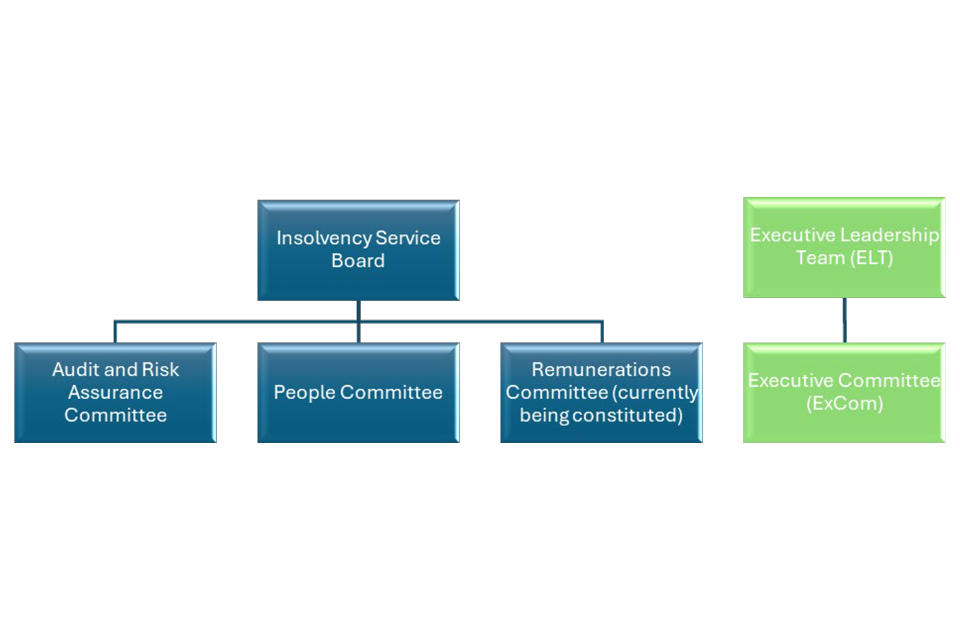
The ISB provides strategic leadership within a framework of prudent and effective controls which enable risk to be assessed and managed. It is collectively responsible for the long-term success of the agency. This includes setting strategic aims and objectives, ensuring that necessary leadership and resources are in place to deliver these aims, challenging and supporting management performance, and reporting to the Department for Business and Trade (DBT) and externally on its stewardship.
The prescribed composition of ISB is for a greater number of non-executive Board members (NEBMs) than executive members, designed to give an appropriate balance of skills, experience, independence and knowledge to enable the Board to effectively discharge its duties and responsibilities.
The ISB is independently led by a non-executive Chair who ensures its ongoing effectiveness and that it meets the high standards of regularity and propriety expected of a public body. The Chair is also responsible for ensuring that the Board both supports the CEO and executive team and also holds them to account for the agency’s performance, taking collective responsibility for the Insolvency Service’s overall success.
The ISB met eight times during the year, Matters considered by it included:
- regular review and scrutiny of progress against the 2025 to 2026 annual plan and targets
- approval of the agency’s budget for 2025 to 2026
- progress of the implementation of the agency’s five-year strategy, and consideration of the agency’s forthcoming strategy to 2030 due to be rolled out in 2026
- the adequacy of resources to deliver the agency’s strategic objectives and operations
- strategic priorities for the agency set in the context of developing the future long-term objectives for the Insolvency Service, departmental and wider government aims, and changes to external insolvency markets
- major projects delivering organisational change
- topical items such as technology principles and customer satisfaction, progress on major cases of public interest
- feedback from Board committees including reviewing the annual reports produced by the Audit and Risk Assurance Committee (ARAC) and People Committee
- regular assessment of exposure to, and management of, risks. The Board also reviewed agency risk appetite at their meeting in November 2025.
Management information is used extensively by the ISB to monitor agency risk and performance. An operational performance pack is presented to the Board by the Chief Operating Officer, highlighting progress against key targets. The information presented to the Board is closely monitored and challenged by directors at their monthly performance meeting before being presented to the Board. The agency’s strategic risk register is reviewed quarterly by the ARAC and bi-annually by ISB.
There have been no ministerial directions given to the agency during 2025 to 2026.
The ISB has three sub-committees, one of which is currently being constituted and is not yet in full operation: Audit & Risk Assurance Committee (ARAC), People Committee and a Remunerations Committee (RemCo). RemCo is currently being set up and is expected to hold its first meeting later in 2026 and its Terms of Reference have yet to be approved by the Board.
The ARAC is chaired by an appropriately qualified independent NEBM. Its membership comprises three further NEBMs. I attend along with the Finance, Commercial and Sustainability Director, and the internal and external auditors. Other senior leaders attend as required.
ARAC supports me as Accounting Officer and receives and reviews reports from both internal and external auditors. It reviews the annual financial statements prior to publication and provides assurance to ISB on controls and risk. ARAC met four times during the year.
Matters considered by ARAC included:
- approval of the internal audit plan, review of all internal audit reports issued, review of progress against the annual internal audit plan and annual audit opinion on risk management, governance, and internal control
- reviewing work on the preparation and completion of both the agency annual report and accounts and ISA (White Paper) accounts
- regular reviews of the agency risk register and risk management
- scrutiny of fraud and error incidents
- regular reviews of the agency’s finance management reports
- assurance reviews of the following areas
- commercial controls: managing third party risk and data handling
- cyber security
- relationship with Companies House
The People Committee is an advisory sub-committee of the ISB and is delegated by the Board to provide governance, advice, support and to oversee activity relating to:
- people strategy
- staff engagement and culture change
- diversity, inclusion and wellbeing
- health and safety
- talent management and succession planning
- change capability
- future state organisational capability
People Committee is chaired by an independent NEBM. It also includes two other NEBMs, two executive Board members and one external committee member. People Committee met three times during the year.
Matters considered by the committee included:
- performance management
- learning and development
- talent and succession planning (including Board Skills matrix)
- equality, diversity and inclusion
- People Survey results (including engagement and culture)
- annual health and safety report
The Remunerations Committee (RemCo) is currently being constituted following the delegation of SCS1 pay matters from DBT to the agency. This will meet twice a year to satisfy itself that the agency is complying with Cabinet Office spending controls and any delegations from DBT in respect of SCS pay. Its membership will consist of two NEBMs and the CEO. Matters to be considered by the Committee include:
-
agreeing the agency’s SCS pay strategy and remuneration framework
-
scrutinising and moderating performance assessments and performance-related pay recommendations
-
approving starting salaries for SCS1 appointments
-
overseeing the recruitment and appointment process for SCS1 roles
-
reviewing pay equity across SCS1 roles
-
providing assurance to the Board that pay decisions are consistent, fair, and affordable, and considering any exceptional pay proposals
The Executive Committee (ExCom) meets twice monthly to review agency performance, finance, strategy and operational and strategic risks. I share chairing responsibilities for ExCom meetings with the Chief Operating Officer. All directors, (collectively known as ELT), are involved in decision making at these meetings. The ELT is responsible for discussing agency risks and issues, and monthly management information including, but not limited to, the agency’s performance targets.
The following table summarises NEBM attendance at ISB, ARAC and People Committee meetings held between April 2025 and March 2026.
| Non-Executive Board Members | Insolvency Service Board (ISB) | Audit and Risk Assurance Committee (ARAC) | People Committee (PC) |
|---|---|---|---|
| Mark Austen (Chair of ISB) | 8/8 | N/A | 4/4 |
| Robert Hunt (Chair of ARAC) | 8/8 | 4/4 | N/A |
| Samantha Durrant (Chair of People Committee) | 8/8 | N/A | 4/4 |
| Gary Kildare | 8/8 | 2/4 | N/A |
| Eoin Parker* | 1/2 | N/A | 0/1 |
| Frances Coulson | 8/8 | 3/4 | N/A |
| Lorcan O’Connor | 8/8 | 4/4 | N/A |
| Matilda Curtis** | 4/4 | N/A | 1/1 |
| Chris Carr*** | 2/3 | N/A | 1/1 |
- Eoin Parker left his role as departmental sponsor in May 2025
** Matilda Curtis took the role of departmental sponsor temporarily between April 2025 to July 2025 and again from January 2026
*** Chris Carr took on the role of departmental sponsor in September 2025 and departed in December 2025
Compliance with the Corporate Governance Code for Central Government Departments
An external Board Effectiveness Review is planned for 2026. This is expected to be completed by September 2026.
The last external review of Board effectiveness was undertaken in 2023. This review found many areas of good practice. Key strengths were identified in the breadth of skills and experience, the balance of support and challenge in meetings and the strong sense of customer focus by the Board. The recommendations focussed on strengthening the Board’s succession planning, deepening Board members’ understanding of the agency’s operational teams and building relationships with internal and external stakeholders. These were addressed via an action plan with all agreed recommendations now completed.
Strategic planning review
During 2025 to 2026, the agency has successfully delivered the final year of its five-year agency strategy. The programme of projects aimed to deliver a modernised, responsive, and sustainable service that puts customers at the heart of everything we do.
Following the agency’s funding settlement from HM Treasury in the Comprehensive Spending Review 2021, this year we have invested over £13 million in our transformation plans and delivered more effective and efficient services across all seven of our strategic themes.
The agency has now completed the final year of its strategy. It is developing a new strategy that will focus on increasing the economic impact of the agency’s work.
Risk and internal control framework
Risk management framework
Risk management is a key aspect of the agency’s internal control framework. A fundamental part of the agency’s risk management process is the regular review of the management of individual risks by the ExCom. Agency risks are maintained in a register that captures strategic and operational risks and details the controls and actions required to mitigate these to a manageable level.
During the year, the key risks and issues which were likely to impact on our ability to meet our objectives were identified and assessed for likelihood and impact. Each risk or issue is owned by a Director, and these are reviewed by the ExCom at each monthly meeting where we challenge the mitigating actions put forward and collectively agree the approach to be taken to manage the risk. When considering proposed mitigating action, the ExCom will consider the cost and benefit of such action.
The Risk Management process and the risk register is scrutinised by the ARAC at every meeting to ensure that it is operating effectively. Risks and issues are reported to the ISB at least twice a year. The register is also used to inform the annual audit plan.
ARAC and the ISB maintain oversight and monitor the mechanisms for the assessment and management of risk; ExCom identifies, defines and investigates new risks across the organisation to ensure that appropriate mitigating measures are in place.
Significant issues
Our agency’s Redundancy Payments Service (RPS) is responsible for making certain payments in respect of debts owed by insolvent employers to employees under section 182 of Part 12 of the Employment Rights Act 1996, on behalf of the Secretary of State.
Our agency uses a calculation engine to determine the appropriate amount of Income Tax and National Insurance to be deducted from taxable components paid to former employees of insolvent employers. The RPS calculation engine was built, following consultation with HM Revenue & Customs (HMRC) in 2018.
Following further engagement with HMRC, we have worked to understand the complexity of National Insurance Contributions (NIC) deductions from Secretary of State payments. This complexity is exacerbated by the difficulty of applying social security contributions regulations and guidance in HMRC’s national insurance manuals to the unique circumstances of RPS.
In December 2021, our agency undertook a review of the calculation leading to queries being raised with HMRC about the accuracy of the calculation methodology. HMRC advised that RPS’s calculation engine would require amending to be compliant with its interpretation of the applicable legislation.
Following these enquiries, including working with expert Counsel, it has been determined that the solution remains complex, as the application of National Insurance deductions is determined by a number of factors including the redundancy component having been paid, when it was paid, what other payments it was paid in conjuncture with, and the individual claimant’s earnings period. In addition, HMRC also informed RPS that its status as a payer of redundancy and related payments could only be that of an ‘other payer.’ In practice, this determination would mean that our agency is required to perform the calculations, deductions, and reporting of ‘Pay As You Earn’ and NICs on the claimant’s specific earnings to HMRC.
Following further discussions with HMRC, RPS, with the assistance of government lawyers, modelled scenarios dealing with all possible combinations of payments in order to seek an understanding as to how NICs should be deducted. It should be noted that payments made by RPS can also span different earnings periods and tax years. To manage the workflow to HMRC, the scenarios were shared in an iterative manner throughout 2023 to 2024, with amendments made to those scenarios as feedback was received.
We have continued to engage with HMRC throughout the current financial year, during the period our agency successfully agreed an appropriate methodology to calculate National Insurance (NI) on taxable components. This falls within the scope of an agency project which is anticipated to be completed in 2028 and will deliver and end to end solution.
Payments will be recalculated in line with revised HMRC guidance. In order to recalculate, our agency will have to contact claimants since December 2021 to obtain additional information in order to determine the recipient’s earnings period and for their bank details. The project is due to finish in 2027 to 2028.
In order to quantify the potential error, our agency has modelled scenarios to assess the potential impact of applying the calculation engine changes advised by HMRC in 2023 to 2024.
As such we cannot, with total accuracy, estimate the value of the impact as we do not retain usual earnings period data and modelling the waterfalling of some payments before the implementation of a remediated calculation engine is not practicable.
Therefore, we have devised an appropriate estimation model that will provide a material approximation of the size of the error. This methodology calculates the NI on each component using a weekly, and monthly threshold and then creates a blended average to reflect the composition of payment frequency in the wider economy.
Based upon this methodology, we estimate a potential £1 million under deduction and a £2 million over deduction of national insurance across c.110,000 individual components in 2024 to 2025. The gross value of these deductions represents c.0.6% of the total value of RPS payments of c.£496.9 million. The median over deduction is c.£25 and the median under deduction is c.£30.
On a cumulative basis since December 2021, we have issued total RPS payments of £2.1 billion with total estimated over deductions of £9.2 million (0.43%) and under deductions of £5.7 million (0.27%). The cumulative value of over deductions, £9.2 million, has been classified as a provision, details of which can be seen in Note 12.
Given the low median values of under-deductions, many of these will be written off as uneconomic to recover, as many components fall below our agency’s internal de minimis. Larger balances will be recovered through our agency’s established debt recovery processes within RPS, though noting that the process to recover these will have to be agreed with HMRC. Our agency will then explore the costs of issuing additional payments to correct over deductions and devise an appropriate approach in conjunction with HMRC.
Our agency has continued to make redundancy payments as required by law since the issue with NIC deductions was first raised. Managing Public Money does require that our agency prevent recurrence of irregular spending; however, as the irregularity pertains to supporting those in financial distress it has been agreed with the Department and with HMRC, that we should continue to make redundancy payments whilst working towards remediating any deduction errors within our NIC calculation engine. Our agency, acting for the Secretary of State, is bound by legislation to make payments to those eligible for the RPS scheme, therefore ceasing payments would contravene legislation as well as the principle of regularity as set out within Managing Public Money. It may also impact the contributory benefit entitlement of the recipients of the payments. For example, it may lead to gaps in an individual’s national insurance contributions record, affecting their entitlement to state benefits.
In September 2025, two further issues were identified within RPS calculation processes which dated back to 2019 and had resulted in overpayments totalling £2.4 million across 1,078 claims. There were no associated underpayments.
In certain situations, if a claimant provided an employment start date that predated the date of incorporation of their employer, Redundancy Pay and Compensatory Notice Pay would be automatically calculated from this date even where employer records provided a later date. At present, £57,200 has been recovered through repayment or offsetting; £71,000 has been referred to our recovery agents.
Overpayments relating to claims from December 2021 onwards will be addressed as part of the wider recalculation exercise within the RPS Calculations and Service Development project.
Following implementation, issues were identified with the original fix, resulting in a temporary pause to recovery activity. Corrective changes have been developed and completed by our supplier. A further release is being progressed, following which a reassessment of the recovery approach and associated timelines will be undertaken.
Key strategic risks
Our agency may be vulnerable to cyberattack due to a lack of appropriate controls on its information assets. The risk is actively managed and reflects a significant part of the work of the Change and Technology Services within our agency. Our agency has an overarching strategy for Cyber Security improvement, focussed on three key areas: culture, patching, and network security.
Actions in the three key areas include compulsory annual bespoke all staff training, system documentation, security patching within specific time frames and an ongoing programme to remove vulnerabilities
Cyber risk will remain a key risk for all organisations for the foreseeable future. Our agency has put corporate controls in place to reduce the level of residual risk. An assessment of our agency’s infrastructure is undertaken against the National Cyber Security Centre’s Cyber Assessment framework. Measures taken include penetration testing of resources, prompt patching of software (including through a review of contracts) and encryption.
Our agency may fail to proportionally adopt Artificial Intelligence and ensure the data used for decision making is accurate and from reliable sources. Our agency has controls in place structured around Artificial Intelligence’s (AI) use in data security, data quality, people training and support), commercial application, and counter fraud.
Furthermore, our agency has contracted expertise to develop an AI roadmap. Alongside this, our agency is part to several cross-government AI forums in order to identify and share best practice.
There is a risk that the agency is unable to deliver its portfolio of change at a sustainable pace due to capacity constraints, competing priorities, and variable organisational readiness, which may result in delivery delays, and cost pressures. This is mitigated through strengthened portfolio oversight, prioritisation, and resource planning.
Further mitigating actions include strengthening resource modelling, clarifying roles and accountabilities, and embedding regular prioritisation cycles to ensure delivery remains aligned with organisational capacity and strategic priorities.
Key operational risk
Risk that inefficient counter fraud controls in our agency could cause fraud not to be effectively prevented, detected or recovered. Our agency has a counter fraud action plan with measurable targets that is reported quarterly to the Public Sector Fraud Authority and undertakes audits to detect fraud. Fraud risks are prioritised on the basis of data including Fraud Risk Assessment which are drawn from all areas of the business. The activities that the agency has taken in 2025 to 2026 to mature the function and mitigate this risk are at page 47.
Internal controls
Quality assurance of analytical models
Further to a Government Internal Audit Agency (GIAA) review in 2022 to 2023, all recommendations relating to the assurance of the two business-critical Income models, used by our agency in relation to planning assumptions for case inputs and fee income, have been closed.
To mitigate the identified risks with a single point of failure, our agency continues to implement independent review to assure the accuracy and reliability procedure to validate the complex income models. Through promotion and rotation in Official Receiver Service Finance Business Partner roles, there is increased overall capability and detailed knowledge and understanding of the models through a broader number of staff with income accounting knowledge.
To ensure income assumptions have been applied appropriately the data available has been considered by a variety of internal stakeholders, including colleagues from operations with detailed understanding of casework processes. In previous reviews recommendations were primarily based on subjective considerations, however this broader input has added the capacity to link economic, operational and fee regime changes to improve the reliability of the review.
Finance staff have also held meetings with external stakeholders to review whether modelling could be amended to reflect forecast economic conditions; however, this was discounted as the resource demands and complexity were considered disproportionate to any benefit that might be gained.
Finally, to improve change management procedures our agency has adopted more rigorous version control of the income models and a reconciliation between the income models and their source data.
The Income Accounting Team will continue to periodically review the models and processes to ensure they are reliable and align with our agency’s strategic plans, whilst also reflecting any significant economic, operational and fee regime changes.
Effectiveness of Raising a Concern Policy
We work in partnership with our parent department to give independent oversight and assurance to our Raising a Concern policy. The policy and procedure we use were adopted from the Civil Service Employee Policy and constructed with reference to the Public Interest Disclosure Act 1998, which offers protection to those in both the private and public sectors who blow the whistle, in certain circumstances.
Our aim is to raise and encourage awareness of our whistleblowing policies and procedures, and to create a culture where it is a safe place to raise a concern so that employees speak up and challenge suspected wrongdoing at work.
Our agency has a dedicated Raising a Concern Nominated Officer responsible for providing support to the whistle blower whilst undertaking an impartial review of the concerns raised to determine whether they fall under the Raising a Concern policy and decide on the most appropriate way to take the matter forward; they are also the central point of contact for the whistle blower and any investigation.
Our Raising a Concern policy, procedures and guidance are on our Intranet which is available to all employees and the policy is highlighted through internal communications annually. Particularly, in the last year a video presentation was delivered to all staff to outlines the process and address staff questions.
One issue was raised during 2025 to 2026 that fell within the scope of the policy and was appropriate to investigate within it.
Customer feedback and complaints process
Our agency Annual Plan sets a target against which we can measure customer satisfaction. The Insolvency Service gathers feedback from our service users by means of:
- an annual customer satisfaction survey
- annual surveys with delivery partners
- service exit surveys
- our complaint process
The customer satisfaction survey is conducted by an independent research agency who uses computer-assisted telephone interviews that typically last around 15 minutes. The delivery partner surveys and exit surveys are conducted in house via an online survey.
The yearly surveys capture the perceptions and experiences of the main customer groups using our services.
The Insolvency Service complaint process consists of two internal tiers with a third external independent review by our oversight regulator the Parliamentary and Health Service Ombudsman (PHSO). We aim to respond to 90% of complaints within 10 working days of receipt. During 2025 to 2026 this target was exceeded. If we are unable to respond within our usual time frame, we make contact within five working days to advise the reasons why.
In 2025 to 2026, the Parliamentary and Health Service Ombudsman did not take forward any complaints concerning the Insolvency Service for investigation.
An integral lessons-learned procedure advances our performance while embedding a culture of continuous improvement.
Delegated financial authorities
Our agency’s budgets are allocated at director-level, in line with approved ExCom and ISB annual budgets that align to directorate plans. Budget positions are reported quarterly to ISB and monthly to ExCom at agency level and monthly to directors at directorate level by Finance Business Partners.
A delegated financial authority system is in place throughout our agency as a key financial control to ensure that formal processes exist for the assessment, approval, and authorisation of expenditure. These were last reviewed and updated in January 2026. A schedule of delegations is available to all staff.
My financial delegations as Accounting Officer are set by DBT and sub-delegated to directors and senior leaders.
Physical security
Our agency had 13 main and three Remote Interview Facilities across England, Wales and Scotland, reducing to 11 main and three Remote Interview Facilities across England, Wales and Scotland at the close of the Financial Year. The majority of our sites have high protective security control systems.
Our agency ensures that National Protective Security Authority (NPSA), Operational Requirements Inspections and Secure by Design Principles are adhered to. The NPSA methodology has enabled the Physical Security and Resilience Team to identify and remediate sites which fall below NPSA standards across the estate.
Our agency will always implement proportionate protective security controls to ensure the safety of personnel and the protection of assets and information at the Official Sensitive level.
During the year, our agency achieved a 100% compliance level in the annual Departmental Security Health Check report against the Security Functional Standard 007. There were no reportable physical breaches of security or protective security issues during the financial year.
Information governance
Our agency’s Chief Information Officer is Ian Dogherty, director for change and technology services, who oversees information risk and is supported in the role by the security team. A network of information asset owners exists in a manner consistent with published guidance, ‘The Role of Information Asset Owners in Government’.
During the reporting year our agency made two reports to the Information Commissioner’s Office.
Compliance with statutory timescales for the provision of information were adequate over the reporting year, with 99% of Freedom of Information and 98% of Subject Access Request responses within statutory timescales.
Our agency replied to two Freedom of Information requests and four subject access requests outside the statutory timescales.
Government Functional Standards
Heads of Function and Functional Leads have been appointed across our agency.
Heads of Function that have subject specific Standards undertake a process of self-assessment and are peer reviewed each year by partner organisations, together with additional oversight and assurance activities undertaken by Corporate Governance team to monitor and ensure compliance with the Standard.
| Standard | Narrative |
|---|---|
| GovS 001: Government Functions | GIAA have undertaken a review of some functional standards including 001 as part of our audit programme. The outputs from this are presently being considered by the agency. |
| GovS 002: Project Delivery | Since our last review in April 2025, we have continued to make steady progress across all elements of the functional standards categories. Every area is currently rated as good, with two areas now achieving a higher rating of ‘better’. This reflects the ongoing commitment across the team to embed and mature our standards. Looking ahead to the April 2026 review, our aim is to increase the number of areas rated in the better category as we further strengthen our practices. |
| GovS 003: Human Resources | Strategic workforce planning maturity assessments have been completed identifying our current maturity, key capability gaps and opportunities to improve alignment; a consequent agency-wide action plan is underway. A comprehensive review and redesign of our performance management and poor performance policies is in progress. |
| GovS 004: Property | Now that we are fully onboarded to the GPA, many of the metrics contained within Functional Standard 004 are no longer applicable to the agency from an internal operational perspective. To ensure we continue to drive continuous improvement, we are maintaining internal performance monitoring while also using this transition period to design a refreshed framework for ongoing assessment. In the new financial year, we will work with DBT, OGP and GIAA to develop and implement a structured approach for periodic reviews, performance metrics, and reporting mechanisms. This will include establishing measures for strategic alignment, operational effectiveness, and user satisfaction, ensuring we have a robust and repeatable process for continuous improvement. |
| GovS 005: Digital | Work to further embed our organisational design, project delivery approach and revised governance processes has commenced and continues to progress. While key foundations are now in place, full implementation is not yet complete. A comprehensive review will be required between April to June 2026 to ensure full compliance across the standard is achieved and maintained. |
| GovS 006: Finance | There have been no significant changes to the standard or working practises, therefore the agency is still compliant with the standard. A further internal and cross government annual review will take place in 2026 to 2027. Feasibility work completed during a review of potential new finance system has identified improvements to data handling and structure, with a project being setup in 2026 to 2027 to make these enhancements. Taking the agency above the standard compliance level, ensuring our systems are fit for the future. |
| GovS 007: Security | Annual and bi annual protective security assurance inspections were completed across all INSS Regional Centres and remote interview facilities, with full reports produced in line with required standards. Updated personal security guidance was published for all staff, supporting continued awareness and compliance. A draft five-year Physical Security and Resilience Strategy has been developed, including a defined communications plan to support implementation. Overall, the agency’s protective security posture remains proportionate to organisational needs and fully compliant with the GovS 007 Functional Standard. |
| GovS 008: Commercial and Commercial Continuous Improvement Framework | INSS Commercial produced and published its development plan and is currently working towards activities covered in its development plan following CCIAF assessment. Two of the four development activities have now been completed. During 2026 to 2027 a new assessment against standards will be undertaken in December or January. |
| GovS 009: Internal Audit | Our agency’s internal audit plan is aligned with its strategic risks and is approved by both the Executive Committee and ARAC. It primarily depends on the GIAA for audit delivery, with which it maintains a close working relationship. The self-assessment completed in April to June 2024, for the 2024 to 2025 financial year, confirmed compliance with all requirements. Since then, we have taken steps to mature our approach, including strengthening evidence collections, clarifying ownership of functional responsibilities, and improving the consistency of supporting documentation |
| GovS 010: Analysis | We have completed a second internal assessment against the functional standard, which showed an improvement in skills and also highlighted increased expectations among stakeholders. Detailed analysis plans are being drawn up for each of our areas of analysis. |
| GovS 011: Communication | We have delivered extensive communications about our enforcement outcomes, although primarily this seeks to drive a deterrent effect it also showcases how our work we do protects consumers and drives confidence in the economy. In all our communications we seek to draw the link between our work and the government’s focus driving economic growth. We now have a multiyear communications strategy in place aligned to organisational outcomes, as per Government Communications Service best practice. |
| GovS 012: | This standard number has not been allocated to a function or is deliberately blank. |
| GovS 013: Counter Fraud | The agency strengthened its internal and external reporting routes for fraud and error in 2025, resulting in increased savings through the prevention, detection and recovery of fraud. During this period, the agency also enhanced its compliance with GovS013 by completing a Compliance Improvement Assessment Framework in line with the requirements of the Public Sector Fraud Authority. The agency delivered a refreshed Counter Fraud Strategy in January 2026 and successfully delivered upon the strategy through a comprehensive annual Counter Fraud Action Plan, ensuring alignment with strategic priorities and continuous improvement across the counter fraud function. |
| GovS 014: Debt | The agency has not yet completed the transition of all debt types to online systems. This delay results from the prioritisation of the agency’s new case management system (FCMC). As a result, full compliance has not yet been achieved. However, implementation work is now underway, with all debt types scheduled to be fully integrated into the system by the end of June 2026. Following completion, an internal and cross government review will be carried out during 2026 to 2027 to reassess overall compliance. |
| GovS 015: Grants | Our agency does not issue grants and as such is not subject to GOVS 015 grants. Therefore, no assessment, peer review, or improvement plan is required for this Standard. |
Accounting Officer annual review of governance effectiveness
Internal audit
The audit programme is prepared by the GIAA and discussed with and approved by the Executive Leadership team. The annual audit plan is informed by our agency’s key risks and strategic objectives and is reassessed during the year to ensure assignments focus on business priorities and highest risk. The internal audit plan is approved annually by ARAC which receives copies of all reports and reviews progress at each meeting.
Internal audit annual assurance opinion
The Head of Internal Audit provides a report annually on the internal audit activity during the year. This opinion is based on the results of individual audit engagements undertaken throughout the year, attendance at boards and committees and regular meetings with senior management. The report provides an opinion on the adequacy and effectiveness of internal control and for 2025 to 2026 the overall audit opinion given is Moderate: Some improvements are required to enhance the adequacy and effectiveness of the framework of governance, risk management and control’.
Our agency continues to maintain a proportionate level of key controls. Internal audit reviews have generally highlighted areas with good levels of governance in broad alignment with relevant functional standards and good practice. They have provided guidance regarding how we might further improve the effectiveness of our new change model and how to sharpen governance over payments arising from operational errors, including fruitless and ex gratia payments. Our agency continues to be proactive in managing actions arising from audit recommendations to closure and has committed to review older recommendations which have not been implemented to ensure we are not carrying an unreasonable level of risk.
Accounting Officer conclusion
I have considered the evidence provided regarding the production of the Annual Governance Statement and the independent advice and assurance provided by the Audit and Risk Assurance Committee. I was appointed Chief Executive and Accounting Officer in January 2026, and I am satisfied that the handover arrangements, which included meetings with my predecessor, are sufficient for me to provide assurance that a sound system of internal control was in place for the year as a whole. I conclude that our agency has satisfactory governance and risk management systems with effective plans to ensure continuous improvement.
Signed:
Duncan Beach
Chief Executive
Date: 8 July 2026
Remuneration and staff report
Remuneration report
Service contracts
Insolvency Service employees are civil servants. The Constitutional Reform and Governance Act 2010 requires Civil Service appointments to be made on merit on the basis of fair and open competition. The Recruitment Principles published by the Civil Service Commission specify the circumstances when appointments may be made otherwise.
Unless otherwise stated below, the officials covered by this report hold appointments which are open-ended. Early termination, other than for misconduct, would result in the individual receiving compensation as set out in the Civil Service Compensation Scheme.
Further information about the work of the Civil Service Commission can be found at www.civilservicecommission.org.uk.
Remuneration policy
The remuneration of senior civil servants is set by the Cabinet Office following independent advice from the Review Body on Senior Salaries.
In reaching its recommendations, the review body is to have regard for the following considerations:
- the need to recruit, retain and motivate suitably able and qualified people to exercise their different responsibilities
- regional and local variations in labour markets and their effects on the recruitment and retention of staff
- government policies for improving the public services including the requirement on departments to meet the output targets for the delivery of departmental services
- the funds available to departments as set out in the government’s departmental expenditure limits
- the government’s inflation target
The review body will also take account of the evidence it receives about wider economic considerations and the affordability of its recommendations.
Further information about the work of the review body can be found at www.gov.uk/government/organisations/review-body-on-senior-salaries
Remuneration disclosure
The following sections provide details of the remuneration and pension interests of the most senior management of the Insolvency Service, its Board members.
Salary includes gross salary, overtime, reserved rights to London weighting or London allowances, recruitment and retention allowances, private office allowances, and any other allowance to the extent that it is subject to UK taxation.
This report is based on accrued payments made by the Insolvency Service and thus recorded in these Accounts.
The monetary value of benefits in kind covers any benefits provided by the Insolvency Service and treated by HM Revenue & Customs as a taxable emolument. Benefits in kind were nil in both 2025 to 2026 and 2024 to 2025.
Bonuses are based on performance levels attained and are made as part of the appraisal process. Bonuses relate to the performance in the year in which they become payable to the individual. The bonuses reported in 2025 to 2026 relate to performance in 2025 to 2026 and the comparative bonuses reported for 2024 to 2025 relate to the performance in 2024 to 2025.
Non-executive members get fees for duties on behalf of the Insolvency Service, such as attendance at Board and Committee meetings.
In order to balance reporting requirements against individual privacy, in most cases we report remuneration figures in £5,000 bands (for example £65,000 to £70,000).
Fees paid to non-executive board members (audited)
| Non-executive board member | 2025-26 £’000 | 2024-25 £’000 |
|---|---|---|
| Mark Austen Chair | 15-20 | 15-20 |
| Frances Coulson | 10-15 | 10-15 |
| Samantha Durrant | 10-15 | 10-15 |
| Robert Hunt | 10-15 | 10-15 |
| Gary Kildare | 10-15 | 10-15 |
| Lorcan O’Connor | 10-15 | 10-15 |
| Eoin Parker1 (from 20 April 2021 to 27 April 2025) |
Nil | Nil |
| Matilda Curtis1 (28 April 2025 to 13 July 2025, again from 1 January 2026) |
Nil | Nil |
| Chris Carr1 (14 July 2025 to 31 December 2025) |
Nil | Nil |
1 Eoin Parker, Matilda Curtis, and Chris Carr are civil servants (DBT) and are not additionally remunerated for serving on the Board.
None of the non-executive board members received any benefits in kind in either year.
Remuneration Received - including salary, benefits in kind, and pensions (audited)
| Senior officials | Salary (£’000) | Bonus payments (£’000) | Benefits in kind (to nearest £100) | Pension benefits1 (£’000) | Total (£’000) | |||||
|---|---|---|---|---|---|---|---|---|---|---|
| 2025-26 | 2024-25 | 2025-26 | 2024-25 | 2025-26 | 2024-25 | 2025-26 | 2024-25 | 2025-26 | 2024-25 | |
| Dean Beale2 Chief Executive (until 12 May 2025) | 10-15 | 115-120 | Nil | 0-5 | Nil | Nil | 19 | 63 | 30-35 | 180-185 |
| Duncan Beach3 Chief Executive (from 5 January 2026) | 35-40 | Nil | Nil | Nil | Nil | Nil | 15 | Nil | 50-55 | Nil |
| Alec Pybus4 Chief Operating Officer (until 12 May 2025) Interim Chief Executive (13 May 2025 to 4 January 2026) Senior Executive Advisor to CEO (5 January 2026 to 31 March 2026) |
120-125 | 110-115 | 15-20 | Nil | Nil | Nil | 49 | 44 | 185-190 | 155-160 |
| John Wheatle5 Interim Chief Operating Officer (13 May 2025 to 31 March 2026) | 85-90 | Nil | 0-5 | Nil | Nil | Nil | 17 | Nil | 105-110 | Nil |
| Chantel Kelly6 Finance, Commercial, Sustainability and Property Director (from 9 November 2024) | 85-90 | 30-35 | 0-5 | Nil | Nil | Nil | 30 | 14 | 115-120 | 45-50 |
| Melissa Quignon-Finch7 People and Communications Director (from 1 May 2025) | 90-95 | Nil | 5-10 | Nil | Nil | Nil | 35 | Nil | 130-135 | Nil |
| Angela Crossley8 Strategy, Policy and Analysis Director | 60-65 | 100-105 | 0-5 | 0-5 | Nil | Nil | 20 | 66 | 85-90 | 170-175 |
| Claire Hardgrave8 Strategy, Policy and Analysis Director (from 2 June 2025) | 45-50 | Nil | 0-5 | Nil | Nil | Nil | 57 | Nil | 105-110 | Nil |
1 Accrued pension benefits included in this table for any individual affected by the Public Service Pensions Remedy have been calculated based on their inclusion in the legacy scheme for the period between 1 April 2015 and 31 March 2022, following the McCloud judgment. The Public Service Pensions Remedy applies to individuals that were members, or eligible to be members, of a public service pension scheme on 31 March 2012 and were members of a public service pension scheme between 1 April 2015 and 31 March 2022. The basis for the calculation reflects the legal position that impacted members have been rolled back into the relevant legacy scheme for the remedy period and that this will apply unless the member actively exercises their entitlement on retirement to decide instead to receive benefits calculated under the terms of the Alpha scheme for the period from 1 April 2015 to 31 March 2022.
2 Dean Beale left the agency on 12 May 2025. His full year equivalent salary was £115,000 to £120,000.
3 Duncan Beach joined the agency on 5 January 2026 as Chief Executive. His full year equivalent salary was £155,000 to £160,000.
4 Alec Pybus served as Chief Operating Officer (until 12 May 2025), Interim Chief Executive (13 May 2025 to 4 January 2026), and Senior Executive Adviser to CEO (5 January 2026 to 31 March 2026. His full year equivalent salary was £120,000 to £125,000.
5 John Wheatle was appointed Interim Chief Operating Officer on 13 May 2025, covering the role while Alec Pybus served as Interim Chief Executive. His full year equivalent salary was £95,000 to £100,000.
6 Chantel Kelly was appointed on 9 November 2024, succeeding Christopher Pleass who left on 8 November 2024. Chantel Kelly’s full year equivalent salary was £75,000 to £80,000 in 2024 to 2025
7 Melissa Quignon-Finch was appointed on 5 May 2025, succeeding Daniel Goad who left on 28 February 2025. Melissa Quignon-Finch’s full year equivalent salary was £95,000 to £100,000.
8 During 2025 to 2026 Angela Crossley moved to a part-time working pattern (0.6 FTE) and a job share was established, her full year equivalent salary for 2025 to 2026 was £60,000 to £65,000. Claire Hardgrave was appointed to the job share on 2 July 2025 on a 0.6 FTE basis, with a full year equivalent salary of £50,000 to £55,000.
Fair pay disclosure (audited)
Reporting bodies are required to disclose the banded percentage change from previous financial year in respect of the highest paid director and an average in respect of all employees taken as a whole.
| Banded percentage change from prior year | Salary and allowances | Performance pay and bonuses |
|---|---|---|
| As at 31 March 2026 | ||
| For highest paid director1 | 34% | (100%) 3</sub> |
| For average employee2 | 10% | 5% |
| As at 31 March 2025 | ||
| For highest paid director1 | 9% | (67%) |
| For average employee2 | 1% | 11% |
1 Calculated on the midpoint of a rounded £5,000 pay-band. The highest paid director as at 31 March 2026 is different to the individual as at 31 March 2025.
2 Based on the total pay for all employees on an annualised basis, excluding the highest paid director, divided by the full-time equivalent number of employees (also excluding the highest paid director).
3 Numbers in brackets show a reduction.
Reporting bodies are also required to disclose the relationship between the remuneration of the highest-paid director in their organisation and the quartile remuneration of the organisation’s workforce.
| Year | 25th percentile pay ratio1 | 50th percentile Median pay ratio1 | 75th percentile pay ratio1 |
|---|---|---|---|
| As at 31 March 2026 | 5.2:1 | 4.0:1 | 3.1:1 |
| As at 31 March 20252 | 4.4:1 | 3.3:1 | 2.6:1 |
1 Calculated on the midpoint of a £5,000 rounded pay-band for the highest paid director.
2 As at 31 March 2025 there was an outstanding pay award for staff below the senior civil service. This had the effect of making the figures for 31 March 2025 lower than they would otherwise be.
Pay ratios increased compared to last year, reflecting a new highest-paid director and two pay awards implemented during 2025 to 2026 following the agreement of a business case for additional pay flexibility with Cabinet Office and HM Treasury.
The change in ratios is consistent with the increase in pay for the new highest paid director, along with the pay reward and progression policies of staff below senior civil service where our agency aims to prioritise junior grades.
| 25th percentile pay | 50th percentile (median pay) | 75th percentile pay | |
|---|---|---|---|
| As at 31 March 2026 | |||
| Total remuneration | £30,541 | £39,421 | £50,928 |
| Salary component only | £30,135 | £37,659 | £49,628 |
| As at 31 March 20251 | |||
| Total remuneration | £27,505 | £36,063 | £47,103 |
| Salary component only | £26,711 | £34,341 | £44,812 |
1 As at 31 March 2025 there is an outstanding pay award for staff below the senior civil service. This has the effect of making the figures for 31 March 2025 lower than they would otherwise be.
As at the 31 March 2026 remuneration ranged from £18,000 to £195,000 (31 March 2025, £18,000 to £200,000). This range includes where agency workers and contractors have had their pay calculated as if employed for a full year on a full-time basis. As at 31 March 2026, two people (31 March 2025: 23 people) received remuneration in excess of the highest paid director. This decrease is due to the change in the highest paid director.
Compensation for loss of office (audited)
During 2025 to 2026 no senior managers have received compensation for loss of office (2024 to 2025: none).
Civil Service pensions
Pension benefits are provided through the Civil Service pension arrangements. Before 1 April 2015, the only scheme was the Principal Civil Service Pension Scheme (PCSPS), which is divided into a few different sections - classic, premium, and classic plus provide benefits on a final salary basis, whilst nuvos provides benefits on a career average basis. From 1 April 2015 a new pension scheme for civil servants was introduced - the Civil Servants and Others Pension Scheme, or ‘alpha’, which provides benefits on a career average basis. All newly appointed civil servants, and the majority of those already in service, are in alpha.
The PCSPS and alpha are unfunded statutory schemes. Employees and employers make contributions (employee contributions range between 4.6% and 8.05%, depending on salary). The balance of the cost of benefits in payment is met by monies voted by Parliament each year. Pensions in payment are increased annually in line with the Pensions Increase legislation. Instead of the defined benefit arrangements, employees may opt for a defined contribution pension with an employer contribution, the partnership pension account.
In alpha, pension builds up at a rate of 2.32% of pensionable earnings each year, and the total amount accrued is adjusted annually in line with a rate set by HM Treasury. Members may opt to give up (commute) pension for a lump sum up to the limits set by the Finance Act 2004.
All members who switched to alpha from the PCSPS had their PCSPS benefits ‘banked’, with those with earlier benefits in one of the final salary sections of the PCSPS having those benefits based on their final salary when they leave alpha.
The accrued pensions shown in this report are the pension the member is entitled to receive when they reach normal pension age, or immediately on ceasing to be an active member of the scheme if they are already at or over normal pension age. Normal pension age is 60 for members of classic, premium, and classic plus, 65 for members of nuvos, and the higher of 65 or State Pension Age for members of alpha. The pension figures in this report show pension earned in PCSPS or alpha - as appropriate. Where a member has benefits in both the PCSPS and alpha, the figures show the combined value of their benefits in the two schemes but note that the constituent parts of that pension may be payable from different ages.
When the government introduced new public service pension schemes in 2015, there were transitional arrangements which treated existing scheme members differently based on their age. Older members of the PCSPS remained in that scheme, rather than moving to alpha. In 2018, the Court of Appeal found that the transitional arrangements in the public service pension schemes unlawfully discriminated against younger members (the “McCloud judgment”).
As a result, steps are being taken to remedy those 2015 reforms, making the pension scheme provisions fair to all members. The public service pensions remedy is made up of two parts. The first part closed the PCSPS on 31 March 2022, with all active members becoming members of alpha from 1 April 2022. The second part removes the age discrimination for the remedy period, between 1 April 2015 and 31 March 2022, by moving the membership of eligible members during this period back into the PCSPS on 1 October 2023. This is known as “rollback”.
For members who are in scope of the public service pension remedy, the calculation of their benefits for the purpose of calculating their Cash Equivalent Transfer Value and their single total figure of remuneration, as of 31 March 2025 and 31 March 2026, reflects the fact that membership between 1 April 2015 and 31 March 2022 has been rolled back into the PCSPS. Although members will in due course get an option to decide whether that period should count towards PCSPS or alpha benefits, the figures show the rolled back position i.e., PCSPS benefits for that period.
The partnership pension account is an occupational defined contribution pension arrangement which is part of the Legal & General Mastertrust. The employer makes a basic contribution of between 8% and 14.75% (depending on the age of the member). The employee does not have to contribute but, where they do make contributions, the employer will match these up to a limit of 3% of pensionable salary (in addition to the employer’s basic contribution). Employers also contribute a further 0.5% of pensionable salary to cover the cost of centrally provided risk benefit cover (death in service and ill health retirement).
Further details about the Civil Service pension arrangements can be found at the website www.civilservicepensionscheme.org.uk.
Cash Equivalent Transfer Values
A Cash Equivalent Transfer Value (CETV) is the actuarially assessed capitalised value of the pension scheme benefits accrued by a member at a particular point in time. The benefits valued are the member’s accrued benefits and any contingent spouse’s pension payable from the scheme. A CETV is a payment made by a pension scheme or arrangement to secure pension benefits in another pension scheme or arrangement when the member leaves a scheme and chooses to transfer the benefits accrued in their former scheme. The pension figures shown relate to the benefits that the individual has accrued as a consequence of their total membership of the pension scheme, not just their service in a senior capacity to which disclosure applies.
The figures include the value of any pension benefit in another scheme or arrangement which the member has transferred to the Civil Service pension arrangements. They also include any additional pension benefit accrued to the member as a result of their buying additional pension benefits at their own cost.
CETVs are worked out in accordance with The Occupational Pension Schemes (Transfer Values) (Amendment) Regulations 2008 and do not take account of any actual or potential reduction to benefits resulting from Lifetime Allowance Tax which may be due when pension benefits are taken.
Real increase in CETV
This reflects the increase in CETV that is funded by the employer. It does not include the increase in accrued pension due to inflation, contributions paid by the employee (including the value of any benefits transferred from another pension scheme or arrangement) and uses common market valuation factors for the start and end of the period.
Pension benefits (audited)
| Officials | Accrued pension1 at pension age as at 31 March 2026 | Real increase in pension | CETV2 at 31 March 2026 | CETV2 at 31 March 2025 | Real increase in CETV3 |
|---|---|---|---|---|---|
| £’000 | £’000 | £’000 | £’000 | £’000 | |
| Dean Beale | 60 - 65 | 0 - 2.5 | 1,202 | 1,180 | 18 |
| Duncan Beach | 0 - 5 | 0 - 2.5 | 12 | 0 | 9 |
| Alec Pybus | 25 - 30 | 2.5 - 5 | 414 | 359 | 36 |
| John Wheatle | 40 - 45 | 0 - 2.5 | 897 | 845 | 5 |
| Chantel Kelly | 30 - 35 | ||||
| plus a lump sum of 75 - 80 | 0 - 2.5 plus a lump sum of 0 | 752 | 690 | 20 | |
| Melissa Quignon-Finch | 20 - 25 | 0 - 2.5 | 227 | 197 | 16 |
| Angela Crossley | 45 - 50 plus a lump sum of 115 - 120 | 0 - 2.5 plus a lump sum of 0 | 1,112 | 1,076 | 15 |
| Claire Hardgrave | 30 - 35 plus a lump sum of 70-75 | 2.5 - 5 plus a lump sum of 2.5 - 5 | 614 | 549 | 48 |
1 Accrued pension benefits included in this table for any individual affected by the Public Service Pensions Remedy have been calculated based on their inclusion in the legacy scheme for the period between 1 April 2015 and 31 March 2022, following the McCloud judgment. The Public Service Pensions Remedy applies to individuals that were members, or eligible to be members, of a public service pension scheme on 31 March 2012 and were members of a public service pension scheme between 1 April 2015 and 31 March 2022. The basis for the calculation reflects the legal position that impacted members have been rolled back into the relevant legacy scheme for the remedy period and that this will apply unless the member actively exercises their entitlement on retirement to decide instead to receive benefits calculated under the terms of the Alpha scheme for the period from 1 April 2015 to 31 March 2022.
2 CETV figures are calculated using the guidance on discount rates for calculating unfunded public service pension contribution rates that was extant at 31 March 2026.HM Treasury published updated guidance on 27 April 2023; this guidance will be used in the calculation of 2025-26 CETV figures. Where an individual leaves or joins our agency part way through the year, the CETV columns refer to the value at the date of joining or leaving.
3 The final salary pension of a person in employment is calculated by reference to their pay and length of service. The pension will increase from one year to the next by virtue of any pay rise during the year. Where there is no or a small pay rise, the increase in pension due to extra service may not be sufficient to offset the inflation increase. This means that in real terms, the pension value can reduce.
Staff report
Senior staff by pay band
The table below provides the number of senior civil servants (SCS) or equivalent by pay band:
| As at 31 March 2026 | As at 31 March 2025 | |
|---|---|---|
| SCS pay band 2 | 1 | 1 |
| SCS pay band 1 | 14 | 8 |
Staff composition
| Employees | SCS (inc. board members) | Board members | All staff | |||||
|---|---|---|---|---|---|---|---|---|
| No. | % | No. | % | No. | % | No. | % | |
| As at 31 March 2026 | ||||||||
| Female | 1,160 | 56% | 4 | 33% | 4 | 67% | 1,164 | 56% |
| Male | 912 | 44% | 11 | 67% | 2 | 33% | 921 | 44% |
| 2072 | 15 | 6 | 2085 | |||||
| As at 31 March 2025 | ||||||||
| Female | 1,062 | 58% | 2 | 22% | 3 | 60% | 1064 | 57% |
| Male | 785 | 43% | 7 | 78% | 2 | 40% | 792 | 43% |
| 1,847 | 9 | 5 | 1,856 |
Staff costs (audited)
| 2025-26 | 2024-25 | |||||
|---|---|---|---|---|---|---|
| Permanently employed £’000 | Others £’000 | Total £’000 | Permanently employed £’000 | Others £’000 | Total £’000 | |
| Wages and salaries | 79,509 | 9,040 | 88,549 | 68,758 | 12,006 | 80,764 |
| Social security costs | 10,306 | - | 10,306 | 7,446 | - | 7,446 |
| Other pension costs | 21,611 | - | 21,611 | 18,996 | - | 18,996 |
| Voluntary exit scheme costs | (45) | - | (45) | 566 | - | 566 |
| Subtotal | 111,381 | 9,040 | 120,421 | 95,766 | 12,006 | 107,772 |
| Less recoveries in respect of outward secondments | (204) | - | (204) | (348) | - | (348) |
| Total net costs | 111,177 | 9,040 | 120,217 | 95,418 | 12,006 | 107,424 |
Sickness absence data
During the year, the number of average annual working days lost per employee was 7.3 days (2024 to 2025: 7.3 days).
Staff turnover
During the year, the staff turnover for our agency was 8.1% (2024 to 2025, 9.9%).
Staff policies applied during the year
Three significant changes to staff policies took effect during the year. Office attendance expectations were increased from 40% to 60%, reflecting the importance of in-person working for collaboration, professional development, and service delivery. The previous core hours requirement was removed, providing staff with greater flexibility while maintaining expectations that working patterns support customer and business needs. We also completed our transition to standard Civil Service grades, replacing a bespoke framework and aligning with wider Civil Service pay and career structures.
The Insolvency Service is committed to employing disabled people and is proud to hold Disability Confident Leader (Level Three) status. Where an applicant has indicated they have a disability and has demonstrated the minimum essential criteria for the post, we will guarantee progression to the next stage of the selection process.
Reducing potential bias in recruitment
To ensure a fair and inclusive recruitment process:
- we use the Success Profiles approach, which includes four key elements forming a flexible and fair recruitment framework as part of the Civil Service Workforce Plan
- all application forms are anonymised during shortlisting
- all selection panel members must understand the Success Profiles recruitment approach, and at least one panel member must have completed recruitment and selection training
- all panel members and agency colleagues must complete the Civil Service Expectations training annually
- disabled applicants may request reasonable adjustments at any stage of the recruitment process and do not need to disclose the nature of their disability
We support disabled employees and workers, including those who have recently become disabled, by:
- ensuring all employees understand our Inclusion First strategy and action plan, which promotes equality of opportunity, prevents discrimination based on protected characteristics and socio‑economic background, and supports a working environment free from bullying and harassment. Failure to follow these policies may result in disciplinary action.
- providing workplace adjustments when required and ensuring managers can effectively support disabled employees through clear and accessible guidance
- ensuring access to training materials, learning events and career development opportunities by offering accessible formats and making appropriate workplace adjustments
- applying the same inclusive recruitment and promotion processes when disabled employees apply for internal opportunities
Business Appointment Rules
In compliance with Business Appointment Rules, our agency is transparent in the advice given to individual applications for senior staff, including non-executive directors.
Internal guidance provides advice to staff on their responsibilities under the Business Appointment Rules.
Diversity, inclusion, and wellbeing
We are committed to building a workforce that reflects the public we serve and to delivering services that are fair and accessible to all. Our Inclusion First strategy, launched in July 2021, sets out our approach to advancing equality of opportunity, eliminating discrimination, and fostering good relations across all protected characteristics - the three aims of the Public Sector Equality Duty under the Equality Act 2010.
Progress in 2025 to 2026 includes a reduction in our mean gender pay gap from 6.2% to 4.6% and our median gender pay gap from 8% to 3%, both below the Civil Service averages of 6.9% and 6.4% respectively. Women represent 57.3% of our workforce, above the 54.6% Civil Service average. Of employees with a known ethnicity, 22% are from an ethnic minority background, up from 20.6% in 2024 to 2025 and above the 18% Civil Service average.
We hold Disability Confident Leader (Level 3) status. Disabled applicants who meet the minimum essential criteria for a role are guaranteed progression to the next stage of selection. We provide workplace adjustments for disabled employees and ensure accessible formats for learning and development. All recruitment panels are diverse, and panel members must complete recruitment and selection training.
We have reviewed and updated our Equality Impact Assessment framework to ensure people considerations are central to all organisational change, demonstrating due regard to our public sector equality duty obligations.
All employees are encouraged to hold personal diversity and inclusion objectives as part of their annual performance appraisal. We also hold Carer’s Confident Level 2 status.
Health and Safety
Over the past year, significant progress has been made in strengthening our occupational Health and Safety performance. We enhanced governance arrangements and improved the accuracy, consistency, and visibility of H&S data reporting across the organisation. A major milestone was the development of a new combined management system aligned to ISO 45001, creating a unified and more robust approach to risk management and compliance, and including a new Health and Safety Policy that was introduced in June 2025.
Onboarding with the Government Property Agency (GPA) will also support improved H&S compliance across our estate. This is delivered through GPA Workplace Services, with the Assurance Team of health, safety and fire specialists reviewing compliance documentation and activities against legal requirements, supported by regular compliance reporting. Looking ahead, further improvements are planned, including the implementation of a new five‑year H&S strategy and the introduction of dedicated staff in our regional centres to provide local support on day-to-day health and safety matters.
The agency confirms that no incidents reportable under the Reporting of Injuries, Diseases and Dangerous Occurrences Regulations (RIDDOR) occurred during the 2025 to 2026 reporting year.
Off-payroll engagements
The table below shows all highly paid off-payroll worker engagements as at 31 March 2026, earning £245 per day or greater.
| 2025-26 | 2024-25 | |
|---|---|---|
| Number of existing engagements as of 31 March, earning £245 per day or greater | 31 | 48 |
| Of which, number that existed: | ||
| less than 1 year | 24 | 39 |
| for between 1 and 2 years | 2 | 6 |
| for between 2 and 3 years | 5 | 3 |
| for between 3 and 4 years | 0 | 0 |
| for 4 or more years | 0 | 0 |
The table below shows all highly paid off-payroll workers engaged at any point during the year between 1 April 2025 and 31 March 2026, earning £245 per day or greater.
| 2025-26 | 2024-25 | |
|---|---|---|
| Number of temporary off-payroll workers engaged during the year ended 31 March | 66 | 92 |
| Of which: | ||
| Not subject to off-payroll legislation | 0 | 0 |
| Subject to off-payroll legislation and determined as in-scope of IR35 | 64 | 90 |
| Subject to off-payroll legislation and determined as out-of-scope of IR35 | 2 | 2 |
| No. of engagements reassessed for compliance or assurance purposes during the year | 66 | 92 |
| Of which: No. of engagements that saw a change to IR35 status following review | 0 | 0 |
The table below shows of board members, and / or, senior officials with significant financial responsibility, between 1 April 2025 and 31 March 2026.
| 2025-26 | 2024-25 | |
|---|---|---|
| No. of off-payroll engagements of board members, and/or, senior officials with significant financial responsibility, during the financial year. | 0 | 0 |
| Total no. of individuals on payroll and off payroll that have been deemed “board members and/or senior officials with significant financial responsibility”, during the financial year. | 8 | 6 |
Consultancy
Spend on consultancy was £60,000 (2024 to 2025: £599,000) which included costs relating to a review of existing processes across change and technology services and commercial management with regards to contract management and provided advice on potential areas of improvement and where cost efficiencies could be made. It also covered an external audit of the Legal Services Directorate’s criminal prosecutions from 2023 and 2024.
Staff exit packages (audited)
The table below shows Civil Service and other compensation schemes’ exit packages (2024 to 2025 in brackets) paid during 2025 to 2026.
| Exit package by cost band | Number of compulsory redundancies | Number of other departures agreed | Total number of exit packages by cost band |
|---|---|---|---|
| <£10,000 | 0 (0) | 0 (0) | 0 (0) |
| £10,000-£25,000 | 0 (0) | 0 (1) | 0 (1) |
| £25,000-£50,000 | 0 (0) | 0 (2) | 0 (2) |
| £50,000-£100,000 | 0 (0) | 0 (3) | 0 (3) |
| £100,000-£150,000 | 0 (0) | 0 (1) | 0 (1) |
| Total number of exit packages | 0 (0) | 0 (7) | 0 (7) |
| Total Resource cost / £’000s | 0 (0) | 0 (566) | 0 (566) |
Redundancy and other departure costs have been paid in accordance with the provision of the Civil Service Compensation Scheme, a statutory scheme made under the Superannuation Act 1972. Exit costs are accounted for in full in the year of departure. Where our agency has agreed early retirements, the additional costs are met by the department and not by the Civil Service Pension Scheme. Ill-health retirement costs are met by the pension scheme and are not included in the table.
Pension scheme details
The Principal Civil Service Pension Scheme (PCSPS) and the Civil Servant and Other Pension Scheme (CSOPS) - known as ‘alpha’ - are unfunded multi-employer defined benefit schemes but our agency is unable to identify its share of the underlying assets and liabilities.
The scheme actuary valued the PCSPS as at 31 March 2020. You can find details in the resource accounts of the Cabinet Office: Civil Superannuation at www.civilservicepensionscheme.org.uk.
For 2025 to 2026, employers’ contributions of £21.4 million were payable to the PCSPS (CSOPS) (2024 to 2025: £18.7 million) at one single rate for all staff 28.97% (2024 to 2025: at one of four rates in the range 28.97% to 30.3%) of pensionable pay, based on salary bands.
The scheme’s actuary reviews employer contributions (usually every four years following a full scheme valuation) periodically following a full scheme valuation. The contribution rates are set to meet the cost of the benefits accruing during 2025 to 2026 to be paid when the members retire and not the benefits paid during this period to existing pensioners.
Employees can opt to open a partnership pension account, which is a Defined Contribution pension with an employer contribution. Employers’ contributions of £164,700 in 2025 to 2026 (2024 to 2025: £127,000) were paid to one appointed partnership pension provider.
Employer contributions are age-related and range from 8% to 14.75% (2024 to 2025: 8% to 14.75%) of pensionable pay. Employers also match employee contributions up to 3% of pensionable pay. In addition, employer contributions of £5,200 in 2025 to 2026 (2024 to 2025: £4,200), 0.5% of pensionable pay, were paid to cover the cost of the future provision of lump sum benefits on death in service and ill health retirement of these employees.
In 2025 to 2026 no employees (2024 to 2025: five employees) retired early on ill-health grounds, incurring no additional accrued pension liability (2024 to 2025: £30,000).
Average number of persons employed (audited)
The average number of whole-time equivalent persons employed during the year was:
| 2025-26 | 2024-25 | |
|---|---|---|
| Directly Employed | 1,839 | 1,689 |
| Other | 87 | 128 |
| Total | 1,926 | 1,817 |
Other employee matters
Other employee matters including information on the Civil Service People Survey results can be found in the Performance Report and Governance Statement.
Parliamentary accountability and audit report
Parliamentary accountability disclosures
- Regularity of expenditure (audited)
Additional details can be found in the Governance Statement within the Corporate Governance Report, and the financial performance section within the Performance Report. There are also associated disclosures within Note 12 of our Financial Statements which provide details of the provision recognised in respect of the regularity of expenditure.
(ii) Remote Contingent Liabilities (audited)
In addition to those Contingent Liabilities disclosed within Note 14 of Financial Statements our agency also has 147 active legal cases as at 31 March 2026 which are assessed as having a remote possibility of crystallising and incurring a liability (31 March 2025: 166).
(iii) Losses and special payments (audited)
The disclosures in this note are in accordance with Managing Public Money, the official guidance on handling public funds. In all cases, our agency sought formal approval for its proposals and actions with regards to these matters from either HM Treasury directly or indirectly through the Department for Business and Trade.
(iv) Losses statement (audited)
| 2025-26 | 2024-25 | |
|---|---|---|
| Total number of losses | 9,749 | 6,907 |
| RPS receivable loss (£’000) | 441,740 | 450,627 |
| Other losses (£’000) | 655 | 1,308 |
| Total value of losses (£’000) | 442,395 | 451,935 |
Losses are any cash losses, claims abandoned and fruitless payments which have been made within the year. There were no losses with an individual value of more than £300,000 during the year (2024 to 2025: one).
The RPS receivable loss shown above relates to the expected loss on Redundancy Payments Service included during the year. Most of the redundancy payments made from the National Insurance Fund (NIF) are in respect of employees of insolvent companies. Repayment of debt is recovered from the sale of the assets of the insolvent company, and as such most of the debt is irrecoverable. HM Revenue & Customs records the impairment of the RPS receivable in NIF Accounts. Dividends from insolvencies can take many years to come to fruition, hence it is difficult to evaluate individual debtor losses within a given financial year. However, work is being performed to enable the value of all those debts which reached final loss stage to be estimated in the future.
(v) Special Payments (audited)
| 2025-26 | 2024-25 | |
|---|---|---|
| Total number of special payments | 78 | 39 |
| Total value of special payments (£’000) | 11 | 14 |
There were no special payments with an individual value of more than £300,000 during the year (2024 to 2025: None).
(vi) Fees and Charges Income (audited)
Our agency charges fees for work carried out by the Official Receivers (OR). These fees are set through legislation and are managed by our agency in accordance with the principles of ‘Managing Public Money’, whereby fees are set to cover full costs including the cost of capital.
These fees include principally an Administration Fee, General Fee (previously the Secretary of State fee for cases prior to 2016 to 2017), Trustee Liquidator Fee, and a Distribution Fee.
The Insolvency Proceedings (Fees) (Amendment) Order 2024 (SI 2024/963) was laid before Parliament on 19 September 2024, resulting in changes to some of the fees from 9 January 2025.
| Fee | |||
|---|---|---|---|
| Case | Administration | General | Total |
| Fee | Fee | ||
| Debtor | £2,390 | £7,200 | £9,590 |
| Creditor | £3,300 | £7,200 | £10,500 |
| Company | £6,000 | £7,200 | £13,200 |
Cases petitioned before 9 January 2025 are charged at the fee rates in force at the time of the petition
| Trustee Liquidator Fee | 15% of the realised value |
|---|---|
| Distribution Fee | Time and Rate based |
As our agency is unable to recover the full chargeable amount of the administration fee in many cases, resulting in shortfalls; the general fee is charged and recovered against those cases where assets are available above the amount of the administration fee. This results in a cross subsidy from cases where the general fee is paid to cases where the administration fee is not fully paid. See Notes 1(k), 1(m), and 1(o) for the accounting policies on case administration fees.
The objective of the fees is to cover the cost of the work carried out by the OR Teams. Measurement of the objective is based on the portfolio of cases received in each financial year, with any excess receipts treated as excess income due to the Consolidated Fund. During 2025 to 2026 this objective was not achieved, as the income recognised, excluding the excess income, was insufficient to cover the cost of the OR service (see Note 1):
- the total income received from fees and recognised as income in the year was £66.0 million (2024 to 2025: £54.6 million)
- £12.5 million (2024 to 2025: £7.7 million) of this was recognised as excess income in relation National Interest Cases which is forecasted to be over and above our costs. When this cash is receipted by the agency it will become payable to the Consolidated Fund. This leaves £53.5 million (2024 to 2025: £47.0 million) to be retained.
- cross subsidy fees (General Fee) recognised within income was £11.7 million (2024 to 2025: £10.3 million), within the agreed netting off limit approved by HM Treasury
- the total cost of service to which fees were applicable was £66.7 million (2024 to 2025: £61.5 million), resulting in a deficit of £14.9 million (2024 to 2025: £15.2 million), which was met by funding from DBT
There are some significant areas of judgement used in the revenue recognition for fees, these are explained in Notes 2(a), 2(b), and 2(c). For the values of fee income recognised, see Note 4, and receivable balance, see Note 9. Further details of the fees chargeable can be found in the Insolvency Proceedings (Fees) Order 2016, the Insolvency Proceedings (Fees) (Amendment) Order 2022, and the Insolvency Proceedings (Fees) (Amendment) Order 2024.
Signed:
Duncan Beach
Chief Executive
Date: 8 July 2026
THE CERTIFICATE AND REPORT OF THE COMPTROLLER AND AUDITOR GENERAL TO THE HOUSE OF COMMONS
Opinion on financial statements
I certify that I have audited the financial statements of the Insolvency Service for the year ended 31 March 2026 under the Government Resources and Accounts Act 2000.
The financial statements comprise the Insolvency Service’s
- Statement of Financial Position as at 31 March 2026;
- Statement of Comprehensive Net Expenditure, Statement of Cash Flows and Statement of Changes in Taxpayers’ Equity for the year then ended; and
- the related notes including the significant accounting policies.
The financial reporting framework that has been applied in the preparation of the Insolvency Service’s financial statements is applicable law and UK adopted international accounting standards.
In my opinion, the financial statements:
- give a true and fair view of the state of the Insolvency Service’s affairs as at 31 March 2026 and its net expenditure for the year then ended; and
- have been properly prepared in accordance with the Government Resources and Accounts Act 2000 and HM Treasury directions issued thereunder.
Opinion on regularity
In my opinion, in all material respects, the income and expenditure recorded in the financial statements have been applied to the purposes intended by Parliament and the financial transactions recorded in the financial statements conform to the authorities which govern them.
Basis for opinions
I conducted my audit in accordance with International Standards on Auditing (UK) (ISAs UK), applicable law and Practice Note 10 Audit of Financial Statements and Regularity of Public Sector Bodies in the United Kingdom (2024). My responsibilities under those standards are further described in the Auditor’s responsibilities for the audit of the financial statements section of my certificate.
Those standards require me and my staff to comply with the Financial Reporting Council’s Revised Ethical Standard 2024. I am independent of the Insolvency Service in accordance with the ethical requirements that are relevant to my audit of the financial statements in the UK. My staff and I have fulfilled our other ethical responsibilities in accordance with these requirements.
I believe that the audit evidence I have obtained is sufficient and appropriate to provide a basis for my opinion.
Conclusions relating to going concern
In auditing the financial statements, I have concluded that the Insolvency Service’s use of the going concern basis of accounting in the preparation of the financial statements is appropriate.
Based on the work I have performed, I have not identified any material uncertainties relating to events or conditions that, individually or collectively, may cast significant doubt on the Insolvency Service’s ability to continue as a going concern for a period of at least twelve months from when the financial statements are authorised for issue.
My responsibilities and the responsibilities of the Accounting Officer with respect to going concern are described in the relevant sections of this certificate.
The going concern basis of accounting for the Insolvency Service is adopted in consideration of the requirements set out in HM Treasury’s Government Financial Reporting Manual, which requires entities to adopt the going concern basis of accounting in the preparation of the financial statements where it is anticipated that the services which they provide will continue into the future.
Other information
The other information comprises information included in the Annual Report but does not include the financial statements and my auditor’s certificate and report thereon. The Accounting Officer is responsible for the other information.
My opinion on the financial statements does not cover the other information and, except to the extent otherwise explicitly stated in my certificate, I do not express any form of assurance conclusion thereon.
My responsibility is to read the other information and, in doing so, consider whether the other information is materially inconsistent with the financial statements or my knowledge obtained in the audit, or otherwise appears to be materially misstated.
If I identify such material inconsistencies or apparent material misstatements, I am required to determine whether this gives rise to a material misstatement in the financial statements themselves. If, based on the work I have performed, I conclude that there is a material misstatement of this other information, I am required to report that fact.
I have nothing to report in this regard.
Opinion on other matters
In my opinion the part of the Remuneration and Staff Report to be audited has been properly prepared in accordance with HM Treasury directions issued under the Government Resources and Accounts Act 2000.
In my opinion, based on the work undertaken in the course of the audit:
- the parts of the Accountability Report subject to audit have been properly prepared in accordance with HM Treasury directions issued under the Government Resources and Accounts Act 2000;
- the information given in the Performance and Accountability Reports for the financial year for which the financial statements are prepared is consistent with the financial statements and is in accordance with the applicable legal requirements.
Matters on which I report by exception
In the light of the knowledge and understanding of the Insolvency Service and its environment obtained in the course of the audit, I have not identified material misstatements in the Performance and Accountability Reports.
I have nothing to report in respect of the following matters which I report to you if, in my opinion:
- adequate accounting records have not been kept by the Insolvency Service or returns adequate for my audit have not been received from branches not visited by my staff; or
- I have not received all of the information and explanations I require for my audit; or
- the financial statements and the parts of the Accountability Report subject to audit are not in agreement with the accounting records and returns; or
- certain disclosures of remuneration specified by HM Treasury’s Government Financial Reporting Manual have not been made or parts of the Remuneration and Staff Report to be audited is not in agreement with the accounting records and returns; or
- the Governance Statement does not reflect compliance with HM Treasury’s guidance.
Responsibilities of the Accounting Officer for the financial statements
As explained more fully in the Statement of Accounting Officer’s Responsibilities, the Chief Executive as Accounting Officer is responsible for:
- maintaining proper accounting records;
- providing the C&AG with access to all information of which management is aware that is relevant to the preparation of the financial statements such as records, documentation and other matters;
- providing the C&AG with additional information and explanations needed for his audit;
- providing the C&AG with unrestricted access to persons within the Insolvency Service from whom the auditor determines it necessary to obtain audit evidence;
- ensuring such internal controls are in place as deemed necessary to enable the preparation of financial statements to be free from material misstatement, whether due to fraud or error;
- preparing financial statements which give a true and fair view and are in accordance with HM Treasury directions issued under the Government Resources and Accounts Act 2000;
- preparing the annual report, which includes the Remuneration and Staff Report, in accordance with HM Treasury directions issued under the Government Resources and Accounts Act 2000; and
- assessing the Insolvency Service’s ability to continue as a going concern, disclosing, as applicable, matters related to going concern and using the going concern basis of accounting unless the Accounting Officer anticipates that the services provided by the Insolvency Service will not continue to be provided in the future.
Auditor’s responsibilities for the audit of the financial statements
My responsibility is to audit, certify and report on the financial statements in accordance with the Government Resources and Accounts Act 2000.
My objectives are to obtain reasonable assurance about whether the financial statements as a whole are free from material misstatement, whether due to fraud or error, and to issue a certificate that includes my opinion. Reasonable assurance is a high level of assurance but is not a guarantee that an audit conducted in accordance with ISAs (UK) will always detect a material misstatement when it exists. Misstatements can arise from fraud or error and are considered material if, individually or in the aggregate, they could reasonably be expected to influence the economic decisions of users taken on the basis of these financial statements.
Extent to which the audit was considered capable of detecting non-compliance with laws and regulations, including fraud
I design procedures in line with my responsibilities, outlined above, to detect material misstatements in respect of non-compliance with laws and regulations, including fraud. The extent to which my procedures are capable of detecting non-compliance with laws and regulations, including fraud is detailed below.
Identifying and assessing potential risks related to non-compliance with laws and regulations, including fraud
In identifying and assessing risks of material misstatement in respect of non-compliance with laws and regulations, including fraud, I:
- considered the nature of the sector, control environment and operational performance including the design of the Insolvency Service’s accounting policies, key performance indicators and performance incentives.
- enquired of management, the internal auditors and those charged with governance, including obtaining and reviewing supporting documentation relating to the Insolvency Service’s policies and procedures on:
- identifying, evaluating and complying with laws and regulations;
- detecting and responding to the risks of fraud; and
- the internal controls established to mitigate risks related to fraud or non-compliance with laws and regulations including the Insolvency Service’s controls relating to the Insolvency Service’s compliance with the Government Resources and Accounts Act 2000 and Managing Public Money.
- enquired of management, internal auditors and those charged with governance whether:
- they were aware of any instances of non-compliance with laws and regulations;
- they had knowledge of any actual, suspected, or alleged fraud,
- discussed with the engagement team regarding how and where fraud might occur in the financial statements and any potential indicators of fraud.
As a result of these procedures, I considered the opportunities and incentives that may exist within the Insolvency Service for fraud and identified the greatest potential for fraud in the following areas: revenue recognition, posting of unusual journals, complex transactions, bias in management estimates and payments made by the Redundancy Payments Service. In common with all audits under ISAs (UK), I am required to perform specific procedures to respond to the risk of management override.
I obtained an understanding of the Insolvency Service’s framework of authority and other legal and regulatory frameworks in which the Insolvency Service operates. I focused on those laws and regulations that had a direct effect on material amounts and disclosures in the financial statements or that had a fundamental effect on the operations of the Insolvency Service. The key laws and regulations I considered in this context included Government Resources and Accounts Act 2000, Managing Public Money, Supply and Appropriation (Main Estimates) Act 2024 and relevant employment law and tax legislation.
Audit response to identified risk
To respond to the identified risks resulting from the above procedures:
- I reviewed the financial statement disclosures and testing to supporting documentation to assess compliance with provisions of relevant laws and regulations described above as having direct effect on the financial statements;
- I enquired of management, the Audit and Risk Committee and in-house legal counsel concerning actual and potential litigation and claims;
- I reviewed minutes of meetings of those charged with governance and the Board; and internal audit reports;
- I addressed the risk of fraud through management override of controls and through revenue recognition by testing the appropriateness of journal entries and other adjustments; assessing whether the judgements on estimates are indicative of a potential bias; and evaluating the business rationale of any significant transactions that are unusual or outside the normal course of business; and
- In response to non-compliance with laws and regulations identified with respect to the deduction of national insurance from payments made by the Redundancy Payments Service, I verified the estimated impact, reviewed the regularity implications and the associated disclosures made in the Accountability Report and the financial statements.
I communicated relevant identified laws and regulations and potential risks of fraud to all engagement team members and remained alert to any indications of fraud or non-compliance with laws and regulations throughout the audit.
A further description of my responsibilities for the audit of the financial statements is located on the Financial Reporting Council’s website at: www.frc.org.uk/auditorsresponsibilities. This description forms part of my certificate.
Other auditor’s responsibilities
I am required to obtain sufficient appropriate audit evidence to give reasonable assurance that the expenditure and income recorded in the financial statements have been applied to the purposes intended by Parliament and the financial transactions recorded in the financial statements conform to the authorities which govern them.
I communicate with those charged with governance regarding, among other matters, the planned scope and timing of the audit and significant audit findings, including any significant deficiencies in internal control I identify during my audit.
Report
I have no observations to make on these financial statements.
Gareth Davies Date: 8 July 2026
Comptroller and Auditor General
National Audit Office
157-197 Buckingham Palace Road
Victoria
London
SW1W 9SP