HMRC's annual report and accounts 2025 to 2026: Sustainability review
Published 9 July 2026

© Crown copyright 2026
This publication is licensed under the terms of the Open Government Licence v3.0 except where otherwise stated. To view this licence, visit nationalarchives.gov.uk/doc/open-government-licence/version/3 or write to the Information Policy Team, The National Archives, Kew, London TW9 4DU, or email: psi@nationalarchives.gov.uk.
Where we have identified any third party copyright information you will need to obtain permission from the copyright holders concerned.
This publication is available at https://www.gov.uk/government/publications/hmrc-annual-report-and-accounts-2025-to-2026/hmrcs-annual-report-and-accounts-2024-to-2025-sustainability-review
This chapter reports on the progress made in 2025 to 2026 to strengthen HMRC’s sustainability and consideration of the environmental and social impact of our activities. This is integral to achieving our vision of becoming a trusted, modern tax and customs department as one of the most sustainable communities in government.
“In preparation for the ambitious new set of Greening Government Commitments (GGC), this year’s sustainability performance will be a starting point from which to measure our progress over the next 4 years. In 2025 to 2026, we further reduced our greenhouse gas emissions, cutting them by 8% compared to the previous year.
As we move closer to our net zero target of 2040, it is crucial that we remain focused, cutting emissions and embedding sustainable practices across HMRC.”
Andrew Pemberton
Chair of HMRC’s Sustainability Board
Becoming more sustainable
We are committed to operating sustainably and managing our environmental impact, with the aim of being a net zero organisation by 2040.
We are preparing for the new cycle of GGC. These new targets will require us to act faster, cutting our estate, travel, and digital emissions, while further embedding risk management, nature recovery, and sustainable procurement.
Our environmental impact
We have reduced our greenhouse gas emission substantially over time. In 2025 to 2026, our emissions fell by 8% compared to the previous year. We have also cut water consumption by 4% and reduced waste by 2%.
Figure 16: Greenhouse gas emissions
Our measurement for greenhouse gas emissions combines emissions from our buildings and domestic business travel. In 2025 to 2026, our emissions were 27,523 tonnes of carbon dioxide equivalent, achieving a reduction of 10,929 tonnes compared to 2021 to 2022.
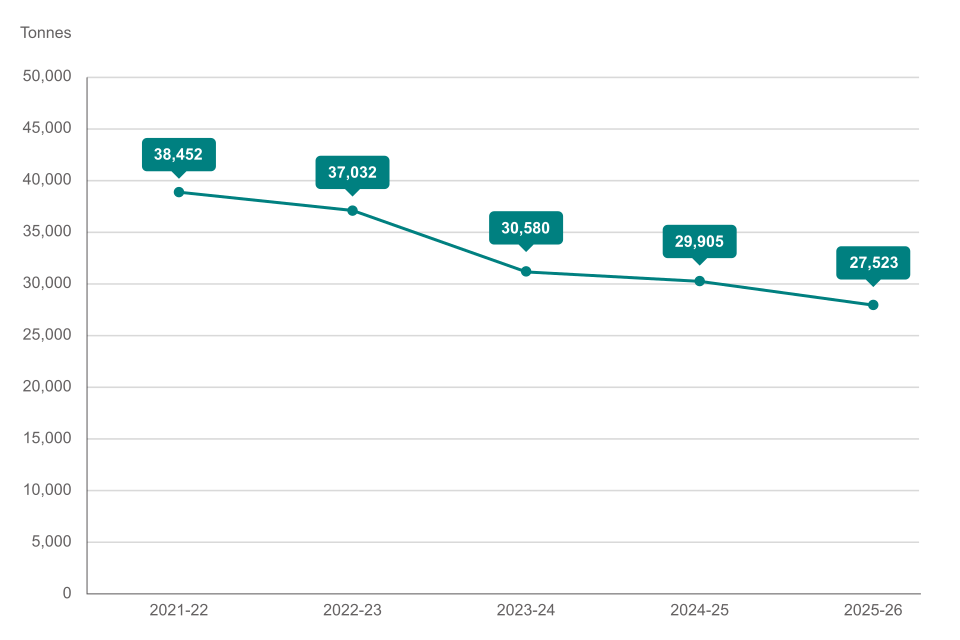
We use an emissions factor (activity-based) method to calculate greenhouse gas emissions. This aligns with the Greenhouse Gases (GHG) Protocol guidance. Reporting covers HMRC and the Valuation Office Agency (VOA), which until 31 March 2026 was an executive agency of HMRC when it was subsumed into HMRC.
In 2025 to 2026, we delivered several key sustainability plans, including our Nature Strategy, which aims to protect natural habitats and integrate biodiversity into decision-making processes, and our Energy Management Plan, which focuses on improving energy performance across HMRC’s estate to reduce consumption and deliver savings.
We also developed a travel plan using insights from business travel data and a commuter survey, to understand our colleagues’ travel habits, identify barriers to sustainable travel and support greener travel choices.
We have strengthened our understanding of the energy use of our IT estate, including AI technologies, specifically looking at the carbon intensity of Copilot functions across the Office365 suite, and we’re sharing learning about efficient use of digital equipment and AI prompts with our staff.
We make sure our contracts adhere to Government Buying Standards and encourage our suppliers to go beyond the minimum requirements. We require suppliers for in-scope contracts to provide a Carbon Reduction Plan confirming their commitment to achieving net zero. We also assess the social value of our contracts, with all our procurements including a minimum 10% weighting allocated to social value, environment and sustainability, in line with government guidelines.
We recognise that a significant proportion of our emissions lie in our supply chain, and we are increasing our efforts to understand and reduce these emissions. In 2025 to 2026, we began several procurements that prioritise wider social value, working with suppliers to cut our supply chain emissions and unlock wider sustainability benefits. We are working with suppliers to accurately quantify our Scope 3 emissions.
Our social impact
We actively encourage our people to make a positive impact by strengthening the skills, wellbeing and connectivity of their local communities through volunteering, for example with schools, charities and third sector organisations. HMRC colleagues also deliver our Tax Facts educational programme, which helps young people aged 8 to 17 to understand how tax works in an engaging and accessible way. Our people also donated £581,191 to charities through Payroll Giving.
Climate-related financial disclosures
This year we are continuing to report in line with HM Treasury’s Task Force on Climate-related Financial Disclosures (TCFD) guidance which interprets and adapts the TCFD framework for the UK public sector.
Principal risk assessment
HMRC conducted a risk mapping exercise in 2023 to identify climate-related risks to the department. Internal analysis determined that climate is not sufficient to be considered a principal or strategic risk for HMRC, as it does not impact HMRC’s ability to deliver our strategic objectives. Therefore, we have complied with the TCFD guidance by including recommended disclosures on governance (a and b), risk management (a to c) and metrics and targets (b).
We are not required to include disclosures for metrics and targets (a and c) or strategic disclosures (a to c) as climate is not considered a principal risk. We did not test if climate was otherwise a material component of another principal risk. Additional assurance is planned in 2026 to 2027, with a benchmarking exercise in collaboration with Government Actuary’s Department to test our principal risk assessment process against other government departments.
Read about the new requirements on climate related financial disclosures on GOV.UK.
Our governance around climate-related risks and opportunities
We are fully compliant with the recommended TCFD disclosures for Governance.
Board oversight (a):
Reporting to the HMRC Strategy Committee and, when required, to the Executive Committee (ExCom), HMRC’s Sustainability Board provides dedicated stewardship of HMRC’s Sustainability Strategy and Net Zero Roadmap. During 2024 to 2025, Sustainability Board met every quarter to oversee our sustainability and net zero commitments. In previous years, the board reviewed analysis of enterprise sustainability risks.
This board is chaired by our ExCom Sustainability Champion, HMRC’s Executive Director of Communications, Andrew Pemberton. Non-executive board member, Bill Dodwell, holds climate change and net zero within his portfolio at the HMRC board.
Management’s role (b):
In 2025 to 2026, we improved our departmental climate governance by embedding climate‑related risks within our core risk management framework. Clear ownership was assigned, with climate risks owned at the appropriate tier and escalated through established governance forums, including the Sustainability Board and Delivery Assurance Group.
Managing climate risk
We are fully compliant with the recommended TCFD disclosures for Risk Management.
Risk identification and assessment (a):
HMRC identifies climate change risks using its standard risk management approach set out in the HM Treasury Orange Book. In 2025 to 2026, we reviewed our previously assessed risks associated with the physical impact of climate change on HMRC’s operations. Risks were analysed by subject matter experts, reviewed by senior governance groups, and managed through existing risk and business continuity processes where needed.
Risk management (b):
The HMRC Process Management Standard requires Process Owners to systematically evaluate how well their processes operate by assessing effectiveness, efficiency, risk and control maturity. In 2025 to 2026 we evaluated our sustainability objectives against this standard. Where risks or weaknesses were identified, we have improved process design, and strengthened controls. We will continue to monitor risks by setting appropriate metrics, and tracking performance and control effectiveness over time.
Overall integration (c):
Climate risks, including the potential effects of extreme weather, are incorporated in our departmental risk management and governance. We have developed a Climate Change Adaptation Plan which outlines mitigations for these risks.
Our understanding of climate risk has been strengthened through modelling 2°C and 4°C warming scenarios, highlighting locations at moderate and high risk from flooding, heatwaves, and drought. This was completed in 2024 to 2025 and will inform current and future climate change adaptation measures.
In 2026 to 2027, we will benchmark our risk management processes against other public sector organisations and national frameworks to ensure our approach is proportionate, rigorous, and effective.
Metrics and targets for climate-related risks
As climate is not considered a principal risk for HMRC, we do not need to comply with metrics and targets disclosures (a and c). Our performance data on sustainability reports on our emissions, following the GGC reporting methodology.
Emissions (b):
We use a variety of metrics to assess climate-related risks and opportunities, which we have reported on within our Annual Report and Accounts for several years. Our performance data on sustainability comes from a range of internal and external sources. The Department for the Environment, Food and Rural Affairs verifies our GGC data, and the Carbon Trust has externally verified our methodology on supply chain emissions, which we do not publish in the Annual Report and Accounts as this is outside of the GGC requirements.
How we contribute to United Nations Sustainable Development Goals
| HMRC Strategic objective | What we’re doing | UN Sustainability Goals |
|---|---|---|
| Close the Tax Gap | We collect the money that pays for the UK’s public services and gives financial support to people. We support customers to get their tax right and step in when they do not. | 1: No poverty, 8: Decent work and economic growth |
| Improve day to day performance and the overall customer experience | We are constantly expanding and improving our online services and systems to improve the customer experience. | 8: Decent work and economic growth |
| Reform and modernisation of the Tax and Customs administration | We are reforming and modernising the tax and customs system to improve the resilience of our systems and to improve the customer experience. | 8: Decent work and economic growth |
| Build a high-performing organisation, with a skilled and engaged workforce | We are building the leadership, tax and digital skills that we need for the future. Our apprenticeship offer builds the skills and capabilities we need for the future. | 4: Quality education, 5: Gender equality, 10: Reduced inequalities |
| Support wider government economic aims through HMRC’s work | We continue to ensure the customs regime remains robust and effective, and we give financial support to people. | 1: No poverty, 8: Decent work and economic growth |
John-Paul Marks
Chief Executive and First Permanent Secretary
1 July 2026