Using the Daily Air Quality Index (DAQI)
Updated 13 April 2026

© Crown copyright 2026
This publication is licensed under the terms of the Open Government Licence v3.0 except where otherwise stated. To view this licence, visit nationalarchives.gov.uk/doc/open-government-licence/version/3 or write to the Information Policy Team, The National Archives, Kew, London TW9 4DU, or email: psi@nationalarchives.gov.uk.
Where we have identified any third party copyright information you will need to obtain permission from the copyright holders concerned.
This publication is available at https://www.gov.uk/government/publications/health-effects-of-air-pollution/using-the-daily-air-quality-index-daqi
Air pollution forecasts
The Department for Environment, Food and Rural Affairs provides a daily air pollution forecast to help you understand and reduce your short term exposure to air pollution.
The forecasts and the associated health advice help you to plan ahead and take action to reduce the effects of air pollution, where relevant.
Daily Air Quality Index (DAQI)
Air pollution forecasts and other air pollution measurements are communicated on the Daily Air Quality Index (DAQI). Each pollutant has different concentrations at each DAQI level.
The DAQI is a simple scale that explains the short term health risk of air pollution in words, numbers and colours:
- low pollution (levels 1, 2 and 3), shown in green
- moderate pollution (levels 4, 5 and 6), shown in yellow
- high pollution (levels 7, 8 and 9), shown in red
- very high pollution (level 10), shown in purple
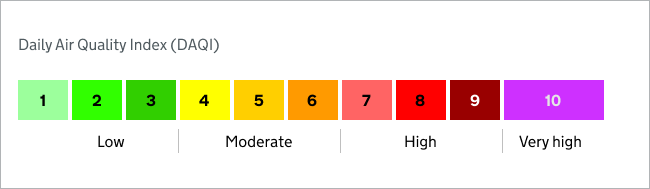
Colour image of the DAQI scale
Each band of the DAQI (low, moderate, high and very high pollution) comes with health advice for:
- the general public
- adults and children with heart or lung conditions, and older people, as these groups may be more sensitive to the health effects of air pollution
You can check the daily air pollution forecast for locations you’re interested in.
DAQI pollutants
The DAQI measures the short term health risk of air pollution based on levels of 5 harmful pollutants:
- particulate matter (PM2.5)
- particulate matter (PM10)
- nitrogen dioxide (NO2)
- ozone (O3)
- sulphur dioxide (SO2)
The DAQI score for a specific location is based on the highest measured or predicted level out of these 5 pollutants.
Particulate matter (PM2.5)
Particulate matter (PM) are small particles of solids or liquids that are in the air. PM2.5 particles are only 2.5 micrometres in diameter. For context, the width of a human hair is 50 to 70 micrometres.
PM2.5 particles may include:
- dust
- soot
- smoke
- drops of liquid
The main sources of particulate matter are from:
- burning of fuel by vehicles, industry and domestic properties
- wear of tyres and brakes
- wind blown soil and dust
- sea spray particles
- burning vegetation
Short term health impacts of PM2.5 can include worsening of conditions such as:
- asthma
- chronic obstructive pulmonary disease (COPD)
Long term health impacts of PM2.5 can include:
- strokes
- lung cancer
- diabetes
- Alzheimer’s and Parkinson’s disease
- poor lung health in children
Particulate matter (PM10)
Particulate matter (PM) are small particles of solids or liquids that are in the air. PM10 particles are only 10 micrometres in diameter. For context, the width of a human hair is 50 to 70 micrometres.
The main sources of particulate matter are:
- dust from construction sites
- dust from landfills
- dust from agriculture
- wildfires
- pollen
- power stations
- vehicles
Short term health impacts of PM10 can include:
- difficulty breathing
- coughing
- eye, nose and throat irritation
- chest tightness and pain
Long term health impacts of PM10 can include:
- lung tissue damage
- asthma
- heart failure
- cancer
- chronic obstructive pulmonary disease (COPD)
Nitrogen dioxide (NO2)
Nitrogen dioxide is a colourless gas. It’s mainly produced during:
- burning of petrol or diesel in a car engine
- burning natural gas in a central-heating boiler or power station
- welding
- the use of explosives
- commercial manufacturing
- food manufacturing
Short term exposure to nitrogen dioxide can cause:
- asthma attacks
- respiratory infections
- symptoms of lung or heart conditions to get worse
Long term exposure to nitrogen dioxide can cause:
- an increase risk of respiratory infections
- poorer lung function in children
Ozone (O3)
There are no major emission sources of ozone itself. Reactions between other pollutants form ozone in the air. For example, when pollutants from cars, power stations and factories react with sunlight.
Ground level ozone can be at unhealthy levels on both hot and cold days. It can travel by the wind, affecting both urban and rural areas.
Short term exposure to ozone can cause:
- shortness of breath, wheezing and coughing
- asthma attacks
- increased risk of respiratory infections
- irritation of eyes, nose and throat
Long term exposure to ozone may lead to:
- increased respiratory illnesses
- nervous system issues
- cancer
- heart issues
Sulphur dioxide (SO2)
Sulphur dioxide is a colourless gas with a strong odour. It’s mainly produced from:
- burning petrol or diesel in vehicles
- gas boilers
- coal burning power stations
- commercial manufacturing
- food manufacturing
Short term exposure can cause irritation to the:
- eyes
- nose
- throat
Long term exposure at high levels may lead to:
- reduced lung function
- altered sense of smell
- increased respiratory infections