Habitat creation and restoration Environment Act target delivery plan
Published 1 December 2025
Applies to England

© Crown copyright 2025
This publication is licensed under the terms of the Open Government Licence v3.0 except where otherwise stated. To view this licence, visit nationalarchives.gov.uk/doc/open-government-licence/version/3 or write to the Information Policy Team, The National Archives, Kew, London TW9 4DU, or email: psi@nationalarchives.gov.uk.
Where we have identified any third party copyright information you will need to obtain permission from the copyright holders concerned.
This publication is available at https://www.gov.uk/government/publications/habitat-creation-and-restoration-environment-act-target-delivery-plan/habitat-creation-and-restoration-environment-act-target-delivery-plan
Statutory Environment Act targets
- restore or create in excess of 500,000ha of a range of wildlife-rich habitats outside protected sites by 2042
Restoring and creating habitat will also support 3 other statutory Environment Act targets:
-
halt the decline in species abundance by 2030
-
increase species abundance so that by 2042 it is greater than in 2022 and at least 10% greater than in 2030
-
improve the Red List Index for England for species extinction by 2042 compared to 2022 levels
Creating and restoring wildlife-rich habitat at scale is essential for improving species abundance and reducing the risk of extinction. Wildlife needs high-quality, connected habitats to thrive. Creating and restoring wildlife-rich habitat helps reduce fragmentation and strengthen ecosystem resilience, supporting long-term species recovery.
Guidance on what counts towards the statutory habitat target is available in the Environment Act habitat target definitions and descriptions paper (TIN219). This document explains how the interim and statutory habitat targets are defined and measured.
Habitat creation and restoration also support other EIP goals, such as water (Goal 3) and climate change (Goal 7). Delivery across the EIP is interdependent; for example, wetland restoration can support both water quality and wildlife habitat, while improving water quality can reduce pressure on freshwater ecosystems.
Other Environment Act targets also support the habitat targets. For example, 100,000ha of the statutory tree canopy and woodland cover target is expected to contribute to the statutory wildlife-rich habitat target (see tree canopy and woodland cover target delivery plan).
Interim target
- restore or create 250,000ha of a range of wildlife-rich habitats outside of protected sites by December 2030
Rationale for the interim target: why and how it will progress delivery of the Environment Act target
The statutory habitat target will deliver habitat creation and restoration at scale, which is one of the key actions we know is needed to achieve nature’s recovery. This work will help build a better network of naturally functioning and climate resilient habitats where wildlife can move and thrive.
The interim habitat target contributes towards the statutory habitat target, which supports the species abundance and extinction targets.
It takes time to create habitats, and some species can take time to respond to habitat improvements. By front-loading habitat creation and restoration we increase the chances of meeting our statutory species targets. The interim target will drive early progress whilst remaining achievable.
Meeting the species abundance and extinction targets will require a variety of habitats to benefit a wide range of species. There are no sub-targets for specific habitats as the statutory habitat target includes delivering a range of wildlife-rich habitats, some that deliver benefits quickly (such as scrub), and others that take longer (such as woodland). We will monitor the split of habitats delivered to ensure they work together to support species recovery.
The interim target is cumulative and gross; it is the sum of all habitat created or restored since January 2023. It does not take account of losses, degradation or reversion. Habitat created to replace known direct losses will not count towards the interim target, in line with the approach taken for the statutory target.
Delivery measures
We expect to meet the interim and statutory habitat targets through a mix of delivery measures. Many of these will rely on voluntary action from landowners, farmers, Environmental non-governmental organisations, businesses, and the public.
The largest share is expected through Environmental Land Management schemes, particularly Countryside Stewardship Higher Tier and Landscape Recovery.
Private finance and emerging green finance mechanisms (for example nature markets and biodiversity credits) are also expected to grow in importance over time.
In the Land Use Framework we will outline how land use must change to meet the range of targets and demands made of it. It will include principles for spatial prioritisation to help make the most effective use of our limited land area and deliver multiple benefits. Local Nature Recovery Strategies will provide the spatial framework to prioritise nature recovery action.
Together, these frameworks will target habitat creation and restoration in the right places to support multiple outcomes, for example protecting our homes from flooding through creating wildlife-rich wetlands to reduce flood risk.
Protected Landscapes are key areas for nature recovery because they already contain significant areas of wildlife-rich habitat and benefit from legal protection and dedicated management bodies. To meet national environmental targets, we must go further and faster in these areas. The Protected Landscapes Targets and Outcomes Framework sets out that 50% of the statutory habitat target should be delivered in Protected Landscapes.
Table 1. Summary of delivery measures to support the habitats interim targets delivery plan
| Delivery measure | Description | Estimated contribution to the interim targets | Evidence of impact | Responsible | Status |
|---|---|---|---|---|---|
| Agri-environment schemes (AES) | Agri environment schemes fund farmers and land managers to create and restore wildlife-rich habitat using appropriate agri-environment options. Includes Landscape Recovery, Countryside Stewardship Higher Tier, and Sustainable Farming Incentive. [note 1] |
High | 31,944ha of wildlife-rich habitat has been delivered since January 2023 through AES actions. It is expected that these actions will continue to deliver habitat creation and restoration, with programme evaluation frameworks in place. | Defra | In delivery |
| Nature for Climate Fund (NCF) woodland creation and Public forest activity | Creation of woodland through the England Woodland Creation Offer, Community Forests, and Woodland Creation Partnerships. Restoration of Plantations on Ancient Woodland Sites. | Medium low | 11,302ha of woodland has been created under NCF between 2022 and 2025 much of which will contribute to the habitat target where outside of protected sites and delivery of native woodland. 767ha of Plantations on Ancient Woodland Sites on public forest land showing restoration progress since January 2023. These programmes are expected to continue contributing to habitat creation and restoration over the remainder of the delivery period. |
Defra, Forestry Commission, Forestry England | In delivery |
| Nature for Climate Peatland Grant Scheme (NCPGS) Flood and Coastal Erosion Risk Management Programme (FCERM) Water Environment Improvement Fund (WEIF) Farming in Protected Landscapes The National Lottery Heritage Fund projects Species Recovery Programme (SRP) Species Survival Fund (SSF) Water Industry National Environment Programme (WINEP) Water Restoration Fund Biodiversity Net Gain & Nature Markets Local Investment in Natural Capital (LINC) Big Nature Impact Fund Nature Environment Investment Readiness Fund (NEIRF) Projects for Nature Seedcorn projects Nature Returns National Education Nature Park Nature Recovery Projects |
Collectively, these programmes contribute a mix of targeted habitat creation, restoration, and species recovery. | Low | Some (e.g. NCPGS) report quantifiable hectares, while others (e.g. BNG, NEIRF, Nature Markets) are still developing evaluation frameworks. Notable contributions include: •2,661ha of peatland restoration which counts towards the habitat target delivered through the NCPGS since January 2023 •£20.7 million partnership funding (WEIF 2023 to 2024) •£11 million funding through the Water Restoration Fund to support projects to improve water environment •£4 million invested into Combined Authorities through LINC to build local capacity and unlock nature finance opportunities •Over 300 investable projects developed through green finance programmes, including LINC and NEIRF •More than £700,000 raised via Projects for Nature These programmes are expected to continue contributing to the habitat target as delivery and monitoring frameworks mature. |
Defra, EA, NE, National Lottery Heritage Fund, DfE, Water Industry | Various - in delivery and development |
Notes about table 1
Note 1 - AES options from CSHT and SFI that count towards the habitat target will be reviewed as schemes change and new evidence becomes available.
- As of March 2025 these were: GS7, GS8, WT9, WT7, UP5 in conjunction with WN1, WN1, LH3, LH2, AB8, WD8, WN5, WN6, WN7, BE5, WD6, WD12, CT4, CT5, CT7, BN7, BN11, CT2
Key milestones
Key milestones for 2025 include:
-
the Countryside Stewardship Higher Tier scheme opened in September to those invited to apply, this included additional habitat actions
-
all 48 Local Nature Recovery Strategies are expected to be published by the end of 2025, or shortly after, covering the whole of England with no gaps or overlaps
-
implementation underway for successful Round 1 Landscape Recovery Projects
Key milestones for 2026 include:
-
Sustainable Farming Incentive will be open for applications in 2026, with further details published in due course
-
implementation underway for successful Round 2 Landscape Recovery Projects
Illustrative trajectory
To meet the interim habitat target, an average 31,250ha a year is needed. This represents a front-loading of habitat creation and restoration to support the statutory species abundance target (a linear trajectory to the habitat target would require 25,000ha a year to be delivered). If the 2030 interim target is achieved, an average of approximately 20,800ha a year would then be needed to meet the statutory habitat target by 2042. This required trajectory is shown in Figure 1.
While the trajectory outlines average annual targets, we do not expect delivery to be consistent year on year. Some years are likely to see higher levels of delivery as larger projects, such as those in the Landscape Recovery scheme, begin to deliver.
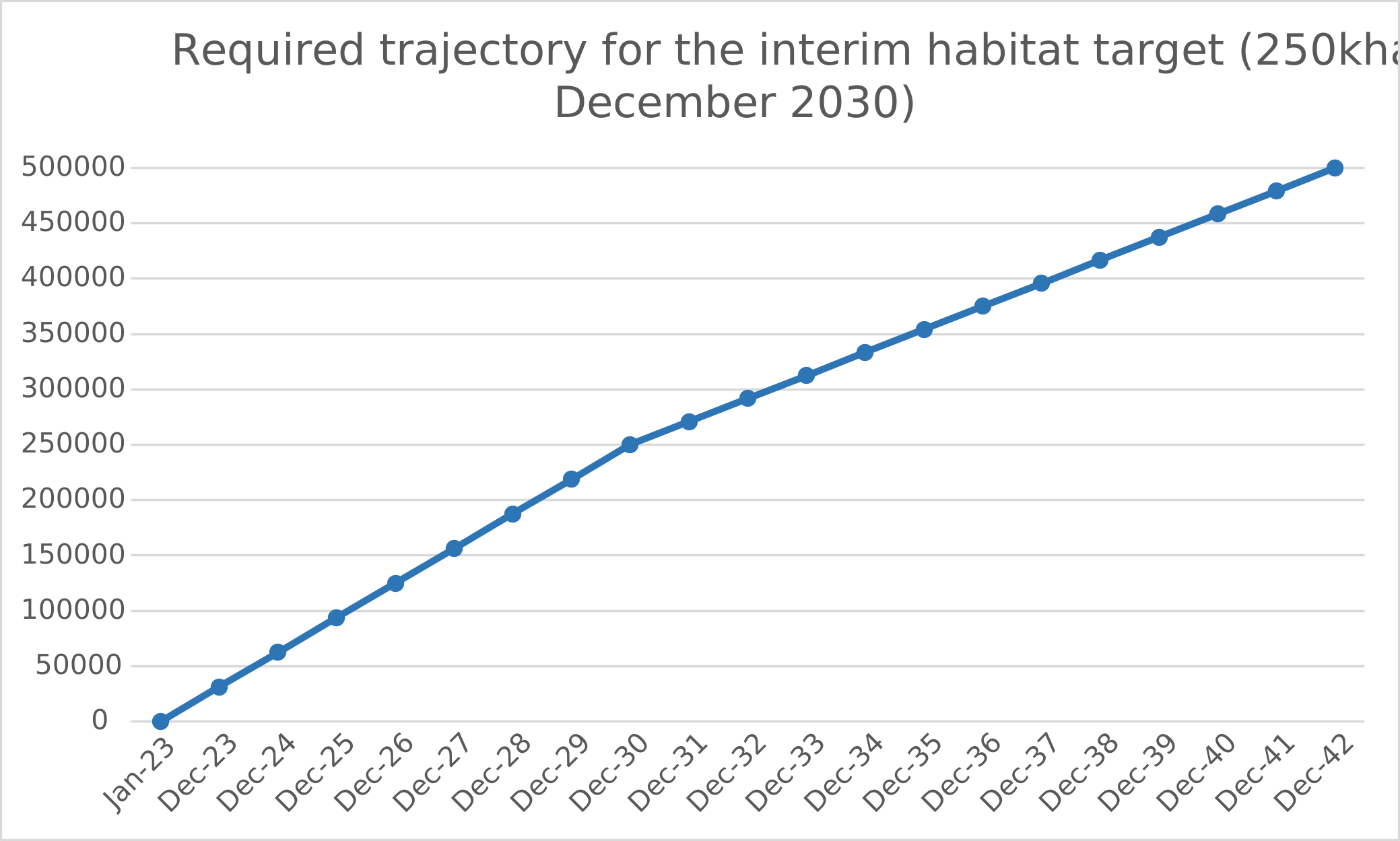
Figure 1. Required trajectory for the interim habitat targets. Source: Defra
Monitoring and evaluation summary
The metric we will use for monitoring the interim target is the gross number of hectares of habitat created or restored since January 2023. The metric will be updated annually, subject to data availability.
Some delivery mechanisms have well-established monitoring while others are developing or have gaps in reporting. We are improving consistency and coverage of monitoring data across delivery partners and programmes.
Detailed guidance on the type, format, and quality of data needed to support robust reporting is provided in Environment Act habitat target reporting data model and standard (TIN223).
As habitat creation and restoration should contribute to the Lawton principles of bigger, better, more and joined up sites for nature, data will also be analysed to see if delivery is supporting this ambition by increasing the size and connectivity of habitat patches.