Guidance for managing government’s implicit liabilities
Published 26 November 2025

© Crown copyright 2025
This publication is licensed under the terms of the Open Government Licence v3.0 except where otherwise stated. To view this licence, visit nationalarchives.gov.uk/doc/open-government-licence/version/3 or write to the Information Policy Team, The National Archives, Kew, London TW9 4DU, or email: psi@nationalarchives.gov.uk.
Where we have identified any third party copyright information you will need to obtain permission from the copyright holders concerned.
This publication is available at https://www.gov.uk/government/publications/guidance-for-managing-governments-implicit-liabilities/guidance-for-managing-governments-implicit-liabilities
1. Introduction
1.1 Background and context
Strong management of the public finances underpins economic growth and provision of high-quality public services and investment. The comprehensive balance sheet, capturing what the public sector owns (assets) and what it owes (liabilities), is the broadest measure of fiscal sustainability and a strong balance sheet is key to fiscal health. This should include all potential costs that may fall to the taxpayer, even if not recognised within typical measures of the balance sheet.
When economic shocks, natural disasters or failures of firms have arisen, government has often found itself compelled to assume costs normally borne by the private sector to ensure continued delivery of critical services and the functioning of the economy. In some instances, government was effectively providing implicit insurance to the private sector against risks, i.e. holding an implicit liability. This was the case for banks deemed ‘too big to fail’ that were bailed out with £137 billion public funds after the financial crisis,[footnote 1] business interruption insurance provided to firms during the COVID-19 pandemic, and government underwriting critical energy supplies in the 2022-23 energy price shock.
The shocks that precipitated these interventions were not explicitly the responsibility of the public sector, but in recognition of their impact on living standards and the economy, the government chose to step in to ensure continuation of key services. The scale of costs that fell to government and their lasting impact on the economy demonstrates the importance of building economic resilience and managing fiscal risks to free up money to be spent on public services.
Government has existing tools to support risk management, like the Orange Book[footnote 2] and Contingent Liability Approval Framework.[footnote 3] This guidance builds on these principles, the risk monitoring of the National Risk Register,[footnote 4] the analysis set out in the OBR’s Report on Fiscal Risks and Sustainability,[footnote 5] and the approach to implementing risk management detailed in the Resilience Action Plan.[footnote 6]
This document is designed to help departments and public bodies take action to reduce government’s fiscal exposure, identifying where risks could result in private sector liabilities falling to government in contingency events and putting in place strategies that reduce costs. Whilst it is challenging to plan for every possible scenario, organisations can establish mechanisms to identify their key risks, act to reduce their likelihood, and prepare to manage their impacts in the least costly way.
This forms part of a broader package of innovative reforms to improve management of the public finances, including targeting public sector net financial liabilities in the fiscal rules and publishing the Balance Sheet Framework to ensure that all government’s assets and liabilities are managed robustly.[footnote 7] Together they represent a significant step forward in the extent of fiscal policy and put the UK at the forefront of balance sheet management on the international stage.
Box 1.A Long-term debt projections with shocks
The shocks to the UK economy over the last 20 years have driven debt to just under 100% of GDP, with 90% of the government debt accumulated in the last 17 years falling in the two years after the financial crisis and the two years after the COVID pandemic.
The Office for Budget Responsibility (OBR), in analysis set out in their Fiscal Risk and Sustainability Report, projected that if shocks of the same frequency and severity arose in the next 50 years, this could add an extra 125% to the debt-to-GDP ratio in the long run.[footnote 8]
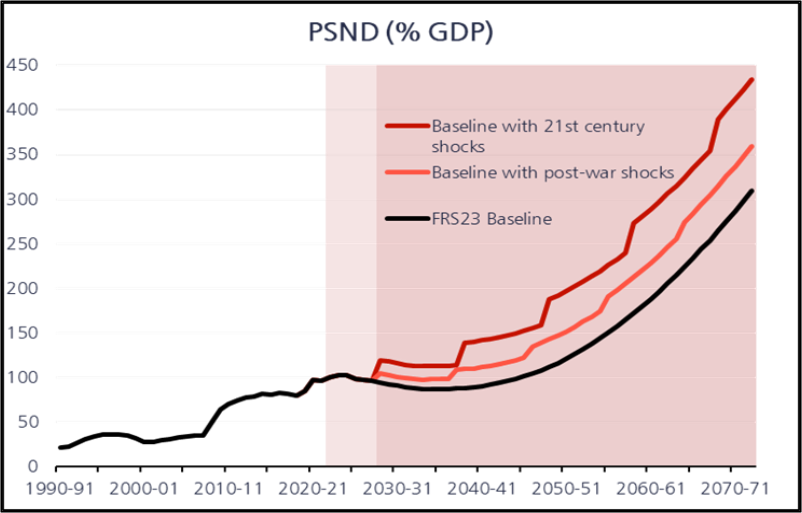
Source: OBR Fiscal Risks and Sustainability Report, July 2023
1.2 Overview of implicit liabilities
What are implicit liabilities?
This guidance mirrors government’s separate approach to managing contingent liabilities and applies it to implicit liabilities, which are similar to contingent liabilities in that they represent uncertain future liabilities that government may be required to meet.
Contingent liabilities are, in the context of Managing Public Money (MPM) and Treasury spending control, commitments to use public funds if uncertain future events occur. In line with the Contingent Liability Approval Framework, this is a wider definition than the accounting definition of contingent liabilities set out in IAS 37.[footnote 9] Contingent liabilities expose the government to fiscal risk and potential future costs of an uncertain size or timing.
Implicit liabilities are defined by the OECD as “obligations that a government may feel obliged to fulfil for political or moral reasons in the absence of any contractual or legal obligation to do so.”[footnote 10] Implicit liabilities are similar to contingent liabilities in that they are uncertain future costs that could arise, but they are not liabilities in a legal or financial reporting sense as there is no formal commitment by government to spend money ahead of the event.
For this guidance, the Treasury is focussing on a further subset of implicit liabilities, namely those implicit liabilities that are normally met by the private sector or third sector, but which may fall to government in a contingency scenario. This may include a critical firm failure, a sector-specific shock, or natural disaster. The liabilities covered are often shocks borne by a specific part of the economy but can spill over into wider economic crises with significant second-round impacts.
How should government manage implicit liabilities?
The government has an established approach to managing the fiscal risks posed by contingent liabilities. The Contingent Liability Approval Framework ensures that new guarantees, indemnities and insurance products are well designed, affordable and value for money. The government has also committed in the Charter for Budget Responsibility to produce an annual report on the stock of contingent liabilities, led by UK Government Investments, enabling the Treasury to monitor and quantify government’s overall risk exposure.
This document looks to mirror this approach in managing where government effectively provides implicit insurance to the private sector. In these cases, government should seek to take proportionate and appropriate action: transferring risk back to the private sector where possible or limiting exposure through risk sharing.
Government can also choose to make implicit liabilities into explicit contingent liabilities and then reduce its fiscal risk by charging the private sector to cover its risk exposure, such as through charging a premium on insurance or establishing levies to fund a risk. The OECD recommends that governments take this approach where it is not reasonable for them to pursue a non-interventionist approach.[footnote 11]
Box 1.B Scope of contingent and implicit liabilities
Contingent liabilities – these are commitments to use public funds if uncertain future events occur through explicit or contractual obligations such as guarantees, indemnities, insurance. Implicit liabilities – an uncertain future liability from government being economically or morally obliged to ensure key services and the economy remain functional in a contingency scenario.
Implicit liabilities arising in private sector – the focus of this guidance (in blue below) are costs that arise in the private sector but that may fall to government in a contingency scenario. It excludes costs that predominantly arise in the public sector in crisis events, such as the public healthcare costs of pandemic responses or the costs of military interventions in wars.
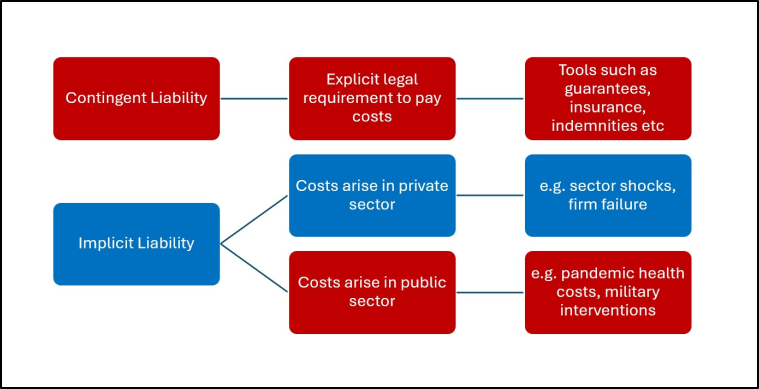
Source: HMT
1.3 Structure and application of this guidance
The objective of this guidance is to set out how government can proactively identify and manage implicit liabilities, reduce the need for government to step in, and limit the costs if it chooses to do so. It ultimately looks to minimise the government’s fiscal exposure to a range of contingency scenarios.
This document draws on successful mitigation options currently or previously used by the government to manage the risk of implicit liabilities crystallising. It aims to support departments and public bodies to understand the exposure to the taxpayer posed by implicit liabilities, provide a toolkit for identification of these risks, and advise on potential avenues to remove or mitigate this exposure in the long-term.
All central government departments, supported by specific expert public bodies (such as sector regulators), are responsible for applying this guidance, with the Treasury playing an oversight function and convening departments on cross-cutting risks.
Departments shall be responsible for identifying and mitigating implicit liabilities. They shall bear responsibility for management of specific risks based on their policy ownership of the levers that may affect this risk, with responsibility for elements of cross-cutting risks allocated across departments by the Treasury on a similar basis.
The document is structured as follows:
Chapter 2 – Principles for implicit liability management. This chapter summarises when implicit liabilities arise, government’s approach to managing implicit liabilities and the key policy trade-offs.
Chapter 3 – Identification and ongoing monitoring. This chapter sets out approaches departments can use to identify and quantify implicit liabilities within their remit.
Chapter 4 – Exiting and mitigating liabilities. This chapter sets out mitigation options that can be used to better manage implicit liabilities, including drawing from successful past mitigations.
Chapter 5 – Application and next steps. This chapter sets out how the Treasury expects this guidance to be applied in practice, including milestones for an initial cross-government work programme.
Annex A – Implicit liability summary table. This annex sets out key questions departments should be able to address when undertaking work to identify, quantify and manage implicit liabilities.
Annex B – Further mitigation option detail. This annex sets out key design considerations for the various mitigation options set out in Chapter 4.
2. Principles for implicit liability management
2.1 Overview of chapter
This chapter sets out the overarching policy principles government intends to apply to the management of implicit liabilities.
It aims to facilitate decision-making through applying consistent considerations to policy interventions and improving understanding of the economic costs that could arise and fall to government.
Key definitions of concepts discussed are set out below:
Box 2.A Definitions of economic costs
Economic costs – these are the costs in money, time, and other resources needed to do something. They can be met by the public or private sectors and include non-monetised costs such as pollution. Throughout this document references to ‘costs’ should be read as economic costs, except for when ‘fiscal cost’ is specified.
Economic costs arising in a contingency scenario – new, significant economic costs can arise in a contingency scenario, creating a risk that government may choose to step in. In past scenarios, economic costs have included the cost of higher energy prices following the Russian invasion of Ukraine and costs associated with bank failure and potential losses of bank deposits in the financial crisis.
Share of economic costs met by government in a contingency scenario – government may choose to meet some portion of economic costs arising in a contingency scenario. In meeting these costs government will incur a fiscal cost. This will offset some economic costs faced by households and businesses.
Economic cost of mitigation approach – when government puts in place mitigations to manage implicit liabilities, they can have economic costs, such as not being able to take forward profitable activity due to regulations. The mitigation of implicit liabilities may also have economic benefits if it reduces moral hazard.
2.2 Government’s approach to implicit liabilities
Government intervention as a last resort
Any government intervention to assume liabilities that should normally be met by the private sector must always be a last resort and an exception. Due to the enormous pressure placed on public funds in meeting the costs of historic crystallisations of implicit liabilities, the Treasury is now embedding a proactive approach to managing fiscal risks across government, to reduce the need for future government intervention. This document underpins that approach by providing departments with clear guidance and tools to identify and put mitigations in place to limit private sector liabilities falling to government in contingency scenarios.
The private sector should be encouraged to operate sustainably and build resilience against crisis events, limiting costs to taxpayers and avoiding raised expectations about future government intervention. This includes allowing some private sector entities to fail safely, i.e. in a way that ensures critical services are still provided, as part of the normal functioning of a market economy to ensure economic efficiency. If this does not take place because government intervenes to avoid private sector failures, private sector agents may take disproportionate risks as they do not bear the costs of their activity, referred to as ‘moral hazard’. This in turn can increase the scope of government’s implicit liabilities.
In specific cases where it is judged that only government can manage a specific risk, departments should develop a proactive strategy for meeting any associated potential costs ahead of time in a sustainable way, such as levying a sector to repay costs after an event. These proactive interventions can also be used to transfer financial risk away from the taxpayer altogether. The process for developing these strategies is covered in more detail at paragraphs 4.5-4.7.
Key principles for managing implicit liabilities
The government’s approach for managing implicit liabilities will be governed by the following key principles moving forward:
Managing implicit liabilities similarly to contingent liabilities (such as via the Contingent Liability Approval Framework), namely:
- Identifying all significant implicit liabilities government holds, i.e. those with a plausible risk of crystallisation or sizeable scale of costs.
- Quantifying the fiscal exposure to a particular risk, based on understanding the probability and costs of contingency scenarios.
- Developing policy reforms to reduce the fiscal exposure held by government, as if it were an actual liability.
- Top-down monitoring by the Treasury of government’s overall fiscal exposure at a portfolio level to inform strategic decision-making.
Ensuring that government does not hold risks by default. This includes actively deciding which implicit liabilities it is appropriate for government to hold (and convert to explicit liabilities to manage), where risk could be shared with the private sector, or where to exit the liability fully by reallocating costs proportionately to the private sector.
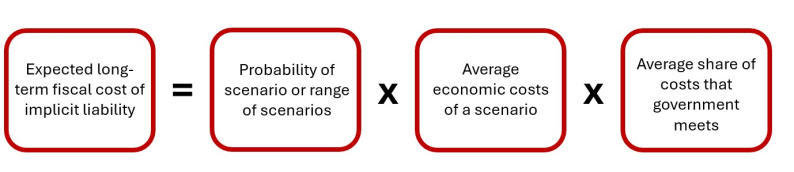
Balancing the expected long-term fiscal cost of an implicit liability against the fiscal costs of mitigation. To support this, the expected cost of an implicit liability needs to be calculated. This is the probability of a contingency event crystallising multiplied by the costs of crystallisation, calculated based on a probability distribution for the frequency and severity of events (see paragraphs 2.16-2.18). Any upfront government spending on mitigations should be traded off with the expected long-term fiscal costs of the liability to assess value for money.
Balancing the fiscal benefits of mitigating implicit liabilities against the wider economic costs. Mitigations can reduce fiscal exposure but may also impose economic costs. For example, overregulation can impose cost in the economy and harm growth in a way not justified by the reduction in fiscal exposure it achieves. Implicit liabilities with higher expected costs often have more costly mitigation approaches and government should look to mitigate liabilities where the economic cost is lower than the expected long-term economic cost.
Ensuring costs are allocated to the parties (public or private sector), best able to manage the risks, to ensure incentives and capabilities are aligned. This approach will support the efficient allocation of risk across the whole economy.
Assigning responsibility for identification and management of specific implicit liabilities to responsible departments. This is based on where contingency spending would flow via departmental budgets or where they have ownership of policy levers that affect the risk, for example where a department is responsible for regulating a sector. Departmental responsibility shall include identifying and quantifying implicit liabilities, developing mitigation options, and managing the fiscal exposure on an ongoing basis.
Ensuring government effectively co-ordinates to manage cross-cutting or systemic risks. For cross-cutting or systemic risks, a lead department will be assigned to co-ordinate work and there shall be clear ownership for different elements of managing a risk across departments with equities.[footnote 12] The Treasury will help assign and codify these responsibilities. Given that different mitigation approaches may be preferred by different departments based on their policy priorities, the Treasury will also help broker cross-government agreement on the preferred mitigation strategy.
Understanding the costs of implicit liabilities
In applying these principles to policymaking, it is important that departments understand the potential impact of contingency scenarios that could give rise to private sector liabilities falling to government.
To improve this understanding, a robust assessment should be undertaken of the potential long-term fiscal costs of implicit liabilities. Chapter 5 sets out how this analysis will form part of a wider process to develop an implicit liability management strategy.
Figure 2.A is a simplified model of how the expected long-term fiscal costs can be calculated. This is driven by:
- The probability of a contingency scenario or a range of possible scenarios happening,
- The economic costs arising when a contingency scenario happens,
- The share of costs that government meets in that scenario.
In practice, the costs will likely sit on a spectrum as more severe shocks may be less probable or happen less frequently than minor shocks. Assessing a range of scenarios of varying severity and likelihood and understanding the probabilistic distribution of potential outcomes and costs of each scenario should allow departments to understand the expected cost of a contingency scenario.
Support can be sought from the Government Actuary’s Department in modelling this appropriately (see paragraph 5.20).
Figure 2.A Calculating long-term fiscal cost
The Treasury’s view is that policy interventions can make a substantial difference to the probability of a contingency scenario occurring, the scale of costs that arise in a scenario, and the share of costs met by government in managing these events.
This has been demonstrated by the regulatory reforms put in place for the banking sector following the 2008-09 financial crisis and examples of some of the steps that government took to address this risk are set out in Chapter 4 within Boxes 4.D, 4.H and 4.I.
3. Identification and monitoring
3.1 Overview of chapter
This section sets out when implicit liabilities arise, how to identify implicit liabilities, and questions for departments to support an assessment of whether an implicit liability exists.
Carrying out regular assessments (every two years at minimum) using the approach set out in this chapter is the first step in any effective departmental implicit liability management strategy.
3.2 When implicit liabilities arise
It is often hard to assess whether an implicit liability exists. By their nature, implicit liabilities are not formal commitments and so no record of these liabilities exists. Whether, and if so how, to meet private sector liabilities is also driven by choices of the government of the day.
Departments should consider policy areas where a contingency scenario may create pressures to provide new support, and whether proactive policy interventions can reduce this ahead of time. The government’s responsibility to maintain functioning of key economic systems and public services give it a unique position in the economy and expands the remit of risks for which it could become liable.
Where these policy areas have been identified, departments should take steps to understand what measures are already in place, if any, to manage the risk associated with the contingency scenario, how likely the scenario is to occur and how effective current measures are at balancing risk across the public and private sectors.
3.3 Identification of implicit liabilities
Departments should begin by considering government’s existing tools to identify and monitor fiscal risks, which include the OBR’s Fiscal Risks and Sustainability Report, the Cabinet Office’s National Risk Register, and the principles set out in the Orange Book.
Departments should identify the plausible and potentially costly implicit liabilities they hold, through articulating a series of contingency scenarios, the potential costs of each, the probability of them arising, and whether there may be any expectations of taxpayer support.
To help departments identify whether they are holding implicit liabilities, the box below sets out a list of questions, with further detail on how to approach these questions provided in the rest of the chapter.
Box 3.A Questions for identifying and understanding implicit liabilities
A. The contingency scenario
- What event could occur that would generate large, unexpected costs in the economy? This should be based on using higher confidence intervals (such as 90%) to estimate worst-case losses.[footnote 13]
- What sequence of events would need to happen for that event to occur?
- How would the event impact the rest of the economy, wider public service delivery, or national security?
- What government policy or interventions would either trigger or be impacted by the event?
B. The current mitigation approach and its costs
- Are there any regulations or other policy in place to control the probability of the event arising or the costs if it does, and if so, what are they?
- Are there any processes in place to allocate costs in a contingency scenario, and if so, what are they?
- What are the ongoing costs of the current mitigation approach?
C. The scale of economic costs if the event occurs
- What direct economic cost would be realised if the event occurred?
- What indirect economic costs would there be on the economy as a whole?
- Where would this economic cost be borne across the public and private sector?
D. The probability of the event occurring
- Has this event occurred before, either in the UK or another country?
- Is the probability of this event changing or likely to change in the future due to wider trends such as geopolitics?
E. Implicit expectation of taxpayer support
- How would costs be allocated in the contingency scenario without government action?
- What impact would there be on the sector if government took no action?
- Is there any precedent for general taxpayer support, either from the UK or from another country?
- Have economic actors internalised all costs in their decision making or is there moral hazard?
3.4 Detail on questions for identification
A. The contingency scenario
What event could occur that would generate large, unexpected costs in the economy? Departments should consider areas of risk where an implicit liability could crystallise into spending through their department if government chose to provide support. Not all large, unexpected costs would result in an implicit liability, as there are scenarios where sufficient market diversification and resilience means that the private sector could absorb costs. Departments should consider low probability, unexpected scenarios rather than forecasts of what they expect to happen. This can draw on past events to inform the scenario. Often contingency scenarios are triggered by firm failures or price spikes in the economy, although each department may face different and unique triggers that would need to be considered.
What sequence of events would need to happen for that event to occur? Working through a sequence of events that need to occur will help support an assessment of probability, scale, and cost. It is important to consider how changes in wider economic conditions, such as higher-than-expected inflation or interest rates, or wider trends such as geopolitics, may trigger an unexpected event.
How would the event impact the rest of the economy, wider public service delivery or national security? If a failure affecting the functioning of a key economic system is being considered it is important to map out the customers of that system and whether those customers are themselves key suppliers in the economy. It is also important to consider how national security, critical national infrastructure or public service delivery will be impacted, as this will influence expectations of government support.
What government policy or interventions would either trigger or be impacted by the event? Departments should consider the interactions with various policy interventions and whether a contingency scenario may be exacerbated by government policy (for example, certain types of regulation). They should also consider whether a scenario crystallising would affect wider government policy priorities (for example, delivery of key public services), which may increase government’s fiscal exposure.
B. The current mitigation approach and its costs
Are there any regulations or other policy in place to control the probability of the event arising or the costs if it does, and if so, what are they? These will usually be regulation on the activity that private economic actors can undertake. They could include capital controls to ensure firms are suitably capitalised and so reduce the probability of failure or they could include prohibition of certain risky activity. Guidance can be found in paragraphs 4.20-4.21 and 4.24-4.25.
Are there any processes in place to allocate costs in a contingency scenario, and if so, what are they? Cost allocation describes which economic actors meet the costs that have arisen, e.g., specific households and businesses, company shareholders or debt holders, the government, billpayers or private insurers. It is the allocation of costs to government that creates a fiscal cost. Cost allocation processes include private insurance, funds to absorb risk, or any of the other mitigation options set out in paragraphs 4.29-4.38.
What are the ongoing costs of the current mitigation approach? This should assess direct costs such as the number of staff employed to regulate economic sectors, and the number of staff in those sectors working on compliance and reporting to the regulator. It should also include an assessment of the economic activity that can no longer be undertaken due to regulations and the cost of any capital not as productively deployed due to the holding of funds to manage risk.
C. The scale of economic costs if the event occurs
Implicit liabilities crystallise when government chooses to meet private sector costs in a contingency scenario, in full or part. It is therefore necessary to consider how large the overall costs of a contingency scenario would be before considering how those costs would be allocated. The costs considered are the full economic costs of an event occurring rather than just costs that fall to government.
What direct cost would be realised if the event occurred? Direct costs are costs suffered directly because of the contingency scenario, for example the loss of access to bank deposits in a banking failure or damage to property due to flooding. This can also include non-monetisable costs consistent with the Green Book methodology.
What indirect costs would there be on the economy as a whole? Indirect costs are costs suffered through wider economic disruption caused by the contingency scenario. Often these are second round effects from direct costs and stem from wider economic failures. While in many cases it may not be practical to undertake a full analysis of indirect costs, in some cases they can help inform government’s judgement on what policy intervention to pursue. An example of this is the contagion effect from historic failures in the banking sector on the wider economy due to its importance in the overall economic system.
Where would this cost be borne across the public and private sector? Understanding where costs would be borne between different economic actors in a contingency scenario is important to understand the nature of the risk, the size of government’s implicit liability, and what steps may be needed to mitigate government’s fiscal exposure.
D. The probability of the event occurring
Given implicit liabilities are often triggered by low probability events it is often very difficult to produce a robust estimate of probability. The questions below are designed to support a high-level indication of probability to support prioritisation.
Has this event occurred before, either in the UK or another country? If an event has occurred in the past, either in the UK or internationally, it is an indication that the probability of the event happening again is not negligible. Departments should therefore look at previous crises or risk crystallisations to help inform planning, particularly in critical or vulnerable sectors.
Is the probability of this event changing or likely to change in the future due to wider trends such as geopolitics? Often the probability of contingency scenarios can change over time, meaning past evidence on probability may not be a good guide to future probability. Examples of a changing wider context include climate change, which could increase the probability of extreme weather events that trigger future contingency scenarios.
E. Implicit expectations of taxpayer support
The below questions can provide evidence to support an assessment on what government’s actions may be, but they will not be definitive or binding.
How would costs be allocated in the contingency scenario without government action? Are there any public or private institutional arrangements that allocate cost away from those impacted like private insurance or publicly facilitated compensation schemes such as the Financial Services Compensation Scheme (FSCS)? How are costs allocated both in the short and long term? For example, temporary losses may be faced before insurance pay-outs or insolvency procedures are completed, but those temporary losses may create costs due to for example a lack of liquidity for businesses.
What impact would there be on the sector if government took no action? To enable better decision making on whether to intervene, it is important to understand the most plausible counterfactual and what is likely to happen if government does nothing. As the Treasury’s default position is that private sector failures should be allowed to occur without government intervention, there must be a very clear rationale behind why this would be broken.
Is there any precedent for government support, either from the UK or from another country? Often expectations around cost sharing between the public and private sector will be driven by past precedent. If government has stepped in to cover costs in the past, and made no subsequent reforms, that could create expectations of future support. There could be related schemes or initiatives that might create wider expectations of intervention. Precedents can also arise from other countries – if other governments provide support, it could raise expectations of the UK government doing likewise.
Have economic actors internalised all costs in their decision making or is there moral hazard? One issue arising from government holding implicit liabilities is that private sector actors may not internalise all costs and risks associated with their actions as they will expect government to cover costs in a downside scenario. This could lead to excessive risk taking and an overall higher level of risk in the economy than is optimal, i.e. moral hazard. If there is evidence of moral hazard, with private actors taking on excessive risk, then it is possible they may expect government to take on implicit liabilities.
4. Mitigating government’s fiscal exposure
4.1 Overview of chapter
- This chapter focuses on mitigation strategies to reduce the risk of implicit liabilities and minimise the costs that may fall to government in contingency scenarios, providing a policy toolkit for departments.
- In some cases, mitigations may already be in place. Reforming existing mitigation approaches should be considered if there is doubt as to their efficacy, the current fiscal or economic costs of mitigation are large, or if the probability and expected cost of the liability has significantly changed since the mitigation was introduced.
- The toolkit set out in this chapter is not intended to be an exhaustive list, but rather illustrative of the types of measures departments can implement to reduce the costs that may fall to government in a contingency scenario.
- Further detail on the questions departments should consider when designing or implementing mitigations is set out in Annex B.
4.2 Developing a successful mitigation strategy
Developing a successful mitigation strategy for implicit liabilities relies on ensuring the allocation of costs is clear, well-reasoned and well-managed across actors in the public and private sector.
While each mitigation strategy will be distinct based on the nuances of the potential contingency scenario, a successful mitigation strategy will meet as many as possible of the following principles:
- Decrease the potential fiscal exposure government holds and the ensuing likelihood that public sector funds will be used through actively transferring risk onto the private sector.
- Change private sector expectations so general taxpayers are not expected to stand behind risks or failures in the private sector.
- Change the probability of the liability crystallising at all so that a contingency scenario (including one where costs fall to government) is less likely to occur.
- Change the scale of economic costs that would fall to government in a contingency scenario to make the net fiscal impact smaller where possible.
These principles often interact with one another: a reduction in costs that fall to government may in turn lower expectations of government standing behind a liability. Equally, implementing regulation that lowers the probability of a liability arising can in turn increase the expectation that government will intervene.
When not to implement mitigations
In choosing whether to employ a mitigation strategy, or which strategy to pursue, departments should balance benefits of mitigation with the economic and fiscal costs of any mitigation approach.
Departments should actively consider these costs as well as any potential unintended or unfavourable consequences of mitigation and trade these off against the reduction in fiscal exposure achieved. It is often useful to model the counterfactual scenario in which government takes no action and compare it to an interventionist scenario.
Considerations when deciding whether to mitigate can include:
- The impact on fiscal costs in both the short and medium term.
- The impact on sector output of pursuing a regulatory regime.
- The impact on provision or continuity of delivery for critical services.
- The impact on risk concentration by creating barriers to entry or increasing market diversification in critical sectors or infrastructure.
- Whether implicit liabilities are exacerbated by government policy (e.g. regulation) and so should be mitigated at the source.
- Subsidy control or classification risk associated with mitigation.
In some cases, it will not be appropriate for government to decide ahead of time how it will manage an implicit liability, as this could limit policy discretion or optionality and could expand the scope of liabilities for which government may end up liable.
4.3 Exiting liabilities upfront
Government should first seek to exit implicit liabilities through committing not to meet costs in the future, either through a public statement or policy and regulatory changes that set clear expectations that government will not intervene in the event of a shock or failure.
Exiting a liability removes expectation that taxpayers will pay for a contingency scenario and decreases the probability of the contingency scenario occurring through reducing moral hazard. It is only possible if the risk can credibly be managed by the private sector.
Departments should assess whether a private insurance market would arise if government stated its intention to exit the liability. Government can facilitate this by demonstrating the viability of an insurance-based intervention on a temporary basis. This can provide confidence that risk levels are tolerable and encourage private sector solutions to arise, allowing government to exit the liability.
If government exits a liability, this should be communicated clearly so that firms or individuals affected understand the implications. A thorough and ongoing evaluation of market conditions following this communication should also be conducted to ensure that there will be no unintended consequences, such as costly changes in behaviour that may fall to government in the longer term.
Box 4.A Aviation insurance to encourage private market
Following the terror attacks of September 11, 2001, the commercial market for war and terrorism insurance for the aviation sector collapsed. The government established the Troika aviation insurance scheme to fill the vacuum created by the private market.
The scheme was established and regulated akin to a commercial insurance company and charged commercial premia for the provision of services. Over time this provided confidence for private providers to re-enter the market and offer insurance cover. All UK air carriers and aviation service providers were able to purchase replacement cover from the commercial market prior to government’s exit of this market.
This scheme ceased to write new policies in late 2002 and government therefore exited the market for aviation insurance.[footnote 14]
4.4 Understanding and changing behaviours
It may be beneficial to undertake work to better understand or change private sector behaviour. This could include targeted engagement with responsible regulators to understand financial health of a sector or analysis of market diversification.
This can enable government to understand developing risks and increase transparency in key sectors. Better regulation can then be put in place to manage risks where doing so is economically efficient. Some options and examples of successful implementation are set out below:
Independent Financial Monitoring
Introduction of independent financial monitoring systems is designed to increase scrutiny of the financial health and resilience of specific firms or markets. This monitoring, carried out by the sector’s regulator, focusses on tracking and reporting of risk levels, resilience, sustainability and volatility. There will likely be small-scale operational and compliance costs associated with establishing this monitoring.
Monitoring will usually focus on a subset of firms within a sector whose function is to deliver a critical service or form a key part of infrastructure. Findings from independent financial monitoring can be used to inform future mitigation strategy development.
Box 4.B Independent monitoring in adult social care
The Care Quality Commission (CQC) is required to oversee financial health of difficult-to-replace providers of adult social care services.[footnote 15] The CQC’s duty to perform this role is set out in the Care Act 2014. The scheme includes providers with a large local or regional presence where, if they were to fail, this could disrupt continuity of care.
CQC monitors providers in the scheme and would notify authorities when required, if they consider it likely that any provider’s services will be disrupted because of business failure. Monitoring may include looking in more detail at historical trading trends, reading inspection reports and performing stress testing on key indicators.
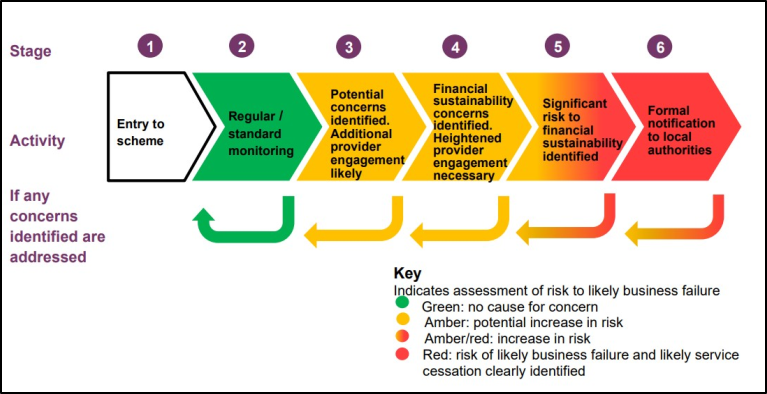
Source: CQC ‘Market Oversight of Adult Social Care’, November 2025
Regulating to lower the probability and cost of a contingency scenario
This option seeks to reduce excessive risk-taking by private sector agents to lower the probability of firm or sector-wide failures. This can include capital requirements or ringfencing activity.
This type of regulation can be costly to firms so it should be pursued when the risk reduction achieved outweighs the cost of mitigation. Importantly, this regulation should not increase expectations of government support in failure scenarios.
Box 4.C Building financial resilience for energy suppliers
During the energy crisis of 2021-22, 27 domestic suppliers became insolvent and left the market, resulting in significant costs passed to billpayers. In response, Ofgem implemented a package of regulatory measures to enhance the supply sector’s resilience to shocks.[footnote 16] These reduce the likelihood of suppliers failing and the costs if they do:
- The Capital Floor and Capital Target, meaning that domestic suppliers must hold a minimum amount of capital within their business as a buffer to absorb losses in a stress event.
- An enhanced ‘Financial Responsibility Principle’ placing stronger obligations on suppliers to ensure they manage their finances in a responsible way, including maintaining liquidity.
- Requirements to protect Renewables Obligation receipts. This means suppliers must set aside these funds to ensure that the money is passed through to renewable generation.
- Powers to direct suppliers to ringfence their Customer Credit Balances (CCBs) in certain circumstances. This supports a ban on suppliers overly relying on CCBs as a source of working capital, which can put licensees in a risky position if there is a shock.
In 2025, data published by Ofgem indicated that the net asset position of the energy supply sector had improved from -£1.7billion in 2022 to £7.5billion in 2025.[footnote 17]
4.5 Reducing costs in a contingency scenario
Mitigations can reduce the costs of liabilities, both reducing the total economic costs of a potential contingency scenario and increasing the likelihood of costs being managed wholly within the private sector.
In some cases, it will be appropriate to convert an implicit liability into an explicit contingent liability, in line with the OECD’s guidance on budgeting for contingent liability risk.[footnote 18] Explicitly recognising a risk through creating a contingent liability can clearly limit their terms and scope. These should be capped, and departments should charge for the risk they take on, lowering the net costs that fall to government.
Regulating to allow firms to fail safely
This option increases the transparency of failure management plans for firms in sectors that deliver key public services. The aim is to encourage increased market diversification and reduce widespread dependence on any single provider.
By regulating to control firm failure, such as requiring firms to provide ‘living wills’, it is more likely that other private sector agents can absorb failing firms or their costs, continuing delivery of critical services and reducing the likelihood of costs being passed to government.
Box 4.D Regulating banks to allow firms to fail safely
The Resolvability Assessment Framework sets out how the Bank of England (BoE) assesses UK banking firms’ resolvability and introduces a public disclosure regime.[footnote 19]
In July 2019, the BoE and the Prudential Regulation Authority (PRA) set out that all UK lenders with more than £50 billion in retail deposits must periodically assess their preparations for resolution, submit a report on their assessment to the PRA and publish a summary of their self-assessment of resolvability. In 2025, the PRA consulted industry on increasing this threshold to £100 billion.
The BoE conducts and publishes its own assessment of firms’ readiness for resolution without recourse to the Exchequer. The BoE also undertakes a proportionate assessment of the resolvability of mid-tier firms below the retail deposit threshold, but outcomes are not publicly disclosed.
Firms need to show how they have taken the steps needed to support the BoE to implement their preferred resolution strategy. This includes showing that they have identified any risks to their successful resolution. These processes reduce the probability that public funds will be used in a resolution.
Temporary shelter
Temporary government sheltering of firms, including through modified insolvency regimes, allows private sector entities to fail safely. This option should only be pursued when firm continuation is strictly necessary for the delivery of a vital service or critical national infrastructure, and when all options for the private sector absorbing customers or costs have been exhausted.
This approach is taken in a small number of industries via Special administration regimes (SARs) or, in the case of financial institutions, resolution regimes. These alter “normal” insolvency principles whereby the primary obligation to creditors is made subordinate to the SAR’s overreaching vital public service objective.
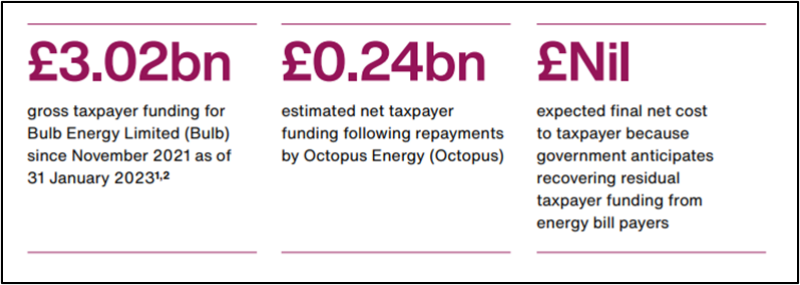
Box 4.E Special Administration Regime for Bulb Energy
Some regulators can use a special administration regime (SAR), to ensure continuity of supply in the event of a failure of a large supplier.
The SAR for energy supply companies was introduced by The Energy Act 20[footnote 20]. It allows for a temporary special administrator to continue running the company to ensure continued supplies until the company is either sold as a going concern or, if that is not possible, transferred to another company as a going concern.
Provision is made to recover any government funding from the company or, if it cannot repay, through a cost recovery mechanism where the costs are borne by industry.
Bulb, an energy supply company with 1.7 million customers, was the first energy supplier to have special administrators appointed. An administrator implemented a restructuring, acting in the interest of creditors while ensuring continuity of supply. This was achieved at no net cost to the taxpayer.[footnote 21]
Source: NAO, Investigation into Bulb Energy, March 2023
4.6 Re-allocating costs in a contingency scenario
When a contingency scenario arises, costs will be allocated between different economic actors. Pre-emptive allocation of costs can enable risk sharing between the public and private sector and move away from the expectation that government will bear the majority or all of the costs in a contingency scenario.
Provision or facilitation of insurance
Government can provide explicit insurance through bespoke schemes or facilitate the provision of private sector insurance schemes. While recognising these liabilities explicitly can result in increased expectations that government bears some of the costs, this can be offset through charging an insurance premium to cover the cost of risk.
Insurance schemes should draw explicit boundaries to establish which costs fall to government and should ensure private sector agents continue to bear a proportionate amount of risk. They can be deployed if a risk is uninsurable by private market solutions for credible reasons.
Box 4.F Pool Re government reinsurance model
The costs of terrorist attacks in the 1990s led to the insurance industry withdrawing cover for terrorism related damage. Terrorist attacks were difficult to model reliably, and potential costs of large attacks were perceived to be too high for private insurers to take on the risk. This meant that costs could fall to government if terrorist attacks caused costly damage to uninsured commercial properties.
The government and insurance industry established Pool Re, a reinsurer owned by its members (insurers) and backed by a government guarantee. Reinsurance allows insurance companies to transfer some of their risk to other commercial actors (such as other insurance firms), who assume portions of the initial liability to spread risk and costs more evenly amongst the insurance sector.
Pool Re pays a premium to the government, linked to premia written by insurers and the investment returns on its assets. If Pool Re exhausts its funds due to losses from terrorism incidents and calls on the guarantee, it is obliged to repay the money called over time.[footnote 22]
This provided stability and made it possible for private insurers to re-enter the market and offer businesses full terrorism cover. The Treasury and Pool Re aim to facilitate return of terrorism risk to private markets in the future and distance the taxpayer from loss.
Pre-funding a risk
Through establishing a levy on industry or mandating that firms ringfence capital, a fund can be built up and held to be used in the future to meet specific liabilities, should they arise.
As set out in Managing Public Money Annex 4.16, funds should only be held to meet specific liabilities if financial risk sits outside of the Consolidated Fund (e.g., if the scheme is funded by a levy on industry or contributions from beneficiaries). Generally, government should not hold or set up a fund when all risk sits with the Consolidated Fund, as this is financially inefficient from a whole public sector perspective.
Pre-funding will only be suitable for sectors with sufficient financial resilience to accept these mandated levies, and where there is sufficient market diversification to ensure costs are spread evenly. It is also important that costs of pre-funding, such as tying up potentially productive capital, are proportionate to the policy benefits of doing so.
Box 4.G Funded Decommissioning Programme
The Funded Decommissioning Programme (FDP) ensures that the developer will meet the costs of decommissioning a nuclear power plant, including managing and disposing of its waste, so that the taxpayer does not bear the burden of these costs in the future.[footnote 23]
Under the Energy Act 2008, operators of new nuclear power stations are required to have secure financing arrangements to meet the full costs of decommissioning and their full share of waste management and disposal costs. These arrangements are set out in the FDP.
The FDP consists of:
- a Decommissioning and Waste Management Plan (DWMP), which sets out the operator’s costed plans for dealing with its liabilities. The plan is reviewed and updated every five years.
- a Funding Arrangements Plan (FAP), which sets out how the operator will make financial provision to meet its liabilities.
The FDP is supported by a range of agreements and contracts.
Committing to net cost recovery
Where costs that may fall to government in a contingency scenario can be clearly defined, are time-bound and can credibly be recovered from the private sector, governments can commit to recovering costs after a contingency scenario has crystallised. This is appropriate in sectors that are sufficiently large and financially resilient.
Cost recovery is achieved through setting up a system ahead of failure, such as to levy a relevant group to recoup the costs after an event. This is useful insofar as it allocates costs to a more specific group than the general taxpayer and should ensure that government faces no net costs in the medium-term once the costs have been fully recovered.
Departments should ensure that the amount recovered does not exceed the costs of the contingency scenario and should ensure that recoveries are considered in real as opposed to cash terms.
Box 4.H Financial Services Compensation Scheme (FSCS)
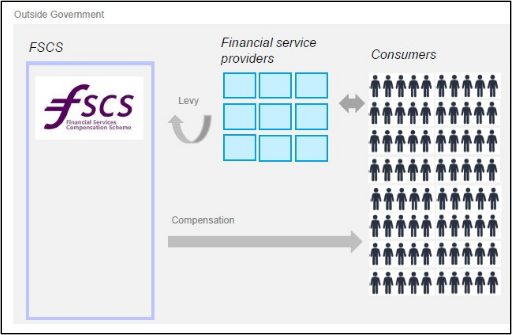
The FSCS is the UK’s deposit guarantee scheme. Eligible bank, building society and credit union deposits up to £120,000 are protected in the event of a firm being placed into insolvency.
This is funded by a levy on banks and building societies, proportional to each institution’s share of protected deposits within the industry. The levy funds the cost of compensation paid to customers, as well as the costs of running the FSCS’ service.
Limiting the eligibility of deposits protected also places a credible cap on costs that are covered by the FSCS if a firm enters insolvency. The FSCS is designed to mitigate the risk of depositors withdrawing covered deposits in the event of a bank failure and limit risks to public funds in instances of bank failure.
FSCS coverage is widely understood through advertising and FSCS branding on bank accounts.
Source: HMT
Managing firm failure through private sector bail-ins
This mitigation option is a requirement for firms to self-insure or take out insurance policies. These policies and the debt held by firms should be priced by a market to ensure sustainability is incentivised and that transparency is maintained within the sector.
Providing insurance policies in a competitive market allows for firms to absorb losses and insulate taxpayers from the costs of a contingency scenario, as shareholders and creditors should bear losses before taxpayers. This approach is useful when information on firm financial resilience is sufficiently available for the markets to price risk.
Box 4.I Reforms to banking resolution
In the financial services sector, the Bank of England (BoE) is responsible for ensuring that certain financial services firms can fail in a safe manner, minimising disruption – this is known as “resolution.”
During the financial crisis, public money was used to bail out banks considered ‘too big to fail’. Afterwards, the government put in place significant reforms to protect public funds in the future.
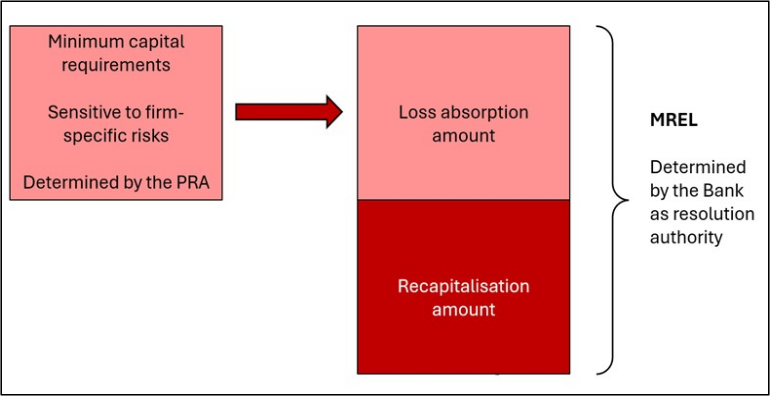
A key reform required firms to maintain a minimum level of equity and eligible debt above minimal capital requirements. This ensures these firms can be ‘bailed in’ or support a resolution should they fail. This minimum requirement for own funds and eligible liabilities (MREL) ensures that when certain firms fail, resolution authorities can use these resources to absorb losses and recapitalise the businesses.[footnote 24]
This system reduces the likelihood that government or the BoE needs to use public funds to rescue or bail out firms. The cost of resolution and depositors’ uninterrupted access to funds is met by banks’ shareholders and investors rather than falling on taxpayers.
Figure 4.A MREL Model
Source: Bank of England, November 2016
5. Application of this guidance
5.1 Applying the guidance to policymaking
Overview
This chapter details the roles and responsibilities for applying this guidance, as well as the process that departments should undertake in identifying, analysing and managing their implicit liabilities.
While the term ‘liability’ has been used throughout this document, this guidance will not affect any financial reporting requirements for organisations.
There will also not be a formal data collection or reporting process for implicit liabilities as exists for contingent liabilities; but it is important that risk owners have early-stage discussions with the Treasury about how best to manage plausible or potentially costly implicit liabilities, well in advance of potential crystallisations.
Roles and Responsibilities
Departments will be responsible for the identification and proactive management of risks associated with implicit liabilities, with the Treasury playing an oversight function.
As outlined in paragraph 2.13, departmental responsibility for management of implicit liabilities will be allocated based on policy ownership of the levers that affect or could reduce the risk. Departments will have responsibility for considering policy levers to mitigate these risks, even if their systemic nature means the risk cannot be managed entirely out of existing budgets.
If implicit liabilities crystallise and costs fall to government, the expectation is that these should be managed from departmental budgets in the year of crystallisation or future years in the first instance, depending on the scale, as is the case with contingent liabilities. In line with wider spending control guidance, the Treasury will only consider providing funding to meet crystallisation costs in circumstances that are genuinely unforeseeable, unaffordable, and unabsorbable.[footnote 25]
Some implicit liabilities sit across department responsibilities or exist on a system-wide level. For such risks, the following process should be followed:
- Where cross-cutting or systemic risks are identified, a lead department should be assigned to help co-ordinate work and there should be clear, agreed ownership for different elements of risk management across other departments with equities.[footnote 26] The Treasury will help assign and codify these responsibilities, including departmental responsibility for risk analysis, developing mitigations, and meeting costs in the event of potential crystallisation.
- Given that different mitigation approaches may be preferred by different departments based on their policy priorities, the Treasury will help facilitate shared understanding of the impacts of an implicit liability and broker agreement on the preferred mitigation strategy to strike an appropriate balance on policy trade-offs.
Timescales for implementation
The Treasury is putting in place an initial multi-year programme to mitigate implicit liabilities across government, with funding for priority projects available from the Implicit Liability Management Fund from 2026-27 to 2028-29 inclusive. Following publication of this guidance, the Treasury expects that departments will do the following:
- Initiate Stage 1, a scoping process outlined in paragraph 5.10-5.14, by the start of the 2026-27 financial year. This stage will need to be completed ahead of 2026-27 for any policy areas where departments wish to access the Fund from the start of 2026-27.
- Undertake Stage 2, a series of policy deep dives outlined in paragraph 5.15-5.20, during the 2026-27 and 2027-28 financial years.
- Agree a plan for Stage 3, the implementation of policy reforms identified via policy deep dives, which should aim for completion before the end of the parliament wherever possible.
After this initial process, departments should review the risks they and their public bodies hold at least every two years. Where new risks are identified or significant developments have altered risk levels, the process set out below should be repeated.
5.2 Stage 1: Identifying risks within departments
The first stage involves departments ascertaining whether they hold implicit liabilities. They should draw on the list of questions set out in Chapter 3 to help identify and understand potential implicit liabilities.
Having determined that implicit liabilities are held, departments should use the questions in Chapter 3 to conduct initial scoping to better understand the potential scale of costs that could fall to government in a contingency scenario.
This initial scoping does not require significant analytical detail when quantifying the fiscal exposure. If initial findings indicate plausible risk of crystallisation or unabsorbable costs associated with crystallisation, departments should conduct fuller quantitative analysis through the second stage – a policy deep dive process.
The scoping exercise should produce the following outputs, for which the Treasury will commission returns from departments:
- A comprehensive list of the potential policy areas that could give rise to an implicit liability.
- An explanation of factors that could contribute to an implicit liability crystallising, be they economy-driven, government-driven or other.
- An indicative assessment of the probability of crystallisation of these implicit liabilities (e.g. low, medium, high, acute).
- A summary of readily accessible evidence on the potential economic and fiscal costs of the implicit liability.
- An assessment of the current mitigation approach, including a judgement of its success and any meaningful gaps in the strategy.
- The internal priority level (low, medium, high) of managing this risk within the responsible department.
This assessment of departmental policy areas should be carried out on a regular basis (every two years at a minimum) to ensure departments have up to assessments of risk. The scoping exercise will inform the policy deep dive process in Stage 2.
5.3 Stage 2: Undertaking deep dives into risk areas
Having conducted initial scoping, departments should undertake a prioritisation of the implicit liabilities they have identified. This should be supported by the outputs of the scoping exercise, which can be used to complete the table in Annex A for each liability.
Key considerations for prioritisation should be departments’ assessment of the probability of an implicit liability crystallising and the impact that crystallisation would have on the public finances and economy. The Treasury will provide support and steers on the prioritisation of implicit liabilities, including triaging prioritisation assessments in the event of cross-cutting or systemic risks.
Where the department and Treasury judge that priority implicit liabilities have been unaddressed, or current mitigation strategies require reform, departments should undertake a policy deep dive.
A policy deep dive should aim to cover analytical work and policy option generation, not the delivery or implementation of policy options themselves. The aim is to substantiate the risk faced by government in holding these implicit liabilities, so that ministers can take proactive and well-informed decisions on whether to progress policy options.
Policy deep dives should cover the following areas and would be expected to last between three and nine months:
- Quantification of fiscal exposure. This should include probability of the implicit liability crystallising, the scale of costs that may fall to government in contingency scenarios, and an assessment of the expected and reasonable worst-case costs in event of crystallisation.
- Quantification of likely wider economic costs of a crystallisation scenario, covering the first-order and second-order impacts.
- A more detailed assessment of the current mitigation approach, any related economic costs, and barriers to further mitigation.
- An options analysis of potential mitigations drawing on the toolkit in Chapter 4 and Annex B. This should include options that would require regulatory reform or legislation, assessing how potential mitigation options influence long-term fiscal cost, balanced against the fiscal and economic costs of implementing the mitigations.
- A mapping of policy interdependencies to understand how a proposed implicit liability’s mitigation strategy affects wider government priorities. Where regulatory levers are considered, this may be achieved via a light-touch regulatory impact assessment.
The Government Actuary’s Department (GAD) is available to support departments in understanding and quantifying the risk of implicit liabilities. You can contact GAD at enquiries@gad.gov.uk.
5.4 Stage 3: Implementing deep dive findings
Deep dives should result in clear recommendations on a mitigation strategy, which should be agreed with the Treasury.
After completing deep dives, departments should present policy options to ministers for consideration, including the likely success of each option in reducing risk exposure, the estimated economic and fiscal cost of implementation, and steps required for implementation.
Departments should subsequently undertake specific policy development and consultations to progress ministerial steers where mitigation development or reform is required. This could feed into decisions made at regular spending reviews or other fiscal events.
Departments should then work across government to implement these reforms, including pursuing legislative or regulatory changes where appropriate. Where a cross-cutting or system-wide liability is mitigated, the Treasury will maintain strategic oversight.
5.5 Support available from the Treasury
The Treasury will support departments with the allocation of ownership for specific implicit liabilities (especially for cross-cutting risks), prioritisation of identified implicit liabilities for deep dives, and will agree the preferred mitigation strategy with departments.
The Treasury will offer guidance on conducting the deep dive process, but ultimate responsibility for delivering these sits with the department or departments who are accountable for the risk.
5.6 Implicit Liability Management Fund
The £15m Implicit Liability Management Fund is available to ensure departments have sufficient resource and can gain access to support for scoping and mitigation strategy design work. This could range from improving analysis of risk, to designing and implementing regulatory systems, to establishing the policy case for government to entirely transfer risk onto the private sector.
Departments will need to submit bids to the Treasury using a template to be issued by the Treasury. This will detail the risk they are looking to mitigate, the project’s scope, and justification for why they cannot deliver this work from existing budgets. Bids will be considered on an annual basis ahead of the start of the financial year, commencing prior to 2026-27. Priority will be given to implicit liabilities that are most challenging, potentially costly, or with the highest risk of crystallisation.
Funding will be conditional on deliverables agreed between the department and the Treasury. The Treasury will not consider funding for departments that are not actively applying this guidance.
It is expected that where departments are not provided with support from the Fund, they should still undertake the processes listed above, unless the department would not reasonably be able to deliver this due to its complexity or where they can demonstrate they are already assessing and managing the risk comprehensively. These exceptions should be clearly justified to the Treasury.
Contact details
If departments need support with applying this guidance, or would like more information, they should contact the Implicit Liabilities Team within HM Treasury at implicit.liabilities@hmtreasury.gov.uk.
6. Annex A: Summary table for implicit liability identification
The below table is designed to help departments summarise the financial implications of identified implicit liabilities, using the questions for identification set out in Box 3.A. As set out in paragraph 5.15, this table should be used to inform the prioritisation exercises conducted by departments when selecting policy areas for deep dives.
Given the uncertain nature of implicit liabilities, it is likely that the figures in this table will be estimated with a degree of uncertainty. The estimates of costs should be an indication of quantum based on professional judgement and should account for the distribution of likelihood and severity. Departments should engage the Government Actuary’s Department (GAD), as required, to support them in producing this quantification. You can contact GAD at enquiries@gad.gov.uk.
The table covers the following key areas:
- Probability of crystallisation. This will depend on whether it is possible for the liabilities to crystallise multiple times, or with varying degrees of severity, as opposed to a single crystallisation event. Departments should provide an indication of the probability of a single large cost and multiple small costs occurring, covering both a quantified figure and supporting explanation.
- Long-term economic cost: This will be a judgement of costs in money, time, and other resources resulting from a contingency scenario. Ideally, this will be a piece of quantitative economic modelling, but in many cases, it will be a qualitative summary of first- and second-order impacts that may be anticipated.
- Assumed share of costs met by government: An estimate of what risk can reasonably be borne by the private sector, and what departments assume would fall to government either due to its size or unforeseen nature. This should be an iterative estimate and will help inform private sector engagement.
- Ability to charge: Where government converts implicit liabilities into explicit contingent liabilities, charging for risk held can minimise the long-term fiscal impacts. Where this is an agreed or potential policy approach, departments should give an indication of the scale of premium government could charge.
- Reasonable worst-case exposure to government: By necessity this is judgement based. It shows the costliest plausible manifestation of the implicit liability crystallising over its lifetime once very highly unlikely scenarios have been discounted. Departments should describe the scenario that would lead to this exposure level.
- Current level of contingency plan implemented: an overview of current policies to manage the risk of the liability crystallising, and an indicative assessment of the success of current mitigation, including any meaningful gaps in present strategies.
- Current priority level: departments should give an indication of the level of urgency and priority (low, medium, high) being given to addressing the implicit liability and any recent Ministerial decisions.
Table A.1 Implicit Liability Summary Table
| Risk factor | Assessment |
|---|---|
| Probability that implicit liability crystallises | |
| Long-term economic cost (£m) | |
| Assumed share of costs met by government | |
| Ability for HMG to charge for any risk held (where appropriate) | |
| Reasonable worst-case exposure to government (£m) | |
| Current level of contingency plan implemented | |
| Current priority level |
7. Annex B: Key design questions for mitigation options
7.1 Overview
This annex details key design questions departments should consider when developing implicit liability mitigations. Any mitigation strategy should quantify the risk held, consider impacts on expectations in the private sector, and the probability of a liability crystallising.
Options should aim to meet as many of the principles of mitigation as possible that are set out in paragraph 4.6. The design questions below are intended to shape thinking about optimising a mitigation strategy and how to transfer risk away from taxpayers.
7.2 Understanding and changing behaviours
Two options that seek to understand or change firm behaviour are establishing independent financial monitoring systems, and regulation to lower either the probability of a contingency scenario arising, or cost of a contingency scenario when crystallised.
Box B.1 Key design questions – Independent financial monitoring
- Which organisation is best placed to provide this monitoring and what powers will the monitoring organisation have to compel firms to provide it with information?
- What other objectives does the monitoring organisation have, for example ensuring competitive markets or lowering consumer bills and are these objectives in tension?
- How will government explain why it is monitoring these firms? Will that explanation imply any government backing for certain activities or economic systems?
- Will the results of independent financial monitoring be made public? How would publication enhance accountability of firms?
Would the monitoring organisation conduct stress tests and scenario analysis? Would these tests be published?
Box B.2 Key design questions – Regulation to lower the probability and cost of a contingency scenario
- What scale of shock does the proposed level of regulation mitigate against and how likely is a shock of that scale?
- Will regulation push activity into unregulated sectors and would those unregulated sectors still impose an implicit liability on government?
- Does the regulation address a market failure where firms do not recognise the cost of their own systemic importance (i.e., moral hazard) incentivising them to take on more risk than they should?
- What additional cost will be imposed on businesses due to the regulation?
How would government explain why it had chosen to regulate firm activity and the limits to its regulation?
7.3 Reducing economic costs in a contingency scenario
To minimise the costs in the event of firm failure, government can regulate firms to fail safely, with the aim of encouraging market diversification and resilience. When implicit liabilities are triggered by the failure of a firm responsible for critical service delivery, government can provide a firm with temporary shelter until such time as its responsibilities can be transferred to another private sector entity.
Box B.3 Key design questions – Regulation to allow firms to fail safely
- How would costs be reduced in a failure scenario to ensure government is not solely responsible for picking up any shortfall in service delivery?
- Would reducing the cost in a failure scenario also reduce the probability of the contingency scenario occurring?
- Will any assessment of “resolvability” be made public?
- Will this regulation create expectations that government would step in if the resolution plans failed?
Will any regulation be applicable in all failure scenarios or are there large-scale failures where plans would not work?
Box B.4 Key design questions – Temporary sheltering
- What expectations do households and businesses have of continuity of service and what would the wider economic costs be of interruption in that service?
- Would any additional costs be recovered, for example through levies after the event? Who would pay those levies and how similar would they be to general taxpayers?
What additional cost would government face through temporary public ownership or control? Would they exceed the revenues generated through ownership?
7.4 Allocating economic costs in a contingency scenario
The aim of explicitly allocating costs is to enable risk sharing between the public and private sector and avoid government bearing the majority or all of costs in a contingency scenario.
If recognising the liability would be beneficial, government can facilitate insurance to key sectors while charging to cover government’s risk exposure. If the industry is sufficiently financially resilient to do so, pre-funding a risk through levies or ringfencing capital can allocate costs effectively to less productive parts of the economy.
Where there is sufficient credible confidence in the resilience of the sector, government can commit to recover costs after the event, resulting in a lifetime fiscally neutral intervention. If private firms can independently raise capital or buy insurance, then private sector bail-ins can effectively transfer risk onto future private sector entities.
Box B.5 Key Design Questions – Provision or facilitation of insurance
- Who will bear the costs of this insurance, for example will consumer bills rise?
- Will the insurance provided credibly cover costs in all scenarios?
- Would insurance help to change expectations even if it doesn’t have full take-up?
How will moral hazard be mitigated; will riskier behaviour be encouraged as a result of insurance and if so, what controls should be in place?
Box B.6 Key Design Questions – Prefunding a risk
- What contingency scenario(s) will the fund cover and how likely is a scenario of this scale? How large should the fund be? What mechanism will the fund have to raise its funds independently?
- How will the fund ensure that financial risk is transferred away from the Exchequer and there is no recourse to the Exchequer?
- Who should own the fund, should it be government or the industry creating the implicit liability?
- What would be the cost of holding the fund in this way through changing capital allocation in the economy?
What will happen if the fund isn’t sufficient to cover costs?
Box B.7 Key Design Questions – committing to cost recovery
- Can the costs covered by this approach be clearly defined?
- If there are multiple failures, how will cost recovery be managed, (i.e., costs will increase while the base for recovering the costs will shrink)? Will cost recovery after the event be credible?
- Over what time period would it be credible for these costs to be repaid?
- Will cost recovery after the event put the UK at a disadvantage internationally as a place to do business?
Will covering a portion of costs increase expectations that all costs are covered by government regardless of the scope of the cost recovery scheme?
Box B.8 Key Design Questions – Private sector bail-in or insurance
- Which institution should set the amount of bail in capital needed? How will they balance economic cost with risk mitigation?
- Which institution will decide when and if bail in instruments should be written down or converted and how can their decisions be challenged?
- If bail-in capital or insurance is insufficient to meet the liability what will happen?
- Will financial markets be able to credibly provide financial discipline to these firms – what information will they based pricing and risk decisions on?
Will there be sufficient differences in the price of bail in capital or insurance to create an incentive for firm to reduce the risk of failure?
7.5 Meeting the principles of mitigation
Different options can be summarised by their relative impact on government’s fiscal exposure, their impact on private sector expectations that government may intervene, their impact on the probability of a contingency event crystallising, and their impact on the scale of economic costs that arise if a contingency event crystallises.
Table B.1 below summarises this for the mitigation options listed.
Table B.1 Summary of impacts of mitigation options.
| Option | Impact on fiscal exposure | Impact on expectations | Impact on probability of risk crystallising | Impact on size of economic costs |
|---|---|---|---|---|
| Understanding and changing behaviour | ||||
| Independent Financial Monitoring | Limited. Aims to ensure a crystallisation isn’t reached | Dependent on presentation of increased monitoring | Decreases if monitoring impacts firm behaviour | Decreases if monitoring impacts firm behaviour |
| Regulation to lower the probability and cost | Moderate. Firms need to hold adequate capital, etc | Dependent on presentation of regulatory change | Decreases if regulation is effective | Decreases if regulation is effective |
| Reducing economic costs in a contingency scenario | ||||
| Regulating to allow firms to fail safely | Moderate. Can both increase and decrease govt’s costs in a contingency scenario | Decrease if costs easier to manage but increase if regulation changes expectations of support | Neutral, regulations would aim to reduce costs during a failure | Decreases if regulations are effective |
| Managing firm failure | Moderate. Govt will only need to meet essential liabilities | Neutral, where costs fall will depend on cost recovery mechanism | Neutral | Decreases, as it allows for more controlled failure in a contingency scenario |
| Allocating economic costs in a contingency scenario | ||||
| Provision or facilitation of insurance | Significant. Allows govt to cover costs of risk it holds | Decreases as there are credible alternate ways for costs to be allocated | Could increase or decrease depending on policy design | Could increase or decrease depending on policy design |
| Prefunding a risk | Significant. Can remove govt need to intervene | Decreases, if the fund is sufficient, increase if it is not. | Neutral | Neutral |
| Commitment to cost recovery | Moderate. In established sectors can be effective but may be prohibitive in smaller areas | Decreases up to point cost recovery is not credible. | Neutral or decreasing if it changes behaviour | Neutral or decreasing if it changes behaviour |
| Private sector bail-in or insurance | Significant. Can remove govt need to intervene | Reduced to the point that self-insurance covers losses, increased once firm’s own resources are exhausted | Decreases as need for self-insurance incentivises firms to minimise perceived risk of failure | Neutral |
-
Bank rescues of 2007-09: outcomes and cost, House of Commons, October 2018. ↩
-
The Orange Book – Management of Risk – Principles and Concepts, HM Treasury, 2013. ↩
-
Contingent Liability Approval Framework, HM Treasury, April 2023. ↩
-
National Risk Register, Cabinet Office, 2025. ↩
-
Fiscal Risks and Sustainability Report, Office for Budget Responsibility, July 2025. ↩
-
UK Government Resilience Action Plan, Cabinet Office, July 2025. ↩
-
Balance Sheet Framework, HM Treasury, November 2025 ↩
-
Fiscal Risks and Sustainability Report, Office for Budget Responsibility, July 2023. ↩
-
IAS 37 Provisions, Contingent Liabilities and Contingent Assets, IFRS, 2025 ↩
-
Rise of non-standard policy Instruments: Can budgeting catch up?, OECD, December 2023. ↩
-
Budgeting for Contingent Liabilities, OECD, June 2013. ↩
-
The Roles of Lead Government Departments, Devolved Administrations and Other Public Bodies, Cabinet Office, August 2023 ↩
-
Confidence intervals represent the mean of an estimate plus and minus the variation in that estimate, i.e. using a 90% confidence interval indicates that in 90% of cases your estimate of the probability will fall in the 90th percentile of costs. ↩
-
Aviation Insurance, Hansard, November 2002 ↩
-
Market Oversight of adult social care, Care Quality Commission, November 2025 ↩
-
Powering Trust: Protecting consumers through Financial Resilience, Ofgem May 2025 ↩
-
Markets Regulatory Vision and Strategy to 2030, Ofgem, November 2025 ↩
-
Budgeting for Contingent Liabilities, OECD, June 2013. ↩
-
The Bank of England’s approach to assessing resolvability, Bank of England, July 2019. ↩
-
Memorandum of Understanding: Energy Supply Company Administration, Ofgem, February 2017. ↩
-
Investigation into Bulb Energy, National Audit Office, March 2023 ↩
-
HM Treasury’s review of Pool Reinsurance Company Limited 2020-2022, HM Treasury, March 2022. ↩
-
Funded Decommissioning Programme Guidance for New Nuclear Power Stations, Department of Energy Security and Net Zero, December 2011. ↩
-
The Bank of England’s approach to setting a minimum requirement for own funds and eligible liabilities (MREL), Bank of England, November 2016. ↩
-
Consolidated Budget Guidance 2.39, HM Treasury , February 2025 ↩
-
The Roles of Lead Government Departments, Devolved Administrations and Other Public Bodies, Cabinet Office, August 2023 ↩