Research brief
Published 1 October 2026
Applies to England

© Crown copyright 2026
This publication is licensed under the terms of the Open Government Licence v3.0 except where otherwise stated. To view this licence, visit nationalarchives.gov.uk/doc/open-government-licence/version/3 or write to the Information Policy Team, The National Archives, Kew, London TW9 4DU, or email: psi@nationalarchives.gov.uk.
Where we have identified any third party copyright information you will need to obtain permission from the copyright holders concerned.
This publication is available at https://www.gov.uk/government/publications/growing-up-in-the-2020s-first-survey-of-young-people-at-age-12-and-13/research-brief
Authors
Dr Jessica Stepanous (Anna Freud)
Dr Tanya Lereya (Anna Freud)
Dr Larissa Pople (UCL)
Prof. Emla Fitzsimons (UCL)
Prof. Jessica Deighton (Anna Freud)
Overview
Growing Up in the 2020s is a longitudinal study funded by the Department for Education (DfE) and led by Anna Freud, in partnership with University College London (UCL) and Ipsos.
It follows a nationally representative cohort of young people in England from secondary school into early adulthood, providing new evidence on young people’s education and wellbeing experiences during a period of significant social and technological change.
This report presents findings from the first wave of data collection, based on information from nearly 8,000 young people in year 8 (aged 12 and 13) in 2025. It provides a comprehensive contemporary picture of adolescent life at this age.
The findings suggest that most young people are doing well across many aspects of their lives. However, a substantial minority experience challenges related to mental health, school engagement and belonging. The report also highlights persistent inequalities, with some groups of young people experiencing less favourable outcomes across multiple areas of their lives.
Research objectives
This first report from the Growing Up in the 2020s study provides a baseline picture of year 8 pupils in England and examines differences in experiences and outcomes across groups including:
- eligibility for free school meals (FSM)
- special educational needs (SEN) provision
- sex
- ethnicity
- parental education
- region
The report covers a wide range of topics, including:
- physical and mental health
- cognitive development
- family relationships
- socioeconomic circumstances
- peer experiences and friendships
- school belonging, engagement and attendance
- enrichment activities
- self-reported social media use
Methodology
Data was collected from nearly 8,000 young people in year 8 (aged 12 and 13) in the 2024 to 2025 academic year, together with information from parents and carers and teachers. Survey data were combined with cognitive assessments and linked administrative education records.
Main findings
Cohort profile
The Growing Up in the 2020s cohort is highly representative of year 8 young people in England in the 2024 to 2025 academic year, with age, sex, ethnicity and regional distributions closely aligned with national population estimates from the Office for National Statistics (ONS) census and related administrative statistics.
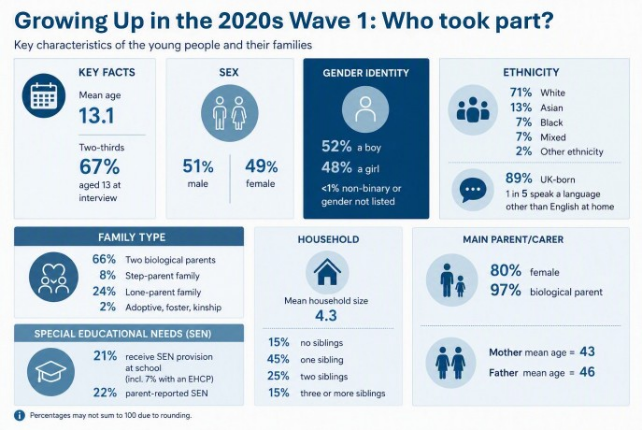
The characteristics of participating young people (and their families) included:
- a mean age of 13.1 years
- a broadly even split by sex (51% male and 49% female)
- a predominantly white sample (71%), with 29% from other ethnic backgrounds
- 89% being born in the UK, and one in 5 speaking a language other than English at home
- two-thirds (66%) living with 2 biological parents and around one-quarter (24%) living in lone-parent families
- around one in 5 (21%) young people receiving special educational needs (SEN) provision at school (based on national pupil database records)
Young people’s health, wellbeing and cognition
Generally positive wellbeing and health behaviours among young people included:
- that 94% reported feeling neutral about or happy with life overall
- that 98% reported feeling neutral about or happy with family relationships and 95% with friendships
- that most young people reported feeling resilient, with 71% agreeing that they keep trying when they find something difficult
- that 90% reported that they achieved at least 8 hours of sleep on a typical weekday
- low levels of alcohol use (11% ever used), smoking (0.2% currently used) and vaping (9% ever used)
Areas of concern in young people’s health and wellbeing included:
- around one in 4 (25%) meeting the criteria for a probable mental health disorder
- around one in 4 (24%) having a longstanding condition affecting daily functioning
- only 17% meeting the recommended physical activity guidelines of at least 60 minutes of physical activity every day
Marked inequalities in wellbeing, health and cognition across sociodemographic groups included:
- higher rates of a probable mental health disorder and a longstanding condition affecting daily functioning among young people receiving SEN provision and those eligible for free school meals (FSM)
- lower levels of physical activity among young people receiving SEN provision and those eligible for FSM
- lower rates of achieving recommended sleep levels among young people eligible for FSM
- higher rates of alcohol use among young people receiving SEN provision and higher rates of vaping among young people receiving SEN provision and those eligible for FSM
- lower Matrix Reasoning task scores (a widely used indicator of fluid intelligence and general cognitive ability) among young people eligible for FSM, those with lower parental education, and those with lower prior key stage 2 (KS2) attainment
- lower life satisfaction and resilience, and less favourable sleep and physical activity outcomes, among girls compared to boys
Family relationships and engagement
Positive family relationships and parental engagement in education included:
- positive relationships with parents or carers, with 85% reporting that it was always or often true that their parent or carer listened to them
- high levels of parental monitoring, with 95% reporting that their parent or carer knew a few, most or all of their friends
- largely positive interparental relationships, although 12% of main parents or carers reported having ever felt afraid of a partner
- most young people (73%) reporting that it was always true that their parent or carer showed an interest in their learning
- 16% of young people having accessed additional tuition
Associations between socioeconomic disadvantage, fewer home learning resources and poorer parental wellbeing included:
- lower likelihood of access to key learning resources, such as a quiet place to study and a personal digital device, among young people eligible for FSM and those with less-educated parents
- higher rates of parent or carer long-term conditions, depression and anxiety symptoms, smoking and vaping, alongside lower alcohol use, in FSM-eligible and lower-educated-parent households
Peer relationships
Supportive peer relationships included:
- most young people reporting feeling supported by friends (average score of 5.16 out of 7) and accepted by peers (70% agree or strongly agree)
- favourable teacher-rated peer relationships, with 88% of young people reported by their teachers to be liked by peers and 70% making friends easily
- most young people reporting no experience of physical (80%), relational (61%) or cyberbullying (86%), with bullying rates lower than those reported in comparable national surveys
Differences in peer experiences and bullying across demographic groups included:
- less positive peer relationships and higher rates of bullying among young people receiving SEN provision and those from socioeconomically disadvantaged backgrounds
- higher rates of relational and cyberbullying among girls, and higher rates of physical bullying among boys
- 31% of young people who experienced bullying reported that school staff were aware of it
School experiences
Mixed experiences of school included:
- 74% of young people feeling safe at school
- most young people reporting that they settled into secondary school either very well (33%) or quite well (53%)
- 63% reporting a sense of belonging at school
- 36% often or always looking forward to school
- nearly one in 5 (19%) meeting the threshold for persistent absence
- 17% reporting classroom disruption in all lessons
Inequalities in young people’s experiences of school included:
- lower sense of school belonging, greater difficulty with learning, lower enjoyment of learning, and lower engagement than their peers among young people receiving SEN provision and those with lower prior KS2 attainment
- associations between socioeconomic disadvantage and poorer educational experiences in several areas, including greater difficulties with learning, less time spent on homework, and substantially higher rates of lateness, persistent absence and suspension
- less favourable teacher assessments of ability and engagement for young people with SEN, those eligible for FSM, those with lower-educated parents or carers, and those with lower prior KS2 attainment
- lower parental expectations that their child would attend university among parents or carers of young people with SEN and lower prior KS2 attainment
- lower awareness of post-16 educational routes – for example, lower awareness of A levels among parents or carers of young people receiving SEN provision and those eligible for FSM
Wider context: activities and social media
Prominent leisure activities among young people included:
- participation in sports (69%) and gaming (63%) being the most common weekly activities
- average self-reported weekday social media use of 2.3 hours
- mixed patterns of reading for enjoyment, with 22% reading most days but one quarter (25%) never reading for enjoyment
Fewer opportunities for enrichment beyond school among young people experiencing socioeconomic disadvantage and those receiving SEN provision included:
- lower participation in sports, arts and other enrichment activities
- lower levels of reading for enjoyment
- greater time spent on social media
In contrast, young people with degree-educated parents or carers participated more frequently across most activities.
Implications
As one of the largest and most comprehensive studies of adolescents in England, Growing Up in the 2020s provides an important new evidence base for understanding both the strengths and challenges of contemporary adolescence.
The findings suggest that many of the inequalities shaping young people’s experiences are already well established by the beginning of secondary school. Differences in mental health, attendance, school engagement, cognitive development and wider life experiences often occur together, creating patterns of cumulative advantage and disadvantage for different groups of young people.
Future research
The wave 1 report provides a nationally representative baseline against which future changes can be assessed. Future stages of the study will track young people’s experiences and outcomes through adolescence and into early adulthood, helping to identify how inequalities develop over time and the factors associated with different life trajectories. The study findings will provide an important evidence base to inform policy and practice.