Government Science and Engineering profession strategy 2026
Ensuring the GSE profession can support its people to place excellent science and engineering at the heart of government decisions for a better future.
Documents
Details
Foreword
Science and engineering equip us with the tools to help us understand our changing world and shape decisions to create a more resilient future for the United Kingdom. Whether it is rising to the challenge of climate change, shaping our society and public services to support an ageing population, or embracing the transformative potential of new technologies – from artificial intelligence to innovative energy solutions – science and engineering have an important role to play.
These developments will affect every part of our lives. We need the very best science and engineering expertise to help us ask the right questions, provide evidence, and make decisions that will stand the test of time.
Bringing together people with different experiences, skills, and viewpoints improves our profession and our science advice. Diverse evidence matters – it helps us see the full picture, challenge our assumptions, and make choices that are fair, inclusive and effective for everyone.
This strategy sets out how the Government Science and Engineering profession will put science and engineering at the heart of government decision making.
The strategy is built on four themes: career development and leadership, skills, recognition and reward, talent and interchange, and connection and community. Each has measurable goals designed to improve capability, encourage inclusion, and support professional growth across government. Equity, diversity and inclusion are embedded throughout, reflecting the commitment to a fair and supportive environment for all members.
As Head of the GSE Profession, my ambition is to build a community that is ready for what comes next: curious, skilled, and confident to lead.
Professor Dame Angela McLean
Government Chief Scientific Adviser and Head of the GSE Profession
Executive summary
This strategy sets out how we’ll achieve our new vision: “Placing excellent science and engineering at the heart of government decisions for a better future”. From April 2026, the Government Science and Engineering (GSE) profession will work on four themes that increase science and engineering capability across government:
-
Career development and leadership: clear pathways for career progression and leadership development.
-
Skills, recognition and reward: improved skills, an enhanced recognition offer and implementation of the GSE reward framework
-
Talent and interchange: stronger talent schemes, career mobility and networks across government and beyond.
-
Connection and community: a more connected, inclusive profession with better access to resources and events.
We will embed equity, diversity and inclusion in all four themes.
Our 2026 GSE profession strategy builds on the 2021 strategy. This achieved 62% of its objectives – including launching STEM Futures and the Science & Engineering 101 learning modules. We are building on that momentum, while improving how we measure progress and making sure our work aligns with government priorities and evolving cross-Civil Service People Strategy. We will track progress against measurable goals and publish annual updates on our GSE members’ site. Your feedback will help us keep the strategy relevant and ensure it provides real benefits for government science and engineering.
1. About the GSE profession
1.1 What we do
From building and applying scientific knowledge to conducting critical analyses, generating and evaluating evidence or creating new standards – the breadth of experience in the GSE profession is vast.
Science and engineering expertise can improve every policy and operational area. Whether this is artificial intelligence, engineering biology, public housing, net zero or transport, to name only a few, science and engineering have a role to play in making a real difference.
1.2 Who we are
With around 10,000 signed-up members across the civil, public and crown services, we embed science and engineering in government decision making.
Science and engineering roles fall into four job families:
-
Deep specialist: experts in a specific technical area.
-
Specialist: applying technical knowledge in policy or delivery.
-
Cross-discipline: working across different scientific or engineering fields.
-
Affiliate: supporting science and engineering without being a technical expert.
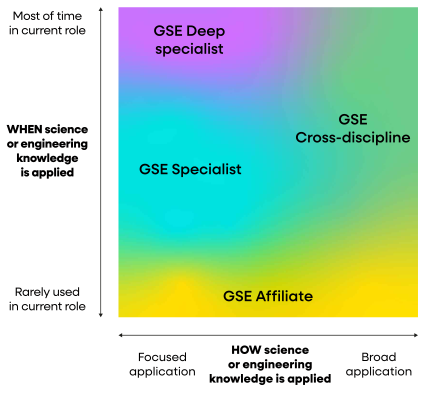
These groups exist to help you structure your development and you may find yourself moving between them quite often. The diagram below describes each of our job families and shows the flexibility between them.
Figure 1: Classification of GSE job families by when (y) and how (x) science and engineering is applied.
Classification of GSE job families by when and how science and engineering is applied
Figure showing four GSE job families positioned by how often science or engineering knowledge is used and how broadly it is applied in their role. The GSE Affiliate job family rarely uses science and engineering knowledge in their current role and covers a range of applications from focused to broad. The GSE cross-discipline job family is characterised by a broad application of science and engineering knowledge and uses it some to most of the time in their current role. The GSE Specialist job family has a focused application of science and engineering knowledge and uses it a medium amount in their current role. The GSE Deep specialist job family also has a focused application of science and engineering knowledge but uses it most of the time in their current role.
Figure 2: Distribution of GSE roles by job family.
| Job family | Percentage distribution by job family |
|---|---|
| Specialist | 51 |
| Deep specialist | 35 |
| Cross-discipline | 11 |
| Affiliate | 2 |
| Unknown | 1 |
Source: GSE Skills Taxonomy Data Commission, spring 2025.
Figure 3: Distribution of GSE roles by skill grouping.
| Skill grouping | Percentage distribution by skill grouping |
|---|---|
| Agricultural, veterinary and food sciences | 8.8 |
| Biological sciences | 7.8 |
| Biomedical and clinical sciences | 6.3 |
| Built environment and design | 1.3 |
| Chemical sciences | 1.8 |
| Earth sciences | 1.3 |
| Education | 0.1 |
| Engineering | 21.7 |
| Environmental sciences | 1.2 |
| Health sciences | 15.8 |
| Information and computing sciences | 8.3 |
| Mathematical sciences | 2.9 |
| Physical sciences | 5 |
| Psychology | 8 |
| Social sciences | 2.1 |
| Other | 7.3 |
Source: GSE Skills Taxonomy Data Commission, spring 2025.
1.3 What can the GSE profession do for you?
Our offer includes tailored learning and development, career pathways, and ways to connect across government. We support professional recognition, such as charterships, and provide opportunities like the Royal Society Pairing Scheme, which connects experts and policymakers to support evidence-based decision-making.
We host flagship events including Leadership Values Masterclasses with senior leaders, Community of Practice meetings and the Science, Technology, Engineering and Mathematics (STEM) Futures programme. This cross-sector partnership enables placements, mentoring and secondments to connect STEM across government, industry and academia. You will find support whether you’re a specialist or simply curious about how science and engineering can enhance your work.
Find out more on the join a profession page or on the GSE blog. We look forward to working with you.
2. The GSE profession strategy refresh
2.1 Why we refreshed the GSE profession strategy
Refreshing the strategy ensures that government decisions continue to draw on the best available science and engineering, improving outcomes for the public. The 2021 strategy achieved 62% of objectives, including:
-
growing the GSE community and offering a wide range of events
-
launching our Leadership Values offer and increasing our talent pipeline through the growth of the science and engineering fast stream
-
launching STEM Futures
-
launching Science & Engineering 101 learning modules
-
introducing the GSE Professional Recognition Offer
Our evaluation of the 2021 strategy revealed gaps in support for deep specialists, equity, diversity and inclusion, and communications. The update ensures continuity with ongoing work while increasing the profession’s influence.
2.2 How we conducted the refresh
We consulted Chief Scientific Advisers, Heads of Science and Engineering Profession, government departments, and over 150 GSE members through focus groups, interviews, and a survey. This strategy ensures government has the right scientific and engineering capability to meet Civil, Public and Crown Services’ goals and achieve the best possible results for the UK. We tested a draft vision and goals against government frameworks including the Science and Technology Framework. The GSE Strategic Board and Government Chief Scientific Adviser oversaw the evaluation of the 2021 strategy, a review of upcoming science and technology developments, and the strategy’s redesign.
3. Our vision for the future
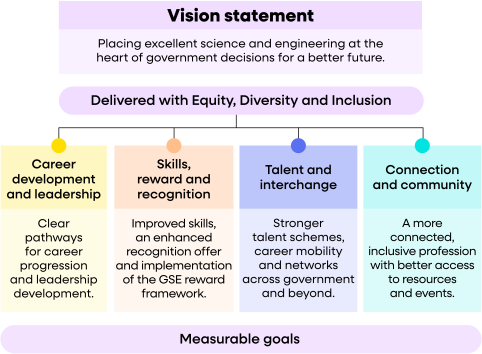
Figure 4: Framework linking the vision statement with strategic themes.
Framework linking the vision statement with strategic themes
The top level reads: “Vision statement: Placing excellent science and engineering at the heart of government decisions for a better future.” The next level reads: “Delivered with Equity, Diversity and Inclusion.” On the next level, the flow chart branches out into four sections: 1 Career development and leadership: Clear pathways for career progression and leadership development. 2 Skills, reward and recognition: Improved skills, an enhanced recognition offer and implementation of the GSE reward framework. 3 Talent and interchange: Stronger talent schemes, career mobility and networks across government and beyond. 4 Connection and community: A more connected, inclusive profession with better access to resources and events. The bottom level reads: “Measurable goals.”
We want excellent science and engineering to be at the heart of government decisions. Our goal is simple: use credible, unbiased evidence, and expertise to ensure a better future for the UK.
The four themes reflect member feedback and will increase science and engineering capability, community and visibility. We will embed equity, diversity and inclusion in all four themes.
To realise this vision, we will work with cross-government professions, functions, the Government People Group and relevant external partners to place excellent science and engineering at the heart of government decision making.
4. Achieving our vision
4.1 Career development and leadership
Goal 1 – We will build leadership excellence by:
-
piloting a mid-career scheme by 2027 to develop scientists and engineers into Senior Civil Service leaders
-
piloting new learning on science and engineering for Senior Civil Service leaders by 2028 to support evidence-based decision-making
-
evaluating the Leadership Values learning offer and refresh it to include offers for HEO/SEO members
-
running leadership masterclasses, achieving an average of 85% satisfaction per masterclass by 2027
-
upgrading GSE mentoring by 2027, adding member site functionality to support at least 50 mentor–mentee pairs per year
-
piloting a GSE Senior Civil Service Network by 2028 for networking and peer support
Goal 2 – We will create clear career pathways for GSE members by:
-
publishing a refreshed GSE Career Framework so members, external applicants and departments can check skills, identify gaps and see clear routes for progression up to and including the Senior Civil Service
-
publishing six diverse career journeys per year on the GSE careers site from 2027, concentrating on department-specific skills
-
linking the GSE careers and members’ sites to help members network and develop their careers by the end of 2026
Goal 3 – We will build capability and expertise by:
-
launching a deep specialist development offer across government in 2026
-
identifying member-specific AI upskilling for scientists and engineers
-
offering accessible online GSE learning aligned with government priorities and GSE job families
-
working with other professions to help the wider Civil Service understand science and engineering by 2027 – we will achieve this by partnering on learning, development and events (such as contributing speakers to their programmes and involving their experts in ours)
-
building partnerships with science and engineering professional institutions by 2027 – these partnerships will help members with professional recognition and give deep specialists access to targeted events and courses to enhance their expertise
-
piloting a mid-career recruitment scheme by 2027, securing five departments offering placements, and working with departments on headhunting for Senior Civil Service roles
Goal 4 – We will increase outreach and awareness of GSE careers by:
-
raising awareness of GSE careers among higher education students and apprentices, concentrating on underrepresented groups – from 2026, we will provide guidance, training and routes for outreach
-
raising awareness of GSE careers among mid-career scientists and engineers with a new outreach platform and promotional material in 2026
Case study:
Leadership and mentoring across the Civil Service through the GSE Mentoring Programme
Dr Prasanta Pati, Deputy Head of Delivery, Nuclear Infrastructure, Major Project and Programmes, Defence Infra Organisation in the Ministry of Defence, reflects on his experience:
Through the GSE Mentoring Programme, I connected with colleagues across the Civil Service and supported them in gaining professional recognition, building confidence and improving leadership capability. Over six months, I mentored two GSE members through the Empowering Leadership programme, helping them to develop their ability to lead teams and encourage high performance.
Mentoring improved my coaching, active listening and people-development skills, supporting my progression towards senior leadership roles. For mentees, the programme enhanced technical leadership, deepened their understanding of how science and engineering inform policy and delivery, and increased their confidence when operating in complex, ambiguous environments.
Case study:
GSE Leadership Values Masterclass
Over 150 GSE members joined a masterclass in September 2025 to explore how science and engineering leaders can lead through change. Senior leaders from across government shared their diverse career journeys through academia, apprenticeships and professional recognition.
Discussions concentrated on GSE Leadership Values – integrity, inclusiveness, decisiveness and collaboration – and emphasised that leadership can come from all grades. Speakers shared effective ways to challenge senior leadership constructively through evidence-based arguments and collaborative solutions. Feedback was overwhelmingly positive, with attendees praising the hybrid format and diversity of speakers. Spot coaching was described as “brilliant”, contributing to “a fabulous event overall”.
4.2 Skills, recognition and reward
Goal 5 – We will invest in skills by:
-
conducting a biennial cross‑government Skills Data Commission while working with central Civil Service teams to improve visibility and data assurance
-
maintaining the GSE Skills Taxonomy, informed by the Skills Data Commission, as the main reference for science and engineering skills and roles in government
-
using the GSE Skills Taxonomy data to guide skills development and learning and development provision
-
promoting STEM apprenticeships to increase visibility, departmental participation and uptake
Goal 6 – We will improve recognition by:
- supporting GSE members to gain professional registration, with a target of increasing registrations by 10% per year from 2026 to 2028
Goal 7 – We will improve reward by:
- working with departments to develop and implement the GSE reward framework – targeting science and engineering skills shortages to improve attraction and retention and work towards a more consistent approach to pay
Case study:
Unlock your potential with the GSE Professional Recognition Offer
Katherine Cockle, civil servant and Chartered Scientist, shares her story:
As a child, I could never have dreamed I would become a Chartered Scientist. I returned to biology at 27 and, through various Civil Service roles, science became more than a discipline – it became a way of approaching the world with questioning curiosity.
In 2024, I saw the GSE Professional Recognition Offer and decided to apply for chartership. The support made it feel achievable – I had built an imaginary mountain, but I was nearly at the summit. GSE provided application guidance, skills gap analysis tools and funding, and my mentor encouraged me throughout.
Two months after submitting, I received confirmation I had been awarded Chartered Scientist status. The process gave me confidence to pursue more challenging roles. I highly recommend it.
Case study:
Why I completed a technical apprenticeship in my 30s
Mark Donaghy from the Driver and Vehicle Standards Agency (DVSA) shares his perspective:
Many people think apprenticeships are just for young people – that is not true. I have just completed an HGV service and maintenance apprenticeship, setting myself on a rewarding career path with the DVSA.
Changing careers was daunting, but completing an apprenticeship in my 30s brought major benefits. I had already developed strong time management and knew where I wanted my career to go. The apprenticeship allowed me to earn while learning, gain hands-on experience and achieve job security in a high‑demand industry.
My life experience proved an asset – building relationships, demonstrating professionalism and sharing knowledge with others aged 25 to 40‑plus. It is never too late to make a change.
4.3 Talent and interchange
Goal 8 – We will develop talent by:
-
building a strong talent scheme alumni network and development offer for the mid-career scientist and engineer programme, the deep specialist development scheme, and Science and Engineering Fast Stream (SEFS) – we will publish three Senior Civil Servant alumni case studies per year
-
evaluating the career progression of 10 diverse talent scheme alumni to understand barriers to promotion to the Senior Civil Service by 2028
-
improving the SEFS scheme learning and development opportunities and piloting externally recognised certifications by 2027
-
assessing and reporting on engagement points with SEFS during scheme lifecycle, acting on its outcomes by the end of 2027
-
by 2028, ensuring at least 70% of SEFS participants complete the scheme or secure a Grade 7 role before it ends
-
achieving at least 75% satisfaction with SEFS postings, based on end‑of-year feedback
-
supporting Cabinet Office to establish a baseline of fast stream posting locations by the end of 2026 and reach 50% postings located outside London by 2030
Goal 9 – We will increase engagement with and awareness of interchange activities by:
-
increasing civil servant applications for the Royal Society Pairing Scheme by end of 2028 through targeted advertising and outreach campaigns
-
embedding STEM Futures into the organisational culture of government departments by raising awareness and integrating into ways of working by the end of 2026
-
increasing the number of STEM Futures opportunities – such as shadowing, secondments, and learning and development initiatives – by running networking events for STEM Future partners and promoting effective use of the platform
-
publishing three STEM Futures partner case studies per year on the GSE member’s site from 2026 to 2028
Case study:
Science meets policy: Insights from the Royal Society Pairing Scheme
Eunice Wong, who took part in the scheme in 2024 as Senior Research Adviser in the Office for Product Safety and Standards, reflects on her experience:
My role involves working with specialists across academia and industry. Taking part in the Royal Society Pairing Scheme widened my network and deepened my understanding of research challenges in academia and government.
A day at The Royal Society with my scientist pair, George from the UK Dementia Research Institute, highlighted how science and policy overlap.
I learned the importance of policymakers engaging with scientists at all levels to ensure comprehensive evidence for regulation and policy. I would encourage anyone passionate about using science for policy to apply.
Case study:
STEM Futures Secondment: Bringing expertise to the National Positioning, Navigation and Timing Office
Sarah Dalmedo from the National Physical Laboratory (NPL) talks about her experience:
The Department for Science, Innovation and Technology asked NPL for expertise to set up programmatic functions for the newly formed National Positioning, Navigation and Timing Office. The role concentrated on developing reporting systems, risk registers, stakeholder mapping, governance and accountability processes.
The secondment was then extended to allow Sarah to work on crisis planning too. Sarah experienced different ways of working during an election period, saw priorities changing under a new government, and learned how a spending review works. Sarah’s top tips:
Forget imposter syndrome – you have been brought in for your external perspective and expertise, so share it. Lean into opportunities to connect with people in and outside your team. Join coffee roulette, attend away days and do the social things where you can. You will feel more part of the organisation and understand how it really works.
4.4 Connection and community
Goal 10 – We will increase GSE members’ participation in and visibility of our offer by:
-
launching a new members’ website that meets WCAG 2.2AA accessibility standards by summer 2026
-
enabling GSE members to engage with academics, Heads of Science and Engineering Profession, and the wider Government Office for Science capability offer through the new website by the end of 2026
-
relaunching a GSE directory on the members’ site by the end of 2026, allowing members to update their details
-
running a GSE survey, including a departmental community health-check, with a 25% response rate by the end of 2026 (compared to 7% in 2023) and publish findings to improve our offer
-
using a range of channels to communicate GSE initiatives inclusively, increasing newsletter open rate by 10% (from 29% in 2025) and ensuring all new content meets accessibility standards by the end of 2026
Goal 11 – We will run inclusive and relevant events by:
-
trialling at least two new event formats and community activities (such as topical communities of interest on the members’ site, turbo talks or a GSE events series) before the end of 2028
-
running the GSE Conference every two years and achieving over 85% overall delegate satisfaction in the post-event survey
-
running one hybrid event per year, linked to an existing event, to welcome new members and celebrate existing members until end of 2028 – using various methods of feedback to improve engagement and influence
-
supporting GSE volunteers to run two extra events per year, shaped by member interests, and pilot regional events with Learning and Development GSE champions from 2026 to 2028
-
ensuring at least 50% of in-person events have a hybrid option (compared to 24% in 2025)
Goal 12 – We will improve our governance and the GSE volunteer community by:
-
ensuring our work aligns with and draws on the expertise of a wide professional network including government professions and functions
-
gaining a deeper understanding of our membership’s diversity through data by mid-2027, enabling us to provide responsive support and address issues including barriers to volunteering
-
reviewing volunteer engagement in running events, community activities, and supporting talent schemes to help understand and improve volunteer representation across location, specialism and department
-
maintaining active GSE Learning and Development Champions in at least 75% of departments that the GSE draws its membership from by the end of 2026, with quarterly check-ins
-
providing quarterly briefings for Chief Scientific Advisers and Heads of Science and Engineering Profession by the end of 2026, launching an induction toolkit and achieving 70% positive feedback through a survey
Case study:
The GSE conference: Showcasing the breadth of government science and engineering
Rachel Liang, Technology Adviser at the Department for Transport, reflects on her experience:
The 2024 GSE Conference was a valuable opportunity to learn about science and engineering across government through panel sessions, turbo talks and the GSE Awards.
The conference brought together profession members to celebrate ‘an innovative public sector’. Engaging panel sessions hosted by senior leaders prompted me to reflect on improvements I could make to my work. Turbo talks spotlighted 30 speakers across 20 organisations, highlighting the breadth and depth of work across the profession. I found it inspiring to hear how passionate colleagues were about their work.
Meeting other profession members proved invaluable, expanding my network and showing me diverse career pathways. The conference improved my connection to the GSE community.
Case study on the SEFS Final Selection Board:
Recruiting the next generation science and engineering leaders into the Civil Service
The GSE profession runs the annual SEFS Final Selection Board (FSB), recruiting science and engineering talent into government via the Civil Service Fast Stream. In 2024, over 1,300 applicants were narrowed down to 52 recommended for appointment. GSE provides training and on-call support to ensure a fair process. Volunteering as an assessor takes about an hour’s training and at least one day for interviews or written assessments. It’s a great way to support the profession and refresh candidate assessment skills. Wendy, a volunteer assessor, says:
I’ve volunteered as a SEFS FSB assessor for over 5 years now and it’s always inspiring to meet such talented candidates. I am lucky enough to have a number of SEFS at various stages of the scheme in my team and so experience first-hand the enormous value they offer. Supporting the next generation of science and engineering leaders is both a privilege and a responsibility I value deeply.
4.5 Our approach to equity, diversity and inclusion
We embed equity, diversity, and inclusion across every theme to nurture and celebrate STEM talent, supporting world class science and engineering. As the GSE profession, we will:
-
use cross-government networks to increase the diversity of our members
-
increase the diversity of evidence and expertise used
-
create an inclusive environment for scientists and engineers in government
Such accessible workplaces offer equitable opportunities for every scientist and engineer, with a focus on supporting underrepresented groups. We will be accessible in our communication, offer and event delivery. In practice, this means:
-
publishing high-level analysis of the diversity of government scientists and engineers on the members’ site annually from 2026
-
sharing case studies that represent diverse and non-linear career pathways, such as part-time working and job sharing
-
making sure the new members’ website complies with accessibility guidance
Working with departmental networks and partners, we will ensure the GSE offer is diverse, supportive, and inclusive for all profession members. For more detail, see the GSE Profession diversity and inclusion strategy.
Case study:
Celebrating International Day of Women and Girls in Science: Extreme Women in STEM
Philip Lawrence, Senior Patent Examiner at the Intellectual Property Office, reflects on his experience:
For International Day of Women and Girls in Science 2025, I volunteered to organise talks celebrating women working in ‘extreme’ areas of science and engineering in the public sector.
Four inspiring speakers shared their work, inspiration and career challenges: Aurelia Reichardt (Station Leader, Rothera, British Antarctic Survey), Marie Shackleford (Team Leader, Future Pyrotechnic Countermeasure Solutions, DSTL), Charlotte Sarfas (Novel and Dangerous Pathogens Team, UKHSA) and Lieutenant Commander Izzy Rawlinson (Deputy Marine Engineering Officer, Submarine Service).
Over 1,400 people from more than 50 departments attended. Feedback was overwhelmingly positive:
Gaining insight into fields outside my expertise is incredibly thrilling, especially seeing women excelling in prominent roles.
The whole event was exhilarating, inspiring and very interesting.
Philip Lawrence’s engagement earned him the 2025 Diversity and Inclusion in Science and Engineering Award.
5. Monitoring and evaluation
We will track progress against each goal and assess our overall influence. From 2027, we will publish an annual progress update on the GSE members’ website. Each update will outline progress and we will seek feedback from the GSE community as well. We will also publish our monitoring and evaluation plan as part of the first progress update in 2027. Together, these measures will give senior GSE leaders confidence that delivery is on track and enable early identification and resolution of any issues.
6. How to get involved
If this strategy has inspired you to help shape government science and engineering, you can:
-
join the GSE profession
-
find out more about our work and priorities
-
email gse@go-science.gov.uk for information and ways to contribute
-
look out for our new members’ website coming soon
Annex A: The use of AI in the strategy review
In the interests of transparency around the use of AI – an important pillar of our ethical approach – we used generative AI tools to redraft certain sections of this strategy, reduce word count, and improve clarity of communication. No factual information was provided by AI.