Governance of taxonomies (relating to vulnerabilities)
Published 30 June 2026

© Crown copyright 2026
This publication is licensed under the terms of the Open Government Licence v3.0 except where otherwise stated. To view this licence, visit nationalarchives.gov.uk/doc/open-government-licence/version/3 or write to the Information Policy Team, The National Archives, Kew, London TW9 4DU, or email: psi@nationalarchives.gov.uk.
Where we have identified any third party copyright information you will need to obtain permission from the copyright holders concerned.
This publication is available at https://www.gov.uk/government/publications/governance-of-vulnerability-related-taxonomies/governance-of-taxonomies-relating-to-vulnerabilities
1. Owner
Ownership of each taxonomy will be discussed and documented as part of the development.
Where possible, relevant Departments will be the owners of taxonomies relevant to their areas; however, where a taxonomy spans a number of departments and areas of responsibility, the Vulnerabilities Working Group (VWG) – or some descendant thereof – will be the accountable owner of the taxonomy. The Data Standards Authority will continue to have oversight of the activities of the Group.
2. Scope
This process will govern only taxonomies and terminologies pertaining to the Vulnerabilities Working Group and interoperable data surrounding vulnerable individuals.
Taxonomies that are owned and controlled externally must still go through review by this Group before they are published or endorsed by the Group.
3. Process
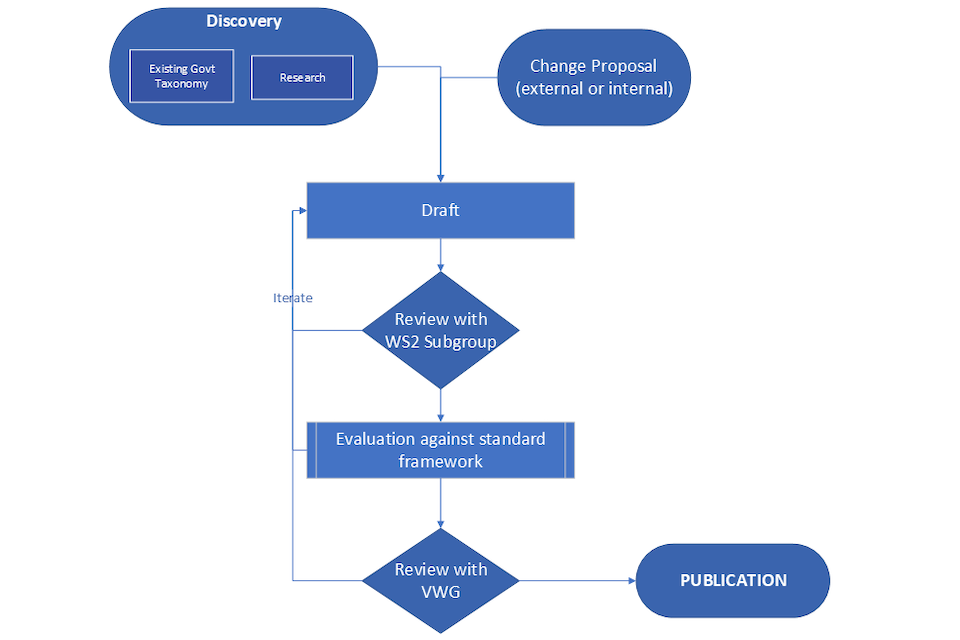
4. Discovery
This process is currently to be driven by the Data Standards Authority for the Vulnerabilities work, but this does not necessarily need to be the case – other Departments or owners of taxonomies should be able to bring these to this Group for review.
5. Change proposal
Proposals for changes to taxonomies may come from external individuals or bodies (for example the general public, local authorities, special interest groups, etc.) but are probably more likely to be internal (from another Government Department or from VWG members).
There will be no formal process controlling change proposals, and no specific format in which they are expected.
However, whilst the change proposals can arise in an informal manner, all changes to taxonomies must continue to be governed formally by the process outlined in this document.
6. Draft format
The draft taxonomy must contain at least the following elements:
-
the intended owner (this could be an organisation or a role description) of the taxonomy
-
a brief description of the overall purpose
-
list of terms within the taxonomy and clear indication of any hierarchy, with specific definitions
-
some references, which may not be exhaustive, on the input considerations that have been used to create it
7. Framework for evaluation
The process set out in this document aims to align with the principles in the ONS-published Taxonomy Best Practice Framework.
The principles of Ownership and governance, Accessibility, Supported, Revision and maintenance; Engagement strategy and Futureproof are reflected in the process and controls set out in this document and by the membership of the working group addressing vulnerabilities.
The taxonomies produced by this process should aim to conform in particular to these principles:
- definition
- purpose
- complexity
- balance
- interoperability
- well-defined terms
- metadata
- methodology
The Vulnerabilities Working Group for Taxonomies will be expected to review the conformance of taxonomy drafts to these principles as part of the review process. No formal documentation of this is required.
The remaining key principles in that Framework (Ownership and governance; Accessibility; Supported; Revision and maintenance; Engagement strategy Futureproof) are intended to be covered by this governance process and how it is implemented.
8. Publication
The technical specifications of publication (including location) are outside the scope of this document. However, in addition to the contents of a taxonomy, the published version of taxonomies must include:
- metadata including versioning
- explicit statement of changes since the previous version
- contact information for how to propose changes
- a persistent, resolvable identifier for the list
- a persistent, resolvable identifier for each entity within the list
9. Futureproofing and change control
In order to allow sustainable use and trust of published taxonomies, changes to published taxonomies must:
- result in the publication of a new, numbered version
- undergo review through the process outlined in this document, focusing on entities being removed, amalgamated or split, and material changes to definitions
- include usage notes that highlight these types of changes