Global Supply Chains: A Foresight report on risk and resilience
Published 15 June 2026

© Crown copyright 2026
This publication is licensed under the terms of the Open Government Licence v3.0 except where otherwise stated. To view this licence, visit nationalarchives.gov.uk/doc/open-government-licence/version/3 or write to the Information Policy Team, The National Archives, Kew, London TW9 4DU, or email: psi@nationalarchives.gov.uk.
Where we have identified any third party copyright information you will need to obtain permission from the copyright holders concerned.
This publication is available at https://www.gov.uk/government/publications/global-supply-chains-a-foresight-report-on-risk-and-resilience/global-supply-chains-a-foresight-report-on-risk-and-resilience
This is not a statement of government policy.
Foreword
The UK’s prosperity and security depend on supply chains that are reliable, diverse and resilient. Recent global disruptions have shown how quickly these systems can come under pressure, and how shocks far beyond our borders can affect everyday life here at home. We are already seeing some of the risks highlighted in this report emerge in real time. It is a clear reminder that the world is changing, its norms are shifting, and we must be ready for a future that looks very different from the stability we once took for granted.
Highly interconnected supply chains bring huge benefits, but they can also create vulnerabilities that are not always visible and cannot be addressed by commercial incentives alone. Government is acting to strengthen the UK’s resilience, supporting and facilitating coordination to address shared risks. At the same time, businesses play a vital role by improving visibility of their supply chains, understanding their upstream risks, and exploring where sectoral, regional or international coordination can help reduce shared vulnerabilities.
This Foresight report is an important contribution to that shared effort. It shows that supply chain risk is multi‑layered, shaped by firm‑level choices, the structure of global production networks, and external pressures such as climate change and geopolitics. And it highlights how these factors interact, creating concentrations of risk that can only be understood by looking across systems as a whole.
By thinking ahead, testing our assumptions and planning for a range of plausible futures, we can ensure the UK is better prepared for the challenges and opportunities of a rapidly changing world. I am grateful to the Government Office for Science for this work, which will help inform the decisions we take to protect the UK’s long‑term resilience and prosperity.
Sir Chris Bryant, MP
Minister for Trade, Department for Business and Trade

Image of Sir Chris Bryant, Minister of State for Trade Policy of the United Kingdom
Preface
Global supply chains underpin the UK’s prosperity and security, connecting people and businesses to essential goods, services, and technologies from around the world. And as Napoleon once quipped, we are “a nation of shopkeepers”, a reminder, perhaps unintended, of just how deeply the UK’s economy depends on goods flowing reliably across borders. Recent disruptions have shown how exposed these systems can be, and how quickly shocks driven by geopolitics, climate change, and global interdependence can cascade across economies.
This report was commissioned in response to that challenge. It reflects a growing recognition that traditional approaches to supply chain risk, often focused on direct trade relationships or single points of failure, are no longer sufficient. To understand supply chain vulnerability in today’s world, we need a more systemic view of where risk sits, how it accumulates, and how it may evolve over time.
Global Supply Chains is a foresight study, designed to help decision makers navigate deep uncertainty and shape more resilient, flexible approaches to economic resilience. It explores what makes supply chains vulnerable, where risk concentrates in networks, how climate change and geopolitics may interact to reshape the UK’s exposure, and how government can make more robust decisions under persistent uncertainty. As a Foresight report, it does not attempt to predict specific disruptions or prescribe a single policy solution.
The report brings together evidence, innovative supply chain network modelling, and scenarios to explore how risks propagate through complex, multi‑tier supply systems and how global supply chains relevant to the UK could evolve to 2040 under different geopolitical and climate adaptation futures. A central insight is that supply chain risk is layered and interconnected, shaped by firm‑level practices, network structures, and external pressures. Strengthening resilience therefore requires proportionate responses that combine firm action with coordination and targeted system‑level interventions.
This report is designed to be useful to policy makers, analysts, and others working on supply chain resilience across government and beyond. The challenges it explores will continue to evolve, and so too must our understanding. Foresight cannot remove uncertainty, but it can help us prepare for it, and that is increasingly essential for securing the UK’s long-term prosperity and resilience.
Dame Angela McLean
Government Chief Scientific Adviser

Image of Professor Dame Angela McLean, Government Chief Scientific Adviser, sitting at a desk.
Chapter 1: Executive Summary
1.1 Key findings
Global supply chains underpin the UK’s growth, prosperity, and security, connecting households and businesses to goods, services, and critical inputs produced around the world. Yet these supply chains are increasingly exposed to disruption from climate change, geopolitical tensions, and structural dependencies that are often poorly understood. Traditional trade statistics show where goods are bought and sold, but they do not reveal how risks build up across the many layers of production involved in making a final product. Vulnerabilities can sit several steps back in the production process, long before goods reach the UK, or arise at shared transport routes and chokepoints that are challenging for a single firm to control.
This creates a clear challenge: how to understand where risk is really concentrated within complex, global supply networks, how that risk may evolve over time, and what approaches are most likely to strengthen resilience in the face of uncertainty. This report responds to that challenge. Its purpose is to improve our understanding of what makes supply chains vulnerable, what supports resilience, how future pressures may reshape the UK’s exposure to risk, and what policy makers inside and beyond government can practically do to improve their supply chain resilience into the future. Looking ahead to 2040, it explores how supply chains could evolve under different geopolitical and climate adaptation futures, and how government can better prepare for uncertainty.
The key findings that follow draw these strands together, showing how supply chain vulnerability and resilience emerge from complex system dynamics, and why an evidence‑based understanding of network structures, geopolitical realities, and climate and environmental pressures is essential for resilient policy and strategy. Rather than predicting what will happen, the report is designed to support robust, flexible policy making by identifying structural risks, plausible future pathways, and strategic trade-offs that matter for long-term resilience.
Table 1: Overview of key findings of the report
| Key finding | What this means |
|---|---|
| Supply chains are networks, not chains, and risk is concentrated. | Supply chains are complex, multi‑tier networks, not linear chains. As a result, risk is typically highly concentrated in a small number of firms, routes, and chokepoints that play system‑critical roles. Disruption spreads through network connections, not just direct trade links, which is why targeted and system‑level interventions are more effective than broad, undifferentiated approaches. |
| Many critical risks are shared and need coordinated action. | Even well‑prepared firms can fail together. Shared suppliers, regions, infrastructure, and routes mean disruption often affects whole sectors at once. Managing these risks therefore requires coordination beyond individual companies at regional, sectoral or national level to address system‑wide vulnerabilities. |
| Supply chain vulnerability and resilience operate at multiple levels and resilience is an ongoing process. | There is no single “supply chain problem”. Risk emerges from the interaction of firm‑level practices, network structure, and external shocks, and resilience involves trade‑offs. Effective responses are context specific and iterative, not one‑off fixes or universal solutions. |
| Tomorrow’s risks are increasingly rooted in the earlier, less visible stages of supply chains and are evolving faster than firms are adapting. | Pressure points are probably shifting away from final manufacturing with increasing pressures on raw materials, processing, and transport infrastructure. While many firms are adapting, limited multi‑tier visibility and recovery capacity mean systemic risks are evolving faster than current responses, requiring earlier, more proactive intervention. |
| Climate and geopolitics are risk multipliers and adaptation is essential for future supply chain resilience. | Climate change and geopolitics increasingly amplify each other, especially at shared global chokepoints, making disruption more frequent, severe, and persistent. Climate adaptation will be essential for supply chain resilience over coming decades, but it is also harder to deliver in a fragmented geopolitical landscape, where cooperation is constrained. |
1.2 How we set out to better understand supply chain risk
The report brings together 3 complementary strands. First, it draws on existing literature and evidence to establish how supply chain vulnerability and resilience emerge, distinguishing between firm‑level practices, network‑level structures, and trends of changing external pressures, particularly for critical trends regarding climate change and geopolitics. This evidence anchors both the scenarios and the analysis in how risks have developed historically and where uncertainties remain most consequential.
Second, the report applies supply‑chain network modelling to move beyond country‑level trade exposure and examine how disruption can propagate through interconnected production systems. This analysis reveals patterns of systemic risk, identifies recurring “risk archetypes”, and highlights where vulnerabilities are concentrated in ways not directly visible in aggregate data. The modelling shows that systemic risk is often highly concentrated, with a small number of firms, countries, or processing stages accounting for a disproportionate share of potential disruption. These risks frequently arise from network position, such as upstream bottlenecks or limited substitutability, rather than trade volumes alone, helping to explain why some vulnerabilities lie beyond the control of individual firms and require coordination and system‑level responses.
Third, the report sets out 4 scenarios for 2040 to explore how future uncertainty might unfold, structured around 2 critical uncertainties for supply chain resilience: the degree of geopolitical fragmentation or cooperation, and the extent of proactive investment in climate adaptation. The scenarios show how similar climate hazards can lead to very different outcomes depending on governance, cooperation, and resilience choices, and how climate and geopolitics can interact to amplify or reduce supply‑chain risk. Scenarios are thinking tools that help decision‑makers test assumptions, examine trade‑offs, and consider how today’s choices may perform under very different conditions. They are evidence-anchored and plausible, but deliberately stretching rather than limiting narratives, designed to widen thinking, and they should not be read as forecasts.
1.3 How can this report be used?
This report is designed as a practical resource for policy makers and analysts, both inside and outside of government, whether new to the topic or more experienced, who are looking to better understand supply chain vulnerability and resilience, how risks develop across complex production systems, and how external trends, such as geopolitical fragmentation or climate hazards might affect the UK’s security and prosperity. Its insights can be used to stress‑test strategies against different future conditions, identify where vulnerabilities are most concentrated, and prioritise interventions where they are likely to have the greatest systemic impact.
To support practical application, the report also introduces a three‑step resilience cycle, a simple, repeatable programme that brings together the evidence, modelling insights, and scenarios presented here. This cycle is aimed at supporting decision‑makers to move from (1) identifying risk early and proactively to (2) testing and refining interventions and then (3) supporting more robust, flexible approaches to securing the UK’s access to critical goods. In an increasingly uncertain global environment where the future is uncertain these 3 steps are intended to be used iteratively as supply chain risks evolve over time. The conclusion sets out this cycle in more detail, including how to update risk registers, adapt interventions, and refresh scenarios as conditions change.
We hope you find this report useful. It’s important for us to monitor the impact of our work: contact us at foresight@go-science.gov.uk to let us know how this report has informed and influenced your work or if you would like support to use the analysis or the scenarios in your area of work.
Chapter 2: Introduction
2.1 Background
UK growth and prosperity hinge on global supply chains
The UK is an internationally connected economy, strongly integrated into the global trade landscape. Each year, hundreds of billions of pounds’ worth of goods and services flow into and out of the country, linking UK households and businesses to producers and consumers across the globe and across all sectors of the economy from energy security, healthcare, food systems, to advanced manufacturing. In 2024, the total value of trade for goods and services in the UK approached £1.8 trillion, reflecting the scale of these connections (Jozepa, 2026). The UK typically imports more than it exports. In other words, it runs a trade deficit, meaning that reliable access to global markets and to the supply chains that underpin them is central to economic resilience, affordability, and growth.
Our prosperity is closely linked to the reliability of the goods and services crossing our borders every day. In 2024, global trade flows of both imports and exports equalled roughly 63% of UK GDP. This places the UK among the more trade‑reliant large, advanced economies, above countries such as the United States (25%), China (37%), and Japan (46%), and in line with France (68%) and Italy (63%). Over time, the UK has become steadily more integrated into global markets, with trade rising from around 51% of GDP in the 1970s to a peak of nearly 69% in 2022, reflecting both broader, long-term globalisation and the UK’s growing reliance on cross‑border economic activity (World Bank, 2025).
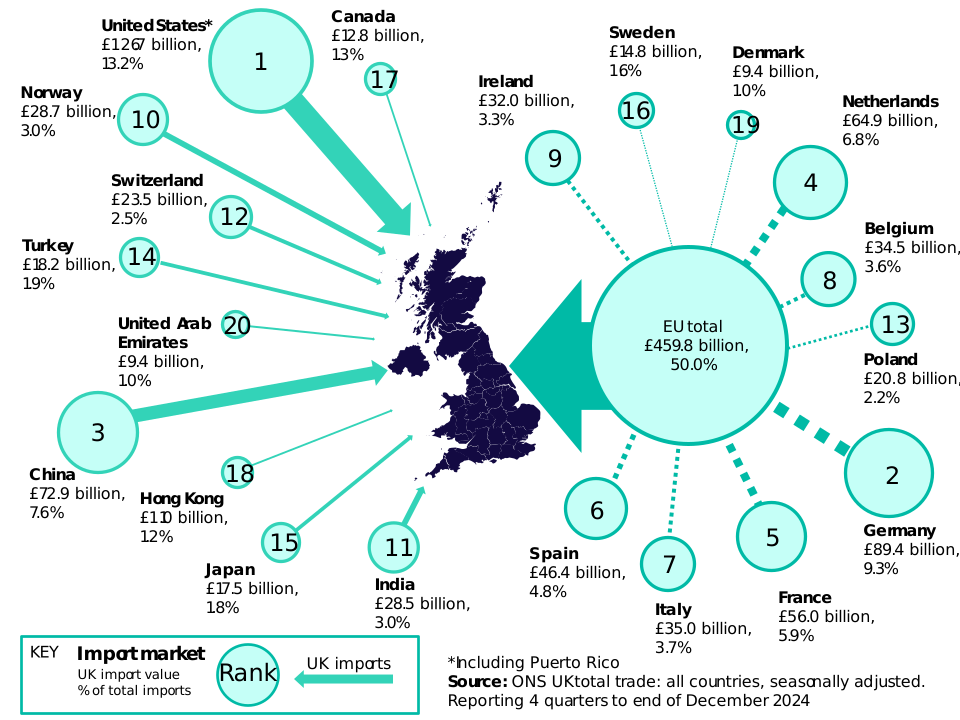
Figure 1: Top 20 import markets for goods and services in 2024
Alt text: Top UK import markets by value in 2024, highlighting EU and non‑EU countries.
Source: ONS UK total trade: all countries, seasonally adjusted, reporting 4 quarters until the end of December 2024.
This figure shares details of the Top 20 import markets for goods and services in 2024. The image splits it into two sides – one that shows EU countries and their rank and market value, while the other side shows countries external to the UK. The largest non-EU import market is the United States, ranked first with £126.7 billion (13.2% of imports). Germany is second with £89.4 billion (9.3%), followed by China in third place with £72.9 billion (7.6%) and the Netherlands in fourth with £64.9 billion (6.8%). France ranks fifth at £56.0 billion (5.9%), Spain sixth with £46.4 billion (4.8%), Italy seventh with £35.0 billion (3.7%), Belgium eighth with £34.5 billion (3.6%), and Ireland ninth with £32.0 billion (3.3%). Norway is tenth at £28.7 billion (3.0%). India ranks eleventh with £28.5 billion (3.0%), Switzerland twelfth with £23.5 billion (2.5%), Poland thirteenth with £20.8 billion (2.2%), Turkey fourteenth with £18.2 billion (1.9%), Japan fifteenth with £17.5 billion (1.8%), Sweden sixteenth with £14.8 billion (1.6%), Canada seventeenth with £12.8 billion (1.3%), Hong Kong eighteenth with £11.0 billion (1.2%), Denmark nineteenth with £9.4 billion (1.0%), and the United Arab Emirates twentieth with £9.4 billion (1.0%).
The EU total is highlighted separately at £471.6 billion, representing 49.3% of total UK imports.
Our production systems are similarly interwoven with global markets: around half of total UK production depends on intermediate inputs, such as goods, services, and data, that are produced abroad and used as building blocks in domestic activities. Put simply, many of our goods and services, and even some things that appear ‘made in the UK’, depend on international supply chains. As a result, global supply chains function as strategic capabilities that underpin the UK’s prosperity and security, shaping everything from prices and medicine availability to industrial continuity, making supply chain resilience a key determinant of economic competitiveness (Bank of England, 2024).
Growing pressures pose a risk to UK growth and prosperity
Global supply chains are highly interconnected systems, which means disruptions in 1 place can quickly affect many others. Their complexity and limited visibility also make them difficult to fully map or monitor, making it challenging to anticipate emerging risks. But rising geopolitical tensions, climate‑related shifts, and other shocks are placing increasing strain on these systems.
Recent events illustrate the effects these pressures might have on global supply chains and economies around the world. For example, Russia’s invasion of Ukraine contributed to UK Consumer Prices Index (CPI) inflation reaching 11.1% in October 2022, the highest in 41 years, largely through energy market disruption. The 2021 Suez Canal blockage delayed an estimated $9.6 billion in trade per day, revealing how the closure of a single chokepoint can stall production and increase costs worldwide. Severe drought in the Panama Canal in 2023-24 forced transit restrictions, driving up shipping rates and delaying energy and consumer goods. Recent conflict in the Middle East has highlighted the exposure of oil and gas trade to disruption at critical transport routes and maritime chokepoints. These examples show how impactful disruption through climate change, geopolitical shocks, and physical chokepoints are to global supply chains. The evidence reviewed and analysis conducted in this report outline the benefits of rethink our approach to supply chain resilience, to enable supply chains security in the future. This is especially pertinent for the UK, a medium-sized, open economy that is highly integrated into global trade systems (Bank of England, 2024).
Supply chain resilience will matter even more in the future
Disruptions to global supply chains are becoming more frequent and more consequential. Climate extremes, geopolitical tensions, and increasingly interdependent production systems mean that shocks can spread further and faster, affecting the availability and affordability of essential goods. For the UK, these disruptions carry real risk for households, businesses, national security, growth, and prosperity. Companies are already starting to shift supply strategies, selectively adding buffers and multisourcing, investing in visibility and risk governance, and reconfiguring networks, moving from pure just‑in‑time to combine efficiency with resilient‑by‑design models where it matters most (Zhang and Doan, 2023; Ahn and Tan, 2025; Kilpatrick et al., 2024).
This report brings together evidence on emerging external pressures, analytical insight into patterns of vulnerability within supply networks, and an assessment of the characteristics that support supply chain resilience. Alongside this, it provides structured thinking tools, most notably a set of future scenarios, to support long‑term, robust, and flexible policy and strategic decision‑making in the face of uncertainty. Used together, these elements can help decision makers to build a clearer understanding of how supply chain risk could affect the UK, how these pressures might evolve, and how government and industry can plan more effectively to secure access to critical goods in an increasingly uncertain global environment.
2.2 Scope
This section sets out how the report frames supply chain resilience for the UK, including time horizon, core perspectives, and key uncertainties that shape the analysis.
This report specifically seeks to:
- Adopt a medium‑term horizon to 2040, long enough to capture structural shifts while remaining relevant for today’s decisions.
- Examine how supply chain vulnerabilities arise and may evolve under future uncertainty. It does not forecast demand, growth pathways for individual sectors, or predict specific disruptions. We use 3 complementary perspectives, firm‑level behaviour, network structure, and external trends to understand systemic risk to supply chain resilience.
- Although global in outlook, assess what global disruptions could mean specifically for the UK, given its position within international, multi‑tier supply networks.
- Explore deeply uncertain external drivers, focusing on geopolitical tensions and climate and environmental pressures as critical uncertainties over the next 10-15 years.
- Provide structured thinking tools, including scenarios, to support long‑term, robust, and flexible decision‑making.
The report adopts a medium‑term horizon to 2040, long enough to capture structural and systemic change in global supply chains while remaining sufficiently close to inform today’s policy and strategic decisions. Its focus is on understanding how supply chain vulnerabilities arise, how they may evolve under intensifying global pressures, and what this means for the UK. Rather than forecasting demand, estimating sector-specific growth pathways, or predicting specific disruptions, the report explores how major uncertainties might evolve and interact to influence the UK’s exposure to shocks through the goods[footnote 1] and inputs it relies on.
Because modern supply chains span multiple layers, locations, and actors, this report examines resilience through 3 interconnected perspectives. A firm‑level view draws on academic evidence about how sourcing decisions, inventories, and recovery strategies shape micro-level vulnerability and resilience (Chapter 3). Then, a meso-, network‑level view uses supply chain network modelling to understand how the structure of interconnected global supply networks can amplify disruption through cascading failures (Chapter 4). Finally, a macro-level perspective considers how geopolitical and climate trends could evolve into medium‑term pressures on supply chains, both through academic evidence (Chapter 3) and illustrated throughout the scenarios (Chapter 5). No single perspective is sufficient on its own but considered together, these 3 levels provide a fuller understanding of systemic risks and help identify where resilience can be strengthened across the whole system.
Although global in scope, the report’s core interest lies in what global disruptions mean for the UK. As a highly interconnected economy embedded in international supply networks, the UK’s resilience depends not only on domestic capabilities but on the stability and behaviour of the wider systems it participates in. The report therefore pays particular attention to geopolitical tensions and climate and environmental pressures as key macro-level uncertainties, judged to be both highly consequential and deeply uncertain over the next 10-15 years. A detailed breakdown of the specific issues considered under each category and background to why they were chosen is provided in the Approach and methods section below.
2.3 Approach and methods
This report follows the UK Government Futures Toolkit for Policymakers and Analysts and applies a structured foresight process to explore how trends affecting global supply chains relevant to the UK could evolve to 2040. The Futures Toolkit emphasises that foresight is not about predicting the future, but about systematically exploring uncertainty to support robust, flexible policy making. We applied a four‑step process, enabling us to move from a broad exploration of emerging drivers, through structured scenario development, to evidence‑informed and system‑level insights:
- Setting the scope and agreeing critical uncertainties
- Providing robust evidence through targeted reviews
- Exploring systemic risk through agent‑based supply chain modelling
- Imagining the future through scenarios
The selection of critical uncertainties frames the overall scope of the project and shapes the review of relevant evidence and the scenario development, while the evidence informs both the modelling and the scenarios. The modelling and scenarios are complementary outputs, used together to explore current (meso‑level) and future (macro‑level) supply chain vulnerabilities and to support policy makers in understanding how risks may evolve under different conditions. The next section explains why each step was used and how it was implemented.
2.3.1 Setting the scope and agreeing critical uncertainties
Why focus on critical uncertainties?
Foresight differs from forecasting by placing uncertainty at the centre of research and analysis. Many of the forces shaping future supply chains are not only impactful, but also highly uncertain in how they will unfold. These are referred to as critical uncertainties: factors that could plausibly develop in diverging ways and that would materially affect outcomes for policy and strategy. Rather than attempting to forecast which pathway will occur or plan around a single expected future, foresight uses critical uncertainties to explore a range of plausible futures. This approach is designed to open up thinking in the present by challenging implicit assumptions, revealing where current approaches may be brittle, and helping decision‑makers better understand the limits and robustness of today’s strategies under conditions of uncertainty.
Given the complexity of global supply chains, identifying critical uncertainties requires a systematic and participatory approach, drawing on diverse expertise. We therefore gathered insights on emerging drivers of change and narrowed these into a small number of uncertainties that form the backbone of the scenarios. The outputs of this stage fed directly into both the review of our evidence (Chapter 3) and the scenario development (Chapter 5).
How we identified and prioritised uncertainties
To identify relevant drivers of change, we drew on 2 core methods from the Futures Toolkit: horizon scanning and driver mapping.
In consultation with academic experts and government officials, we first carried out a horizon scanning exercise to identify emerging trends, risks, and developments that could plausibly affect global supply chains over the next 15 years, looking out to 2040. To ensure breadth and balance, trends were captured using a PESTE framework (Political, Economic, Social, Technological, Environmental). This produced a long list of trends and signals spanning areas such as geopolitical alignment, trade governance, climate hazards, adaptation capacity, resource constraints, technological change, and social responses to disruption.
We then moved to driver mapping to organise and interrogate the trends identified through horizon scanning, working collaboratively with experts and government officials. Overall, we collected around 230 trends which were then clustered into 31 overarching uncertainties. These uncertainties were prioritised by importance (how relevant the uncertainty is to future UK supply chain resilience and policy) and uncertainty (the degree to which the direction or nature of its future development is unpredictable). This process allowed us to narrow the focus to 2 broad areas of uncertainty[footnote 2]:
- Geopolitical dynamics (fragmentation ↔ cooperation): captures long‑term uncertainty in the structure of the global order, from a fractured, protectionist, and fluid system to a more collaborative but bloc‑aligned world that offers greater predictability but also constrains.
- Climate adaptation readiness (reactive ↔ proactive): captures whether governments and businesses mostly respond after climate shocks or invest ahead of them in resilient infrastructure, systems, and standards to protect supply chains from climate hazards proactively.
The resulting 2 axes of uncertainty are explored in our evidence review (Chapter 3), underpin the scenario matrix (described in Chapter 5), and are as follows:
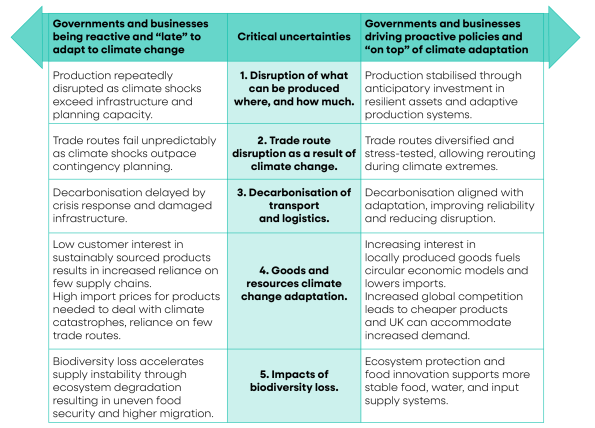
Figure 2: Axis of uncertainty for the climate and environmental uncertainties
Alt text: Comparison of reactive versus proactive climate adaptation impacts on supply chains.
| Governments and businesses being reactive and “late” to adapt to climate change | Critical uncertainties | Governments and businesses driving proactive policies and “on top” of climate adaptation |
|---|---|---|
| Production repeatedly disrupted as climate shocks exceed infrastructure and planning capacity. | 1. Disruption of what can be produced where, and how much | Production stabilised through anticipatory investment in resilient assets and adaptive production systems. |
| Trade routes fail unpredictably as climate shocks outpace contingency planning. | 2. Trade route disruption as a result of climate change | Trade routes diversified and stress‑tested, allowing rerouting during climate extremes. |
| Decarbonisation delayed by crisis response and damaged infrastructure. | 3. Decarbonisation of transport and logistics | Decarbonisation aligned with adaptation, improving reliability and reducing disruption. |
| Low customer interest in sustainably sourced products results in increased reliance on few supply chains. High import prices for products needed to deal with climate catastrophes, reliance on few trade routes. | 4. Goods and resources climate change adaptation | Increasing interest in locally produced goods fuels circular economic models and lowers imports. Increased global competition leads to cheaper products and UK can accommodate increased demand. |
| Biodiversity loss accelerates supply instability through ecosystem degradation resulting in uneven food security and higher migration. | 5. Impacts of biodiversity loss | Ecosystem protection and food innovation supports more stable food, water, and input supply systems. |
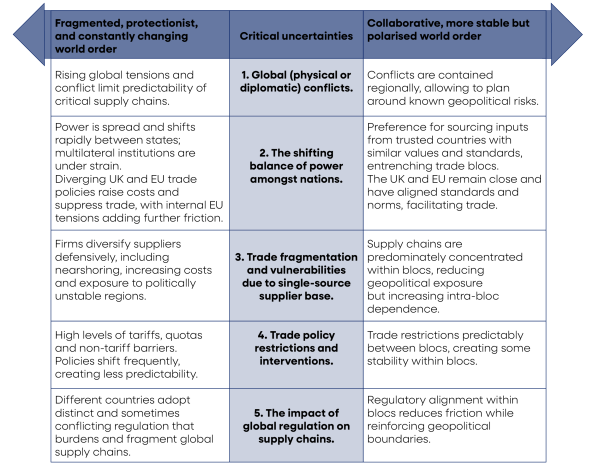
Figure 3: Axis of uncertainty for the geopolitical uncertainties
Alt text: Comparison of fragmented versus collaborative geopolitical futures affecting supply chains.
| Fragmented, protectionist, and constantly changing world order | Critical uncertainties | Collaborative, more stable but polarised world order |
|---|---|---|
| Rising global tensions and conflict limit predictability of critical supply chains. | 1. Global (physical or diplomatic) conflicts | Conflicts are contained regionally, allowing to plan around known geopolitical risks. |
| Power is spread and shifts rapidly between states; multilateral institutions are under strain. Diverging UK and EU trade policies raise costs and suppress trade, with internal EU tensions adding further friction. | 2. The shifting balance of power amongst nations | Preference for sourcing inputs from trusted countries with similar values and standards, entrenching trade blocs. The UK and EU remain close and have aligned standards and norms, facilitating trade. |
| Firms diversify suppliers defensively, including nearshoring, increasing costs and exposure to politically unstable regions. | 3. Trade fragmentation and vulnerabilities due to single-source supplier base | Supply chains are predominately concentrated within blocs, reducing geopolitical exposure but increasing intra-bloc dependence. |
| High levels of tariffs, quotas and non-tariff barriers. Policies shift frequently, creating less predictability. | 4. Trade policy restrictions and interventions | Trade restrictions predictably between blocs, creating some stability within blocs. |
| Different countries adopt distinct and sometimes conflicting regulation that burdens and fragment global supply chains. | 5. The impact of global regulation on supply chains | Regulatory alignment within blocs reduces friction while reinforcing geopolitical boundaries. |
Although geopolitical dynamics and environmental and climate factors are treated as analytically distinct uncertainties, they are not fully independent in practice. They can interact in ways that amplify, constrain, or reshape 1 another over time. For example, geopolitical fragmentation can limit access to adaptation technologies, finance, and critical resources, while climate impacts can intensify geopolitical tensions through food insecurity, displacement, infrastructure damage, and competition over critical materials. Our evidence reviews (Chapter 3) explicitly consider areas of overlap between the two, while the scenarios outline plausible but deliberately stretching ways in which these interactions could unfold and shape future supply chain vulnerability and resilience.
How climate mitigation is handled in this framework
While our evidence review takes a broad view of climate and environmental risks, our scenario framework narrows in on climate adaptation (rather than climate change or mitigation) as the core climate‑related uncertainty.
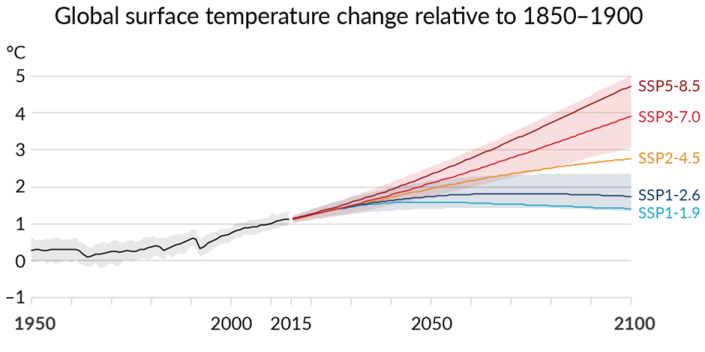
Evidence shows that by 2040, differences in global warming between low-, medium-, and high‑emission pathways are relatively small, and the uncertainty ranges of each projection overlap (IPCC, 2021a). Most of the warming projected by 2040 is already locked in by past emissions and cumulative historic emissions dominate the climate signal. As a result, climate hazards, such as heatwaves, droughts, floods, storms, or sea-level rise, are expected to be broadly similar across emissions pathways within this timeframe[footnote 3]. This allows us to hold climate hazards roughly constant across scenarios and focus on how exposure and vulnerability differ depending on political, economic, and adaptation decisions. Even if hazards look similar in 2040, total climate risk still varies significantly because societies differ in how exposed and vulnerable they are. Adaptation decisions, governance quality, and resilience investments therefore remain decisive.
Figure 4: Change in global warming as measured through surface temperature under low-, medium-, and high-emissions pathways, showing only modest differences with considerable overlap of uncertainty ranges between low- and high-mitigation projections; adapted from (IPCC, 2021a)
Alt text: Projected global temperature rise under different emissions scenarios to 2100.
The line chart above shows projected global surface temperature change relative to 1850–1900 from 1950 to 2100 under five emissions scenarios. Historical temperatures (1950–2015) rise gradually from around 0°C to about 1.1°C. From 2015 onward, coloured lines diverge: a high-emissions pathway (SSP5-8.5) increases steeply to nearly 5°C by 2100, while a slightly lower high pathway (SSP3-7.0) reaches around 4°C. A medium pathway (SSP2-4.5) rises to roughly 2.5–3°C. Two low-emissions pathways (SSP1-2.6 and SSP1-1.9) level off around 1.5–2°C, with the lowest slightly declining after mid-century. Shaded bands around each line indicate uncertainty ranges, which overlap considerably between scenarios, especially in mid-century projections.
However, we still vary mitigation levels across the scenarios. Although it is not a core uncertainty in the framework, changing mitigation assumptions adds important value. Different geopolitical and adaptation futures would naturally pursue different levels of emissions reduction, so varying mitigation helps keep each scenario internally coherent and realistic[footnote 4].
It also allows us to explore their long‑term consequences: while varying level of mitigation is not expected to greatly alter hazards by 2040, it has profound effects later in the century as pathways diverge. Decisions taken today on emissions, and in 2040, will strongly shape climate hazards in the second half of the century, influencing supply chains, long‑term resilience, and global stability. Each scenario therefore includes an outlook beyond 2040 to reflect how differing emissions pathways increasingly matter over time. Including these differences in the narrative lets each scenario show where the world is heading, even if the near‑term climate hazards are similar.
2.3.2 Building a robust evidence base through targeted reviews
We gathered evidence to anchor the project in an evidence-based understanding of how supply chain vulnerability and resilience emerge, how key drivers of change have developed historically, how they shape risk and resilience in supply chains today, and how they may interact to amplify or dampen future vulnerabilities.
The work focused on the geopolitical and climate‑ and environment‑related uncertainties prioritised during the scoping phase, as well as on broader considerations of how supply chain vulnerability and resilience emerge at different, interacting dimensions (at the firm‑level, network‑level, and external, macro-level). We undertook targeted, desk‑based research to understand the historical development of each uncertainty, identify recent events and emerging inflection points, and explore plausible future trajectories to 2040. This work was deliberately selective and not intended as a systematic literature review.
The resulting insights are summarised in Chapter 3 and presented in more detail in Annex A. They are used throughout the report to inform both the scenario narratives and the wider analysis of supply chain vulnerability and resilience.
2.3.3 Agent‑based modelling of supply chain risk
Global supply chains are complex, adaptive, and fragile systems. Disruptions do not only matter at the point where they occur, but can propagate through networks, amplify risks, and generate cascading failures. Traditional analytical approaches often struggle to capture these systemic dynamics. Agent‑based modelling allows us to explore how disruptions interact with network structure, behaviour, and dependencies. It complements qualitative foresight by exploring systemic vulnerability and resilience and identifying patterns of risk mechanism.
The modelling was not designed to forecast specific outcomes or predict future trade volumes. Instead, it provides insights into systemic vulnerabilities, how risk accumulates and propagates, and how resilience can be strengthened at a system level. The modelling approach and the insights it generates are a core outcome of the project, and details of the methodology are set out alongside the key analytical findings in Chapter 4, with the full agent‑based modelling methodology set out in a separate annex (see Annex B*).
2.3.4 Imagining the future through scenarios
What are scenarios and why should decision makers use them
Scenarios are not predictions or research papers. They are compelling but hypothetical stories that explore how different futures could unfold under deep uncertainty. Built from evidence on emerging trends, they show how uncertainties might interact and push developments in extreme or unexpected directions. Their purpose is not to describe what will happen, but to help decision‑makers test assumptions, recognise the limits of current thinking, and prepare for a range of plausible futures, none of which will map exactly onto the real world but all of which illuminate aspects of it.
Scenarios help us navigate the unknown, not just what is risky. Scenarios are useful because they enable decision makers to explore uncertainty, not just risk. Uncertainty is fundamentally different from risk. Under uncertainty, the range of future outcomes and the likelihood of them occurring are fundamentally unknown and even unknowable. This is different to risk where the outcomes are better understood and their likelihood can be estimated, particularly by gathering more data and applying mathematical forecasting techniques. Arguably, very few policy relevant events and trends are ones of risk, and we need to plan for and embrace uncertain futures. Scenarios offer a structured way to confront uncertainty by drawing on evidence to identify emerging trends and prompting us to creatively consider possibilities we might otherwise miss. Their purpose is not to predict the future, but to help us prepare for a wide range of possibilities and build resilience into today’s strategies.
Plausible scenarios help shape strong, flexible policies. Scenarios allow us to explore how relevant trends might unfold, how they could affect the policies and strategies we care about, and what actions we might take to prepare for uncertain futures.
Figure 5: The futures cone visualises the variety of different possible futures
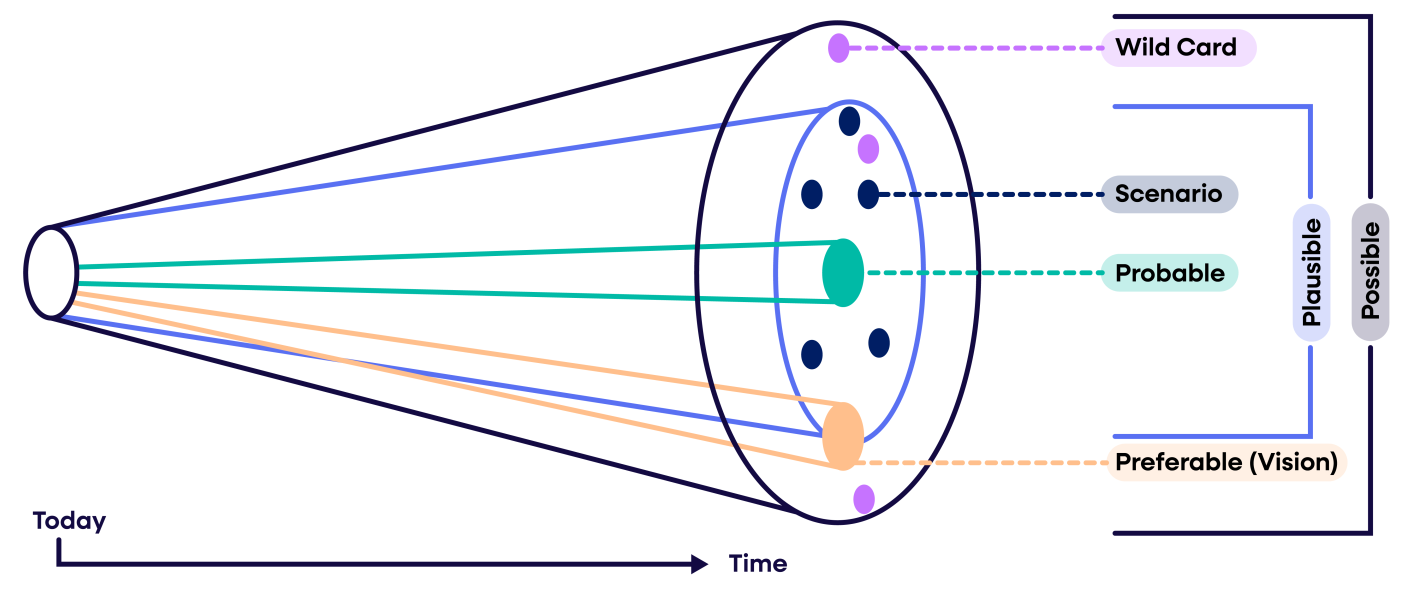
Alt text: Futures cone showing a widening range of possible and plausible outcomes over time.
The diagram of a “futures cone” extends from “Today” on the left to “Time” moving right. The cone widens outward to show an increasing range of possible futures. Inside the cone are layers: a central green path labelled “Probable,” a surrounding area with dots labelled “Scenario,” and broader outer areas representing wider possibilities. A separate point at the top is labelled “Wild Card,” indicating an unexpected future. At the lower edge, an orange path is labelled “Preferable (Vision).” Brackets on the right group these as “Plausible” and “Possible,” showing how different types of futures expand over time.
Our work uses plausible scenarios that combine key elements that support decision makers in developing evidence-based strategies that can adapt to change and uncertainty. They are:
- science-led: grounded in thorough research on emerging trends and refined through expert judgement, helping build a shared understanding of how trends might interact and what they could mean.
- outcome-oriented: designed to explore policy-relevant questions and spark thinking around resilient and adaptable solutions.
- deliberately-stretching: crafted to challenge assumptions for policy that accounts for uncertainty, enabling flexibility against a range of different futures.
How can policy makers use scenarios?
Scenarios can strengthen policy at every stage. Scenarios are a useful way for policy makers to incorporate uncertainty into the design of policies. They help test how resilient and adaptable a policy is against a range of different futures, whether you’re setting objectives, exploring possible solutions, or finalising detailed proposals. In workshops, scenarios act as mental models that challenge assumptions by asking “what if?” and encouraging open discussion. These conversations can reveal what a policy needs to succeed, uncover hidden assumptions that might limit its effectiveness, and broaden thinking to include emerging trends and possible future developments.
Wildcards can be used to spur thinking even further. Alongside scenarios, we use “wildcards” to explore rare but high-impact events that, while imaginable, are considered very unlikely to occur. Unlike scenarios, which describe complex, interconnected forces shaping entire future worlds, wildcards focus on specific, time-bound events. For example, a scenario might depict a future where technological advances have made human labour largely obsolete, while a wildcard could be a solar storm that knocks out GPS and internet services. Wildcards can act as early warning signals for highly impactful events, helping policy makers build flexibility into plans, prepare for existential risks, and spark creative thinking.
How the scenarios were developed
Using the 2 axes of uncertainty for geopolitical tensions and climate adaptation agreed during the scoping phase, we followed the Futures Toolkit approach to develop a 2×2 scenario matrix. Crossing the axes produced 4 distinct, plausible yet deliberately stretching future scenarios for global supply chains in 2040.
Figure 6: The 2x2 matrix outlining 4 plausible yet deliberately stretching geopolitical and climate adaptation futures for global supply chains
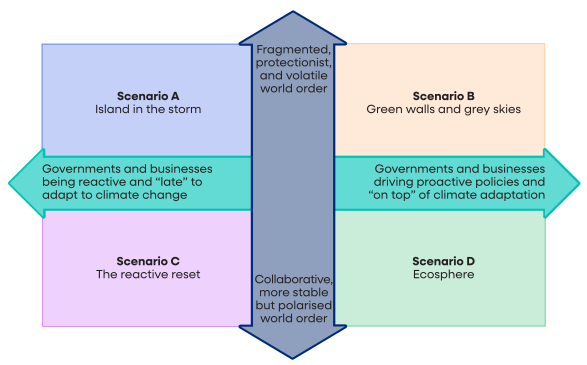
Alt text: Four supply chain scenarios based on geopolitics and climate adaptation in a 2×2 matrix.
The 2×2 matrix shows four future scenarios for global supply chains, shaped by geopolitics and climate adaptation. The vertical axis ranges from a collaborative, more stable but polarised world order at the bottom to a fragmented, protectionist, and volatile world order at the top. The horizontal axis ranges from governments and businesses being reactive and late to adapt to climate change on the left, to proactive and on top of climate adaptation on the right. The four quadrants are labelled: Scenario A “Island in the storm”, Scenario B “Green walls and grey skies”, Scenario C “The reactive reset”, and Scenario D “Ecosphere.”
As set out in the section on setting our scope (Chapter 2.3.1), climate mitigation is not treated as a core uncertainty in this report. Mitigation levels nonetheless vary across scenarios to maintain internal coherence and realism, reflecting how different geopolitical and climate adaptation futures would plausibly pursue different emissions‑reduction pathways and allowing exploration of their longer‑term consequences. In practical terms, the scenarios assume:
-
Scenario A follows a high-emission, low-mitigation pathway;
-
Scenarios B and C represent medium-emission, medium-mitigation futures;
-
Scenario D depicts a low-emission, high-mitigation trajectory
The scenarios were developed through a structured, collaborative workshop process involving government officials and external experts, designed to ensure policy relevance and analytical robustness. Participants jointly explored plausible future pathways and stress‑tested emerging narratives, which were then refined through further engagement to produce the final scenarios presented in Chapter 5.
2.4 Navigating this report
This report is designed to support a wide range of readers who are thinking about the future resilience of supply chains linked to the UK. Its primary audience is policy makers and decision makers across government, but it will also be useful to businesses, regulators, local authorities, and others with an interest in economic and supply chain resilience. Readers with different levels of experience, from generalist policy officials to analysts, strategists, and technical experts, will find material at varying depths. The guide below outlines what each section covers and which audiences may find each section most relevant.
Table 2: Overview of chapters to help readers navigate the Global Supply Chains report
| Chapter / Section | What it contains | Who it’s for |
|---|---|---|
| 1. Executive Summary | Key findings and main messages at a glance. | All readers wanting the headline insights quickly. |
| 2.1 Background | Why supply chain resilience matters for the UK. | Generalist policy makers and anyone new to the topic. |
| 2.2 Scope | What the report covers and the boundaries of the analysis. | Readers wanting a quick orientation to the report. |
| 2.3 Approach | How the study was carried out (methods, evidence, modelling, scenarios). | Interested policy makers, analysts, and researchers. |
| 3.2 Vulnerability & Resilience | Overview of the 3 dimensions of supply chain vulnerability and resilience. | Non‑technical readers wanting a clear, accessible overview. |
| 3.3 Critical Uncertainties | High‑level geopolitical and environmental trends affecting supply chains. | Policy and decision makers looking to understand where risks may come from. |
| 4. Modelling | High‑level explanation of the network‑based modelling and key findings. | Policy makers needing a concise overview of systemic risks; analysts seeking non‑technical insight. |
| 5.2 Scenarios | Detailed 2040 scenarios for stress‑testing strategy and policy. | Policy makers, strategists, analysts using scenarios to test plans or explore plausible futures. |
| 5.3 Wildcards | High‑impact, low‑probability events for additional stress- testing. | Advanced users exploring extreme or less predictable shocks. |
| 6. Conclusion | Practical three‑step resilience cycle for applying insights. | Policy makers and practitioners wanting actionable guidance. |
| Annex A – Evidence | In‑depth evidence supporting the trends and resilience concepts. | Officials, analysts, academics or R&D stakeholders seeking detailed evidence. |
| Annex B* – Modelling | Full technical methodology, assumptions, model design, and metrics details. | Modellers, technical analysts, or researchers working with supply chain analysis. |
Chapter 3: Understanding supply chain vulnerability and resilience: evidence and trends
3.1 Introduction
Global supply chains are complex systems made up of many interlinked stages of production, transport, and coordination that often span multiple countries. While trade data at the country level can show where goods are bought and sold, it does not capture the full goods production process or the extent of exposure embedded along entire supply chains (Bank of England, 2024). As a result, understanding supply chain vulnerability and resilience requires looking beyond national trade flows to the structures, relationships, and external conditions that shape how supply chains function and respond to disruption.
This chapter provides a high-level summary of a more in-depth review of relevant literature (in Annex A). It first draws on existing literature to set out what makes supply chains vulnerable and what supports resilience. It distinguishes 3 interconnected dimensions of vulnerability: firm‑level factors, such as sourcing strategies and operational practices; macro-level factors, such as geopolitical dynamics and climate and environmental pressures; and network‑level factors, including concentration, interdependencies, and bottlenecks. Genuine supply chain resilience depends on how these dimensions interact, rather than on any single factor in isolation. This conceptual grounding provides the basis for understanding why some shocks propagate widely while others are absorbed, and why similar hazards can lead to very different outcomes.
Building on this foundation, the chapter then reviews evidence on the external risk factors scoped in Chapter 2.2 (geopolitical fragmentation and climate and environmental change) and how trends in these areas may shape future supply chain vulnerability and resilience. These external pressures are treated as key sources of uncertainty that influence firm and network behaviour, and that may interact in ways that compound risk. Insights from supply chain modelling, which focuses on network‑level vulnerability patterns, are presented separately in Chapter 4. This evidence base anchors the subsequent scenarios, which explore how remaining uncertainties around geopolitical futures and climate adaptation could drive divergent supply chain outcomes over time.
3.2 What makes supply chains vulnerable, and what makes them resilient?
Understanding supply chain vulnerability and resilience
Supply chain vulnerability is the susceptibility of a supply chain to disruption and its ability to respond or recover. Disruption could originate inside the chain itself, stem from wider external forces, or be attributed to effects resulting from the production network the supply chain is part of (Wieland and Durach, 2021; Ivanov, 2023).
Supply chain resilience is the capacity of the supply chain to continue to function and recover when things go wrong. Across the literature, authors use different terms, but they consistently describe 3 connected capabilities that underpin supply chain resilience: withstanding disruption, adapting to it, and recovering from it (Wieland and Durach, 2021; Hosseini, Ivanov, and Dolgui, 2019).
Given the complexity, no single measure or perspective can fully capture supply chain resilience or vulnerability. Network-level models can highlight structurally critical firms and risk archetypes, for example, hubs whose failure would create large ripple effects across multiple industries. However, these models say little about how individual firms actually manage shocks (their redundancy, flexibility, and recovery practices), or about how likely those firms are to be hit by particular external threats, such as climate hazards, geopolitical conflict, or cyber-attacks. To support robust and reliable decision making for resilient supply chains, supply chain vulnerability and resilience needs to be explored through 3 complementary lenses:
(i) firm-level resilience and vulnerability (how companies organise and invest to cope with shocks),
(ii) the network structure of supply chains and the corresponding systemic risks
(iii) the landscape of external, macro-level threats that may impact them
The following sections provide a high-level summary of each lens. Effective policy needs to address all 3 and the interactions between them.
Three drivers of supply chain vulnerability
Firm-level exposure and resilience
-
Firm-level vulnerability: Exposure to disruption given sourcing decisions, inventory policies, production set-up and organisational practices. Firms are particularly vulnerable when they rely on single critical suppliers or sites, operate with very low inventories, or lack visibility beyond their first tier of suppliers (Hosseini, Ivanov, and Dolgui, 2019).
-
Firm-level resilience: describes a combination of 3 “lines of defence”:
- absorptive capacity, or redundancy: withstanding shocks, e.g. through additional inventory, back-up suppliers
- adaptive capacity, or flexibility: switching suppliers, rerouting or reallocating production
- restorative capacity: recover and learn, e.g. crisis planning, digital tools, physical repair, learning from past events and adjusting strategies accordingly (Hosseini, Ivanov, and Dolgui, 2019; Behzadi, O’Sullivan, and Olsen, 2020).
-
Firms should use redundancy selectively, focused on genuinely critical inputs and bottlenecks, and combine it with better information and risk assessment, rather than assuming that more stock is always better (Vlajic, 2017).
-
No single approach is enough. Redundancy without flexibility can be costly yet still fail in extreme events; flexibility without buffers can be overwhelmed by major shocks; and fast recovery is limited if firms keep the same high-risk exposure (Behzadi, O’Sullivan, and Olsen, 2020; Wieland and Durach, 2021).
→ What this means for resilience: When firms rely on single suppliers, hold minimal buffers, or lack visibility beyond their first-tier suppliers, relatively minor disruptions can escalate into major operational and financial losses, especially if redundancy, flexibility and recovery capabilities are not balanced.
Network-level systemic fragility
-
Global supply chains behave as networks of interconnected firms rather than linear chains, meaning shocks can ripple through the system.
-
Highly connected “hub” firms or chokepoints can create cascading failures. Relatively small shocks can cause large-scale disruptions (Brintrup and Ledwoch, 2018).
-
Modelling can help to identify structurally important firms and estimate how different types of disruption could cascade through complex supply networks.
→ What this means for resilience: Because supply chains operate as tightly connected networks, disruption at critical hubs or chokepoints can spread rapidly across sectors and borders, affecting even firms that appear well prepared at an individual level.
External, macro-level shocks and global risks
-
These risks originate outside a firm’s own operations. These include climate hazards, operational risks (logistics, transport etc), demand and supply side risks (e.g. sudden demand surges or supplier failures), global risks (economic, political, regulatory), and digital and cyber threats (Ho et al., 2015; Arowosegbe et al., 2024; Pandey et al. 2020).
-
Enhancing visibility, through multi-tier supplier mapping and digital monitoring can help to understand vulnerability and detect disruption earlier (Ivanov and Dolgui, 2021; Piprani et al., 2025).
-
Diversification strategies, such as multisourcing, can reduce exposure to individual chokepoints or politically sensitive regions (Lin et al., 2021).
-
Collaborative risk management, including information-sharing and joint contingency planning between firms and with governments, can improve response and recovery during major disruptions (Maemunah, 2024).
→ What this means for resilience: As climate, geopolitical, technological and operational shocks become more frequent and interconnected, disruption is likely to occur more often and last longer, particularly where firms and governments lack shared visibility, coordination and contingency planning.
3.3 Critical uncertainties of macro-level supply chain trends
The broad categories of critical uncertainties we have examined are “climate and environmental uncertainties” and “geopolitical tensions”. This section focuses on global supply chains for physical goods, rather than services. Climate and environmental pressures can alter what is produced, where it is produced, and how goods move, affecting every stage of global supply chains. Differing levels of climate adaptation planning and investment create additional uncertainty around future production, infrastructure resilience, and access to critical goods. Geopolitical tensions, meanwhile, influence trade policy, market access, transport routes, resource availability, and the stability of global economic systems. Together, these forces underpin many of the other commonly recognised external, macro-level risks for supply chain resilience, such as natural hazards, transport disruption, demand supply shocks, and regulatory volatility. These 2 critical uncertainties form the building blocks of our scenarios, and therefore also of this review. Each broad category is made up of sub-uncertainties, described in more detail below, which correspond directly to the critical uncertainties identified during the scoping phase (Chapter 2.3.1).
3.3.1 Climate and environmental uncertainties
Climate and environmental pressures are expected to intensify, reshaping how and where goods are produced, the reliability of global transport systems, and the resilience of ecosystems that underpin supply chains. Near-term climate impacts are relatively well understood (5-15 years), but longer-term impacts are uncertain. Some key impacts for supply chains are below:
-
Disruption to production. There may be shifts in what can be produced, where, and in what volumes. Heat, drought, extreme weather, pests, soil and ecosystem degradation are impacting different industries already, and the scale of the impact in the future will be shaped by countries’ and industries’ ability to adapt. These production shocks can also trigger demand shifts elsewhere (e.g. higher import demand when domestic output falls).
-
For example, the 2010 heatwave in Russia doubled global wheat prices (Ministry of Defence, 2024), and Hurricane Helene shut down quartz mines in Spruce Pine, North Carolina, which supply ~70% of high-purity quartz used in semiconductors (Greene, 2024).
-
Global transport networks and trade routes. Climate impacts may disrupt transport more often as extremes intensify, causing delays, higher costs, and wider supply chain knock-on effects. Storms, flooding, sea-level rise, heat, and drought can reduce capacity and reliability across ports, maritime chokepoints, waterways, road/rail, air transport and domestic networks unless adaptation keeps pace (e.g. resilient infrastructure, improved logistics, and better warning/planning systems).
-
For example, the Panama Canal is vulnerable to drought and already restricts the number and size of ships that transit per day when water levels drop, impacting global trade since it accounts for about 5 per cent of global maritime trade (Barnes, et al., 2024; Kamali et al., 2024). Without adaptation or emissions mitigation, these disruptions will likely continue (Muñoz et al., 2025).
-
Decarbonisation of transport and logistics. How transport and logistics decarbonises could impact supply chains in different ways, from potentially shifting routes, using lower-carbon models (rail, inland waterways) where possible, and adopting new fuels where long distance remains essential.
-
For example, it may shorten and regionalise supply chains in certain sector, due to factors such as carbon pricing and fuel costs making closer regional sourcing and rail-based corridors preferable (Çapar et al., 2025; IPCC, 2022; EU Rail JU, 2025). Decarbonising logistics could increase lead times, for example, maritime shipping is already encouraging slow steaming and alternative fuel use to reduce carbon-intensity, adding days to some Asia-Europe routes, whilst reducing fuel burn and emissions (Seo and Shin, 2024).
-
Demand for goods and resources needed for net zero goals and climate change adaptation. Net zero commitments and climate adaptation needs are likely to drive shifts in demand for low-carbon and resilience goods, especially minerals and technologies, creating supply chain pressure and volatility. There is uncertainty in exact demand, innovation and deployment timelines and new dependencies this may create. Beyond demand for mitigation and adaptation goods, climate variability can also shift demand directly, for example, unusually cold winters raise heating demand. For example, global mineral demand for clean energy technologies could rise four- to six-fold by 2040 (IEA, 2021), and many minerals and metals for key low-carbon technologies may face supply shortages by 2030 (McKinsey & Company, 2022). These pressures could lead to price spikes, market volatility, and higher costs for the technologies that rely on these minerals.
-
Biodiversity loss. Biodiversity decline, driven by factors like climate change, habitat loss, pollution and overexploitation, can disrupt supply chains directly by reducing ecosystem services (impacting food production and crop yields), indirectly through economic and social instability (e.g. social unrest in production regions if communities lose access to ecosystem services), as well as by increasing physical risks (e.g. greater vulnerability to natural disasters impacting transport routes).
-
For example, mangroves act as natural coastal flood defences, currently reducing expected annual flood damages from tropical cyclones by about $60bn and protecting around 14 million people (Menéndez, Losada, and Torres-Ortega, 2020). Clearing mangroves for coastal development or aquaculture can increase coastal flood damages (by removing a natural flood defence), which in turn can disrupt coastal logistics infrastructure such as ports and roads.
3.3.2 Geopolitical uncertainties
Supply chains operate across complex global networks and are therefore highly exposed to geopolitical instability. Events such as conflicts, as well as policy shifts, and changing international relationships can reshape trading conditions and influence corporate decisions.
-
Conflicts. Geopolitical conflicts are increasingly disrupting supply chains, including by damaging infrastructure, constraining key trade routes, driving up costs, and creating long-term uncertainty for businesses. Examples include direct military attacks on transport corridors and production sites, diplomatic tensions that impact sanctions, tariffs, and resource competition. The growing use of cyberattacks and the internationalisation of conflicts further increases volatility, making supply chains harder to plan, insure, and secure.
-
For example, Russia’s attacks on agriculture facilities, ports and key transport routes in Ukraine affected global grain availability and a price increase of approximately 2% (Devadoss and Ridley, 2024).
-
Shifting global power dynamics. Emerging powers, new alliances, and demographic change are reshaping the geopolitical environment in ways that may increasingly influence global trade and supply chain stability. The transition to a more multipolar world is altering the rules, alliances, and incentives that underpin global trade, and flexible issue-based partnerships may become more prominent (Ministry of Defence, 2024). In the future, economic weight may shift further towards emerging economies, which are projected to contribute around 65% of global growth by 2035, led by Asia-Pacific (DBT, 2025a; Bates, 2026). At the same time, demographics are also changing, with population growth projected to be fastest in sub-Saharan Africa and countries such as India and Pakistan (UN WPP, 2024). These trends mean supply chains may need to adapt to changing demand, strategic dependencies, and more politically driven patterns of trade.
-
Trade fragmentation. Friendshoring, nearshoring, and reliance on single-source suppliers may reshape global supply chains by prioritising resilience and geopolitical alignment over efficiency and cost. While efforts to reduce exposure to distant or high-risk suppliers can strengthen resilience, they may also introduce new vulnerabilities, including higher production costs, capacity constraints, and increased exposure to regional shocks. There is mixed evidence on firms’ response and the extent of nearshoring globally, and how this trend plays out and interacts with other trends will impact future supply chains.
-
Trade policy restrictions and interventions. These measures can alter global trade patterns directly and indirectly since their spillover effects can impact countries not directly involved (Bednarski et al., 2023). The objective and design of a measure influence which sectors are affected and how other countries respond. Global trade liberalisation has been reversing, with an increasing number of trade restrictions in recent years. The use of trade restrictive measures and interventions is likely to fluctuate based on geopolitical dynamics and economic conditions (Arif and Zahid, 2024).
-
For example, between mid-October 2023 and mid-October 2024, the WTO recorded 169 new trade restrictive measures by its members, covering US $887.7 billion in trade, up from US $337.1 billion in the previous year (WTO, 2024). Export restrictions on industrial raw materials increased more than fivefold between 2009 and 2023 (OECD, 2025a).
-
Regulation. Domestic policies and international frameworks impact supply chains in different ways. The future of multilateral institutions and how well disputes are managed will impact trade, as well as if there is a move toward regionalisation and an increase in plurilateral agreements. How wider domestic legislation evolves, from environmental to labour law and technology and data regulation, may also impact supply chains.
-
For example, regulatory frameworks are expected to evolve alongside the development of AI, with a stronger emphasis on proactive cybersecurity measures and third-party risk management (Huang, Madnick, and Zhang, 2021). Differing data protection rules across jurisdictions already require businesses to navigate complex compliance landscapes, potentially creating trade barriers. As digital globalisation accelerates, global data governance may become increasingly fragmented, further complicating digital trade (Kalin, 2024).
3.4 Relationships between climate and geopolitical uncertainties
Climate change out to 2040 is almost certain to create challenges for supply chains (IPCC, 2021a), but how countries, economies, and societies respond to these challenges and adapt to its effects is much less certain. Geopolitical shifts have the potential for even more acute, extreme, and unpredictable changes for global supply chains. There are several ways in which these critical uncertainties can impact and exacerbate each other, further increasing the amount of uncertainty global supply chains will face out to 2040.
This section provides examples of how geopolitics can shape climate action and how climate impacts can, in turn, reshape geopolitical dynamics. In many cases, these forces interact, reinforcing and amplifying 1 another.
-
Geopolitical tensions may impact the availability of critical minerals for renewable energy technology. Tensions between countries that control rare earth elements and those that need them for green technologies could slow down the deployment of renewable energy infrastructure (World Economic Forum, 2024).
-
Geopolitical shifts may impact energy policy and trade. For example, Russia’s invasion of Ukraine in 2022 exposed how dependent Europe was on imported gas, and European governments responded by pursuing a combination of short-term measures to secure alternative supplies and structural shifts, including accelerated investment in domestically generated renewable energy (European Investment Bank, 2024). India purchased Russian oil at discounted prices, with their oil consumption increasing by 14% in 2023/24 compared to 2021/22 (Block et al., 2024)
-
Conflict may divert climate finance by shrinking fiscal space and shifting spending priorities. For example, following Russia’s invasion of Ukraine, Ukraine’s ability to invest in climate change mitigation decreased as funds were diverted to the war and reconstruction efforts (Block et al., 2024). Additionally, climate adaptation finance tends not to be allocated to fragile and conflict affected areas, due to perceived higher risks and challenges (Jones et al., 2024; Meijer and Ahmad, 2024).
-
Economic sanctions and environmental policies. Geopolitical conflicts can lead to economic sanctions that impact environmental policies. Sanctioned countries such as Iran, North Korea, and Cuba tend to deprioritise the environment compared to issues causing more immediate national security problems (Madani, 2020).
-
International cooperation on climate change. Rising geopolitical tensions can undermine international cooperation on climate change by making it harder for countries to agree on collective action and binding commitments.
-
Climate policy. Differences in the design of sustainability regulations across countries can raise compliance costs, prompt firms to adjust sourcing and investment decisions, and reshape trade patterns (Venmans, Ellis and Nachtigall, 2020).
-
Conflicts caused by resource scarcity. Climate-driven resource scarcity challenges global governance by intensifying competition over essential resources and could place strain on existing mechanisms for cooperation, conflict prevention and equitable access.
-
Biodiversity loss and geopolitics. Conflict drives biodiversity loss, and biodiversity loss can exacerbate conflict, creating reinforcing negative feedback loops (Defra, 2026). As ecosystems degrade, countries are increasingly likely to compete for food, water, and other natural resources, heightening geopolitical tensions and driving interstate rivalry. These cascading risks, from resource scarcity to migration and conflict, could destabilise regions that underpin global supply chains, and increase the likelihood of disruptions to essential imports such as food and fertiliser (Defra, 2026).
-
Food shortages exacerbated by conflict and climate change. Violent conflict and climate change each disrupt food production, access and markets. When they occur together, they can create reinforcing feedback loops in which food shortages increase conflict risk, and conflict further undermines food systems, deepening scarcity. This dynamic has been observed in contexts such as Yemen, Syria and Somalia, where climate shocks and conflict have jointly driven severe food insecurity (FAO and WFP, 2025).
-
Climate- and conflict-induced displacement. Climate impacts can interact with conflict to drive large-scale displacement, particularly where environmental stress undermines livelihoods in fragile and conflict-affected contexts, amplifying humanitarian and geopolitical pressures.
-
Transport routes and chokepoints are vulnerable to both climate and geopolitical hazards. For example, climate-driven drought reduced capacity through the Panama Canal, at the same time as geopolitical insecurity on alternate routes (the Red Sea/Bab el-Mandeb) disrupted Suez Canal traffic (ERPS, 2024). More recently, conflict in the Middle East has highlighted the exposure of oil and gas trade to disruption at critical transport corridors and maritime chokepoints.
-
Energy transition and geopolitics. The renewables transition may reshape geopolitical power: influence may shift away from fossil‑fuel exporters towards countries controlling critical minerals and concentrated processing and clean‑tech manufacturing capacity, creating new dynamics and potential vulnerabilities.
Chapter 4: Systemic risk in global supply networks
4.1 Modelling supply network risk
Understanding systemic risk is essential for assessing supply chain resilience. Modern supply chains are not simple, straight lines of suppliers and buyers. Instead, they are networks, operating as complex, multi-tier, interconnected systems, where firms are linked through many direct and indirect relationships. When disruptions occur, effects can spread upstream (i.e. towards earlier stages of production, for example when reduced demand affects suppliers) and downstream (towards later assembly, distribution, and delivery stages, for example when input shortages affect customers). As a result, the economic consequences of disruptions can extend far beyond the firms or countries where the initial shock occurs.
To better understand how these knock‑on effects arise within supply networks, and how risk is generated and propagates through interconnected firms and countries, we used network‑based analysis addressing a central question: What kinds of firms and countries are system-critical for complex supply networks, both for the UK and for the global supply chain, and through what structural mechanisms does their disruption generate economy- or industry-wide losses? To answer this, we used an agent-based modelling approach. The following outlines a high-level summary of our approach. Full details of the modelling framework, data processes, and methodological assumptions and limitations are provided in Annex B*.
First, we mapped firm-to-firm supply links of all firms for sample supply chain goods using data from the Global Supply Chain Intelligence Programme (GSCIP). This data captures who supplies whom, where firms and facilities are located, and how products flow through supply chains. These relationships form a network in which firms are connected not only to their direct suppliers and customers, but also indirectly to many others further upstream and downstream across multiple tiers in the production process.
We then simulated how shocks affect production as they ripple through these interconnected supplier-buyer relationships. We used an agent‑based model, where firms act as “agents” and respond to shortages and demand changes. This approach reflects established findings showing that supply chain shocks can have large indirect effects that are difficult to observe using aggregated trade data (Inoue and Todo, 2019). This simulation allowed us to estimate how an initial disruption translates into lost production across the wider system.
From these simulations, we calculated the Economic Systemic Risk Index (ESRI), a quantitative measure that captures how much total production would be affected if a particular firm or country was disrupted, both for the UK and for the global supply chain. In plain terms, ESRI asks: if this firm (or country) is disrupted, how large are the knock-on effects for overall production? This measure captures indirect dependencies that are not visible in conventional trade statistics, which typically focus on direct trade links. It allows us to look beyond a firm’s (or country’s) size as the only indicator of importance and instead shift the focus from asking “who trades a lot?” to considering “who is system-critical and why?” (Diem et al., 2022). To interpret these results, we also examined which network features are associated with high systemic risk, helping identify the mechanisms that create vulnerability within supply networks and where targeted action is probably going to reduce system-wide risk.
Whilst agent-based modelling is a powerful approach to quantify and characterise in detail network-based supply chain vulnerabilities, useful insights can also be gained from simpler network measures that can be calculated directly from commercial transaction‑level data, such as GSCIP. For example, network centrality measures (e.g. degree[footnote 5], betweenness[footnote 6], or eigenvector[footnote 7] centrality) can help identify firms that occupy structurally important positions, e.g. sitting on multiple paths through the network and are therefore more likely to transmit disruption; supplier concentration ratios can be used to perform simple single-point-of-failure checks, and network density or clustering metrics can assess whether a network has alternative paths or substitutes, affecting recovery speed (Ledwoch et al., 2016; Mungo et al., 2024). These approaches can be applied to help identify vulnerabilities and system‑critical actors without necessitating a full simulation model.
4.2 Key insights
Across modelled supply networks, consistent structural patterns emerge in both the drivers and concentration of systemic risk, despite differences in product characteristics and geographic distribution.
Supply chains are complex networks, not linear chains. They are organised as multi-tier networks characterised by indirect dependencies, heterogeneities between firms, feedback loops, and propagation mechanisms. Disruption in 1 place can therefore affect other parts of the system in unexpected ways, even when there is no direct trading relationship. This means that commonly used measures of supply chain risk, such as looking only at direct suppliers, bilateral trade flows, or market concentration, are insufficient to identify where vulnerabilities exist. To understand supply chain risk properly, a complex systems approach that shows how firms and routes are positioned within the wider network is necessary. Simple network measures, such as how central or connected an entity is, can provide valuable insight about where disruption could spread most widely. More advanced network analysis and modelling can provide deeper, system‑level understanding of risk and resilience across the supply network. The specific ways in which these network features generate risk are illustrated later in this section.
Figure 7: An illustrated macro view of a supply network, demonstrating that they are not linear configurations of suppliers and buyers, but complex networks.
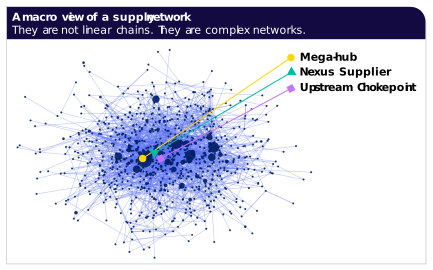
Alt text: Supply networks shown as complex, interconnected systems with multiple dependencies.
The dense web of interconnected nodes and lines fills the above image, representing firms embedded in an intertwined network of relationships. Labels highlight key points in the network, including a mega‑hub, a nexus supplier, and an upstream chokepoint. The visual shows how these interdependencies create indirect connections, meaning disruptions in one part of the network can propagate widely across the entire supply system.
Systemic risk is typically highly concentrated. Modelling results indicate that a small subset of countries and firms account for the overwhelming majority of global and UK systemic risk and could generate disproportionately large output losses under disruption, while the vast majority contribute only negligible risk. This insight supports the use of targeted interventions for system-critical firms to increase resilience for particularly critical entities, rather than applying broad, undifferentiated diversification strategies.
Figure 8: Ranked ESRI risk scores for firms within a modelled supply chain
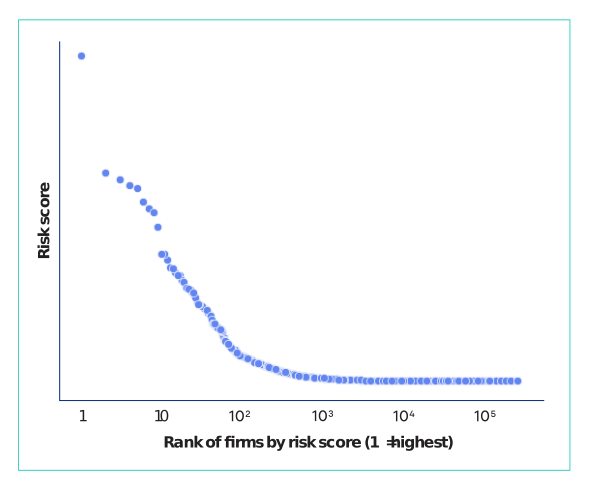
Alt text: Risk scores across firms showing a long‑tail distribution with highly concentrated risk.
Each point in the above chart shows a firm’s individual ESRI score (y-axis) and its position in the risk ranking (x-axis). The steep drop-off shows that systemic risk is highly concentrated: a handful of firms drive most of the overall risk, while most others pose minimal impact if disrupted. This “long-tail” pattern is common across all networks analysed.
Global network structure shapes UK risk, alongside direct UK exposure. The UK’s exposure to supply chain risk is driven by both (i) the global network and how UK firms are embedded within it (through indirect, multi-tier pathways) and (ii) economically important UK firms and a small number of suppliers directly critical to the UK. This means that disruption in a place where the UK has limited direct (i.e. bilateral) trade with a particular firm or country can still pose a significant UK risk if that firm is structurally central in global production pathways, for instance by linking the UK to major producers upstream in the supply chain. This implies that resilience might be ineffective if it is delivered solely through reshoring (domestic relocation of production) or friend-shoring (shifting to sourcing from politically aligned countries). Reducing exposure effectively requires international coordination and attention to upstream parts of supply chains, where risks often originate and spread. The examples that follow show how these indirect pathways operate in practice.
Network position can be as important as scale. Our analysis shows that systemic risk is shaped not only by how much a firm or country trades, but also by how it is connected to others within the wider supply network, consistent with wider evidence (Diem et al., 2022; DiGiovanni et al., 2024; Inoue and Todo, 2019). In practice, this means that risk depends on factors such as the volume of goods or services flowing through a firm (flow volume or trade intensity), how many suppliers and customers it is connected to (connectedness), its stage in the production process (tier position), whether it links otherwise separate parts of the network (centrality), and how concentrated its suppliers or customers are (supplier/buyer concentration). Firms that score highly on these characteristics can transmit disruption widely and therefore pose a significant risk to overall supply chain resilience, even if they do not trade large volumes themselves. As a result, some relatively small firms can be system‑critical because they sit on key dependency paths or act as connectors between multiple parts of the supply chain. This also explains why high‑level trade statistics, which mainly capture trade intensity and volumes, are not sufficient to identify supply chain vulnerability: they miss the structural roles that allow disruption to spread. Resilience measures should therefore focus on system-critical positions within networks rather than relying on size, trade volumes, or concentration measures. The analysis below brings these concepts to life through a set of illustrative risk pathways (outlined below), showing how different network structures can generate vulnerability.
Figure 9: Illustration highlighting the different structural mechanisms through which risk can arise in supply networks
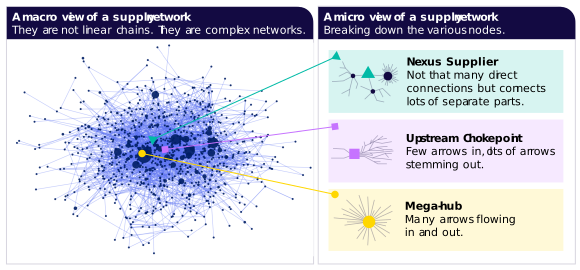
Alt text: Key network structures (hub, chokepoint, nexus) that create supply chain risk.
In the illustration above, on the left, a dense macro view shows a complex web of interconnected nodes and links, emphasising that supply networks are not linear chains but highly interconnected systems. Three highlighted nodes are picked out within the network: a nexus supplier, an upstream chokepoint, and a mega‑hub. On the right, a micro view breaks down these node types: a nexus supplier has relatively few direct links but connects lots of separate parts of the network; an upstream chokepoint has limited inputs but lots of arrows stemming out; and a mega‑hub has many connections flowing both in and out. The diagram illustrates how different node structures can create vulnerabilities and allow disruption to spread across the network.
Systemic risk can arise through different structural pathways. Our analyses, together with wider academic literature, show that systemic supply chain risk emerges through different mechanisms (“risk archetypes”) rather than in a single way. These recurring structural patterns shape where risk originates in the supply network, how shocks propagate, and how their impacts are amplified across multiple tiers, sectors, and geographies. Recognising these patterns matters because evidence suggests that different types of risk respond best to different types of intervention, and that blanket approaches are often ineffective. In practice, this means selecting and combining measures such as redundancy, flexibility, monitoring and visibility, or network redesign based on the specific mechanism through which risk is generated in the system, rather than applying the same response across all supply chains (Dolgui and Ivanov, 2021; Sheffi and Rice, 2005). Below are outlined the most common supply‑chain risk pathways, showing how risk arises, providing practical examples, and highlighting evidence on the most effective interventions for each.
- System-critical mega-hubs and clusters.
Transaction mega-hubs are high‑throughput ports, logistics hubs, and trading centres through which many supply chains pass. Because so much trade activity flows through them, these hubs occupy structurally important positions in supply networks. In network terms, these nodes concentrate flows and often have high betweenness, meaning they sit on many of the main routes linking different parts of the system (Borgatti, 2005; Ledwoch et al., 2016).
Risk from these hubs arises because activity and connectivity are concentrated. When a hub is disrupted, the effects can spread quickly and widely, forcing detours, delays, and congestion elsewhere in the system. Recent disruptions at major maritime chokepoints such as the Suez Canal, the Red Sea, and the Panama Canal illustrate how rapidly global costs and lead times can increase when core nodes and corridors are impaired.
Evidence suggests that the most effective ways to manage risk from system‑critical mega‑hubs focus on increasing flexibility rather than attempting to eliminate reliance altogether. Examples include pre‑planned alternative routes, the ability to switch transport modes, access to contingent surge capacity, and coordinated diversification of pathways to avoid over‑dependence on any single hub (Sheffi and Rice, 2005). For example, during the 2021 Suez blockage, carriers that rapidly rerouted via the Cape of Good Hope saw shorter‑lived impacts than those that waited for the canal to reopen, illustrating the value of pre‑planned alternatives and capacity agreements (Leonard, 2021).
- Upstream bottlenecks and chokepoints.
Upstream bottlenecks are often specialised suppliers, facilities, or processing stages with few viable substitutes, situated early in the production process, such as critical inputs with high qualification barriers (Kawabata and Fujita, 2026).
They are risky because low substitutability means that even a local shock can propagate downstream, interrupting assembly and production across multiple firms and sectors. When such a chokepoint fails, its impact is amplified by structural features of the network, including how many downstream firms depend on it and how tightly integrated production stages are (Craighead et al., 2007).
Evidence suggests that the most effective ways to manage risk from upstream bottlenecks focus on targeted resilience at the point of failure, rather than spreading resources broadly. These include limited buffer stocks for the most critical inputs, pre‑qualified backup capacity where substitution is hardest, supplier development, and gradual diversification over time, including into alternative geographies (Ivanov and Dolgui, 2021). Such approaches reduce exposure where it matters most, without imposing unnecessary efficiency costs elsewhere in the system. A well‑known example is the 2000 fire at the Philips semiconductor plant in Albuquerque, after which Nokia recovered faster than competitors by rapidly redesigning components and requalifying alternative suppliers, demonstrating how targeted redundancy and agile supplier development can outperform single‑source dependence (Hansen, 2025).
- Nexus suppliers.
Nexus suppliers are firms or regions that handle relatively modest trade volumes but occupy pivotal positions that connect otherwise separate parts of the network. Their importance comes not from scale, but from where they sit in the network, which means they are often difficult to identify using headline trade or production statistics alone (Choi and Kim, 2008).
Risk arises because disruption at these connectors can transmit shocks across multiple parts of the network that would otherwise be only weakly linked. When few alternative connections exist, failure at a nexus supplier can trigger cascading impacts that are disproportionate to size, particularly in less modular networks or where there are limited “bridges” between sectors or regions (Namdar et al., 2024).
Evidence suggests that the most effective way to manage risk from nexus suppliers is first to make them visible. This includes investing in network mapping, monitoring, and analysis to identify them, followed by targeted stress‑testing and tailored resilience requirements to ensure recovery capacity. Where appropriate, firms and policy makers can also reduce risk by reconfiguring dependencies, for example by adding alternative links or secondary connectors, to limit how widely disruption can spread (Bowen and Siegler, 2024). For example, a 2021 fire at the Renesas Naka plant, a supplier with outsized influence in automotive microcontrollers, triggered production adjustments across multiple automakers. Firms with inventory buffers and alternate sourcing options navigated the shock more effectively until capacity was restored (Schorr, 2021).
Figure 10: Schematic illustration showing how different patterns of risk archetype within supply networks can result in high risk
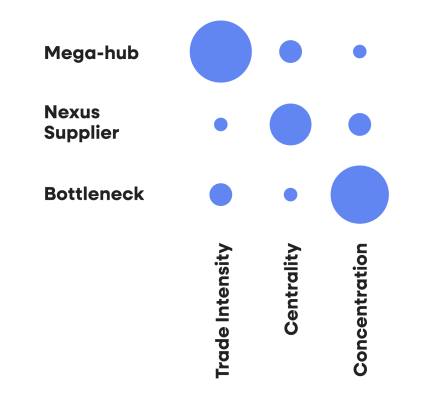
Alt text: Different risk drivers combine to create high systemic supply chain risk.
The bubble chart above plots three categories on the vertical axis—“Mega-hub,” “Nexus Supplier,” and “Bottleneck”—against three horizontal drivers of risk: “Trade Intensity,” “Centrality,” and “Concentration.” Blue circles of varying sizes represent the relative importance of each driver (larger circles indicate greater importance, smaller circles indicate less importance). Large bubbles appear in the Mega-hub under Trade Intensity and in the Bottleneck under Concentration, while smaller and medium-sized bubbles are distributed across other intersections. The diagram highlights that high systemic risk scores can arise through different structural mechanisms within supply networks.
Granularity matters. Country-level and firm-level analyses reveal different vulnerability patterns. Some high-risk firms are located outside high-risk countries, and vice versa. Effective policy should therefore operate at multiple scales, for example combining country-level engagement with firm-level monitoring, stress-testing, and selective domestic capability building where UK-relevant chokepoints are identified.
Figure 11: Schematic representation of firm and country ESRI classifications
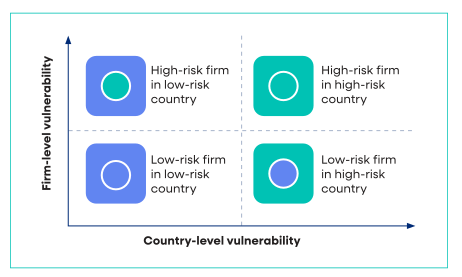
Alt text: Firm‑ and country‑level risks combine in different ways to shape overall vulnerability.
The four-quadrant diagram above plots “Firm-level vulnerability” on the vertical axis (increasing upward) and “Country-level vulnerability” on the horizontal axis (increasing to the right), divided by dashed lines. Each quadrant contains a rounded square with a circle inside to represent firm risk within a country context. The top-left quadrant shows a “High-risk firm in low-risk country,” while the top-right shows a “High-risk firm in high-risk country.” The bottom-left shows a “Low-risk firm in low-risk country,” and the bottom-right shows a “Low-risk firm in high-risk country.” The contrast in colours between squares and inner circles reinforces differences between firm and country risk. The diagram highlights that high-risk firms can exist in otherwise low-risk countries, and vice versa, emphasising the need for multi-dimensional assessment and targeted interventions.
Network exposure to macro-level, external shocks
A key implication of these results is that the consequences of disruption depend as much on how shocks transmit as on where shocks originate. As outlined previously, climate hazards, geopolitical tensions, trade restrictions, and technological transitions can act as disturbances to production and logistics, but their consequences for supply chains are also shaped by supply network structure. Disruptions are amplified where supply networks are concentrated, or dependent on a small set of upstream manufacturers, and attenuated where redundancy, diversification, or routing flexibility exist. The same disruption can produce sharply different outcomes depending on whether it affects a mega-trader hub, an upstream chokepoint, a nexus supplier, or a peripheral or weakly connected entity. Structural patterns indicate where vulnerabilities exist within supply networks, while external shocks, often informed by exposure to climate and geopolitical risk, determine whether and how those vulnerabilities might translate into wider systemic disruption. This suggests a proactive policy approach: identifying key ‘transmitter’ firms and vulnerable network structures in advance and strengthening diversification and redundancy at the sector or supply chain level to enable more effective responses when shocks occur.
Chapter 5: Scenarios for the future of global supply chains
5.1 Overview of our scenarios
Scenario framework and narrative structure
The scenario framework and development process are set out in Chapter 2.3.4, including how the 4 scenarios were constructed using a 2×2 matrix approach based on the critical uncertainties described in Chapter 2.3.1.
Each scenario follows a consistent structure to support both easy comparison and deeper engagement. It opens with 5 core elements – key assumptions, a scenario summary, headline metrics, an overview table of key factors, and a visual – which together provide a complete, self‑contained overview of the world in 2040. These components explain the basis of each scenario, what it feels like to live in it, and how it differs from the others. Readers can then move into a more detailed narrative that expands on each of the key factors set out in the overview table. This narrative follows the same structure and numbering as the overview table. This allows readers to move easily between the summary and the full narrative, while also working as a continuous story for those who prefer a more immersive reading experience.
Using metrics to visualise and compare scenarios
To support comparison across the 4 scenarios, each world is also presented through a set of 6 headline metrics. The metrics provide a simple quantitative lens on key dimensions of change for trade, climate adaptation, and geopolitics, providing a consistent estimate for understanding how each scenario diverges from current trends and how scenarios differ from each other. 2 metrics relate to climate adaptation and 2 to geopolitical fragmentation, reflecting the axes of uncertainty used to construct the 2×2 scenario framework, while 2 additional trade‑related metrics are included to anchor the scenarios against overall future trade levels. Each metric is reported against a 2040 estimate, assuming current trends continue, to make differences across scenarios clear and comparable. They are shown alongside scenario summaries and in overview tables.
The metrics are grounded in available evidence and expert judgement, but it is important to emphasise that these metrics are not forecasts, projections, or point estimates. They do not represent rigorous predictions of future outcomes, nor are they the result of formal modelling or probabilistic analysis. Instead, they are illustrative tools to help describe and differentiate the scenarios. Their purpose is to support scenario comparison, not to provide definitive numbers for planning or investment.
The 6 scenario metrics are:
Trade generic metrics:
1. Global trade intensity
Measured through total value of global goods exports (US$): High‑level anchor for global economic integration, to help distinguish between futures characterised by expanding, stable, or contracting global trade.
2. UK trade integration
Measured through total UK exports value (£bn): National‑level anchor to illustrate how the UK’s trade position evolves relative to wider global trade conditions.
Climate adaptation metrics:
3. Climate shock exposure
Measured through number of climate disasters: Captures how often climate hazards translate into major disasters that overwhelm local capacity and require external assistance. While climate hazards themselves are broadly similar across scenarios in 2040, variation in this metric reflects differences in adaptation, preparedness, and response capability, making it a direct indicator of climate adaptation outcomes.
4. Societal readiness for climate adaptation
Measured through percentage of the UK public concerned about climate change: This metric measures the share of the UK public expressing concern about climate change, serving as a proxy[footnote 8] for public awareness, attitudes, and behavioural support for mitigation and adaptation measures. It complements the disaster metric by capturing the social and political readiness that shapes whether adaptation is proactive or reactive.
Geopolitical fragmentation metrics:
5. Global trade cooperation
Measured through cumulative number of regional trade agreements (RTAs): Used as a proxy for the degree of global trade cooperation or fragmentation[footnote 9]. Higher values indicate more cooperative, rules‑based trade relations, while lower values reflect a more fragmented and protectionist global trading system.
6. Alignment with trusted trade partners
Measured through share of UK trade (goods and services) with the EU: Used as an indicator of alignment with geopolitically allied partners. It is not intended to forecast UK-EU trade specifically, but to illustrate broader patterns of preferential trade within trusted blocs (as is assumed in our scenarios C and D), complementing the RTA metric in capturing geopolitical fragmentation.
Each metric is explained in more depth in Annex B*, including the approach for selection, the method of estimation, and its interpretation within the scenario framework.
Comparative scenario overview
This section compares all 4 scenarios side‑by‑side. Figure 12 positions them within a 2×2 matrix, offering a simplified view of a richer multi‑dimensional space in which each world reflects interacting changes beyond a single axis. The radar diagram below highlights how the scenarios differ across trade, climate, and geopolitical dimensions, using the 6 headline metrics developed for this project.
Figure 12: The 2x2 matrix outlining 4 plausible yet deliberately stretching geopolitical and climate futures for global supply chains
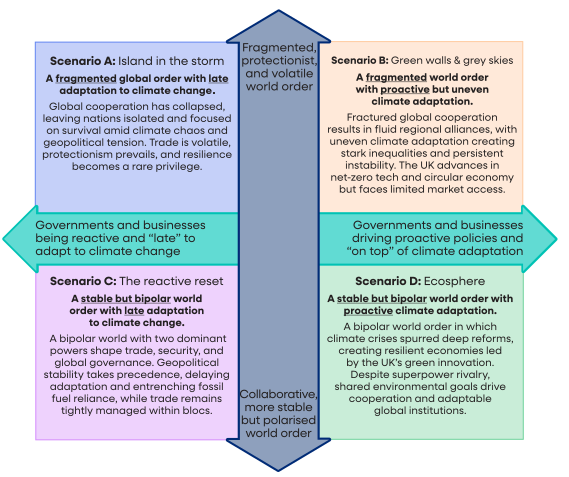
Alt text: Four future supply chain scenarios combining geopolitics and climate responses.
The diagram above is divided into four coloured quadrants, with a vertical arrow indicating a spectrum from a “Collaborative, more stable but polarised world order” at the bottom to a “Fragmented, protectionist, and volatile world order” at the top. A horizontal band highlights approaches to climate adaptation, ranging from reactive and late adaptation on the left to proactive, “on top of” adaptation on the right. Top-left (Scenario A: Island in the storm) describes a fragmented global order with late climate adaptation, where cooperation has collapsed, protectionism dominates, and resilience is limited. Top-right (Scenario B: Green walls & grey skies) shows a fragmented but proactively adapting world, with uneven regional alliances, climate progress alongside inequality and restricted market access. Bottom-left (Scenario C: The reactive reset) illustrates a stable but bipolar world with late adaptation, where two dominant powers shape trade and governance, delaying climate action and reinforcing fossil fuel reliance. Bottom-right (Scenario D: Ecosphere) presents a stable, bipolar world with proactive climate adaptation, where reforms and green innovation drive resilience and some cooperation despite rivalry. The diagram highlights contrasting combinations of geopolitical order and climate response and their implications for global supply chains.
Figure 13: Radar diagram showing how scenarios differ across trade, geopolitical, and climate dimensions using 6 headline metrics
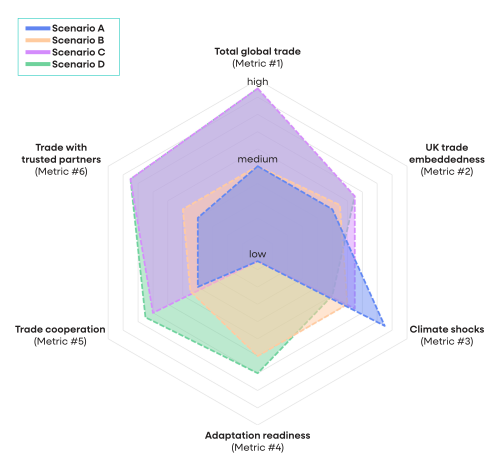
Alt text: Scenario comparison across trade, geopolitical and climate metrics.
In the chart above, four coloured shapes represent Scenario A (blue), Scenario B (orange), Scenario C (purple), and Scenario D (green). The six axes are total global trade, UK trade embeddedness, climate shocks, adaptation readiness, trade cooperation, and trade with trusted partners, each labelled from low to high. Scenario C reaches high values across most metrics. Scenario D also performs strongly on cooperation, adaptation readiness, and trusted partners. Scenario B sits around medium across all dimensions. Scenario A peaks at high climate shocks but is low on adaptation readiness and lower on most other metrics, creating a more uneven profile.
The table below summarises key headlines from each scenario for a comparative overview of major variables and consequences.
Table 3: Comparative summary of key headlines of all 4 supply chain scenarios
| Scenario A | Scenario B | Scenario C | Scenario D |
|---|---|---|---|
| Forces in motion: Key drivers reshaping the landscape | |||
| Highly fragmented trade, dominated by nationalism; climate disasters disrupt supply chains; Arctic resource tensions. | Fragmented trade shifts alliances; uneven climate adaptation drives migration and competition; Arctic competition grows. | Bloc-based trade; climate disasters intensify with weak adaptation; Arctic resources become a contested flashpoint for leverage. | Bloc-aligned trade supports climate goals; adaptation mitigates hazards; Arctic access remains collaborative. |
| Rules and frictions: How trade is channelled or constrained | |||
| Global standards collapse; fragmentation and politicised access drive costs, delays, and strain near-market trade. | Weak global standards; fragmentation drives costs; near trade is stable but constantly renegotiated. | Bloc-aligned rules ease internal trade; resource-rich nations wield disproportionate influence. | Reformed bloc standards widen access; strong near‑market trade; resources via recycling. |
| Networks and flows: Routes, logistics, and supply reliability | |||
| Climate and conflict disrupt routes; resilient nearshored supply chains stay volatile. | Open but costly routes; resilient nearshored, circular supply chains remain volatile. | Friendshoring dominates; bloc loyalty and climate damaged ports reshape shipping routes. | Resilient infrastructure; decentralised, circular, AI‑driven supply chains with diversified sourcing. |
| The UK at home: Public mood and priorities | |||
| Affordability prioritised over adaptation; social unrest over shortages and export controls. | Public backs green goals but fears inequality; cities thrive, rural areas decline. | Public backs bloc loyalty; slow adaptation as climate strains infrastructure. | Strong public backing for climate policies; resilience grows through UK tech and circularity. |
| Strategic choices and pathways: Where the world is headed and where UK value is created and exposed | |||
| High-emissions path; hardened geopolitics shrink UK opportunities amid trade losses | Medium-emissions path; uneven adaptation fiels tensions and limits UK options | Medium-emissions path; stability prioritised; blocs hold order as UK leads adaptation tech through circularity | Low-emissions path; aligned climate goals ease tensions as UK leads green innovation |
5.2 Our scenarios in detail
Scenario A – “Island in the storm”
A fragmented global order with late adaptation to climate change
Figure 14: Visual for scenario A
Alt text: Visual of a fragmented, climate‑vulnerable world with disrupted infrastructure and supply chains.
The visual for Scenario A, “Island in the storm”, illustrates the defining features of a fragmented, volatile world with late climate adaptation. A dense urban and industrial landscape is shown in cool blue tones, combining high-rise city buildings, factories with smokestacks, roads with traffic, and container shipping areas. Cracks and fractures run across the entire scene like breaking glass, symbolising geopolitical fragmentation and disruption. On the left, a suburban neighbourhood with houses and parked cars is partially submerged in floodwater, indicating climate impacts and inadequate resilience. Across the city, industrial zones emit pollution, reinforcing environmental strain. Transport and logistics elements, including trucks, a cargo ship, stacked containers, and an aircraft, appear disrupted or disconnected across the fractured terrain. The composition conveys isolation, instability, and weakened global cooperation, with infrastructure and supply chains fragmented across the scene, reflecting a world where countries operate independently under stress from both climate shocks and geopolitical tensions.
How we created this scenario
We created this scenario by assuming a world where political fragmentation and geopolitical volatility increase, while action on climate adaptation remains late and reactive. Experts involved in the process felt it was plausible that global governance could weaken significantly, with trade rules and alliances shifting frequently and global coordination as we know it today breaking down. They suggested that in such a world, adaptation measures would often follow crises rather than anticipate them, leading to higher costs and greater disruption. Although this creates significant risks for supply chains, our experts noted that it could also drive innovation in resilience and local production in some sectors. This combination of axes means that by 2040, supply chains are shaped by uncertainty, protectionism, and uneven access to critical resources, with resilience becoming a rare privilege for some rather than a shared goal.
Snapshot: What it feels like to live in this world
By 2040, the world is defined by extreme fragmentation, crisis-driven governance, widespread climate disasters in the face of climate instability, and instances of breakdown of social institutions. Global cooperation has broken down as nations prioritise their own supply chains, security, and survival in the face of escalating geopolitical tensions and worsening environmental pressures. The UK, like many nations, finds itself increasingly isolated, struggling to maintain access to critical imports and secure its economy amidst volatile global markets. Protectionism dominates international trade, while key production and transport routes are frequently disrupted, leading to shortages, widespread social unrest, collapsing social services, and economic and social instability. Many of these trends have roots in today’s world, from rising protectionism and trade weaponisation to increasingly extreme climate events, but by 2040 they have hardened into a new, even more volatile normal. In this world, trade relationships are volatile, resources are hoarded, and resilience is a privilege rather than a shared goal.
Metric headlines[footnote 10]
Figure 15: Radar diagram with six headline metrics for scenario A – Island in the storm
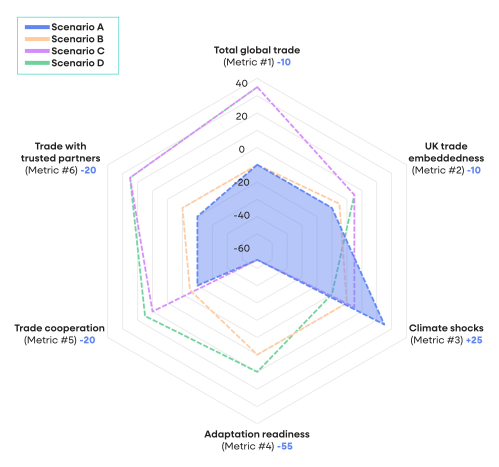
Alt text: Scenario A shows high climate shocks and low adaptation and cooperation.
In the radar diagram above, the blue shaded area represents Scenario A across six axes: total global trade (around -10), UK trade embeddedness (-10), climate shocks (+25), adaptation readiness (-55), trade cooperation (-20), and trade with trusted partners (-20). The shape is uneven, with its highest point at climate shocks and its lowest at adaptation readiness. Additional faint outlines show other scenarios for comparison.
Table 4: Key factor summary and implications for trade and supply chains for scenario A – Island in the storm
| Key factor | Implications for trade under scenario A – Island in the storm |
|---|---|
| Forces in motion: Key drivers reshaping the landscape | |
| 1. Global trade landscape | Highly fragmented and unstable, dominated by protectionism, shifting alliances, and economic nationalism. Global trade frameworks and multilateral organisation have lost relevance or collapsed. |
| 2. Climate impacts | Severe and frequent climate disasters disrupt global food production and supply chains, driving price spikes, food insecurity, and cascading trade shocks. |
| 3. Climate adaptation | Reactive and fragmented, Governments and businesses respond only after crises hit, with limited planning or coordination. |
| 4. The Arctic | Strategic resource hotspot, driving competition over shipping routes and critical resources, heightening geopolitical tensions. |
| Rules and frictions: How trade is channelled or constrained | |
| 5. Global standards alignment | Minimal to none, WTO and UN mechanisms have collapsed, and it is challenging to align environmental or trade standards. |
| 6. Regulatory environment | Divergent and uncoordinated, countries adopt conflicting regulations, increasing bureaucracy, compliance costs, and delays across markets. |
| 7. Near-market trade dynamics | Continues but strained, Trade with nearby markets continues due to proximity but faces higher costs, delays, and regulatory divergence. |
| 8. Access to critical resources | Highly constrained and politicised, semiconductors, medicines, and fertilisers, etc. are controlled by dominant economies and weaponised. |
| Networks and flows: Routes, logistics, and supply reliability | |
| 9. Transport & logistics | Severely disrupted by climate disasters, damaged infrastructure, and regional conflicts. Key ports and routes are frequently inaccessible. |
| 10. Supply chain strategy | Focused on resilience over efficiency, nearshoring, diversification, and redundancy replace just-in-time models, varying by sector, but still face volatility and resource constraints. |
| The UK at home: Public mood and priorities | |
| 11. Public attitudes | Shifted away from sustainability, net zero goals are deprioritised amid inflation and social unrest. Affordability trumps long-term planning. |
| 12. Climate impacts in the UK | High demand for adaptation goods outstrips supply, with tariffs and export controls limiting access. |
| Strategic choices and pathways: Where the world is headed and where UK value is created and exposed | |
| 13. Climate mitigation outlook | High emission pathway – Low investment in renewable energy and other technology to meet net zero goals. Governments and business prioritise traditional economic measures for growth. |
| 14. Climate-driven geopolitical trends | Escalating climate shocks harden geopolitics, fuelling export controls, ad‑hoc bloc formation and route disruptions; critical minerals and food inputs are increasingly weaponised, amplifying volatility for the UK’s trade‑dependent sectors. |
| 15. UK opportunities | Limited and sector-specific, e.g. potential in vertical farming, flood resilience tech, and local manufacturing, but insufficient to offset trade losses. |
Forces in motion: Key drivers reshaping the landscape
1. Geopolitical fragmentation drives global power struggles. Global governance has eroded, leaving nations to fend for themselves. Armed conflicts over scarce resources, particularly food and water, have intensified, and transactional alliances shift frequently based on short-term interests. The multilateral world order has broken down, giving way to a fragmented system of multipolar, frequently shifting alliances. International security treaties have collapsed, and military spending is at record levels. Longstanding institutions, such as the WTO and the UN, have lost relevance or been abolished, dismantling multilateral trade frameworks and conflict resolution mechanisms, deepening global instability and increasing trade friction.
2. Climate pressures arise as systemic drivers Increasing climate extremes (e.g. high temperatures and extreme rainfall events) and biodiversity loss disrupt global food production, as crops optimised to the previous climate become less high-yielding. Droughts weaken plants, increasing pest vulnerability, and harvest failures hit the world’s poorest hardest as prices spike, fuelling chronic food insecurity and famine risk. Severe climate disasters trigger cascading supply chain failures in critical breadbasket regions and disrupt production from palm oil to microelectronics, reducing global availability and inflating prices. Limited reserves and poor planning push staple prices sharply upwards, fuelling geopolitical tensions and protectionist export restrictions, amplifying shocks elsewhere.
3. Failure to adapt deepens systemic fragility. The failure to actively pursue climate resilience has caused widespread disruptions across various sectors and countries. Geopolitical fragmentation results in high costs for climate adaptation technologies, such as flood defences and energy storage, further limiting efforts to minimise impacts from climate change. There is limited coordinated international response to humanitarian disasters, causing further instability as affected countries try to recover.
4. Arctic flashpoint drives resource competition. Access to critical minerals and materials for adaptation and energy transition is increasingly constrained by fractured supply chains and rivalries. As sea ice thins and seasonal navigability improves, Arctic states assert greater control over the Northern Sea Route and surrounding resources, reshaping trade dynamics and intensifying competition over untapped oil, gas and critical minerals. Rather than cooperation, climate-induced Arctic change amplifies brinkmanship and contributes to armed tensions in border regions, amplifying power struggles and adding a new layer of tension to an already fragile international order.
Rules and frictions: How trade is channelled or constrained
5. Fragmented rules dismantle predictability. The collapse of multilateral institutions leaves the UK and others without formal recourse in trade disputes, making supply chains vulnerable to coercion, price spikes, and abrupt embargoes. Trade becomes highly politicised. The lack of any agreed international standards regime leads to inefficiencies, especially for small and medium enterprises.
6. Divergent rules drive cost and delay. Countries adopt distinct and often conflicting regulations, raising compliance costs and delaying market access, for example, medical devices or electrical goods must meet different safety and sustainability standards in each market, increasing bureaucracy for exporters. Countries frequently shift their trade policy, requiring constant agility from government and businesses alike.
7. Protectionist strategies amplify shocks. Near-market trade continues due to proximity, but trade is increasingly expensive and inefficient due to diverging policies and border delays. Producer nations frequently impose export restrictions to shield domestic populations from shortages, amplifying shocks elsewhere. The UK is struggling to navigate unpredictable global markets to secure essential imports.
8. Critical minerals become weaponised as political leverage. Access to critical raw materials is severely constrained. Dominant economies control essential inputs like semiconductors, pharmaceuticals, and fertilisers, using them as political leverage. The collapse of multilateral institutions leaves the UK without formal recourse, making supply chains vulnerable to coercion, price spikes, and abrupt embargoes. Efforts to substitute or localise supply remain insufficient, particularly in sectors where the UK has long relied on imports. This leaves the UK exposed in critical areas such as defence, technology, health, and food, with severe national security and prosperity risks. Restrictions on critical minerals also slow down climate adaptation efforts, which have been strategically deprioritised in favour of immediate security concerns.
Networks and flows: Routes, logistics, and supply reliability
9. Transport chokepoints become chronic vulnerabilities. Global trade is fractured and unreliable, with little preparation for route disruptions from increasingly intense storms, rising sea levels, and droughts. Some key seaports suffer significant damage, with others restricting vessel size. Key ports and shipping routes are targeted in ongoing conflicts, regularly making certain routes unusable. Heavy silt build-up through intense inland rainfall and storm damage at the Port of Felixstowe reduce capacity, while the Suez Canal faces routine closures due to regional tensions and adverse weather events (e.g. high wind and sandstorms), increasing the risk of ship blockages.
10. Supply chains prioritise survival over efficiency. Severe flooding, heatwaves, and erratic growing seasons cut UK food output, increasing reliance on fragile imports. Rising climate disasters and public pressure push businesses from “just‑in‑time” to resilience‑first models: selectively onshoring sensitive nodes, nearshoring to trusted partners, building dual sourcing for critical inputs, and carrying more buffer stock in regulated sectors (e.g. health). Targeted on- and near-shoring where exposure is highest (medicines, defence‑grade materials, grid equipment) avoids the challenges of blanket reshoring (shrinking trade and GDP while not necessarily improving resilience) and is complemented by supplier diversification, redundancy across tiers, and renationalisation of key industries, varying by sector. Companies avoid overreliance on any single region or supplier where possible, but for some products there are minimal options. Volatility and frequent shifts in trade policy make strategic planning difficult.
The UK at home: Public mood and priorities
11. Social strain erodes climate ambitions while climate disasters increase social unrest. Persistent supply chain breakdowns, inflation, and rationing leave households struggling to secure basic goods. Empty shelves and prolonged shortages fuel food and health insecurity, as essential items, such as medicines, fuel, and fresh food, are becoming scarce. Public services, including schools and hospitals, lack staff and equipment, and infrastructure remains broken for months. Violent protests over food, energy, and inequality erupt frequently, stretching law enforcement and eroding trust in government. Communities fracture along economic and regional lines, with wealthier areas hoarding resources while poorer regions face chronic deprivation. Public support for climate policy has significantly decreased, with many abandoning longer-term environmental goals to prioritise short-term affordability and subsistence. Businesses reduce their climate ambitions, pushing adaptation off the political agenda worldwide.
12. Adaptation demand outpaces supply. There is a high demand for goods for climate change adaptation. For example, the UK needs goods for flood management, heat resilience, and smart grid systems for energy resilience. Demand outpaces supply. Countries which produce products and services for climate adaptation use tariffs and export controls to support domestic industries.
Strategic choices and pathways: Where the world is headed and where UK value is created and exposed
13. Short-term fixes undermine long-term climate security. Despite increasing climate disasters, fragmented geopolitics and persistent climate crises have shifted the focus of many countries, including the UK, towards immediate disaster response. This approach diverts resources and attention away from long-term climate adaptation and emissions reduction. As access to critical minerals needed for large-scale climate adaptation is heavily constrained by fractured geopolitics, many lower-income countries are left dangerously exposed to escalating climate impacts, with limited capacity to respond. This global focus on short-term relief over strategic climate action, combined with a continued high-emission trajectory, is profoundly dangerous, locking in the prospect of more extreme and frequent climate hazards in the decades ahead and driving intensifying competition for scarce resources.
14. Geopolitics and climate risks become entangled as shocks intensify. Climate disasters cascade through food, energy, and technology supply chains, prompting coercive geo‑economic tools. Climate‑linked chokepoint disruptions (e.g. Red Sea/Suez rerouting; Panama Canal drought) lengthen voyages and spike prices, while rising export curbs on raw materials and fertilisers fragment markets. High concentration in critical‑mineral processing enables weaponised interdependence, from rare earths and battery metals to semiconductor inputs, driving short‑lived trade alliances and friend‑shoring at multilateralism’s expense, with the Arctic a strategic flashpoint for resources. For the UK, this means more frequent shocks to pharmaceutical precursors, fertilisers and semiconductor components, tighter standards divergence, and reliance on redundant suppliers and alternative routes to recover disrupted supply.
15. UK opportunities are targeted but niche and scarce. Nearshoring, renationalisation and diversification strategies are widespread but uneven: aerospace is constrained by certification and long lead times, other sectors adjust faster. Opportunities are scarce, but the UK makes targeted investments in specific manufacturing industries and processes to reduce dependence on volatile global supply chains. Niches emerge for innovation, such as urban vertical farming or community‑level renewables, as well as some new opportunities to introduce products that previously weren’t suited to the UK climate, such as olives, grapes, and oranges. However, investment efforts and novel production are insufficient to fully offset losses from disrupted trade, especially where the UK traditionally relies on imports, such as pharmaceuticals, advanced technologies including clean energy systems, high‑end optics, telecoms, defence, and aerospace technologies.
Scenario B – “Green walls, grey skies”
A fragmented world order with proactive but uneven climate adaptation
Figure 16: Visual for scenario B
Alt text: Visual of a fragmented world with uneven climate adaptation and ongoing environmental pressures.
The visual for Scenario B, “Green walls, grey skies”, is a bespoke illustration representing the defining features of uneven but proactive climate adaptation in a fragmented global system. The scene shows a dense urban and industrial environment with tall city buildings, factories emitting smoke, transport infrastructure, and busy shipping waterways. Grey skies and visible air pollution dominate, with emissions rising from multiple industrial sites. At the same time, there are pockets of green adaptation, including buildings fitted with solar panels, tree-lined streets, and areas of managed woodland, illustrating progress that is unevenly distributed. Some neighbourhoods appear modern and climate-adapted, while others remain exposed. In the upper-right, a residential area is surrounded by floodwater, showing ongoing climate impacts despite adaptation efforts. Across the city, groups of people are visibly gathered and moving through streets and open areas, including large concentrations near buildings and in open spaces, indicating displacement and the presence of climate refugees. Temporary-looking shelters and crowded zones suggest pressure on infrastructure and services. Cargo ships, trucks, and an aircraft highlight continued but constrained global trade. The overall composition conveys a fragmented world where climate action is proactive but uneven, combining environmental progress with persistent pollution, inequality, and widespread human displacement.
How we created this scenario
We created this scenario by assuming a world where global governance fragments, but climate adaptation becomes proactive. Experts involved in the creation process considered it plausible that multilateral institutions could weaken significantly, forcing nations into bilateral or regional arrangements, creating persistent trade volatility. In such a world, climate adaptation would advance in some regions through innovation and investment, as well as circular economy practices, while others would lag due to resource constraints and conflict, leading to stark inequalities. This uneven progress was seen as a driver of geopolitical tension, migration pressures, and competitive behaviour over critical resources. Although this scenario introduces risks of inefficiency and supply chain strain, our experts noted that it could also accelerate breakthroughs in circular economy models and net-zero technologies in regions with strong governance and technical capacity.
Snapshot: What it feels like to live in this world
By 2040, the world is shaped by regional resilience and insular climate adaptation. Some proactivity exists, but it is unevenly distributed, creating stark inequalities, which fuels further conflict. Global cooperation is fractured, replaced by fluid trade alliances shifting with political interests. The UK plays an active role in climate discussions but remains outside any stable alliance, navigating a landscape of constant renegotiations after the collapse of multilateral institutions. Adaptation efforts vary widely, and innovations are rarely shared, leading to inefficiencies. The roots of this world lie in today’s retreat from multilateralism and increasingly regionalised trade patterns, with diverging approaches to climate mitigation and adaptation resulting in less coordination and overall inefficiencies. By 2040, those dynamics have solidified, producing a world of partly functional but fragmented and uneven progress.
Metric headlines[footnote 11]
Figure 17: Radar diagram with six headline metrics for scenario B – Green walls, grey skies
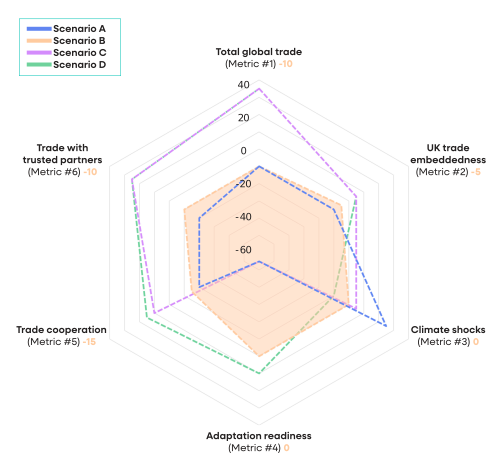
Alt text: Scenario B shows moderate performance across all metrics with limited cooperation.
In the radar diagram above, the orange shaded area represents Scenario B across six axes: total global trade (around -10), UK trade embeddedness (-5), climate shocks (0), adaptation readiness (0), trade cooperation (-15), and trade with trusted partners (-10). The profile is relatively even and centred around the middle, with no strong positive peaks and slightly lower scores in cooperation and trusted partnerships. Faint outlines of other scenarios are visible for comparison in the background.
Table 5: Key factor summary and implications for trade and supply chains for scenario B – Green walls, grey skies
| Key factor | Implications for trade under scenario B – Green walls, grey skies | ||
|---|---|---|---|
| Forces in motion: Key drivers reshaping the landscape | |||
| 1. Global trade landscape | Fragmented with fluid alliances, trade policy frequently shifts, and multilateral frameworks are absent. | ||
| 2. Climate impacts | Uneven adaptation alongside increasing climate hazards drive inequality, migration, and supply chain shocks; vulnerable regions face repeated disasters and existential risks. | ||
| 2. Climate adaptation | Proactive but uneven, resource scarcity and trade limits widen gaps between resilient and at‑risk nations. | ||
| 4. The Arctic | Strategic bargaining chip, states leverage access to oil, gas, and minerals, deepening global power imbalances. | ||
| Rules and frictions: How trade is channelled or constrained | |||
| 5. Global standards alignment | Weak, innovations are not widely shared | ||
| 6. Regulatory environment | Divergent and uncoordinated, countries adopt conflicting regulations, increasing bureaucracy, compliance costs, and delays across markets. | ||
| 7. Near-market trade dynamics | Near trade is relatively stable, but the lack of wider global frameworks results in constant renegotiations | ||
| 8. Access to critical resources | Highly constrained and politicised; semiconductors, medicines, and fertilisers, etc. are controlled by dominant economies and weaponised. | ||
| Networks and flows: Routes, logistics, and supply reliability | |||
| 9. Transport & logistics | Ports are protected individually, some routes remain accessible, but high conflict zones raise costs and delay goods. | ||
| 10. Supply chain strategy | Resilience-focused but reactive, persistent strain from resource scarcity, shifting trade policies, and regional conflict. Nearshoring and circular economy mediate some impact, but volatility remains high. | ||
| The UK at home: Public mood and priorities | |||
| 11. Public attitudes | Citizens generally support environmental goals, but concerns grow over inequality, migration, and national resilience. | ||
| 12. Climate impacts at home | Urban tech and circular economy thrive; rural areas decline as adaptation investment concentrates in cities. | ||
| Strategic choices and pathways: Where the world is headed and where UK value is created and exposed | |||
| 13. Climate mitigation outlook | Medium emissions pathway - Proactive but uncoordinated, advanced in some regions (e.g. UK, Germany), limited in others due to resource constraints and conflict. | ||
| 14. Climate-driven geopolitical trends | Uneven adaptation and resource competition fuel shifting alliances, as climate shocks and critical mineral scarcity reshape the UK’s web of international relations and supply chain risks. | ||
| 15. UK opportunities | Strong in net-zero tech, circular economy, and synthetic foods, but progress is hindered by limited market access and global instability. |
Forces in motion: Key drivers reshaping the landscape
1. Geopolitics splinters into short-term deals. Power is spread amongst various countries, with rising global tensions and frequent shifts in trade alliances. Broad multilateral agreements have lost significance, and the UK finds itself needing to constantly renegotiate its position and access. Trade relationships are governed by short-term political interests and strategic necessity rather than long-term frameworks.
2. Climate-induced global inequality drives migration. In this world, climate hazards are met with an uneven distribution of adaptation capacity, fuelling geopolitical instability and limiting global production capacity. Recurring harvest failures in breadbasket regions threaten global food production, and more frequent extreme weather impacts resource availability. Some already arid, water‑stressed, low‑lying island and coastal regions are nearing adaptation limits, facing repeated disasters, economic stagnation, and in some cases existential threats. Cross-border and internal displacement increases as populations seek more habitable land and resilient regions. Food and mineral supply chains remain under pressure, with regular price shocks for grains and strategic commodities, often exacerbated by conflict in key regions.
3. Climate adaptation cushions some but does not cure. Proactive adaptation across many regions reduces the severity of climate impacts in key sectors. Investments in water management, resilient infrastructure, and urban planning have minimised some of the worst effects, but adaptation is uneven and varies by geography, governance capacity, and resources. Any climate ambition collides with geopolitically induced resource scarcity, as fragmented trade limits access to raw materials, making imports expensive. As raw materials become increasingly critical, especially for climate adaptation technologies, resource-rich nations gain strategic importance and use protectionist measures to maintain their advantage and supply, limiting global climate efforts. Since access and distribution are unequal, climate adaptation progresses to varying degrees: richer nations and those with less vulnerable geographies develop advanced technologies to moderate hazards, while more at-risk countries prove increasingly unable to adapt to the direct threat posed to human habitability.
4. The Arctic emerges as a strategic bargaining chip. Despite some local innovation, reliance on extractive industries and fossil fuels persists, particularly in regions facing energy insecurity or limited access to clean technologies. Rapid warming continues to thin sea ice, making the Northern Sea Route navigable for longer portions of the year and improving access to untapped oil, gas, and critical mineral reserves. States with Arctic coastlines use their dominance over these routes and resources to broker favourable trade deals and secure leverage over supply chains vital to global industries. In a fragmented geopolitical landscape, control over the High North becomes a bargaining chip shaping alliances and trade flows, deepening global power imbalances in an increasingly climate-stressed world.
Rules and frictions: How trade is channelled or constrained
5. Trade as political leverage slows down innovation. The absence of multilateral enforcement mechanisms, such as through the WTO, means trade disputes are difficult to resolve, and retaliatory measures are the norm. While this fosters some regional innovation, it also creates barriers to technology transfer and slows overall progress toward global climate goals. Licensing restrictions, retaliatory policies, and protectionist measures disrupt global collaboration, limiting the sharing of innovations.
6. Divergent standards multiply trade friction. In a fragmented global context without strong multilateral institutions, regulations diverge sharply. Whilst some countries have been proactive with climate adaptation to varying degrees, there has not been a coordinated approach, and with trade policies in perpetual flux challenging stable alignment with countries or regions, divergences in environmental legislation and standards are constantly increasing. This leads to trade frictions and higher costs as companies need to comply with different rules and standards in different markets.
7. Trade without multilateral safety nets intensifies strain. While the UK maintains relatively stable trade with nearby countries, the absence of multilateral mechanisms forces the UK to negotiate trade deals on a nation-by-nation basis, with high transaction costs and diplomatic effort. Trade is increasingly used as a tool of leverage, and policy volatility creates uncertainty for investors and businesses.
8. Critical minerals become politicised and scarce. Raw materials, especially critical minerals, are unevenly distributed and often difficult to access due to protectionist trade measures. Strategic resources are increasingly controlled by countries prioritising national security or regional advantage, resulting in frequent price shocks and supply volatility. The UK and its partners invest in circular economy practices to mitigate some of these challenges, enabling a degree of resilience in key priority areas, such as national security or critical infrastructure, but access to strategic inputs remains a key vulnerability, especially where licensing and IP disputes limit technology transfer.
Networks and flows: routes, logistics and supply reliability
9. Ports hold firm, but routes grow risky. Most maritime routes remain open but volatile due to conflict. Countries protect port infrastructure individually, yet high‑risk corridors raise costs and delays. Freight insurance has more than doubled near the Red Sea and Gulf of Guinea and some firms avoid the Bab el‑Mandeb entirely, opt for air freight, or divert around the Cape of Good Hope, increasing costs and lead times. The lack of coordinated action prolongs downstream impacts.
10. Volatility keeps UK trade on shifting ground. The UK’s trade strategy is in constant flux, shaped by global volatility and limited multilateral alignment. Supply chains are under constant resource constraints, shifting trade policies, and regional conflict. Fragmentation and protectionism result in nearshoring and friendshoring to trusted markets. The UK invests in circular economy levers, advanced recycling, design‑for‑repair, and urban mining to ease pressure on scarce inputs and shorten exposure‑prone links. Yet because mineral processing and many upstream nodes remain highly concentrated and export restrictions have surged, price and supply risks persist despite regional diversification. Where multilateral alignment is weak, firms face friction and hedge with redundant supplier bases, multi‑route logistics, and buffer inventories for (climate‑) critical components (grid equipment, storage systems, semiconductors). The net effect is a resilience-focussed but reactive supply chain strategy, where near trade continues and softens shocks, but accessing critical goods from farther afield is difficult and volatile.
The UK at home: public mood and priorities
11. Climate ambition meets inequality anxiety. The UK public support climate adaptation, seeing benefits from a proactive approach, but concerns grow over inequality and economic vulnerability. They also support decarbonisation, recognising economic opportunities and resilience benefits. Public opinion on immigration remains divided. Migration pressures and perceived inequality across the country lead to political tension, especially in rural areas. The UK has also taken steps to protect biodiversity, enabling some resilience to pests and diseases, but these fail to offset shortages caused by global shocks and conflicts. While UK quality of life remains stable, concerns over long-term security and global instability persist. National policy focuses on technological innovation, urban sustainability, and resource resilience, while trade shocks test public trust.
12. Adaptation inequalities spur both gaps and innovation. The UK’s adaptation strategy prioritises self-sufficiency through technology and sustainable production. With supply chains under constant strain, rural regions suffer economic decline as investments concentrate in urban centres. Cities embrace vertical farming, renewable energy, and circular economies. For instance, circularity is embedded in UK policy through urban mining programmes, national repair mandates, and closed-loop manufacturing systems, reducing exposure to international material shocks.
Strategic choices and pathways: Where the world is headed and where UK value is created and exposed
13. Circularity underpins resilience amid medium emissions. The UK is making some progress on net-zero targets, but global emissions stay on a medium-level trajectory without international coordination. In a fragmented world, circular economy measures, such as advanced recycling, closed-loop manufacturing, and resource-efficient production, reduce reliance on scarce imports and support sustainability. Strong consumer demand, regulation, and geopolitics drive European innovation in decarbonisation, with renewable investment spurred by energy security concerns. Yet uneven climate leaves the world’s most vulnerable regions exposed to escalating hazards, threatening livelihoods, while fragmented governance hampers coordinated mitigation and adaptation. This path risks fuelling a competitive scramble for critical resources and deepening divides between regions able to invest in resilience and those left increasingly exposed.
14. Fragmented adaptation, shifting alliances, and resource competition reshape UK risks. Uneven climate adaptation amid fragmented governance leaves the UK navigating shifting alliances and rivalries. Shocks, from crop failures to extreme weather, amplify instability, fuel displacement toward better‑adapted regions, and spur short‑lived trade alliances. Climate‑exacerbated migration intensifies competition for resources and influence, as countries secure supply chains to buffer domestic pressures. Persistent geopolitical fragmentation raises the risk of moves away from the US dollar as the dominant reserve currency, leaving medium-sized economies like the UK navigating a more complex, multi-aligned global financial system. The Arctic becomes a strategic bargaining chip, with access to routes and critical minerals deepening power imbalances. Resource‑rich nations leverage export controls, and weak multilateral frameworks expose the UK to price volatility, supply disruptions, and diplomatic uncertainty. In this landscape, UK supply chain resilience depends on adapting to rapid trade shifts, managing regulatory divergence, and securing essential inputs.
15. Innovation offers local opportunity but cannot offset global downturn. Opportunities centre on technological innovation. Biodiversity enables breakthroughs in pharmaceuticals and sustainable infrastructure. The UK leads in synthetic foods, advanced renewable energy systems, and circular economic models minimising waste and resource dependency, supporting domestic needs and regional competitiveness. Many countries have developed products and services for climate adaptation, but fewer focus on net zero goals. While no single country dominates globally, the UK has emerged as a leading climate innovator out of necessity, leveraging regulatory and technical strengths. Protectionist measures safeguard nascent industries domestically, and to address concerns of national security, while frequent changes to trade policy internationally create challenges. The UK seeks economic benefit in sustainability sectors where it has a strategic benefit, but progress in the UK and Europe does little to offset worsening conditions elsewhere; widen disparities, and long‑term risks to global stability.
Scenario C - “The reactive reset”
A stable but bloc-dominated world order with late adaptation to climate change
Figure 18: Visual for scenario C
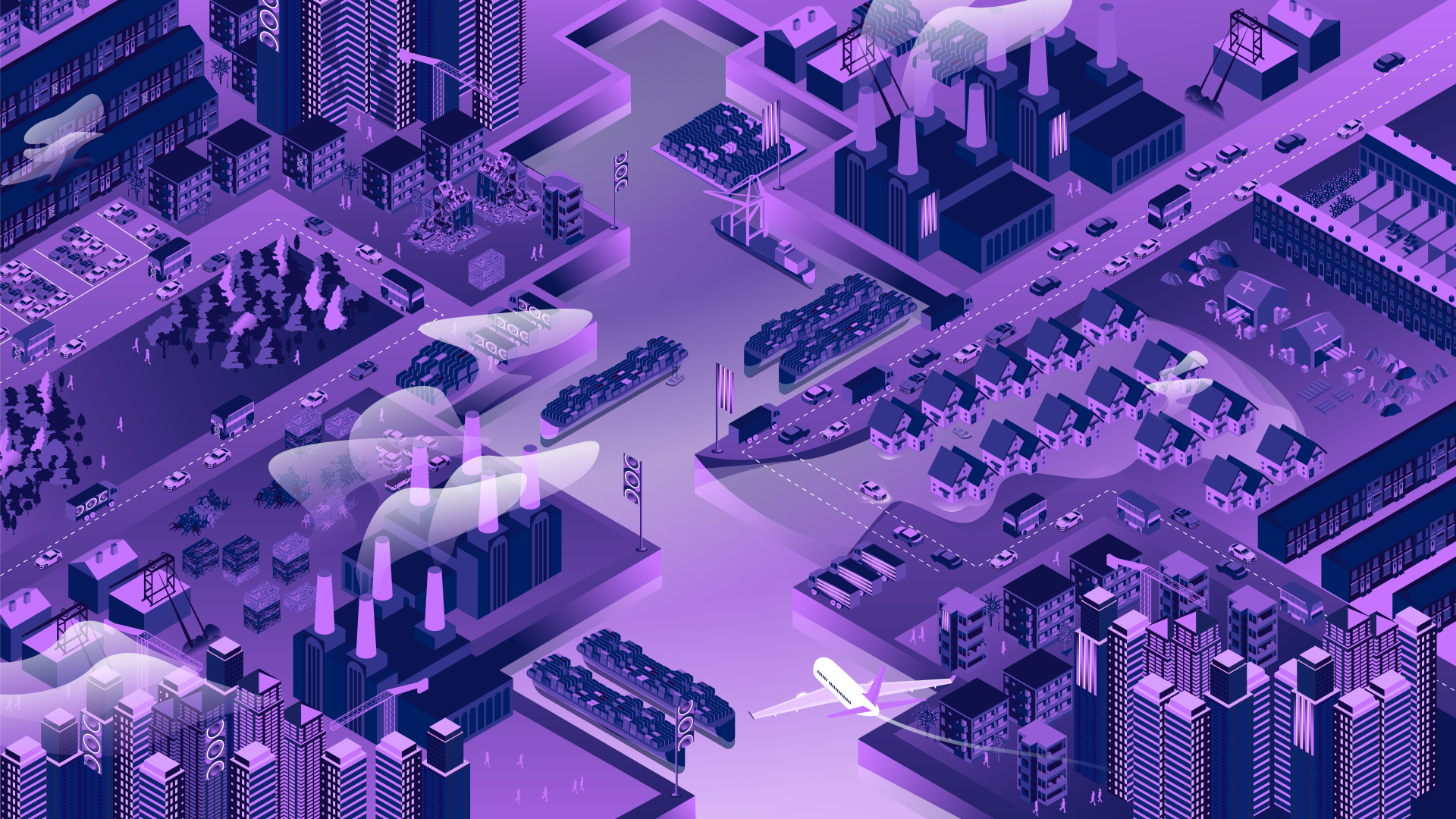
Alt text: Visual of a stable but divided world with delayed climate action and fossil‑fuel reliance.
The visual for Scenario C, “The reactive reset”, is a bespoke illustration representing a stable but bipolar world with delayed climate adaptation. The scene shows a large urban and industrial landscape rendered in purple tones, divided into distinct zones connected by roads, shipping routes, and transport infrastructure. Multiple industrial sites with smokestacks release visible emissions across the scene, indicating continued reliance on fossil fuels. Cargo ships loaded with containers move through waterways, while trucks and cars circulate along busy roads, reflecting active but tightly managed trade. An aircraft travels above the city, reinforcing ongoing global movement. In several areas, infrastructure appears damaged or under strain, including partially collapsed buildings and disrupted urban blocks, suggesting past shocks or crises. Natural spaces such as forested areas remain intact in places, but there is little visible large-scale green innovation or renewable energy deployment. Residential neighbourhoods show orderly rows of houses and apartment blocks, while nearby areas include emergency tents and aid-like structures, pointing to uneven recovery and delayed responses to climate impacts. Overall, the composition highlights a world shaped by two dominant systems, where stability is maintained but climate adaptation is reactive and slow, and supply chains continue operating under constraints and legacy systems.
How we created this scenario
We created this scenario by assuming a world where geopolitical power consolidates into 2 dominant blocs, shaping trade, security, and climate responses. Experts considered it plausible that bloc alignment could become the primary organising principle for global governance, with multilateral institutions weakened but still functional in a limited capacity. They suggested that in such a world, adaptation would increasingly be used as a strategic tool, offered in exchange for resource access or political allegiance. Climate adaptation remains reactive and uneven, as resources are diverted to short-term recovery and bloc priorities rather than systemic resilience. While this bipolar structure provides some stability and rapid disaster response within alliances, it also entrenches global inequalities and politicises access to critical minerals, technology, and shipping routes. Supply chains are shaped by loyalty corridors rather than efficiency.
Snapshot: What it feels like to live in this world
By 2040, the world has 2 dominant spheres of influence which shape global trade. The geopolitical landscape is significantly influenced by the dynamic between these powers. Adaptation to environmental change remains limited, and countries are having to deal with the impacts of climate change reactively. Trade is closely aligned to geopolitics, with trade prioritised between allies, especially in defence. The UK pushes for wider collaboration through existing global forums. While multilateral institutions face challenges in a bipolar world, they also demonstrate resilience and some adaptability in navigating the complex dynamics between the superpowers. Governments prioritise geopolitical stability over climate risks, entrenching reliance on fossil fuels and delaying climate mitigation efforts. Trade deals, regulations, and security agreements are tightly managed within blocs, creating a sense of internal coherence but with rising external friction.
Metric headlines[footnote 12]
Figure 19: Radar diagram with six headline metrics for scenario C – The reactive reset
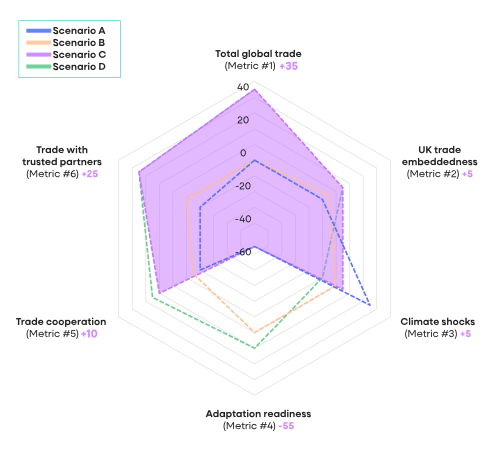
Alt text: Scenario C shows strong trade and cooperation but very low adaptation readiness.
In the radar diagram above, the purple shaded area represents Scenario C across six axes: total global trade (35), UK trade embeddedness (+5), climate shocks (+5), adaptation readiness (-55), trade cooperation (+10), and trade with trusted partners (+25). The shape shows strong positive performance across most trade and cooperation metrics, peaking at trusted partners, but a pronounced drop to very low levels for adaptation readiness. Faint outlines of other scenarios (A, B, and D) appear in the background for comparison.
Table 6: Key factor summary and implications for trade and supply chains for scenario C – The reactive reset
| Key factor | Implications for trade under Scenario C - The reactive reset |
|---|---|
| Forces in motion: Key drivers reshaping the landscape | |
| 1. Global trade landscape | Stable but bloc-based, trade functions well within alliances but is constrained externally by protectionism and rivalry. |
| 2. Climate impacts | Climate disasters intensify, fragile supply chains are exposed, and global South suffers as aid becomes a bargaining chip. |
| 3. Climate adaptation | Reactive and underfunded, adaptation occurs post-crisis, with slow infrastructure improvements and limited coordination. |
| 4. The Arctic | Contested flashpoint, states weaponise resources and vie for control of future Arctic routes to secure bloc leverage. |
| Rules and frictions: How trade is channelled or constrained | |
| 5. Global standards alignment | Cooperation amongst allies is strong. Multilateral institutions play a role in alignment between blocs |
| 6. Regulatory environment | Aligned within blocs, divergence with external powers complicates cross-bloc trade and raises compliance costs. |
| 7. Near-market trade dynamics | Strong, aligned standards and cooperation within the Western bloc (and thus near trade partner) facilitate trade. |
| 8. Access to critical resources | Countries with resources have disproportional influence. Rare earths and green inputs are expensive and strategically managed. |
| Networks and flows: Routes, logistics, and supply reliability | |
| 9. Transport & logistics | Access is restricted by bloc loyalty and climate-related port damage and shifting geopolitics alter shipping routes. |
| 10. Supply chain strategy | Friendshoring dominates, production shifts to trusted partners, reducing flexibility but improving reliability. Stockpiling is avoided. |
| The UK at home: Public mood and priorities | |
| 11. Public attitudes | Climate concern exists, but national strength and defence are prioritised; public discourse downplays environmental urgency. |
| 12. Climate impacts in the UK | Extreme weather strains infrastructure as bloc priorities sideline climate ambitions. |
| Strategic choices and pathways: Where the world is headed and where UK value is created and exposed | |
| 13. Climate mitigation outlook | Medium emissions pathway - Geopolitical stability and adaption prioritised over net zero goals. However, functioning multilateral organisations enables some coordination for net zero. |
| 14. Climate-driven geopolitical trends | Stability is tentatively maintained by blocs but increasing climate hazards without strategic adaptation expose and entrench supply chain vulnerabilities. |
| 15. UK opportunities | Positioned as a leader in adaptation services within its bloc, potential in tech and infrastructure if investment priorities shift. |
Forces in motion: Key drivers reshaping the landscape
1. Global power crystallises into 2 dominant blocs. Global power converges around 2 dominant poles, the Western- and the Eastern-aligned poles. Whilst tensions between the 2 poles of influence are high, the international system is relatively stable, and multilateral organisations, whilst overshadowed by bloc dominance, remain functional, if less influential than they used to be. Both have spheres of influence and strong alliances, and global trade is heavily influenced by these alliances. Conflicts are largely contained to specific regions, and whilst proxy wars occur, conflicts don’t spread globally.
2. Climate hazards expose fragile supply chains. With climate hazards increasing, the lack of adequate adaptation in combination with bloc-led trading arrangements has led to production disruptions in several advanced technologies. For example, extreme droughts in East and Southeast Asia have limited purified water availability for semiconductor fabrication and copper ore processing in key South American mining regions, exposing vulnerabilities throughout high‑tech supply chains. Despite the UK having achieved securing 10% of its critical minerals demand from domestic sources a few years ago, critical mineral supply chains remain vulnerable to global environmental and geopolitical shocks. Adaptation efforts are reactive, often coming only after severe damage, and consequently limited, as resources are often diverted towards immediate recovery following increasing climate disasters. The Global South suffers disproportionately, with relief and adaptation technology used as geopolitical bargaining chips. Powerful blocs offer aid in exchange for resource access or favourable trade terms.
3. Adaptation lags despite rising urgency, and aid becomes leverage for allegiance. In high-income countries, climate adaptation is slow, with infrastructure trailing need, even as increasing climate disasters make it increasingly urgent. Demand for adaptation products and services is growing, but demand outpaces supply and prices are high. Blocs align on standards and targets, but spending priorities, for example, on defence, take precedence, and reliance on fossil fuels persists. A stable but bloc-limited geopolitical context keeps oil prices and energy security stable, limiting clean energy innovation. For the UK, aligned with the Western bloc, this means strategic investment in allied vulnerable countries to secure critical resource supply chains for infrastructure resilience and political loyalty, neglecting to address global systemic risks. Vital regions outside these alliances, such as the breadbasket areas in Northwestern Europe or East Asia, remain underprepared for intensifying hazards, fuelling market volatility and humanitarian crises. After climate-driven supply chain shocks, allied countries coordinate humanitarian responses, but these often serve geopolitical aims, as aid becomes a tool of influence as much as a response to need.
4. The Arctic becomes a contested prize. The Arctic remains a critical geopolitical flashpoint, with its untapped mineral reserves and oil deposits weaponised by neighbouring states to secure bloc allegiance and political leverage. As traditional shipping routes face repeated climate-related port closures, competition to control future potentially navigable Arctic Sea routes is intensifying, further entwining access to this region with global power struggles.
Rules and frictions: How trade is channelled or constrained
5. Cooperation amongst allies is strong, but tensions between blocs make consensus challenging. Regulatory alignment is strong within each bloc, reducing friction for internal trade. Friendshoring is high, with companies withdrawing from ‘risky’ markets in favour of those with shared values and regulatory alignment. International institutions like the WTO still exist and provide structures for dispute mechanisms. However, there are often tensions between blocs in multilateral institutions, making progress slow and consensus challenging.
6. Bloc alignment simplifies some rules, complicates others. Diverging standards across blocs result in barriers for global firms. IP enforcement and environmental standards are politicised. When trading outside the bloc, businesses must navigate different regulations, and prices are often higher due to a lack of preferential access.
7. Friendshoring boosts reliability but raises costs. Being part of the Western bloc, the UK has stable trade relationships with nearby countries, facilitating trade. Trade with the other bloc is challenging, but often necessary to access certain goods. Protectionist measures are targeted at non-ally countries. Targeted tariffs and trade barriers have led to higher costs for some products. This has improved stability but has resulted in higher production costs. While this has improved reliability within blocs, it reinforces global inequality and stifles innovation, particularly where cross-border collaboration is essential for climate adaptation.
8. Neutral states exploit resource leverage. Most countries have aligned with a bloc, driven by security concerns as well as perceived economic benefits. Countries allied with those holding substantial mineral deposits, such as rare earths, lithium, and cobalt, are able to dictate terms and auction off access, leaving the UK and its bloc vulnerable to supply disruptions and strategic dependencies for its critical national infrastructure and adaptation technologies. However, some countries have chosen to remain neutral and benefit from relations with both sides, using their position to maximise their own benefit. Many of these countries are countries with critical minerals. These non-aligned states use their influence strategically, exchanging access to resources in return for infrastructure investment, military guarantees, technological licensing rights, or other benefits.
Networks and flows: Routes, logistics, and supply reliability
9. Climate and geopolitics reroute global shipping. Adverse weather, such as unprecedented tropical storms or low inland water-levels, and rising sea levels, alter shipping routes and heighten vulnerability at maritime chokepoints. Some ports become economically unfeasible, though allies intervene to limit disruptions where possible. Geopolitics compounds this, restricting key channels and ports to allied countries and forcing rerouting to avoid adversarial waters or ports, increasing transit times and costs. Western bloc shipping often relies on longer, less efficient routes via the Cape of Good Hope or Pacific corridors, while strategic rallying for future access to Arctic Sea routes intensifies. Maritime infrastructure is increasingly politicised, with preferred shipping routes effectively functioning as loyalty corridors within bloc. Flooding, coastal erosion, and heatwaves inflate insurance and infrastructure maintenance costs, worsening business conditions. Efforts to bolster infrastructure resilience and protect key industries are reactive rather than strategic, with limited cross-sectors coordination.
10. Supply chains prioritise allegiance over efficiency and bloc rigidity reshapes supply chains. Regulatory consistency reduces friction within blocs, but for the UK, critical minerals, pharmaceuticals, and food supplies have become more expensive due to upstream dependencies. The UK still relies on key imports from both allies and non-aligned nations, especially in critical minerals and pharmaceuticals, driving expense, delays, and shortages when intra-bloc coordination lags. Trade is increasingly shaped by rigid bloc structures, and businesses favour friendshoring from trusted regions. This enhances reliability but reduces flexibility, raising costs. Disruptions are shorter due to the joined-up responses, and trade persists despite rising climate disruption due to the geopolitical alliances. Governments explore targeted strategic reserves in defence, health, and certain critical minerals, while industry instead hedges through redundant suppliers, selective buffers, and surge contracts inside the bloc. Stockpiling is largely avoided. Green supply chain development stalls amid reliance on fossil fuels and slow clean-tech investment.
The UK at home: Public mood and priorities
11. National strength overshadows climate urgency. Public messaging frames climate impacts as isolated crises rather than systemic risks, emphasising defence and economic resilience. Severe weather and infrastructure damage are frequent, but bloc-aligned relief funds cushion the worst effects within allied nations, preventing the collapse seen in more fragmented worlds. Health outcomes decline due to increasingly poor air quality and financial barriers to medicine. Intensifying climate impacts leave populations fearful for the country’s and the planet’s future. Adoption of green technologies, such as electric vehicles, slows as rising living costs deter consumers. While government plans for emissions reduction remain, the rapid and large-scale intervention needed is politically and financially constrained. Public investment prioritises security and economic stability.
12. Businesses retreat from climate goals due to financial pressures. Despite growing evidence of climate risk, political and financial capital is reserved for bloc cohesion and maintaining international competitiveness, not long-term environmental investment. The UK has adopted a reactive approach to climate adaptation, and increasing extreme weather events, such as flooding, extreme heatwaves, and prolonged periods of low rainfall, are putting significant strain on infrastructure and agricultural systems across the country. Geopolitical stability and economic security take priority over climate adaptation and mitigation.
Strategic choices and pathways: Where the world is headed and where UK value is created and exposed
13. Climate ambitions falter under bloc politics. The UK’s sustainability targets are slipping, as trade barriers among non-allied countries impose tariffs on sectors which underpin green industries, especially for critical minerals. Initiatives, such as reforestation and peatland restoration, lag significantly behind schedule. Strategic adaptation funding is increasingly tied to political alignment, leaving vital regions, such as major breadbasket areas, the Amazon rainforest, and climate tipping points in the Arctic, highly vulnerable to escalating hazards. Even where aid is provided, conditions often favour short-term economic gains, undermining global adaptation and mitigation efforts and embedding unsustainable practices. A lack of impartial, coordinated, and strategic international action leaves systemic vulnerabilities unaddressed. Blocs can mobilise quickly for disaster relief to support their allies, politically motivated, ad-hoc efforts risk leaving regions dangerously exposed to intensifying climate extremes. Without a shift towards collaborative and systematic cooperation, adaptation and survival will depend on allegiance rather than collective need, allowing climate hazards to spiral unchecked.
14. Bloc politics shape climate risk and trade resilience. 2 dominant blocs prioritise internal stability and loyalty, while reactive, underfunded climate adaptation leaves global supply chains exposed to escalating hazards. Strategic resources are weaponised to auction access in exchange for political allegiance or economic concessions. The Arctic’s routes and minerals are leveraged for bloc advantage. Friendshoring and regulatory alignment improve reliability but reduce flexibility and raise costs, leaving the UK reliant on expensive imports and vulnerable when intra‑bloc coordination falters. Adaptation aid and disaster relief become tools of influence, widening divides and exposing regions outside major alliances to climate extremes and crises. UK resilience hinges on navigating shifting alliances, managing resource dependencies, and tackling risks that cross bloc boundaries.
15. UK faces narrow opportunities amid global strain. The UK faces only limited openings in a strained, bipolar global system, but strategic opportunities remain within its alliance. As rising climate hazards meet years of under‑investment in preparedness, escalating climate‑related catastrophes force governments into slow, reactive adaptation. This growing demand for resilience and recovery services creates a space for the UK to lead in adaptation expertise and selective mitigation technologies but faces limitations due to restricted critical mineral access. Beyond climate‑focused capabilities, the broader global reset may also open emerging markets where the UK can expand its role in foundational goods and services, reshore or localise production of certain foods and materials, strengthen domestic manufacturing to buffer environmental disruptions, and use its research and innovation clusters to advance renewable technologies. Working with aligned partners could also provide openings into new markets, including those linked to public‑health capabilities and products.
Scenario D - “Ecosphere”
A stable but bloc-dominated world order with proactive climate adaptation
Figure 20: Visual for scenario D
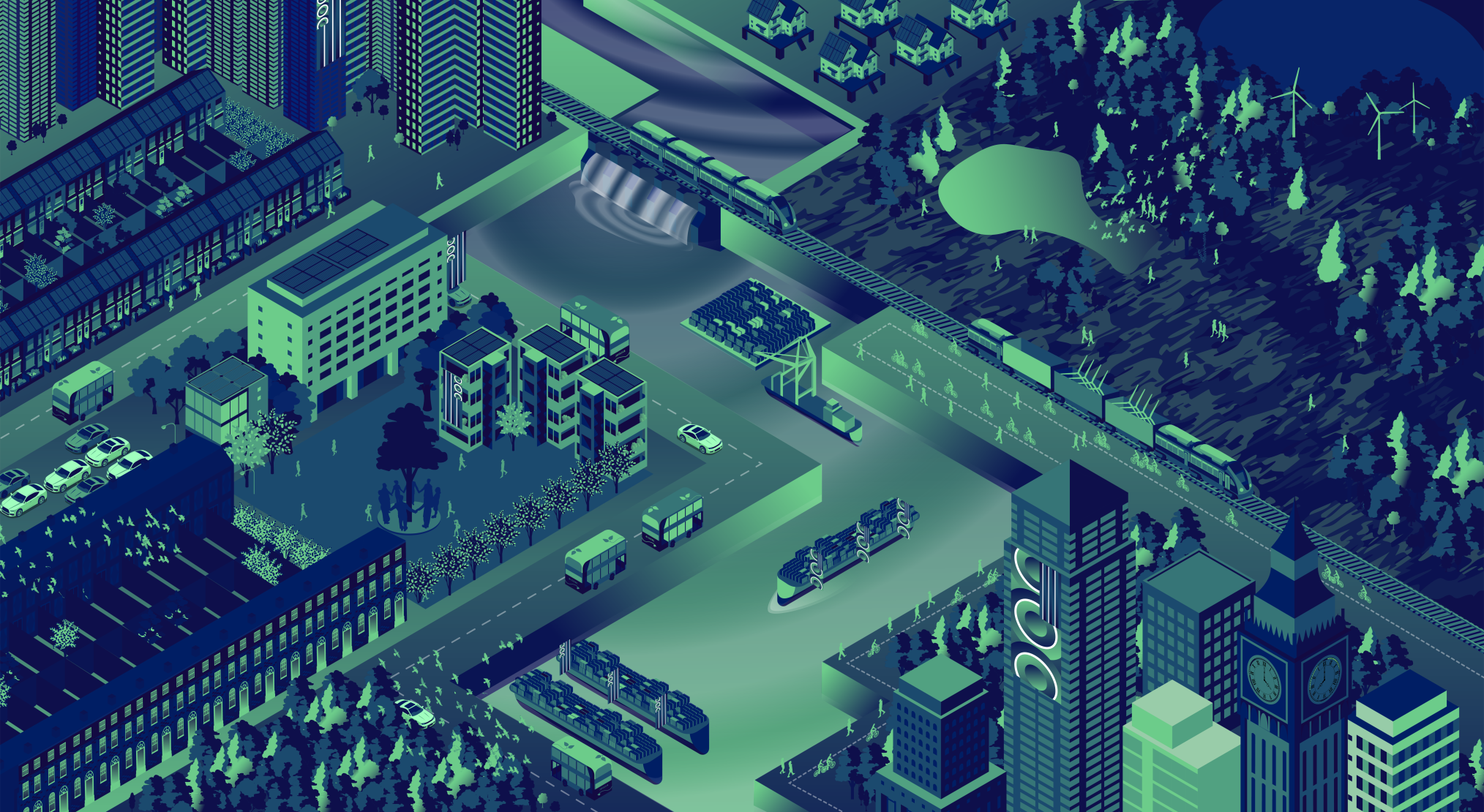
Alt text: Visual of a collaborative world with green infrastructure and proactive climate adaptation.
The visual for Scenario D, “Ecosphere”, is a bespoke illustration representing a stable, more collaborative world with proactive climate adaptation and green innovation. The scene depicts a modern urban environment integrated with natural landscapes and sustainable infrastructure. City buildings are equipped with solar panels and surrounded by tree-lined streets, while public transport such as electric buses and trains moves efficiently through the area. A rail line crosses a river via a bridge, with water flowing cleanly below and cargo ships transporting goods along managed waterways. To the right, a large green space includes dense forests, open grassland, and a small lake, with wind turbines generating renewable energy nearby. Residential areas feature energy-efficient homes elevated above the ground, suggesting climate-resilient design. Pedestrian and cycling pathways are visible, indicating low-emission mobility. Unlike other scenarios, there are no visible signs of heavy pollution; industrial activity appears cleaner and more integrated with environmental considerations. The overall composition highlights coordinated planning, sustainable supply chains, and a balance between economic activity and environmental protection, reflecting a future shaped by proactive climate action and cooperative systems.
How we created this scenario
We developed this scenario by assuming a world where geopolitical stability coexists with strong, proactive climate action. Experts considered it plausible that, following a decade of climate impacts in the early 2030s, countries would recognise the systemic risks of inaction and commit to coordinated adaptation and mitigation strategies. They suggested that while global governance might remain organised around 2 dominant blocs, competition might support cooperation and innovation while avoiding escalation, with reformed multilateral institutions enabling shared climate goals. In this world, climate adaptation becomes a key consideration for trade and economic policy, supported by cultural change and investment in green technologies. Experts noted that such a scenario would require some jurisdictions to adopt complementary metrics to GDP, including measures on wellbeing and planetary boundaries, and introduce alternative economic models, such as closed-loop circular economies.
Snapshot: What it feels like to live in this world
By 2040, proactive climate adaptation has fostered economic and environmental resilience. Proactive climate adaptation led to mitigation measures also being prioritised. There are 2 superpowers who are vying for power. While multilateral institutions face challenges in a bipolar world, they also demonstrate resilience and some adaptability in navigating the complex dynamics between superpowers, especially as countries have a shared goal of climate mitigation and adaptation. The UK plays a key role in the Western-led bloc, leveraging leadership in sustainability and advanced manufacturing. Investment in green infrastructure, circular economies, and equitable trade partnerships ensures strong supply chain security. Although competition between the blocs remains, there is a shared commitment to environmental goals. This shift did not occur incrementally. It followed a decade of escalating impacts from climate change and public backlash against fossil-fuel-centric governance. The tipping point came when successive disasters in the early 2030s galvanised new coalitions of states, citizens, and investors to demand deep structural reform, prioritising planetary health over short-term gain.
Metric headlines[footnote 13]
Figure 21: Radar diagram with six headline metrics for scenario D – Ecosphere
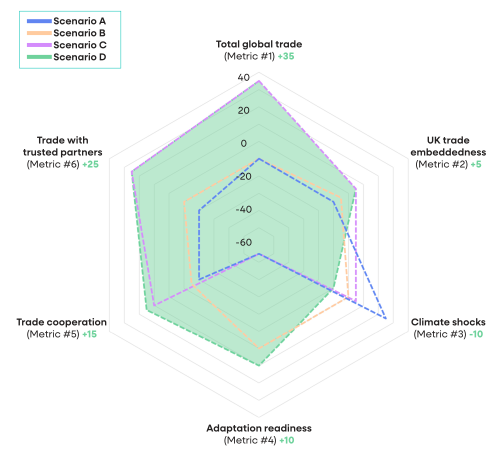
Alt text: Scenario D shows strong trade, cooperation and adaptation with lower climate shocks.
In the radar diagram above, the green shaded area represents Scenario D across six axes: total global trade (+35), UK trade embeddedness (+5), climate shocks (-10), adaptation readiness (+10), trade cooperation (+15), and trade with trusted partners (+25). The shape shows consistently strong performance across trade and cooperation dimensions, with its highest point at global trade, solid scores for trusted partners and cooperation, and a moderate positive score for adaptation readiness. Climate shocks are lower than neutral, indicating fewer impacts compared to other scenarios. Faint outlines of other scenarios (A, B, and C) appear in the background for comparison.
Table 7: Key factor summary and implications for trade and supply chains for scenario D – Ecosphere
| Key factor | Implications for trade under scenario D - Ecosphere |
|---|---|
| Forces in motion: Key drivers reshaping the landscape | |
| 1. Global trade landscape | Stable but bloc-aligned, trade functions well within alliances and is used to advance environmental objectives, development, and selected innovation sharing across blocs. |
| 2. Climate impacts | Climate hazards persist due to historic emissions, yet global coordination limits damage and supports long‑term resilience. |
| 3. Climate adaptation | Proactive and coordinated, major investments in resilient infrastructure, water management, and agriculture. |
| 4. The Arctic | Access to Arctic routes and resources is collaborative, balancing strategic use with environmental safeguards. |
| Rules and frictions: How trade is channelled or constrained | |
| 5. Global standards alignment | Reformed and more representative, with greater participation by developing countries. |
| 6. Regulatory environment | High alignment on environmental and product standards within blocs, global progress through reformed institutions. |
| 7. Near-market trade dynamics | Robust: aligned standards and cooperation within the Western bloc facilitate trade. |
| 8. Access to critical resources | Stabilised through recycling, circular design, and long‑term supply agreements, reduced reliance on extraction. |
| Networks and flows: Routes, logistics, and supply reliability | |
| 9. Transport & logistics | Resilient infrastructure and planning prevent major disruptions, ports are relocated or reinforced. |
| 10. Supply chain strategy | Decentralised, circular, and with greater emphasis on resilience, AI-supported logistics, closed-loop systems, and diversified sourcing. |
| The UK at home: Public mood and priorities | |
| 11. Public attitudes | Public support for sustainability increases, enabling more resources for long-term environmental goals. |
| 12. Climate impacts in the UK | Urban and key rural areas gain resilience through flood defences, rewilding, and circular economy practices. |
| Strategic choices and pathways: Where the world is headed and where UK value is created and exposed | |
| 13. Climate mitigation outlook | Low emissions pathway – Proactive, multilateral institutions enable aligned sustainability goals despite competition between blocs |
| 14. Climate-driven geopolitical trends | Coordinated climate action lowers geopolitical frictions whilst enabling a credible path towards net zero. |
| 15. UK opportunities | Strong leadership in green tech, circular economy, sustainable finance, and climate services across the bloc. |
Forces in motion: Key drivers reshaping the landscape
1. Geopolitical stability fuels innovation and reform. The world remains organised around 2 dominant blocs, but competition drives diplomacy and stability rather than conflict. These blocs emerged from a weakened multilateral system through institutional changes and procedural reforms. The Western-led bloc adopted complementary metrics alongside GDP, incorporating wellbeing and planetary boundaries as key considerations into policy and trade, using trade to advance environmental goals and capacity‑building. Multilateral institutions, reshaped through institutional reform after late-2020s conflicts, now grant greater relative political power to states heavily impacted by climate change, rebuilding trust and legitimacy. Despite tensions, countries use these institutions to agree common goals, especially on climate. Collaboration on climate spills over onto other multilateral efforts, enabling smaller countries to contribute and have a voice.
2. Historic emissions keep hazards rising, but global efforts dampen effects. A decade of severe impacts from climate hazards in the early 2030s led to significant changes globally to address climate risk. This does not mean climate risk has been eliminated, as historic carbon emissions still pose hazards similar to other scenarios, threatening global agriculture, infrastructure, and livelihoods. But significant, almost decade-long and internationally coordinated efforts have resulted in strong capabilities limiting exposure and increasing adaptation, and a global agenda to limit effects, where possible, as well as develop solutions towards sustainability. This is putting countries on a more consistent pathway towards net zero globally, and adaptation is treated as a shared responsibility.
3. Proactive climate strategy transforms global priorities. A global, pro-active strategy was developed in this scenario as a response to the climate hazards experienced in the preceding decade: by 2040, countries have made significant progress towards climate adaptation and taken measures to mitigate future impacts by prioritising sustainable models like circular economies, green infrastructure, rewilding, carbon capture, and sustainable agriculture. This increased resilience has fostered collaboration on agreements, enabling internationally coordinated efforts shaping adaptation globally, helping to curb impacts where possible.
4. Arctic access balances resource use with responsibility. The Arctic remains strategically important for its mineral wealth and emerging sea routes, but access is managed collaboratively. Major powers balance resource use with environmental safeguards, using Arctic shipping responsibly to cut carbon emissions while avoiding exploitation that could undermine collective climate goals.
Rules and frictions: How trade is channelled or constrained
5. Regulatory harmonisation underpins climate-conscious trade. In line with cultural change towards more climate-conscious trade, there is a strong push for regulatory alignment across blocs, resulting in harmonisation of environmental standards, which facilitates trade. WTO-like institutions have been reformed to allow broader representation, especially from smaller or nations suffering disproportionately from climate change and enforce sustainability criteria and operate with stronger mandates to include climate-conscious regulation and regulatory harmonisation globally. The UK contributes to standard-setting across sectors, from low-carbon manufacturing to sustainable finance.
6. Aligned rules drive progress but expose gaps. Regulations support circularity, carbon pricing, and fair labour practices, encouraging both innovation and stability. Whilst harmonisation facilitates trade, it also creates trade‑offs where some countries face challenges meeting standards.
7. Bloc integration secures UK access and influence. Regulatory harmonisation within the bloc has facilitated smoother supply chains, while targeted trade agreements with emerging economies strengthen economic ties. The UK, firmly integrated into the Western-led alliance alongside other European nations, benefits from coordinated trade and security frameworks that help to ensure access to critical materials and technologies. While military conflicts are rare, diplomatic rivalries shape global trade policy, creating a world where collaboration is strong within blocs, but competition persists between them. The UK and its allies increase investment in developing nations to create sustainable supply chains and reduce reliance on non-renewable resources.
8. Critical resources shared through multilateral cooperation. While critical minerals are sometimes held by countries not allied with the Western-led bloc, innovation in multiple sectors, including technology, medicine, and defence, combined with agreements to share resources for climate adaptation, reduces the risk of resource weaponisation. Multilateral organisations facilitate the exchange of critical resources for mutual global benefit, preventing price inflation or strategic withholding.
Networks and flows: Routes, logistics, and supply reliability
9. Resilient infrastructure keeps trade flowing. Trade within the UK’s geopolitical bloc is more stable, with supply chains benefiting from coordinated policies, shared sustainability standards, and investment in resilient infrastructure. Most transport routes are still available as countries proactively prioritised resilient infrastructure, and in certain cases, ports were moved to more protected locations. Conflicts are largely contained and do not directly impact shipping routes. Strategic investment in resilient logistics infrastructure was accelerated through new governance compacts, including public climate banks and regional planning agencies that complemented market approaches through new governance compacts.
10. Diversified systems minimise climate disruption. In a bipolar but climate‑cooperative system, blocs create “green corridors” to lower barriers for mitigation and adaptation goods and services while competing on scale, cost, and standards in circular manufacturing, battery and mineral recycling, AI‑orchestrated logistics, and product‑passport traceability. Globally and in the UK, trade flows remain resilient despite climate impacts thanks to decentralised manufacturing, diversified sourcing, and AI-driven logistics. Firms prioritise resilience and redundancy alongside cost‑efficiency, supporting long-term supply chain performance. UK supply chains strengthened by circular practices based on closed-loop manufacturing systems that minimise waste and reduce reliance on raw material imports. Trade shifts towards secondary materials, remanufactured goods, repair and reverse‑logistics services, with UK strategies emphasising cross‑border take‑back schemes and mutual recognition of recycled‑content and eco‑design standards.
The UK at home: Public mood and priorities
11. Cultural change embeds climate stewardship. Benefits resulting from material changes driving proactive climate adaptation are underpinned by accompanied cultural change, with a greater uptake of sufficiency and localisation practices by people living in the UK, embedded by education reform and civil society-led transitions to regenerative living. Green industrial policy instruments support economic activity, with subsidies and incentives for sustainable businesses and proactive, innovative practices. Businesses adopt more demanding net zero targets and are helping to drive national and international climate action. Environmental goals align with national and bloc-level economic ambitions.
12. Physical adaptation reinforces systemic resilience. Urban and strategic rural areas benefit most from climate adaptation: major coastal regions have sophisticated flood defences, and inland areas are building back resilience through rewilding and sustainable agriculture. Cultural change supports these physical adaptations, but preference is still given to areas with the highest return on investment. Climate adaptation influences economic growth and trade policy and supports prioritisation of mitigation globally. The UK and its partners lead large-scale decarbonisation, investing in carbon capture, next-generation renewables, and nature-based solutions. This is supported by advanced circular economy practices, including regulation on closed-loop manufacturing systems to support supply chain performance.
Strategic choices and pathways: Where the world is headed and where UK value is created and exposed
13. Global coordination sets a credible path to net zero. Economic prosperity is still linked to bloc alliances, yet climate action has become a shared global priority. Coordinated mitigation and adaptation efforts extend beyond political boundaries, directing resources to vulnerable regions critical for food, water, and resource security, helping to reduce systemic fragility and stabilise supply chains. Global coordination on climate mitigation and adaptation has set the world on a consistent path towards net zero. Emissions remain but are steadily declining, limiting future climate hazards while investments in sustainable practices and nature-based solutions enhance resilience and create reinforcing effects for long-term stability.
14. Shared climate goals reshape global competition and cooperation.
2 major blocs maintain stable relations and use multilateral institutions to coordinate climate mitigation and adaptation. Regulatory harmonisation and shared environmental standards facilitate trade in climate‑related goods and services, while circular practices and resource‑sharing reduce reliance on primary extraction and stabilise access to critical materials. Competition persists in advanced recycling, logistics, and green technology, but collaboration on climate objectives reduces the risk of resource weaponisation and strengthens supply‑chain resilience. For the UK, this provides more stable access to essential inputs, opportunities to lead in green innovation, and a platform for long‑term economic and environmental goals, though continued monitoring of global risks remains essential.
15. UK leverages leadership in green innovation. Opportunities for the UK in this world are broad but selective: The UK has developed leading capabilities in defence, green innovation and technology, where early investments in nascent technologies 15 years ago enabled the UK to hold leading positions in selected segments. The UK is not exporting hydrogen production, advanced batteries, and smart grid systems essential for decarbonising industry. UK industry excels in advanced manufacturing, sustainable finance, and climate adaptation technologies. Its expertise in synthetic materials, renewable energy, and resilient infrastructure strengthens its position within the bloc. However, some risks and opportunity costs remain: the reliance on a bipolar world order carries risks, as shifts in global power dynamics could destabilise supply chains. Traditional sectors have been impacted by the focus on climate adaptation, and there is slower growth in certain industries.
5.3 Wildcards
Wildcards are unexpected, low-probability events that would have a huge impact if they happened. They can help decision makers stretch their thinking beyond the predictable outcomes considered and can be used as possible ‘shocks’ to stress-test decision making and introduce robustness and flexibility into strategy and policy.
Climate and environmental wildcards
Sudden shifts in major ocean current
Large changes in ocean circulation play a central role in regulating regional climates. Changes in these systems, particularly in the North Atlantic, can alter how heat and moisture are distributed between the tropics and Europe, with knock‑on effects for weather patterns, agriculture, and food production, including in the UK.
One example is a rapid weakening of the Atlantic Subpolar Gyre (SPG), a major surface current system in the North Atlantic. The gyre helps circulate heat and influences the position of storm tracks affecting the UK and northern Europe. Whilst the SPG is part of the Atlantic Meridional Overturning Circulation (AMOC), such a change would not represent a collapse of the AMOC. The AMOC, which transports warm water northwards and cold water southwards at depth, is expected to gradually weaken rather than collapse this century. However, a sharp reorganisation of surface currents (i.e. the Atlantic sub-polar gyre) could still have significant climate effects (Met Office, 2025), and highlight how sensitive Europe’s climate is to ocean circulation.
Potential impacts include cooler winters in the UK and northern Europe; shifts in rainfall patterns, including wetter winters and drier summers in some regions; and increased frequency of disruptive storms and weather extremes. These changes would pose challenges for agriculture, energy systems, transport reliability, and food supply chains. Because similar ocean-atmosphere linkages influence weather beyond Europe, ripple effects could also be felt across parts of the Atlantic basin, increasing the risk of simultaneous disruptions in multiple regions.
For global supply chains, these shifts would disrupt agricultural output, energy systems, and transport reliability across multiple regions at once, increasing the risk of correlated shocks and global price volatility. The response could involve rapid adaptation, technological innovation and greater international cooperation, or, alternatively, increased fragmentation and competition as countries seek to protect domestic supply and infrastructure.
Higher than expected global warming[footnote 14]
A sudden and larger-than-expected jump in global temperatures pushes global warming levels above 2 °C for at least 1 year compared to pre-industrial levels. This is driven by human-induced greenhouse‑gas emissions and compounded by natural climate variability (such as a strong El Niño) and short-term changes linked to cleaner air reducing cooling aerosols. This represents a temporary spike, rather than a permanent shift to a 2 °C world. The result is a sharp increase in extreme heat, marine heatwaves, and severe weather events across multiple regions.
Global shipping is particularly affected in this wildcard. Warmer ocean and atmospheric conditions contribute to more intense tropical cyclones, including a higher risk of rapid intensification, creating dangerous sea states that threaten ships, crews, and cargo. Operators divert vessels away from high‑risk routes, often via longer journeys around southern capes, while insurance costs rise sharply. At the same time, prolonged drought linked to elevated temperatures severely limits water levels in the Panama Canal, forcing strict limits on ship size and traffic and at times making the canal unusable for high‑volume container and gas trade.
Other critical supply chains also come under strain. Persistent heat and droughts affect semiconductor manufacturing hubs that rely on large quantities of ultra‑pure water, slowing production and triggering knock‑on disruption across electronics and automotive supply chains. Food systems are also affected, as extreme heat and rainfall variability reduce crop yields in multiple exporting regions at once, prompting export restrictions, price spikes, and increased humanitarian need worldwide.
For global supply chains, this wildcard highlights the risk posed not just by long‑term climate change, but by short‑lived periods of exceptional warming that generate simultaneous shocks across transport, food, and manufacturing systems, overwhelming adaptive capacity and increasing supply chain volatility.
Breakthrough in lab-grown or synthetic alternatives to key agricultural goods
Lab-grown alternatives to key agricultural goods provide a more diverse and resilient food supply that is less exposed to climate shocks, pests, and disease outbreaks. Production takes place in controlled environments, reducing vulnerability to heat, drought, and flooding.
As a result, food supply becomes more stable even during extreme weather events. Land previously used for agriculture can be restored or repurposed, contributing to biodiversity gains and reduced pressure on water and soils.
From a supply‑chain perspective, widespread adoption of lab‑grown or synthetic foods would shorten and reconfigure global food supply chains, reducing reliance on climate‑sensitive growing regions and long, vulnerable transport routes. Evidence suggests this could improve food security for import‑dependent countries, including the UK, by decoupling parts of food production from geography and climate variability, while also lowering exposure to livestock disease risks and feed price shocks. However, it would also shift risk upstream to new inputs, such as energy, nutrients, and specialised manufacturing capacity, and could have disruptive distributional impacts on agricultural exporters and rural economies unless managed through transition and trade policy (Kim et al., 2025; Morris and Swain, 2025).
An early, ice-free Arctic[footnote 15]
Earlier than most projections had anticipated, an unusually warm summer delivers not just isolated ice‑free days, as seen before, but a full late‑summer month with broadly open conditions across key Arctic routes. The shift becomes widely visible when a commercial shipping operator announces that, for the first time, it has completed the entirety of September using mainly Arctic routes, planned in advance rather than opportunistically.
The transit itself is not unprecedented: ice‑strengthened vessels have operated in the Arctic for years. What is new is that much of the transit is carried out by conventional open‑water vessels through the Northern Sea Route. The successful company highlights that routing decisions were made before the season began, that icebreaker support was limited and used only as a contingency, and that schedules were largely met. Trade media, satellite imagery, and corporate communications quickly reinforce a simple message: the Arctic is becoming operationally relevant sooner than expected.
This moment crystallises a shift that had previously been gradual and uncertain. Activity once seen as niche now appears, to many observers, as a viable seasonal option. While the Northwest Passage remains significantly riskier, shipping companies rerun route models, insurers and logistics firms reassess risk and timing assumptions, and governments and port authorities face renewed questions about infrastructure, regulation, and preparedness. Reduced transit times, fuel use, and emissions are publicly promoted, accelerating interest and investment in Arctic‑capable ships, ports, and supporting services.
Figure 22: Map of Arctic shipping routes, taken from The Arctic Institute (2016)
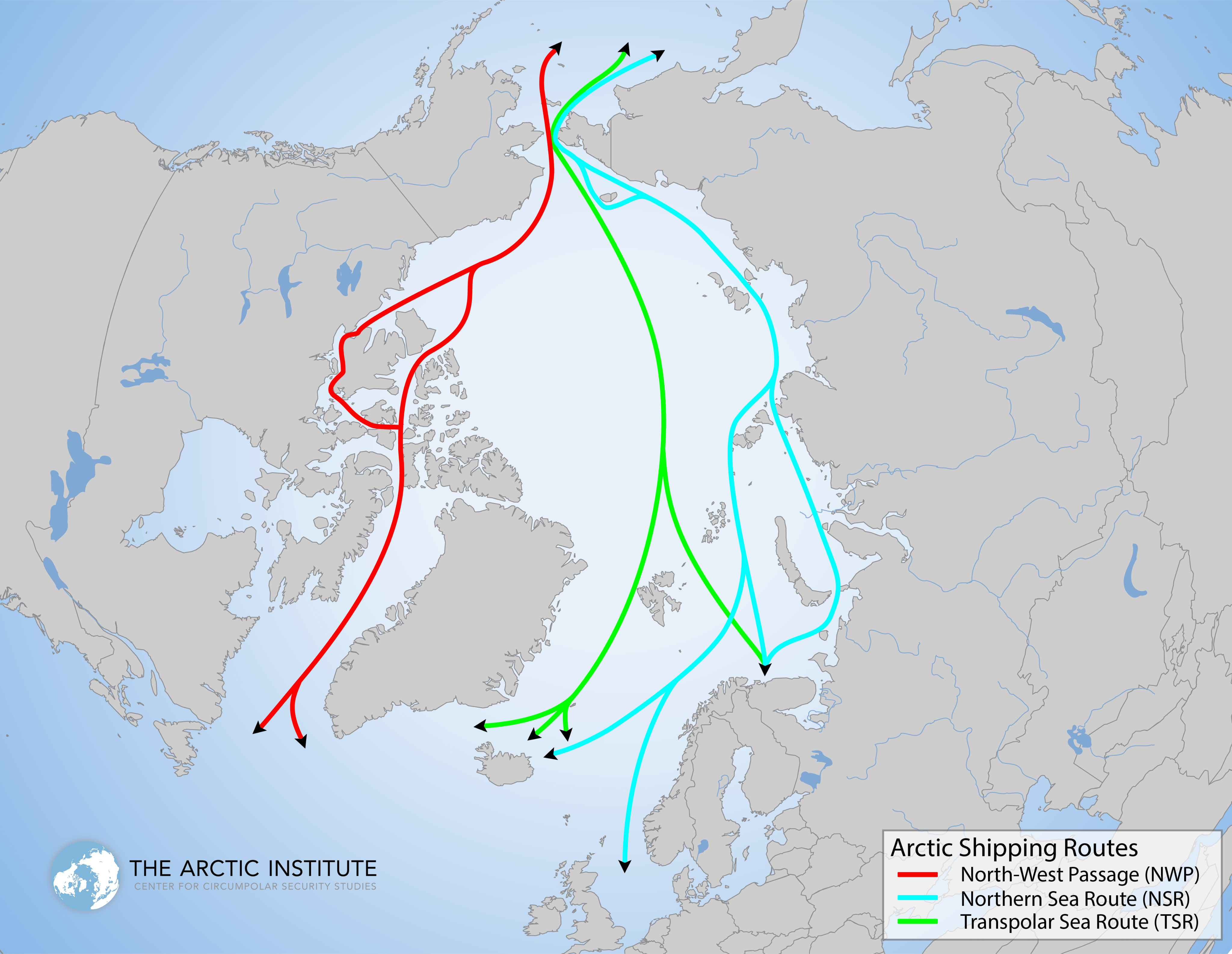
Alt text: Arctic shipping routes including Northwest Passage, Northern Sea Route and Transpolar Route.
The above map shows major navigational pathways across the polar region between North America, Greenland, Europe, and Russia. The map is rendered in light blue and grey, with coastlines of surrounding landmasses clearly outlined. Three primary shipping routes are highlighted with coloured lines and directional arrows. The Northwest Passage (NWP) is shown in red, weaving through the Canadian Arctic archipelago and connecting the North Atlantic to the Pacific along the northern coast of North America. The Northern Sea Route (NSR) is shown in light blue, running along Russia’s northern coastline from Europe to the Bering Strait. The Transpolar Sea Route (TSR) is shown in green, cutting more directly across the central Arctic Ocean between the Atlantic and Pacific. Arrows indicate directions of travel along each route, emphasising potential passages across the Arctic as sea ice diminishes. A legend in the lower-right corner labels each route by colour, and a logo for The Arctic Institute appears in the lower-left corner.
As expectations shift, supply chains respond. Even limited rerouting of cargo has knock‑on effects: some shipping and energy flows are redirected for the upcoming season, insurance pricing adjusts, and ports outside the Arctic experience sudden changes in demand.
At the same time, risks remain high. Ice and weather conditions are still volatile, emergency response capacity is limited, and search‑and‑rescue operations remain complex and costly. The widening gap between perceived accessibility and operational reliability becomes a new source of strategic uncertainty, adding volatility to shipping, insurance, and supply‑chain planning just as companies and governments are already adapting to frequent disruption.
Geopolitical wildcards
Global Government
The Global Government has managed to unify all nations under a single banner, creating a seamless global governance system. There are only a few trade barriers, tariffs or customs checks. Regulations are standardised globally. Resources are allocated strategically, focusing on areas that maximise global benefit. In the event of localised disasters, the Global Government can quickly mobilise resources quickly and efficiently. For global supply chains, unified global governance would reduce trade frictions, regulatory differences, and policy uncertainty, allowing firms to organise production and sourcing more efficiently across borders. Lower trade barriers and aligned rules cut transaction costs and improve the reliability of complex, multi‑country supply chains. Centralised coordination could also strengthen resilience by enabling faster collective responses to shocks, such as reallocating transport capacity or critical inputs across regions. However, highly integrated systems can be more exposed to systemic failures, meaning overall resilience would depend on whether redundancy, transparency, and risk‑monitoring are built into the global governance framework.
Cascading climate extremes hardens the world into rival trade blocs
A cluster of climate‑amplified hazards hits in rapid succession: back‑to‑back multi‑breadbasket harvest failures coincide with marine heatwaves that supercharge typhoons striking East and Southeast Asian logistics hubs, while drought forces fresh, prolonged transit and draft restrictions at the Panama Canal and extreme winds intermittently shut the Red Sea/Suez corridor. Insurance costs spike and carriers reroute along longer, riskier capes. Shocks to food, fertiliser, and critical‑mineral supply chains accelerate tit‑for‑tat export controls, as governments prioritise domestic price stability and strategic industries. Within weeks, emergency “loyalty corridors” solidify around 2 antagonistic blocs that weaponise market access (tariff surcharges, licensing, extraterritorial standards) and ring‑fence key ports and routes to allies only. Several resource‑rich states announce that selected commodity trades (grain, fertiliser, copper concentrates, rare‑earth oxides) will settle via bilateral currency swaps or basket pricing, signalling a partial shift away from dollar‑only settlement in those flows. As a medium‑sized, trade‑dependent economy, the UK faces immediate availability and timing risk for grains, semiconductor inputs, grid hardware and battery minerals; premium freight and insurance push delivered costs higher, and regulatory divergence across blocs multiplies compliance burdens. Rapid choices on which “corridors” to align with (and when to hedge) become unavoidable.
Large-scale cyber-attacks on critical infrastructure
Cyber-attacks are frequent and targeted. The increasing dependence on digital infrastructure makes it vulnerable to attacks. State-sponsored attacks become more frequent, targeting the critical infrastructure of rival states. Cybercrime syndicates evolve into highly organised and well-funded operations which are exploit vulnerabilities in critical infrastructure. The transport systems, power networks, armed forces bases, and financial systems are all simultaneously hit. This leads to massive delays and disruption in the movement of goods and impacts key services. Cybercriminals infiltrate the supply chains of critical infrastructure, embedding malware in hardware and software components. These compromised components are then used to launch attacks. The reliance on technology is reevaluated, and there is a push for more resilient, low-tech solutions. This includes the development of manual overrides and analogue backup systems.
Key trade routes controlled by a single terrorist organisation or network of terrorist organisations
The Panama Canal, Suez Canal, and Strait of Malacca and key ports are controlled by a single terrorist organisation. The flow of goods, including essential commodities like oil, gas, and food, is severely hampered. This leads to shortages and skyrocketing prices, affecting economies worldwide. Nations with vested interests in these trade routes deploy naval forces to secure their interests, leading to a significant increase in military tensions. With the official trade routes compromised, black markets for goods flourish and smuggling and piracy increases, whilst some goods have become unavailable, such as some medicines, semi-conductors, and particular food items.
Conclusions: from insight to action
This report was designed to help policy makers, analysts, and other decision makers move beyond awareness of supply chain risk towards more targeted, system‑level action. It brings together evidence, analytical insight, and structured exploration of future uncertainty to support more robust, flexible policy- and decision-making in an increasingly volatile global environment. Its value lies not only in its findings, but in the practical ways its approaches and tools can be used now. While building concrete resilience often sits with companies, regional and national bodies, such as sector-level groups and governments, have a distinct role in coordinating responses to shared risks, addressing system‑wide blind spots, and enabling capabilities that individual firms cannot deliver alone.
The report’s insights form a three‑step resilience cycle that can be applied to any supply chain, sector, or critical good. The steps are iterative, recognising that supply chain risk evolves over time and that resilience must evolve with it.
Step 1 – Identify where risk really sits
Begin by clarifying the supply chain or system of concern, and the outcomes that matter most for the UK, for example, loss of availability, loss of continuity, or harmful dependencies. Then build a system‑level picture of vulnerability that goes beyond headline trade data. This includes understanding multi‑tier supplier dependencies, upstream processing and transport nodes, shared suppliers, hubs, and chokepoints, and how firm‑level, network‑level, and external pressures interact.
A central conclusion of this work is that supply chain resilience cannot be understood or addressed through a single lens. Vulnerabilities emerge from the interaction of 3 dimensions: firm‑level capabilities and practices, network‑level structures and dependencies, and external pressures such as climate change and geopolitics. Effective decision making therefore needs to integrate all three:
- Firm level: Work with businesses to understand their contingency plans, how far visibility extends beyond direct suppliers, and where known gaps or single points of failure sit. Government can support this through stress‑testing, information‑sharing, and collaboration across firms, sectors, and regions, particularly for risks that no single firm can manage alone.
- Network level: Use network‑aware analysis, such as the modelling outlined in this report, to identify system‑wide pressure points and hidden dependencies that are not visible in conventional trade statistics. Government can add value by supporting shared analytical capability, including access to transaction‑level data, common tools, and coordinated cross‑sector analysis to surface system‑critical risks.
- External, macro-level pressures: Use horizon scanning, risk assessments, and monitoring of significant trends (such as climate, geopolitical, or technological) to identify risks that originate outside supply chains but propagate through them. Government is well placed to support work on shared external risk intelligence, supporting businesses and policy makers work from a common evidence base.
The report provides evidence, supply chain mapping, network‑modelling insights, and a set of risk archetypes that help decision makers recognise the structural patterns that drive systemic vulnerability. These tools support both an assessment of today’s pressures and the identification of future risk pathways using evidence‑anchored trends and the scenario framework.
Alongside current‑state analysis, evidence and evidence‑anchored views of future trends and risks can also be used at this stage to inform policy thinking early. Sources such as updated horizon‑scanning outputs, chronic risk assessments (such as the Government’s Chronic risks analysis), and the scenarios set out in this report can be used to map out future vulnerabilities and risks that policy needs to be aware of when designing flexible policy and strategy that explicitly accounts for future uncertainty.
Step 2 – Design targeted and proportionate responses
Different vulnerabilities require different approaches. Evidence consistently shows that interventions are most effective when they are matched to the specific mechanism through which risk arises, rather than applied uniformly across all suppliers or sectors (Sheffi, 2005; Ivanov and Dolgui, 2021). Insights from Step 1 should be used to tailor interventions to the specific risk pathways identified. For example:
- System-critical hubs benefit from measures that increase flexibility and rerouting options. Firms with pre‑agreed alternative routes and capacity contracts recover significantly faster than those relying on single corridors, such as was observed during the 2021 disruption in the Suez Canal (Daniel, 2025).
- Upstream bottlenecks benefit from targeted backups rather than blanket stockpiling. Where critical inputs have few substitutes, firms recover faster when they have pre‑qualified alternative suppliers in place, even if it slightly increases costs in normal times (Ahn and Tan, 2025). For example, after a major fire at a semiconductor plant in 2000, firms with buffer stocks and pre‑approved alternative suppliers resumed production more quickly than those dependent on a single supplier (Sheffi and Rice, 2005).
- Shared dependencies often benefit from coordinated approaches across firms, sectors, or internationally, such as through shared standards, pooled contingency planning, and information‑sharing, to reduce recovery time and prevent “fail‑together” dynamics, particularly in energy, food, and semiconductor supply chains (Ivanov, 2023; OECD, 2025b).
This step involves assessing where resilience already exists, understanding trade‑offs, and combining interventions where appropriate. The goal is not to eliminate all risk, but to use a differentiated perspective to reduce exposure where it matters most, and to distinguish between what can be managed by firms and what requires coordinated, system‑level action, for example across sectors or at broader national or international level. This report highlights the importance of aligning any resilience planning with the specific risk pathways and constraints revealed through analysis, and of recognising that firm‑level preparedness and system‑level resilience are related but distinct.
For policy makers, this highlights an important role in convening actors around shared risks to support collective solutions where firm‑by‑firm action would be inefficient or ineffective. Evidence suggests that well‑designed competition and data‑sharing frameworks can help enable collaboration on resilience and risk management, such as joint contingency planning or information‑sharing, while preserving appropriate safeguards against anti‑competitive behaviour (Banomyong, 2018; OECD, 2025).
The effectiveness of strategic interventions also depends on the capabilities that support them. Early‑warning systems, clear end-to-end supply‑chain data, and the ability to adapt and reconfigure supply networks in real time are central to reducing disruption impacts and accelerating recovery (Patrucco et al., 2025). Without these sensing, visibility, and adaptive response capabilities, even well‑designed resilience measures risk being ineffective during a major shock.
Government can support these capabilities by investing in shared data infrastructure, improving supply chain visibility, and developing early‑warning indicators that flag emerging disruptions abroad before impacts reach UK firms.
The evidence overview and different structural pathways included in this report support this stage.
Step 3 – Stress test and iterate
Even the best‑designed strategies may not hold under future pressures. Proposed responses should be stress‑tested against a range of plausible future conditions, including different climate‑adaptation and geopolitical pathways. Scenarios help surface hidden assumptions, highlight where approaches are robust, and reveal the conditions under which a strategy may need to adapt.
Scenarios can also be used as a practical policy tool, for example to run simulation‑based exercises on priority supply chains with UK firms, testing how different policy levers perform under stress and where government intervention would be most effective.
Because supply chains and their operating environments continually change, resilience must be treated as a continuous process rather than a one‑off decision. Regular horizon scanning, refreshed analysis, updated evidence, and repeated stress testing help ensure that strategies remain fit for purpose as technologies, global dynamics, and vulnerabilities evolve.
Government can support this iterative process by providing shared intelligence, coordinating horizon scanning and risk analysis, and bringing together evidence across sectors to inform stress‑testing and adaptive decision‑making over time.
Acknowledgements
GO-Science would like to extend thanks to everyone who contributed to the work of this project and generously provided their time, expertise, and feedback.
The project team was led by Julia Erdelmann, Eleonore Batteux, and Emily Connolly, and included Declan Cooper, Eve Cox, Bryan Hatton, Sanna Latif, Tattie Knutson, Ciara Macdonald, Rachel Mortlock, Cara Nicol, and Emily White. We would like especially to thank our academic secondee, Güven Demirel, Reader in Supply Chain Management at Queen Mary University of London, for his significant time and contributions to the project.
We are also very grateful for the valuable time and input from those listed below:
-
GO-Science staff from a variety of teams who gave support at different stages in the project: Samuel Arnold, Millie Evans, Jonathan Nunn, Marcin Bryszak, Georgia Cairns, Ted Hayden, Douglas Taylor, Jacob Waldock, Rory Walshe, and Tom Wells.
-
Government officials who contributed by participating in our critical uncertainties and scenarios workshops, our metrics workshop, and by providing their expertise throughout the project, including representatives from CO, DBT, DCMS, Defra, DESNZ, DfT, DHSC, DSIT, DSTL, FCDO, HMRC, MOD, OZEV, Scottish Government, UKHO, UKHSA, and UKSA.
External experts who generously provided their time and feedback throughout the project and shared their expertise in our critical uncertainties and scenarios workshops, our metrics workshop, and through expert engagement at various points:
- Julian Allwood – University of Cambridge
- Michael Bourlakis – Cranfield University
- Alexandra Brintrup – University of Cambridge
- Catherine Cyphus – Marsh
- Arijit De – University of Manchester
- Julia Giese – Bank of England
- Charles Godfray – University of Oxford
- Jim Hall – University of Oxford
- Behzad Hezarkhani – University of Southampton
- Aarti Krishnan – University of Manchester
- Benn Lawson – University of Oxford
- Bartholomew MacCarthy – University of Nottingham
- Sarah Nelson – Climate Change Committee
- Grigory Pishchulov – University of Manchester
- Nicola Ranger – London School of Economics
- Chris Tang – UCLA Anderson School of Management
- Marcus Tindall – University of Reading
- Jasper Verschuur – TU Delft
- Chris West – Stockholm Environment Institute
- Noah Wescombe – ALLFED
- Chee Yew Wong – University of Leeds
Glossary
Adaptation (climate adaptation) Actions taken to reduce harm or exploit beneficial opportunities from actual or expected climate change by adjusting systems, infrastructure, or behaviour, such as flood defences, heat‑resilient buildings, drought planning, and more resilient infrastructure.
Agent‑based modelling A computational simulation method used to model complex systems from the “bottom up”, through the behaviour and interactions of individual agents (such as firms) in order to explore how system-level patterns emerge.
AMOC (Atlantic Meridional Overturning Circulation)
A major system of Atlantic Ocean currents that moves warm surface water northward and colder, deeper water southward, helping regulate climate, especially around the North Atlantic and Europe
Arctic / Northern Sea Route (NSR)
A shipping route along the Arctic coastline that may shorten travel between Europe and Asia as sea ice declines.
Archetype (risk archetype)
A recurring structural pathway through which vulnerability arises and disruption propagates in supply networks.
Betweenness centrality
A network measure of how often a node (e.g. a firm) lies on the shortest paths between other nodes (e.g. other firms). It captures the extent to which a firm or location can act as an intermediary or bridge through which flows, information, or disruption may pass.
Biodiversity loss The decline in variety and abundance of species, habitats, and ecosystems, which can weaken the natural systems that support food production, raw materials, pollination, water regulation, and protection from hazards.
Bloc
A group of countries that act together politically or economically, often prioritising trade and cooperation within the group.
Breadbasket A region that produces large amounts of food and is especially important for global or regional food supply and security.
Buffer stock / buffers Extra inventory, spare inputs, or reserve capacity held so that operations can continue during delays, shortages, or other disruptions.
Carbon pricing
Policies that put a cost on greenhouse gas emissions to encourage lower‑carbon choices.
Cascade / cascading effects A sequence of knock-on impacts in which an initial disruption spreads through connected parts of a system, often amplifying as it moves across a supply network.
Centrality
A general term for measures that indicate how structurally important a firm or location is within a supply network, based on its patterns of connection or position.
Chokepoint (transport or supply chain chokepoint)
A narrow, highly concentrated, or otherwise critical route, location, or stage in a supply chain where disruption can block, delay, or constrain large volumes of trade or production.
Circular economy
An economic approach that reduces waste by reusing, repairing, recycling, and remanufacturing products and materials.
Climate disaster
A serious disruption caused when a climate-related hazard, such as a flood, heatwave, drought, or storm, interacts with exposure, vulnerability, and limited coping capacity, leading to major human, economic, or environmental losses. Whether an event becomes a disaster depends not only on climate exposure, but also on how well a place is prepared and able to respond, reflecting both climate mitigation and adaptation.
Climate mitigation
Anthropogenic actions taken to reduce greenhouse gas emissions or enhance sinks, thereby limiting future climate change.
Complex system
A system made up of many interacting parts whose overall behaviour emerges from those interactions and cannot be understood by looking at each part in isolation.
Connectedness
The extent to which a node is linked to others in a network, either through the number of its connections or the density of its relationships.
Consumer Prices Index (CPI) inflation A measure of how quickly the prices paid by households for everyday goods and services are rising, indicating pressure on the cost of living. When CPI inflation reaches high levels, it reduces purchasing power and can affect demand, wages, and economic stability.
Critical minerals Essential natural resources, such as lithium, cobalt, and rare earth elements (REEs), that are vital for modern technology, defence, and the green energy transition. They are economically important and highly exposed to supply‑chain risk, often because production or processing is concentrated in a small number of locations.
Decarbonisation
Reducing carbon emissions from energy, transport, manufacturing, and other activities, often with the ambition to reduce greenhouse gas emissions.
Degree centrality
A measure of how many direct connections a firm or location has to suppliers or customers in a network, often expressed as the fraction of nodes in the network to which a node is directly connected.
Downstream
Later stages of the supply chain, closer to final assembly, distribution, or delivery to end users.
Economic Systemic Risk Index (ESRI) A quantitative measure for agent-based supply chain modelling, estimating how much overall production would be disrupted if a particular firm or country is disrupted, including indirect effects that propagate through the network.
Eigenvector centrality A measure of node importance that gives higher scores to nodes connected to other well-connected or influential nodes. It captures not just how many links a node has, but how important those linked nodes are.
External shock
A disruptive event that originates outside the supply chain itself, such as war, natural hazards, or policy change.
Flexibility (supply chain flexibility)
The ability to change suppliers, routes, or production processes, or logistics arrangements quickly in response to changing conditions or disruption.
Foresight study
A structured exploration of possible futures to support long‑term decision making under uncertainty.
Friendshoring
A strategy of sourcing production or inputs from countries seen as politically aligned, strategically trusted, or lower risk from a geopolitical perspective.
Geopolitical fragmentation
A breakdown of global cooperation into competing blocs with weaker shared rules.
Greenhouse gas emissions
Gases released by human activity that trap heat in the atmosphere and drive climate change.
Hub
A highly connected or high-throughput node, such as a firm, port, or logistics centre, through which many transactions, shipments, or relationships pass.
Infrastructure
Essential physical systems such as ports, roads, rail, energy, and communications.
Inventory
Stocks of goods or materials held by firms for production, storage, or sale.
Iteration / iterative
A repeated cycle of action, review, and adjustment in which strategies or decisions are refined over time as evidence or conditions change.
Just‑in‑time (JIT)
A production and inventory strategy in which inputs arrive only as needed, reducing storage costs and stockholding but often increasing vulnerability to delay or disruption.
Lead time
The elapsed time between the initiation of an order or process and its completion or delivery.
Logistics
The planning and movement of goods through transport, storage, and distribution.
Macro‑level
Relating to whole economies or global systems rather than individual firms.
Maritime
Related to shipping and transport by sea.
Mega‑hub
An exceptionally large and highly connected hub, such as a major port or logistics node, that handles very large volumes and plays a disproportionately important role in wider flows.
Mitigation (general)
Actions that reduce the severity of a problem; in climate policy, mainly reducing emissions.
Multi‑tier Having multiple layers of suppliers beyond a firm’s direct suppliers, such as second-tier, third-tier, and further upstream suppliers.
Multisourcing
Using more than 1 supplier for the same input, component, or service in order to reduce dependence on a single source.
Nearshoring / Onshoring / Reshoring
Related strategies for changing where production takes place: nearshoring moves production closer to the home market, onshoring places production domestically, and reshoring brings production back to a country where it was previously located abroad.
Network (supply chain network)
The web of firms, routes, and relationships involved in producing, moving, and delivering goods.
Network centrality
A general term for measures of how important a firm or location is within a network because of its position, connectivity, or role in linking other nodes; such as degree, betweenness, and eigenvector centrality.
Net zero
Balancing greenhouse gas emissions with removal so that overall emissions are zero to limit greenhouse gas emissions and global warming.
Nexus supplier
A firm or location that links otherwise separate parts of a supply network and can therefore transmit disruption widely, even if its own trade volume is modest.
Node (network node)
A point in a network representing an entity such as a firm, facility, port, or country.
Pathway
A plausible route showing how the future could unfold over time.
PESTE framework
A way of examining Political, Economic, Social, Technological, and Environmental factors shaping change.
Protectionism
Policies that restrict imports to protect domestic industries.
Proxy (indicator)
A measure used to represent something that is hard to observe directly.
Redundancy
The provision of extra capacity, backup suppliers, spare routes, or additional stock so that disruption can be absorbed without immediate failure.
Regional Trade Agreement (RTA)
A reciprocal trade agreement between 2 or more partners that liberalises trade between them. RTAs include free trade areas, customs unions, and some services agreements; they are not limited to countries in the same geographic region.
Resilience (supply chain resilience)
The ability (of a supply chain) to prepare for, absorb, adapt to, and recover from disruption while continuing to function.
Risk concentration
A situation in which a large share of vulnerability, dependency, or potential disruption is associated with a small number of firms, routes, locations, or inputs.
Risk multiplier A factor that increases the likelihood, scale, or consequences of other risks, often by interacting with them. For example, climate change can magnify food, water, migration, or geopolitical pressures.
Scenario A detailed, evidence‑based story showing how the future might plausibly develop under uncertainty.
Shared dependency
A situation in which many firms, sectors, or countries rely on the same supplier, route, technology, or region, creating correlated exposure to disruption.
Shock
A sudden disruptive event or change that interrupts normal activity.
Single sourcing / sole sourcing
Relying on only 1 supplier for a given input or service; “single sourcing” often used broadly, while “sole sourcing” can imply that no alternative supplier is available.
Supplier/buyer concentration The extent to which a firm’s purchases or sales are concentrated among a small number of suppliers or customers, increasing dependency on them.
System‑critical So important to the functioning of the wider system that failure would generate major knock-on effects beyond the entity itself.
Systemic (system‑level)
Relating to the behaviour, structure, and outcomes of the system as a whole rather than just its individual parts.
Systems thinking
An approach that focuses on connections, feedback, and interactions rather than isolated problems.
Tier (first‑tier, second‑tier, etc.)
Levels of suppliers, with first‑tier supplying the company directly and higher tiers supplying suppliers.
Tier position Where a firm, activity, or production stage sits in the supply chain, from upstream raw materials and processing to downstream assembly and distribution.
Trade‑off
A situation where improving 1 outcome requires accepting a cost elsewhere.
Transparency (supply chain transparency) The ability to see where goods come from, how they are made, and by whom.
Upstream
Earlier stages of production, such as extraction, raw materials, processing, or basic component manufacture.
Vulnerability (supply chain vulnerability)
The degree to which a supply chain is susceptible to disruption and harm, based on its exposure, sensitivity, dependencies, and limited capacity to cope or recover.
Visibility (multi‑tier visibility) The extent to which firms or governments can identify and monitor suppliers, dependencies, and risks beyond their direct counterparties, including further upstream tiers.
Weaponise (trade) The use of trade, resources, or supply chains as a tool of political pressure or coercion, such as through export controls or restrictions.
Wildcard
A rare, high‑impact event used to test how strategies cope with extreme disruption.
References
Ahn, J. and Tan, B. (2025). Supply Chain Diversification and Resilience. IMF Working Paper.
Akerlof, K., DeBono, R., Berry, P., Leiserowitz, A., Roser-Renouf, C., Clarke, K.-L. and Maibach, E.W. (2010). Public perceptions of climate change as a human health risk: surveys of the United States, Canada and Malta. International Journal of Environmental Research and Public Health, 7(6), 2559–2606.
Arif, U. and Zahid, H. (2024). Global Trade Policies and Economic Warfare: Analysing the Rise of Protectionism.
Arowosegbe, O.B., Olutimehin, D.O., Odunaiya, O.G. and Soyombo, O.T. (2024). Risk management in global supply chains: addressing vulnerabilities in shipping and logistics. International Journal of Management and Entrepreneurship Research, 6(3), 910–922.
Baier, S.L. and Bergstrand, J.H. (2007). Do free trade agreements actually increase members’ international trade? Journal of International Economics, 71(1), 72–95.
Bank of England (2024). A portrait of the UK’s global supply chain exposure.
Banomyong, R. (2018). Collaboration in supply chain management: a resilience perspective. International Transport Forum Discussion Paper.
Barnes, C., Paton, S., Stallard, R.F., de Lima, H., Clarke, B., Vahlberg, M. and Arrighi, J. (2024). Low water levels in Panama Canal due to increasing demand exacerbated by El Niño event. Centre for Environmental Policy, Imperial College London (report).
Bates, J. (2026). The Changing Global Economic Order: Anchor Paper – The Building Blocks and Choices for a Strategy. University of Oxford, Heywood Fellowship, Blavatnik School of Government.
Bednarski, L., Roscoe, S., Blome, C. and Schleper, M.C. (2025). Geopolitical disruptions in global supply chains: a state‑of‑the‑art literature review. Production Planning and Control, 36(4), 536–562.
Behzadi, G., O’Sullivan, M.J. and Olsen, T.L. (2020). On metrics for supply chain resilience. European Journal of Operational Research, 287(1), 145–158.
Block, K., Li, M., Gärtner, J. et al. (2025). Geopolitical conflict impedes climate change mitigation. Climate Action, 4, 33.
Borgatti, S.P. (2005). Centrality and network flow. Social Networks, 27(1), 55–71.
Bowen, F. and Siegler, J. (2024). The role of visibility in supply chain resiliency: Applying the Nexus supplier index to unveil hidden critical suppliers in deep supply networks. Decision Support Systems, 176, 114063.
Brintrup, A. and Ledwoch, A. (2018). Supply network science: emergence of a new perspective on a classical field. Institute for Manufacturing, Department of Engineering, University of Cambridge.
Çapar, İ., Rump, C.M., Sawaya, W., Mohamed, Z. and Alves (Mysyk), J. (2025). Green supply chain evolution: a multimodal logistics strategy for capping carbon emissions. Transportation Research Part E: Logistics and Transportation Review, 202, 104250.
Choi, T. and Kim, Y. (2008). Structural embeddedness and supplier management: a network perspective. Journal of Supply Chain Management, 44(4), 5–13.
Craighead, C.W., Blackhurst, J., Rungtusanatham, M.J. and Handfield, R.B. (2007). The severity of supply chain disruptions: design characteristics and mitigation capabilities. Decision Sciences, 38(1), 131–156.
Daniel, S. (2025). Logistics flow disruptions through the Suez Canal: enhancing supply chain risk management and resilience. International Scientific Journal about Logistics, 12(3), 595–603.
DBT (2025a). Global trade outlook: June 2025 report.
DBT (2025b). The UK’s trade strategy.
Defra (2026). National security assessment on global ecosystems (accessible version).
Devadoss, S., and Ridley, W. (2024). Impacts of the Russian Invasion of Ukraine on the global wheat market. World Development, 173.
Dolgui, A. and Ivanov, D. (2021). Ripple effect and supply chain disruption management: new trends and research directions. International Journal of Production Research, 59(1), 102-109.
Di Giovanni, J., Levchenko, A.A. and Mejean, I., (2024). Foreign shocks as granular fluctuations. Journal of Political Economy, 132(2), pp.391-433.
Diem, C., Borsos, A., Reisch, T., Kertész, J. and Thurner, S. (2022). Quantifying firm-level economic systemic risk from nation-wide supply networks. Scientific Reports, 12, 7719.
European Parliamentary Research Service (2024). Recent threats in the Red Sea: Economic impact on the region and on the EU.
Europe’s Rail Joint Undertaking (EU‑Rail JU) (2025). Net‑Zero Logistics: The Contribution of Rail Transport.
FAO and WFP (2025). Hunger Hotspots: FAO–WFP early warnings on acute food insecurity: November 2025 to May 2026 outlook. Rome.
Freund, C. and Ornelas, E. (2010) Regional trade agreements, Annual Review of Economics, 2(1), 139–166.
Greene, T. (2024). Helene takes ultrapure quartz mines offline, threatens tech supply chains. Wired.
Hansen, J. (2025, June 1). What If? Revisiting The Famous Nokia and Ericsson Case Study. Procurement Insights.
Heuzé C, Jahn A. (2024). The first ice-free day in the Arctic Ocean could occur before 2030. Nat Commun, 15(1):10101.
Ho, W., Zheng, T., Yildiz, H. and Talluri, S. (2015). Supply chain risk management: a literature review. International Journal of Production Research, 53(16), pp. 5031–5069.
Hosseini, S., Ivanov, D. and Dolgui, A. (2019) Review of quantitative methods for supply chain resilience analysis, Transportation Research Part E: Logistics and Transportation Review, 125, 285–307.
Huang, K., Madnick, S., and Zhang, F. (2021). Navigating cybersecurity risks in international trade. Harvard Business Review.
IEA. (2021). The Role of Critical Minerals in Clean Energy Transitions. International Energy Agency.
Inoue, H. and Todo, Y. (2019) Firm-level propagation of shocks through supply-chain networks. Nature Sustainability, 2(9), 841–847.
IPCC. (2021a). Summary for Policymakers. In V. P. Masson-Delmotte, Climate Change 2021: The Physical Science Basis. Contribution of Working Group I to the Sixth Assessment Report of the Intergovernmental Panel on Climate Change.
IPCC. (2021b). Weather and climate extreme events in a changing climate. Climate Change 2021: The Physical Science Basis. Contribution of Working Group I to the Sixth Assessment Report of the Intergovernmental Panel on Climate.
IPCC. (2022). AR6 Working Group II: Impacts, Adaptation and Vulnerability (mitigation and security chapters).
Ivanov, D. (2023). Two views of supply chain resilience. International Journal of Production Research 62(11), 4031-4045.
Ivanov, D., and Dolgui, A. (2021). OR-methods for coping with the ripple effect in supply chains during COVID-19 pandemic: Managerial insights and research implications. International Journal of Production Economics.
Jones, L., Banga, J., Notkin, B., and Brochen, A. (2024). Closing the Gap: Trends in Adaptation Finance for Fragile and Conflict-affected Settings. World Bank Group. http://documents.worldbank.org/curated/en/099071924093036614
Jozepa, I. (2026). Trade in goods and services: Economic indicators. House of Commons Library.
Kalin, R. (2024). Data Protection and Data Protectionism in International Trade. In Digital Trade and Data Privacy. European Yearbook of International Economic Law.
Kamali, P., Koepke, R., Sozzi, A., and Verschuur, J. (2024). Red Sea Attacks Disrupt Global Trade. IMF Blog.
Kawabata, Y., and Fujita, K. (2026). Bottleneck Detection within Supply Chain Networks beyond the Factory Boundary and Shifting Bottleneck Trajectories. Information Technology and Management.
Kilpatrick, J., Berckman, L., Faver, A. D., Hardin, K., and Sloane, M. (2024). Restructuring the supply base: Prioritizing a resilient, yet efficient supply chain. Deloitte - Energy & Industrials.
Kim, S., Jeong, Y., Jo, H., Park, Y.G., and Moon, S. H. (2025). Cultured meat: advances in stem cell biology, tissue engineering, and bioprocess optimisation for scalable and sustainable production - a review. International Journal of Food Science and Technology.
Ledwoch, A., Brintrup, A. M., Mehnen, J., and Tiwari, A. (2016). Systemic Risk Assessment in Complex Supply Networks. IEEE Systems Journal, 1-12.
Leonard, M. (2021). Container ships steer toward longer route around Cape of Good Hope to avoid Suez Canal. March 2021.
Lesk, C., Anderson, W., Rigden, A., Coast, O., Jägermeyr, J., McDermid, S., Konar, M. (2022). Compound heat and moisture extreme impacts on global crop yields under climate change. Nature Reviews Earth and Environment.
Limão, N. (2016). Preferential Trade Agreements. National Bureau of Economic Research (NBER) Working Paper 22138.
Lin, Y., Fan, D., Shi, X., andFu, M. (2021). The effects of supply chain diversification during the COVID-19 crisis: Evidence from Chinese manufacturers. Transportation Research Part E: Logistics and Transportation Review (155), 102493.
Lorenzoni, I., and Pidgeon, N. F. (2006). Public Views on Climate Change: European and USA Perspectives. Climate Change 77, 73-95.
Madani, K. (2020). How International Economic Sanctions Harm the Environment. Advancing Earth and Space Science.
Maemunah, S. (2024). Supply Chain Resilience: Strategies for Mitigating Disruptions and Building Adaptive Networks. Management Studies and Business Journal 1(3), 421-431.
McKinsey & Company. (2022). The Net Zero Materials Transition: Implications for Global Supply Chains.
Meijer, K., and Ahmad, A. (2024). Unveiling Challenges and Gaps in Climate Finance in Conflict Areas. Stockholm: SIPRI Insights on Peace and Security.
Menéndez, P., Losada, I., and Torres-Ortega, S. (2020). The Global Flood Protection Benefits of Mangroves. Scientific Reports, 4404.
Met Office. (2025). Factsheet: The Atlantic Meridional Overturning Circulation (AMOC).
Ministry of Defence. (2024). Global Strategic Trends: Out to 2055 v7.
Morris, K., and Swain, S. (2025). Lab-Grown Meat, the Right to Adequate Food, and the Climate Crisis. 12 November 2025. Frontiers of Socio Legal Studies (blog), University of Oxford:
Mungo, L., Brintrup, A., Garlaschelli, D., and Lafond, F. (2024). Reconstructing supply networks. Journal of Physics: Complexity 5, 012001.
Muñoz, S., Lawrence, L., and Wang, S. (2025). Drying of the Panama Canal in a Warming Climate. Geophysical Research Letters.
Namdar, J., Blackhurt, J., Zhao, K., and Suyong, S. (2024). Cascading disruptions: Impact of modularity and nexus supplier predictions. Journal of Supply Chain Management 60(3), 18-38.
Notz, D. and the SIMIP Community (2020). Arctic sea ice in CMIP6. Geophysical Research Letters, 47(10).
OECD. (2025a). OECD Inventory of Export Restrictions on Industrial Raw Materials 2025: Monitoring the Use of Export Restrictions. Paris: OECD Publishing.
OECD. (2025b). OECD Supply Chain Resilience Review: Navigating risks. Paris: OECD Publishing.
Pandey, S., Singh, R.K., Gunasekaran, A. and Kaushik, A. (2020). Cyber security risks in globalized supply chains: a conceptual framework. Journal of Global Operations and Strategic Sourcing, 13(1),103–128.
Patrucco, A. S., Rodrigues, V. P., Fransoo, J. C., and Mejia-Argueta, C. (2025). Resilient Supply Chains Amid Uncertainty: Do Agility, Adaptability, and Alignment Mitigate the Effects of Major Disruptions? Journal of Business Logistics 46(4).
Piprani, A. Z., Nazir, S., Najmi, A., Watabe, M., and Jaafar, N. I. (2025). Digital Capabilities and Supply Chain Resilience: Is Supply Chain Mapping the Missing Link? Business Strategy & Development 8(3).
Seo, D. and Shin, Y. (2024). A study on the impact of slow steaming on containership operations under the Carbon Intensity Indicator regulation’, Journal of Navigation and Port Research, 48(2), 97–103.
Schorr, R. (2021). Impact from Renesas Fire Manageable for Toyota, Honda. 22 March 2021.
Sheffi, Y. (2005). Building a Resilient Supply Chain. Harvard Business Review - Supply Chain Strategy 1(8), 1-4.
Sheffi, Y., and J. B. (2005). A Supply Chain View of the Resilient Enterprise. MIT Sloan Management Review 47(1), 41-48.
The Arctic Institute. (2016). Arctic Maps - Visualizing the Arctic. [online] The Arctic Institute - Center for Circumpolar Security Studies. Available at:
UN WPP. (2024). World Population Prospects. United Nations Department of Economic and Social Affairs, Population Division.
van der Linden, S. (2021). The Gateway Belief Model (GBM): A review and research agenda for communicating the scientific consensus on climate change. Current Opinion in Psychology 42, 7-12.
Venmans, F., Ellis, J., and Nachtigall, D. (2020). Carbon pricing and competitiveness: are they at odds? Climate Policy 20(9), 1070–1091.
Vlajic, J. (2017). Effective Usage of Redundancy and Flexibility in Resilient Supply. In K. S. Pawar, A. Potter, and A. Lisec, Proceedings of the 22nd International Symposium on Logistics, ISL 2017, 450-458, Nottingham: Centre for Concurrent Enterprise, Nottingham University Business School.
Wieland, A., and Durach, C. F. (2021). [Two perspectives on supply chain resilience.]https://doi.org/10.1111/jbl.12271 Journal of Business Logistics 42(3), 315-322.
World Bank. (2025). Trade (% of GDP), all countries [Data table].
World Economic Forum. (2024). 4 ways geopolitical tensions are increasing carbon emissions.
WTO. (2024). WTO report shows increase in trade restrictions against backdrop of unilateral policies. World Trade Organization Trade Monitoring.
Zhang, H., and Doan, T. (2023). From just-in-time to just-in-case: Global sourcing and firm inventory after the pandemic.
Zscheischler, J., Martius, O., Westra, S., Bevacqua, E., Raymond, C., Horton, R., Jézéquel, A. (2020). A typology of compound weather and climate events. Nature Reviews Earth and Environment.
Graph data
Data for Figure 1: Top 20 import markets for goods and services in 2024
| Rank | Market | Figure in £ billion | Percentage share |
|---|---|---|---|
| EU total | £459.8 billion | 50.0% | |
| 1 | United States | £126.7 billion | 13.2% |
| 2 | Germany | £89.4 billion | 9.3% |
| 3 | China | £72.9 billion | 7.6% |
| 4 | Netherlands | £64.9 billion | 6.8% |
| 5 | France | £56.0 billion | 5.9% |
| 6 | Spain | £46.4 billion | 4.8% |
| 7 | Italy | £35.0 billion | 3.7% |
| 8 | Belgium | £34.5 billion | 3.6% |
| 9 | Ireland | £32.0 billion | 3.3% |
| 10 | Norway | £28.7 billion | 3.0% |
| 11 | India | £28.5 billion | 3.0% |
| 12 | Switzerland | £23.5 billion | 2.5% |
| 13 | Poland | £20.8 billion | 2.2% |
| 14 | Turkey | £18.2 billion | 1.9% |
| 15 | Japan | £17.5 billion | 1.8% |
| 16 | Sweden | £14.8 billion | 1.6% |
| 17 | Canada | £12.8 billion | 1.3% |
| 18 | Hong Kong | £11.0 billion | 1.2% |
| 19 | Denmark | £9.4 billion | 1.0% |
| 20 | United Arab Emirates | £9.4 billion | 1.0% |
Source: ONS UK total trade: all countries, seasonally adjusted, reporting 4 quarters until the end of December 2024
Data for Figure 10: Schematic illustration showing how different patterns of risk archetype within supply networks can result in high risk
| Trade intensity | Centrality | Concentration | |
|---|---|---|---|
| Mega-hub | Very high importance | Medium Importance | Low importance |
| Nexus Supplier | Low importance | High Importance | Medium importance |
| Bottleneck | Medium importance | Low importance | Very high importance |
Data for Figures 15, 17, 19, 21: Radar diagram with 6 headline metrics for scenarios A, B, C and D
| | Scenario A | Scenario B | Scenario C | Scenario D |
|---|---|---|---|---|
| Total global trade (#1) | -10 | -10 | 35 | 35 |
| UK trade embeddedness (#2) | -10 | -5 | 5 | 5 |
| Climate shocks (#3) | 25 | 0 | 5 | -10 |
| Adaptation readiness (#4) | -55 | 0 | -55 | 10 |
| Trade cooperation (#5) | -20 | -15 | 10 | 15 |
| Trade with trusted partners (#6) | -20 | -10 | 25 | 25 |
*Annex B to be published shortly.
-
We focus on goods rather than services in this report ↩
-
While the report is generally framed by 2 critical uncertainties, the scenarios and evidence also consider how more established and directional pressures, such as net‑zero‑driven demand shifts, might compound these uncertainties where supply chains lack the capacity to adapt. ↩
-
However, even small differences in global mean surface temperature can translate into materially different hazard outcomes in some regions or for specific risks, particularly where impacts are driven by threshold effects or compound hazards, such as combined heat and drought. Evidence shows that modest temperature changes can push systems past critical limits in already marginal climates, amplifying impacts disproportionately (IPCC, 2021b; Zscheischler et al., 2020; Lesk et al., 2022). ↩
-
In addition, rapid emissions reductions may temporarily reduce cooling aerosols, making it plausible that near‑term warming out to around 2040 could be slightly higher in strong‑mitigation pathways than in more moderate ones, even as long‑term warming is reduced. This short‑term effect is well documented in the climate literature and reflects changes in short‑lived climate forcers rather than underlying greenhouse‑gas trends (IPCC, 2021; Hodnebrog et al., 2024). ↩
-
Degree centrality is a measure of how many direct connections a firm or location has to suppliers or customers in a network, often expressed as the fraction of nodes in the network to which a node is directly connected. ↩
-
Betweenness centrality is a network measure of how often a node (e.g. a firm) lies on the shortest paths between other nodes (e.g. other firms). It captures the extent to which a firm or location can act as an intermediary or bridge through which flows, information, or disruption may pass. ↩
-
Eigenvector centrality is a measure of node importance (e.g. importance of a firm) that gives higher scores to nodes connected to other well-connected or influential nodes. It captures not just how many links a node has, but how important those linked nodes are. ↩
-
Public attitudes are widely used in climate‑policy and social‑science research as a proxy for societal readiness to support or accept adaptation measures, even when public policy does not perfectly track public opinion (Lorenzoni and Pidgeon, 2006; van der Linden, 2021; Akerlof, et al., 2010 ). ↩
-
Economic literature widely uses the number of RTAs as a measurable indicator of the depth and direction of institutionalised trade cooperation, even while recognising that RTAs can emerge under both integrative and fragmented global conditions (Freund and Ornelas, 2010 ; Limão, 2016; Baier & Bergstrand, 2007). ↩
-
These metrics are not forecasts, projections, or point estimates. They do not represent rigorous predictions of future outcomes, nor are they the result of formal modelling or probabilistic analysis. Instead, they are illustrative tools, grounded in evidence and expert judgement, to help describe and differentiate the scenarios. Percentage changes shown for each scenario should be understood as changes relative to the 2040 estimate (the expected outcomes if current trends continue as they are now) rather than changes from today. For more information about each metric, please see Annex B*. ↩
-
These metrics are not forecasts, projections, or point estimates. They do not represent rigorous predictions of future outcomes, nor are they the result of formal modelling or probabilistic analysis. Instead, they are illustrative tools, grounded in evidence and expert judgement, to help describe and differentiate the scenarios. Percentage changes shown for each scenario should be understood as changes relative to the 2040 estimate (the expected outcomes if current trends continue as they are now) rather than changes from today. For more information about each metric, please see Annex B*. ↩
-
These metrics are not forecasts, projections, or point estimates. They do not represent rigorous predictions of future outcomes, nor are they the result of formal modelling or probabilistic analysis. Instead, they are illustrative tools, grounded in evidence and expert judgement, to help describe and differentiate the scenarios. Percentage changes shown for each scenario should be understood as changes relative to the 2040 estimate (the expected outcomes if current trends continue as they are now) rather than changes from today. For more information about each metric, please see Annex B*. ↩
-
These metrics are not forecasts, projections, or point estimates. They do not represent rigorous predictions of future outcomes, nor are they the result of formal modelling or probabilistic analysis. Instead, they are illustrative tools, grounded in evidence and expert judgement, to help describe and differentiate the scenarios. Percentage changes shown for each scenario should be understood as changes relative to the 2040 estimate (the expected outcomes if current trends continue as they are now) rather than changes from today. For more information about each metric, please see Annex B*. ↩
-
This wildcard draws on estimates outlined in the IPCC’s Sixth Assessment Report. In the near term (2021-2040), 2 °C of global mean surface temperature warming relative to the 1850-1900 baseline lies outside the range considered “very likely” across all assessed emissions scenarios (IPCC, 2021a). However, it remains a plausible outcome under higher‑emissions pathways and is therefore treated as a plausible but low‑probability wildcard outcome. ↩
-
Current projections from climate models suggest that the first monthly mean September sea ice area at or below 1 million km2 could occur as early 2050 (Notz & SIMIP Community, 2020), irrespective of the emission scenario, and recent simulations suggest the first sea ice-free days could occur before 2030 (Heuzé & Jahn, 2024). ↩