Gender and Ethnicity Pay Gap Report as at 31 March 2025
Published 30 March 2026
Applies to England

© Crown copyright 2026
This publication is licensed under the terms of the Open Government Licence v3.0 except where otherwise stated. To view this licence, visit nationalarchives.gov.uk/doc/open-government-licence/version/3 or write to the Information Policy Team, The National Archives, Kew, London TW9 4DU, or email: psi@nationalarchives.gov.uk.
Where we have identified any third party copyright information you will need to obtain permission from the copyright holders concerned.
This publication is available at https://www.gov.uk/government/publications/gender-and-ethnicity-pay-gap-report-as-at-31-march-2025/gender-and-ethnicity-pay-gap-report-as-at-31-march-2025
Foreword
This report reflects our gender and ethnicity pay gap data as of 31 March 2025, which we annually report in arrears.
We are committed to creating an inclusive, welcoming, and fair environment for everyone in our organisation. Our plans cover all areas of our work - from recruitment and promotion to training and mentorship - and are designed to remove barriers and ensure equal opportunities. Our goal is to provide every colleague with a fair path to success, enabling us to better support the regulator in driving positive change.
Gender Identity
In accordance with the current requirements for reporting on the gender pay gap, our approach involves categorising gender into male and female within our data classification.
It is important to note that we define gender in accordance with the classifications provided by His Majesty’s Revenue and Customs (HMRC), which categorise individuals as male or female, in our data.
In the context of this report, we have employed the terms ‘gender,’ ‘male,’ and ‘female,’ understanding that they typically relate to biological sex. However, it’s important to acknowledge that for some individuals, these terms may not fully encapsulate their gender identity.
How the Gender Pay Gap is worked out
In 2017, the government introduced a statutory requirement for organisations with 250 or more employees to report annually on their gender pay gap. Government departments are covered by the
Equality Act 2010 (Specific Duties and Public Authorities) Regulations 2017 which came into force on 31 March 2017. These regulations underpin the Public Sector Equality Duty and require the relevant organisations to annually publish their gender pay gap data on:
- Mean and median gender pay gap in hourly pay.
- Mean and median bonus gender pay gap.
- Proportion of men and women receiving a bonus payment.
- Proportion of men and women in each pay quartile.
The gender pay gap shows the difference in the average pay between all men and women in a workforce. Mean and median gender pay gap figures are based on a comparison of men and women’s hourly pay across the organisation irrespective of grade, which means that the gap shows the difference in the average pay between all men and women in the organisation’s workforce.
-
The mean figure is the percentage difference between the mean average hourly rates of men and women’s pay.
-
The median figure is the percentage difference between the midpoints in the ranges of men and women’s pay.
-
The bonus gap refers to bonus payments paid to men and women employees during the 12 months period prior to the snapshot date.
Our Gender Pay Gap at 31 March 2025
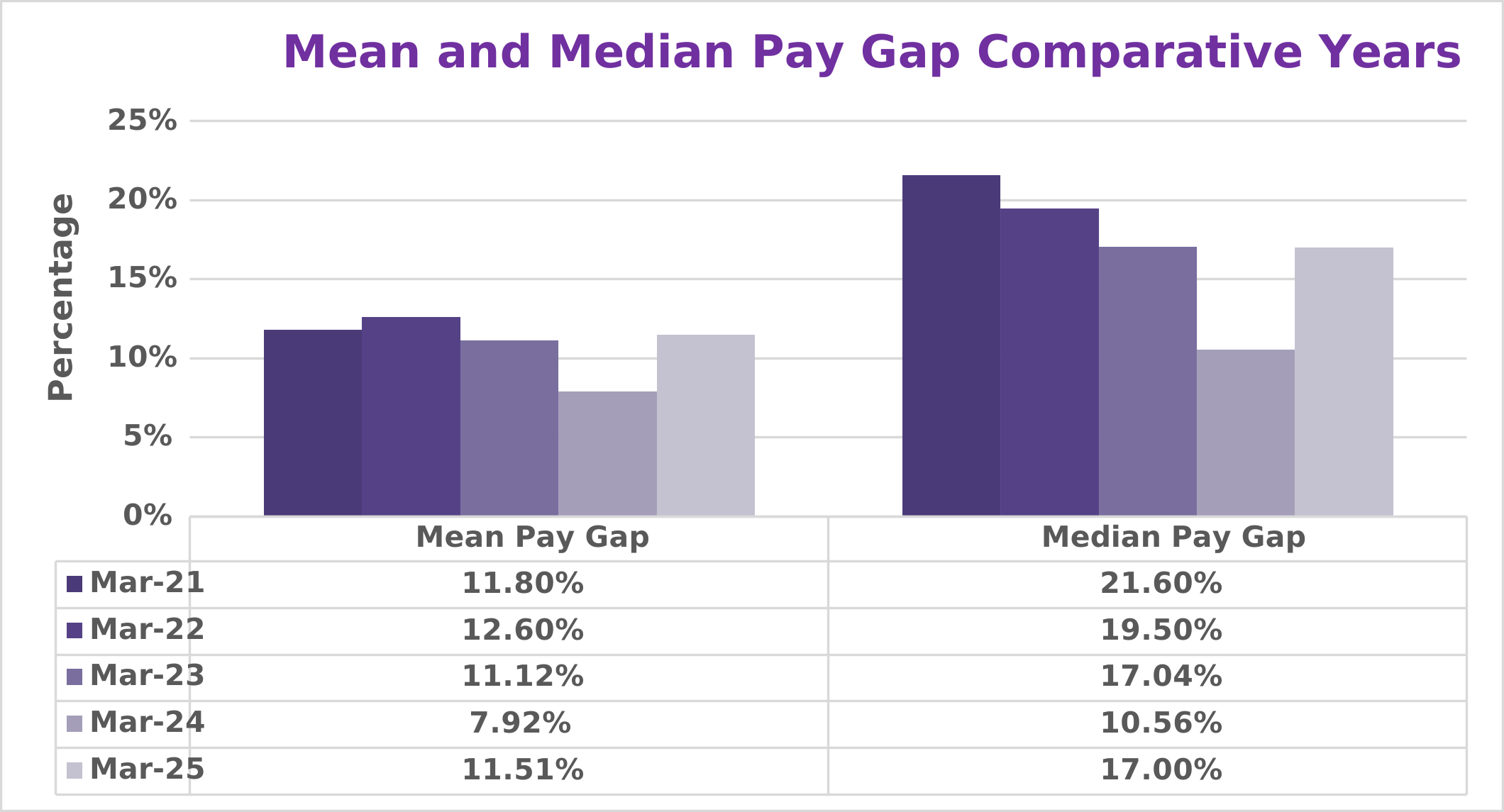
Our figures at 31 March 2025
| Mar-20 | Mar-21 | Mar-22 | Mar-23 | Mar-24 | Mar-25 | |
|---|---|---|---|---|---|---|
| Mean Pay Gap | 11.30% | 11.80% | 12.60% | 11.12% | 7.92% | 11.51% |
| Median Pay Gap | 15.90% | 21.60% | 19.50% | 17.04% | 10.56% | 17.00% |
Gender pay gaps, where present at The Regulator of Social Housing, tend to favour men. The factors contributing to these disparities are discussed below.
Pay Gap Analysis
The examination of both mean and median pay at the regulator reveals a gender pay gap that generally benefits men. It is important to note that these gaps do not signify a significant difference in pay between male and female employees at any specific role grade within the organisation.
The primary drivers behind these gaps are the overall demographics of the organisation and the higher representation of female staff in the lower pay quartiles, as shown later in this report.
Bonus Pay Gap
RSH operates a modest annual bonus pay scheme on a fixed scale, with awards based on individual staff performance in their role. During the year, bonuses were paid at set values of:
-
£0 where individual performance does not meet expectations.
-
£340 where performance meets expectations.
-
£640 where performance exceeds expectations.
Bonuses are awarded irrespective of gender or any other protected characteristic. To be considered for a bonus, staff must first have successfully completed their six-month probationary period following joining the organisation.
Gender Bonus Values 2025
| Mean Bonus Pay | Count | Mean Bonus Pay | Median Bonus Pay |
|---|---|---|---|
| Male | 81 | 416.10 | 340.00 |
| Female | 129 | 405.84 | 340.00 |
| Difference (£) | N/A | 10.25 | 0.00 |
| Difference (%) | N/A | 2.46% | 0.00% |
Gender Bonus Gap
| Mar-21 | Mar-22 | Mar-23 | Mar-24 | Mar-25 | |
|---|---|---|---|---|---|
| Mean Bonus Gap | -1.62% | 2.90% | -2.48% | 2.19% | 2.46% |
| Median Bonus Gap | 0.00% | 0.00% | 0.00% | 0.00% | 0.00% |
It is common practice in organisations to proportionally adjust non-consolidated bonus payments based on the number of hours worked by individual employees. Consequently, part-time employees typically receive a lower bonus compared to their full-time counterparts.
In 2022, there was a mean bonus pay gap of 2.9%, favouring men, which contrasts with 2021 when there was a mean bonus gap of 1.62%, favouring women. In 2023, there was a mean bonus pay gap of 2.48%, favouring women. In 2024 the gap was 2.19% favouring men. This increased in 2025, with a mean bonus gap of 2.46% favouring men.
Pay Quartiles
The data in the gender pay gap quartiles table provides insights into the distribution of male and female employees across different pay quartiles within the organisation over five years.
| Mar-21 | Mar-22 | Mar-23 | Mar-24 | Mar-25 | ||||||
|---|---|---|---|---|---|---|---|---|---|---|
| Pay Quartile | Female | Male | Female | Male | Female | Male | Female | Male | Female | Male |
| Top Quartile | 54.50% | 45.50% | 51.10% | 48.90% | 50.00% | 50.00% | 53.03% | 46.97% | 51.30% | 48.80% |
| Upper Middle Quartile | 54.50% | 45.50% | 59.60% | 40.40% | 65.40% | 34.60% | 66.67% | 33.33% | 62.50% | 37.50% |
| Lower Middle Quartile | 75.00% | 25.00% | 64.60% | 35.40% | 56.60% | 43.40% | 54.55% | 45.45% | 68.40% | 31.60% |
| Bottom Quartile | 67.40% | 32.60% | 75.00% | 25.00% | 73.60% | 26.40% | 75.38% | 24.62% | 78.50% | 21.50% |
| Total | 62.90% | 37.10% | 62.60% | 37.40% | 61.40% | 38.60% | 62.36% | 37.64% | 65.10% | 34.90% |
It reveals:
Top Quartile: Female representation in the top quartile has decreased from 54.5% in 2021 to 51.30% in 2025.
Upper Middle Quartile: Female representation has increased from 54.5% in 2021 to 62.50% in 2025. The proportion has decreased from 66.67% in 2024.
Lower Middle Quartile: Female representation in the lower middle quartile started at 75% in March 2021 and has decreased to 68.4% in 2025.
Bottom Quartile: In the bottom quartile, female representation began at 67.5% in March 2021 and has increased to 78.5% in 2025.
Total Workforce: The data also provides the overall gender distribution in the organisation which has remained stable.
Our Declaration
Our calculations follow the legislative requirements as set out in the Equality Act 2010 (Specific Duties & Public Authorities) Regulations 2017. The data includes all staff who were deemed to be full paid relevant employees at 31 March 2025.
What are we doing about the gap?
Over the period 2021 to 2025 we have expanded from 175 staff in March 2021 to 318 staff in March 2025, with significant levels of recruitment and a shift in quartile boundaries resulting in fluctuations in the annual snapshot pay gap information. This makes it more difficult to identify underlying trends.
Our commitment to supporting an inclusive culture in the regulator is detailed in our equality, diversity and inclusion strategy and we have implemented initiatives directed at ensuring equality and diversity in recruitment.
What do we mean by ethnicity?
The Office for National Statistics[1] observes that defining what constitutes an ethnic group lacks consensus, as it is a self-defined and subjectively significant concept for individuals. Given the dynamic and multifaceted nature of ethnicity, there are several approaches for measuring ethnic groups, which have evolved over time. These approaches encompass factors such as shared ancestry, cultural elements, identity, religious beliefs, language, and physical characteristics. What is widely acknowledged, however, is that ethnicity encompasses a combination of all these elements and more.
The ethnicity pay gap reflects the contrast in average earnings between employees from minority ethnic backgrounds and those categorised as ‘White’ (i.e. non-Black, Asian and Minority Ethnic (BAME)) within a workforce.
When the percentage is positive, it signifies that the average pay of a white employee is higher than that of an employee from a minority ethnic group. The greater the positive percentage, the wider the ethnicity pay gap. Conversely, a negative percentage indicates that the average pay of the minority ethnic group surpasses that of the White group.
It’s essential to distinguish the ethnicity pay gap from equal pay. Ethnic pay disparities primarily do not concern individuals from non-BAME and other ethnic backgrounds receiving distinct compensation for the same job. The Equality Act of 2010 prohibits racial discrimination, both direct and indirect, against employees. Therefore, unless there is a violation of existing legal provisions, discrepancies in pay between ethnic groups are typically attributable to factors other than explicit discrimination that impose disadvantages on individuals from ethnic minorities.
How the Ethnicity Pay Gap is worked out
There is currently no guidance on the pay measures that need to be reported as part of Ethnicity Pay Gap reporting nor any guidance on the methodology for calculation. Therefore, RSH continues to take the approach to mirror the legislated pay measures used for Gender Pay Gap reporting, and the methods of calculation, but applied through a lens of ethnicity (where outcomes for ethnic minority groups (BAME) are compared against non-BAME groups).
This approach allows us to assess and report on the ethnicity pay gap with a consistent and structured framework, despite the absence of specific guidance. We remain committed to transparency and the pursuit of fairness, utilising these measures to gauge and address pay disparities based on ethnicity within RSH.
Our Ethnicity Pay Gap at 31 March 2025
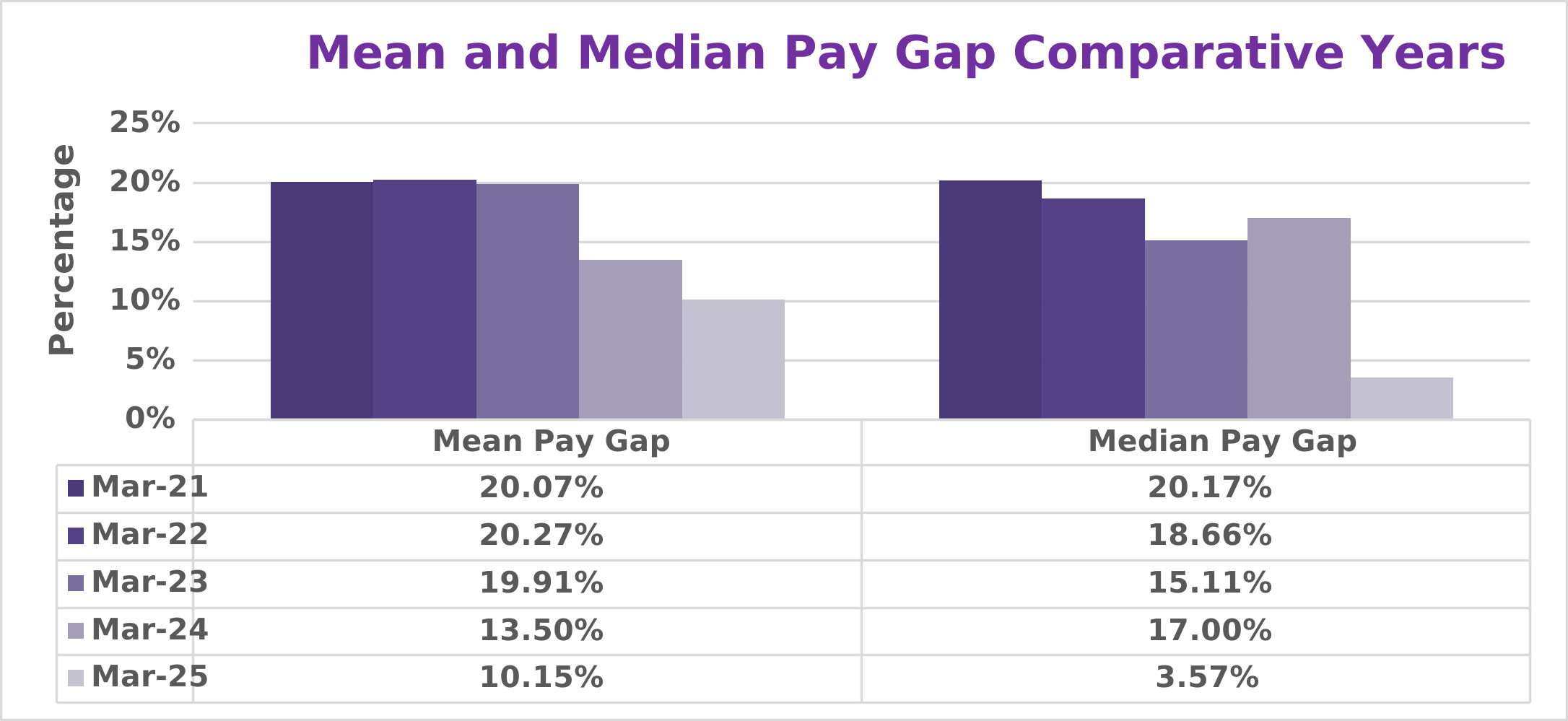
Our pay gap as at March 2025 with comparatives for the preceding five years are as follows.
| Mar-21 | Mar-22 | Mar-23 | Mar-24 | Mar-25 | |
|---|---|---|---|---|---|
| Mean Pay Gap | 20.07% | 20.27% | 19.91% | 13.50% | 10.15% |
| Median Pay Gap | 20.17% | 18.66% | 15.11% | 17.00% | 3.57% |
Pay Gap Analysis
The examination of both mean and median pay at the regulator reveals an ethnicity pay gap that generally benefits non-BAME employees. It is important to note that these gaps do not signify a significant difference in pay between BAME and Non-BAME employees at any specific role grade within the organisation.
The ethnicity pay gaps at the regulator primarily stem from the organisation’s demographic makeup, particularly the lack of ethnic diversity in higher paid roles. Addressing these gaps involves providing opportunities in recruitment and for career development and advancement within the organisation to shift that demographic balance.
Bonus Pay Gap
Bonuses are awarded irrespective of gender or any other protected characteristic. To be considered for a bonus, staff must first have successfully completed their six-month probationary period following joining the organisation.
Ethnicity Bonus Values 2025
| Count | Mean Bonus Pay | Median Bonus Pay | |
|---|---|---|---|
| Non-BAME | 165 | 412.64 | 340.00 |
| BAME | 39 | 377.77 | 340.00 |
| Difference (£) | N/A | 34.87 | 0 |
| Difference (%) | N/A | 8.45% | 0.00% |
Bonus Pay Gap
| Mar-21 | Mar-22 | Mar-23 | Mar-24 | Mar-25 | |
|---|---|---|---|---|---|
| Mean Bonus Gap | 3.81% | -1.35% | 9.40% | 0.97% | 8.45% |
| Median Bonus Gap | 0 | 0 | 0 | 0 | 0 |
It is common practice in organisations to proportionally adjust non-consolidated bonus payments based on the number of hours worked by individual employees. Consequently, part-time employees typically receive a lower bonus compared to their full-time counterparts.
It is noted that in a small organisation such as RSH, low staff numbers used for some calculations can make some statistics particularly prone to fluctuation. In 2022, there was a mean bonus pay gap of 1.35%, favouring BAME employees, which contrasts with 2021 when there was a mean bonus gap of 3.81% favouring non-BAME employees. In 2023, there was a mean bonus pay gap of 9.4%, favouring non-BAME, but this shifted to a gap in favour of BAME employees of 0.97% in 2024. This has increased to 8.45% in favour of non-BAME staff in 2025.
Pay Quartiles
| Mar-21 | Mar-22 | Mar-23 | Mar-24 | Mar-25 | ||||||
|---|---|---|---|---|---|---|---|---|---|---|
| Pay Quartile | White % | BAME % | White % | BAME % | White % | BAME % | White % | BAME % | White % | BAME % |
| Top Quartile | 97.70% | 2.30% | 97.83% | 2.17% | 92.31% | 1.92% | 92.19% | 7.81% | 89.74% | 10.26% |
| Upper Middle Quartile | 84.10% | 15.90% | 78.26% | 21.74% | 76.92% | 23.08% | 81.25% | 18.75% | 84.62% | 15.38% |
| Lower Middle Quartile | 79.50% | 20.50% | 89.36% | 10.64% | 88.68% | 9.43% | 81.25% | 18.75% | 80.77% | 19.23% |
| Bottom Quartile | 74.40% | 25.60% | 65.96% | 34.04% | 66.04% | 32.08% | 72.31% | 27.69% | 76.62% | 23.38% |
| Total | 84.00% | 16.00% | 82.80% | 17.20% | 80.95% | 16.67% | 81.71% | 18.29% | 82.96% | 17.04% |
In March 2025, BAME employees constitute 17.04% of the total workforce, compared to 18.29% in 2024.
There continues to be notable variations in BAME representation across different pay quartiles since 2021, notably an increase in the proportion of BAME staff in the top quartile, and a similar decrease in proportion in the upper middle quartile, which has resulted in a narrowing of the median gap.
For the same period, there has also been an increase in proportion of BAME staff in the lower middle quartile and a decrease in the proportion of BAME staff in the bottom quartile.
As previously noted, we have seen significant levels of recruitment over the period 2023 to 2024, and this continued in the period 2024 to 2025 which saw our highest level of recruitment so far. Again, this resulted in a shift in quartile boundaries resulting in fluctuations in the annual snapshot pay gap information. As previously, this makes it more difficult to identify underlying trends, however we have increased the overall diversity of the organisation throughout that growth.
Our ethnicity pay gap journey
Comparing the results of the ethnicity pay gap at The Regulator of Social Housing for the last five years, we continue to strive to close our pay gap. Progress has been modest overall as whilst we have increased diversity in the Upper Middle and Bottom quartiles the net impact has been limited. We have also seen an increase in diversity in the Top quartile, and continuing this increase remains critical to reducing the pay gap.
What are we doing about the gap?
Our commitment to fostering a more inclusive organisation is detailed in our equality, diversity and inclusion strategy. Our overarching diversity and inclusion goals are strategically designed to have a positive influence on our overall diversity which will, when successful, act to close the pay gap. With regards to specific actions, we will direct our efforts toward areas where we anticipate the most significant impact in the year 2025/26.