Forthcoming change: updates to TAG economic and demographic parameters
Updated 5 November 2026

© Crown copyright 2026
This publication is licensed under the terms of the Open Government Licence v3.0 except where otherwise stated. To view this licence, visit nationalarchives.gov.uk/doc/open-government-licence/version/3 or write to the Information Policy Team, The National Archives, Kew, London TW9 4DU, or email: psi@nationalarchives.gov.uk.
Where we have identified any third party copyright information you will need to obtain permission from the copyright holders concerned.
This publication is available at https://www.gov.uk/government/publications/forthcoming-changes-and-previous-versions-of-tag/forthcoming-change-updates-to-tag-economic-and-demographic-parameters
Description: updates to TAG economic and demographic parameters
Unit: TAG data book, tabs: annual parameters, A5.3.1, TAG unit A1.1 (cost-benefit analysis)
Change announced: November 2026
Expected release date: December 2026
Description
We are updating the transport analysis guidance (TAG) data book’s economic and demographic parameters after the Office for Budget Responsibility (OBR) and the Office for National Statistics (ONS) published updated data and forecasts.
Detail
Changes to economic and demographic parameters
The TAG data book includes economic and demographic parameters used across transport appraisal. These parameters are updated periodically to reflect the latest available data and forecasts from the OBR and the ONS.
Since the May 2026 updates to the TAG data book, the OBR has released:
- the economic and fiscal outlook (EFO) underlying the Budget announced on 28 October 2026
- the long-term economic determinants (LTED) underlying its March 2026 EFO
- the 2026 fiscal risks and sustainability (FRS) report
The EFO provides the OBR’s medium-term forecast, while the LTED provide the longer-term economic and demographic assumptions needed to extend the data book’s annual parameters beyond the 5-year EFO forecast period.
Key insights from the 2026 LTED and FRSR are:
- long-term labour productivity growth remains unchanged at 1.5% per annum, as currently in the TAG data book
- minor downward revision of real GDP per capita growth (-0.27 percentage points) and GDP deflator (-0.1 percentage point) over the LTED forecast horizon (2031-32 to 2075-76)
- no changes in the long-term trends of CPI and RPI/CPIH
A significant change in the economic and demographic parameters comes from updated population projections. This is relevant to appraisal practitioners because TAG unit A1.1 recommends that after the last modelled year, demand-related impacts should be extrapolated in line with the OBR’s choice of population projection.
The OBR has now adopted ONS’s 2024-based principal population projection, while last year it adopted ONS’s 2022-based migration category variant population projection. Chart 1 shows the 2 projections until 2076, the last year of the OBR’s forecast horizon.
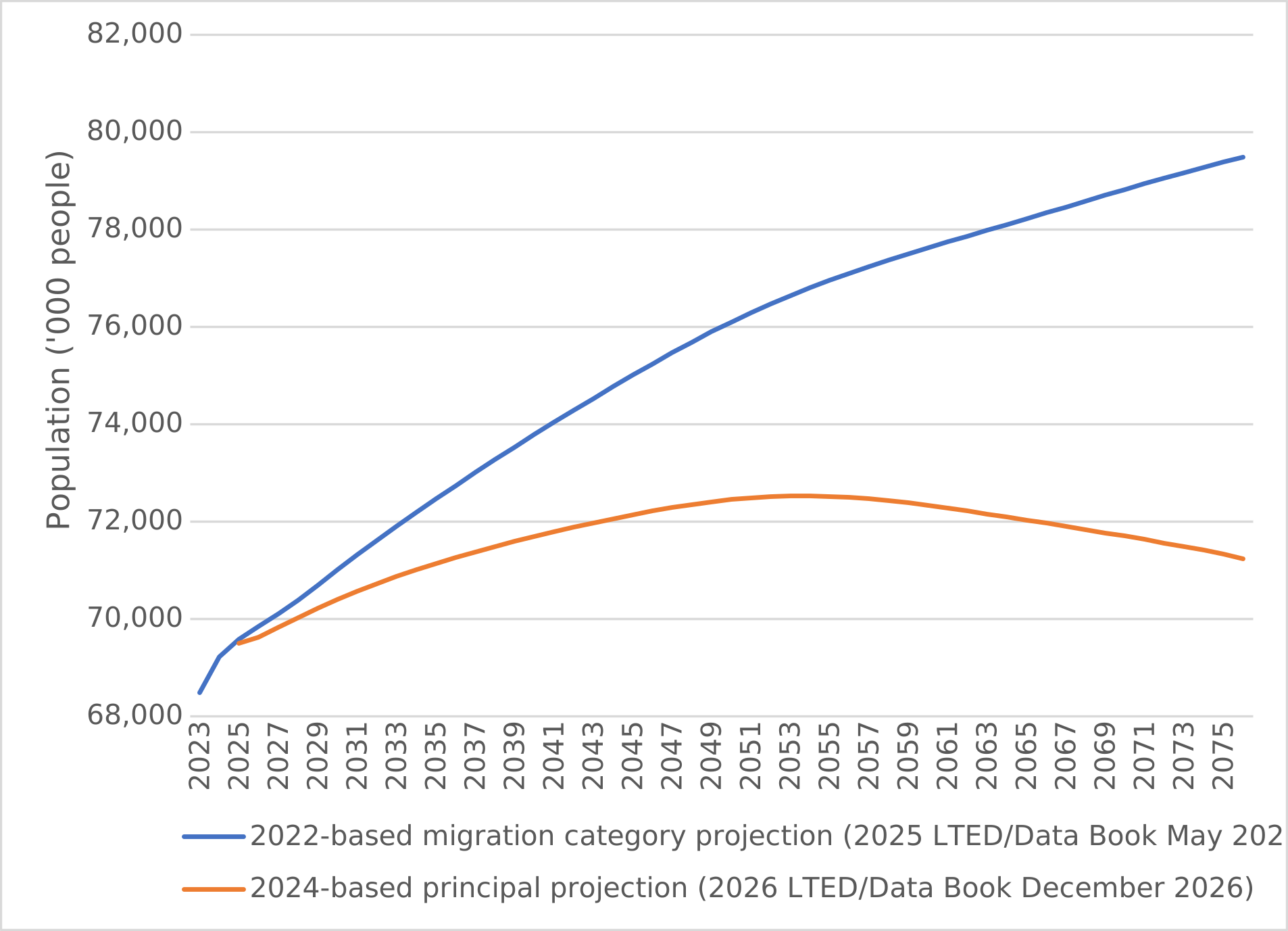
Chart 1: 2022-based migration category projection and 2024-based principal projection
By the end of the forecast period, in the 2024-based principal projection (TAG data book December 2026), population is projected to be approximately 8 million people lower than in the 2022-based migration category variant (TAG data book May 2026).
More importantly, in the 2024-based principal projection, population grows until 2054 and decreases thereafter. As mentioned earlier, this may have implications for the extrapolation of demand-linked transport impacts, particularly rail demand forecasts.
Contact
For further information on this guidance update, please contact:
Transport Appraisal and Strategic Modelling (TASM) Division
Department for Transport
First floor, Great Minster House
33 Horseferry Road
London
SW1P 4DR