
Developing your benefit area
Published 22 June 2026
Applies to England

© Crown copyright 2026
This publication is licensed under the terms of the Open Government Licence v3.0 except where otherwise stated. To view this licence, visit nationalarchives.gov.uk/doc/open-government-licence/version/3 or write to the Information Policy Team, The National Archives, Kew, London TW9 4DU, or email: psi@nationalarchives.gov.uk.
Where we have identified any third party copyright information you will need to obtain permission from the copyright holders concerned.
This publication is available at https://www.gov.uk/government/publications/fcerm-project-metrics-and-benefit-areas/developing-your-benefit-area
1. Developing your benefit area
When you submit a project opportunity, you will need to create and submit a project benefit area. Defining which areas and properties benefit from investment defines what a benefit area is and the methods you can use to create one.
If your project is approved for early project development, you should continually review the benefit area and update it to reflect the latest understanding of the project’s benefits. You should continue to review and, if necessary, update the benefit area until the completion of your project.
Proposals with the following project types must maintain a benefit area shapefile:
- Defence (including natural flood management projects)
- Asset Refurbishment
- Asset Replacement
- Study
- Strategy
- Habitat Compensation and Restoration
2. Projects resulting in flood or coastal erosion benefits
2.1 Guidelines for benefit areas
The benefit area of your project must represent the area that could plausibly benefit from the intervention. The benefit area of your project should not:
- only show the footprint of the asset
- include an area that is not at flood or coastal erosion risk
The examples below show a red line on the left bank of a river where there is either a new defence or a refurbished existing defence. The blue area is the area at flood risk. The blue dots show the outline of the benefit area. Each example shows a benefit area. Example 1 is acceptable. Example 2, 3 and 4 are not acceptable.
Example 1
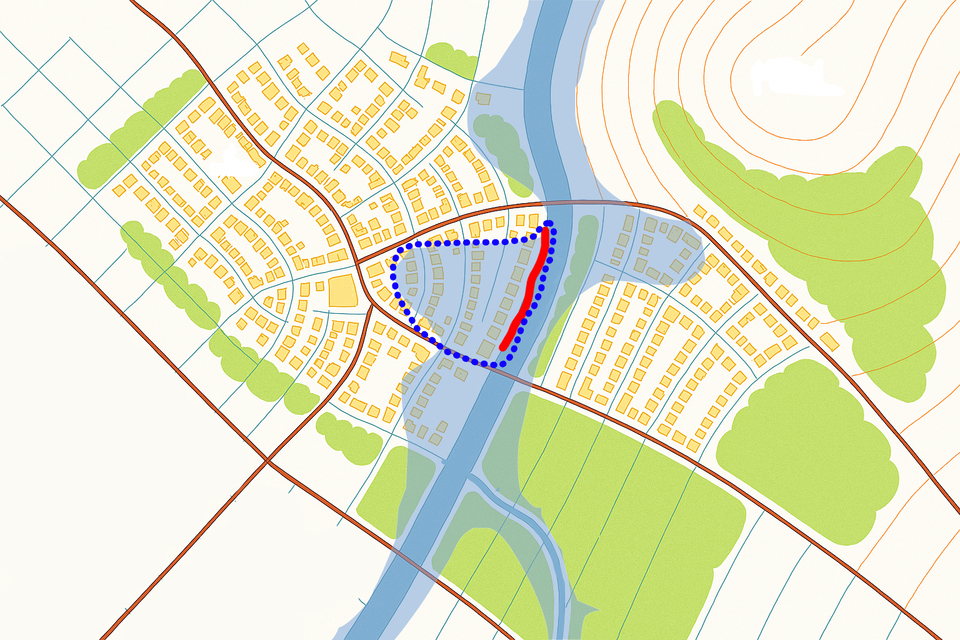
Example 1: An acceptable benefit area. Credit Environment Agency.
This is acceptable. The area is at risk of flooding and will plausibly benefit from the investment.
Example 2
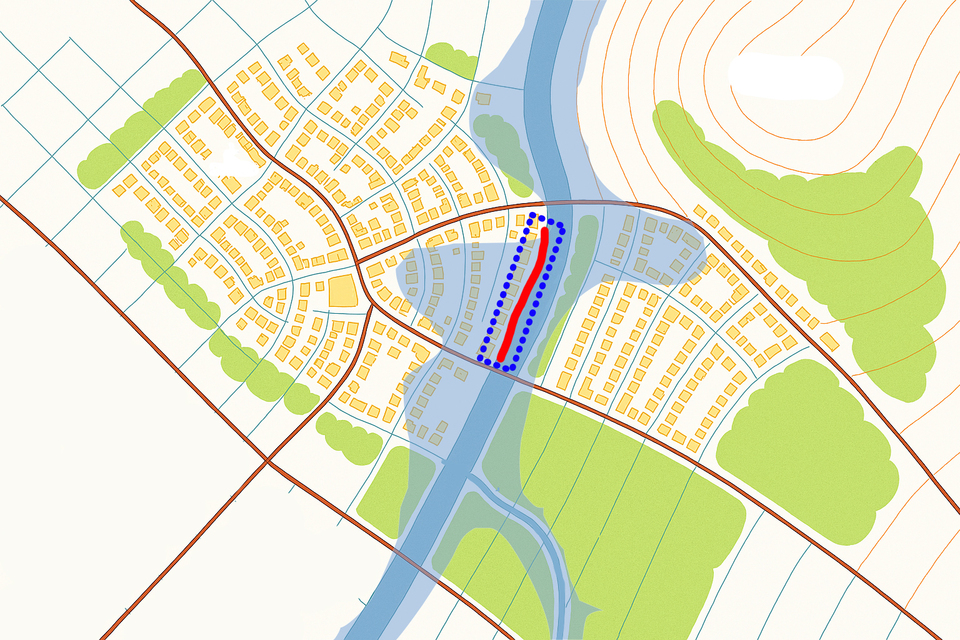
Example 2: An unacceptable benefit area. Credit Environment Agency.
This is not acceptable. The benefit area covers the asset only and not the area that will benefit.
Example 3
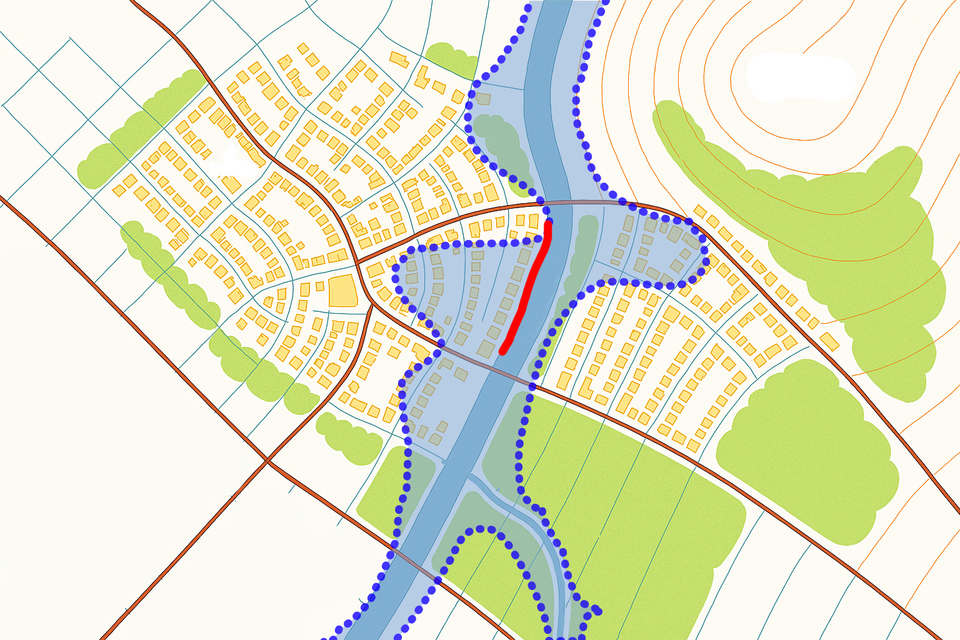
Example 3: An unacceptable benefit area. Credit Environment Agency.
This is not acceptable. The benefit area includes area that would not plausibly benefit from the asset.
Example 4
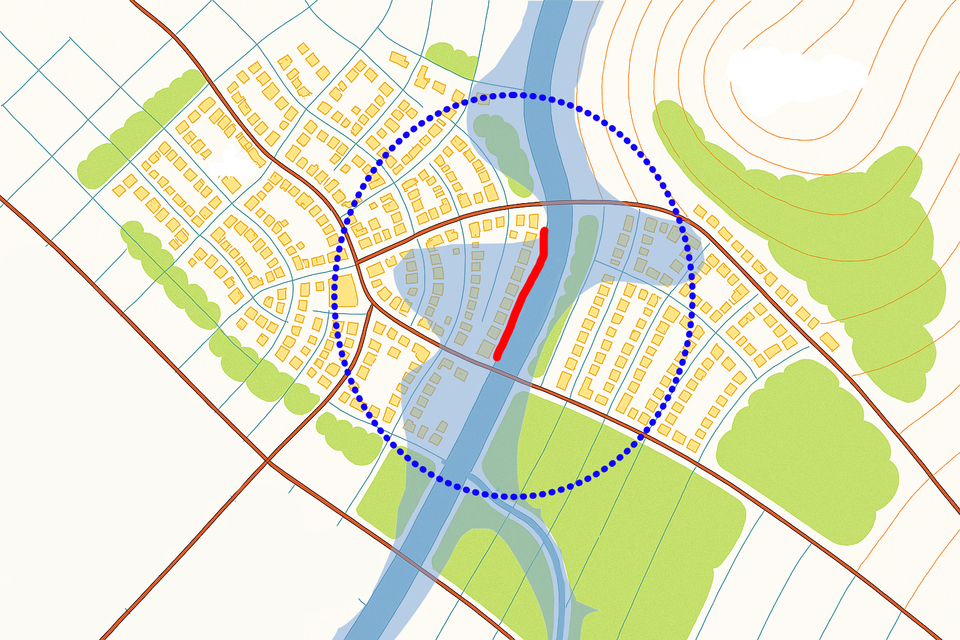
Example 4: An unacceptable benefit area. Credit Environment Agency.
This is not acceptable. The benefit area includes area not at risk and area that would not plausibly benefit from the asset.
2.2 Source of risk
Throughout your project, depending on the source of flood risk, you should define your benefit area using the best flood risk evidence available. Defining which areas and properties benefit from investment outlines the national datasets that should be used when you are submitting a project opportunity. If your project is approved for early project development, you can begin to refine the benefit area with any project specific data that becomes available. You could include any modelling that has been completed to support the project’s appraisal.
2.3 Defence projects building new or improved assets
If your project is approved for early project development, you should refine your benefit area as you develop your outline or single stage business case. You may have carried out some project specific modelling, and a preferred option will have been identified. You should update the benefit area to reflect this preferred option using the data that has informed the business case. The benefit area should represent your best understanding of the entire area that will see a measurable reduction in flood risk due to the investment.
When your project is completed, you should ensure the benefit area reflects the benefits of the completed intervention. In most cases, project specific modelling should be used to inform the benefit area.
2.4 Sustainable drainage systems (SuDS)
If your project is approved for early project development, you should refine your benefit area as you develop your outline business case. You may have carried out some project specific modelling, and identified a preferred option. You should update the benefit area to reflect this preferred option using the data that has informed the business case. The benefit area should represent your best understanding of the entire area that will see a measurable reduction in flood risk. If you are following the Surface Water Investment Model (SWIM) appraisal route, refine your benefit area to reflect the specific locations of flood risk that are likely to receive benefits. You should exclude locations that only receive wider benefits (such as greening or biodiversity gains) without a measurable reduction in surface water risk. The SuDS features themselves may be located outside the benefit area.
When your project is completed, you should ensure the benefit area reflects the benefits of the completed intervention. In many cases, you should use project specific modelling to inform the benefit area. The benefit area should represent your best understanding of the entire area that will see a measurable reduction in flood risk due to the investment.
2.5 Natural Flood Management
For standalone natural flood management (NFM) projects under £3 million, use the method at Defining which areas and properties benefit from investment - GOV.UK through all stages of your project. This assessment should be updated when any changes are made to the downstream point of the NFM interventions or the volume of effective storage.
For NFM interventions where the project includes hard-engineering or other resilience measures, you should define the benefit area using the benefits of the main intervention.
2.6 Property flood resilience
If your project is approved for early project development, you should refine your benefit area as you develop your outline or single stage business case. You should ensure your benefit area focused on the areas that are most likely to have property flood resilience (PFR) installed. You should avoid overly large benefit areas which include locations with little or no flood risk.
As you develop the project further you should have a good understanding of where PFR measures are likely to be installed. You should aim to show the specific locations that will benefit from the investment down to the street level if possible. The benefit area should highlight the specific hotspots of flood risk that the project will seek to benefit. This could comprise several small polygons across a wider area that has been defined as high risk.
When your project is completed, your benefit area should reflect the PFR measures that have been installed in as much detail as is reasonably possible. For large projects, you should aim to define the benefit area to at least a street level. For small projects you should aim for property level where possible.
2.7 Asset refurbishment and asset replacement
If your project is approved for early project development, you should refine your benefit area as you develop your outline or single stage business case. As you develop the business case, there may be an improved understanding of the specific area that the project will benefit. The benefit area should reflect the area of land that would see an increase in risk if the investment did not occur.
For asset related projects, project specific modelling may not be required so refinements should focus on reflecting the data that as informed the appraisal. You should review the benefit area when the asset is ready for service, to ensure it reflects the benefit of the intervention.