FCDO Main Estimates Memorandum 2026 to 2027
Published 29 April 2026

© Crown copyright 2026
This publication is licensed under the terms of the Open Government Licence v3.0 except where otherwise stated. To view this licence, visit nationalarchives.gov.uk/doc/open-government-licence/version/3 or write to the Information Policy Team, The National Archives, Kew, London TW9 4DU, or email: psi@nationalarchives.gov.uk.
Where we have identified any third party copyright information you will need to obtain permission from the copyright holders concerned.
This publication is available at https://www.gov.uk/government/publications/fcdo-main-estimates-memorandum-2026-to-2027/fcdo-main-estimates-memorandum-2026-to-2027
1. Overview
The FCDO makes the UK stronger, safer and more prosperous, by leading and integrating delivery of the Government’s objectives abroad.
FCDO2030 is a strategic transformation that will redefine how the Foreign, Commonwealth & Development Office delivers for the UK in an increasingly complex and volatile world. The purpose of FCDO2030 is clear: to ensure the UK’s interests are advanced and protected, and to deliver better results for the British people. We are building an organisation that is agile, innovative, and equipped to tackle the challenges and seize the opportunities of tomorrow.
The Main Estimate 2026-27 provides details of the changes to the FCDO’s budget since the Spending Review 2025 (SR25).
1.1. Objectives
The FCDO’s Priorities for the Main Estimate in 2026-27 are as follows:
1. Security
Protecting Euro-Atlantic security, strengthening the NATO alliance, supporting Ukraine and deterring Russian aggression. Transforming UK capability to address growing hybrid threats to our economy, democratic processes and institutions, and working with allies to respond to escalating security threats or conflicts and disrupt hostile actors including terrorist threats.
2. Growth and resilience
Prioritising a targeted set of high-value economic partnerships to deliver growth and jobs in the UK. Securing new trade and investment wins to strengthen the UK economy. Boosting Britain’s economic security, resilience and geoeconomic position by de-risking critical supply chains, navigating bloc dynamics and sharpening our advantage in key sectors.
3. Migration
Increased international cooperation to drive down small boat arrivals and strengthen UK border security. Deterring illegal migration through returns agreements with neighbours and innovative approaches further afield. Improving law enforcement cooperation. Reforming global migration policy to deliver a managed and principled resettlement and migration system fit for the modern world.
4. Development and climate
Working for a world free from poverty on a liveable planet where the UK helps to anticipate crisis, reduce humanitarian need and reduce violent conflict. Strengthening resilience to climate impacts, accelerating the global clean energy transition and seizing the opportunities for Britain. Reforming the global development architecture and modernising our approach: shifting from donor to investor, from service delivery to system support, from grants to expertise, and from international intervention to local leadership and focusing most support on fragile and conflict affected states.
5. Women and girls
As pressures on women’s and girls’ safety and rights are intensifying and increasingly used to polarise societies, prioritising this agenda is both a core UK value and a strategic imperative for global stability and progress. We will embed women’s and girls’ safety and rights at the heart of our diplomatic, security, trade, and development work. We will deliver change across our posts, using our influence multilaterally and driving new collaborations and partnerships to scale action and finance, and to rebuild a global consensus around progress for women and girls.
6. Agile alliances
Pursuing resilient, pragmatic partnerships with states where we have shared priorities. Sustaining traditional partnerships while minimising dependencies and diversifying alliances to serve Britain’s interests and increase our agency abroad. Making Britain a partner of choice in a contested and competitive world. Supporting reform and renewal of vital multilateral institutions including the United Nations.
FCDO’s spending is designed to support its objectives.
1.2. Spending controls
The FCDO’s spending is broken down into several different spending totals, for which Parliament’s approval is sought.
The spending totals which Parliament votes are:
- Resource Departmental Expenditure Limit (“Resource DEL”): day-to-day running costs of the department. In the FCDO’s case, mainly programme funds, frontline diplomacy and development, the overseas platform, scholarships, grants to international organisations and other bodies supporting FCDO objectives and associated non-cash items
- Capital Departmental Expenditure Limit (“Capital DEL”): investment in infrastructure, or loans. In the FCDO’s case, mainly investment in capital assets, capital grants, research and development, and investments and assets to create growth in the future for either the UK or our partner governments
- Resource Annually Managed Expenditure (“Resource AME”): less predictable day-to-day spending. In the FCDO’s case, this includes accounting adjustments for financial guarantees, impairments, provisions, foreign exchange, and the refund of certain taxes and duties paid by certain foreign and Commonwealth governments
-
Capital Annually Managed Expenditure (“Capital AME”): less predictable investment spending. In the FCDO’s case, the FCDO is required to record capital injections in its wholly owned self-financing public corporation, British International Investment (BII) as prescribed by the government budgeting rules
- in addition, Parliament votes a net cash requirement, designed to cover the elements of the above budgets which require FCDO to pay out cash in year
1.3. Main areas of spending
The graphic below shows the main components of FCDO’s proposed budget for the new year, included in the latest Main Estimate, and the proportions of funds spent on its main activities.
Resource DEL by spending area in 2026-27 (£ million)
(Total budget £6,282.9 million)
| Description | £m |
|---|---|
| D: Regional bilateral programmes | 1,847.1 |
| A: Operating costs, frontline diplomacy and overseas network | 1,805.2 |
| F: Centrally managed programmes | 843.3 |
| E: Core multilateral programmes | 511.4 |
| H: International Security Fund | 499.1 |
| G: International subscriptions, scholarships and BBC World Service | 443.1 |
| C: British Council | 183.0 |
| I: European Union Attributed Aid | 109.0 |
| B: Funding for NDPBs within Departmental Group (Net) | 41.6 |
Capital DEL by spending area in 2026-27 (£ million)
(Total budget £3,140.3 million)
| Description | £m |
|---|---|
| E: Core multilateral programmes | 1,563.8 |
| F: Centrally managed programmes | 764.5 |
| A: Operating costs, frontline diplomacy and overseas network | 540.6 |
| D: Regional bilateral programmes | 271.4 |
1.4. Comparison of spending totals sought
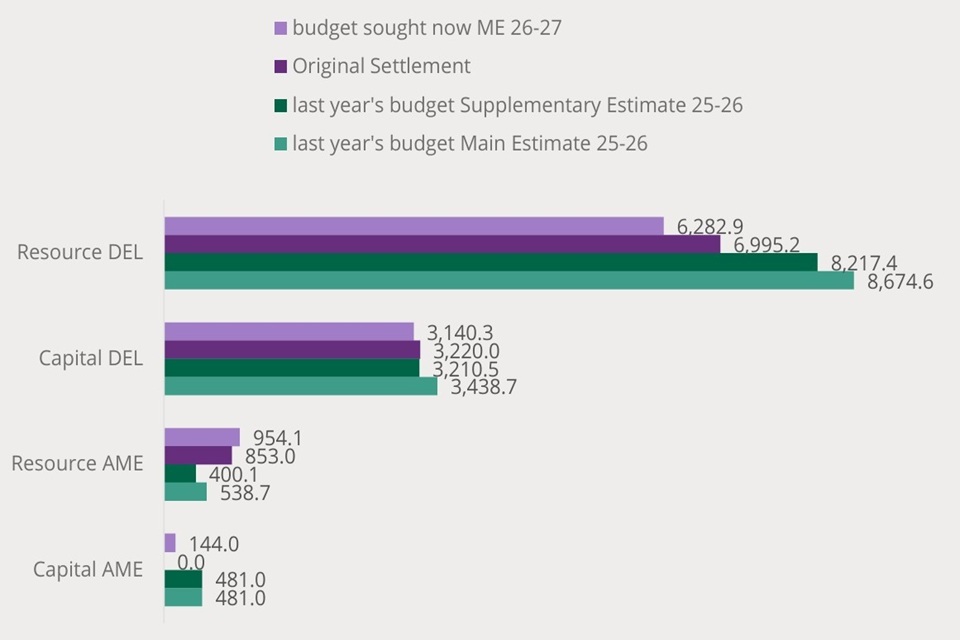
The table and graphic below show how the totals sought for the FCDO in its Main Estimate compare with last year and the latest Spending Review settlement (SR 2025):
| Amounts sought this year (Main Estimate 2026-27) | Difference £m (+/-) compared to final budget last year (Supplementary Estimate 2025-26) | Difference % (+/-) compared to final budget last year (Supplementary Estimate 2025-26) | Difference £m (+/-) compared to original budget last year (Main Estimate 2025-26) | Difference % (+/-) compared to original budget last year (Main Estimate 2025-26) | Difference £m (+/-) compared to Spending Review (SR 2025) | Difference % (+/-) compared to Spending Review (SR 2025) | |
|---|---|---|---|---|---|---|---|
| Resource DEL | 6283 | -1,934 | -24% | -2,392 | -28% | -712 | -10% |
| Capital DEL | 3140 | -70 | -2% | -298 | -9% | -80 | -2% |
| Resource AME | 954 | 554 | 138% | 415 | 77% | 101 | 11% |
| Capital AME | 144 | -337 | -70% | -337 | -70% | 144 | 100% |
FCDO budget comparison for Main Estimate 2026-27 (£ million)
1.5. Key drivers of spending changes since last year
The main causes of the changes in Resource DEL arise from the revised levels of DEL funding for the FCDO for 2026-27 published in the 2025 Spending Review for the department.
Notable amongst DEL changes are:
- Machinery of Government transfer of UKISF budget to the Cabinet Office £580.2 million
- ODA allocations for 2026-27 have been announced – see 1.8 below for further information
- the depreciation budget has transferred from Resource DEL to Resource AME £389.9 million
All other spend is similar to 2025-26.
1.6. Key drivers of change since the Spending Review
The levels of DEL funding for the FCDO for 2026-27 are based on plans published in the 2025 Spending Review for the department. Since that time, the Government has made a number of changes to 2026-27 spending plans. Details of funding changes are set out in the Table at Annex B.
Notable amongst Resource DEL changes are:
- Machinery of Government changes to transfer the Integrated Security Fund to the Cabinet Office and multi-year budget transfer to Home Office and Ministry of Defence
| £000 | 2026-27 | 2027-28 | 2028-29 |
|---|---|---|---|
| Budget Cover Transfer: HO | £30,000 | £70,000 | £100,000 |
| Budget Cover Transfer: MOD | £5,000 | £5,000 | £5,000 |
| Cabinet Office inc. £12 million Budget Exchange from 2025-26 to 2026-27 | £545,220 | £499,200 | £471,250 |
| £580,220 | £574,200 | £576,250 |
- the depreciation budget has transferred from Resource DEL to Resource AME (£389.9 million)
- as agreed in the Supplementary Estimate, a budget exchange from 2025-26 to 2026-27 for the International Security Fund of £12.0 million and £12.0 million for the Voluntary Exit scheme to align budgets with timing of spend
Notable amongst Capital DEL changes are:
- budget for British International Investment is received within the FCDO’s Capital DEL Financial Transactions budget before it is switched to Capital AME £143.0 million
- as agreed in the Supplementary Estimate, a budget exchange from 2025-26 to 2026-27 of £55.0 million for Capital expenditure to align budgets with timing of spend
1.7. Reserve claims and spending pressures
In 2026-27 the FCDO will be operating within the Spending Review settlement received in SR25. Budgets will be monitored throughout the year to identify spending pressures. In line with the HM Treasury approach to reduce future Reserve access, any requirement to be drawn will be evaluated tautly and realistically and will be raised ahead of the Supplementary Estimate 2026-27.
1.8. Funding and other spending announcements
Official Development Assistance (ODA)
In recent years, the world has been reshaped by global instability. Faced with growing global security threats the Government last year took the decision to increase spending on defence by reducing ODA to the equivalent of 0.3% of GNI by 2027. The UK will return to spending 0.7% of GNI on ODA when fiscal circumstances allow.
The UK’s commitment to international development is as important as ever – it reflects UK values, supporting those in conflict and extreme poverty, and is also in the UK national interest because in an interconnected world, crises and instability across the world undermine our security and prosperity at home.
On Thursday 19 March 2026, the Foreign Secretary set out FCDO ODA programme allocations from 2026/27 to 2028/29. The FCDO’s priority themes for ODA remain humanitarian, global health, and climate and nature, underpinned by economic development. The FCDO will prioritise countries affected by war and crises, including increasing the share of country and regional ODA allocated to fragile and conflict affected states. Women and girls will be at central to the UK’s international development work. The FCDO will increase the share of ODA spent through multilateral organisations, targeted strategically towards the most effective organisations. See Annex A for further details of ODA allocation.
UK Integrated Security Fund (UKISF)
As announced by the Prime Minister in the Written Ministerial Statement on 14 April 2026 the management of the Integrated Security Fund, and associated funding, was permanently transferred from the Foreign, Commonwealth and Development Office to the Cabinet Office.
The Integrated Security Fund is the UK’s cross-government national security fund, which works to address major threats to the UK and its interests. This change consolidates the management of the Fund within the Cabinet Office, simplifying the Fund’s leadership and delivery structures. By centralising these functions in the Cabinet Office, the Government will improve its ability to respond to an evolving domestic and international threat landscape.
This change took effect from 1 April 2026.
Details of all new funding announcements by the FCDO can be found on GOV.UK.
1.9. New policies and programmes; ambit changes
Details of all new policies and programmes announced by the FCDO can be found on GOV.UK.
There are no changes to the FCDO’s ambit in 2026-27.
1.10. Administration costs and efficiency plans
Administration costs are set to decrease by 6% in 2026-27 compared to last year’s final budget.
| Amounts sought this year (Main Estimate 2026-27) | Difference £m (+/-) compared to final budget last year (Supplementary Estimate 2025-26) | Difference % (+/-) compared to final budget last year (Supplementary Estimate 2025-26) | Difference £m (+/-) compared to original budget last year (Main Estimate 2025-26) | Difference % (+/-) compared to original budget last year (Main Estimate 2025-26) | Difference £m (+/-) compared to Spending Review (SR 2025) | Difference % (+/-) compared to Spending Review (SR 2025) | |
|---|---|---|---|---|---|---|---|
| Administration costs | 327 | -20 | -6% | -61 | -16% | -1 | 0% |
The FCDO are committed to delivering overall savings and efficiencies in 2026-27. Details of technical efficiencies will be provided in the next edition of the quarterly Government Efficiency Framework reporting.
1.11. Spending trends
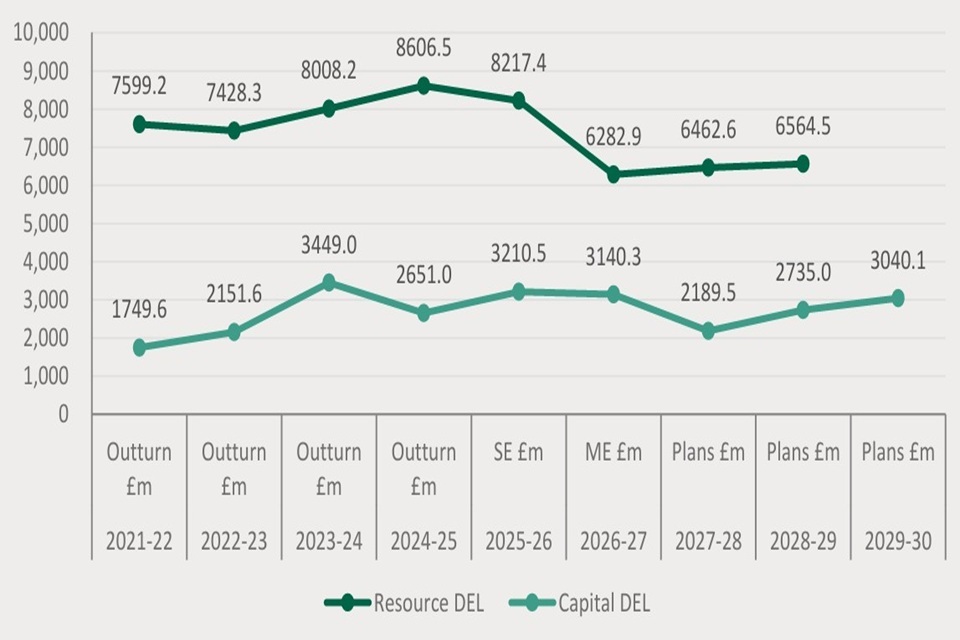
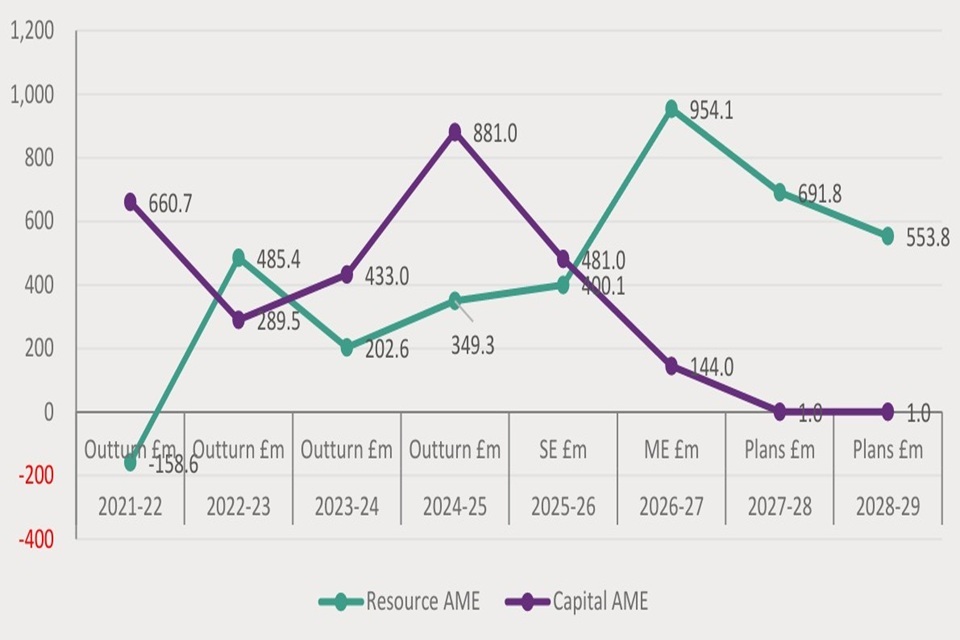
The charts below show overall spending trends for the last five years, plans presented in Estimates for 2026-27.
FCDO spending trends (£million)
Capital and Resource DEL
Capital and Resource AME
- Resource DEL has reduced since the Supplementary Estimate 2025-26 due to the transfer of depreciation from Resource DEL to Resource AME, the transfer of UKISF to the Cabinet Office and the reduction to ODA allocations
- Capital DEL has broadly remained stable between the Supplementary Estimate 2025-26 and the Main Estimate 2026-27. The reduction in plans years arises mainly from the reduction to ODA allocations
- Resource AME has been steadily increasing due to an increase in Financial Guarantees and the transfer of depreciation from Resource DEL to Resource AME
- Capital AME has reduced to £143 million in line with the 3 year ODA Budget allocations announced by the Foreign Secretary in the Written Ministerial Statement of 19th March
2. Spending detail
2.1. Explanations of changes in spending
Resource DEL
The table comments below show how the FCDO’s spending plans for Resource DEL at the Main Estimate 2026-27 compared with the budget received in the Spending Review 2025.
Differences of more than 10% which are more than £10 million; of more than 5% and £200 million; and significant or unusual changes, are explained below. Numbers relate to the relevant row in the table above. Further detail of spending within these totals is given in the Annex Tables.
| Subhead | Description | This year (2026-27 Main Estimate budget sought) £m | Spending Review 2025 (SR budget approved) £m | Change from Spending Review £m | Change from Spending Review % | See note number |
|---|---|---|---|---|---|---|
| A | Operating costs, frontline diplomacy and overseas network | 1,826.2 | 1,793.8 | 32.4 | 2% | 1 |
| B | Funding for NDPBs within Departmental Group (Net) | 41.6 | 41.6 | 0.0 | 0% | |
| C | British Council | 183.0 | 183.0 | 0.0 | 0% | |
| D | Regional bilateral programmes | 1,850.8 | 1,854.5 | -3.7 | 0% | |
| E | Core multilateral programmes | 511.4 | 511.4 | 0.0 | 0% | |
| F | Centrally managed programmes | 843.3 | 961.9 | -118.6 | -12% | 2 |
| G | International subscriptions, scholarships and BBC World Service | 443.1 | 443.1 | 0.0 | 0% | |
| H | Integrated Security Fund | 499.1 | 816.0 | -316.9 | -39% | 3 |
| I | European Union Attributed Aid | 109.0 | 0.0 | 109.0 | 100% | 4 |
1. Operating costs, frontline diplomacy and overseas network
The net increase comprised mainly of:
- a Budget Exchange of £12.0 million Resource DEL from 2025-26 to 2026-27 for the Voluntary Exit scheme to align budget with the timing of departures
- net budget transfers made of £0.6 million to other departments
2. Centrally-managed programmes costs
The net decrease comprised mainly of:
- a budget switch of £109.0 million from voted to non-voted for EU Attributed Aid. The budget for EU Attributed Aid is received within the FCDO’s voted programme budget (See note 5 below)
- net budget transfers made of £9.6 million to other departments, comprising of £10.0 million to the Cabinet Office for G7 and G20 funding
3. Integrated Security Fund (ISF)
The net decrease comprised mainly of:
- a Budget Exchange of £12.0 million Resource DEL from 2025-26 to 2026-27 to align budget with the timing of expenditure
- a Machinery of Government transfer to Cabinet Office of £580.2 million and
- net budget transfers received of £251.4 million from Cabinet Office for ISF programmes to be undertaken by the FCDO
4. European Union Attributed Aid
Under the EU-UK Withdrawal Agreement, the UK will continue to meet outstanding commitments to EU development programmes, the EU budget (MFF 2014-2020) and the European Development Fund until around 2027. A budget switch of £109.0 million is requested from voted to non-voted for EU Attributed Aid.
Capital DEL
The table comments below show how the FCDO’s spending plans for Capital DEL at the Main Estimate 2026-27 compared with the budget received in the Autumn Spending Review 2025 and the Supplementary Estimate 2025-26.
| Subhead | Description | This year (2026-27 Main Estimate budget sought) £m | Spending Review 2025 (SR budget approved) £m | Change from Spending Review £m | Change from Spending Review % | See note number |
|---|---|---|---|---|---|---|
| A | Operating costs, frontline diplomacy and overseas network | 540.6 | 478.5 | 62.1 | 13% | 5 |
| D | Regional bilateral programmes | 271.4 | 271.4 | -0.0 | 0% | |
| E | Core multilateral programmes | 1,563.8 | 1,563.8 | 0.0 | 0% | |
| F | Centrally managed programmes | 764.5 | 906.3 | -141.8 | -16% | 6 |
| H | Integrated Security Fund | 0.0 | 0.0 | -0.0 | 0% |
Differences of more than 10% which are more than £10 million; of more than 5% and £200 million; and significant or unusual changes, are explained below.
5. Operating costs, frontline diplomacy and overseas network
The net increase comprised mainly of:
- a Budget Exchange of £55.0 million Capital DEL from 2025-26 to 2026-27 due to changes and delays in estates budget spend
- net budget transfers received of £7.1 million from the Departments for Science, Innovation and Technology for Science and Technology staff costs
6. Centrally Managed Programmes Costs
The decrease of £143 million is from the budget switch from Capital DEL to Capital AME for British International Investment (BII). (See 9 below)
Resource AME
The table comments below show how the FCDO’s spending plans for Resource AME at the Main Estimate 2026-27 compared with the budget received in the Autumn Budget 2024.
| Subhead | Description | This year (2026-27 Main Estimate budget sought) £m | Spending Review 2025 (SR budget approved) £m | Change from Spending Review £m | Change from Spending Review % | See note number |
|---|---|---|---|---|---|---|
| J | Other central programme and technical costs | 954.1 | 463.1 | 491.0 | 106% | 7,8 |
Differences which are significantly above or below inflation are explained below.
7. Other central programme and technical costs
Resource AME is used primarily for accounting adjustments and by definition is volatile. £101.0 million increase is due to an increase in Financial Guarantees.
8. Depreciation
The £389.9 million increase to RAME arises from the technical accounting decision by HMT to reclassify depreciation and impairments from ring-fenced Resource DEL to Resource AME from 2026-27.
Capital AME
The table comments below show how the FCDO’s spending plans for Capital AME at the Main Estimate 2026-27 compared with the budget received in the Autumn Budget 2024.
| Subhead | Description | This year (2026-27 Main Estimate budget sought) £m | Spending Review 2025 (SR budget approved) £m | Change from Spending Review £m | Change from Spending Review % | See note number |
|---|---|---|---|---|---|---|
| K | British International Investment | 144.0 | 1.0 | 143.0 | 100% | 9 |
Differences which are significantly above or below inflation are explained below.
9. British International Investment
Capital AME shows British International Investment’s (BII) forecast capital needs. The increase to Capital AME shows additional funding to recapitalise FCDO’s investment in British International Investment plc. Budget for British International Investment is received within the FCDO’s Capital DEL Financial Transactions budget before it is switched to Capital AME.
2.2. Restructuring
In April 2026 the Prime Minister, Sir Keir Starmer, announced in a Written Ministerial Statement that the responsibility for the United Kingdom’s Integrated Security Fund will move from the Foreign, Commonwealth and Development Office to the Cabinet Office. In the Main Estimate, the FCDO transferred £580.2 million as a Machinery of Government transfer to the Cabinet Office.
2.3. Ring-fenced budgets
Within the totals, administration, research and development and financial transactions are ring-fenced and funding cannot be transferred into other parts of the core FCDO budget without HMT approval.
| Amounts sought this year (Main Estimate 2026-27) | Difference £m (+/-) compared to final budget last year (Supplementary Estimate 2025-26) | Difference % (+/-) compared to final budget last year (Supplementary Estimate 2025-26) | Difference £m (+/-) compared to original budget last year | Difference % (+/-) compared to original budget last year | |
|---|---|---|---|---|---|
| Research and Development (CDEL) | 320 | -91 | -22% | -61 | -16% |
| Financial Transactions (CDEL) | 216 | 90 | 71% | 90 | 71% |
| Administration (RDEL) | 327 | -20 | -6% | -61 | -16% |
The reduction in ring-fenced Research and Development budget is due to lower forecasted requirements for 2026-27.
The ring-fenced Financial Transactions budget appears larger in 2026-27 due to a reduction to the amount transferred to BII compared to prior years.
The Administration ring-fenced budget has reduced by £20.0 million. The 2026-27 budget received in SR2025 no longer includes a provision of £41.0 million for depreciation but has increased to reflect the additional budget received from the FCDO2030 programme.
2.4. Changes to contingent liabilities
The FCDO’s contingent liabilities have increased by around £3.2 billion from the Supplementary Estimate 2025-26 to the Main Estimate 2026-27.
The increase mainly relates to financial guarantees of £1.9 billion which were not signed in the financial year 2025-26 but might be in financial year 2026-27, being £1.4 billion for Indonesia and £1.5 billion for Ukraine.
An increase of £0.3 billion relates to gains in foreign exchange on Multilateral Development Banks (MDBs).
3. Priorities and performance
3.1. How spending relates to objectives
It is not possible to reflect the breakdown of resources by Priority as the FCDO is not structured in this way. Our resources, both people and projects, are cross cutting and delivery of our objectives contribute towards all of our Priorities.
3.2. Measures of performance against each priority outcome
Data on the FCDO’s 2025-26 performance will be given in the FCDO 2025-26 Annual Report and Accounts which will be published in Summer 2026.
3.3. Commentary on steps being taken to address performance issues
The Department continues to address the performance issues identified by the Public Accounts Committee and the National Audit Office in relation to the condition, management, and affordability of the overseas estate. The Government accepted all recommendations, as set out in the Treasury Minute published in January 2026, and delivery is now underway.
From 2026–27, the Department is implementing a more structured and risk-based approach to estate management through a new Global Asset Management Plan, aligned with the FCDO2030 reform programme and informed by the Overseas Network Review. Maintenance funding is prioritised using Forward Maintenance Register data, focusing on health and safety, statutory compliance, and operational risk, while reviewing standards and residential policies to reduce long-term maintenance liabilities and improve value for money.
Capital DEL will continue to fund the contractually committed projects that are part of the estates programme of global new builds and refurbishments, including compound works in Tokyo, new offices in Nicosia and Suva, and various infrastructure works in Baghdad. We continue to invest other capital in a long pipeline of smaller projects.
The Department is also investing in improvements to its data, systems, and capability. In 2026–27 it will begin rollout of a computer-aided facilities management system to centralise asset data, compliance records, and project information, improving oversight and decision-making. In parallel, the Department is developing an estates capability and workforce plan, including piloting skills mapping in selected regions, to strengthen project delivery and reduce the risk of underspends and delays. Progress against these actions will continue to be monitored through strengthened governance and reported to Parliament.
The Department will also continue to prioritise investment in cyber security in 2026–27 to drive a sustained reduction in cyber risk. The development and rollout of robust Secure by Design processes will strengthen compliance with the National Cyber Security Centre’s Cyber Assessment Framework and support the delivery of Government Cyber Assurance (GovAssure) outcomes.
In parallel, enhancements to the Department’s 24/7 Security Operations Centre will significantly strengthen security monitoring and incident response, materially improving the Department’s resilience to cyber-attack.
3.4. Major projects
The FCDO will deliver the following major project as defined by the National Infrastructure and Service Transformation Authority (NISTA):
- a project which will refurbish and upgrade key buildings on the British Embassy compound in Tokyo
The following project, although still on the 2024-25 report, has now completed and will be removed from the next NISTA report:
- Echo 2: a joint project with the British Council to provide new network, telephony and video-conferencing services
Progress on major projects is recorded at with the next report due to be published in the summer 2026.
NISTA Annual Report 2024-2025 - GOV.UK
4. Other information
4.1. Additional specific information required by the select committee
The Spring Statement 2024 confirmed the impact of the Government’s decision to reduce ODA to 0.3% of GNI by 2027 to fund increased Defence spend. See section 1.8 for further information on budget allocations for 2026-27.
Provisional UK ODA figures for calendar year 2025 were published on 9th April with final figures expected in Autumn 2026.
5. Accounting Officer Approval
This memorandum has been prepared according to the requirements and guidance set out by the House of Commons Scrutiny Unit, available on the Scrutiny Unit website.
The information in this Estimates Memorandum has been approved by myself as Departmental Accounting Officer.
Nick Dyer
Accounting Officer
Permanent Under-Secretary of State
Foreign, Commonwealth and Development Office
28 April 2026
Annex A
| FCDO ODA Programme | 2024/25 TDEL | 2025/26 Initial Allocation RDEL | 2025/26 Initial Allocation CDEL | 2025/26 Initial Allocation TDEL | 2026/27 Proposed Allocation RDEL | 2026/27 Proposed Allocation CDEL | 2026/27 Proposed Allocation TDEL | 2027/28 Proposed Allocation RDEL | 2027/28 Proposed Allocation CDEL | 2027/28 Proposed Allocation TDEL | 2028/29 Proposed Allocation RDEL | 2028/29 Proposed Allocation CDEL | 2028/29 Proposed Allocation TDEL | SR Average TDEL | 28/29 v 25/26 CDEL | 28/29 v 24/25 TDEL |
|---|---|---|---|---|---|---|---|---|---|---|---|---|---|---|---|---|
| 9037 | 5180 | 3341 | 8522 | 3406 | 2692 | 6098 | 3824 | 1647 | 5471 | 4091 | 2177 | 6268 | 5946 | -26% | -31% | |
| ALBs, International Subs and Scholarships | 402 | 400 | 0 | 400 | 390 | 0 | 390 | 395 | 0 | 395 | 401 | 0 | 401 | 395 | 0% | 0% |
| Multilateral | 2809 | 1271 | 1586 | 2857 | 560 | 1546 | 2,106 | 1086 | 707 | 1793 | 1336 | 1187 | 2523 | 2141 | -12% | -10% |
| Financial Transactions | 1,045 | 0 | 606 | 606 | 0 | 358 | 358 | 0 | 258 | 258 | 0 | 258 | 258 | 291 | -57% | -75% |
| Research and Development | 500 | 13 | 411 | 424 | 0 | 310 | 310 | 0 | 230 | 230 | 6 | 230 | 236 | 259 | -44% | -53% |
| Bilateral ODA | 4,213 | 3528 | 707 | 4235 | 2395 | 364 | 2759 | 2329 | 331 | 2659 | 2294 | 308 | 2602 | 2674 | -39% | -38% |
| Unallocated Budget | 0 | 0 | 0 | 0 | 61 | 114 | 175 | 14 | 121 | 135 | 19 | 194 | 213 | 174 |