Farming Sector Environmental Objectives: invasive non-native species
Published 22 October 2026
Applies to England

© Crown copyright 2026
This publication is licensed under the terms of the Open Government Licence v3.0 except where otherwise stated. To view this licence, visit nationalarchives.gov.uk/doc/open-government-licence/version/3 or write to the Information Policy Team, The National Archives, Kew, London TW9 4DU, or email: psi@nationalarchives.gov.uk.
Where we have identified any third party copyright information you will need to obtain permission from the copyright holders concerned.
This publication is available at https://www.gov.uk/government/publications/farming-sector-environmental-objectives/farming-sector-environmental-objectives-invasive-non-native-species
1. Objective title
The farming sector and delivery partners will deliver 125,000 hectares of actions to control and manage invasive non-native species by 2030.
2. Objective overview
Invasive non‑native species (INNS) are widely recognised as a significant pressure on biodiversity, due to the threats they pose to native species and local ecosystems. Introduced outside their natural range, these species often lack natural predators or controls, allowing them to spread rapidly and disrupt ecological balance. As a result, mitigating the impacts of invasive non‑native species is recognised as an international environmental challenge.
The UK Government already recognises the adverse impacts of invasive non‑native species (INNS), including grey squirrel, Asian hornet and Japanese knotweed, across a wide range of habitats in England.
Defra aims to reduce the impacts of invasive non‑native species (INNS) on native plants and animals. This will be achieved through population control and management measures that address existing pressures and help prevent future impacts on native species and ecosystems.
3. Relevant targets and commitments
Environment Act 2021
The Environment Act 2021 sets several statutory targets focussed on species abundance, stating:
-
halt the decline in species abundance by 2030, as represented by the overall relative species abundance index
-
increase the relative species abundance index by 2042 so that it is greater than in 2022 and at least 10% greater than in 2030
-
restore or create in excess of 500,000 hectares of a range of wildlife-rich habitats, outside protected sites, by 2042
-
increase the relative species abundance index by 2042 so that it is greater than in 2022 and at least 10% greater than in 2030
Environmental Improvement Plan
In order to meet the statutory targets set under the Environment Act 2021, the Environmental Improvement Plan 2025 sets an interim target for invasive non-native species:
- reduce the rate of establishment of invasive non-native species by at least 50% by December 2030, compared to 2000 levels.
Convention on Biological Diversity
The United Kingdom also has a commitment under the Convention on Biological Diversity (CBD) Global Biodiversity Framework. Target 6 sets a requirement to:
- reduce the introduction of invasive alien species by 50% and minimize their impact by 2030.
The national target for Great Britain states:
- the UK will eliminate, minimise, reduce and or mitigate the impacts of invasive alien species on biodiversity and ecosystem services by identifying and managing pathways of the introduction of alien species, preventing the introduction and establishment of priority invasive alien species, reducing the rates of introduction and establishment of other known or potential invasive alien species by at least 50% by 2030, and eradicating or controlling invasive alien species, especially in priority sites, such as islands.
Progress towards this commitment is being delivered through the Great Britain Invasive Non-Native Species Strategy.
4. Delivery approach
4.1 Methodology
A range of identified invasive non‑native species can be mitigated and controlled through existing environmental land management (ELM) actions. However, there are currently no reliable estimates of the area affected by invasive non‑native species (INNS) within England.
Defra has identified and agreed existing agri‑environment scheme actions aimed at managing invasive fauna and flora to support the restoration of native ecosystems. These actions target, control and manage species including Japanese knotweed, grey squirrels, American mink and other invasive plant species. Methods of control and management might include physical removal, chemical treatments or biological control.
Minimum suitable uptake targets for each contributing key ELM action have been set, to ensure that the objective is delivered through a balanced portfolio. Further contribution is expected from projects under the Landscape Recovery scheme, which will be reporting in future publications.
Progress towards restoration under this objective is measured as total uptake of new or increased contributing key ELM actions between 2022 and 2030. Where an increase in actions occurs, only the additional amount is counted. All key actions are measured in hectares.
Supporting actions make a direct or indirect contribution that is not measurable with current methodologies, and therefore not included in achieved uptake. Inclusion may change as further evidence and information becomes available.
Actions that support the control and management of deer populations (WS1 and CWS1) are partially attributed to this objective, with only 50% of uptake counted. This is because the actions are eligible for both native and invasive non-native deer species, and the proportion of uptake relevant to this objective cannot currently be disaggregated. This assumption will be reviewed and refined as new evidence becomes available.
While a single area may include actions to control multiple species, duplicate actions targeting the same species within the same area are only counted once, to avoid double‑counting.
4.2 Baselines and assumptions
For the purposes of this objective, 1st January 2022 is used as the baseline date, with contributing uptake assumed to be zero at this point. This does not imply that no related activity took place before this date.
4.3 Key and supporting actions
Table 1: Environmental land management actions contributing to Invasive Non-Native Species
| Action Code | Action Name | Scheme | Type |
|---|---|---|---|
| SP4 | Invasive plant species control and management | Countryside Stewardship | Key |
| CSP12 | Supplement: rhododendron control and management | CS Higher Tier | Key |
| CSP13 | Invasive plant species control and management (lower rate) | CS Higher Tier | Key |
| CSP14 | Invasive plant species control and management (intermediate rate) | CS Higher Tier | Key |
| CSP15 | Invasive plant species control and management (upper rate) | CS Higher Tier | Key |
| CSP20 | Edible dormouse control and management | CS Higher Tier | Key |
| CSP21 | American mink control and management | CS Higher Tier | Key |
| WS1 | Deer control and management | Countryside Stewardship | Key (m) |
| CWS1 | Deer control and management | CS Higher Tier | Key (m) |
| WS3 | Grey squirrel control and management | Countryside Stewardship | Key |
| CWS3 | Grey squirrel control and management | CS Higher Tier | Key |
Note: (m) indicates where only 50% of action is considered to contribute to this objective
4.4 Required trajectory
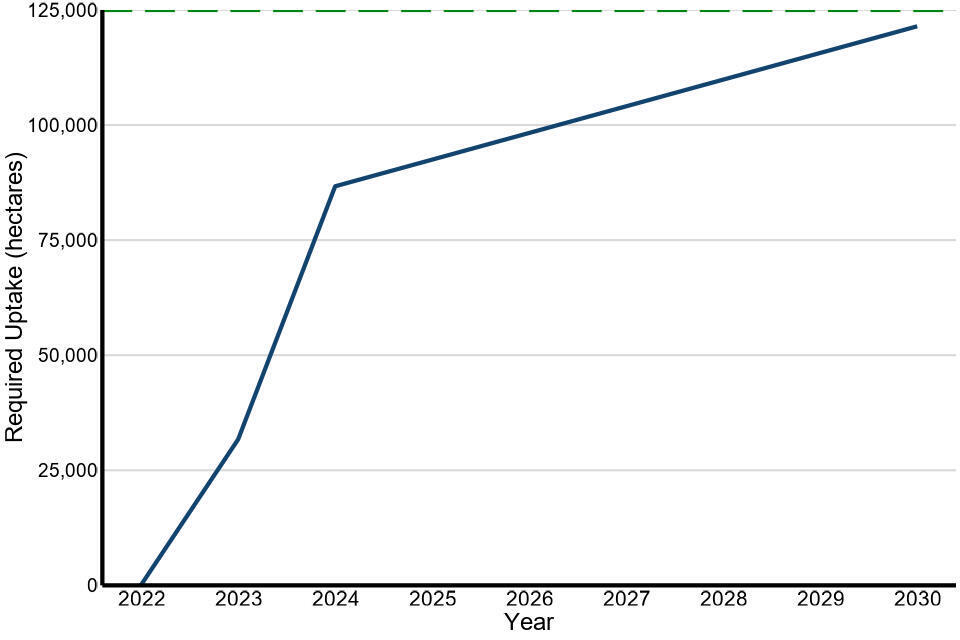
The required area of contributing actions has been calculated through to 2030. This trajectory is based on analysis of historic uptake and illustrates the annual uptake that would be required to contribute to the environmental objective by the end of the assessment period. Its shape is informed by assumptions about economic and behavioural factors and delivery constraints.
As information on future schemes is not currently available, the trajectory should not be interpreted as a forecast of uptake or as an indication of future scheme availability.
Figure 2: Required uptake of actions contributing to Invasive Non-Native Species to 2030, hectares
Source: Department for Environment, Food and Rural Affairs
5. Metadata
| Objective | Invasive Non-Native Species |
|---|---|
| Related commitments | Statutory species abundance targets |
| Reporting status | Final |
| Contributing schemes | CS, CSHT |
| Aggregation method | Agreements live since January 2022 |
| Geographical scope | England |
| First reported | October 2026 |
| Last updated | October 2026 |