Farming Sector Environmental Objectives: farm wildlife
Published 22 October 2026
Applies to England

© Crown copyright 2026
This publication is licensed under the terms of the Open Government Licence v3.0 except where otherwise stated. To view this licence, visit nationalarchives.gov.uk/doc/open-government-licence/version/3 or write to the Information Policy Team, The National Archives, Kew, London TW9 4DU, or email: psi@nationalarchives.gov.uk.
Where we have identified any third party copyright information you will need to obtain permission from the copyright holders concerned.
This publication is available at https://www.gov.uk/government/publications/farming-sector-environmental-objectives/farming-sector-environmental-objectives-farm-wildlife
1. Objective title
By 2030, the farming sector and delivery partners will double the number of farms providing sufficient year-round resources for farm wildlife, compared with 2025.
2. Objective overview
Biodiversity across England is declining, with consequences for our wellbeing, economy, and access to essential natural resources. While recovery requires focused action in specific areas, it also depends on integrating nature across the whole landscape.
Around 70% of England is farmland, meaning that agricultural land use has a decisive influence on biodiversity at a national scale. As biodiversity recovery requires both targeted action and landscape‑wide change, farmland must play a key role in providing space for nature alongside food production.
This objective aims to support this transition by providing sufficient year‑round resources for farm wildlife through agri‑environment schemes (AES), helping to integrate nature into farmed landscapes while supporting farming to remain productive, resilient, and sustainable.
3. Relevant targets and commitments
Environment Act 2021
The Environment Act 2021 sets three statutory targets relating to terrestrial and freshwater species, stating:
-
halt the decline in species abundance by 2030, as represented by the overall relative species abundance index
-
increase the relative species abundance index by 2042 so that it is greater than in 2022 and at least 10% greater than in 2030
-
improve the Red List Index for England for species extinction by 2042 compared to 2022 levels
Environmental Improvement Plan
In order to meet the statutory targets set under the Environment Act 2021, the Environmental Improvement Plan 2025 sets an interim target for farm wildlife:
- By December 2030, double the number of farms providing sufficient year-round resources for farm wildlife, compared with 2025
4. Delivery approach
4.1 Methodology
Farms are encouraged to put in place an effective combination of agri-environment scheme actions that provide year-round support for birds, pollinators and other wildlife typical of the farmed environment.
A ‘farm wildlife action’ refers to over 100 specific actions identified across the Sustainable Farming Incentive (SFI) and Countryside Stewardship (CS) schemes. These actions are categorised into four broad action groups:
-
summer food: supply of flowers that support pollinating insects such as bees, butterflies and hoverflies, helping wildlife feed and thrive throughout the growing season.
-
nesting and shelter: create safe places for birds, insects and other wildlife to nest, breed, shelter and move through the farmed landscape.
-
winter food: actions to provide vital food resources during autumn and winter, helping farmland birds and other wildlife survive periods when natural food is scarce.
-
supporting habitat: additional actions to maintain and enhance features such as hedgerows, ponds, trees and watercourses that provide habitat, connectivity and year-round resources for a wide range of wildlife.
To contribute towards achieving the objective, at least one action from each of the first three groups must be undertaken by a farm business to ensure year-round resources. These actions must also cover a minimum of 7% of the total farm area collectively. The actions currently identified as contributing to this objective and their categories can be found in Table 1 and Table 2 respectively.
Progress towards the farm wildlife objective is measured by the percentage of farm businesses with contributing actions in live agreements at the capture date. This includes both the action group and farm area coverage requirements.
4.2 Baselines and Assumptions
Farm area is defined as the total land area within a farm business that is used for agricultural activity. A threshold of 7% is required, as reviewed evidence indicates this level supports positive outcomes for species while remaining achievable within productive farming systems.
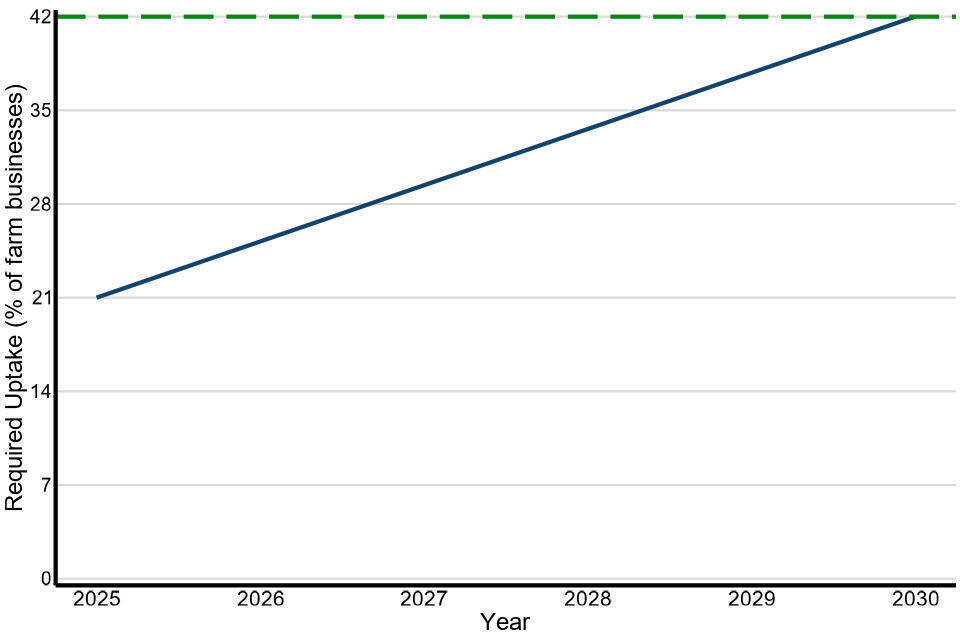
As at July 2025, 21% of all farm businesses in England were providing sufficient year-round resources for farm wildlife. Taking 21% as the baseline, the objective sets an ambition for 42% of farm business to meet the requirements by 2030.
For this objective, hedgerow actions have been converted from metres to hectares, assuming that coverage extends 1.5 metres into the parcel. This is based on the minimum requirements for favourable width threshold for mature hedgerows (established by Natural England)[https://publications.naturalengland.org.uk/publication/5565675205820416] and the minimum width for new planting requirements under agri-environment schemes.
4.3 Key and supporting actions
Table 1: Environmental land management actions contributing to Farm Wildlife
| Action Code | Action Name | Scheme | Type |
|---|---|---|---|
| CAB2 | Basic overwintered stubble | CS Higher Tier | Key |
| CAB5 | Nesting plots for lapwing and stone curlew | CS Higher Tier | Key |
| CAB6 | Enhanced overwintered stubble | CS Higher Tier | Key |
| CAB10 | Unharvested cereal headland | CS Higher Tier | Key |
| CAB11 | Cultivated areas for arable plants | CS Higher Tier | Key |
| CAB12 | Supplementary winter bird food | CS Higher Tier | Key |
| CAB14 | Low input harvested cereal crops | CS Higher Tier | Key |
| CAB17 | Winter bird food on arable and horticulture land | CS Higher Tier | Key |
| CAB18 | Flower-rich grass margins, blocks, or in-field strips | CS Higher Tier | Key |
| CAB19 | Pollen and nectar flower mix | CS Higher Tier | Key |
| CGS4 | Herbal leys | CS Higher Tier | Key |
| CHRW4 | Management of hedgerows | CS Higher Tier | Key |
| CWD3 | Manage woodland edges on arable land | CS Higher Tier | Key |
| CWD7 | Manage scrub and open habitat mosaics | CS Higher Tier | Key |
| CWD8 | Create scrub and open habitat mosaics | CS Higher Tier | Key |
| CWT1 | Buffer in-field ponds and ditches on improved grassland | CS Higher Tier | Key |
| CWT2 | Buffer in-field ponds and ditches on arable land | CS Higher Tier | Key |
| AGF1 | Maintain very low density in-field agroforestry on less sensitive land | SFI Expanded Offer | Key |
| AGF2 | Maintain low density in-field agroforestry on less sensitive land | SFI Expanded Offer | Key |
| AHW1 | Bumblebird mix | SFI Expanded Offer | Key |
| AHW2 | Supplementary winter bird food | SFI Expanded Offer | Key |
| AHW3 | Beetle banks | SFI Expanded Offer | Key |
| AHW4 | Skylark plots | SFI Expanded Offer | Key |
| AHW5 | Nesting plots for lapwing | SFI Expanded Offer | Key |
| AHW6 | Basic overwinter stubble | SFI Expanded Offer | Key |
| AHW7 | Enhanced overwinter stubble | SFI Expanded Offer | Key |
| AHW8 | Whole crop spring cereals and overwinter stubble | SFI Expanded Offer | Key |
| AHW9 | Unharvested cereal headland | SFI Expanded Offer | Key |
| AHW10 | Low input harvested cereal crop | SFI Expanded Offer | Key |
| AHW11 | Cultivated areas for arable plants | SFI Expanded Offer | Key |
| AHW12 | Manage woodland edges on arable land | SFI Expanded Offer | Key |
| BFS1 | 12m to 24m watercourse buffer strip on cultivated land | SFI Expanded Offer | Key |
| BFS2 | Buffer in-field ponds on arable land | SFI Expanded Offer | Key |
| BFS3 | Buffer in-field ponds on improved grassland | SFI Expanded Offer | Key |
| BFS4 | Protect in-field trees on arable land | SFI Expanded Offer | Key |
| BFS5 | Protect in-field trees on intensive grassland | SFI Expanded Offer | Key |
| BFS6 | 6m to 12m habitat strip next to watercourses | SFI Expanded Offer | Key |
| CAHL1 | Pollen and nectar flower mix | SFI Expanded Offer | Key |
| CAHL2 | Winter bird food on arable and horticultural land | SFI Expanded Offer | Key |
| CAHL3 | Grassy field corners or blocks | SFI Expanded Offer | Key |
| CAHL4 | 4m to 12m grass buffer strip on arable and horticultural land | SFI Expanded Offer | Key |
| CHRW2 | Manage hedgerows | SFI Expanded Offer | Key |
| CHRW3 | Maintain or establish hedgerow trees | SFI Expanded Offer | Key |
| CIGL1 | Take grassland field corners or blocks out of management | SFI Expanded Offer | Key |
| CIGL2 | Winter bird food on improved grassland | SFI Expanded Offer | Key |
| CIGL3 | 4m to 12m grass buffer strip on improved grassland | SFI Expanded Offer | Key |
| CIPM2 | Flower-rich grass margins, blocks or in-field strips | SFI Expanded Offer | Key |
| CLIG3 | Manage grassland with very low nutrient inputs | SFI Expanded Offer | Key |
| CNUM3 | Legume fallow | SFI Expanded Offer | Key |
| CSAM3 | Herbal leys | SFI Expanded Offer | Key |
| GRH1 | Manage rough grazing for birds | SFI Expanded Offer | Key |
| GRH10 | Supplement: Lenient grazing | SFI Expanded Offer | Key |
| OFA1 | Overwinter stubble (organic land) | SFI Expanded Offer | Key |
| OFA3 | Supplementary winter bird food (organic land) | SFI Expanded Offer | Key |
| SCR1 | Create scrub and open habitat mosaics | SFI Expanded Offer | Key |
| SCR2 | Manage scrub and open habitat mosaics | SFI Expanded Offer | Key |
| WBD1 | Manage ponds | SFI Expanded Offer | Key |
| WBD2 | Manage ditches | SFI Expanded Offer | Key |
| WBD3 | In-field grass strips | SFI Expanded Offer | Key |
| AB1 | Nectar flower mix | Countryside Stewardship | Key |
| AB10 | Unharvested cereal headland | Countryside Stewardship | Key |
| AB11 | Cultivated areas for arable plants | Countryside Stewardship | Key |
| AB12 | Supplementary winter feeding for farmland birds | Countryside Stewardship | Key |
| AB14 | Harvested low input cereal | Countryside Stewardship | Key |
| AB2 | Basic overwinter stubble | Countryside Stewardship | Key |
| AB3 | Beetle banks | Countryside Stewardship | Key |
| AB5 | Nesting plots for lapwing and stone curlew | Countryside Stewardship | Key |
| AB6 | Enhanced overwinter stubble | Countryside Stewardship | Key |
| AB8 | Flower-rich margins and plots | Countryside Stewardship | Key |
| AB9 | Winter bird food | Countryside Stewardship | Key |
| BE1 | Protection of in-field trees on arable land | Countryside Stewardship | Key |
| BE3 | Management of hedgerows | Countryside Stewardship | Key |
| GS1 | Take small areas out of management | Countryside Stewardship | Key |
| GS13 | Management of grassland for target features | Countryside Stewardship | Key |
| GS2 | Permanent grassland with very low inputs (outside SDAs) | Countryside Stewardship | Key |
| GS3 | Ryegrass seed-set as winter food for birds | Countryside Stewardship | Key |
| GS4 | Legume and herb-rich swards | Countryside Stewardship | Key |
| OP1 | Overwintered stubble | Countryside Stewardship | Key |
| OP2 | Wild bird seed mixture | Countryside Stewardship | Key |
| OP3 | Supplementary feeding for farmland birds | Countryside Stewardship | Key |
| OP4 | Multi species ley | Countryside Stewardship | Key |
| SW1 | 4-6m buffer strip on cultivated land | Countryside Stewardship | Key |
| SW2 | 4-6m buffer strip on intensive grassland | Countryside Stewardship | Key |
| SW4 | 12m to 24m watercourse buffer strip on cultivated land | Countryside Stewardship | Key |
| WD3 | Woodland edges on arable land | Countryside Stewardship | Key |
| WD7 | Maintenance of successional areas and scrub | Countryside Stewardship | Key |
| WD8 | Creation of successional areas and scrub | Countryside Stewardship | Key |
| WT1 | Buffering in-field ponds and ditches in improved grassland | Countryside Stewardship | Key |
| WT2 | Buffering in-field ponds and ditches on arable land | Countryside Stewardship | Key |
| WT4 | Management of ponds of High Wildlife value (first 100 sq m) | Countryside Stewardship | Key |
| WT5 | Management of ponds of High Wildlife value (areas greater than 100 sq m) | Countryside Stewardship | Key |
| AHL1 | Pollen and nectar flower mix | Sustainable Farming Incentive 2023 | Key |
| AHL2 | Winter bird food on arable and horticultural land | Sustainable Farming Incentive 2023 | Key |
| AHL4 | 4m to 12m grass buffer strip on arable and horticultural land | Sustainable Farming Incentive 2023 | Key |
| HRW2 | Manage hedgerows | Sustainable Farming Incentive 2023 | Key |
| IGL1 | Take improved grassland field corners or blocks out of management | Sustainable Farming Incentive 2023 | Key |
| IGL2 | Winter bird food on improved grassland | Sustainable Farming Incentive 2023 | Key |
| IGL3 | 4m to 12m grass buffer strip on improved grassland | Sustainable Farming Incentive 2023 | Key |
| IPM2 | Flower-rich grass margins, blocks, or in-field strips | Sustainable Farming Incentive 2023 | Key |
| LIG1 | Manage grassland with very low nutrient inputs (outside SDAs) | Sustainable Farming Incentive 2023 | Key |
| NUM3 | Legume fallows | Sustainable Farming Incentive 2023 | Key |
| SAM3 | Herbal leys | Sustainable Farming Incentive 2023 | Key |
| IGS4 | establish and maintain herbal leys on at least 15% of land in this level of the standard | Sustainable Farming Incentive 2022 | Key |
| BN11 | Planting new hedges | Capital Grants | Key |
| BN5 | Hedgerow laying | Capital Grants | Key |
| BN6 | Hedgerow coppicing | Capital Grants | Key |
| BN7 | Hedgerow gapping-up | Capital Grants | Key |
| WB1 | Small Wildlife Box | Capital Grants | Key |
| WB2 | Medium Wildlife Box | Capital Grants | Key |
| WB3 | Large Wildlife Box | Capital Grants | Key |
| WN2 | Creation of scrapes and gutters | Capital Grants | Key |
Table 2: Environmental land management actions categorised by action group required for Farm Wildlife
| Summer food | Nesting and shelter | Winter food | Supporting habitat |
|---|---|---|---|
| AB1: Nectar flower mix | AB10: Unharvested cereal headland | AB10: Unharvested cereal headland | AB9: Winter bird food |
| AB10: Unharvested cereal headland | AB11: Cultivated areas for arable plants | AB12: Supplementary winter feeding for farmland birds | AGF1: Maintain very low density in-field agroforestry on less sensitive land |
| AB11: Cultivated areas for arable plants | AB14: Harvested low input cereal | AB2: Basic overwinter stubble | AGF2: Maintain low density in-field agroforestry on less sensitive land |
| AB12: Supplementary winter feeding for farmland birds | AB2: Basic overwinter stubble | AB3: Beetle banks | AHL1: Pollen and nectar flower mix |
| AB14: Harvested low input cereal | AB3: Beetle banks | AB6: Enhanced overwinter stubble | AHL2: Winter bird food on arable and horticultural land |
| AB2: Basic overwinter stubble | AB5: Nesting plots for lapwing and stone curlew | AB9: Winter bird food | AHL4: 4m to 12m grass buffer strip on arable and horticultural land |
| AB3: Beetle banks | AB6: Enhanced overwinter stubble | AHL2: Winter bird food on arable and horticultural land | AHW12: Manage woodland edges on arable land |
| AB6: Enhanced overwinter stubble | AB8: Flower-rich margins and plots | AHW1: Bumblebird mix | BFS1: 12m to 24m watercourse buffer strip on cultivated land |
| AB8: Flower-rich margins and plots | AB9: Winter bird food | AHW2: Supplementary winter bird food | BFS2: Buffer in-field ponds on arable land |
| AB9: Winter bird food | AHL1: Pollen and nectar flower mix | AHW3: Beetle banks | BFS3: Buffer in-field ponds on improved grassland |
| AHL1: Pollen and nectar flower mix | AHL2: Winter bird food on arable and horticultural land | AHW6: Basic overwinter stubble | BFS4: Protect in-field trees on arable land |
| AHL2: Winter bird food on arable and horticultural land | AHL4: 4m to 12m grass buffer strip on arable and horticultural land | AHW7: Enhanced overwinter stubble | BFS5: Protect in-field trees on intensive grassland |
| AHL4: 4m to 12m grass buffer strip on arable and horticultural land | AHW10: Low input harvested cereal crop | AHW8: Whole crop spring cereals and overwinter stubble | CAB19: Pollen and nectar flower mix |
| AHW1: Bumblebird mix | AHW11: Cultivated areas for arable plants | AHW9: Unharvested cereal headland | CAHL2: Winter bird food on arable and horticultural land |
| AHW10: Low input harvested cereal crop | AHW3: Beetle banks | BE3: Management of hedgerows | CAHL4: 4m to 12m grass buffer strip on arable and horticultural land |
| AHW11: Cultivated areas for arable plants | AHW4: Skylark plots | BN11: Planting new hedges | CHRW2: Manage hedgerows |
| AHW2: Supplementary winter bird food | AHW5: Nesting plots for lapwing | BN7: Hedgerow gapping-up | CHRW3: Maintain or establish hedgerow trees |
| AHW3: Beetle banks | AHW6: Basic overwinter stubble | CAB10: Unharvested cereal headland | CIGL3: 4m to 12m grass buffer strip on improved grassland |
| AHW7: Enhanced overwinter stubble | AHW7: Enhanced overwinter stubble | CAB12: Supplementary winter bird food | CLIG3: Manage grassland with very low nutrient inputs |
| AHW9: Unharvested cereal headland | AHW8: Whole crop spring cereals and overwinter stubble | CAB17: Winter bird food on arable and horticulture land | CWD3: Manage woodland edges on arable land |
| CAB14: Low input harvested cereal crops | BN6: Hedgerow coppicing | GS1: Take small areas out of management | SW2: 4-6m buffer strip on intensive grassland |
| CAB17: Winter bird food on arable and horticulture land | BN7: Hedgerow gapping-up | GS13: Management of grassland for target features | WBD1: Manage ponds |
| CAB18: Flower-rich grass margins, blocks, or in-field strips (on arable land or permanent crops) | CAB10: Unharvested cereal headland | GS3: Ryegrass seed-set as winter food for birds | WBD2: Manage ditches |
| BE1: Protection of in-field trees on arable land | AHW9: Unharvested cereal headland | CAB2: Basic overwintered stubble | CWT1: Buffer in-field ponds and ditches on improved grassland |
| BE3: Management of hedgerows | BE1: Protection of in-field trees on arable land | CAB6: Enhanced overwintered stubble | CWT2: Buffer in-field ponds and ditches on arable land |
| BFS1: 12m to 24m watercourse buffer strip on cultivated land | BE3: Management of hedgerows | CAHL2: Winter bird food on arable and horticultural land | GS13: Management of grassland for target features |
| BFS4: Protect in-field trees on arable land | BFS1: 12m to 24m watercourse buffer strip on cultivated land | CHRW2: Manage hedgerows | GS2: Permanent grassland with very low inputs (outside SDAs) |
| BN11: Planting new hedges | BFS4: Protect in-field trees on arable land | CHRW4: Management of hedgerows | IGL3: 4m to 12m grass buffer strip on improved grassland |
| BN7: Hedgerow gapping-up | BFS6: 6m to 12m habitat strip next to watercourses | CIGL2: Winter bird food on improved grassland | LIG1: Manage grassland with very low nutrient inputs (outside SDAs) |
| CAB10: Unharvested cereal headland | BN11: Planting new hedges | CWD7: Manage scrub and open habitat mosaics | OP2: Wild bird seed mixture |
| CAB11: Cultivated areas for arable plants | BN5: Hedgerow laying | CWD8: Create scrub and open habitat mosaics | SW1: 4-6m buffer strip on cultivated land |
| CAB19: Pollen and nectar flower mix | CAB11: Cultivated areas for arable plants | HRW2: Manage hedgerows | WD3: Woodland edges on arable land |
| CAB6: Enhanced overwintered stubble | CAB14: Low input harvested cereal crops | IGL2: Winter bird food on improved grassland | WN2: Creation of scrapes and gutters |
| CAHL1: Pollen and nectar flower mix | CAB19: Pollen and nectar flower mix | OFA1: Overwinter stubble (organic land) | WT1: Buffering in-field ponds and ditches in improved grassland |
| CAHL2: Winter bird food on arable and horticultural land | CAB5: Nesting plots for lapwing and stone curlew | OFA3: Supplementary winter bird food (organic land) | WT2: Buffering in-field ponds and ditches on arable land |
| CAHL3: Grassy field corners or blocks | CAB6: Enhanced overwintered stubble | OP1: Overwintered stubble | WT4: Management of ponds of High Wildlife value (first 100 sq m) |
| CAHL4: 4m to 12m grass buffer strip on arable and horticultural land | CAHL1: Pollen and nectar flower mix | OP2: Wild bird seed mixture | WT5: Management of ponds of High Wildlife value (areas greater than 100 sq m) |
| CGS4: Herbal leys | CAHL2: Winter bird food on arable and horticultural land | OP3: Supplementary feeding for farmland birds | |
| CHRW2: Manage hedgerows | CAHL3: Grassy field corners or blocks | SCR1: Create scrub and open habitat mosaics | |
| CHRW4: Management of hedgerows | CAHL4: 4m to 12m grass buffer strip on arable and horticultural land | SCR2: Manage scrub and open habitat mosaics | |
| CIGL1: Take grassland field corners or blocks out of management | CHRW2: Manage hedgerows | WD7: Maintenance of successional areas and scrub | |
| CIGL3: 4m to 12m grass buffer strip on improved grassland | CHRW4: Management of hedgerows | WD8: Creation of successional areas and scrub | |
| CIPM2: Flower-rich grass margins, blocks or in-field strips | CIGL1: Take grassland field corners or blocks out of management | ||
| CLIG3: Manage grassland with very low nutrient inputs | CIGL3: 4m to 12m grass buffer strip on improved grassland | ||
| CNUM3: Legume fallow | CLIG3: Manage grassland with very low nutrient inputs | ||
| CSAM3: Herbal leys | CWD3: Manage woodland edges on arable land | ||
| CWD7: Manage scrub and open habitat mosaics | CWD7: Manage scrub and open habitat mosaics | ||
| CWD8: Create scrub and open habitat mosaics | CWD8: Create scrub and open habitat mosaics | ||
| GRH1: Manage rough grazing for birds | GRH1: Manage rough grazing for birds | ||
| GRH10: Supplement: Lenient grazing | GRH10: Supplement: Lenient grazing | ||
| GS1: Take small areas out of management | GS1: Take small areas out of management | ||
| GS13: Management of grassland for target features | GS13: Management of grassland for target features | ||
| GS2: Permanent grassland with very low inputs (outside SDAs) | GS2: Permanent grassland with very low inputs (outside SDAs) | ||
| GS4: Legume and herb-rich swards | HRW2: Manage hedgerows | ||
| HRW2: Manage hedgerows | IGL1: Take improved grassland field corners or blocks out of management | ||
| IGL1: Take improved grassland field corners or blocks out of management | IGL3: 4m to 12m grass buffer strip on improved grassland | ||
| IGL3: 4m to 12m grass buffer strip on improved grassland | LIG1: Manage grassland with very low nutrient inputs (outside SDAs) | ||
| IGS4: establish and maintain herbal leys on at least 15% of land in this level of the standard | OP2: Wild bird seed mixture | ||
| IPM2: Flower-rich grass margins, blocks, or in-field strips | SCR1: Create scrub and open habitat mosaics | ||
| LIG1: Manage grassland with very low nutrient inputs (outside SDAs) | SCR2: Manage scrub and open habitat mosaics | ||
| NUM3: Legume fallows | SW1: 4-6m buffer strip on cultivated land | ||
| OFA1: Overwinter stubble (organic land) | SW2: 4-6m buffer strip on intensive grassland | ||
| OFA3: Supplementary winter bird food (organic land) | SW4: 12m to 24m watercourse buffer strip on cultivated land | ||
| OP1: Overwintered stubble | WB1: Small Wildlife Box | ||
| OP2: Wild bird seed mixture | WB2: Medium Wildlife Box | ||
| OP3: Supplementary feeding for farmland birds | WB3: Large Wildlife Box | ||
| OP4: Multi species ley | WBD3: In-field grass strips | ||
| SAM3: Herbal leys | WD7: Maintenance of successional areas and scrub | ||
| SCR1: Create scrub and open habitat mosaics | WD8: Creation of successional areas and scrub | ||
| SCR2: Manage scrub and open habitat mosaics | WN2: Creation of scrapes and gutters | ||
| SW1: 4-6m buffer strip on cultivated land | WT4: Management of ponds of High Wildlife value (first 100 sq m) | ||
| SW2: 4-6m buffer strip on intensive grassland | WT5: Management of ponds of High Wildlife value (areas greater than 100 sq m) | ||
| SW4: 12m to 24m watercourse buffer strip on cultivated land | |||
| WBD3: In-field grass strips | |||
| WD3: Woodland edges on arable land | |||
| WD7: Maintenance of successional areas and scrub | |||
| WD8: Creation of successional areas and scrub | |||
| WN2: Creation of scrapes and gutters | |||
| WT4: Management of ponds of High Wildlife value (first 100 sq m) | |||
| WT5: Management of ponds of High Wildlife value (areas greater than 100 sq m) |
4.4 Required trajectory
The required number of farm businesses supporting farm wildlife has been calculated through to 2030.
This trajectory considers required uptake of agri-environment schemes within the timeframe, however, information on future schemes is not currently available. Therefore, this should not be assumed to reflect future scheme availability.
Figure 3: Required number of farm businesses contributing to Farm Wildlife to 2030, percent
Source: Department for Environment, Food and Rural Affairs
5. Metadata
| Objective | Farm Wildlife |
|---|---|
| Related commitments | Statutory species abundance targets |
| Reporting status | Final |
| Contributing schemes | CS, CSHT, SFI |
| Aggregation method | Agreements live as at the capture date |
| Geographical scope | England |
| First reported | October 2026 |
| Last updated | October 2026 |