Farming Sector Environmental Objectives: agricultural decarbonisation
Published 22 October 2026
Applies to England

© Crown copyright 2026
This publication is licensed under the terms of the Open Government Licence v3.0 except where otherwise stated. To view this licence, visit nationalarchives.gov.uk/doc/open-government-licence/version/3 or write to the Information Policy Team, The National Archives, Kew, London TW9 4DU, or email: psi@nationalarchives.gov.uk.
Where we have identified any third party copyright information you will need to obtain permission from the copyright holders concerned.
This publication is available at https://www.gov.uk/government/publications/farming-sector-environmental-objectives/farming-sector-environmental-objectives-agricultural-decarbonisation
1. Objective title
The farming sector and delivery partners will deliver at least 1.63 million tonnes CO2e agricultural emissions abatement per annum by the end of Carbon Budget 6 (2037)
2. Objective overview
In 2024, the United Kingdom was estimated to have produce 373 million tonnes CO2 equivalent (CO2e) of Greenhouse Gas (GHG) emissions, of which agriculture was responsible for 46.5 million tonnes CO2e (12%).
CO2e is a metric used to quantify the global warming potential (GWP) of different greenhouse gases relative to carbon dioxide. For instance, Methane is attributed a GWP of 27 by the International Panel of Climate Change, meaning that a tonne of methane has the same GWP of 27 tonnes of carbon dioxide.
Since 1990, annual emissions have declined by around 15%, with the majority of emissions from livestock and fertiliser usage.
Through this objective, Defra is pursuing measures to further mitigate on‑farm agricultural emissions, considering a broad range of pathways including improvements in on-farm efficiency and innovative farming practices.
3. Relevant targets and commitments
Carbon Budget 6
The Climate Change Committee issues a series of reports advising the UK Government on key milestones for achieving Net Zero. These Carbon Budgets set legally binding, five‑year caps on greenhouse gas emissions through to 2050.
Using Carbon Budget 6, covering the period 2033 to 2037, the following target is set:
- by 2037, we will reduce annual net emissions through agriculture, forestry and other land uses (AFOLU) by 4.9Mt CO2e per annum, in line with the Sixth Carbon Budget.
Environmental Improvement Plan
The Environmental Improvement Plan 2025 (EIP25) has also committed to:
- reduce and report on carbon emissions from farming and agricultural practices in line with Carbon Budgets 4, 5 and 6 (2023 to 2037)
4. Delivery approach
4.1 Methodology
The Delivering Clean Growth through Sustainable Intensification (CGSI) project report was commissioned by Defra in order to identify approaches to reduce GHG emissions from agriculture. The resulting evidence base, published in 2022, provided on-farm mitigation measures and mechanisms for policy interventions to reduce GHG emissions across English agriculture. This evidence base also informed the Carbon Budget and Growth Delivery Plan (CBGDP).
Mitigation measures identified in the CGBDP were reviewed against Countryside Stewardship (CS) and Sustainable Farming Incentive (SFI) schemes to identify contributing actions, which can be found in Table 1. For these actions, estimated abatement potential from the CGSI report was used to calculate the uptake required to meet the agricultural sector’s shared emissions target.
Progress towards this objective is measured as the net change in the total uptake of key environmental land management (ELM) actions in live agreements at the point of measurement, compared with 2018 levels. All key actions are measured in hectares.
Supporting actions make a direct or indirect contribution that is not measurable with current methodologies, and therefore not included in achieved uptake. Inclusion may change as further evidence and information becomes available.
Additional mitigation measures within CBGDP focused on activities outside of ELM schemes, such as covering slurry tanks, methane‑suppressing feed products, and other livestock‑based initiatives. These are currently under internal review to determine their eligibility within agri-environment schemes, quantify their sequestration or emissions impacts and establish robust reporting methods through the available data.
4.2 Assumptions and baselines
Contributing live uptake is measured against uptake as of 31 December 2018, with only net changes counted towards this objective. Deadweight is also removed from live uptake, accounting for relevant activity that does not represent additionality caused by agri-environment schemes. Contributing options are able to overlap within a land parcel, meaning that action area can viably exceed land area.
4.3 Key and supporting actions
Table 1: Environmental land management actions contributing to Agricultural Decarbonisation
| Action Code | Action Name | Scheme | Type |
|---|---|---|---|
| CSW14 | Nil fertiliser supplement | CS Higher Tier | Key |
| CGS4 | Herbal leys | CS Higher Tier | Key |
| CGS25 | Legumes on improved grassland | CS Higher Tier | Key |
| SW14 | Nil fertiliser supplement | Countryside Stewardship | Key |
| GS4 | Legume and herb-rich swards | Countryside Stewardship | Key |
| OP4 | Multi species ley | Countryside Stewardship | Key |
| SW6 | Winter cover crops | Countryside Stewardship | Key |
| AB15 | Two year sown legume fallow | Countryside Stewardship | Key |
| WBD9 | Supplement: Nil fertiliser | SFI Expanded Offer | Key |
| CNUM2 | Legumes on improved grassland | SFI Expanded Offer | Key |
| CSAM3 | Herbal leys | SFI Expanded Offer | Key |
| CIPM3 | Companion crop on arable and horticultural land | SFI Expanded Offer | Key |
| CSAM2 | Multi-species winter cover crop | SFI Expanded Offer | Key |
| SOH2 | Multi-species spring-sown cover crop | SFI Expanded Offer | Key |
| SOH3 | Multi-species summer-sown cover crop | SFI Expanded Offer | Key |
| SOH4 | Winter cover following maize crops | SFI Expanded Offer | Key |
| CNUM3 | Legume fallow | SFI Expanded Offer | Key |
| PRF1 | Variable rate application of nutrients | SFI Expanded Offer | Key |
| NUM2 | Establish and maintain legumes | Sustainable Farming Incentive 2023 | Key |
| SAM3 | Herbal leys | Sustainable Farming Incentive 2023 | Key |
| IPM3 | Establish a companion crop | Sustainable Farming Incentive 2023 | Key |
| IGS4 | Establish and maintain herbal leys on at least 15% of land in this level of the standard | Sustainable Farming Incentive 2022 | Key |
| SAM2 | Multi-species winter cover crops | Sustainable Farming Incentive 2023 | Key |
| CNUM1 | Assess nutrient management and produce a review report | SFI Expanded Offer | Supporting |
| CIPM1 | Assess integrated pest management and produce a plan | SFI Expanded Offer | Supporting |
| NUM1 | Complete a nutrient management (NM) assessment and produce an NM review report | Sustainable Farming Incentive 2023 | Supporting |
| IPM1 | Complete an integrated pest management (IPM) assessment and produce an IPM plan | Sustainable Farming Incentive 2023 | Supporting |
| AHS1 | complete a soil assessment and produce a soil management plan | Sustainable Farming Incentive 2022 | Supporting |
| IGS1 | complete a soil assessment and produce a soil management plan | Sustainable Farming Incentive 2022 | Supporting |
4.4 Required trajectory
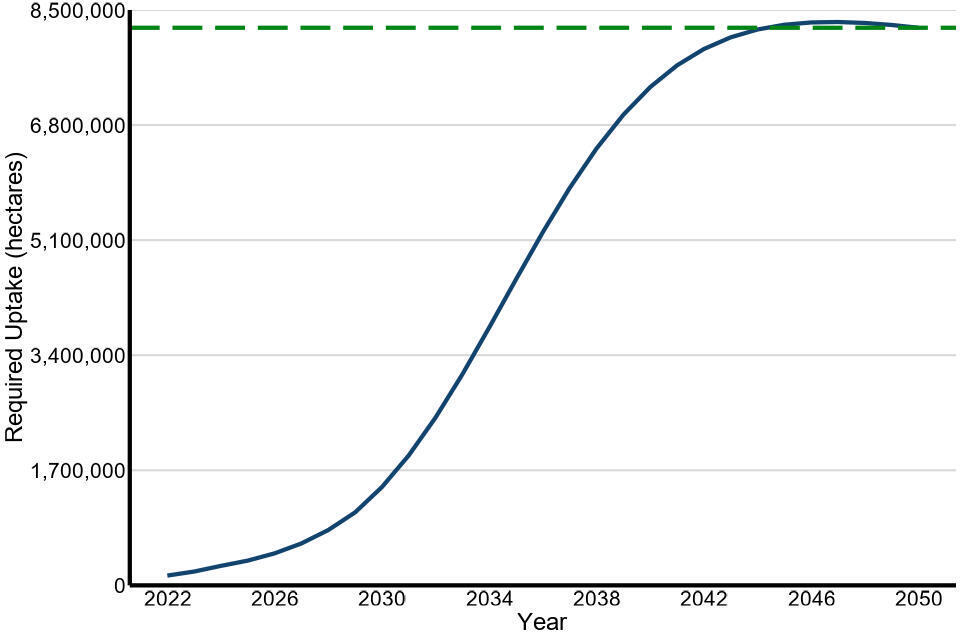
The level of uptake required for contributing actions to meet the long‑term objective has been projected to 2050. This projection is informed by the CGSI high mitigation scenario, developed through an independently peer-reviewed assessment of the emissions reduction potential of relevant measures, complemented by stakeholder engagement on the feasibility of deploying them.
This objective uses the projections for CGSI mitigation measures which can be delivered through agri-environment schemes, estimating an area-based value to determine the required trajectory.
This trajectory is based on analysis of historic uptake of environmental land management schemes and illustrates the annual uptake that would be required to contribute to the environmental objective by the end of the assessment period. Its shape is informed by assumptions about economic and behavioural factors and delivery constraints.
As information on future schemes is not currently available, the trajectory should not be interpreted as a forecast of uptake or as an indication of future scheme availability.
Figure 1: Required uptake of actions contributing to Agricultural Decarbonisation to 2050, hectares
Source: Department for Environment, Food, and Rural Affairs
5. Technical information
| Objective | Agricultural Decarbonisation |
|---|---|
| Related commitments | Statutory carbon emission reduction |
| Reporting status | Interim |
| Contributing schemes | CS, CS-HT, SFI |
| Aggregation method | Agreements live as at the capture date |
| Geographical scope | England |
| First reported | October 2026 |
| Last updated | October 2026 |