Introducing a new method for measuring the income of farming households
Published 18 December 2025
Applies to England

© Crown copyright 2025
This publication is licensed under the terms of the Open Government Licence v3.0 except where otherwise stated. To view this licence, visit nationalarchives.gov.uk/doc/open-government-licence/version/3 or write to the Information Policy Team, The National Archives, Kew, London TW9 4DU, or email: psi@nationalarchives.gov.uk.
Where we have identified any third party copyright information you will need to obtain permission from the copyright holders concerned.
This publication is available at https://www.gov.uk/government/publications/farm-household-income-methodology/introducing-a-new-method-for-measuring-the-income-of-farming-households
Introduction
Defra has been reviewing the way we collect and measure data on Farm Household Income for England only. This paper summarises discussions with the Office for National Statistics (ONS), Teagasc (The Agriculture and Food Development Authority in Ireland), and the United States’ Department of Agriculture (USDA), and reviews literature on Farm Household Income data collection across European Union Member States, as well as in the USA, Switzerland, Norway, Japan and Korea.
Farm Household Income is generally understood to mean the disposable income of a farming household. However, it has been defined and measured in various ways, based on the data available in different countries and time periods. Therefore, Defra are introducing a new measure: Farm Household Earnings. This measure will be consumption-based, therefore, it will be calculated using the equivalised sum of:
-
The principal household’s share of drawings from the farm business.
-
Wages paid from the farm to the household.
-
Off-Farm Income earned by the household.
This new measure will improve Defra’s ability to monitor the economic welfare of farming households in England as they move through the Agricultural Transition period and beyond. It is important to note that the term ‘household’ refers here to a family unit sharing both a dwelling and a common budget.
In order to provide continuity for users, Defra will also continue to publish statistics on the FBI-based Farm Household Income. The FBI-based measure allows for fairer comparisons both internationally and with other sectors, however, it is not possible to produce a fully comparable measure due to differing methodologies in survey data collection.
Farm Income or Private Drawings?
As discussed later in this paper, the on-farm part of the Farm Household Income calculation generally uses the farm’s income. However, Defra have been reviewing whether it is more accurate to use the household’s private drawings instead.
In the Farm Business Survey in England, private drawings are calculated as the amount that the farm household took from the farm for paying personal taxes, corporation tax, private insurance premiums, national insurance for farmer and spouse, and living expenses. For most farms in England, the farmer and their family live on the farm and the farmhouse is often used as an office. Therefore, some of the household expenses, including things that an average employed person spends their income on, can legitimately be claimed as farm expenditure. For example, fuel and energy costs and property costs. This means private drawings could underestimate the farm household expenses, however, the Farm Business Survey data collection deals with this by fully reconciling farm business accounts to their bank account. In cases where money from the business is going towards assets that the business and the household share, the amounts that are applicable to the business and the household are carefully estimated by Research Officers on a case-by-case basis. The amount that is applicable to the household is assigned into private drawings, along with any other monies transferred out of the business for private use. The share of the private drawings taken by the principal household has been recorded in the surveys from 2004/05 to 2014/15, and in 2021/22, 2023/24 and 2024/25.
The Farm Business Survey also calculates Farm Business Income, which is essentially the net profit of the farm, by subtracting the variable and fixed costs incurred from farming from the farm outputs (crop and livestock sales, subsidies, income from diversified activities, and machinery, equipment, glasshouses and permanent crops sales). Because they are not a cost incurred from farming, private drawings are not included as a cost in Farm Business Income. FBI uses depreciation of machinery and buildings, rather than the full amount paid, which is designed to account for future reinvestment in those large purchases. With this in mind, FBI could be described as the theoretical maximum disposable income for the household. In other words, while the farmer may not choose to spend all of their FBI on private expenses, they could. However, depreciation is estimated using standard rates, meaning that it can lack accuracy, and the possibility of replacing an asset with a higher value one is generally not accounted for. Additionally, cash will need to be set aside each year for the following year’s farm expenditure (for example, paying tax, buying seeds and fertiliser, etc.) so will not be available to the household for private expenditure. Farms can also have negative income if their costs were higher than their outputs. In addition, the percentage of private drawings taken by each partner in a farm business tends to be static over time, so variation in the FBI-based household income is much more likely to arise from changes to the Farm Business Income itself. This may result in the measure becoming somewhat redundant, as annual FBI statistics are already published by Defra [1].
How household income is measured in the UK
The Office for National Statistics (ONS) publishes annual statistics on average UK disposable household income [2]. The data are sourced from the Household Finances Survey [3] which is the combination of two surveys: the Living Costs and Food (LCF) Survey [4] and the Survey on Living Conditions [5].
The ONS uses different methods for calculating disposable income for employed and self-employed individuals. For Defra’s household income measure, the equivalent method from the ONS statistics is the one used for self-employed income, because we will be focussing on the primary household of family farms. For this, the ONS calculation sums three elements:
-
The individual’s share of the business’ profit or loss.
-
Private drawings taken from the business by the individual.
-
Any salary paid by the business to the individual.
This may result in double-counting of some funds, however, the respondents to the survey come from a wide variety of businesses, which are all set up very differently. For example, some individuals may use the same account for personal and business use and may not track how much of their profit they are spending for personal use. The ONS do not have access to bank accounts to reconcile transactions. Under these circumstances, the ONS calculation is as accurate as it can possibly be.
The OECD (Organisation for Economic Co-operation and Development) modified equivalence scale [6] presents data at the level of one adult with the following multipliers:
-
A single adult, or the first adult in the household, is given a value of 1.
-
Each additional adult is given a smaller value of 0.5 to reflect the economies of scale achieved when people live together.
-
Children aged 14 and over are given a value of 0.5 because their living costs are assumed to be the same as an adult.
-
Children under the age of 14 are given a value of 0.3 to take account of their lower living costs.
The equivalence values for each household member are summed to give an equivalence value and the household income is divided by this value. This allows a like-for-like comparison of household income for households of varying sizes.
However, when publishing the Household income inequality [7] and Effects of taxes and benefits [8] publications, the ONS use a rescaled version of the OECD modified scale to present household income at the level of two adults (i.e., a couple with no children) [9]:
-
A single adult, or the first adult in the household, is given a value of 0.67.
-
Each additional adult is given a smaller value of 0.33.
-
Children aged 14 and over are given a value of 0.33.
-
Children under the age of 14 are given a value of 0.2.
This was done so that comparison was possible with data prior to 2010/11, which used the McClements equivalence scale (a scale which is designed to present income at the level of two adults) [10].
How other countries measure disposable income of farming households
EU countries
Ireland
Teagasc – the Agriculture and Food Development Authority runs the National Farm Survey [11] for Ireland, which uses Family Farm Income as the principal measure. In the past, Ireland also published agricultural household income, estimated from Household Budget Survey data [12]. The Irish Central Statistics Office would target survey questions towards farms from the National Farm Survey. However, due to methodology changes, the estimates of agricultural household income are no longer possible to calculate.
The National Farm Survey records the off-farm employment status of the Farm Operator and an estimate of the off-farm income of that main Farm Operator. However, it does not record the income of other household members, and so cannot establish farm household income.
France
Research conducted in 2019 [13] seems to acknowledge that private drawings are the better measure of on-farm income: ‘In concrete terms, it is the private deductions that constitute the part of the company’s profit actually devoted to the remuneration of the work of the self-employed farmer. They can be carried out on a regular basis or not, with some farmers paying themselves a fixed sum each month and/or making individual withdrawals, depending on the state of the cash flow or their more or less exceptional private needs’. However, the research paper states that France is not currently collecting this data.
The same research paper also defined total household income as the sum of the income from agricultural activity, income from non-agricultural activities, pensions and income from assets. For a family farm, income from agricultural activity is the farm’s current income before taxes, minus the farmer’s social security contributions. Agricultural income also includes income, not exceeding €50,000 or 30% of other agricultural income, from diversification, such as agrotourism or direct sales. Where diversified income exceeds €50,000 or 30% of other agricultural income, it is recorded as non-agricultural income.
Income from non-agricultural activities combines wages and industrial, commercial or non-commercial profits. This is taken from government tax data, which has data on anyone subject to income tax in France. Non-taxable income, such as family allowances, is not considered. The allowances of elected officials, like other secondary salaries, are included in the salaries to be declared.
Income from assets includes income from securities and movable capital, capital gains from disposals and income from real estate.
French farm data has since been linked with tax databases to allow taxes to be subtracted from the household income, creating a measure of disposable income [14]. Agricultural income is also taken from the tax data; it is defined as the agricultural profits, or deficits, declared to the tax authorities for the calculation of income tax. However, it is still the income of the farm, rather than the private drawings taken by the household.
Comparing the whole of the EU
Farmers’ incomes in the EU were compared in 2015 [15]; the UK was still a Member State at this time and was therefore included. This comparison used Farm Net Value Added (FNVA), which represents the rewards to all the fixed factors used in the farm business, irrespective of their ownership. It also used Farm Family Income (FFI), which is defined as the farm income after the deduction of the costs of hired labour, interest paid and rent paid; it is described as the return to the farmer for the use of their own labour, own land and own capital. The report states that FFI represents the amount generated by the farm business that is available for consumption, investment and saving. FFI expressed per business or per work unit of family labour (FFI/FWU) is the income concept presented in the analysis, which the report states is because it corresponds most closely to the concept of the profit from farming that is available to support the living standards of farmers.
A report from 2016 [16] discusses the EU’s approach to collecting Farm Household Income data. Farm Household Income is defined as income of households from an independent activity in agriculture and from non-agricultural activities. Disposable Farm Household Income is Farm Household Income less taxes and mandatory social insurance contributions. Data on the disposable income and living conditions of households in general, including farm households, are available through the EU statistics on income and living conditions (EU-SILC). The number of farm households included in this survey is, however, generally too small to draw valid conclusions on the incomes and living conditions of the farmers.
At the time of the 2016 report, data on the income of farm households was being collected in Bulgaria, Denmark, Spain, France, the Netherlands, Austria, Poland, Finland, Sweden and the UK. However, there was no common definition of ‘farm households’ and methodologies applied vary. In the Netherlands, it was reported in 2013 that information on household income is available for more than half of the farms in the Farm Accountancy Data Network (FADN) sample. France uses the FADN data together with information from tax registers to calculate the income of farm households. In Poland, the EU-SILC survey is used and FADN respondents are asked to provide additional information about the income of their households on a voluntary basis. Bulgaria, Spain and Finland use only the EU-SILC survey, which contains a comparatively small number of farm households.
The FADN data was not designed to collect data on farm household income. Rather, it is a key data source for the Common Agricultural Policy monitoring and evaluation framework. The objectives of the FADN are clearly laid down in Council Regulation (EC) No 1217/2009 of 30 November 2009 [17]: to collect the accountancy data needed to calculate annual incomes of the agricultural holdings which come within the scope of the survey, and to conduct business analyses of these agricultural holdings. Therefore, an assessment of the standard of living of farmers or of farm household income is outside the scope of the FADN. However, the Farm Sustainability Data Network (FSDN) is replacing the FADN, and will also collect information on their environmental and social sustainability performance [18]. This may mean that disposable household income will be part of the future data collection.
Some comparisons of multiple EU countries have used EU-SILC data [19] [20]. In the EU-SILC, household disposable income is defined as the total income of a household, after tax and other deductions (transfers to other households), that is available for spending or saving.
Non-EU countries
United States of America
The USA’s equivalent to Defra’s Farm Business Survey is the Agricultural Resource Management Survey (ARMS) [21], which the Economic Research Service in the U.S. Department Of Agriculture (USDA) uses to produce annual statistics on Farm Household Income [22]. The scope of the survey includes family farms (farms where over 50% stake is owned by a single person or group of people related by blood, marriage or adoption) with an income of at least US$1,000. In 2021, the sample of farms used in the Farm Household Income statistics was around 19,000 farms, which was approximately 1% of the total number of farms in scope of the survey.
The USDA statistics on Farm Household Income are designed to be consistent with the overall US Household Income statistics [23] to allow comparison between the two. The USDA defines Farm Household Income as the sum of two measures:
1. Household income from farming:
- If the farm has multiple operators who do not share a single household, household income is calculated only for the principal farm operator’s household and includes only that household’s share of the farm business income.
- If a farm is organised as a C-corporation (a corporation that is taxed separately from its owners), the household income from the farm business is equal to the dividends that the principal operator household receives.
- For other business organisation types, the household income from the farm business is equal to the household’s share of the net farm income of the business.
- Wages paid to household members from the farm are included both as an expense to the business and as income to the farm household.
- Net income earned from operating another farm and net income from renting out farmland to others are also included in the income from farming.
2. Household Off-Farm Income:
- ‘Earned’ income sources, which require a household member to allocate their labour or management time to their off-farm activity, such as wages and salaries and off-farm self-employment income.
- ‘Unearned’ income sources, which are passive or transfer income, such as from interest, dividends, private pensions, Social Security, veterans’ benefits, and other public programs.
The Agricultural Resource Management Survey does not collect data on private drawings from the farm business. The USDA does not apply equivalisation to their income statistics.
Switzerland
Farm Household Income is also monitored in Switzerland [24]. Here, agricultural income (profits minus costs) is used to calculate working income per family labour unit. This calculation is done by first remunerating the capital invested in the farm at the rate of ten-year federal bonds, then dividing the remaining amount by the number of family labour units. This measure is then compared with the median reference wage of employees in other sectors to assess the income situation in agriculture. Additionally, household income is calculated by summing agricultural income, off-farm income and household spending (which is payments in pension funds and insurances and private consumption) [25].
Norway
As in France, researchers in Norway used tax data to assess household income of farmers [26]. For each household, income from wages, agriculture and other self-employment were summed, along with capital income and any other income. Taxes paid, net wealth and debt were also considered. These data were then combined with social factor data (family composition, education, and employment) to compare farming households with non-farming households.
Japan
Official statistics published by the Japanese Ministry of Agriculture, Forestry and Fisheries measure Farm Household Income as the sum of farm income (including subsidies), non-farm income, and pensions and other transfer income [27] [28] [29]. Its data is sourced from the Survey on Farm Management and Economy [30], which monitors the management and economy of farm households and other entities as well as the production cost of farm products and to contribute to agricultural policy making.
Republic of Korea
Similarly to Japan, South Korean official statistics sum farm income, non-farm income, and other income to measure Farm Household Income [31]. The data for South Korea is sourced from the Farm Household Economy Survey, which aims to provide basic data for establishing agricultural policies, improving agricultural management and facilitating various kinds of research by grasping trends in the status of farm management such as incomes, spending and assets of sample households [32]. The survey aims to sample 3,000 households which meet one of the following conditions: cultivates an agricultural area of at least 10 hectares; has annual sales of self-produced agricultural and livestock products of at least 1.2 million KRW (around £700); or raises livestock valued at 1.2 million KRW or more.
Summary
For a tabular summary of each country’s methodology, see Annexe 1. The data available, as well as the reasons for collecting such data, varies considerably across different countries and over time. Therefore, creating a measure of disposable income for farming households in England which is universally comparable is not likely to be feasible. However, in general, most of the measures combine income from off-farm sources with the income of the farm (which is usually equivalent to the farm’s net profit).
Measuring disposable income of farming households in England
Case studies
The following paragraphs describe some examples of income in farming households and provide some reasons why private drawings often differs from FBI. These examples are hypothetical, but are based on real-life situations.
Case study 1
This is a sole trading dairy farmer who has had a profitable year and takes private drawings. The Farm Business Income (FBI) is £65,000, but the farmer takes only £12,000 in private drawings. This is because the milk parlour will reach the end of its life very soon. The farmer would like to modernise his parlour, bringing in new technology such as milking robots. While he will still need to take a loan to cover part of the cost, he would prefer to take the smallest loan possible so that he can pay less in the long-term. In past years, the farmer has often taken more in private drawings, however, over the last few he has been taking as little as possible to save up for the new milk parlour.
Case study 2
This case study is two hill farmers in a partnership where the principal farmer takes two thirds of the private drawings and also owns a rental property. The principal farmer takes £12,000 in private drawings, which is similar to her £14,000 share of the FBI. The principal farmer has taken over most of the running of this farm from her father, who she is still in partnership with. She has two young children, and her and her husband bought a property in town a few years ago to rent out. They are still paying off the mortgage on this property. The farm had a relatively small profit margin this year. This farm is supporting two households, and the principal household has a fair amount of private expenses. Therefore, the farmers drew down more, which equated to almost their full FBI for that year.
Case study 3
This is a tenant cereal farmer who has made a loss this year. He takes private drawings from the farm, and his wife is a teacher. The farm made a £50,000 loss in FBI this year. However, there are still private expenses which the farmer must pay. Some of these are shared with the business, for example, phone bills, fuel and electricity. Some are not related to the business at all, for example, food bills or his son’s swimming classes. His wife’s salary covers most of these, however, he must still take some money in private drawings from the business in order to cover all of his family’s private expenses. He is able to do this because he had an FBI of £40,000 last year and drew only £20,000 of that, so he covered himself for this year’s loss.
Case study 4
This is a sole trading potato farmer who takes private drawings. His 17-year-old daughter works for him part-time, and he pays her £8,000 per year using the Pay As You Earn (PAYE) system. The FBI (£55,000) was more than double the amount that the farmer took in private drawings (£22,000). This was because the farm is in an area that often floods, so in some years it makes stark losses. The farmer did not take the full FBI in private drawings so that he could be covered for future loss years. The farmer’s daughter used her wage to help pay for the weekly food shop throughout the year and to take a holiday abroad, in other words, contributing to household expenses.
Decision
As discussed earlier in this paper, measures of Farm Household Income have generally used the farm’s income rather than household drawings as the household’s income from the farm business. However, unlike most other data collection exercises mentioned earlier in this paper, Defra’s Farm Business Survey involves fully reconciling farm business accounts, allowing for an accurate calculation of private drawings. In addition, the survey collects the wages taken from the farm business by household members. Using the sum of the household members’ private drawings and farm wages results in a more accurate representation of household earnings than using farm income.
The Farm Business Survey also recorded the off-farm income of members of the household between 2004/05 and 2014/15, and in 2021/22. Data collection continued in 2022/23, however this only included income from the principal farmer and their spouse/partner. From 2024/25, data for the whole household will be collected again.
Figure 1: The calculation of the new measure of Farm Household Earnings
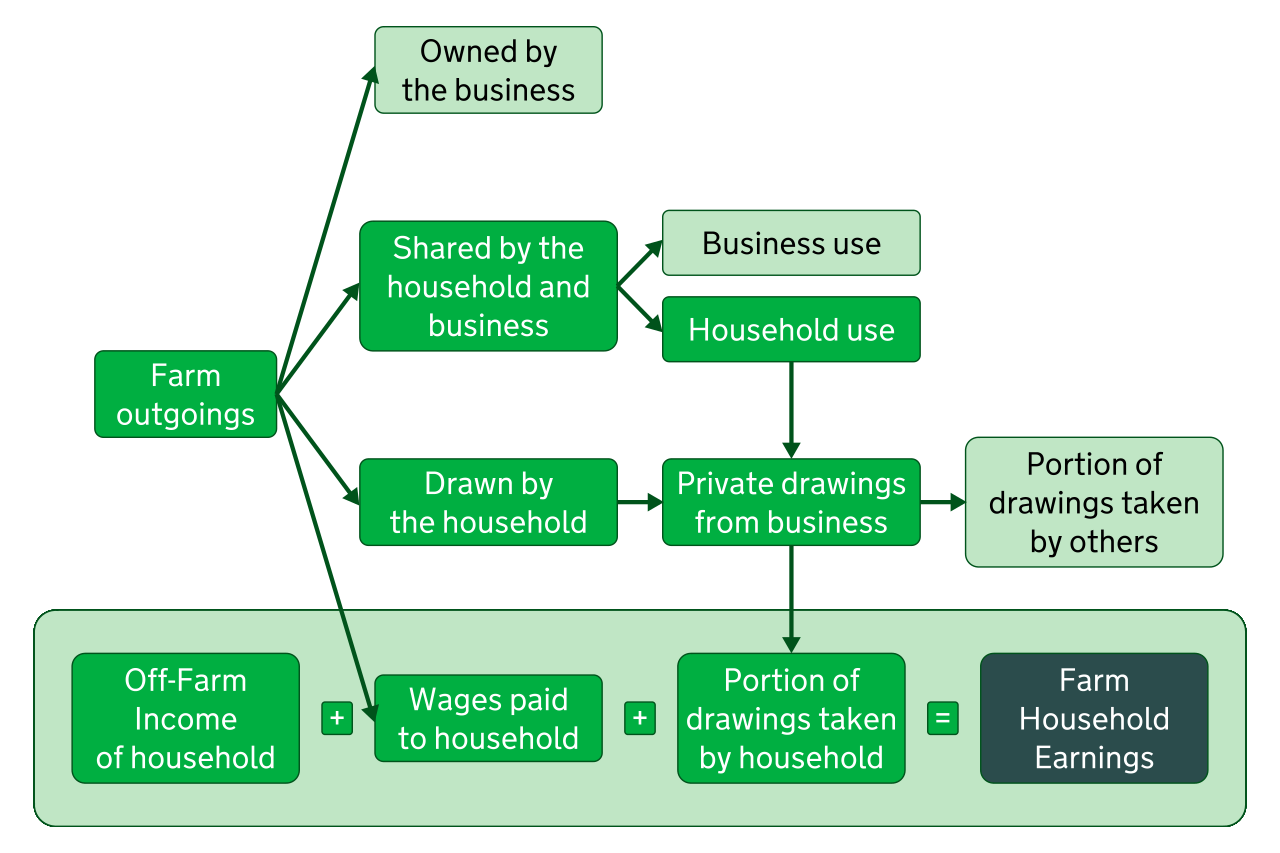
Defra has made the decision to measure disposable income of farm households using the sum of:
-
The household’s share of private drawings, which includes: (a) The household’s portion of the outgoings which are shared by the business and the household (for example, fuel and phone bills); and (b) Private drawings from the farm business (for example, used for the household’s food shop or swimming lessons).
-
Any wages paid to household members by the farm.
-
The Off-Farm Income of household members.
However, we will not be calling this measure ‘Farm Household Income’, as the widely accepted definition of this term uses farm income rather than private drawings. Therefore, the same term with a different definition could be confusing for users of the data. Therefore, we will be using the term Farm Household Earnings.
In addition, Defra accepts that, in order to make international comparisons, an FBI-based Farm Household Income measure would still be useful for users. Therefore, Defra intends to publish both measures in future statistical releases.
Contact details
Responsible statistician: Cat Hand
Public enquiries: fbs.queries@defra.gov.uk
For media queries between 9am and 6pm on weekdays:
Telephone: 0330 041 6560
Email: newsdesk@defra.gov.uk
References
-
Defra. Farm business income. GOV.UK. [Online] https://www.gov.uk/government/statistics/farm-business-income.
-
Office for National Statistics. Average household income, UK: financial year ending 2022. Office for National Statistics. [Online] 25 January 2023. https://www.ons.gov.uk/peoplepopulationandcommunity/personalandhouseholdfinances/incomeandwealth/bulletins/householddisposableincomeandinequality/financialyearending2022.
-
Office for National Statistics. Household Finances Survey. Office for National Statistics. [Online] 5 April 2022. https://www.ons.gov.uk/peoplepopulationandcommunity/personalandhouseholdfinances/incomeandwealth/methodologies/householdfinancessurvey.
-
Office for National Statistics. Living Costs and Food Survey. Office for National Statistics. [Online] 16 February 2017. https://www.ons.gov.uk/peoplepopulationandcommunity/personalandhouseholdfinances/incomeandwealth/methodologies/livingcostsandfoodsurvey.
-
Office for National Statistics. Survey on Living Conditions. Office for National Statistics. [Online] [Cited: 30 August 2024.] https://www.ons.gov.uk/surveys/informationforhouseholdsandindividuals/householdandindividualsurveys/surveyonlivingconditions.
-
OECD. Glossary:Equivalised income. Eurostat Statistics Explained. [Online] 13 April 2021. https://ec.europa.eu/eurostat/statistics-explained/index.php?title=Glossary:Equivalised_income.
-
Office for National Statistics. Household income inequality, UK: financial year ending 2022. Office for National Statistics. [Online] 25 January 2023. https://www.ons.gov.uk/peoplepopulationandcommunity/personalandhouseholdfinances/incomeandwealth/bulletins/householdincomeinequalityfinancial/financialyearending2022.
-
Office for National Statistics. Effects of taxes and benefits on UK household income: financial year ending 2022. Office for National Statistics. [Online] 18 July 2023. https://www.ons.gov.uk/peoplepopulationandcommunity/personalandhouseholdfinances/incomeandwealth/bulletins/theeffectsoftaxesandbenefitsonhouseholdincome/financialyearending2022.
-
Anyaegbu, Grace. Using the OECD equivalence scale in taxes and benefits analysis. Economic & Labour Market Review. January, 2010, Vol. 4, 1.
-
Equivalence scales for children. McClements, L. D. 2, London : Journal of Public Economics, 1977, Vol. 8. ISSN 0047-2727.
-
Agricultural Economics and Farm Surveys Department, Teagasc. https://www.teagasc.ie/media/website/publications/2023/NFSfinalreport2022.pdf. Athenry : Teagasc, 2023.
-
Central Statistics Office Ireland. Income Of Agricultural Households In Ireland. Central Statistics Office Ireland. [Online] 19 June 2008. https://www.cso.ie/en/csolatestnews/pressreleases/2008pressreleases/incomeofagriculturalhouseholdsinireland/.
-
Hétérogénéité, déterminants et soutien du revenu des agriculteurs français. Piet, Laurent, et al. s.l. : Ministère de l’Agriculture et de l’Alimentation, July 2021, Notes et études socio-économiques, Vol. 49. ISSN 2259-4841.
-
La pauvreté monétaire, moins fréquente en présence de non-exploitants. Ministère de l’agriculture et de la souveraineté alimentaire. Service de la statistique et de la prospective. Paris : SSP, February 2024, Agreste Primeur, Vol. 1. ark:/12148/bc6p08t5thx.
-
Hill, Berkley and Bradley, B. Dylan. Comparison of Farmers’ Incomes in the EU Member States. Brussels : Policy Department B: Structural and Cohesion Policies, European Parliament, 2015.
-
Budbergytė, Rasa, et al. Is the Commission’s system for performance measurement in relation to farmers’ incomes well designed and based on sound data? Luxembourg : Publications Office of the European Union, 2016.
-
Council Regulation (EC) No 1217/2009 of 30 November 2009 setting up the Farm Sustainability Data Network (codified version). Council of the European Union. 15 December 2009, Brussels : Official Journal of the European Union, 2009, Vol. 52. ISSN 1725-2555.
-
Directorate-General for Agriculture and Rural Development. Farm sustainability data network. Agriculture and rural development. [Online] https://agriculture.ec.europa.eu/data-and-analysis/farm-structures-and-economics/fsdn_en.
-
Income situation of agricultural households of EU countries. Antošová, Irena, Hazuchová, Naďa and Stávková, Jana. 121–128, 2021, Agricultural Economics – Czech, Vol. 67.
-
Are rural households poorer than non-rural households in Europe? Meloni, Cesare, et al. s.l. : Elsevier, February 2024, Journal of Rural Studies, Vol. 106. ISSN 0743-0167.
-
United States Department of Agriculture. Agricultural Resource Management Survey (ARMS). National Agricultural Statistics Service. [Online] United States Department of Agriculture. [Cited: 30 August 2024.] https://www.nass.usda.gov/Surveys/Guide_to_NASS_Surveys/Ag_Resource_Management/.
-
U.S. Department of Agriculture, Economic Research Service. Farm Household Income Estimates. U.S. Department of Agriculture. [Online] 30 November 2023. https://www.ers.usda.gov/topics/farm-economy/farm-household-well-being/farm-household-income-estimates/.
-
United States Census Bureau. Income in the United States: 2022. United States Census Bureau. [Online] 12 September 2023. https://www.census.gov/library/publications/2023/demo/p60-279.html.
-
Agricultural and off-farm income of Swiss farming households and contribution of the spouse. Renner, Swetlana. 2024. Pacioli 29.
-
Collection and Estimation of Off-Farm Income of Swiss Farm Households. Renner, Swetlana. 2024. 34th meeting of the FLAN.
-
Decomposing household income differences between farmers and non-farmers: Empirical evidence from Norway. Mittenzwei, Klaus, et al. 2, s.l. : Journal of Agricultural Economics, February 2024, Vol. 75, pp. 475-825. doi/10.1111/1477-9552.12579.
-
OECD. Overview of the food and agriculture situation in Japan. OECD Food and Agricultural Reviews: Innovation, Agricultural Productivity and Sustainability in Japan. Paris : OECD Publishing, 2019.
-
Yamashita, Kazuhito. Why Must Only Farmers’ Income be Guaranteed? The reason why government repeatedly addresses only farmers’ income. REITI Policy Update. 52, 2014.
-
Embassy of the Kingdom of the Netherlands in Japan. Structure, land use and profitability of farming in Japan. Tokyo : Ministerie van Landbouw, Visserij, Voedselzekerheid en Natuur, 2020.
-
Statistics Bureau of Japan. Agriculture, Forestry And Fisheries. Japan Statistical Yearbook. s.l. : Ministry of Internal Affairs and Communications, 2024.
-
OECD. Overview of the food and agriculture situation in Korea. OECD Food and Agricultural Reviews: Innovation, Agricultural Productivity and Sustainability in Korea. Paris : OECD Publishing, 2018.
-
Statistics Korea. Farm Household Economy Survey. Statistics Korea. [Online] [Cited: 30 August 2024.] https://kostat.go.kr/menu.es?mid=a20201060000.
Annexe
Annexe 1: Comparing Farm Household Income across countries
| Ireland | France | USA | Switzerland | Norway | Japan | Republic of Korea | |
|---|---|---|---|---|---|---|---|
| Uses Family Farm Income for on-farm income | Yes | No | No | No | No | No | No |
| Uses a net-profit equivalent for on-farm income | No | Yes | Yes | Yes | Yes | Yes | Yes |
| Uses private drawings for on-farm income | No | No | No | Yes | No | No | No |
| Includes farm wages in on-farm income | No | Yes | Yes | No | Yes | No | No |
| Collects Off-Farm Income | Only for Farm Operator | Yes | Yes | Yes | Yes | Yes | Yes |
| Deducts tax for household income figure | No | Yes | No | No | Yes | No | No |