
PackUK extended producer responsibility (EPR) for packaging: producer disposal fees modulation statement
Updated 17 February 2026

© Crown copyright 2026
This publication is licensed under the terms of the Open Government Licence v3.0 except where otherwise stated. To view this licence, visit nationalarchives.gov.uk/doc/open-government-licence/version/3 or write to the Information Policy Team, The National Archives, Kew, London TW9 4DU, or email: psi@nationalarchives.gov.uk.
Where we have identified any third party copyright information you will need to obtain permission from the copyright holders concerned.
This publication is available at https://www.gov.uk/government/publications/extended-producer-responsibility-for-packaging-modulated-disposal-fees/packuk-extended-producer-responsibility-epr-for-packaging-producer-disposal-fees-modulation-statement
Date: 28 June 2025
In setting up the EPR for packaging scheme (referred in this document as “the scheme”), the Producer Responsibility Obligations (Packaging and Packaging Waste) Regulations 2024 (referred in this document as “the Regulations”) require the scheme administrator PackUK to publish a statement of policy on household packaging waste disposal fee modulation as soon as is practicable after its establishment.
This modulation policy statement sets out the approach PackUK will take to varying EPR for packaging household packaging waste disposal fees to reflect the extent to which household packaging supplied by a producer in a packaging category is environmentally sustainable and to incentivise producers to use packaging that is more environmentally sustainable.
Under this policy statement, recyclability - according to the Recyclability Assessment Methodology (RAM) v1.1 will be the measure of environmental sustainability, in line with regulation 64(7)(c) of the regulations. The most recent version of the RAM will be used at the point when each year’s invoices are generated.
Modulation will commence from year 2 of the scheme with the first modulated fees applying to disposal fee calculations for the 2026 to 2027 financial year (calculated using data relating to packaging supplied in 2025).
A revised policy statement will be published to cover years after 2028 to 2029 following a review of the modulation policy in line with paragraph 8(7)(b) of Schedule 7 to the Regulations. In the meanwhile, we will continue to monitor the impacts of the modulation policy, engage with industry to consider available evidence and clarify any emerging issues.
The modulation of household packaging waste disposal fees will not increase the total of all household packaging waste disposal fees paid. Instead, it will affect how these costs are allocated by material.
Modulation strategy
To underpin this modulation policy, PackUK will follow 2 initial principles to determine the impacts of modulation. PackUK will:
- drive a shift to more environmentally sustainable packaging design, with recyclability as the indicator
- reduce the risk of switching to less environmentally sustainable materials
Recyclability is only the first modulation factor. PackUK will consider further indicators of environmental sustainability, as described in regulation 64 (7) of the Regulations for subsequent modulation policy statements from 2029 to 2030.
Modulation
The modulation policy contained within this statement should be read together with the base fees which PackUK will publish as they become available. Base fees for 2025 are published on GOV.UK. In future years will be published with modulated fees following the submission of packaging data by obligated producers.
Modulation applies to the household packaging waste disposal fee which is a significant component of base fees. Only once the household packaging waste disposal fee has been calculated can the modulated fees be calculated.
Under the RAM, all in-scope packaging materials are assigned a rating of red, amber, or green, with red being the least recyclable and green being the most recyclable. The environmental regulators will ensure that these self-reported ratings are accurate.
From 2026, the base fee provided for each material will be calculated using a household packaging waste tonnage fee and be reflective of an amber rating. The price per tonne will be higher than this for packaging assigned the red rating and lower for packaging assigned the green rating.
How modulation is performed
When calculating disposal fees, modulation will be implemented by multiplying the household packaging waste disposal fee element by the modulation factor. This statement sets out the modulation factor for each of the 3 years that the statement covers and it is anticipated that subsequent statements will have similar approach.
Multiplication of the household packaging waste disposal fee by the modulation factor for RAM red-rated packaging material will result in an increase in that fee.
The additional funds raised by the application of the modulation factor to the household packaging waste disposal fee for each tonne of RAM red-rated packaging material will form a pot of money for redistribution. This redistribution pot will be used to apply a lower household packaging waste disposal fee for RAM green-rated packaging material. Each tonne of green material (across all material categories) will receive an equal percentage discount on its household packaging waste disposal fee. This approach has been chosen to reduce the risk of switching to less environmentally sustainable materials.
Amber-rated material will see no change in its household packaging waste disposal fee as a result of modulation.
The modulation factor
For each assessment year covered by this statement, the modulation factor for red RAM packaging materials will be as described in Table one.
Table one: Modulation factors per year
| Assessment year | Factor |
|---|---|
| 2026 to 2027 | 1.2 |
| 2027 to 2028 | 1.6 |
| 2028 to 2029 | 2.0 |
The modulation factor has been designed to increase incrementally over the initial period, giving an immediate reward to packaging which is already RAM Green, while also offering a fair and reasonable transition for producers of RAM red packaging who struggle to move to more environmentally sustainable packaging immediately.
These modulation factors have been chosen following careful consideration of the policy objective, and discussions with the value chain.
The objective of modulation is to drive improvements in the design and composition of packaging, aligning with PackUK’s duty under paragraph 2(c) of schedule 7 to the regulations. PackUK will continue to adjust the modulation factor if doing so serves that objective, whilst taking into consideration the relevant implications of doing so. A decision on future modulation factors will be taken as part of the first review point of the fee modulation policy which will take place no later than 2028.
The modulation factors specified in this statement will be applied when calculating household packaging waste disposal fees each year. Household packaging waste disposal fees can be calculated only once all data has been reported by obligated producers. Once household packaging waste disposal fees have been calculated, PackUK will publish a table of final modulated fees, and this will coincide with the issuing of invoices to obligated large producers.
Under paragraph 2(c) of Schedule 7, of The Producer Responsibility Obligations (Packaging and Packaging Waste) Regulations 2024, PackUK, in exercising its functions, must act in accordance with the principle of the need to:
- incentivise the use of environmentally sustainable packaging
- prevent packaging becoming waste
- reduce disposal of packaging waste
- increase reuse of packaging and in the quantity and quality of packaging materials recycled
Medical packaging
PackUK recognises that medical packaging occupies a special place in the packaging landscape and is subject to a different approach to regulation to other types of packaging.
Consistent with Regulation 64(10) of the Regulations, PackUK has taken account of the legislation which applies to medical packaging, and which affects the ability of producers to use more environmentally sustainable packaging. Additionally, PackUK recognises that some medical packaging is recyclable and for that reason medical packaging is not exempt from fee modulation.
Medical packaging will however be treated differently to other packaging. Medical packaging must be reported under different codes:
- red - medical
- amber - medical
- green - medical
Fees for medical packaging which are assessed as ‘green - medical’ or ‘amber - medical’ will be modulated in accordance with these RAM ratings.
Medical packaging assessed as red must be reported as ‘red-medical’ unless it is not possible to use more recyclable packaging due to legal rules and restrictions - referred to as red by virtue of a regulatory requirement (RBVORR).
If your product is RBVORR , you should report it as amber-medical.
You must provide evidence to support your recyclability assessment in both cases, if you report your product as:
- amber-medical, as it’s RBVORR
- red-medical because RBVORR does not apply
Where medical packaging is assessed to be red, but this is not a result of a regulatory requirement, it will be subject to modulation in the same way as other red-rated packaging materials. Further details on how to report medical packaging data are set out in the reporting guidance.
Next steps
PackUK will continue to gather evidence to support the modulation of the household packaging disposal fee and identify new measures which could form the basis of future iterations of fee modulation. A review of the impact and success of this modulation policy will be undertaken before the next policy statement is published.
We are also commissioning a research project to develop a more comprehensive assessment of environmental sustainability. This is needed to extend EPR for packaging fee modulation to include a wider range of environmental sustainability criteria in the most objective and evidence-based manner. This project will help EPR for packaging incentivise better packaging and reduce harms to the wider environment in the UK from packaging waste.
Annex: Calculation of green disposal fees
The calculation for the modulation of RAM green-rated household packaging waste disposal fees starts by calculating the size of additional revenue generated by the modulation factor applied to RAM red-rated packaging materials. This additional revenue is then divided this by the amount of green tonnage multiplied by its respective disposal fee.
This calculates the available fee discount which can be applied to all RAM green-rated household packaging waste disposal fees, while maintaining the total value of disposal fees paid across all packaging equal to that before modulation.
This calculated discount is then applied to a RAM green-rated household packaging waste disposal fee for a certain material category by multiplying its respective disposal by one minus the calculated discount.
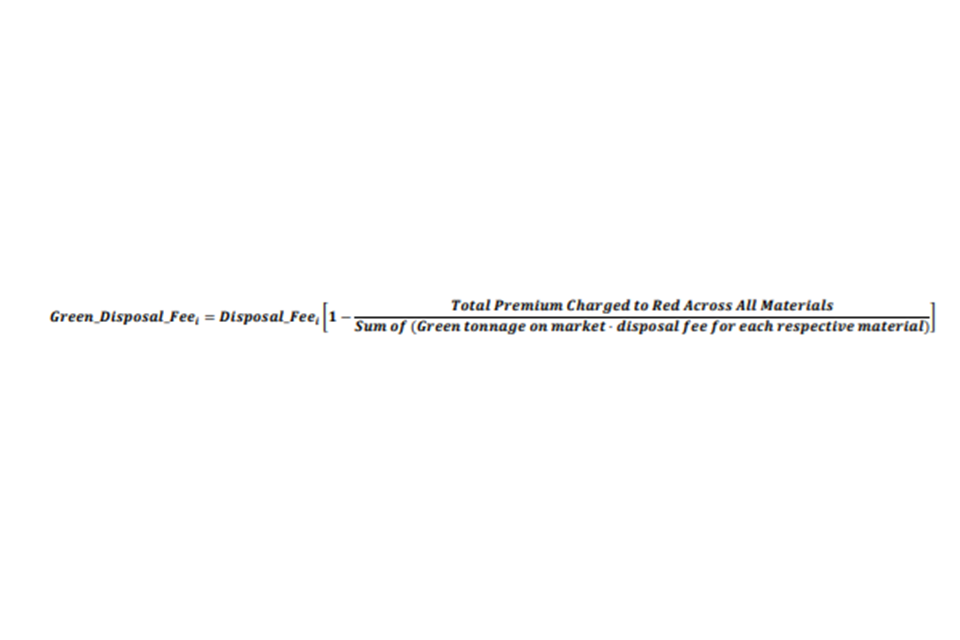
The green disposal fee equals the disposal fee multiplied by one, minus the total premium charged to red materials across all materials, divided by the sum of green tonnage on the market, multiplied by the disposal fee for each respective material.
Formally, this equation can be written as follows.
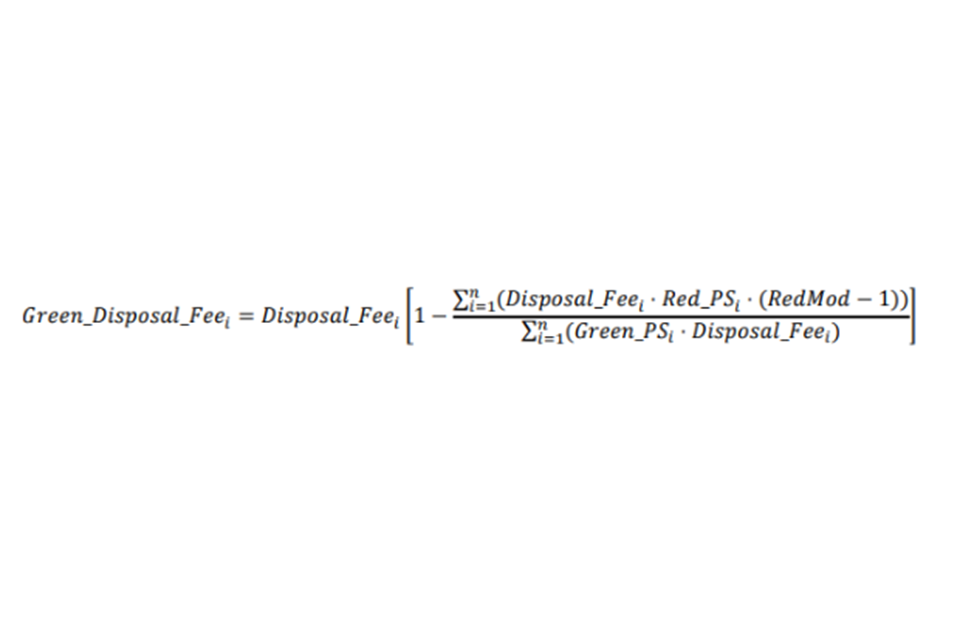
The green disposal fee for material i equals the disposal fee multiplied by one, minus a ratio. The numerator of the ratio is the sum across all materials of the disposal fee, multiplied by the red premium share and the red modifier, minus one. The denominator is the sum, across all materials, of the green premium share, multiplied by the disposal fee.
Where ‘i’ is the series of the 8 material categories:
- Red_PS is the quantity, in tonnes, of RAM red-rated materials supplied in the market
- Green_PS is the quantity, in tonnes, of RAM green-rated materials supplied in the market
- RedMod is the modulation factor applied to RAM red-rated packaging material fees (1.2, 1.6 or 2 times disposal fee, increasing over the 3 years)
- Disposal_Fee is the disposal fee for each material category
- Green_Disposal_Fee is the RAM green-rated disposal fee category charged per tonne, with a different fee charged for each material category
Illustrative simplified example
To simplify, there are only 3 material categories on the market. 1,000 tonnes of rigid plastics on the market, 2,000 tonnes of paper and 3,000 tonnes of glass.
The RAM breakdown of these categories is the following:
- rigid plastic - 60% green, 30% amber, 10% red (600 tonnes of green, 300 tonnes of amber, 100 tonnes of red)
- paper - 50% green, 30% amber, 20% red (1000 tonnes of green, 600 tonnes of amber, 400 tonnes of red)
- glass - 70% green, 20% amber, 10% red (2100 tonnes of green, 600 tonnes of amber, 300 tonnes of red)
The disposal fees for these categories are the following:
- rigid plastic - £423
- paper - £196
- glass - £192
The red modulation factor is 2 times the disposal fee.
Example of rigid plastic green disposal fee calculation
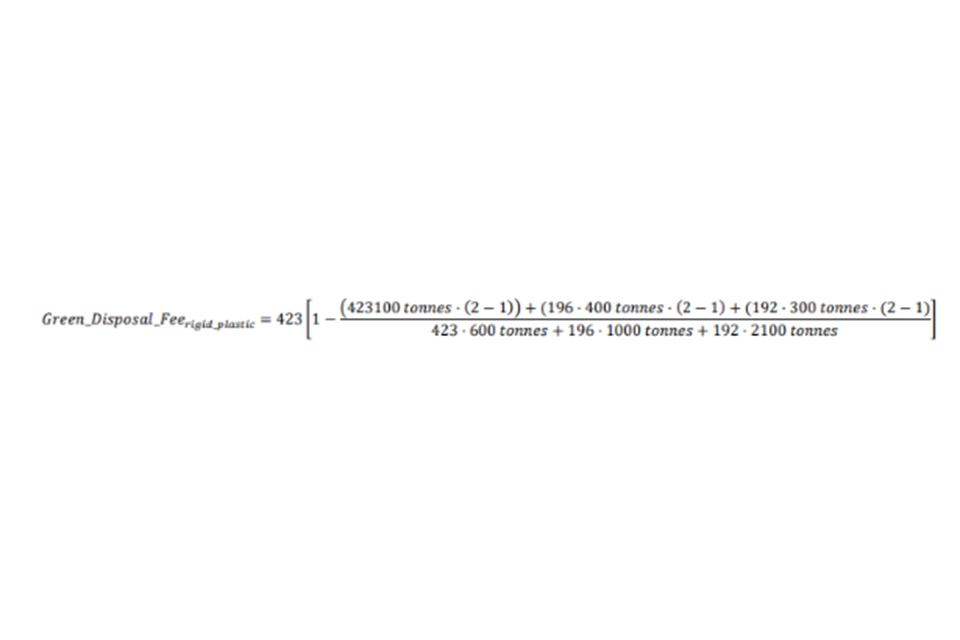
Equation for the green disposal fee for rigid plastic. The fee equals 423 multiplied by one, minus a fraction. The numerator of the fraction is: 423,100 tonnes multiplied by (two minus one), plus 196 multiplied by 400 tonnes multiplied by (two minus one), plus 192 multiplied by 300 tonnes multiplied by (two minus one). The denominator of the fraction is: 423 multiplied by 600 tonnes, plus 196 multiplied by 1,000 tonnes, plus 192 multiplied by 2,100 tonnes.
Example of the numerical equation for the rigid plastic green disposal fee
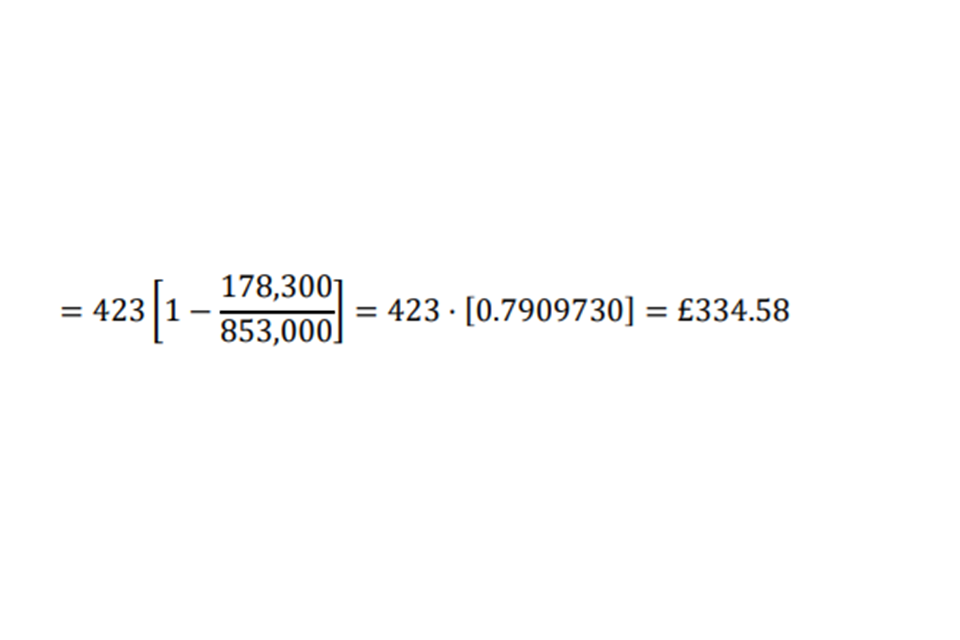
Numerical evaluation of the green disposal fee formula. The expression simplifies to 423 multiplied by one minus 178,300 divided by 853,000, equal to 423 times 0.790973, giving a final value of £334.58.
The discount for green RAM-rated packaging for all material categories is one minus 0.7909730 = 20.903%
This would be applied to all green RAM-rated packaging, across all material categories.
Because the value of the redistribution pot is dependent on the quantity of RAM red-rated packaging material supplied, and the share of it is dependent on the quantity of RAM green-rated packaging material supplied, the final modulated fees can only be published once all data has been submitted for a given reporting year.
The approach to modulation being taken by PackUK operates across all material categories, providing consistent incentives for producers to switch to more recyclable packaging.