European Partnership Bill Impact Assessment (HTML)
Published 26 November 2026

© Crown copyright 2026
This publication is licensed under the terms of the Open Government Licence v3.0 except where otherwise stated. To view this licence, visit nationalarchives.gov.uk/doc/open-government-licence/version/3 or write to the Information Policy Team, The National Archives, Kew, London TW9 4DU, or email: psi@nationalarchives.gov.uk.
Where we have identified any third party copyright information you will need to obtain permission from the copyright holders concerned.
This publication is available at https://www.gov.uk/government/publications/european-partnership-bill/european-partnership-bill-impact-assessment-html
Final stage impact assessment
Title: European Partnership Bill
Type of measure: Primary legislation
Department or agency: Cabinet Office
IA number: CO2034
RPC reference number: RPC-CO-26130-IA (1)
Contact for enquiries: cet-economics@cabinetoffice.gov.uk
Date: 25 November 2026
1. Summary of proposal
Primary legislation to ensure that the government is able to comply with international agreements made between the United Kingdom (‘UK’) and the European Union (‘EU’), or third countries - such as EFTA countries - where those international agreements correspond with agreements made between the UK and the EU.
It will allow the government to make regulations which facilitate alignment and equivalence where that is required by specified international agreements.
2. Strategic case for proposed regulation
This Government was elected with a manifesto commitment to improve the UK’s relationship with the EU. At the UK-EU Summit of 20 November 2026, the parties announced the conclusion of negotiations of agreements on a Sanitary and Phytosanitary (agri-food) area and the linking of the parties’ Emissions Trading Schemes. Alongside this, the parties announced a range of further ongoing initiatives, which will continue to focus on building a closer relationship with the EU that benefits Britain - making people across the UK safer, more secure and more prosperous.
The EU is our largest trading market. In 2025, almost half (45%) of the UK’s total trade was with the EU. Our total trade with the EU was valued at more than £830 billion in 2025, more than 91,000 UK businesses exported goods to the EU, and over 154,000 businesses imported goods. 10 of the UK’s top 20 export destinations for goods and services are EU Member States in 2025, and 11 of the UK’s top 20 import sources are EU Member States. [footnote 1] [footnote 2] [footnote 3]
However, there is a growing body of evidence showing that the post-exit trading arrangements have weakened the UK’s trade and economic performance. Multiple independent studies and official forecasts expected the UK’s economic growth to reduce following the UK’s exit from the EU. Since the June 2016 referendum, the Office for Budget Responsibility’s (OBR) Economic and Fiscal Outlooks have assumed the UK’s trade with the EU would be 15% lower in the long run, compared to a scenario where the UK had remained in the EU. In March 2020, this reduction in trade intensity was estimated to lead to a 4% reduction in the productivity of the UK economy in the long run. [footnote 4]
In addition, there has been a significant impact on investment. Uncertainty in the trading relationship puts off investment by firms and this, in turn, lowers productivity. In its March 2021 Economic and Fiscal Outlook, the OBR estimated that around two-fifths of the long run impact on productivity had already materialised at the time the TCA came into force, as a result of “uncertainty since the referendum weighing on investment and capital deepening”. [footnote 5]
Recent official statistics and empirical evidence aligns with the OBR estimate of weak trade and economic performance. In 2025, the UK’s total trade with the EU fell by 1% compared to 2018 levels, whilst trade with non-EU markets increased by 13% over the same period.[footnote 6] This is key, given the magnitude of the UK’s trade with the EU. On top of this, various ex-post analyses, including “Doppelganger” analyses (comparing the UK’s performance to a counterfactual based on average performance of similar real economies), show GDP is now 5–6% lower than if the UK had remained in the EU. These estimates are consistent across academic and government sources, and are set out in more detail in the evidence base section of this Impact Assessment. November 2025 analysis suggests that, by 2025, the way the UK left the EU had reduced UK GDP by 6-8%; business investment: by 12–18%; employment by 3–4%; and productivity by 3–4%. [footnote 7]
Businesses have also reported that they are facing more barriers and more costs since 2020. For example, in a survey published by the British Chambers of Commerce (BCC) in December 2025, 54% of its exporting members disagreed that the TCA was enabling their business to grow or increase sales.[footnote 8] Adjusting to new barriers has been particularly difficult for small and medium sized enterprises who exported primarily or solely to the EU. Many have given up trading in response to the extra paperwork and hassle. Some estimates suggest that around 16,400 exporters stopped exporting to the EU as a result of how the UK left the EU. [footnote 9]
There is opportunity to further smooth trade within the United Kingdom. The Windsor Framework provided facilitations for agri-food and plants to move within the UK on the basis of UK rules through two schemes, and the UK Internal Market Act provides Northern Ireland with protected, unfettered market access. The application of an aligned regulatory framework across the UK for agri-food and emissions will protect the internal market and reduce costs and administrative burdens for businesses and consumers.
The government remains committed to ensuring growth across the UK, and boosting trade abroad is essential to delivering a strong economy at home. As our largest trading market, reducing unnecessary barriers to trade and investment with the EU is an important piece of that puzzle. For example, research published in August 2025 reveals the significant non-tariff measure costs applicable to GB exports of agri-foods and plant products to the EU under current TCA arrangements. This includes the requirement for Export Health Certificates, which typically cost between £80 and £200 per certificate for fish and seafood goods and between £113 and £200 per certificate for other agri-foods.[footnote 10] These firm-level impacts add up across all traders to have substantial impacts on UK trade and growth.
In addition, linking with the EU on emissions trading will create a larger and more liquid market for carbon allowances, reducing costs in the longer term. More stable prices will support industry confidence to invest in new technologies and jobs and decarbonise more quickly and efficiently. It will also create the conditions for mutual exemptions from our respective UK/EU Carbon Border Adjustment Mechanisms (CBAM), saving UK industry from being charged on nearly £6.5bn of UK exports.[footnote 11]
Although the Government recognises the scale of the challenges, it is committed to addressing them by strengthening UK-EU relations and making trade easier for businesses, by realising the full potential of the TCA. This government has committed to resetting its trade and investment relationship with the EU. On 19 May 2025, the first UK-EU Summit took place. Through the Common Understanding, the UK and the EU set out various measures to strengthen the UK-EU bilateral relationship. On 20 November 2026, the government held its second UK-EU Summit. This confirmed that the government had successfully concluded negotiations of agreements on a Sanitary and Phytosanitary (agri-food) area and the linking of the parties’ Emissions Trading Schemes.
In order for the UK to meet its obligations the Government must pass primary legislation to give domestic legal effect to the international agreements which resulted from these negotiations.
3. SMART objectives for intervention
The immediate intended outcome of the powers within the Bill are to ensure smooth implementation of relevant treaty requirements domestically. It will enable the UK Government, where it has agreed to align with specific EU law under an agreement, to apply that law in the United Kingdom - subject to any agreed modifications. It will also ensure that we are able to facilitate specified exceptions from EU Law, and maintain equivalency arrangements as needed.
Achieving these objectives can be expected to support the Government’s pledge to reset the relationship with the EU. This will allow the Government to implement the international treaties emerging from negotiations with the EU. Although specific quantified targets for monitoring progress against the objectives for this Bill cannot be set at this stage, the treaties themselves will allow the government to deliver on its manifesto commitments, which included ambitions to:
- Improve the UK’s trade and investment relationship with the EU and increase prosperity by tearing down unnecessary barriers to trade. The aim is to achieve a measurable reduction in identified trade barriers, which could be tracked through trade flow data, business surveys and stakeholder feedback.
- Negotiate a veterinary agreement to prevent unnecessary border checks and help put downward pressure on food price inflation. Securing a formal Sanitary and Phytosanitary (SPS) agreement with the EU will reduce border checks on animal and plant products. This could be monitored through, for example, customs declarations and ongoing analysis on food prices.
In addition to the manifesto commitment to negotiate a veterinary (agri-food) agreement, the Government’s commitments include negotiating separate agreements on linking Emissions Trading Schemes, as announced in the Summit of 20 November.
The timing of when benefits will start to accrue depends on the pace at which the legislation and subsequent implementation proceed. As with all international agreements, resetting Britain’s relationship with the EU will take time and involve trade-offs and shared rules, and total benefits are expected to accrue in the medium to long term.
The ultimate outcome sought from this Bill, and broader efforts to build a valuable relationship with the EU, is to strike important deals that will boost our economy, cut red tape, help our businesses grow and support good growth in every postcode.
The “theory of change” set out in section 4 below indicates the key channels through which the Government expects that the implementation of the EU deal, enabled by the Bill, will contribute to improvements against each of the objectives described above, and deliver against the Government’s missions.
4. Description of proposed intervention and explanation of the logical change process whereby this achieves SMART objectives
To fulfil its international obligations with the EU, the UK Government must establish a domestic legal framework that grants various authorities the power to implement, adopt, and manage treaty requirements. This includes making domestic changes to meet treaty commitments and the ability to designate specific EU regulations as applying in the UK.
In the package of negotiated agreements, the treaties that include dynamic alignment are linking Emissions Trading Schemes (ETSs) and a Sanitary and Phytosanitary Agreement (SPS). The section below briefly summarises how each of these aspects contributes to the Government’s objectives. A fuller analysis of the channels of impact of these agreements is set out in the evidence base.
Linking Emissions Trading Schemes
The Government has concluded an agreement to link Emissions Trading Systems (ETSs) with the EU. The agreement will include the sectors of; electricity generation, industrial heat generation (excluding the individual heating of houses), industry, domestic and international maritime transport and domestic and international aviation.
Once implemented, the agreement will:
- Establish a larger and more liquid carbon market, which will support industry confidence to invest in new technologies and jobs and decarbonise more quickly and efficiently.
- Provide a cheaper path to net zero and support the UK and EU’s shared decarbonisation goals.
- Make the UK and EU energy markets more efficient and effective, reducing costs in the longer term. Remove regulatory barriers in sectors like CO2 storage.
- Create the conditions for mutual exemptions from our respective Carbon Border Adjustment Mechanisms (CBAM), saving UK industry from being charged on nearly £6.5bn of UK exports. [footnote 12]
Sanitary and Phytosanitary Agreement
In line with the manifesto commitment to agree a veterinary agreement, the Government has concluded an SPS agreement with the EU. The agreement will simplify agrifood trade with our largest market, cutting costs and red tape for British producers and retailers.
Once implemented, the agreement will:
- Lower costs to UK business exporting to the EU by removing certificate and routine inspection requirements.
- Speed up border processing as routine SPS border checks will be eliminated.
- Restore market access by resuming trade in currently restricted goods like fresh sausages and burgers.
- Simplify pet travel through a multi-use pet passport.
- Establish exceptions that grant the UK autonomy to set specific rules where our national interest is best served.
- Remove a broad and wide-ranging set of requirements for goods and plants moving from Great Britain to Northern Ireland, because the same regulations will be followed across the UK.
Taken together, these two elements alone (the SPS deal and ETS linking) could deliver an estimated £4bn to £9bn to the UK economy a year by 2040.[footnote 13] The components of this range are unpacked in the evidence base.
Theory of Change
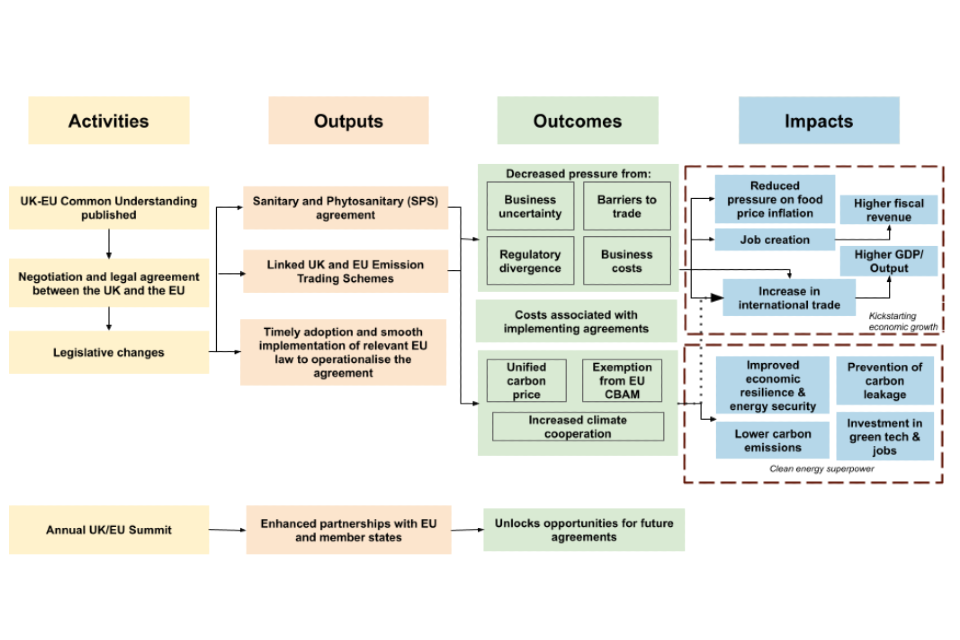
5. Summary of long-list and alternatives
The Bill has been prepared to enable swift delivery of a manifesto commitment and binding international agreements. Without primary legislation, the Government will be unable to meet its obligations under the agreements, as there will be no route through which the government is able to align with specified pieces of EU law in those agreements. In addition, the only feasible policy outcome is the one that will be agreed with the EU through negotiations. As such, it has not been practicable for the Department to undertake the usual long-listing process. Instead, the evidence base section below sets out an assessment based on the latest expectations from negotiations with the EU at the time of writing.
There are, in principle, alternative outcomes to negotiations that could have materialised. However, these are all hypothetical and would involve making assumptions about how the EU would have responded to UK positions. This would not be a valuable exercise. It is worth noting, however, that negotiators pursued the best outcome for the UK and UK industry across all aspects of the deal during negotiations.
In theory, it may have been possible to agree elements of negotiations with the EU in isolation - for example, the SPS agreement without the ETS linking agreement (and vice versa). However, this has been discounted for assessment for reasons including: 1) this was also subject to the package of agreements being negotiated with the EU, and 2) this is not an option related to the design of the European Partnership Bill. Impacts of the individual agreements have, however, been considered individually in the evidence base, in order to demonstrate the potential impacts of using the powers with the Bill.
While we have not actively considered a ‘do nothing’ scenario, the impacts are presented against a baseline which has been constructed to represent post-EU Exit trading arrangements, where current trading arrangements remain in place. For SPS modelling, this means estimating the marginal impacts of the agreement compared to a counterfactual of no policy in place, while maintaining all other factors affecting the UK-EU economic relationship constant.[footnote 14] For ETS linking, a scenario with linked schemes has been compared to a future ‘unlinked’ scenario. This could be considered representative of a ‘do nothing’ scenario for the policy measures in scope of the Bill.
6. Description of shortlisted policy options carried forward
As set out in Section 5 above, the Government does not consider that there are alternative ways to enable the UK to meet its obligations under the agreements. Without primary legislation, the Government is unable to meet its obligations. Therefore, only two options are shortlisted.
OPTION 0 (do nothing) – with this option, the UK government would be unable to implement the agreement, including the SPS agreement and agreement to link ETSs.The UK would continue to trade with the EU under the current terms of the Trade and Cooperation Agreement. As such, this is not considered a viable option to meet the Government’s objectives and manifesto commitment to improve the UK’s trade and investment relationship with the EU.
OPTION 1 (preferred option: legislation to implement the international agreement) - the proposed policy is justified because it ensures the agreement has domestic legal effect. Without primary legislation, the Government is unable to meet its obligations. Option 1 is the only option that meets the policy objectives to ensure reduced trade barriers for UK traders, and to ensure certainty for UK businesses and consumers.
7. Regulatory scorecard for preferred option
As the European Partnership Bill is a framework Bill, the impacts of the Bill itself are minimal, and will only materialise following the use of secondary legislation to implement the final agreements with the EU. However, this scorecard has been completed by assessing the future international agreements with the EU that the Bill will enable the government to implement. Details are set out in the evidence base section of this impact assessment.
Part A: Overall and stakeholder impacts
| (1) Overall impacts | Details | Directional rating |
|---|---|---|
| Description of overall expected impact | Businesses have experienced and continue to experience a wide range of regulatory barriers to trade by virtue of the UK being a separate market outside the EU market. An SPS Agreement will make agrifood trade with the EU lower cost and easier, cutting costs for British businesses who export to, and import from, the EU. Routine SPS border checks will be eliminated, so fresh produce can hit supermarket shelves more quickly, with less paperwork and fewer costs. For consumers, it will reduce the pressure on price inflation. The benefits are not just limited to trade. In energy, linking our carbon markets will cut costs for our major UK industries and stop British firms paying the EU’s carbon border tax. The European Partnership Bill will ensure these expected impacts can become a reality. |
Positive Based on all impacts (incl. non-monetised) |
| Monetised impacts | As the European Partnership Bill is a framework Bill, the impacts of the Bill itself are minimal, and will only materialise following the use of secondary legislation to implement the final agreements with the EU. Taken together, based on the current assessment, an SPS deal and linking ETSs could deliver an estimated £4bn up to £9bn to the UK economy a year by 2040. Impacts are projected to 2040 using estimated UK GDP in 2040 (from the Global Trade Outlook). This GDP approach to assessing impacts follows international best-practice for determining the impact of international agreements. The ‘positive’ rating is based on the best available evidence at the time of this assessment. Certain costs and benefits could not be considered at the stage of negotiations at the time of writing. For example, costs and benefits relating to the specific regulations in scope of the final agreements, possible transition periods, and impacts associated with implementation. These are not direct impacts from the European Partnership Bill, and were based on ongoing negotiations at the time of writing. |
Positive Based on likely impact on UK GDP |
| Non-monetised impacts | For some areas it has not been possible to monetise impacts, largely because they were subject to negotiations with the EU at the time of writing. There will likely be spending requirements in relation to future agreements on SPS and ETS, where the government is prepared to make an appropriate financial contribution to support the relevant costs associated with the EU’s work in each policy area, for example to access EU agencies or databases. The details of any financial contributions will be determined in line with the final legal text of the agreements, once published. The ‘positive’ rating is based on the best available evidence at the time of this assessment. |
Positive |
| Any significant or adverse distributional impacts? | The agreement’s distributional impact is expected to be broadly neutral, as benefits are distributed across various sectors and regions rather than creating significant disparities. The application of an aligned regulatory framework across the UK for agri-food and emissions will protect the internal market and reduce costs and administrative burdens for businesses and consumers across GB and NI. In particular, an SPS agreement will be highly beneficial to Northern Ireland, it will remove a broad and wide-ranging set of requirements for goods and plants moving from Great Britain to Northern Ireland, because the same regulations will be followed across the UK. The agreement will smooth flows of trade, protect the UK’s internal market, reduce costs for businesses and improve consumer choice in Northern Ireland. SMEs stand to benefit significantly from the removal of non-tariff barriers, which previously imposed disproportionate costs. However, these localised gains are balanced by cross-cutting benefits - such as lower energy bills and decarbonisation - that apply to all UK households and regions. |
Neutral |
| (2) Expected impacts on businesses | Details | Directional rating |
|---|---|---|
| Description of overall business impact | Agreeing and implementing deals on emissions and on food and agriculture trade between the UK and the EU will reduce costs for businesses. | Positive Based on all impacts (incl. non-monetised) |
| Monetised impacts | As set out above, based on the current assessment, negotiating an SPS deal and linking ETSs could deliver an estimated £4bn up to £9bn to the UK economy a year by 2040. This will benefit UK businesses. Specific monetised business cost (non-tariff measures) reductions have also been set out in the evidence base. In the context of food exports, for example, Export Health Certificates will no longer be required. This will save businesses up to £200 per consignment each time goods are sent, meaning a single lorry carrying a mixed load of animal products could see £1000s in reduced costs. The ‘positive’ rating is based on the best available evidence at the time of this assessment. Any additional impacts on businesses will be subject to the final negotiated agreements. |
Positive Based on likely impact on UK GDP |
| Non-monetised impacts | Certain costs and benefits could not be considered at this stage, and while negotiations were ongoing at the time of writing. For example, costs and benefits relating to the specific regulations in scope of the final agreements, possible transition periods, and impacts associated with implementation. These are not direct impacts from the European Partnership Bill, and negotiations were ongoing at the time of writing. Because of this, an “uncertain” rating has been given at this stage. The government will support businesses in adapting to new rules and requirements. | Uncertain |
| Any significant or adverse distributional impacts? | For Northern Ireland, the Windsor Framework provided facilitations for agri-food and plants to move within the UK on the basis of UK rules through two schemes, and the UK Internal Market Act provides Northern Ireland with protected, unfettered market access. The application of an aligned regulatory framework across the UK for agri-food and emissions will protect the internal market and reduce costs and administrative burdens for businesses and consumers. For other UK regions, there may be some distributional impacts reflecting UK-EU trading patterns across the UK, however, all UK regions conduct the majority of their agri-food trade with the EU, particularly Wales and Northern Ireland. SMEs are disproportionately impacted by fixed costs of trade and have been disproportionately impacted by post EU-Exit trading arrangements. Small businesses that currently trade or want to trade could particularly benefit from removing as many as possible of the non-tariff measures resulting from the Trade and Cooperation Agreement. Lowering these costs reduces barriers to exporting for both existing and prospective SME traders. While there are clear expected benefits for certain regions and small traders, other impacts - such as reductions in energy bills - are likely to be felt across regions and stakeholders. As such, a neutral rating has been given. |
Neutral |
| (3) Expected impacts on households | Details | Directional rating |
|---|---|---|
| Description of overall household impact | Agreeing and implementing deals on emissions and on food and agriculture trade between the UK and the EU will reduce costs for businesses, offering more choice to consumers and reducing the pressure on prices, including energy bills and food price inflation. | Positive Based on all impacts (incl. non-monetised) |
| Monetised impacts | As set out above, based on the current assessment, negotiating an SPS deal and linking ETSs could deliver an estimated £4bn up to £9bn to the UK economy a year by 2040. This will benefit UK households. The ‘positive’ rating is based on the best available evidence at the time of this assessment. Negotiations with the EU were ongoing at the time of writing. Any additional impacts on businesses will be subject to the final agreements. |
Positive Based on likely impact on UK GDP |
| Non-monetised impacts | As a result of the reduced costs on agri-food trade, the SPS agreement could help reduce the pressure on food price inflation. This depends on whether and how business savings are passed through from producer prices to retail prices. ETS costs currently contribute a small share of household energy bills, which will fall as the UK grid decarbonises. However, in the long run, linking may lower UK carbon prices and household bills. On this basis, a ‘positive’ rating has been given. Negotiations with the EU were ongoing at the time of writing. Any additional impacts on households will be subject to the final agreements. |
Positive |
| Any significant or adverse distributional impacts? | Unlikely. The impacts the deals on households are likely to be cross-cutting - such as through reductions in energy bills. Decarbonisation benefits are similarly cross-cutting. | Neutral |
Part B: Impacts on wider government priorities
| Category | Description of impact | Directional rating |
|---|---|---|
| Business environment: Does the measure impact on the ease of doing business in the UK? |
The measures implemented by this Bill are likely to have positive impacts on the ease of doing business in the UK, for example, through trade costs reductions with our largest trading market. Various stakeholders have spoken publicly about the potential benefits of the deals for their sectors. For example, more than 50 companies and business bodies across the UK and EU - including the CBI, British Steel and Energy UK - called for linking ETSs to ‘lower costs of decarbonising, unlock market’s confidence and enable acceleration in the delivery of clean energy’. As a result of the SPS deal, trade in products such as fresh sausages and burgers, some shellfish from domestic waters, and seed potatoes will be able to resume. That will re-open the EU market for these goods, supporting businesses to expand their production and stimulating jobs. |
Positive |
| International Considerations: Does the measure support international trade and investment? |
As a framework Bill, it does not directly impact international trade. However, the objective of the Bill is to enable the UK Government, where it has agreed to align with specific EU law under an agreement, to apply that law in the UK - subject to any agreed modifications. This will allow the Government to implement the international treaties with the EU. Achieving these objectives can be expected to support the Government’s pledge to make Brexit work and reset the relationship with the EU, and “tearing down any unnecessary barriers to trade”, supporting international trade and investment with the UK’s largest trading market. The estimated GDP gains from this agreement are driven, in part, by reduced barriers to trade (e.g., reduced barriers to agri-food trade). |
Positive |
| Natural capital and Decarbonisation: Does the measure support commitments to improve the environment and decarbonise? |
Emissions trading is one of the UK’s most powerful tools to decarbonise industry and achieve our net zero goals. A linking agreement would mean a cheaper path to net zero, with a larger and more stable carbon market, which will support industry confidence to invest in new technologies and jobs and decarbonise more quickly and efficiently. It will also remove regulatory barriers in sectors like CO2 storage. | Positive |
8. Monitoring and evaluation of preferred option
As this intervention is being enacted through Primary Legislation, it falls outside the statutory scope of the Small Business, Enterprise and Employment Act 2015, which mandates Post-Implementation Reviews (PIRs) for secondary regulatory measures. While there is no legal requirement to publish a formal PIR for this Act, the Government remains fully committed to rigorous and evidence-based monitoring of the relationship with the EU through established channels.
The UK ETS Authority will remain the body responsible for the running of the UK ETS, and will monitor and evaluate the impact of the linking agreement on emissions, carbon leakage and economic performance as part of the existing UK ETS evaluation programme. Similarly, the Department for Environment, Food & Rural Affairs (Defra) will monitor the Sanitary and Phytosanitary (SPS) agreement and its implementation. This approach ensures that monitoring is continuous and embedded within the relevant Departments.
Furthermore, we recognise that this primary legislation establishes a framework that may require further implementation in the future. Therefore, implementing regulations introduced under the powers of this Act will be subject to the appropriate scrutiny, assessment of impact and review provisions at the time of their proposal. This ensures that while the overarching legislative architecture is established now, the specific regulatory mechanics implementing these measures will remain subject to the necessary checks, balances, and flexibility required to adapt to any future agreements and context.
The exact implementation schedule is not yet finalised and depends on ongoing technical and international arrangements. Because of this, we cannot accurately define a fixed schedule for the monitoring process.
9. Minimising administrative and compliance costs for preferred option
Specific costs associated with reduced requirements for traders are set out in the evidence base section below. The Government is committed to providing appropriate analysis of any agreement made with the EU, but providing a full assessment of the impacts was not possible whilst detailed negotiations were ongoing at the time of writing.
Declaration
Department: Cabinet Office
Contact details for enquiries: cet-economics@cabinetoffice.gov.uk
Minister: Hamish Falconer MP, Minister for Intergovernmental Relations and European Relations
I have read the Impact Assessment and I am satisfied that, given the available evidence, it represents a reasonable view of the likely costs, benefits and impact of the leading options.
Signed: Hamish Falconer MP
Date: Wednesday 25 November 2026
Summary: Analysis and evidence
Price base year: 2023 prices
PV base year: N/A - impacts presented in GDP terms (international best practice for international trade agreements)
| Category | 0. Do nothing (baseline) | 1. Preferred option: legislation to implement the international agreement |
| Estimated impact on Growth (GDP) (with brief description, including ranges, of individual costs and benefits) |
The UK government would be unable to implement negotiated agreements with the EU, including the SPS agreement and agreement to link ETSs. The UK would continue to trade with the EU under the current terms of the Trade and Cooperation Agreement. The economic and trade trends observed as a result of the way the UK left the EU would be expected to continue. NBER analysis suggests that by 2025, the way the UK left the EU had reduced UK GDP by 6-8%. |
As the European Partnership Bill is a framework Bill, the impacts of the Bill itself are minimal, and will only materialise following the use of secondary legislation to implement the final agreements with the EU. Taken together, based on the current assessment, implementing the SPS deal and linking ETSs could deliver an estimated £4bn up to £9bn to the UK economy a year by 2040. Impacts are projected to 2040 using estimated UK GDP in 2040 (from the Global Trade Outlook). In addition to GDP impacts, the agreements will establish a shared agri-food area and integrate UK-EU carbon markets. This removes costly certificates and physical border checks, easing trade for SMEs. Beyond trade, linking carbon markets will accelerate decarbonisation and unlock extensive CO2 storage potential. |
| Public sector financial costs | In addition to the estimated 6-8% reduction in UK GDP, NBER analysis suggests the way the UK left the EU reduced business investment by 12–18%; employment by 3–4%; and productivity by 3–4%. These impacts inform the government’s objective to strengthen trade with the EU and reduce trade barriers, to mitigate these ongoing impacts across the UK economy. |
The agreements concluded with the EU have been assessed to benefit businesses, create jobs and reduce the pressure on prices. This will drive growth, and growing the economy is an effective way to strengthen public finances. There will be costs associated with implementing the treaties, following the conclusion of negotiations. These have not been assessed while negotiations were ongoing, as the details were still being determined. There will likely be spending requirements in relation to future agreements on SPS and ETS , where the government is prepared to make an appropriate financial contribution to support the relevant costs associated with the EU’s work in each policy area, for example to access EU agencies or databases. The details of any financial contributions will be determined in line with the final legal text of the agreements, once published. |
| Significant un-quantified benefits and costs | While modelling can be used at a macro-level to compare the UK today to a constructed scenario where the UK had not left the EU in the way it did, it is not possible to observe the trade or investment that did not occur as a result of the deal. For example, the companies that bypassed the UK for investment, or the small UK businesses that never started trading because the complexity of EU trade was too high. | Certain costs and benefits could not be considered at the stage of negotiations at the time of writing. For example, costs and benefits relating to the specific regulations in scope of the final agreements, possible transition periods, and impacts associated with implementation. These are not direct impacts from the European Partnership Bill, and could not be assessed while negotiations were ongoing. |
| Key risks | The full impacts of the existing arrangements under the TCA, as a result of how the UK left the EU, are yet to fully materialise. Therefore, the full picture may not be fully understood at this stage. It is also analytically challenging to separate the impacts of the EU Exit deal from other economic and trade shocks, such as the Covid-19 pandemic and Russia’s invasion of Ukraine. |
A full assessment of the impacts of the final agreements was not possible while negotiations were ongoing. |
| Results of sensitivity analysis | A range of government and external evidence sources have been used to make this assessment considering metrics such as productivity, business investment, and changes in trade values. | A range of government and external evidence sources have been used to make this assessment, considering metrics such as business costs (non-tariff barriers), trade values, and infrastructure investment costs. |
Evidence base
Rationale
The body of evidence showing that how the UK left the EU has weakened the UK’s trade and economic performance is growing. Evidence shows it has had a negative aggregate impact on trade, investment, productivity and GDP, and raised uncertainty and consumer prices. It is generally accepted that the full, long-term impacts of how the UK left the EU are still materialising. For example, The Resolution Foundation suggested in 2024 that 45% of the impact had yet to manifest.[footnote 15]
This is the context in which the Government has been reviewing the current trading arrangements with the EU, under the Trade and Cooperation Agreement, and negotiating an improved relationship with the EU. Impacts are broken down by channel of impact below.
Trade
The TCA ensures tariff- and quota-free trade (for goods satisfying rules of origin rules). But leaving the Single Market changed the rules and processes involved in trading with the EU. UK businesses now face relatively higher costs on much of their trade. Ex-ante estimates in 2018 suggest these could roughly be equivalent to an 8% tariff.[footnote 16]
Since 2018, the amount we trade with the EU has fallen relative to our trade with the rest of the world. In 2025, the UK’s total trade with the EU fell by 1% compared to 2018 levels, whilst trade with non-EU markets increased by 13% over the same period. [footnote 17]
As set out in the Strategic Case above, the message from businesses has been clear - they are facing more barriers and more costs as a result of how the UK left the EU Exit. Research suggests that around 16,400 exporters have stopped exporting to the EU since leaving.[footnote 18] As businesses that engage with international markets tend to be more productive, limiting how UK businesses trade with our nearest partner risks hindering economic growth.[footnote 19]
It is, however, worth noting that a combination of global shocks in recent years has made it difficult to disentangle the impacts of EU Exit from other major global geo-political events, including the COVID-19 pandemic, and Russia’s invasion of Ukraine.
Output
Before leaving, the impact of how the UK left the EU on UK GDP ex ante was generally expected to be between 3% and 4% in the long run. For example, The Office for Budget Responsibility (OBR) estimated that the UK’s trade with the EU will be 15% lower in the long run, compared to a scenario where the UK had remained in the EU. This reduction in trade intensity was estimated to lead to a 4% reduction in the productivity of the UK economy in the long run.[footnote 20]
Ex-post analysis and modelling using observed data suggests even greater impacts as a result of how the UK left the EU (see table below). For example, November 2025 NBER analysis suggests that by 2025, the way the UK left the EU had reduced UK GDP by 6-8%; business investment by 12–18%; employment by 3–4%; and productivity by 3–4%.[footnote 21]
Ex-post estimates of the impact of Brexit to date on GDP
(compared to no Brexit counterfactual)
| Institution / Journal | Authors | Year | Estimated impact compared to no Brexit counterfactual | Modelling Approach |
|---|---|---|---|---|
| CER: The cost of Brexit to June 2022 | Springford | 2022 | UK Real GDP: 5.5% lower by Q2 2022. | SCM (doppelganger modelling) |
| NIESR: Revisiting the Effect of Brexit | N/A | 2023 | UK Real GDP: 2-3% lower in 2023. Increases to 5.7% by 2035. | NIESR’s global macroeconomic model, NIGEM |
| Cambridge Econometrics: London’s economy after Brexit: Impacts and implications | Patel et al | 2024 | UK GVA: 6% lower in 2023 (£140bn). Increases to 10.1% by 2035 (£311bn lower). | Macro-sector model (E3ME) |
| Goldman Sachs: The Structural and Cyclical Costs of Brexit | Stehn et al | 2024 | Approximately a 5% hit to real GDP compared to a doppelganger where the UK remained in the EU. However, the estimates are significant between 4-8% | Doppelganger |
| Alabrese et al: Levelling up by levelling down: The economic and political costs of Brexit | Alabrese et al | 2024 | UK Real GDP: 5-10% lower. | Regional doppelganger |
| CER: Brexit, four years on: Answers to two trade paradoxes | Springford | 2024 | Still consistent to say the reduction in GDP is around 4-5%. | Doppelganger |
| NIESR: Five Years on: the Economic Impact of Brexit | N/A | 2025 | In 2023, the UK remained the only G7 nation that has not recovered to pre-pandemic GDP level. | Peer comparisons |
| NBER: The Economic Impact of Brexit | Bloom et al | 2025 | UK Real GDP: 6-8% estimated impact as of 2025. | Micro modelling (DiD and DPM surveys) |
| Macro modelling (SCM, comparator country analysis) |
Uncertainty and Investment
The fallout from the 2016 referendum and the way the UK subsequently left the EU increased uncertainty and reduced investor confidence in the UK. Businesses diverted resources towards adapting to trade barriers, reducing the resource available for R&D. For example, the Bank of England estimated that the decision to exit lowered investment by almost 25% by 2020-21.[footnote 22] A more recent academic estimate places this figure at 12-18% by 2025.[footnote 23]
Uncertainty about the future of the UK economy also reduced demand for Sterling-denominated assets, impacting the exchange rate. Sterling depreciation is estimated to have raised prices by ~2.9% by June 2018 compared to the pre-referendum period.[footnote 24]
In its March 2021 Economic and Fiscal Outlook, the OBR estimated that around two-fifths of the long run impact of EU Exit on UK productivity had already materialised at the time the Trade and Cooperation Agreement came into force, as a result of “uncertainty since the referendum weighing on investment and capital deepening”.[footnote 25]
Sectors and markets affected
Overall, the exit from the EU has introduced new structural friction into the UK economy. However, sectors that are particularly interdependent with the EU, such as manufacturing, agri-food, and labour-intensive sectors, have been hit the hardest. [footnote 26]
As set out in the strategic case, the impacts of how the UK left the EU have been felt particularly keenly by SMEs who trade, or traded, with the EU. New trading costs are largely fixed costs, meaning it costs roughly the same amount of time and money for businesses, regardless of size. One academic estimate finds that the smallest 20% of firms have seen a 30% fall in trade, whereas the largest 20% of firms have seen no notable change.[footnote 27] For example, the administrative burden of a customs declaration remains constant regardless of the shipment’s volume or value. Many businesses have responded to the extra paperwork and hassle by simply giving up trading with the EU.[footnote 28]
In terms of agri-food trade, in 2025, 58% (£14.9bn) of UK agri-food exports were to EU countries and 69% (£47.0bn) of UK agri-food imports were from EU countries.[footnote 29] The UK is the top destination for EU agri-food exports, accounting for 24% (€52.0 billion) of the total EU agri-food exports in 2025. EU agri-food imports from the UK in 2025 accounted for 8% of total EU agri-food imports (€16.1 billion).[footnote 30] All UK regions conduct the majority of their agri-food trade with the EU, particularly Wales and Northern Ireland.[footnote 31]
After adjusting for trade price inflation, overall agri-food exports from the UK were 24% lower in 2025 than in 2018, and agri-food imports into the UK were 3% lower in 2025 than in 2018, by value.[footnote 32] This reflects the period where arrangements under the Trade and Cooperation Agreement came into effect.
In 2025, SMEs accounted for 98.8% of businesses in food and drink manufacturing.[footnote 33] Under the TCA, the impact of additional regulatory checks and associated costs has been more severe for SMEs because of their reliance on sending smaller consignments on mixed loads – a process known as groupage. UK-EU trade rules have made groupage unviable for SMEs due to higher per shipment costs and more inspections. An SPS agreement that reduces these NTM costs, especially those affecting SMEs, would greatly benefit smaller businesses.[footnote 34]
Emissions trading
Emissions trading is one of our most powerful tools to decarbonise industry. Brexit meant we left the EU trading scheme and had to establish a separate market. Our market is relatively small - c.7% of the size of the EU ETS. The smaller size reduces the ability for firms to trade and benefit from cheaper abatement. This makes it less efficient than a larger market, with more abatement opportunities.[footnote 35] This can lead to greater costs for sensitive industries like power generation, and feeds through to the wider economy and consumers. Furthermore, the EU is expected to have a greater abundance of cheaper decarbonisation options available post 2030 to meet the UK’s level of ambition. Given this, linking can help make carbon budgets more achievable through importing relatively cheaper EU allowances. As the UK continues to decarbonise, the UK ETS emissions coverage will continue to shrink and liquidity may deteriorate. Linking with the EU ETS will lead to more efficient decarbonisation, through creating a larger market for abatement, which will lead to increased liquidity, price discovery, and lower volatility. In turn, stable prices, as well as the political signal that linking sends, will provide greater investment certainty into the market, further aiding decarbonisation efforts.
Policy objective
As set out in Section 3, the overarching goals of the Bill are to support the Government’s ambitions for the UK-EU relationship. The Bill establishes powers for the swift alignment with relevant EU law and the removal of domestic red tape. This legal framework is designed to dismantle unnecessary trade barriers and facilitate negotiated agreements.
Description of options considered
As set out in the long and short list sections above, two options have been considered:
- Do nothing – this would see a continuation of the trends set out under ‘rationale’. Impacts are measured against a baseline of current post-EU Exit trading arrangements. SPS impacts are estimated as the marginal gain over a “no SPS deal” counterfactual, while the ETS analysis compares linked schemes against an unlinked future.
- Preferred option – implement the international agreement with the EU using primary legislation. Without primary legislation, the Government is unable to meet its obligations.
These options have been considered by policy area. Detailed breakdowns of the analysis for the SPS agreement and ETS linking have been provided below. This is reflective of current expectations, based on current negotiation progress at the time of writing.
Option 1 is the only option that meets the policy objectives to ensure reduced trade barriers for UK traders can be delivered, and to ensure certainty for UK businesses and consumers. Any transitional arrangements and plans to implement the preferred option will be subject to final agreement with the EU.
Cost benefit analysis
As the European Partnership Bill is a framework Bill, it does not implement treaty requirements directly. The delivery of treaty requirements will be executed through secondary legislation once treaties are in place. Therefore, the impacts of the Bill itself are minimal, and will only materialise following the use of secondary legislation to implement the final agreements with the EU.
The Government is committed to providing appropriate analysis of any agreement made with the EU, but a full assessment of the impacts of the final agreements was not possible while negotiations were ongoing at the time of writing. To understand the potential future impacts, this section will use current examples of how the powers of the Bill will unlock the benefits of the deal with the EU – the SPS agreement and ETS linking. These are considered individually below, and should be considered preliminary estimates. After the final detail of the treaties is published , this evidence base could be supplemented with updated and/or additional analysis.
At this stage, a range of tools have been used to consider potential impacts, including Computable General Equilibrium (CGE). In line with international standards, CGE modelling is the best available technical framework for estimating the overall long-run impacts of a trade agreement. It provides a consistent, quantitative framework to estimate how trade agreements affect metrics such as GDP and trade flows. Because of this, impacts are primarily presented in GDP terms. The modelling is further supported by insights from external stakeholders and externally commissioned research. This approach follows international best-practice for determining the impact of international agreements, while recognising a final agreement has not yet been reached with the EU. GDP impacts have been projected to 2040 using estimated UK GDP in 2040 (from the Global Trade Outlook).[footnote 36]
Certain costs and benefits could not be considered at the stage of negotiations at the time of writing. For example, costs and benefits relating to the specific regulations in scope of the final agreements, possible transition periods, and impacts associated with implementation. However, the government will support businesses in adapting to new rules and requirements.
For SPS, UK alignment with EU rules will ease trade and movements of SPS goods although the details of the final agreement are subject to negotiation at the time of writing. This means businesses in the food and farming sectors – and those associated with it, such as retailers and processors – will need to make some changes to follow EU rules resulting in some potential costs. This will include familiarisation costs, one-off transition costs and potentially higher ongoing costs if the EU rules have a higher regulatory burden. In addition, there may be some changes in costs to the government as a result of changes to implementing and monitoring the SPS agreement. These will become clearer once the final agreement text is published.
For ETS linking, any changes in costs to both ETS operators and the government as a result of aligning with the EU are likely to be minimal, and comparable to the costs of implementing UK ETS. There will also likely be spending requirements in relation to future agreements on SPS and ETS, where the government is prepared to make an appropriate financial contribution to support the relevant costs associated with the EU’s work in each policy area, for example to access EU agencies, systems or databases. The details of any financial contributions will be determined in line with the final legal text of the agreements, once published.
It should be noted, interdependencies between the agreements and their combined impact have not been considered.
Sanitary and Phytosanitary agreement
We have agreed with the EU to deliver an agri-food deal which will establish a UK-EU Sanitary and Phytosanitary Zone.
Costs and benefits to business calculations
While trade remains tariff-free for goods that meet the Rules of Origin under the Trade and Cooperation Agreement, there are a range of non-tariff barriers in place. These include Sanitary and Phytosanitary (SPS) measures and checks that act as barriers to agri-food trade.
The SPS agreement will help reduce these barriers for the UK and EU, boosting agri-food trade flows between us. The SPS agreement can deliver cost savings for businesses trading between GB and the EU, by lowering barriers and easing compliance on both sides. The SPS agreement also supports internal UK trade flows from Great Britain and Northern Ireland, by reducing checks and paperwork.
Research published in August 2025 reveals the significant non-tariff measure costs applicable to GB exports of agri-foods and plant products to the EU under the Trade and Cooperation Agreement (TCA), including:[footnote 37]
- Export Health Certificates, which typically cost between £80 and £200 per certificate for fish and seafood goods and between £113 and £200 per certificate for other agri-foods.
- Phytosanitary Certificates cost approximately £25 each alongside mandatory inspection fees of at least £127.60. Additional expenses include administrative costs and potential laboratory testing, which are not included in these figures.
- Organic Certificates of Inspection (CoI), required for the export of organic lamb and cheese, cost on average £35 in fees per certificate. At border CoI checks, admin costs and potential trade intermediary fees for traders will add to this cost.
- Identity check fees on meat and dairy exports, add a further £31 per load on average.
- For beef and salmon, queueing times for SPS checks can result in additional costs of up to £149 per load.
- Additional driver charges, paid to hauliers to account for border-related friction, typically amounting to £200 per shipment.
- Although rare, sampling can add approximately £1,200 to the cost of a cheese load, £1,400 to a salmon shipment, £440 to a load of apples, and £1,200 to a beef load, including sampling fees, waiting time, and the value of the product lost.
The SPS Agreement will significantly reduce these and other costs. Statistics from the Animal Plant Health Agency suggest there were 328,727 export health certificates issued in 2024.[footnote 38]
Applying trade cost reductions to both UK imports from the EU and UK exports to the EU, UK GDP is estimated to increase by 0%[footnote 39] to 0.14% in the long run (compared to the baseline of no SPS agreement).[footnote 40] This increase is equivalent to £98m to £3.6bn when compared to UK GDP in 2023, or £0.2bn to £5.1bn when compared to projected UK GDP levels in 2040. This is subject to negotiated agreement and the interaction with the UK’s border target operating model.[footnote 41]
Impact on small and micro businesses
SMEs are disproportionately impacted by fixed costs of trade and, as set out above, have been disproportionately impacted by post EU-Exit trading arrangements. Small businesses that currently trade or want to trade could particularly benefit from removing as many as possible of the non-tariff measures (NTMs) resulting from the Trade and Cooperation Agreement.
As set out above, reductions in non-tariff measure (NTM) costs are particularly beneficial for SMEs, as NTMs often involve fixed and per-consignment costs (such as certification, documentation and border procedures) that disproportionately burden smaller firms and deter market entry. Lowering these costs reduces barriers to exporting for both existing and prospective SME traders.
Costs and benefits to households’ calculations
As a result of the reduced costs on agri-food trade, the SPS agreement could help reduce the pressure on food price inflation. This depends on whether and how business savings are passed through from producer prices to retail prices. Producer prices are only one aspect of final food prices. Many other factors such as energy prices, labour costs, exchange rates, and the extent to which producers have previously absorbed cost increases to date all play a part, and there is a lot of uncertainty around the speed and level of passthrough for different commodities.
Business environment
The SPS Agreement will make agrifood trade with the EU lower cost and easier, cutting costs for British businesses who export to and import from the EU. Routine SPS border checks will be eliminated, so fresh produce can hit supermarket shelves more quickly, with less paperwork and fewer costs. GB goods such as dairy, fish, eggs and red meat are currently subject to 100% documentary checks and up to 30% physical checks. An SPS agreement would remove these entirely. Trade in products such as fresh sausages and burgers, some shellfish from domestic waters, and seed potatoes will be able to resume. That will reopen the EU market for these goods, supporting businesses to expand their production and stimulating jobs.
The announcement on the SPS agreement at the 2025 UK-EU Summit met with a broadly positive reaction from stakeholders involved in the production, supply and distribution of agrifood and horticultural products. There was particularly strong support from the retail, horticultural and meat processing sectors and the benefit to small and medium sized businesses was frequently highlighted. Several major businesses and trade associations enthusiastically welcomed the deal, while stressing the need to secure a negotiating outcome that delivered positive outcomes for UK industry.
Trade implications
As set out above, there are a range of non-tariff barriers currently in place that would be removed by the SPS agreement. This is key, as the EU is set to remain – by far – the UK’s top market for exports and imports.
In addition, an SPS agreement could increase the volume of UK exports of major primary agricultural commodities to the EU by around 16% and increase imports from the EU by around 8%.[footnote 42] British goods such as dairy, fish, eggs and red meat are currently subject to 100% paperwork checks and up to 30% physical checks: an SPS agreement would see these removed entirely.[footnote 43]
Environment: Natural capital impact and decarbonisation
Environmental impacts, such as transport emissions resulting from changes in trade patterns, will be considered in future assessments. This would also consider wider environmental costs and benefits of regulations in scope of the final agreement.
Other wider impacts (consider the impacts of your proposals)
As set out above, not all costs and benefits can be included at the stage in the negotiations at the time of writing. This includes impacts to the public sector associated with implementing the agreement, and business impacts including familiarisation costs, one-off transition costs and wider impacts relating to the specific regulations in scope of all final agreements.
Risks and assumptions
The assumptions and limitations involved in making this assessment include:
- It has not been possible to assess the additional impact of stopping further divergence between UK and EU agri-food regulations in the future. This is because we cannot anticipate when the EU will make changes to their legislation in the long run, what changes they will make, or to what extent the changes will differ from UK legislation.
- The final scope of the deal was subject to ongoing negotiations at the point of making this assessment.
Further details on the key assumptions and caveats underpinning the analysis are explained in the published methodology notes.[footnote 44] [footnote 45]
Linking Emissions Trading Schemes
Emissions trading is one of our most powerful tools to decarbonise industry and achieve our Net Zero goals. We have reached an agreement with the EU to link the UK Emissions Trading Scheme (ETS) with the EU system.
Costs and benefits to business calculations
ETS linking is expected to make the UK and EU energy markets more efficient and effective, reducing costs in the longer term. It will:
- Establish a larger and more liquid carbon market, which will support industry confidence to invest in new technologies and jobs and decarbonise more quickly and efficiently.
- Provide a cheaper path to net zero and support the UK and EU’s shared decarbonisation goals.
- Make the UK and EU energy markets more efficient and effective, reducing costs in the longer term. Remove regulatory barriers in sectors like CO2 storage.
- Create the conditions for mutual exemptions from our respective Carbon Border Adjustment Mechanisms (CBAM), saving UK industry from being charged on nearly £6.5bn of UK exports.
Preliminary analysis of the economic impacts suggests that linking the UK and EU ETS will provide a +0.1% GDP gain in the long run, relative to a scenario where the schemes remain unlinked. This is equivalent to a £2.7bn gain in GDP (based on 2023 prices), or £3.8bn when compared to projected UK GDP levels in 2040 (at 2024 prices). [footnote 46]
In this GDP analysis, a 5% decarbonisation target is used as an illustrative benchmark to model the economic impact of linking. It represents a hypothetical requirement to reduce greenhouse gas emissions by 5% across the combined UK-EU market. The model uses this target to compare two scenarios:
- Independent action (unlinked): The UK and EU each try to reach a 5% cut separately, which is more expensive as firms are limited to local, relatively high-cost reduction options.
- Linked action: The UK and EU reach a combined 5% reduction together, which is cheaper because it allows firms to trade permits and find the most cost-effective decarbonisation opportunities across the joint market.
Ultimately, the 5% target demonstrates that linking creates a larger, more efficient market, allowing the same climate goals to be met at a lower cost to the economy. As a sensitivity test, a 10% climate target has also been modelled, which shows the same pattern of results but with proportionally higher impacts.
UK firms become net purchasers of ETS allowances in the linked scenario. These transactions between firms would be net welfare enhancing, as it is assumed the amount paid by UK firms to EU firms would be greater than the EU firms’ cost of marginal decarbonisation, but less than the UK firms’ decarbonisation costs.
This will translate into benefits for UK businesses. By providing access to a deeper, more liquid carbon market, UK business will have more certainty which will support investment.
We expect ETS linking to make the UK and EU energy markets more efficient and effective, reducing costs in the longer term.
Linking will also create the conditions for mutual exemptions from our respective Carbon Border Adjustment Mechanisms (CBAMs). A UK exemption from the EU CBAM will remove a major barrier to trade and lower costs for UK businesses. Without linking, many UK exporters will face both admin and direct CBAM costs, with such revenues flowing to the EU. UK exports of goods in scope of EU CBAM are worth nearly £6.5bn. [footnote 47] The impacts of a mutual CBAM exemption have not been estimated in the modelling and would have further growth benefits, on top of the estimated 0.1% GDP gain.
The details of the modelling approach, including the model, results, and caveats were published at the announcement of ETS linking negotiations at the first UK-EU Summit in May 2025. Further analysis of the impact on businesses will depend on the final agreement.
Impact on small and micro businesses
The EU provides an exemption to the EU CBAM for its own small importers; it is however challenging to understand if and how this may exempt all small UK businesses/exporters in scope of the EU CBAM charge. This will depend on whether their exports are to exempted small EU importers or non-exempted larger EU importers. For those small businesses that are subject to the EU CBAM, the CBAM exemption will provide a similar benefit as described above in avoided costs. For the direct costs, this should scale to the volume of trade associated with small UK businesses exports to the EU.
Costs and benefits to households’ calculations
ETS costs currently contribute a small share of household energy bills, and the share will fall as the UK grid decarbonises. Despite this, in the long run, linking may lower UK carbon prices and household electricity bills, as linking is predicted to lower UK carbon prices relative to a no‑link counterfactual.
Before linking announcements at the UK-EU Summit in May 2025, external forecasts suggested the price of UK Allowances (UKA) would be higher than the price of EU Allowances (EUA) by 2030. Because the latest EU’s projected prices, which serve as a proxy for the new linked price, are lower than those original UK forecasts, linking is expected to reduce costs. Linking is expected to prevent divergence in prices and may reduce carbon costs and therefore, household bills over the long run.
Carbon prices fluctuate over time and there have been periods where UKA prices have been both above and below the EUA price. There is therefore a chance that linking will cause UKA prices to rise compared to the no linking counterfactual. Any small increase in bills caused by linking would be largely offset by other cost reductions, such as lower contract-for-difference (CfD) costs, and avoiding extra costs imposed by the EU CBAM. Higher carbon prices improve the competitiveness of renewables, which reduces the level of government subsidy required through Contracts for Difference (CfD) for renewables investment. [footnote 48]
About - Low Carbon Contracts - What is a Contract for Difference (CfD).
Business environment
Linking will positively support business certainty and investment. Carbon pricing helps businesses invest when underpinned by long-term policy credibility. Linking ETSs would signal international commitment to carbon pricing and strengthen the UK’s role as a leader in decarbonisation policy. This supports business growth and investment, providing policy certainty, lowering regulatory barriers and ETS-related admin burden for UK traders.
Last year, more than 50 companies and business bodies across the UK and EU - including the CBI, British Steel and Energy UK - called for linking ETSs to ‘lower costs of decarbonising, unlock market’s confidence and enable acceleration in the delivery of clean energy’. They said it:
- ‘would avoid the unintended negative impact of the EU Carbon Border Adjustment mechanism (CBAM) application, notably on clean electricity trading in the North Sea’, and
- ‘would save consumers up to €44bn per year by 2040 from lower electricity costs and it would decrease emissions by circa 24% in 2040’.
Reacting to the ETS linking announcement at the first UK/EU Summit in May 2025, Energy UK said:
- ‘Both the UK Government and European Commission should receive credit for this – the energy industry has long called for closer collaboration on carbon pricing and electricity trading, along with trade bodies and businesses in the wider economy.’
Cross-commodity price reporting agency, Fastmarkets said:
- ‘This is a welcome win for EU-UK diplomacy. Industry has been calling for alignment and simplification of carbon pricing arrangements for years. This provides clarity and reduces CBAM-related regulatory burden for UK industry. However, much of the details still need to be ironed out. Expect potential sticking points to be policy around free allocations, price stability mechanisms, and future cap setting.’
Environment: Natural capital impact and decarbonisation
Decarbonisation can be achieved more efficiently in a linked scenario. In the GDP modelling, a 5% decarbonisation target is reached in both scenarios (linked and unlinked), but is achieved more cost-effectively in the linked scenario.
Expanding the market allows decarbonisation to occur where it is cheapest; emissions are reduced wherever it is most economically viable to do so across the joint market. As set out in the business costs and benefits section, there is a welfare enhancing transfer of allowances, to allow decarbonisation to happen where it is most efficient.
Having a larger pool of decarbonisation options lowers the costs of meeting emissions reductions targets. In turn, lower costs potentially enable greater scheme ambition. [footnote 49]This supports the goals of carbon pricing and contributes to HMG’s Energy and Growth Missions.
In addition, linking would help facilitate valuable cross-border CO2 storage between the EU and UK, removing a key barrier to integration. [footnote 50][footnote 51] The UK Continental Shelf offers 78bn tonnes of potential CO2 storage, and the UK is expected to offer the largest supply of usable storage across Europe by 2030.[footnote 52] A cross-border UK-EU CO2 storage market would create significant economic benefits - fostering the UK market, reducing costs, and saving EU emitters around 30% by 2040.[footnote 53]
Risks and assumptions
The assumptions and limitations involved in making this assessment include:
- GDP impacts are sensitive to carbon price assumptions.
- The modelling does not capture the potential interactions with Carbon Border Adjustment Mechanisms, which may provide further economic benefit to aligning with the EU. There is separate ongoing work to quantify this with further analysis.
- Model data is benchmarked to 2017 - compiling a consistent, global economic model including emissions and bilateral trade flows is data and labour intensive and so creates a significant lag to the observations in the database.
This analysis uses a long-term economic model (Computable General Equilibrium, CGE) to compare the impact of linking carbon markets against a baseline where they remain independent. Results should be interpreted as the long-run effects of the policy against a baseline of no ETS linking, and are illustrative of the general direction of economic change rather than exact predictions. The assumptions made in the analysis are set out in more detail in the published methodology note. [footnote 54]
-
Business counts sourced from HMRC: HMRC Regional Trade in Goods, Q4 2025 ↩
-
Trade partners sourced from Office for National Statistics: ONS UK total trade: all countries, Q4 2025 ↩
-
Office for Budget Responsibility: Brexit analysis ↩
-
Office for Budget Responsibility: Economic and Fiscal Outlook, March 2021 (PDF, 2,047KB) ↩
-
Bloom et al, The Economic Impact of Brexit ↩
-
British Chambers of Commerce survey and report: EU Trade Getting Harder ↩
-
LSE and Centre for European Reform - Deep integration and trade: UK firms in the wake of Brexit ↩
-
Defra / The Andersons Centre, 2025: Quantifying Non-Tariff Measures on GB to EU Agri-Food, Plant Products and Fisheries Trade ↩
-
HMG analysis of HMRC Overseas trade data based on EU CBAM HS product scope. 2023-2025 average. ↩
-
HMG analysis of HMRC Overseas trade data, based on EU CBAM HS product scope. 2023-2025 average. ↩
-
Based on a stylised macroeconomic assessment using Computable General Equilibrium (CGE) modeling. It should be noted, interdependencies between the agreements and their combined impact have not been considered. Each element has been assessed against its own baseline. ↩
-
Further details of the baseline are presented in the methodology notes referenced in sections below. Further work could be carried out to develop the counterfactual for any future appraisal of costs and benefits of regulations in scope of the final agreement. ↩
-
Resolution Foundation: EU-turn: Resetting the UK-EU relationship through strategic dynamic alignment. ↩
-
HM Government: EU Exit: Long-term economic analysis (PDF, 2.4MB) ↩
-
LSE and Centre for European Reform - Deep integration and trade: UK firms in the wake of Brexit ↩
-
McKinsey: A microscope on small businesses: Spotting opportunities to boost productivity ↩
-
Office for Budget Responsibility: Brexit analysis ↩
-
Bloom et al, The Economic Impact of Brexit ↩
-
Bunn, P., Oikonomou, M., Anayi, L., Mizen, P., Thwaites, G., & Bloom, N. (2021). Influences on investment by UK businesses: Evidence from the Decision Maker Panel. Bank of England Quarterly Bulletin, 2021 Q2. ↩
-
Bloom, N., Bunn, P., Mizen, P., Smietanka, P., & Thwaites, G. (2025). The economic impact of Brexit (NBER Working Paper No. 34459). National Bureau of Economic Research. ↩
-
Breinlich, H., Leromain, E., Novy, D., & Sampson, T. (2022). The Brexit vote, inflation and U.K. living standards. International Economic Review, 63(1), 3–24. ↩
-
Office for Budget Responsibility: Economic and Fiscal Outlook, March 2021 (PDF, 2,047KB) ↩
-
Freeman et al. (2025) Deep Integration and Trade: UK Firms in the Wake of Brexit (PDF, 869KB) ↩
-
LSE and Centre for European Reform - Deep integration and trade: UK firms in the wake of Brexit ↩
-
HMRC published trade statistics – provided by Defra trade statistics team. Data for 2025 is provisional and subject to change ↩
-
EU Commission published data Eurostat – provided by Defra trade statistics team ↩
-
HMRC regional trade statistics ↩
-
The Andersons Centre, 2025. Quantifying the Impact of Non-Tariff Measures on GB-EU and GB-NI Agri-Food, Plant Products and Fisheries Exports. ↩
-
Based on the UK and EU caps in 2021-30 ↩
-
Global Trade Outlook - February 2023 report ↩
-
Defra / The Andersons Centre, 2025: Quantifying Non-Tariff Measures on GB to EU Agri-Food, Plant Products and Fisheries Trade ↩
-
Export Health Certificates (Live Animals and Animal Product Origins) Issued between Great Britain and European Union by APHA ↩
-
The lower bound represents a scenario where trade cost reductions are only applied to UK exports to the EU, however reductions in both import and export barriers are being negotiated. Rounded to 2 decimal places. ↩
-
This is a preliminary estimate which gives an indication of the order of magnitude of the expected impact. The analysis is subject to revision as new evidence becomes available. ↩
-
Defra/DBT CGE modelling Methodology Note: Assessing the long-run growth impact of a UK-EU Sanitary and Phytosanitary Measures Agreement ↩
-
Defra trade modelling team; updated August 2025, original analysis: Methodology Note: How Defra has estimated the impact of a Sanitary and Phytosanitary agreement on the UK agricultural sector. These numbers are subject to revision. ↩
-
Methodology Note: Assessing the long-run growth impact of a UK-EU Sanitary and Phytosanitary Measures Agreement ↩
-
Methodology Note: How Defra has estimated the impact of a Sanitary and Phytosanitary agreement on the UK agricultural sector ↩
-
Methodology note: preliminary economic impacts of linking the UK-EU Emission Trading Schemes ↩
-
HMG analysis of HMRC Overseas trade data based on EU CBAM HS product scope. 2023-2025 average. ↩
-
The UK government’s primary mechanism for supporting low-carbon electricity generation. ↩
-
Mehling et al (2018) notes linking ‘can reduce the costs of achieving a given emissions-reduction objective … [and] may contribute politically to embracing more ambitious objectives’ ↩
-
As noted by the Oxford Institute for Energy Studies (2024), for cross-border CO2 transport to be feasible, it ‘would require a linking between the EU and UK [ETSs], even if they remain separate’ ↩
-
Cavanagh & Lockwood (2025). Projections rely on expert opinion ↩
-
Xodus Group (2024 (PDF, 19.4MB)) ↩
-
Methodology note: preliminary economic impacts of linking the UK-EU Emission Trading Schemes ↩