A snapshot of entry-level hiring in the UK
Published 8 June 2026

© Crown copyright 2026
This publication is licensed under the terms of the Open Government Licence v3.0 except where otherwise stated. To view this licence, visit nationalarchives.gov.uk/doc/open-government-licence/version/3 or write to the Information Policy Team, The National Archives, Kew, London TW9 4DU, or email: psi@nationalarchives.gov.uk.
Where we have identified any third party copyright information you will need to obtain permission from the copyright holders concerned.
This publication is available at https://www.gov.uk/government/publications/entry-level-hiring-in-the-uk-a-snapshot/a-snapshot-of-entry-level-hiring-in-the-uk
Entry-level hiring shapes the long-run composition of the workforce and affects the supply of skilled workers for years to come. There is increasing concern that opportunities for those entering the workforce are narrowing, and debate about what might be driving this. AI has featured prominently in that debate, but assessing its impact requires understanding the labour market conditions it is interacting with.
LinkedIn and the AI & the Future of Work Unit are partnering to investigate the structural forces shaping labour market outcomes. This brief marks the beginning of that work, providing an initial snapshot of what LinkedIn hiring data can tell us about entry-level dynamics in the UK.
Key messages
- Entry-level hiring is weak, but it is falling broadly in line with the wider labour market rather than dropping rapidly on its own.
- The aggregate picture masks large variation across roles: most entry-level occupations are declining, especially knowledge-sector roles, but some sales and customer-facing roles are growing.
- There is no clear pattern in changes in hiring across seniority, but employers are likely to favour more experienced candidates, particularly for roles with a surplus of applicants.
- Some of the biggest declines in hiring are in roles where AI capabilities have increased, but this is not yet causal evidence of AI’s impact on hiring. These roles are also seeing reduced hiring at all levels of seniority.
Entry-level hiring tracks the market
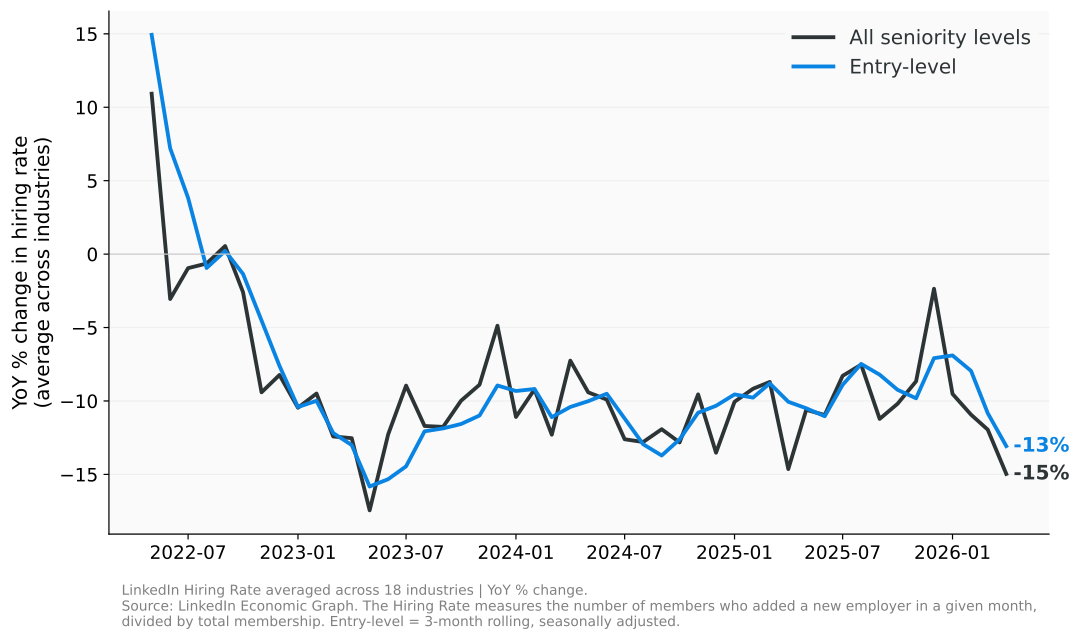
The UK hiring rate turned negative in late 2022 as the post-pandemic hiring surge faded, and has not recovered since. As of April 2026, it sits at – 14% year-over-year, with every tracked industry in decline.
Entry-level hiring is falling in step with the broader market. Averaged across industries, the entry-level trajectory closely mirrors all-seniority (Figure 1). LinkedIn’s most recent EMEA Labour Market Outlook (May 2026) finds the same: junior and senior hiring have weakened in parallel. At this level of aggregation, there is no sign of entry-level being disproportionately hit.
Figure 1: UK hiring – entry-level vs all seniority levels
Variation beneath the headline
Beneath the aggregate, not all entry-level roles are moving at the same rate. Of the 38 UK entry-level occupations above LinkedIn’s minimum hiring threshold in April 2026, 30 are declining and only 8 are growing, with over 50 percentage points separating the strongest from the weakest (Figure 2).
The steepest declines are concentrated in information-processing and professional roles: Software Engineer (–27%), Graphic Designer (–28%), Accountant (–29%), Product Manager (–24%), with further declines in Data Analyst (–15%), Legal Assistant (–14%), and Data Engineer (–11%). The strongest growth is in sales and customer-facing roles: Retail Assistant (+25%), Sales Development Representative (+17%), Business Development Representative (+16%).
Figure 2: UK entry-level hiring by occupation
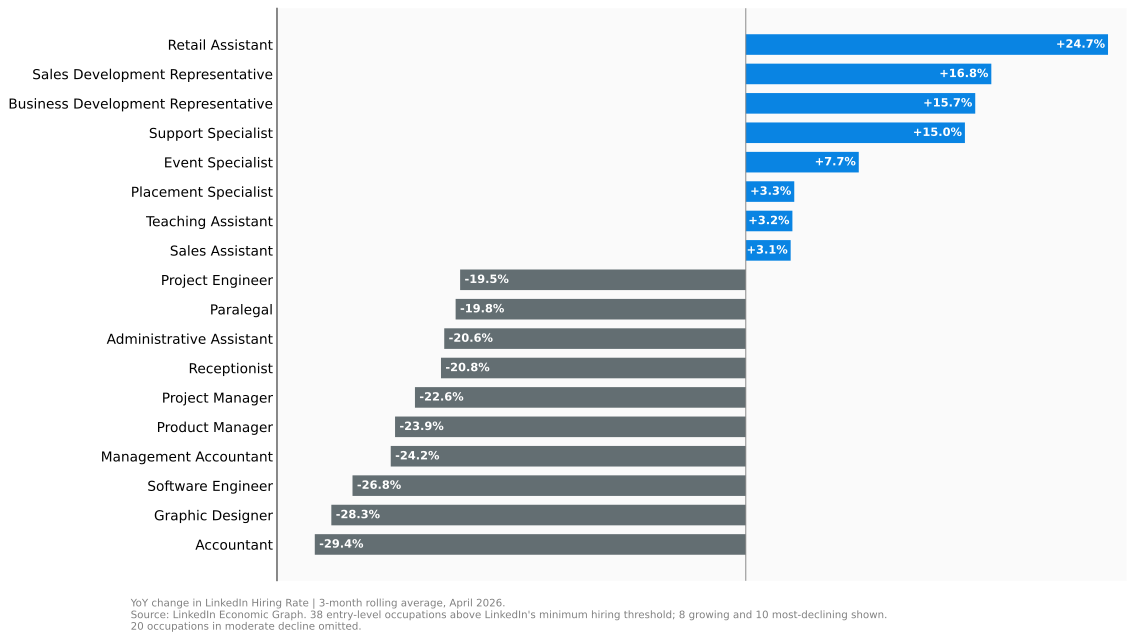
This pattern does not lend itself to straightforward explanation. It does not follow sector lines: Sales Development Representative and Data Analyst are both concentrated in technology and professional services, yet the first is growing at +17% and the second declining at –15%.
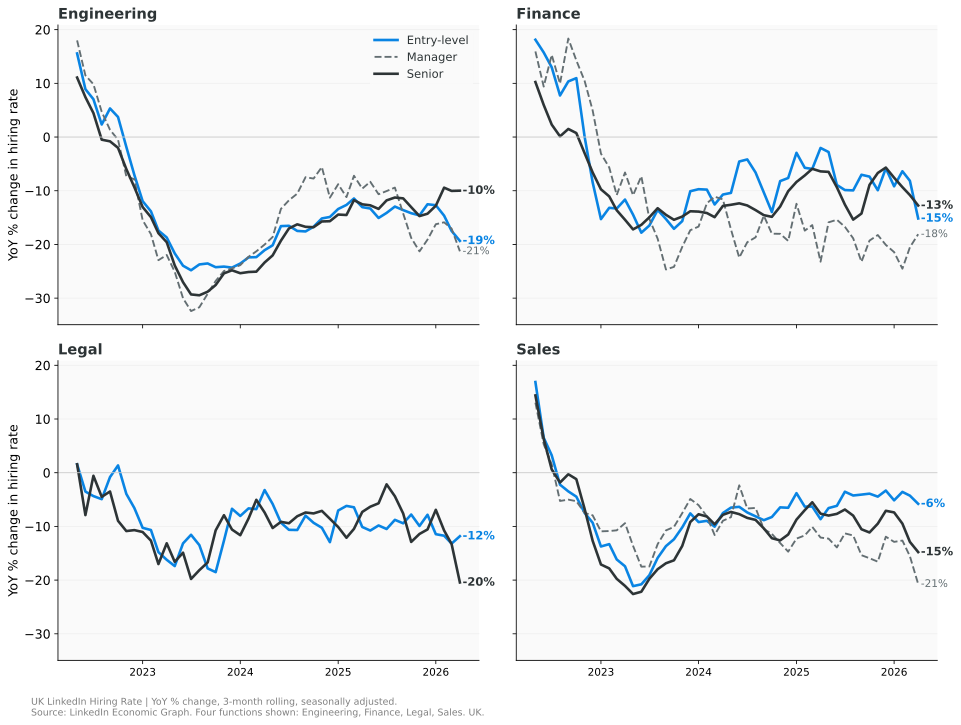
Nor is entry-level consistently weaker than senior. Figure 3 shows entry-level, manager, and senior hiring side by side for 4 functions. In Engineering, entry-level has fallen to -19% while senior sits at -10%, a 9-percentage-point gap. In Finance, all 3 levels are declining at roughly the same rate. In Legal, the relationship reverses: senior hiring (–20%) is weaker than entry (–12%). In Sales, entry-level (–6%) is outperforming senior (–15%).
This divergence is also new. The engineering gap, the most visible case, only appeared in early 2026. It may persist, or it may close as conditions change.
Figure 3: Hiring by seniority and function
The market entry-level candidates are navigating
The occupation-level picture is complex; examining the broader conditions entry-level candidates face may help contextualise it.
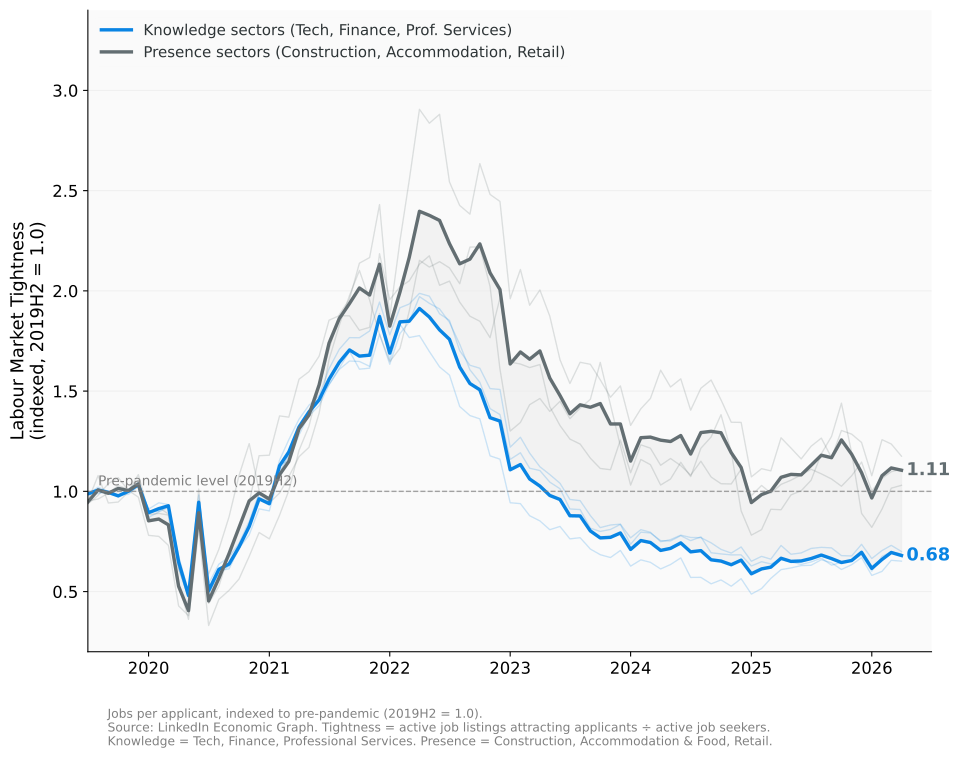
How competitive is the labour market for different sectors? Since the pandemic, sectors have diverged in how hard it is for employers to fill roles. This gap in labour market tightness has persisted. Knowledge sectors (technology, finance, professional services) have remained structurally looser than sectors requiring physical presence (Figure 4). As of April 2026, knowledge sectors sit at roughly 0.65–0.70 on LinkedIn’s tightness index, where 1.0 represents pre-pandemic conditions. Presence sectors (construction, accommodation, retail) remain near or above 1.0. This gap opened in 2022 and has not closed. For candidates seeking roles in knowledge sectors, this translates into substantially more competition per vacancy. This does not explain why some knowledge-sector entry-level roles are growing while others decline. But it describes the competitive environment in which that divergence is playing out: one where employers have had the luxury of selectivity for several years.
Figure 4: Labour market tightness by sector group, UK
What are employers selecting for? Table 1 shows the skills in shortage and surplus for 2 declining entry-level occupations, Data Analyst (–15%) and Legal Assistant (–14%), across all seniority levels. In both cases, there is zero overlap between the 10 skills employers cannot find and the 10 skills candidates most commonly offer.
The pattern is consistent: employers seek specific, operational, production-ready capabilities (data governance, DevOps, VAT processing, consultative selling). Candidates offer general, analytical skills (Python, SQL, legal research, financial accounting, CRM). The disconnect is not about whether candidates are skilled, but about whether they are skilled in the ways employers currently demand.
This data covers all seniority levels within each occupation rather than entry-level specifically. But the skills appearing in surplus (foundational analytical tools and general domain knowledge) are consistent with what a recent graduate would typically offer, while many of the skills in shortage reflect capabilities typically developed through operational experience. In occupations with a surplus of applicants, this mismatch is likely to translate into a preference for more experienced candidates, who already possess the skills employers are looking for, making these roles harder for entry-level candidates to break into, even when they are technically qualified.
Table 1: Skills Mismatch for all Seniority Levels in Selected Declining Entry-Level Occupations
Top 10 skills in shortage vs. surplus
| Occupation | Skills in Shortage | Skills in Surplus |
|---|---|---|
| Data Analyst | Data Governance, Data Engineering, Data Quality, Visualization, Data Models, SAS (Software), Google Cloud Platform (GCP), Alteryx, Microsoft Azure, Data Manipulation | Microsoft SQL Server, Microsoft Power BI, Python (Programming Language), Tableau, Analytics, SQL, Data Visualization, Data Analysis, Data Science, Data Modeling |
| Legal Assistant | Wills, Audio Typing, Private Clients, Digital Dictation, File Management, Document Preparation, Clerical Skills, Document Management, Electronic Filing, Personal Injury Law | Legal Advice, Property Law, Legal Writing, Negotiation, Legal Assistance, Legal Research, Family Law, Dispute Resolution, Client Relations, Research Skills |
Entry-Level Dynamics Deserve Continued Attention
The data here does not support simple narratives. Entry-level hiring is not collapsing relative to the market. But within it, the composition is not uniform: information-processing roles are weakening while relational roles grow, the skills employers want do not match the skills candidates offer, and knowledge sectors have been loose enough for long enough that employers can be much more selective.
It is worth noting which occupations are declining. The steepest fallers, Accountant (–29%), Graphic Designer (–28%), Software Engineer (–27%), Data Analyst (–15%), and Legal Assistant (–14%), all involve processing, organising, or producing structured information. Most of these are also roles where AI tools have become most visibly capable in the past 2 years. Yet at all seniority levels combined, these same occupations do not appear among the weakest performers. The weakness is specific to the junior tier.
This data is consistent with AI having an impact on entry-level hiring in these roles, but this should not be considered causal evidence of AI’s impact. These are the roles in loose sectors, with a wide skills mismatch, where multiple forces are at work simultaneously. Whether AI is compounding these other pressures, or whether the decline would have occurred without it, is not something we can answer yet with certainty. Isolating what each force contributes will require more time and careful research design.
We will return to this data as it evolves, and to investigate what might be driving the patterns we observe.
Data and Limitations
This brief draws on LinkedIn’s economic graph, which captures hiring activity and job postings across the platform, including insights from more than 40 million LinkedIn members in the UK. While LinkedIn data is not a fully representative sample of the labour market, it is best used as a supplement rather than a replacement to administrative data sources. The AI Economics Institute is being established to conduct further rigorous research into AI’s labour market impacts, and will incorporate insights from its partnership with LinkedIn alongside other data sources to build a more complete picture.