Biodiversity action plan for the Driver and Vehicle Licensing Agency, 2025 to 2030
Published 30 April 2026

© Crown copyright 2026
This publication is licensed under the terms of the Open Government Licence v3.0 except where otherwise stated. To view this licence, visit nationalarchives.gov.uk/doc/open-government-licence/version/3 or write to the Information Policy Team, The National Archives, Kew, London TW9 4DU, or email: psi@nationalarchives.gov.uk.
Where we have identified any third party copyright information you will need to obtain permission from the copyright holders concerned.
This publication is available at https://www.gov.uk/government/publications/dvla-biodiversity-action-plan-2025-to-2030/biodiversity-action-plan-for-the-driver-and-vehicle-licensing-agency-2025-to-2030
Executive summary
The Driver and Vehicle Licensing Agency (DVLA) is committed to maintaining and enhancing biodiversity across our estate. Biodiversity is recognised as a key environmental performance indicator in our corporate environmental policy. Our ongoing commitment reflects the importance we place on environmental stewardship on our estate.
Since 2013, DVLA has published a biodiversity action plan (BAP) for the estate. These plans provide a robust framework that guides our efforts to deliver meaningful improvements in biodiversity within the boundaries of our estate located in the City and County of Swansea. The framework enables us to systematically assess, plan, and implement actions that directly benefit local habitats and species.
The latest edition of our BAP is designed to further the achievements of previous years. It sets out clear, specific targets to enhance habitats and support particular species found at one of our sites. By building on our ongoing successes, we remain focused on realising additional biodiversity gains and ensuring our estate continues to provide valuable ecological benefits.
The aims of our BAP are to:
- ensure that habitat and species targets from section 7 of the Environment (Wales) Act 2016, Greening Government Commitments, and Swansea local biodiversity action plan are translated into effective action on the estate
- commit to creating and improving habitats across the estate
- develop effective partnerships with staff and the local community to ensure that programmes for biodiversity conservation are maintained in the long term
- raise awareness internally and locally of the need for biodiversity conservation, and provide guidance on biodiversity
- ensure that opportunities for conservation and enhancement of biodiversity are fully considered throughout DVLA operations
- monitor and report on progress in biodiversity conservation
This biodiversity action plan is a public statement by DVLA of its biodiversity objectives and the methods by which it intends to achieve them.
We would welcome appropriate involvement in the delivery of the plan from interested organisations, companies, and individuals.
Tim Moss, CBE
Chief Executive, DVLA
27 March 2026
1. DVLA biodiversity – an introduction
1.1. Introduction
DVLA remains committed to protecting and enhancing biodiversity across our estate. This is highlighted as a key performance indicator within our corporate environmental policy. We have prepared and published our biodiversity action plan (BAP) since 2013. This is the fifth edition and covers April 2025 to March 2030.
We have conducted biological surveys of the estate and identified habitats and species that would benefit from specific management or actions by the agency. The BAP identifies objectives for the conservation and enhancement of biodiversity and details targets and actions that aim to deliver these objectives. The intention is to integrate, as appropriate, biodiversity into our activities, such as annual maintenance programmes and capital works projects.
The action plan will help to safeguard biodiversity for current and future generations. It is hoped that the implementation of this plan will contribute to the achievement of local and national targets for UK BAP priority species and habitats as appropriate.
The biodiversity action plan is constantly evolving and is to be reviewed and updated on a regular basis.
1.2. Defining biodiversity
In 1992, at the Earth Summit in Rio de Janeiro, the Convention on Biodiversity defined biodiversity as:
The variability among living organisms from all sources, including terrestrial, marine and other aquatic ecosystems and the ecological complexes of which they are part; this includes diversity within species, between species and of ecosystems.
Biodiversity can be defined simply as ‘the variety of life’ and encompasses the whole spectrum of living organisms, including plants, birds, mammals, and insects. It includes both common and rare species, as well as the genetic diversity within species. Biodiversity also refers to habitats and ecosystems supporting these species.
1.3. The importance of conserving biodiversity
Biodiversity is a vital resource, and it is essential to acknowledge its importance to our lives along with the range of benefits that it produces, which include:
- the regulation of the natural environment – climate regulation, flood management, carbon sequestration, water purification, and pollination
- the provision of resources – food, water, medicine, and raw materials
- supporting the fundamental ecological processes – nutrient cycling, photosynthesis, and habitat provision
- improved health and wellbeing
- educational, recreational, and amenity resources
1.4. The biodiversity action planning framework
This biodiversity action plan is part of a much larger biodiversity framework that encompasses international, national and local levels of biodiversity action planning and conservation.
The BAP has been compiled with reference to the UK Biodiversity Framework from which the protection of sites, habitats and species is derived in Wales, and the following relevant nature conservation legislation:
-
The Conservation of Habitats and Species Regulations 2017 (as amended) (Habitats Regulations)
-
The Wildlife and Countryside Act 1981 (as amended) (WCA)
-
Countryside Rights of Way Act 2000
-
The Natural Environment and Rural Communities (NERC) Act 2006 (England)
-
The Protection of Badgers Act 1992
-
Environment (Wales) Act 2016
-
The UK Post-2010 Biodiversity Framework (2011-2020) (JNCC and Defra, 2012)
-
Biodiversity 2020: A strategy for England’s wildlife and ecosystem services (Defra, 2011)
-
UK Biodiversity Action Plan (UKBAP)
-
The Wellbeing of Future Generations (Wales) Act 2015
-
Swansea Local Biodiversity Action Plan 2005
-
Swansea Local Development Plan 2010-2025
The context and applicability of each item is explained as appropriate in the relevant sections of the report.
1.5. DVLA and biodiversity
The Environment (Wales) Act 2016 places a duty on DVLA to conserve biodiversity. As a public body we must have regard in delivering our core business to the purpose of conserving biodiversity. The act states that conserving biodiversity includes restoring or enhancing a population or habitat. In so doing, we should have regard to the list published by the Welsh Government of living organisms and types of habitat that are of principal importance for the purpose of conserving biodiversity. In effect, this list is the BAP priority species and habitats for the estate.
The Greening Government Commitments (GGCs) set out the actions UK government departments and their partner organisations will take to reduce their impacts on the environment. DVLA is an executive agency of the Department for Transport (DfT) and is subject to the objectives set out in the GGCs.
DVLA’s BAP has been produced to help fulfil these requirements and seeks to set out aims and objectives that complement the UK BAP and local biodiversity action plans.
1.6. The aims of the DVLA biodiversity action plan
The aims of the DVLA BAP are to:
- ensure that habitat and species targets from section 7 of the Environment (Wales) Act 2016, Greening Government Commitments, and Swansea local biodiversity action plan are translated into effective action on the estate
- commit to creating and improving habitats across the estate
- develop effective partnerships with staff and the local community to ensure that programs for biodiversity conservation are maintained in the long term
- raise awareness internally and locally of the need for biodiversity conservation, and provide guidance on biodiversity
- ensure that opportunities for conservation and enhancement of biodiversity are fully considered throughout DVLA operations
- monitor and report on progress in biodiversity conservation
2. DVLA BAP process
2.1. Biodiversity benchmarking
To produce the BAP, information on the habitats and species present on the estate was initially obtained from the Preliminary Ecology Appraisal, conducted in August 2024. Furthermore, a desk study and additional habitat and species surveys were conducted.
2.2. Setting aims, objectives, and indicators
To achieve the relative targets set out in the GGCs, the UK BAP, and the local BAP, 6 overarching aims have been established in the DVLA BAP. These aims have been set to focus programmes of action and to identify outcomes that can be monitored to measure achievement. For each aim an indicator has been set – a measurable feature of the aim that, when monitored over time, allows delivery to be assessed.
To maximise effectiveness, all aims, objectives, and actions have been devised to be SMART (Specific, Measurable, Achievable, Relevant and Time-limited). The aims are ambitious but also proportionate and practicable given the resources available.
2.3. Implementation
The overarching aims of the BAP have been systematically broken down into various objectives, and specific action plans have been developed to support the conservation and enhancement of key habitats and species. The implementation of these aims, objectives, and actions are essential for the effective delivery of the biodiversity action plan.
2.4. Monitoring and reporting
Achievement of the plan’s aims will be measured by a programme of monitoring. The methods to be used are described in the plan.
It is important to review the implementation of the BAP, assess changes in the status of habitats and species and the overall feasibility of the aims and objectives.
The plan sets out the methods to review delivery of aims and communicate progress to staff and local community.
3. Baseline conditions
3.1. Overview
This appraisal has been prepared with reference to current good practice guidance published by the Chartered Institute for Ecology and Environmental Management, and Joint Nature Conservation Committee.
This BAP is based on the following data sources:
- previous DVLA BAP
- ecological desk study
- habitat survey
- tree management survey
- reptile survey
3.2. Previous DVLA biodiversity action plans
DVLA has published 4 BAPs, the first of which was in 2013, with the aim to enhance the biodiversity on the DVLA estate. Each one seeks to benchmark and improve the ecological value of our estate and promote benefits to our staff.
3.3. Desk study
The primary desk study was undertaken by principal ecologist, Grace Dooley, as part of the Preliminary Ecological Appraisals conducted by Just Mammals Ltd in August 2024. The purpose of the desk study was to review ecological baseline information available in the public domain.
Records were requested from south-east Wales Biodiversity Records Centre at 1km radius and returned a total of 1,018 records across DVLA’s Morriston and industrial sites.
Sites that hold statutory designations within 1km were searched for. These included:
- National Nature Reserves (NNR)
- Special Areas of Conservation (SAC)
- Sites of Special Scientific Interest (SSSI)
- Special Protection Areas (SPA)
Sites that hold non-statutory designations within 1km were also searched for. These included the following:
- Areas of Ancient Semi Natural Woodland (ASNW)
- Plantations on Ancient Woodland Sites (PAWS)
- Local Wildlife Sites (LWS)
- Local Nature Reserves (LNR)
- Sites of Interest to Nature Conservation (SINC)
An additional desk study on herpetofauna records was completed by graduate trainee sustainability and environment manager, Katherine Stephens. The study provided information relating to herpetofauna activity in the county of Swansea. Approximately 42 records of herpetofauna sightings were documented between 1 January 2024 and 30 May 2025[footnote 1].
The findings of the desk studies have been incorporated within section 3 of this report.
3.4. Habitat survey
A phase 1 habitat survey of both sites was conducted on 5 August 2024, in moderate to good weather conditions. All areas within the site were inspected and assessed for indicators of ecological value, including the presence or field signs of any protected or rare habitats and species. The phase 1 habitat survey was carried out by principal ecologist, Grace Dooley, on behalf of Just Mammals Ltd.
A list of plant species for each site was compiled (Appendix A).
Habitats and notes were drawn onto a map of the survey site, and a coloured phase 1 habitat map was produced (see Appendix B).
3.5. Tree management survey
A full inspection of all trees on the Morriston site was carried out during February 2025 by a suitably trained, experienced, and qualified arboricultural professional from Treecare Consulting.
The inspection was completed at Morriston main site as part of an ongoing inspection schedule to identify trees or tree features which pose a threat or significant nuisance at the time of the on-site survey. There were no significant findings during this survey, however there is a priority 1 work recommendation to remove some ivy from affected trees in the north-east corner of the Morriston estate.
Our industrial unit site was not included in the tree survey at this time as the trees present are young to semi-mature and none are in declining health.
3.6. Protected and notable species surveys
In the previous iteration of the BAP, both a bat survey and a herpetofauna survey were conducted to provide baselines. However, due to constraints, no bat surveys have been completed prior to the publication of this iteration of the BAP. Nevertheless, a bat survey will be undertaken during the next 5 years, and the BAP will be updated accordingly.
A full herpetofauna survey was completed by trained team members, Katherine Stephens and Hilary Elliott, between May and August 2025. The survey report provided recommendations to promote herpetofauna populations across the DVLA estate and has been utilised to identify actions for the next 5 years.
4. DVLA biodiversity action plan
4.1. Aims
The aims of the DVLA BAP are to:
- ensure that habitat and species targets from section 7 of the Environment (Wales) Act 2016, Greening Government Commitments, and Swansea local biodiversity action plan are translated into effective action on the estate
- commit to creating and improving habitats across the estate
- develop effective partnerships with staff and the local community to ensure that programs for biodiversity conservation are maintained in the long term
- raise awareness internally and locally of the need for biodiversity conservation, and provide guidance on biodiversity
- ensure that opportunities for conservation and enhancement of biodiversity are fully considered throughout DVLA operations
- monitor and report on progress in biodiversity conservation
To ensure these aims are met, specific habitat and species action plans have been developed to maintain and enhance their condition on our estate. In addition, the BAP can contribute towards local, regional and national biodiversity objectives of priority habitats and species.
Our estate includes 3 sites in the Swansea area, and one site in Birmingham. These sites provide a different mosaic of habitats. A brief description of these sites is provided below.
Our main site, where the majority of our staff are deployed, is situated within an urban setting in the Morriston area. The site is surrounded by residential properties to the north, east, and south and Morriston crematorium and cemetery to the west. This site forms part of the Crown Estate.
Our secondary non-office unit situated in an urban setting within an industrial estate is on the north-west side of Swansea. The site is surrounded by other industrial units on all sides and a corridor of existing vegetation is present between the units to the north and west which leads to an area of grassland with woodland present to the south. Whilst we do not own this site, we have general autonomy in the management of the building and external environment.
We have a third site, comprising of our contact centre and learning facilities, which is situated in an urban setting with private housing and an industrial estate surrounding. The site is predominantly office buildings with car parking and has minimal green space. Moreover, we do not own this site and have little scope to incorporate biodiversity objectives which would make a material difference to the site. Additionally, our fourth site, Baskerville House, is also situated in an urban setting within the heart of Birmingham. The site is a grade II listed building that does not have any green space. As a result, these sites have not been included within the action plan for habitats and species. Nevertheless, it is important that we ensure that all staff across the estate are included and engaged in the plan.
Given the small scale of our sites and the limited habitat diversity supported within its boundaries, the BAP focuses on 5 species and 6 habitats. Any invasive species are also included. The selection of the species and habitats has been influenced by the results of the PEAs, desk studies, herpetofauna surveys, and the site records previously collated by DVLA. Based on this information, a shortlist of species and habitats was produced.
We selected target species and habitats where:
- a legal obligation exists to protect the species or habitat
- the habitat or species is already present on the site but its status or distribution could be improved with targeted management
- a species has not previously been recorded on the site but there is potential for onsite habitat enhancements to contribute towards the local abundance and conservation status of the species concerned
- invasive species as listed in Schedule 9 the Wildlife and Countryside Act 1981 present on the estate
4.2. DVLA habitats
Ecological surveys were conducted at both our Morriston and industrial sites. The results from these surveys indicate that 7 phase 1 habitat types were identified at our Morriston site and 9 phase 1 habitat types were identified at our industrial site. The order of the habitat descriptions below reflects their ordering in the phase 1 habitat survey manual and does not reflect habitat importance.
Based on the criteria discussed above, the following habitats have been selected for inclusion in the BAP.
| Habitat type | Environment (Wales) Act S.7 priority habitat | Morriston - main site | Industrial site |
|---|---|---|---|
| Dense scrub | Lowland heathland | ✓ | ✓ |
| Parkland and scattered trees mixed | Wood pasture and parkland | ✓ | ✓ |
| Neutral semi-improved grassland | Lowland meadows | ✓ | ✓ |
| Amenity grassland | No | ✓ | ✓ |
| Introduced shrub | No | ✓ | ✓ |
| Species poor intact hedgerow | Hedgerows | ✓ | ✓ |
| Species poor hedgerow with trees | Hedgerows | ✓ | |
| Tall ruderal | Lowland heathland | ✓ | |
| Mesotrophic standing water | Ponds | ✓ | |
| Dry ditch | No | ✓ |
Habitat Action Plan 1 - HAP 1
Lowland heath habitats: dense scrub and tall ruderals.
| Ref. nos. | Action | Site |
|---|---|---|
| HAP 1.1 | Introduce selective cutting and mowing schedule to maintain habitat (interrupt succession). | Main and industrial site |
| HAP 1.2 | Prevent loss of open habitats to scrub invasion. | Main and industrial site |
| HAP 1.3 | Eradicate invasive scrub from important habitats. | Main and industrial site |
| HAP 1.4 | To maintain an agreed balance between scrub and open habitats. | Main and industrial site |
Habitat Action Plan 2 - HAP 2
Woodland pasture and parkland habitat: parkland and scattered trees mixed.
| Ref. nos. | Action | Site |
|---|---|---|
| HAP 2.1 | Wherever possible, retain important existing dead and decaying trees and fallen and standing dead wood. | Main and industrial site |
| HAP 2.2 | Consider appropriate tree hazard and risk assessments where public safety is an issue to prevent unnecessary felling or removal of dead wood. | Main and industrial site |
| HAP 2.3 | Increase trees population with managed planting regime to include planting shrubs for nectar. | Main and industrial site |
| HAP 2.4 | Create a root protection area around mature trees to avoid applying fertilisers or pesticides or allowing soil compaction or excavation to damage roots. | Main and industrial site |
Habitat Action Plan 3 - HAP 3
Lowland meadows: natural semi-improved grassland. Increase species diversity.
| Ref. nos. | Action | Site |
|---|---|---|
| HAP 3.1 | Encourage natural regeneration by maintaining a mowing schedule in appropriate areas. | Main and industrial site |
| HAP 3.2 | Increase sward diversity with appropriate planting schedule. | Main and industrial site |
Habitat Action Plan 4 - HAP 4
Hedgerows.
| Ref. nos. | Action | Site |
|---|---|---|
| HAP 4.1 | Map and measure all hedgerows to establish a baseline measurement. Ensure the total length of on-site hedgerow does not fall below this length. | Main and industrial site |
| HAP 4.2 | Plan and design all future site operations and development activity to avoid loss or shortening of hedgerows. | Main and industrial site |
| HAP 4.3 | Create new native species-rich hedgerow. | Main and industrial site |
| HAP 4.4 | Allow leaf litter to accumulate at the base of hedgerows and in areas of scrub to benefit insects, birds and hibernating hedgehogs. | Main and industrial site |
| HAP 4.5 | Avoid hedge cutting during the bird nesting season between March and August. To encourage biodiversity schedule hedge cutting for January to February and September to October. | Main and industrial site |
Habitat Action Plan 5 - HAP 5
Amenity grassland and introduced shrub. We aim to enhance biodiversity value of ornamental planting and grassland habitat.
| Ref. nos. | Action | Site |
|---|---|---|
| HAP 5.1 | Continue to manage areas of grassland as wildlife areas. | Main and industrial site |
| HAP 5.2 | Maintain mowing schedules to benefit biodiversity in areas and introduce native wildflower seed mix. | Main and industrial site |
| HAP 5.3 | Identify areas of ornamental planting of low biodiversity interest and replace with species or habitats of greater value. | Main and industrial site |
Habitat Action Plan 6 - HAP 6
Pond and dry ditch.
| Ref. nos. | Action | Site |
|---|---|---|
| HAP 6.1 | Partially clear vegetation from pond to provide open aspect. | Industrial site |
| HAP 6.2 | Maintain vegetation to 30cm by strimming in September and March. | Industrial site |
| HAP 6.3 | Control algal growth. | Industrial site |
4.3. DVLA species
Specific actions have been assigned to individual species only when their needs are beyond the means of the actions outlined in the habitat action plans (for example, a species action plan for common frogs and common toads has not been developed as the objectives of a species action plan for these species are already being addressed by the overarching habitat action plan for ponds).
Previous site walkovers highlighted the presence of the following Schedule 9 plant species on site:
- Japanese Knotweed (Reynoutria japonica)
- Montbretia (Crocosmia x crocosmiiflora)
- Rhododendron (Rhododendron ponticum)
- Cotoneaster species (Cotoneaster sp.) - this was not identified to species level and could be one of the species on Schedule 9
These are invasive non-native species (INNS) and must not be spread in the wild. A successful Japanese Knotweed management plan is in place to eradicate small stands of Japanese Knotweed limited to the north-eastern boundary at our main site.
Based on the criteria discussed above, the following species have been selected for inclusion in the BAP.
| Species | S.7 species | Morriston – main site | Industrial site |
|---|---|---|---|
| Bats - Noctule (Nyctalus noctula) | ✓ | ✓ | ✓ |
| Bats - Leisler’s (Nyctalus leisleri) | ✓ | ✓ | ✓ |
| Bats* - Common pipistrelle (Pipistrellus pipistrellus) | ✓ | ✓ | ✓ |
| Bats* - Nathusius’ pipistrelle (Pipistrellus nathusii) | ✓ | ✓ | ✓ |
| Bats* - Soprano Pipistrelle (Pipistrellus pygmaeus) | ✓ | ✓ | |
| Bats - Brown long-eared bat (Plecotus auritus) | ✓ | ✓ | |
| Honeybees | ✓ | ||
| Common lizards (Zootoca vivipara) | ✓ | ✓ | |
| Grass Snake (Natrix Natrix Helvetica) | ✓ | ✓ | |
| Wood vetch (Vicia sylvatica) | ✓ | ||
| Betony (Stachys officinalis) | ✓ | ||
| Japanese Knotweed (Reynoutria japonica) | ✓ | ||
| Montbretia (Crocosmia x crocosmiiflora) | ✓ | ||
| Rhododendron (Rhododendron ponticum) | ✓ | ||
| Cotoneaster (Cotoneaster sp.) | ✓ |
*All 3 Pipistrelle subspecies were found during the last bat survey conducted in 2019.
Species Action Plan 1 - SAP1
We aim to encourage the use of our sites and provide additional roosting features for bats.
| Ref. nos. | Action | Site |
|---|---|---|
| SAP 1.1 | Minimise light spill from external lighting, specifically in proximity to dark corridors, boundary hedgerows, and trees. | Main and industrial site |
| SAP 1.2 | Identify potential locations for roost creation opportunities including trees, buildings and other structures. | Main and industrial site |
| SAP 1.3 | Install appropriate bat boxes or roost features across identified features - built and natural environment. | Main and industrial site |
| SAP 1.4 | Install corridors of deep red cycle lighting to provide connectivity where needed. | Main and industrial site |
Species Action Plan 2 - SAP 2
Bees.
| Ref. nos. | Action | Site |
|---|---|---|
| SAP 2.1 | Maintain bee hives on site. | Industrial site |
| SAP 2.2 | Provide extra pollinator habitat with revised maintenance schedule to specific areas. | Industrial site |
Species Action Plan 3 - SAP 3
Common lizards and grass snakes. We aim to maintain population density and ensure that habitat suitability is maintained.
| Ref. nos. | Action | Site |
|---|---|---|
| SAP 3.1 | Maintain habitat conditions with targeted annual maintenance schedule. | Industrial site |
| SAP 3.2 | Create hibernacula where appropriate. | Industrial site |
Species Action Plan 4 - SAP 4
Ancient woodland indicators: wood vetch and betony.
| Ref. nos. | Action | Site |
|---|---|---|
| SAP 4.1 | Manage habitat to ensure plants are not disturbed. | Main site |
| SAP 4.2 | Introduce signage for awareness. | Main site |
Species Action Plan 5 - SAP 5
Invasive species.
Invasive species on site are:
- Japanese Knotweed (Reynoutria japonica)
- Montbretia (Crocosmia x crocosmiiflora)
- Rhododendron (Rhododendron ponticum)
- Cotoneaster (Cotoneaster sp.)
| Ref. nos. | Action | Site |
|---|---|---|
| SAP 5.1 | Ensure Japanese Knotweed management plan is maintained and monitored for accuracy. | Main and industrial site |
| SAP 5.2 | Ensure all works carried out in areas where Schedule 9 spp. are present does not disturb and spread the plant. | Main and industrial site |
4.4. Raising awareness and community engagement
Staff and community engagement is essential to the successful implementation of the BAP and will ensure that all key stakeholders are informed and aligned with the action plan.
Our commitment to raising awareness of the BAP will help to create a positive environment and foster a sense of investment and involvement in local biodiversity and the natural environment.
We also hope that DVLA’s success can transpire beyond our estates and into the wider community by encouraging positive engagement through communications with external partners and through hosting and attending events.
To promote staff and community engagement with biodiversity the following actions are selected for inclusion in the BAP.
Awareness and Community Engagement Action Plan 1 - ACEAP 1
Promote biodiversity with staff and visitors.
| Ref. nos. | Action |
|---|---|
| ACEAP 1.1 | Raise awareness of wildlife gardening to staff and visitors. |
| ACEAP 1.2 | Include local schools in biodiversity day on site. |
| ACEAP 1.3 | Create a trail with signage to raise awareness of biodiversity on site. |
| ACEAP 1.4 | Create a biodiversity committee to oversee and communicate progress. |
5. Putting the plan into practice
5.1. Roles and responsibilities
DVLA’s sustainability team will ensure the objectives of our BAP are implemented. Main responsibility for coordination will lie with our lead biodiversity officer. Responsibilities will include implementing the BAP, monitoring, measuring and recording progress.
To coordinate implementation of the BAP there is a biodiversity steering group who meet monthly. This group ensures that we maintain momentum and remain on track to achieve the BAP objectives.
5.2. Monitoring and review
Monitoring and review of the DVLA BAP will be the responsibility of our lead biodiversity officer. The aims will be reviewed every 12 months so progress can be monitored and recorded, with adequate preparation made prior to implementation of the next set of aims.
Our BAP will be seen as a living document which can be amended with additional objectives. Likewise, the timeframe to achieve objectives are also flexible so projects should be shifted to coincide with resource or opportunity. Where objectives have not been met or are not achievable, the BAP will be amended accordingly by revising the target date or replacing the objective with another action that would benefit a priority or target species on the BAP, LBAP or UKBAP.
5.3. Reporting
We have a number of reporting requirements which are published externally making it freely accessible to all who wish to become acquainted with our progress during the following 5 years.
We publish our annual report and accounts which monitors our achievements against targets and objectives. Additionally, it is a requirement of the Environment (Wales) Act 2016 to publish a Schedule 6 summary report externally.
Appendix A
Plant species recorded
Main site
| Dense scrub A2.1. |
|---|
| Bramble Rubus fruticosus agg. |
| False oat grass Arrhenatherum elatius |
| Meadow vetchling Lathyrus pratensis |
| Ivy Hedera helix |
| Privet Ligustrum vulgare |
| Greater willowherb Epilobium hirsutum |
| Rosebay willowherb Chamerion angustifolium |
| Broadleaved dock Rumex obtusifolius |
| Wood vetch Vicia sylvatica (TN8 AWI) |
| Common horsetail Equisetum arvense |
| Cotoneaster sp. (potentially Schedule 9 species) |
| Enchanters nightshade Circaea lutetiana |
| Cleavers Galium aparine |
| Common hogweed Heracleum sphondylium |
| Hedge bindweed Calystegia sepium |
| Parkland and scattered trees mixed A3.3. |
|---|
| Rowan Sorbus aucuparia |
| Scots pine Pinus sylvestris |
| Sycamore Acer pseudoplatanus |
| Ash Fraxinus excelsior |
| Leylandii (sp.) Cupressus x leylandii |
| Hornbeam Carpinus betulus |
| English oak Quercus robur |
| Paper birch Betula papyrifera |
| Hawthorn Crataegus monogyna |
| Goat willow Salix caprea |
| London plane Platanus × acerifolia |
| Large-leaved lime Tilia platyphyllos |
| Sweet chestnut Castanea sativa |
| Beech Fagus sylvatica |
| Swedish whitebeam Sorbus intermedia |
| White willow Salix alba |
| Sweetgum Liquidambar styraciflua |
| European Larch Larix decidua |
| Tree of heaven Ailanthus altissima |
| Maple (sp.) Acer sp. |
| Apple Malus sp. |
| Holly Ilex aquifolium |
| Hazel Corylus avellana |
| Alder Alnus glutinosa |
| Italian alder Alnus cordata |
| Neutral semi-improved grassland B2.2. (around car park adjacent to Clasemont Road) |
|---|
| False oat grass Arrhenatherum elatius |
| Yorkshire fog Holcus lanatus |
| Birdsfoot trefoil Lotus corniculatus |
| Cocksfoot Dactylis glomerata |
| Common hogweed Heracleum sphondylium |
| Bramble Rubus fruticosus agg. |
| Herb Robert Geranium robertianum |
| Musk mallow Malva moschata |
| Meadow vetchling Lathyrus pratensis |
| Lesser trefoil Trifolium dubium |
| Creeping cinquefoil Potentilla reptans |
| Long stalked cranesbill Geranium columbinum |
| Tufted vetch Vicia cracca |
| Common mouse ear Cerastium fontanum |
| Selfheal Prunella vulgaris |
| Ivy Hedera helix |
| Neutral semi-improved grassland B2.2. (around B block) |
|---|
| Selfheal Prunella vulgaris |
| Ox eye daisy Leucanthemum vulgare |
| Yorkshire fog Holcus lanatus |
| Common bent Agrostis capillaris |
| Perennial rye grass Lolium perenne |
| Birdsfoot trefoil Lotus corniculatus |
| Common cinquefoil Potentilla simplex |
| Germander speedwell Veronica chamaedrys |
| Field wood rush Luzula campestris |
| Marsh thistle Cirsium palustre |
| Creeping buttercup Ranunculus repens |
| Spear thistle Cirsium vulgare |
| Primrose Primula vulgaris |
| Red clover Trifolium pratense |
| Wood speedwell Veronica montana (awi) |
| Common mouse ear Cerastium fontanum |
| Broadleaved dock Rumex obtusifolius |
| Cowslip Primula veris |
| Ribwort plantain Plantago lanceolata |
| Dandelion (sp.) Taraxacum sp. |
| Cocksfoot Dactylis glomerata |
| Common knapweed Centaurea nigra |
| Ragwort Jacobaea vulgaris |
| Catsear Hypochaeris radicata |
| Neutral semi-improved grassland B2.2. (small section around TN14) |
|---|
| False oat grass Arrhenatherum elatius |
| Couch grass Elymus repens |
| Bramble Rubus fruticosus agg. |
| Broadleaved dock Rumex obtusifolius |
| Greater willowherb Epilobium hirsutum |
| Bracken Pteridium aquilinum |
| Birdsfoot trefoil Lotus corniculatus |
| Cinquefoil sp. Potentilla sp. |
| Betony Stachys officinalis (awi) TN14 |
| Amenity grassland J1.2. |
|---|
| Perennial rye grass Lolium perenne |
| Common bent Agrostis capillaris |
| Yorkshire fog Holcus lanatus |
| White clover Trifolium repens |
| Ox eye daisy Leucanthemum vulgare |
| Birdsfoot trefoil Lotus corniculatus |
| Prickly sow thistle Sonchus asper |
| Selfheal Prunella vulgaris |
| Ribwort plantain Plantago lanceolata |
| Creeping buttercup Ranunculus repens |
| False oat grass Arrhenatherum elatius |
| Daisy Bellis perennis |
| Cocksfoot Dactylis glomerata |
| Wood avens Geum urbanum |
| Red fescue Festuca rubra |
| Moss (sp.) |
| Curly leaved dock Rumex crispus |
| Lesser trefoil Trifolium dubium |
| Catsear Hypochaeris radicata |
| Common mouse ear Cerastium fontanum |
| Intact species poor hedge J2.1.2. (around substation) |
|---|
| Leylandii (sp.) Cupressus x leylandii |
| Intact species poor hedge J2.1.2. (around nursery and adjacent car park) |
|---|
| Holly Ilex aquifolium |
| Ivy Hedera helix |
| Hedge bindweed Calystegia sepium |
| Cleavers Galium aparine |
| Nipplewort Lapsana communis |
| Herb Robert Geranium robertianum |
| False oat grass Arrhenatherum elatius |
| Yorkshire fog Holcus lanatus |
| Bittersweet Solanum dulcamara |
| Bramble Rubus fruticosus agg. |
| Elder Sambucus nigra |
| Ash Fraxinus excelsior |
| Species poor hedgerow with trees J.2.3.2 |
|---|
| Hawthorn Crataegus monogyna |
| Sycamore Acer pseudoplatanus |
| Ash Fraxinus excelsior |
| Privet Ligustrum vulgare |
| Ivy Hedera helix |
| Dense scrub species present as undergrowth |
| Introduced shrub J1.4. |
|---|
| Butterfly bush Buddleja davidii |
| Rose spp. Rosa spp. |
| Gorse Ulex europaeus |
| Rose of Sharon Hypericum calycinum |
| Carex sp. |
| Dogwood Cornus sanguinea |
| Phorrmium sp |
| Spirea sp. |
| Rhododendron sp. |
| Wild strawberry Fragaria vesca |
| Southern marsh orchid Dactylorhiza praetermissa |
| Mahonia sp. |
| Box Buxus sempervirens |
| Jasmine sp. Jasminum sp. |
| Laurel sp. Laurus sp. |
Industrial unit site
| Dense scrub A2.1. (situated in north-western side of the site) |
|---|
| Gorse Ulex europaeus |
| Bramble Rubus fruticosus agg. |
| Creeping thistle Cirsium arvense |
| Greater willowherb Epilobium hirsutum |
| Broadleaved dock Rumex obtusifolius |
| Marsh dock Rumex palustris |
| Dogwood Cornus sanguinea |
| Dog rose Rosa canina |
| Blackthorn Prunus spinosa |
| Giant fescue Festuca gigantea |
| False oat grass Arrhenatherum elatius |
| Yorkshire fog Holcus lanatus |
| Common bulrush Typha latifolia |
| Goat willow Salix caprea |
| Field wood rush Luzula campestris |
| Common knapweed Centaurea nigra |
| Cocksfoot Dactylis glomerata |
| Meadow vetchling Lathyrus pratensis |
| Dense scrub A2.1. (situated in eastern side of the site) |
|---|
| Bramble Rubus fruticosus agg. |
| Goat willow Salix caprea |
| Gorse Ulex europaeus |
| Blackthorn Prunus spinosa |
| Hawthorn Crataegus monogyna |
| Hazel Corylus avellana |
| Broadleaved dock Rumex obtusifolius |
| Osier Salix viminalis |
| Hazel Corylus avellana |
| Ragwort Jacobaea vulgaris |
| Parkland and scattered trees mixed A3.3. |
|---|
| Ash Fraxinus excelsior |
| Goat willow Salix caprea |
| Osier Salix viminalis |
| Neutral semi-improved grassland B2.2. |
|---|
| False oat grass Arrhenatherum elatius |
| Tufted hair grass Deschampsia cespitosa |
| Yorkshire fog Holcus lanatus |
| St. John’s wort Hypericum perforatum |
| Selfheal Prunella vulgaris |
| Creeping cinquefoil Potentilla reptans |
| Silverweed Potentilla anserina |
| Creeping thistle Cirsium arvense |
| Cocksfoot Dactylis glomerata |
| Meadow vetchling Lathyrus pratensis |
| Common horsetail Equisetum arvense |
| Ribwort plantain Plantago lanceolata |
| Common knapweed Centaurea nigra |
| Soft rush Juncus effusus |
| Prickly sow thistle Sonchus asper |
| Greater willowherb Epilobium hirsutum |
| Broadleaved dock Rumex obtusifolius |
| Creeping bent Agrostis stolonifera |
| Broadleaved willow herb Epilobium montanum |
| Ragwort Jacobaea vulgaris |
| Marsh thistle Cirsium palustre |
| Spear thistle Cirsium vulgare |
| Herb Robert Geranium robertianum |
| Timothy Phleum pratense |
| Hard rush Juncus inflexus |
| Dead nettle (sp). Lamium sp. |
| Lady fern Athyrium filix-femina |
| Hemp agrimony Eupatorium cannabinum |
| Purple loosestrife Lythrum salicaria |
| Gorse Ulex europaeus |
| Bramble Rubus fruticosus agg. |
| Tall ruderal C3.1. |
|---|
| Marsh thistle Cirsium palustre |
| Common knapweed Centaurea nigra |
| Tufted hair grass |
| Broadleaved dock Rumex obtusifolius |
| Wild parsnip Pastinaca sativa |
| Hard rush Juncus inflexus |
| Soft rush Juncus effusus |
| Tufted vetch Vicia cracca |
| Cleavers Galium aparine |
| Creeping cinquefoil Potentilla reptans |
| Greater fox sedge Carex vulpinoidea |
| Cocksfoot Dactylis glomerata |
| Giant fescue Festuca gigantea |
| Compact rush Juncus conglomeratus |
| Couch grass Elymus repens |
| Ragwort Jacobaea vulgaris |
| Mesotrophic standing water G1.2. (wet ditch) |
|---|
| Common bulrush Typha latifolia |
| Greater willowherb Epilobium hirsutum |
| Mesotrophic standing water G1.2. (pond) |
|---|
| Common bulrush Typha latifolia |
| Marsh dock Rumex palustris |
| Moss sp. |
| Amenity grassland J1.2. |
|---|
| Moss sp. |
| White clover Trifolium repens |
| Birdsfoot trefoil Lotus corniculatus |
| Selfheal Prunella vulgaris |
| Field wood rush Luzula campestris |
| Giant fescue Festuca gigantea |
| Broadleaved dock Rumex obtusifolius |
| Creeping buttercup Ranunculus repens |
| Daisy Bellis perennis |
| Ribwort plantain Plantago lanceolata |
| False oat grass Arrhenatherum elatius |
| Yorkshire fog Holcus lanatus |
| Common mouse ear Cerastium fontanum |
| Silverweed Potentilla anserina |
| Couch grass Elymus repens |
| Red clover Trifolium pratense |
| Lesser trefoil Trifolium dubium |
| Common knapweed Centaurea nigra |
| Introduced shrub J1.4. |
|---|
| Box Buxus sempervirens |
| Berberis sp. |
| Cotoneaster sp. (potentially Schedule 9 species) |
| Hazel Corylus avellana |
| Rhododendron Rhododendron ponticum (Schedule 9) |
| Gorse Ulex europaeus |
| Apple Malus sp. |
| Goat willow Salix caprea |
| Guelder rose Viburnum opulus |
| Spindle Euonymus europaeus |
| Laurel sp. Laurus sp. |
| Whitebeam spp. Sorbus spp. |
| Dog rose Rosa canina |
| Intact species poor hedge J2.1.2. |
|---|
| Hazel Corylus avellana |
| Osier Salix viminalis |
| Gorse Ulex europaeus |
| Dogwood Cornus sanguinea |
| Dry ditch J2.6. |
|---|
| Dry ditch is colonised by the neutral semi-improved grassland and dense scrub – species composition described at the afore mentioned habitat types. |
Appendix B
Habitat maps
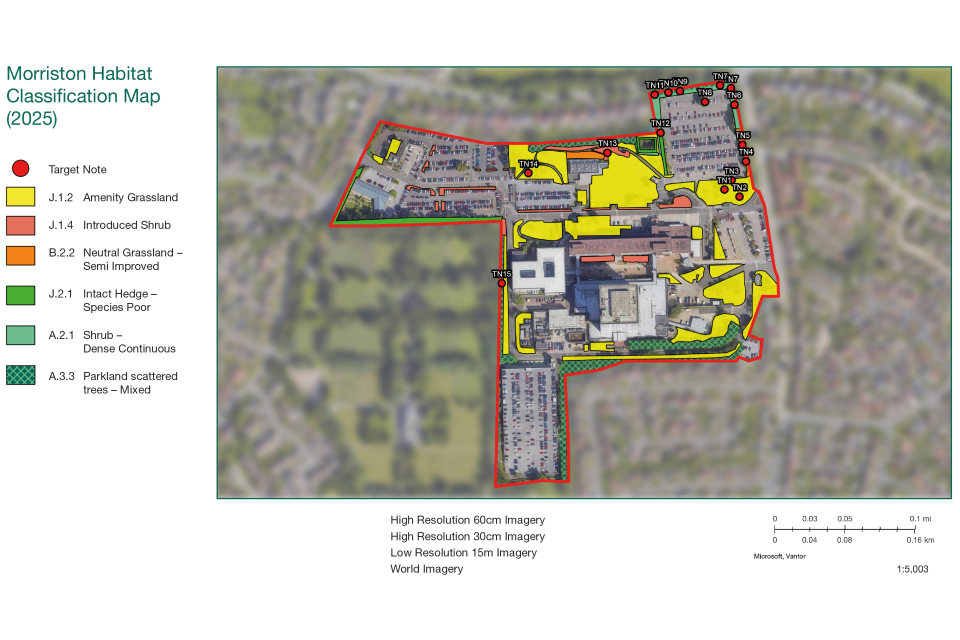
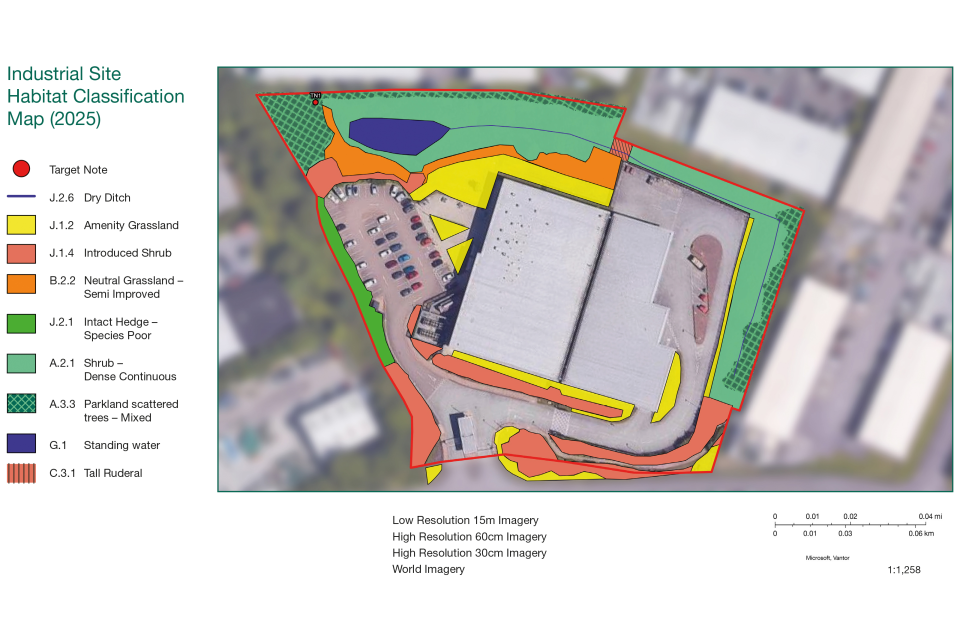
Habitat target notes
Main site
| Target note | Description |
|---|---|
| TN1 | Two pine trees in declining condition. |
| TN2 | Area of amenity grassland with scattered trees outside DVLA property holding but managed by DVLA. Same species are present as on connecting habitats within. Also includes a small stand of dense scrub dominated by ivy and bramble. |
| TN3 | Ash displaying signs of ash dieback disease. |
| TN4 | English elm (Ulmus procera) with ivy cover in declining condition under Tree Preservation Order (TPO). |
| TN5 | Compact rubble pile within vegetation, presents potential for reptiles. |
| TN6 | Area within dense scrub and tree with locally frequent wood vetch (Vicia sylvatica) an ancient woodland indicator species. |
| TN7 | Stand of montbretia (Crocosmia x crocosmiiflora) a Schedule 9 invasive non-native species. |
| TN8 | Single tree within car park (Black pine) with TPO. |
| TN9 | Line of mature trees included in a group TPO. |
| TN10 | Cotoneaster species (Cotoneaster sp.) which was not identified to species level and could be one of the species on Schedule 9. |
| TN11 | Pile of logs with reptile and invertebrate potential. |
| TN12 | Betony (Stachys officinalis) an ancient woodland indicator species. |
| TN13 | Southern marsh orchids (Dactylorhiza praetermissa) opening in between ornamental phormium plants. |
| TN14 | Bird box in declining condition on pine tree. |
| TN15 | Bird box on Norway maple (Acer platanoides). |