
Dry weather and drought in England: 18 to 26 June 2026
Updated 23 October 2026
Applies to England

© Crown copyright 2026
This publication is licensed under the terms of the Open Government Licence v3.0 except where otherwise stated. To view this licence, visit nationalarchives.gov.uk/doc/open-government-licence/version/3 or write to the Information Policy Team, The National Archives, Kew, London TW9 4DU, or email: psi@nationalarchives.gov.uk.
Where we have identified any third party copyright information you will need to obtain permission from the copyright holders concerned.
This publication is available at https://www.gov.uk/government/publications/dry-weather-and-drought-in-england-2026-summary-reports/dry-weather-and-drought-in-england-18-to-26-june-2026
1. Summary
After a dry spring, particularly in the east, early June brought unsettled weather and rainfall. As June has progressed, temperatures have continued to rise, with a heatwave at the end breaking June temperature records. Rainfall is now close to average overall at 97% of long-term average (LTA). River flows have generally receded and most are normal or below normal, with some notably low levels in central, eastern and northeast England. Soils remain dry in the southeast with moisture deficits increasing again after a brief improvement. Groundwater levels are declining seasonally and are notably low in some limestone and chalk areas, though normal elsewhere after a wet winter.
Hot weather and a second heatwave of the year has driven high water demand. Most water companies remain in business as usual (BAU), but some have moved to early drought response (level 1). South East Water has announced a temporary use ban (TUB) in Kent effective 3 July to help manage demand on its distribution network, rather than a drought response.
Early June rain helped the agricultural sector; however, the dry spring has already impacted crops, particularly in the east and southeast. Irrigation demand is high with reservoirs in some areas only 50% to 60% full. Heatwave conditions are increasing pressure on water use and livestock needs.
The Environment Agency is actively co-ordinating drought preparedness, with the National Drought Group scheduled to meet monthly through summer.
2. Area drought status
The Environment Agency
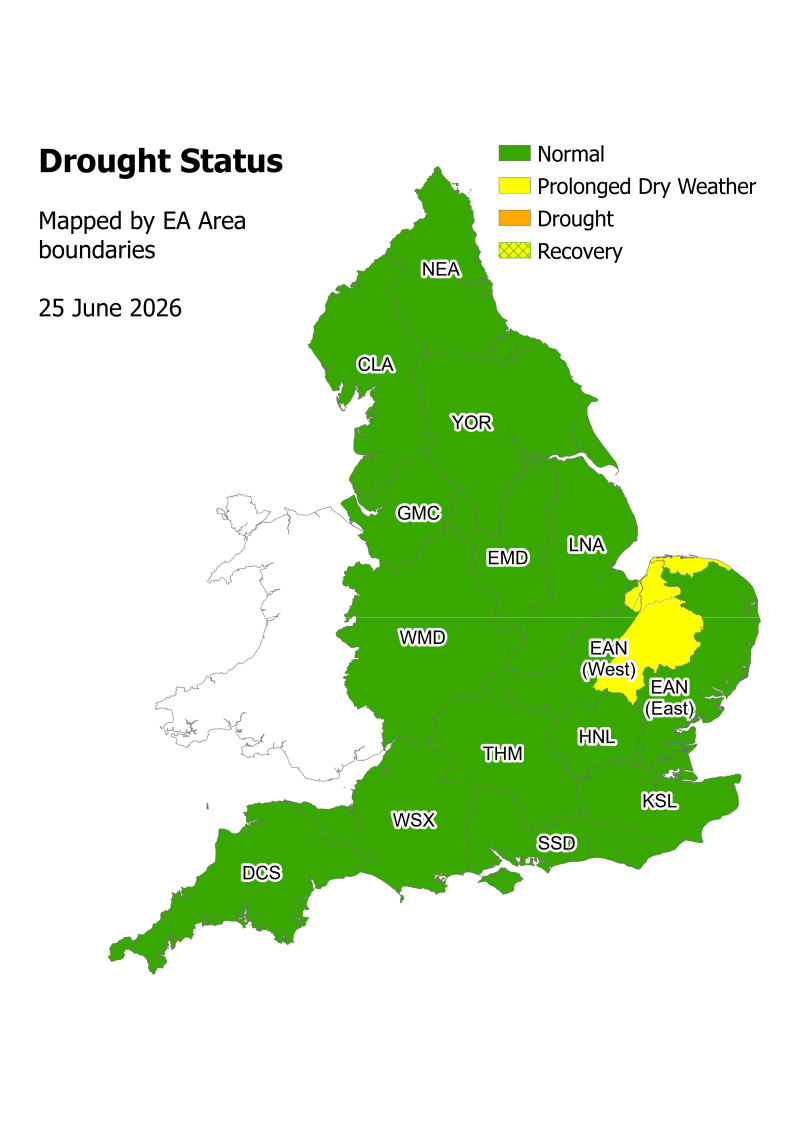
Since our last briefing in March, all areas are at normal status other than the Cam and Ely Ouse, North West Norfolk and North Norfolk catchments in East Anglia Area. These areas have moved from normal to prolonged dry weather status. Several abstraction restrictions remain in force.
Incidents caused by dry weather have remained stable during June. They may rise this week in response to the current heatwave.
For further detail of how we manage drought, including our 4 stages of drought response, see section 4.2.1 of Drought: how it is managed in England.
Natural Resources Wales
As of 9 June, all catchments in Wales remain in normal status.
3. Current water situation
Following a dry spring, particularly across eastern England, June started with a very unsettled period and a series of Atlantic low pressures bringing welcome rainfall. As the month has progressed, we have seen warmer temperatures with localised showers and thunderstorms. Up to 23 June, all but the north-east have seen between 90% and 126% of the LTA for June. Many catchments across the east and southeast have received more rainfall in June so far than in the whole spring period. With a week of June to go, England’s rainfall total is currently close to average at 97% LTA.
River flows receded this week at most indicator sites. Most sites were classed as normal or below normal for the time of year. Several sites across parts of central, eastern and northeast England were classed as notably low or lower for the time of year.
Soils were very dry for the time of year across the southern and eastern England at the end of May. Early June rainfall saw a brief respite. However, with a return of increased temperatures, soil moisture deficits have climbed this week.
Following the dry spring, groundwater water levels are well into their usual seasonal recession. Levels have fallen faster in limestone aquifers, for example, in the Cotswolds they are currently classed as notably low for the time of year. Levels are also below normal in the faster responding chalk aquifers across Yorkshire and Wessex. Elsewhere, levels are in the normal range following a wet autumn and winter.
Reservoir storage rose marginally at the start of June but has now dropped back to 87.5% for England for week ending 23 June, which is the LTA for the time of year. We expect to see the impact of the heatwave on storage in next week’s data.
Several reservoirs are classified as notably low for the time of year:
- Blagdon Reservoir operated by Bristol Water
- Wimbleball Reservoir operated by South West Water
- the Dove Group operated by Severn Trent Water – winter refill was impacted by water quality and operational issues
More details are available in our water situation reports for England.
4. Public water supply
Hot weather, including widespread temperatures exceeding 30 degrees this week, has led to some water companies experiencing significant peak demand for water. On 25 June, South East Water announced a TUB in Kent to come into effect on 3 July. The company is not experiencing a drought but is using it to manage pressure on its distribution network.
Some parts of the country have received lower than average rainfall this spring. With record spring temperatures, this has resulted in a greater than normal reduction in reservoir and groundwater storage and river flows for several water companies. However, most water companies are currently operating in BAU and their raw water supplies are mostly normal or above for the time of year.
Water companies report their drought response using operational drought levels, from drought level 1 escalating to level 4. We expect water companies to follow their drought plans and act early to ensure there are sufficient supplies.
We are regularly engaging with all water companies. Companies not included in this section are in BAU.
4.1 Anglian Water
Anglian Water has moved into drought level 1 in its Norfolk Norwich and the Broads, and Fenland water resource zones (WRZs). The company has sent water efficiency messages to customers and is reviewing further actions to reduce water demand.
4.2 South East Water
South East Water has moved into drought level 1 in its Haywards Heath and Eastbourne WRZs. Driven by the high demand for water, South East Water has announced a TUB in Kent and asked customers to restrict non-essential water use. Restrictions will be enforced from Friday 3 July.
For more information on the hosepipe ban in Kent, see the South East Water website.
4.3 Yorkshire Water
Yorkshire Water has moved into drought level 1 in its Grid WRZ. The company has no dry weather concerns at the moment.
5. Agriculture
Rainfall at the start of June has been welcomed by farmers and growers following the dry spring. This has had led to an early start to the irrigation season and a higher demand on farm irrigation reservoirs. In some parts of the country, irrigation reservoirs are currently around 50% to 60% capacity where irrigators have relied on stored water. Some hands-off flow restrictions have been implemented on surface water abstractions where river flows have been low.
The dry spring has impacted on spring sown cereals and non-irrigated crops especially in the east and southeast of the country. The heatwave conditions this week are likely to increase pressure on farm irrigation reservoirs and water demands for livestock.
Our updated spray irrigation prospects report for the summer, published on 18 June, shows a deterioration in prospects across central and eastern parts of the country. The report also details support for abstractors to help increase resilience this summer and long term. Locally, we have been communicating with farmers about the current conditions.
6. Navigation
Overall the water resource position for the Canal & River Trust is normal for the time of year. Most canals are open for navigation but there are a few localised restrictions and closures across a small part of the network. Most supply reservoirs are in a healthy position. Engineering work is impacting on some reservoir holdings and there is a greater risk of supply issues to canals that are affected by these works.
7. Weather forecast
The far east and southeast of England will retain the warmth the longest. There should be a reduction in temperatures by Saturday 27 June, with peaks around 32 degrees Celsius likely.
Next week (29 June to 5 July) is likely to see a change to more of a westerly influence on the UK’s weather. A return to more average temperatures for the time of year is likely, with a mixture of winds and rain, particularly for those in the northwest.
Further ahead (10 to 24 July), high pressure patterns are looking slightly more likely than low pressure patterns during the early part of this period. This means a greater chance of settled and drier than average conditions. There is still a chance of some changeable or more unsettled conditions developing later in the period, with a risk of some heavy and thundery showers. Temperatures are likely to be above normal, with a greater than normal chance of hot conditions developing at times.
8. Drought readiness actions
The Environment Agency is:
- well prepared
- actively co-ordinating across government and sectors
- acting on lessons from 2022 and 2025
The National Drought Group was reconvened on 18 June to monitor risks, preparation and impacts. It will meet monthly through the summer.
9. Contact us
Contact drought.national@environment-agency.gov.uk if you have questions about this report.