Theory of change: text alternative
Published 24 November 2026

© Crown copyright 2026
This publication is licensed under the terms of the Open Government Licence v3.0 except where otherwise stated. To view this licence, visit nationalarchives.gov.uk/doc/open-government-licence/version/3 or write to the Information Policy Team, The National Archives, Kew, London TW9 4DU, or email: psi@nationalarchives.gov.uk.
Where we have identified any third party copyright information you will need to obtain permission from the copyright holders concerned.
This publication is available at https://www.gov.uk/government/publications/digital-inclusion-innovation-fund-evaluation-report/theory-of-change-text-alternative
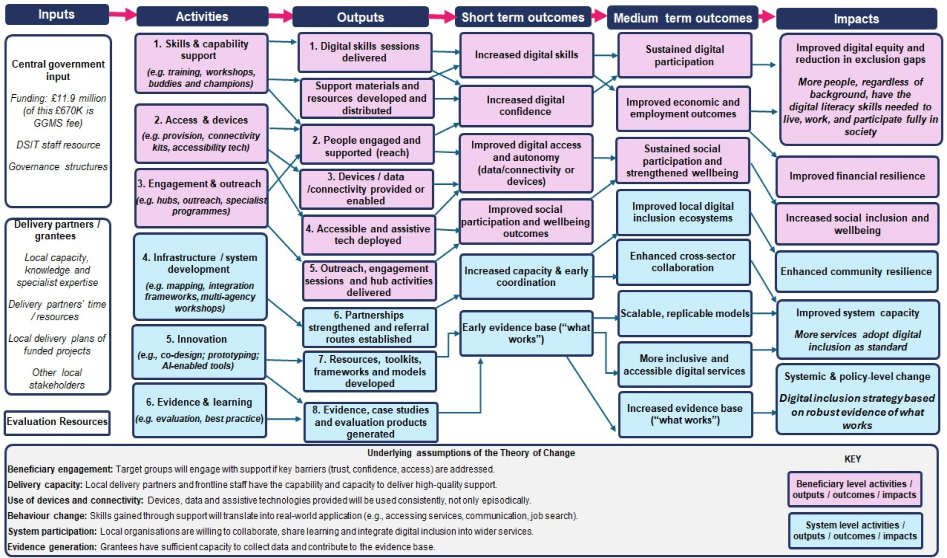
Flow: Inputs → Activities → Outputs → Short term outcomes → Medium term outcomes → Impacts
Inputs
Central government input
- Funding: £11.9 million (of this £670K is GGMS fee)
- DSIT staff resource
- Governance structures
Delivery partners / grantees
- Local capacity, knowledge and specialist expertise
- Delivery partners’ time / resources
- Local delivery plans of funded projects
- Other local stakeholders
Evaluation Resources
Activities
Beneficiary level
- Skills and capability support (e.g. training, workshops, buddies and champions)
- Access and devices (e.g. provision, connectivity kits, accessibility tech)
- Engagement and outreach (e.g. hubs, outreach, specialist programmes)
System level
- Infrastructure / system development (e.g. mapping, integration frameworks, multi-agency workshops)
- Innovation (e.g., co-design; prototyping; AI-enabled tools)
- Evidence and learning (e.g. evaluation, best practice)
Outputs
Beneficiary level
- Digital skills sessions delivered
- Support materials and resources developed and distributed
- People engaged and supported (reach)
- Devices / data /connectivity provided or enabled
- Accessible and assistive tech deployed
- Outreach, engagement sessions and hub activities delivered
System level
- Partnerships strengthened and referral routes established
- Resources, toolkits, frameworks and models developed
- Evidence, case studies and evaluation products generated
Short term outcomes
Beneficiary level
- Increased digital skills
- Increased digital confidence
- Improved digital access and autonomy (data/connectivity or devices)
- Improved social participation and wellbeing outcomes
System level
- Increased capacity and early coordination
- Early evidence base (“what works”)
Medium term outcomes
Beneficiary level
- Sustained digital participation
- Improved economic and employment outcomes
- Sustained social participation and strengthened wellbeing
System level
- Improved local digital inclusion ecosystems
- Enhanced cross-sector collaboration
- Scalable, replicable models
- More inclusive and accessible digital services
- Increased evidence base (“what works”)
Impacts
Beneficiary level
- Improved digital equity and reduction in exclusion gaps – More people, regardless of background, have the digital literacy skills needed to live, work, and participate fully in society
- Improved financial resilience
- Increased social inclusion and wellbeing
System level
- Enhanced community resilience
- Improved system capacity – More services adopt digital inclusion as standard
- Systemic and policy-level change – Digital inclusion strategy based on robust evidence of what works
Underlying assumptions of the Theory of Change
- Beneficiary engagement: Target groups will engage with support if key barriers (trust, confidence, access) are addressed.
- Delivery capacity: Local delivery partners and frontline staff have the capability and capacity to deliver high-quality support.
- Use of devices and connectivity: Devices, data and assistive technologies provided will be used consistently, not only episodically.
- Behaviour change: Skills gained through support will translate into real-world application (e.g., accessing services, communication, job search).
- System participation: Local organisations are willing to collaborate, share learning and integrate digital inclusion into wider services.
- Evidence generation: Grantees have sufficient capacity to collect data and contribute to the evidence base.
Summary table: pathways from each activity
There are 6 stages in order (Inputs → Activities → Outputs → Short term outcomes → Medium term outcomes → Impacts). Arrows link individual boxes, often one-to-many or many-to-one.
| Activity | Outputs | Short term outcomes | Medium term outcomes | Impacts |
|---|---|---|---|---|
| 1. Skills and capability support | Digital skills sessions; support materials; people engaged | Increased digital skills; increased digital confidence; improved digital access and autonomy | Sustained digital participation; improved economic and employment outcomes; sustained social participation and wellbeing | Digital equity; financial resilience; social inclusion and wellbeing |
| 2. Access and devices | People engaged; devices / data / connectivity; accessible and assistive tech | Increased digital confidence; improved digital access and autonomy; improved social participation and wellbeing | Sustained digital participation; improved economic and employment outcomes; sustained social participation and wellbeing | Digital equity; financial resilience; social inclusion and wellbeing |
| 3. Engagement and outreach | Support materials; people engaged; outreach, engagement and hub activities | Increased digital skills and confidence; improved digital access and autonomy; improved social participation and wellbeing | Sustained digital participation; improved economic and employment outcomes; sustained social participation and wellbeing | Digital equity; financial resilience; social inclusion and wellbeing |
| 4. Infrastructure / system development | Partnerships strengthened and referral routes established | Increased capacity and early coordination | Improved local digital inclusion ecosystems; enhanced cross-sector collaboration | Enhanced community resilience; improved system capacity |
| 5. Innovation | Resources, toolkits, frameworks and models; partnerships strengthened | Early evidence base; increased capacity and early coordination | Improved local digital inclusion ecosystems; enhanced cross-sector collaboration; scalable, replicable models; more inclusive and accessible digital services; increased evidence base | Enhanced community resilience; improved system capacity; systemic and policy-level change |
| 6. Evidence and learning | Evidence, case studies and evaluation products | Early evidence base | Scalable, replicable models; more inclusive and accessible digital services; increased evidence base | Improved system capacity; systemic and policy-level change |