Digital and Technologies Economic Statistics - Technical Report
Published 4 June 2026

© Crown copyright 2026
This publication is licensed under the terms of the Open Government Licence v3.0 except where otherwise stated. To view this licence, visit nationalarchives.gov.uk/doc/open-government-licence/version/3 or write to the Information Policy Team, The National Archives, Kew, London TW9 4DU, or email: psi@nationalarchives.gov.uk.
Where we have identified any third party copyright information you will need to obtain permission from the copyright holders concerned.
This publication is available at https://www.gov.uk/government/publications/digital-and-technologies-sector-statistics-volume-1-economic-statistics/digital-and-technologies-economic-statistics-technical-report
1. Summary
This technical report accompanies the Digital and Technologies Sector Statistics publication, a novel release that uses company-level data to produce economic, financial, and innovation statistics.
The economic statistics presented include company count, turnover, employment, gross value added (GVA), wages and productivity for the Digital and Technologies (D&T) sector.
2. Sector Definition
This release adopts a dynamic, company-based definition of the D&T sector, rather than relying on Standard Industrial Classification (SIC) codes. This approach is intended to better capture the cross-cutting and fast-evolving nature of D&T activities, which are often poorly represented within SIC codes.
The D&T sector consists of 107,082 companies, structured around 2 components:
(1) Frontier technologies (10,972 companies) – 6 priority technology areas identified in the Digital and Technologies Sector Plan in June 2025.
(2) Digital (96,110 companies excluding overlaps with frontier technologies) – a set of companies comprising the wider digital component of the D&T sector.
DSIT has developed company-level sector definitions, referred to as company lists. These lists identify in-scope companies directly, rather than inferring sector membership from SIC codes. Each frontier technology area has an associated company list, and together with a corresponding list for the digital component, these are combined to form an overall D&T company list.
This definition is DSIT’s preferred definition of the D&T sector. For more detail on its construction and limitations please visit: Digital and Technologies Sector Statistics – Sector Definition.
3. Data Sources
This section details the data sources used to derive economic estimates for the D&T Sector.
3.1 Sourcing Company-Level Data
As noted in Section 1, within this release the sector is defined using a list of companies, defined by Company Registration Number (CRN). This approach was chosen over ones that use Standard Industrial Classification (SIC) codes or enterprises (discussed in section 3.2) as a CRN-based approach offers a higher degree of granularity. The data required to produce statistics on the sector therefore needs to be able to be broken down to CRN level (e.g. data for each company within the list).
This requirement for company level data rules out some traditional ONS data sources, such as data from ONS’s Blue Book, as this is not available on a per company basis. Therefore, we have needed to source other datasets that do include data on a per company basis – these are detailed in sections 3.2, 3.3 and 3.4.
3.2 The Inter-Departmental Business Register (IDBR)
The Inter-Departmental Business Register (IDBR) is a comprehensive list of UK businesses used by government for statistical purposes.
The IDBR provides the main sampling frame for surveys of businesses carried out by the Office for National Statistics (ONS) and other government departments. It is also an important data source for analyses of business activities.
The 2 main sources of input are Value Added Tax (VAT) and Pay As You Earn (PAYE) records from His Majesty’s Revenue and Customs (HMRC). Additional information comes from Companies House, Dun and Bradstreet, and ONS business surveys. The IDBR covers around 2.7 million businesses in all sectors of the economy, but businesses that are neither registered for VAT, nor operate a PAYE scheme are excluded from the IDBR.
VAT registration is only required for companies with a rolling 12-month taxable turnover of over £90,000. However, some businesses below the VAT threshold do register voluntarily for VAT. PAYE registration is required for companies with employees paid more than £129 per week or earning a pension, company or state benefits or have had a previous job. Employers who have no employees earning above the lower earnings limit for PAYE and no other reasons for deducting PAYE (such as an employee having 2 jobs) do not need a PAYE scheme, although some may still have one.
Businesses with a turnover above the threshold are not required to register if they trade exclusively in exempt goods. If a business has no employees or only low paid (perhaps part-time) employees, then it is unlikely to operate a PAYE scheme.
The business units held on the IDBR can be grouped into 3 types, as set out in Figure 1.
Figure 1: Types of IDBR units and how they fit together
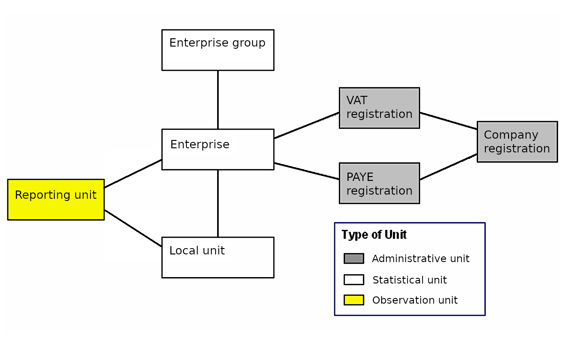
The business units held on the IDBR can be grouped into 3 types:
1. Administrative units:
VAT trader and PAYE employer information supplemented with incorporated business data from Companies House.
2. Statistical units:
A group of legal units under common ownership is called an enterprise group.
An enterprise can be defined as the smallest combination of legal units (generally based on VAT and/or PAYE records) that is an organisational unit producing goods or services, which benefits from a certain degree of autonomy in decision-making, especially for the allocation of its current resources. An enterprise carries out 1 or more activities at 1 or more locations. An enterprise may be a sole legal unit.
A local unit is an enterprise or part thereof (e.g. a workshop, factory, warehouse, office, mine or depot) situated in a geographically identified place. Local unit information is collected directly via an ONS survey called the Business Register and Employment Survey (BRES). There is currently no accessible administrative source that provides this level of information.
3. Observation units:
Reporting units hold the mailing address to which the survey questionnaires are sent. The questionnaire can cover the enterprise as a whole, or parts of the enterprise identified by lists of local units.
Each type of unit on the IDBR will hold the following information:
- Name
- Address including postcode
- Birth date
- Death date
- Standard Industrial Classification (UK SIC 2007 and UK SIC 2003)
- Employment and employees
- Turnover*
- Legal status (company, sole proprietor, partnership, public corporation/nationalised body, local authority or non-profit body)
- Enterprise group links
- Country of ownership
- Company number
(*) Turnover is not available at local unit level.
The IDBR employs a set of rules to update turnover and employment information included in the register. A summary of these rules is set out below:
Turnover
- All large business turnover is updated annually through survey returns.
- Medium/Small businesses with a recent Annual Business Survey (ABS) return, will keep their ABS returned turnover for up to 2 years. After the 2 years, if the unit is not selected for ABS immediately, those businesses with a VAT will revert to the latest VAT figure. Those without a VAT will revert to an imputed turnover, based on the turnover per head ratios.
- Small businesses, not in ABS and not operating a VAT scheme will have turnover updated by an annual imputation, based on turnover per head ratios (calculated by averages from other smaller businesses).
Employment
- All large business employment is updated annually.
- Medium-sized businesses with a recent BRES return will keep their BRES returned employment for up to 4 years. After 4 years, if the unit is not selected for BRES immediately, those businesses with a PAYE will revert to the latest PAYE figure. Those without a PAYE will revert to an imputed employment, based on the turnover per head ratios.
- Smaller businesses, with a PAYE scheme, but not selected for BRES within the last 4 years will be updated by PAYE on a quarterly basis.
- Small businesses, not in BRES and not operating a PAYE scheme will have employment updated by an annual imputation, based on a combination of turnover and turnover per head ratios (calculated by averages from other smaller businesses).
The IDBR therefore provides us with a comprehensive list of registered businesses with which to base our analysis, as well as relatively recent employment and turnover data. As the IDBR also contains CRNs, we can match this data with our D&T Sector company list to derive data at a company level.
For more information on the IDBR, please visit the ONS IDBR webpage with additional information on how it is constructed available on the ONS Introduction to the Inter-departmental business register webpage.
As the IDBR is constructed from multiple different datasets, it is difficult to assess the uncertainty from any statistical estimates that result from its use. It is likely that any estimates for small businesses will have higher uncertainty than those for medium-sized or large businesses, as small businesses have a higher likelihood of having imputed data. We will continue to investigate this uncertainty issue and seek to provide more information in future statistical releases.
3.3 Annual Business Survey (ABS)
The Annual Business Survey (ABS) is the main structural business survey conducted by the Office for National Statistics (ONS). It includes most business sectors, collecting financial data from businesses’ end-year accounts, including turnover, wages and salaries, purchases of goods and services, stocks and capital expenditure.
The ABS is the largest business survey conducted by ONS and Northern Ireland Statistics and Research Agency (NISRA) in terms of the combined number of respondents and variables it covers (around 62,000 questionnaires despatched in Great Britain and around 11,000 in Northern Ireland, with around 600 different questions asked). It is the main resource for understanding the detailed structure and performance of businesses across the UK and is a large contributor of business information to the UK National Accounts.
The ABS sampling method ensures all large businesses are surveyed along with subsets of medium-sized and small businesses, meaning that large businesses are more likely to be surveyed than small or medium-sized businesses.
The ABS provides a number of high-level indicators of economic activity such as the total value of sales and work completed by businesses, the value of purchases of goods, materials and services, and total employment costs.
Of particular relevance to this release is the approximate Gross Value Added (GVA) data collected by the ABS.
The ABS includes an approximate measure of gross value added at basic prices (aGVA). Gross value added (GVA) at basic prices is output at basic prices minus intermediate consumption at purchaser prices. The basic price is the amount receivable by the producer from the purchaser for a unit of a good or service minus any tax payable plus any subsidy receivable on that unit.
There are differences between the ABS approximate measure of GVA and the measure published by national accounts. National accounts carry out coverage adjustments, conceptual adjustments and coherence adjustments. The national accounts estimate of GVA uses inputs from a number of sources and covers the whole UK economy, whereas ABS does not include some parts of the agriculture and financial activities sectors, or public administration and defence.
A more detailed explanation of the differences is available in A comparison between ABS and National Accounts measures of value added.
For more information on the ABS, please see the latest technical report.
At the time of this publication, 2023 is the latest year of ABS data available and is the year used within this release.
4. Methodology
This section details the methodology used to derive economic estimates for the D&T Sector, with a focus on the steps taken to produce the relevant statistics. For more information on the strengths and limitations of these methodologies, please see Section 5: Strengths and Limitations.
4.1 Company Count
In this release, company count refers to the total number of companies regarded as being within the relevant sector or size category. This is a direct count of the companies available in the D&T company list, as the company list should include all relevant companies associated with a sector. In this publication, companies are defined by their company registration number (CRN).
4.2 Producing Employment and Turnover Estimates
In this release, employment is defined as total number of people employed (both full time and part time and including working proprietors) in the D&T sector.
To produce employment and turnover estimates, we aggregate CRN level data on these metrics once broken down from enterprise level data held in the IDBR.
Due to the variety of sources used, employment and turnover figures are not updated at a consistent point in the annual cycle. For this publication, a snapshot of IDBR data was taken that most closely relates to 2024. Therefore, some figures included in this publication may relate to a different year.
To limit the effect of this we remove any data relating to time periods before 2023, so that we are only using recent data. For turnover, data with missing date information was assumed to be 2024. For employment, PAYE data (if available) has been used to provide figures for companies that only had employment data relating to a period before 2023. Additionally, we also assume that company employment and turnover have not changed between 2023 and 2024, so that data across these 2 years are comparable.
To start producing these estimates, we first match the companies within our D&T company list to the enterprises contained within the IDBR. This is achieved through a CRN to enterprise matching, with the majority of CRNs matching to a single corresponding enterprise – we refer to this as one-to-one matches. Some enterprises, however, are made up of multiple CRNs and so many CRNs match to one enterprise - we refer to these as many-to-one matches. Additionally, some CRNs do not match to any enterprises in the IDBR, likely due to the reasons outlined in section 3.2.
Once the companies have been matched to the IDBR, we can start to aggregate employment and turnover data.
For one-to-one matches, this is relatively straightforward as we can just aggregate across the enterprises matched to our list.
For many-to-one matches, this is complicated as some CRNs within an enterprise may not be related to the D&T sector. As employment and turnover data is held at an enterprise level, we need to find a way to apportion the data so that we only capture the employment and turnover of the CRNs included in the sector. To do this, we employ a system of equal disaggregation – we assume that each CRN within an enterprise contributes equally to the enterprise total, and so each have an equal share of the total employment and turnover of the enterprise. We can then calculate the D&T related share of an enterprise’s employment and turnover by working out how many of the total number of CRNs attached to an enterprise are D&T CRNs.
For CRNs that do not match to any enterprises in the IDBR, we assume that this is because their employment and turnover totals are very low, as set out in section 3.2. As such, they are likely to have a minimal impact on our employment and turnover totals, so we exclude them from the analysis.
The totals for the D&T sector produced for both the one-to-one matches and the many-to-one matches can then be summed together to produce employment and turnover totals for the D&T sector.
4.3 Producing Gross Value Added (GVA) Estimates
Whilst the IDBR is useful for producing employment and turnover estimates, it contains little data on GVA for the companies within it. To acquire information on this metric, we have had to use an alternative dataset: the ABS.
The ABS collects data using reporting units which can then be matched up to enterprises (see section 3.2 for more details on ONS data structures). Because of this, we can directly use the same matched enterprises used in section 4.2 to match to the reporting units in the ABS. Once we have done this, we can aggregate data held in the ABS on GVA to enterprise totals based on matches between reporting units and enterprises.
Since the cut of IDBR data we are using is more recent than the ABS data we have available, IDBR turnover data is used to update and scale up ABS aGVA data to IDBR equivalent values. This involves deriving an ABS aGVA to turnover ratio and multiplying this by IDBR turnover.
This will only provide data on enterprises that are sampled in the ABS, which is only 3.4% of the D&T matched enterprises. However, these enterprises account for roughly 52.1% of D&T sector employees. For the other D&T matched enterprises which are not included in the ABS sample, we impute the GVA values.
To do this, we first analyse the D&T reporting units matched in the ABS to generate a median GVA to turnover ratio for each size category (for more information on the size categories used, please see section 4.6). This approach involves aggregating the data held at reporting unit level to the enterprise level and then apportioning this data down to the CRN level through the equal disaggregation approach highlighted in section 4.2. The median GVA to turnover ratio can therefore then be taken at the CRN level, providing added granularity to the ratio. This ratio is multiplied by turnover data available on the IDBR to impute GVA figures for D&T CRNs associated with enterprises that have not been sampled in the ABS. Once this is complete for each size category, we sum GVA totals across the different size categories to get to a total imputed GVA total.
Combining both scaled-up and imputed GVA totals provides us with a total GVA for D&T matched CRNs. As the majority of the data relates to 2024, we normalise any 2023 data so that it can be included in the estimate for 2024. This is done by assuming that 2024 values would be the same as the 2023 values included.
4.4 Producing Wage Estimates
Similar to GVA, we use the ABS instead of the IDBR to source data on wages. This is due to the lack of data available in the IDBR on wages.
The basic process for constructing a D&T average wage estimate involves dividing total company wage data from the ABS by total company employee data from the IDBR to produce estimated mean wage for each D&T matched company in the ABS dataset. Unlike the GVA approach, we do not impute any data for companies missing in the ABS, so we are limited to the data captured by the ABS. This is because there is not a direct relationship between turnover or employment and mean wage per employee, and so any such wages to turnover or wages to employment ratios are unlikely to estimate wages correctly for companies missing wage data.
The median wage per employee is the preferred method to produce average wage estimates as it is less affected by extreme values. We are unable to take a true median wage per employee due to the lack of individual employee wage data in ABS or IDBR. Instead, we produce an artificial list of all D&T employees with an associated wage. This associated wage is the mean wage for the employing company, produced by dividing ABS wage data by IDBR employment data for each company in the ABS. We then take the median employee from this list and assume that their associated wage is the average for the D&T sector.
Therefore, the wage estimates produced as part of this release refer to the mean wage paid by the company containing the median employee within the relevant sector/breakdown.
4.5 Productivity
In this release, productivity is defined as GVA per employee. This metric can be derived by taking our GVA total for the sector and dividing it by the employment total, to get an estimate of GVA per employee.
4.6 Size Breakdowns
Within this release, breakdowns of the D&T sector have been produced based on company size. The approach used focuses on number of employees, using the same basic approach as that used in the Business Population Estimates statistical series.
The size categories therefore are:
- Small companies: fewer than 50 employees
- Medium-sized companies: between 50 and 249 employees (inclusive)
- Large companies: 250 or more employees
5. Strengths and Limitations
Within this release, a range of decisions have been made relating to the definitions and datasets used, as well as the methodology employed to produce statistics using these datasets. These choices provide clear strengths for this release but also result in some limitations for the statistics produced, adding to the uncertainty associated with our estimates.
5.1 Using Company Lists
As mentioned in section 2, company lists provide many benefits compared to standard classification approaches. This is especially true of the D&T sector and its component subsectors, as the innovative and emerging nature of these areas are difficult to capture through standard approaches.
There are, however, certain limitations to using company lists. A quick summary of these is provided below:
- Lack of comparability with other definitions at a domestic or international level
- Limited data and complex ownership structures make it difficult to provide data at a company level
- Time series analysis is complicated by changing company list definitions over time
- The majority of company lists use web-scraped data, with their definitions thereby only focusing on companies with a website
Furthermore, company lists are produced using web‑scraping, machine‑learning, and expert validation, and are sensitive to underlying assumptions. They represent a snapshot in time and require regular updating to reflect company entry, exit, and changes in activity; as a result, historical comparisons may be affected by changes in list coverage.
Taken together, these illustrate that caution is necessary when interpreting the results of these statistics.
For this release, the latest available lists for each frontier technology have been combined to create a single frontier technology companies list. As these lists span different time periods, some newer market entrants may be excluded. In addition, differences in internal company classification frameworks across DSIT sector studies mean that some statistics may include non‑D&T activity, particularly where firms are highly diversified.
The methodology for identifying frontier technology companies will continue to be refined in future releases.
More details on these can be found in the definitions page of this release as well as in the individual sector studies previously published.
5.2 Company Count
The methodology used to produce company counts in this release is very simple and so there are few specific strengths and limitations to this approach. As it is heavily dependent on the company lists used to define the sector, any limitations involved in the creation of such lists will also impact the company count figures. More details on how these lists have been created is available in the definitions page of this release.
It should be noted that the constituent company lists used in this release come from differing time periods and so any resultant company counts are approximate and will reflect the aggregation of snapshots at multiple points in time.
5.3 Employment and Turnover Estimates
For employment and turnover estimates, the likely biggest source of uncertainty is the disaggregation approach used to assign data from enterprises to companies. This revolves around the assumption that each company contributes equally to the enterprise total, which is unlikely to be true. The potential effects of this could be quite large, where companies with a small actual share of turnover or employment are instead assigned the same amount of the total as a company that provides the majority of turnover or employment to the enterprise.
There will also be uncertainty relating to the different sources of information used to populate the IDBR on turnover and employment. As detailed in section 3.2, several different sources are used to provide IDBR turnover and employment data, with different sources selected based on the age of the data. Each source has its own strengths and limitations, and may be collected at different time periods even within the same calendar or financial year. As set out in section 4.2, we have tried to limit the effect of this but it will still be a source of uncertainty in the data.
5.4 Gross Value Added
The GVA estimates included in this release use recorded ABS data to generate sector estimates. As the data from the ABS is usually high quality, we have high confidence that the data is accurate for the companies included in the ABS sample.
For companies not included in the ABS, however, the imputation used to produce estimates likely introduces significant uncertainty into our estimates. The method we use heavily relies on GVA to turnover ratios to assign GVA values to companies, so the strength of the relationships between these factors is key to the figures produced. We plan to explore this in more detail in the future, and consider whether additionally using other ratios (e.g. GVA to employment ratios) can help to improve the reliability of the statistics produced. The imputation method also includes a significant amount of averaging across size breakdowns and enterprises, which will “smooth” the data and reduce the accuracy of these estimates. Similarly, we plan to investigate this further and see if there are alternative approaches that produce higher quality estimates in the future.
5.5 Wages
Similar to GVA, the wage estimates included in our release use recorded ABS data to generate sector estimates. Unlike GVA however, we do not impute for any companies missing from the ABS dataset (as detailed in section 3.4). This means that we are reliant on data from a very small proportion of the total D&T company list to estimate an average across the entire sector. This adds considerable uncertainty into our wage estimates as it is unlikely that the data we have is representative of the sector. Instead, they are likely to be skewed towards the wages found in larger companies as these have much better coverage in the ABS than medium-sized or small companies.
5.6 Productivity
The strengths and limitations of the productivity estimates in this release mostly relate to strengths and limitations within our methodologies used to construct GVA and employment methodologies. For more details on these, please see sections 5.3 and 5.4.
6. Alternative Data Sources
As noted in section 3, we have used mainly IDBR and ABS data to construct and produce our estimates. Whilst data at a company level is generally limited, there are alternative data sources that could be explored in the future.
One of these is HMRC’s Companies Summary across Taxes (CSAT) database which has been used in a recent DSIT sector study. This database similarly provides data at a company level and can be used to construct estimates using company lists. It also potentially contains a wider range of variables than our existing datasets, enabling us to enhance our metric selection.
Before using this dataset, a more detailed exploration is necessary to enable a better understanding of the relative strengths and weaknesses of using this dataset compared to our current approach. We plan to more thoroughly explore this dataset in future to determine if this would provide a better source of evidence than our existing datasets.
7. Further Information
If you have any questions on this release or would like to provide feedback, please contact economicestimates@dsit.gov.uk.