Designs Practice Notice (DPN) 01/26: Practice in respect of graphic symbols/icons, graphical/web user interfaces and animated designs
Published 21 April 2026

© Crown copyright 2026
This publication is licensed under the terms of the Open Government Licence v3.0 except where otherwise stated. To view this licence, visit nationalarchives.gov.uk/doc/open-government-licence/version/3 or write to the Information Policy Team, The National Archives, Kew, London TW9 4DU, or email: psi@nationalarchives.gov.uk.
Where we have identified any third party copyright information you will need to obtain permission from the copyright holders concerned.
This publication is available at https://www.gov.uk/government/publications/designs-practice-notice-dpn-0126-practice-in-respect-of-graphic-symbolsicons-graphicalweb-user-interfaces-and-animated-designs/designs-practice-notice-dpn-0126-practice-in-respect-of-graphic-symbolsicons-graphicalweb-user-interfaces-and-animated-designs
1. Introduction
This DPN revises and clarifies IPO practice around graphic symbols/icons and graphical user interfaces (GUIs), including where these types of designs incorporate animation or movement.
2. The purpose
We have seen an increasing number of applications seeking protection for these types of designs. We have also had an increase in the number of customers asking for clarification about how to file them, in particular what the Intellectual Property Office (IPO) will/will not accept. As part of its digital transformation programme, the IPO is considering introducing animated file formats to make it easier to file GUIs and animated designs. However, this will not be introduced in the short term. Therefore, this revised practice notice is being issued to clarify the IPO’s practice in this area, to help designers protect their designs. Designers and their representatives should note that this DPN sets out general principles, and that each application will be considered on its merits.
3. Previous published practice
Our previous practice published in paragraphs 2.11, 2.12 and 2.13 of the Registered Designs Examination Practice Guide headed “Icons, graphical user interfaces and webpages” is replaced by the following guidance. The Practice Guide will be updated to include this content. References in this guidance to the RDA are references to the Registered Designs Act 1949.
Icons, animated designs, graphical user interfaces and webpages
2.11 Section 1(3) RDA (see para 2.07 in the Registered Designs Examination Practice Guide) sets out that computer programs are specifically excluded from protection. However, this does not mean that the physical appearance and layout of certain forms of digital media cannot be protected as registered designs. For example, the visual appearance of computer icons, screen saver graphics, animated designs, the visual layout of software interfaces (often referred to as ‘Graphical User Interfaces’ or ‘GUIs’) and web pages are not precluded from being protected as designs. The appearance of these types of digital content can be registered provided they meet the requirements of the RDA.
2.12 The appearance of digital media can be both static (for example, web page and GUI layouts) and non-static (for example animated screensavers and ‘dynamic’ icons). Designs can be represented using screenshots or line drawings showing the configuration of the graphic elements of a web page, GUI or other form of digital platform. Further information on how the IPO will assess applications for these types of design is set out below. Considerations relating to formalities of representing animated/dynamic designs is provided at paragraph 11.34 and 11.35 of the Registered Designs Examination Practice Guide.
2.13 Examiners will consider the facts of each case when assessing whether an animated/dynamic design can be registered. Applicants should note that design protection corresponds to a product’s appearance only. Registering the visual characteristics of an animated or dynamic web page, graphical user interface, icon or other form of digital content will not protect any aspect of its functionality.
Basic principles
2.14 It is fundamental to the registration of designs that the representations convey an overall impression that is clear to both the registrar and to third parties. The overall impression must be for a single, unitary design. A person inspecting the register must be able to work out clearly, easily, and unambiguously, what the overall impression shown by the design is. This allows third parties to work out whether another design has a different overall impression and assess validity and the likelihood of infringement.
2.15 This is reasonably straightforward for traditional designs such as the shape of a product or a product’s surface ornamentation. It is more difficult for designs which comprise animation or other forms of movement, particularly as current filing requirements require the design to be represented using static representations.
2.16 This section sets out the principles which examiners will take into account when assessing design applications. However, each application will be considered on its merits. Applicants and their legal representatives need to ensure that the representations they file show a design in a way which meets the requirements. This guidance covers the considerations an examiner will make under section 1(2) of the RDA where an application includes an animated or dynamic design. In particular it covers the assessment of whether the representations depict a single design. It does not cover other considerations which an examiner may make under the RDA.
Static graphic symbols/icons
2.17 The IPO considers that static graphic symbols/icons fall within the definition of a design and may be registered. The following examples illustrate what may be accepted as a design and what might cause issues during the examination process.
Single static icon

2.18 This example is a straightforward design of a graphic symbol. Its overall impression can be clearly, easily and unambiguously ascertained. This design is therefore allowable.
Multiple views

2.19 This example shows two images of a basket, handle up and handle down. If filed as a single image, this may be interpreted in different ways:
-
as a single design consisting of two baskets side-by-side, one with handle up and one with handle down
-
as different stages of an animation showing a basket moving from a handle up configuration to handle down
2.20 The Registrar will not usually query the intention of an applicant who files this as a single representation. In the absence of additional information, the examiner will assume that protection is sought for a single design consisting of the appearance of two baskets side-by-side. Applicants are therefore advised to carefully consider what they are seeking to protect before filing an application. If the design is intended to be animated, please see paras 2.26 and 2.27 of the Registered Designs Examination Practice Guide.
2.21 If the above example is filed as two different views, without it being clear that it is an animated design, an examiner will raise an objection to it being more than one design.
Animated/moving graphic symbols/icons
2.22 Graphic symbols/icons that contain animation or movement will usually be acceptable, so long as the overall impression can be ascertained clearly, easily and unambiguously from the representations filed. To achieve this, an applicant should:
-
use a separate view (up to a maximum of 12) for each step in the animation; and
-
make clear that the design is an animation in the indication of product for the application. The appropriate section to do this is in the section titled “What product is your design going to be used on or incorporated onto?” of the online application form. Acceptable examples include, “animated graphic user interface”, or “animated graphic icon”
2.23 As a design must be understandable from the representations filed, applicants are encouraged to use as many views as possible within the online form (up to a maximum of 12). This is to provide as much detail as possible about the progression of the animation. For the application to be acceptable, the representations must give a clear and understandable overall impression. Generally, the representations should contain visual similarities, although the first and last representation may be significantly different, depending on how the animation flows. The views should show clearly how the animation progresses through its various stages. It must be clear to the examiner, and to somebody viewing the register, that the application relates to a single animation.
2.24 Applicants may also want to consider using a disclaimer to provide information about the nature of the transition between representations. However, where significant additional information is needed to understand the design, it is likely an objection will be raised.
2.25 The following examples illustrate what may be accepted as a design and what might cause issues during the examination process.
Example 1:
2.26 This example shows a variation of the two baskets, side-by-side. If protection is sought for an animated sequence where the orientation of the handle changes, the images should be presented as separate representations/views. Also, the indication of product should make clear that the design is an animation e.g. “animated graphic icon”.
2.27 If the applicant wishes to ensure absolute clarity, they may include a written disclaimer. For example ‘protection is sought for the animated design of a basket, the handle of which instantaneously transitions from an upward to a downward position’.
Example 2:
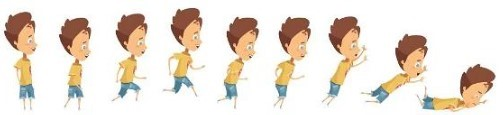
2.28 This series of 9 separate views would be considered to be 9 different designs if filed without any additional information indicating it is an animated design. The applicant would be given the opportunity to divide the application or delete 8 of the views.
2.29 If protection is sought for the animated sequence of the child moving from a standing, to running, and falling position, an applicant will need to provide additional information. This could be an indication of product stating that the design is an animation. The examiner would then assess it as an animation. As such, the sequence clearly transitions from left to right and is easy for a third party to understand how the animated sequence progresses from one view to the next. This example is acceptable. An applicant may also want to consider whether to include a disclaimer explaining the transition.
Example 3:
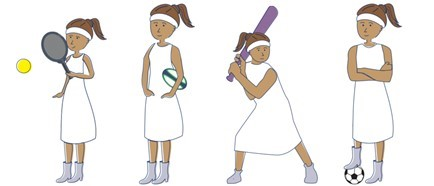
2.30 As for example 2, this series of 4 separate views will be considered 4 different static designs if filed without any additional information. The applicant will be given the opportunity to divide the application into separate designs or delete 3 of the views.
2.31 If an indication of product is filed with the images stating that this is an animated design, it would still be considered unacceptable in its current form. This is because, in contrast to the previous example, the progression between the images is unclear. For example, does the animation flick between the four images shown, or is there a progression between them? Without additional information, it is not possible to clearly and unambiguously understand the design’s overall impression.
2.32 If protection is sought for a single animated sequence using the above images, the applicant would need to provide a written disclaimer that explains how the animation/sequence progresses. The examiner will take account of the disclaimer when examining the application.
2.33 In this example, a disclaimer, such as “an animation which flicks instantaneously between one still to the next” would probably be considered acceptable. This is because it allows third parties to understand the overall impression of the design from the information on the register.
2.34 It is likely that an examiner will raise an objection where the design requires a higher degree of written explanation to understand the sequence. It may be possible to overcome the objection by filing additional representations which more fully set out the sequence. Where adding additional representations significantly alters the appearance of a design, the application will need to be re-dated to the date on which the design was modified (see Chapter 8 of the Registered Designs Examination Practice Guide).
Example 4:

2.35 This example is a variation of example 3. It contains 12 separate views showing a more complex sequence. If filed without any additional information, an examiner will consider the views relate to 12 different designs and provide an opportunity to divide the application, or delete 11 of the views. If the application is intended to show an animation, the applicant should provide an appropriate indication of product.
2.36 The sequence shows a transition from tennis to baseball to rugby to football. However, unlike example 1 above, the representations may require some level of interpretation to understand the sequence. For example, where the woman moves from holding a tennis racket to a baseball bat, from baseball bat to rugby ball and from rugby ball to football. It is possible that an objection could still be raised to the sequence containing more than one design. To avoid this, applicants should consider filing a disclaimer. This may allow the design’s overall impression to be clearly and unambiguously determined. If a disclaimer is provided and requires a high degree of interpretation, an objection may be raised.
2.37 Applicants should be aware that if this sequence was filed in response to an objection to the sequence in example 3, it would be re-dated as the design has been altered significantly.
Graphical User Interfaces (GUIs)
2.38 The IPO considers that graphical user interfaces fall within the definition of a design. The same considerations discussed above therefore also apply to GUIs. The overall impression must be ascertained clearly, easily and unambiguously and that the overall impression must be for a single, unitary design.
2.39 The following examples are provided as a guide to help applicants. Each application will be considered on a case-by-case basis. Applicants and their legal representatives must ensure that the representations they file show a design in a way which meets these requirements. Applicants are reminded that a registered design protects the appearance of the GUI and not how it functions.
2.40 Animated features which form part of a graphical user interface will be assessed according to the guidance set out above in relation to animated designs.
Example 1:
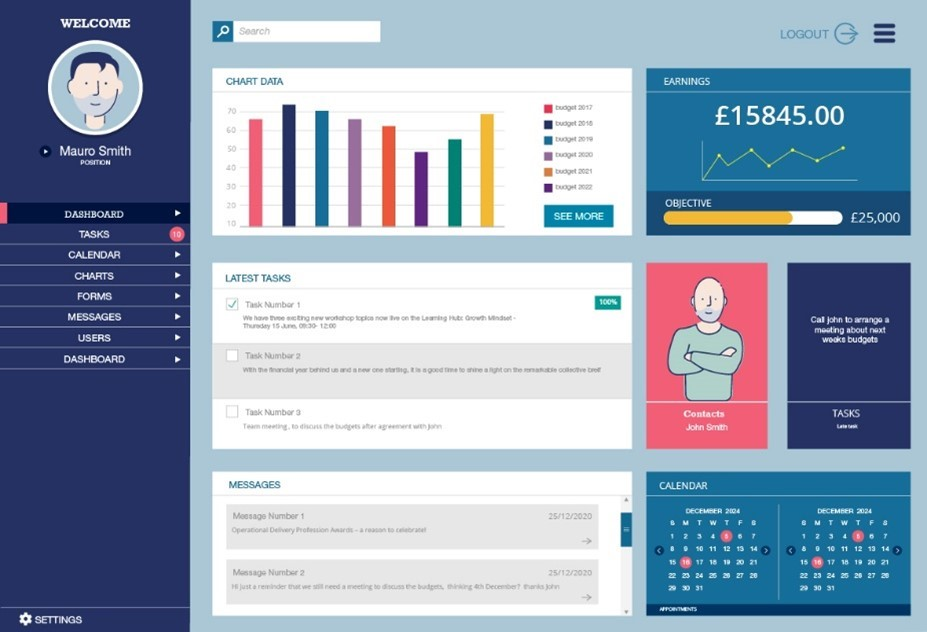
2.41 This example is of a straightforward design for a GUI which would be considered acceptable. Its overall impression can be clearly, easily and unambiguously determined. It clearly relates to a single, unitary design. There are no special requirements for filing this type of design.
2.42 When applying to protect this sort of GUI as a design, applicants should take account of the general guidance relating to designs to ensure that appropriate protection is sought e.g. relating to use of colour, disclaimers etc.
Example 2:
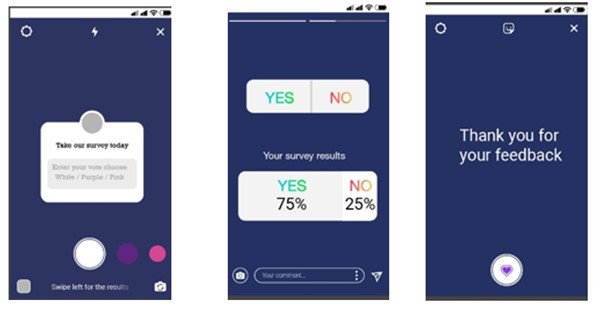
2.43 This example, shown in these 3 separate views, is considered unacceptable. Although each view has similarities, and they are linked in that a user may move from one screen to the next, the overall impression is not of a single unitary design. Unlike the examples above of self-contained animated sequences, this example shows different screens which will vary depending on user input. As such, an examiner would consider that this set of representations shows three different and distinct GUIs.
2.44 Applicants should consider seeking protection for this type of design as separate applications. This could be done at application stage, or by dividing an application in response to an objection.
Example 3:
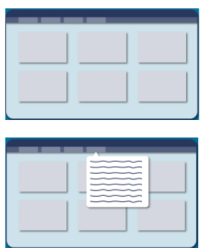
2.45 This example shows 2 separate views of a design of a GUI with a simple pop-up that appears when a tab is hovered over. This design will be considered acceptable if the images are filed as separate representations and the applicant has indicated that the design is a graphical user interface with a pop up. An applicant may also include a disclaimer explaining the transition to ensure that the nature of the transition is clear to anyone viewing the register.
2.46 If protection is sought for a more complicated arrangement of pop-ups, an examiner will consider whether the visual appearance changes such that the representations are not considered to relate to a single design. If so, an objection will be raised to the application containing more than one design. Each case will be considered on its merits.
Use of Disclaimers and Re-Dating
2.47 Registered designs protect the appearance of a product or part of a product. Therefore, the overall impression of a registered design must be discernible from the representations provided and published in the register. Written and visual disclaimers allow applicants to provide additional information about what is protected e.g. excluding some elements of a representation from protection (see Chapter 12 of the Registered Designs Examination Practice Guidance). Disclaimers are published in the register of designs.
2.48 In line with our general practice on disclaimers, an applicant may choose to include one to clarify which elements are in-scope or out-of-scope of the protection sought. Where a disclaimer is filed, the scope of the design will be limited to the overall impression created by the combination of the static representations and the disclaimer. This could be, for example, to make clear that protection is sought for a specific transition between static views, or for a specific sequence.
2.49 Applicants should be aware that where a detailed level of interpretation is required to assess the design, an application may fall foul of the requirement to create a clear and unambiguous overall impression. Applicants should therefore note that if a lengthy or complex disclaimer is required to clarify how a design transitions from one stage to the next, an objection may be made.
2.50 Applicants should also be aware that if a disclaimer is filed to overcome an objection, the examiner will assess whether it significantly alters the design. If it does, the application will need to be re-dated to the date on which the design was modified (see Chapter 8 of the Registered Designs Examination Practice Guide). To avoid the risk of an application being re-dated, applicants are advised to make sure that from the outset they provide sufficient representations and - if necessary - a disclaimer which limits the scope of protection.
4. Additional changes to the Registered Designs Examination Practice Guide
Chapter 11 of the Practice Guide sets out the IPO’s practice in relation to representations of designs. Paragraph 11.35 covers animated sequences. In light of the content of this DPN, paragraph 11.35 will be amended to read:
11.35 Still images depicting a moment within a sequence can be used as a means of representing two-dimensional animated sequences (as opposed to static two-dimensional graphic elements or three-dimensional articles). They can include what are often referred to as “Graphical User Interfaces” (or GUIs). GUIs are the visual configuration of graphic elements as they appear on a computer, tablet or smart phone screen, as well as the manner in which they move through a particular and self-contained animated sequence.
11.36 Since a design must be discernible from the representations, applicants are encouraged to use as many views as possible within the online form (up to a maximum of 12). This is to provide as much detail as possible showing the progression of an animation. The representations should give a clear and understandable overall impression of the design. The representations of a design should contain visual similarities, though it is possible that the first and last representation may be significantly different. The views should clearly show how the animation progresses through its various stages. Substantive considerations relating to how the design will be assessed are set out in Chapter 2 of the Registered Designs Examination Practice Guide.
11.37 The following two sets of representations are acceptable examples of ‘snapshot’-type representations. The first shows the circular motion of a two-dimensional coloured bar as it moves in a circular fashion to create a horseshoe shape. The second shows the movement of a light spot and a rectangular outline around a static grid. Applicants should also refer to the examples set out in the substantive guidance in paragraphs 2.18 to 2.46 of this guide:
Chapter 12 of the Practice Guide sets out the IPO’s practice in relation to disclaimers. Paragraph 12.03 covers written disclaimers. In light of the content of this DPN, paragraph 12.03 will be amended to read:
12.03 Written disclaimers are acceptable provided they are clear, understandable, and correspond to the representation(s) submitted. Where, for example, colour or material is visible in a representation but is not intended to form any part of the registration, a written disclaimer may be necessary. This should always be recorded by the applicant within the appropriate section of the application form and should be worded in accordance with the examples provided (for example “colour forms no part of the design”). Further information on written disclaimers and animated/dynamic designs is provided in paragraphs 2.47 to 2.50 of this guide.
5. Timing
This practice will be adopted with immediate effect.