Demand responsive transport case studies
Published 17 December 2025
Applies to England

© Crown copyright 2025
This publication is licensed under the terms of the Open Government Licence v3.0 except where otherwise stated. To view this licence, visit nationalarchives.gov.uk/doc/open-government-licence/version/3 or write to the Information Policy Team, The National Archives, Kew, London TW9 4DU, or email: psi@nationalarchives.gov.uk.
Where we have identified any third party copyright information you will need to obtain permission from the copyright holders concerned.
This publication is available at https://www.gov.uk/government/publications/demand-responsive-transport/demand-responsive-transport-case-studies
These case studies illustrate different aspects of demand responsive transport (DRT).
They show how local authorities are implementing some of the actions described in the main DfT guidance on DRT.
They are included in the main guidance and grouped together here to make it easier to find case studies about particular aspects of DRT.
Aggregating journeys - Buckinghamshire High Wycombe – Pick Me Up
This scheme uses 6 PSVs. It covers large parts of High Wycombe and has the second smallest operating zone of the Rural Mobility Fund DRT pilots at 14 square miles, but also the second largest population density at 5,978 people per square mile.
As of 2024, it has by far the highest monthly average number of passengers at over 6,000, with the next nearest being under 4,000. The RMF evaluation has shown that there is a strong positive association between passenger journeys and the number of vehicles operating within the zone. In the April to September 2024 reporting period, it had an average of 3.88 passenger journeys per vehicle operating hour.
While the average passenger journeys per vehicle operating hour is 3.88, there will be times when the vehicle is carrying in excess of that. High Wycombe is classified as ‘a town with rural fringe’ in the RMF evaluation report. It is the most urban of all the RMF schemes.
High Wycombe is situated in a valley surrounded by hills – with the edges of the town, served by the DRT scheme to the south of the river Wye, squeezed in and elongated between the hills. It could be argued that this type of geography lends itself well to DRT, as parts of the urban area are too linear to sustain a regular fixed route service and better suited to DRT. The level of demand (alongside other factors), indicates the use of PSVs rather than PHVs.
Assessing and adapting - West of England Combined Authority (WECA)
WECA started off with 2 large zones covering the north and the south of the area - with an additional smaller future of transport funded zone around the north of Bristol.
Such large zone sizes meant passengers were often making long journeys and aggregation was difficult. Consequently, there were many unfulfilled bookings and some passenger and local resident dissatisfaction.
WECA reviewed their system and made substantial changes. This included splitting the operating area into multiple zones rather than just the initial 2. This led to increased aggregation rates, higher booking fulfilment rates and improved customer satisfaction. They also changed the set-up for part of the area, whereby the tech provider was contracted to provide the software, vehicles and drivers.
This involved switching to using private hire vehicles (PHVs) for part of their service. They initially did this in the Future Transport Zone area, before extending the approach more widely. Some PSVs are retained, primarily to transport school children.
The software provider has been overseeing the switch in the former northern zone, using PHV vehicles and operating under section 12 of the Transport Act using a special restricted operator’s licence (SROL). Using an SROL also enables these vehicles to stop at bus stop clearways where they might otherwise be restricted.
WECA has found that this approach allows the number of vehicles to be better matched to demand.
These adjustments demonstrate the need for local authorities to be able to assess whether a scheme has met its objectives, how it is performing and whether changes are needed.
Capping by journey length - East Sussex Flexibus
East Sussex started out with 10 operating zones covering 80% of the county - not serving major towns such as Eastbourne and Hastings. It found that that the rigid system of 1 vehicle per zone meant that, in some zones, the vehicle was underutilised, while in others, there were unfulfilled bookings due to lack of vehicle availability.
Some zones were consequently merged so that there were 7 zones. However, even this was found not to be optimal in terms of maximizing booking fulfilment and aggregation.
East Sussex consequently switched to a single operating zone with the vehicles being able to move around it freely based on bookings and demand. However, the maximum length of a journey is capped at 14 miles, to avoid lengthy journeys which preclude other simultaneous rides, maximizing vehicle availability.
There has since been a 25% decrease in the number of vehicles needed. 95% of rural residents are now within 30 minutes of key destinations by bus or Flexibus while 87% of rural residents are now within a 30 minute ride by bus from the nearest GP surgery – without Flexibus this would be 44%.
East Sussex has calculated a benefit to cost ratio (BCR) of 3.02, indicating high value for money and also estimated over £10 million of wider economic impact over the period of operation until April 2026.
Marketing the service – HertsLynx
Prelaunch
Prior to the launch of the HertsLynx service in September 2021, extensive preparation and marketing campaigns were carried out to inform residents of North and East Hertfordshire about the service and how it differs from traditional fixed line bus services. As DRT was a new concept to residents in the area, the objective was to increase awareness and understanding of the service. Particular attention was paid to audience type, the messaging style, communications strategy and how branding would be implemented to tie all these elements together.
The initial pre-launch campaign was centred around the ‘Coming Soon’ concept, shown in the image below.
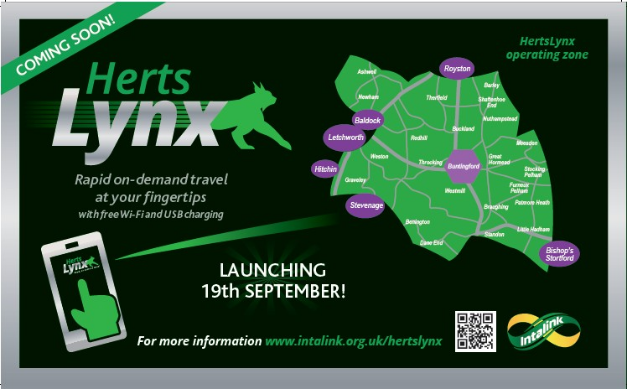
Figure 1: HertsLynx ‘coming soon’ publicity graphic
The pre-launch campaign ran from August to mid-September, ahead of a 19 September launch date, comprising:
- billboards and ad-vans displaying the ‘Coming Soon’ concept in strategic locations across the operating zone
- promotional ‘roadshows’ over 2 weeks, where the team showcased the vehicles and engaged with residents
- a leaflet drop to all residents within the operating zone
- an official press release
- advertisements in the press and online
- engagement on social media
- engagement with local and district councils and schools
A promotional video was also created
Post-launch
Numerous marketing campaigns have been launched using a variety of communication methods.
Roadshows have a been a staple of the marketing campaigns, targeting the service’s ‘Key Hub Towns’, and have proved popular. Team members attend each town throughout the summer and promote the service with leaflets and printed user guides. They allow the HertsLynx team to have direct interaction with the public and answer any questions or concerns they may have. There has been a direct correlation between the frequency of in-person engagement events and increased app registrations. On most occasions, a bus is taken along to showcase the vehicle and attract more engagement from residents.
Passenger satisfaction surveys are used regularly to obtain feedback from HertsLynx users. They are promoted through Hertfordshire County Council’s corporate communications and social media channels. The surveys also provide an opportunity to increase awareness of the service to residents who may not have used it before.
When there is a change to the service, users of the service are emailed via the GOV.Notify system. Users can also be informed of upcoming promotions and events, subject to their marketing preferences. The HertsLynx and Intalink websites are used to share news and articles about the service. In-app notifications send out urgent messages or direct customers to campaigns.
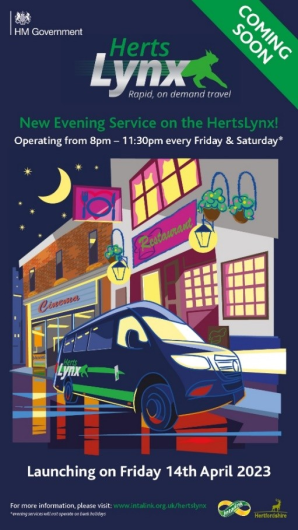
Data from digital marketing can be used to understand the reach and benefits of each marketing approach – for example, a Facebook post promoting the service in 2022 obtained the following engagement:
- 52083 impressions
- 849 engagements
- 1.6% engagement rate (per impression)
- 396 post link clicks
A further promotional video was also produced.
PHVs in a rural area - Go2 DRT: Sevenoaks
This service runs in Sevenoaks and its surrounding area. It operates using shared PHVs under Section 11 of the Transport Act 1985. This service operates as an on-demand service with bookings made no more than 40 minutes in advance of travel.
The average vehicle utilisation rate – passengers per vehicle hour – is around 3.5.
The scheme operates in a predominantly rural area, with narrow roads in some places and limited space for turning, with high car ownership. Go2 concluded that PHVs best suited the service being provided for both cost and operational reasons.
The Robin: Gloucestershire
This scheme began in 2022 in 2 operating zones: a southern area of the Forest of Dean and a north-eastern area of the Cotswolds.
The scheme is designed to connect rural residents to locations where they can connect to fixed-route services for onward travel. The software and app are designed to complement fixed-route services rather than replace them.
The Robin had a staggered start to allow lessons to be learned from the initial deployment, using a community transport provider in the Forest of Dean and a traditional bus operator in the North Cotswolds.
The community transport operator used its network to create awareness of the opportunities offered by the service and to explain how to use it. The service was carefully branded to avoid the perceived stigma around traditional ‘dial-a-ride’ services. This helped it to attract a different passenger profile.
Younger people are using the Robin, particularly during the morning peak where destinations tend to be schools, colleges, employers and the train station. During the day, the demographic is slightly older and the destinations become more varied.
The impact was such that the Robin has subsequently been rolled out across Gloucestershire with services now operating in 6 distinct zones.