Community and Engagement Survey Quality Report
Updated 30 September 2026
Applies to England

© Crown copyright 2026
This publication is licensed under the terms of the Open Government Licence v3.0 except where otherwise stated. To view this licence, visit nationalarchives.gov.uk/doc/open-government-licence/version/3 or write to the Information Policy Team, The National Archives, Kew, London TW9 4DU, or email: psi@nationalarchives.gov.uk.
Where we have identified any third party copyright information you will need to obtain permission from the copyright holders concerned.
This publication is available at https://www.gov.uk/government/publications/community-and-engagement-survey-methodology/community-and-engagement-survey-quality-report
1. Community and Engagement Survey Quality Report
This document supports the Community and Engagement Survey (CES) statistics. The CES replaces DCMS’ Participation Survey and Community Life Survey and runs as a joint survey in practice. This was in response to a public consultation about DCMS’ social surveys run in 2024. The content for the CES has been kept broadly similar to the previous surveys but combining the surveys will result in efficiencies and more coherent outputs. Fieldwork for the CES began in October 2025 and will be a main evidence source for DCMS and its sectors.
1.1 About the Community and Engagement Survey
The Community and Engagement Survey (CES) is a continuous push to web survey of adults aged 16 and over in England (with paper surveys available for those not digitally engaged), designed to explore how people across England engage with their community and with culture, media and live sport and allows respondents’ views to be heard on a range of issues affecting their local area.
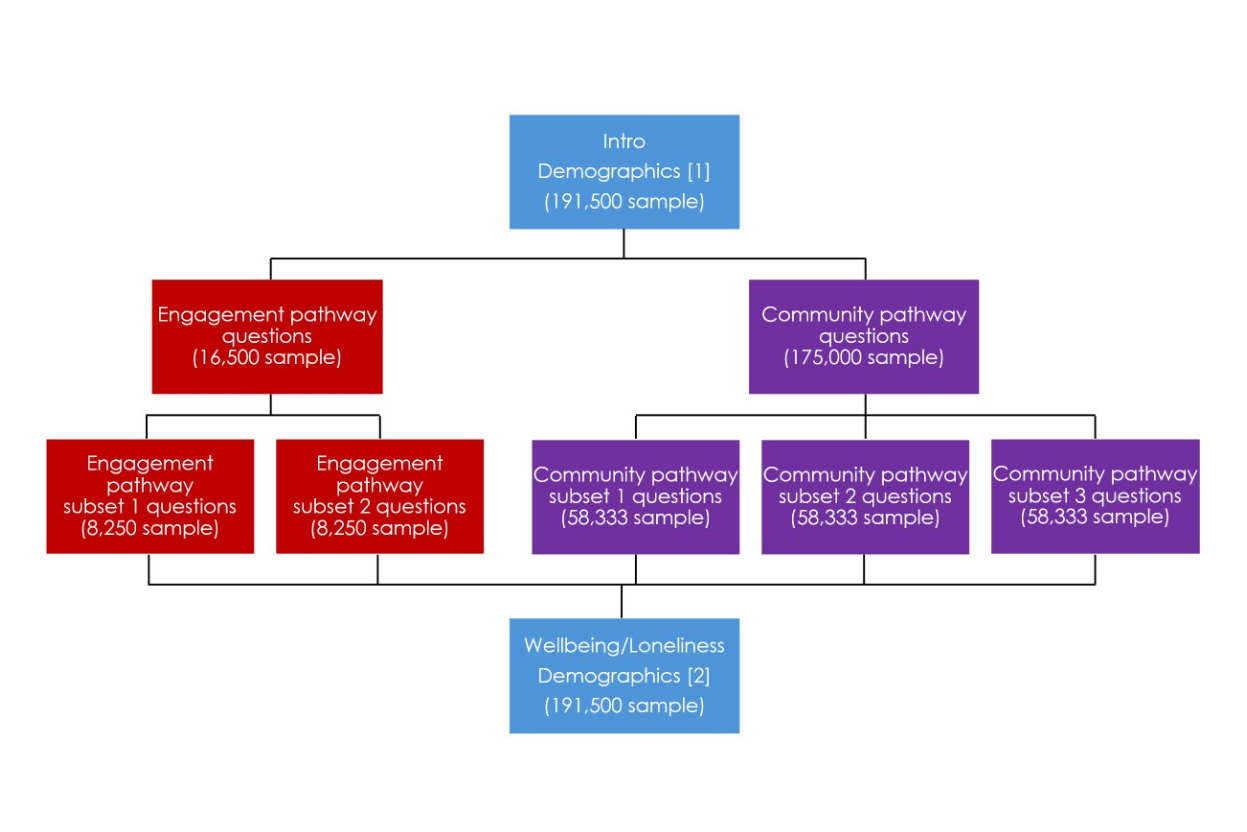
Respondents are automatically selected to one of two available pathways of the survey. One for questions primarily on engagement (similar to the Participation Survey), and one for questions primarily on community and local area (similar to the Community Life Survey). Both pathways will lead to a separate set of questions, with a varied sample size to meet the required sample target for each pathway each year. This is shown in Figure 1 below:
Figure 1: The Community and Engagement Survey design
The findings will help Government, charities and other public sector organisations understand how people engage with culture, media and a range of activities, as well as understand more about communities across England. It will help inform and shape policy and decision making.
CES data is collected on behalf of DCMS by our contractor, Verian. The CES was launched in October 2025. Fieldwork for the Community pathway in 2025/26 was delivered over two quarters (October to December 2025 and January to March 2026) due to additional survey setup requirements. The fieldwork for the Engagement pathway in 2025/26 began in April 2025 as part of the Participation Survey fieldwork until September 2025. These questions continued to be asked as part of the CES from October 2025 until March 2026. There are therefore two quarterly CES publications in 2025/26, in addition to an annual publication, which covers the period of October 2025 to March 2026 (for the Community questions) and April 2025 and March 2026 (for Engagement questions). It is expected that future surveys will run from April to March, with four quarterly and one annual publications each year.
More information on the Community and Engagement Survey can be found on the DCMS website.
1.2 Strengths and limitations of the CES
This section highlights the key strengths and limitations of the Community and Engagement Survey.
Strengths:
- Large and representative sample – The CES is a large survey, collecting representative data and enabling granular breakdowns to be produced. Participants in the survey are selected from addresses from the Post Office’s list of addresses in England. This ensures that results reflect the experiences and views of the whole adult population.
- Inclusivity – The survey represents participants from different demographics such as age, sex and ethnic group. It is also available to be completed in both online and paper formats, aiding those adults who do not wish or are not able to complete a survey digitally.
- Strong, established reputation – The Participation Survey and the Community Life Survey are both longstanding surveys that are used to inform the evidence base for many different policy areas within the Department of Culture, Media and Sport, as well as being used by many external organisations.The CES has brought both of these reputable official statistic publications together.
- Open data – The Community Life and Participation Survey dataset is freely accessible from the UK Data Service for users who wish to explore micro-level data for themselves.
- User consultation and engagement: To ensure that our statistics continue to meet the needs of our users, the DCMS Survey team runs consultations when changes to the survey or published statistics are proposed, both internally within DCMS and externally via our webpages.
Limitations:
- Response rates – The response rates for push-to-web and self-completion are much lower than face-to-face responses. In 2023/24, an individual response rate of 25% completed the PS; this decreased in 2024/25 to 24%. Whereas in 2023/24 the individual response rate for the CLS was 22% and in 2024/25 decreased to 20%.
- Self-reporting may not reflect actual events – There are disadvantages to relying on self-reporting, namely, inaccurate recall. For example, forgetting the number of visits to certain locations, or giving imprecise measurements of how often a participant meets friends or family. However self-reporting can reduce other bias seen in face-to-face interviewing, such as social desirability bias.
- Limitations to the amount of data that can be collected – The CES prioritises a rich depth of community and engagement data while maintaining a 30 minute completion threshold to encourage higher response rates. However, this short time frame means that certain questions or more in depth focused questions may be excluded. Both surveys seek to achieve a balance between achieving its key aims and avoiding over-burdening respondents.
- Limited geographical coverage: The CES covers adults in England. Similar data from the Devolved Administrations is made available, highlighting where comparisons can be made (See chapter 1.9).
- Not fully inclusive: Even though the CES is considered an inclusive methodology, the CES does exclude certain groups such as people with no fixed abode or people living in communal establishments such as residential care homes.
2. Publications
The Community and Engagement Survey data is used to produce five publications per year - one for each quarter (April - June, July - September, October - December and January - March) and one annual each year. The quarterly releases serve as leading indicators that help users assess the trend of responses for the core questions. The quarterly releases tend not include demographic and detailed geographical breakdowns - we publish these annually when we have collected a full year of data.
The publication calendar for the Community and Engagement Survey statistics collection can be found on the GOV.UK website.
3. Quality control
As Official Statistics, Community and Engagement Survey statistics are produced to high professional standards set out in the Code of Practice for statistics and many quality control measures are in place to ensure the integrity of the data. These are covered in this document as well as in more detail in the Technical reports published alongside the statistical releases.
4. Quality Assurance
Quality assurance checks are carried out by our contractor and within DCMS. Quality checks carried out by the contractor are available in the Technical report published alongside the statistical releases.
To ensure an independent evaluation of the work, production of the analysis and the report is typically carried out by one member of staff, and quality assurance is completed by at least one other. Finalised figures are disseminated within OpenDocument Format tables and a written headline report (annually), published on GOV.UK. These are produced by the Surveys Team in DCMS. Before publishing, a quality assurer checks the data tables as well as the report to minimise errors. This is checked against a QA log where comments can be fed back and actioned accordingly. The quality assurer also makes sure any statements made about the figures (for example, regarding trends) are correct according to the analyses and checks for spelling or grammatical errors.
Proof reading and publication checks are done at the final stage, including:
- checking the figures in the publication match the published tables
- checking the footnote numbering is correct
- making sure hyperlinks work
- checking chart and table numbers are in the correct order
- ensuring the publication is signed off by DCMS Head of Profession for Statistics
- contacting press office to ensure they are aware of the release date
- checking the published GOV.UK page, both before and after publication
Once the publication is released, DCMS reviews the processes and procedures followed via a wash up meeting. This occurs usually a week after the publication release date and discusses:
- what went well and what issues were encountered
- what improvements can be made for next time
- what feedback have we received from any users
- any further engagement with users that is planned
5. Revisions policy
Non-Scheduled Revisions
DCMS corrects and revises data in accordance with its Statement of compliance with the Code of Practice for Official Statistics.
Where a substantial error has occurred as a result of the compilation or dissemination process, the statistical release, data tables and other accompanying releases will be updated as soon as is practical. When revisions are made because of changes to methodology or definitions of the data collection, these will be made as part of a regular publication and details of any revisions and their impact on estimates will be published alongside the publication.
5.1 Corrections
When major errors occur they are corrected as soon as possible by reissuing the statistics with the corrected figures. In such circumstances key users and/or ministers may be alerted. Minor errors can be corrected in slower time as appropriate (always within 12 months) and can be timed to coincide with, but are not restricted to, the release of new editions of statistical products. In cases where errors are found in time series that appear in more than one edition, the errors will be corrected in the most recent edition only as the data in older editions is superseded by later releases. If an error is identified but corrected figures are not yet available due to a need for further investigation, a note will be added to the statistics to explain the situation and to make clear that the figures are subject to change.
6. Dimensions of quality
The Community and Engagement Survey is an official statistic, and as such is held to the standard of quality as required by the UK Statistics Authority.
The following section outlines the quality of the statistics from the Community and Engagement Survey using the European Statistical System’s (ESS) Dimensions of Quality criteria for assessing the fitness for the purpose of statistical outputs.
6.1 Relevance
The Community and Engagement Survey is the successor to the Participation Survey, which ran from October 2021, and the Community Life Survey, which ran from 2012. In response to a public consultation about DCMS’ social surveys held in 2024, it was decided that combining the surveys provided an opportunity for increased efficiencies and more coherent outputs. This approach also provides an opportunity to ask a small number of survey questions to the full sample across both question sets, using a combined module. For example, if the sample size for one side of the survey is boosted to Local Authority level, this enables a small number of questions from the other side of the survey (which are within the combined module) to be asked at LA-level also. To enable this meaningful analysis, DCMS and the Ministry of Housing, Communities and Local Government (MHCLG) partnered in 2025/26 to increase the sample size for the Community pathway. This boost provides the necessary scale to generate reliable estimates for the majority of the survey’s metrics across local areas. The partnership between ACE (Arts Council England) and DCMS resulted in the 2023/24 Participation Survey being boosted at LA-level. ACE plans to implement a LA boost every three years, with the next boost planned for 2026/27.
From the running of the Participation Survey and Community Life Survey, DCMS has gained insight into the uses of the data and been able to identify many key users. The users of these statistics fall into five broad categories:
1 . Ministers and other political figures
2 . Policy and other professionals in DCMS and other Government departments
3 . Industries and their representative bodies
4 . Charitable, voluntary, community and social enterprise (VCSE) organisations
5 . Academics
The broad uses of the statistics are:
- Policy making and monitoring – the statistics are used by policy areas to monitor the state of community and engagement in their area and to provide context and evidence for policies; the data is also used to inform discussion around the allocation of resources, and to provide advice to Ministers
- Informing the general public – the statistics are used by both national and local media, which in turn informs the public about engagement in cultural, and sporting activities as well as encouraging social action and empowering communities, including volunteering, charitable giving, community engagement and loneliness.
- Comparisons and benchmarking especially between demographic groups and geographical areas.
- Supporting the evaluation and implementation of local growth funds and informing analysis for communities and cohesion policy development.
- Measuring quantifiable elements of strategies, for example ACE’s strategy ‘Lets Create’.
Every year the Community and Engagement Survey is reviewed to assess if any questions need to be added, removed or amended to ensure the survey meets user needs as much as possible. Any new questions undergo in-depth levels of testing to check that they are fit for purpose and understood by respondents. Recent examples are included in the 2025/26 Pilot Report.
The Community and Engagement Survey annual dataset will be freely accessible from the UK Data Service for users who wish to explore micro-level data for themselves.
6.2 Accuracy & Reliability
As discussed in the section on quality assurance, the DCMS survey team runs some specific checks before publishing the data. The Community and Engagement Survey statistics are based on survey data and, as with all data from surveys, there will be an associated error margin surrounding these estimates, that is, a sampling error. Sampling error is the error caused by observing a sample (as in a survey) instead of the whole population (as in a census). While each sample is designed to produce the “best” estimate of the true population value, a number of equal-sized samples covering the population would generally produce varying population estimates. This means we cannot say an estimate of, for example, 20% is totally accurate for the whole population. Our best estimates, from the survey sample, suggest that the figure is 20%, but due to the degree of error the true population figure could perhaps be 18% or 23%. This is not an issue with the quality of the data or analysis, rather it is an inherent principle when using survey data to inform estimates. As there are also issues with sample variability, confidence intervals are used to show a range containing the true value that would be obtained by surveying the whole population.
To represent the whole population, addresses are randomly selected from the Post Office’s list of addresses in England to all resident adults aged 16+. The sampling frame (Postcode Address File) is designed to yield a respondent sample that is representative with respect to neighbourhood deprivation level, and age group within each of the 296 local authorities in England. The CES is designed to provide a representative sample of households in England and the sampling methodology has been refined based on the experience of the Participation Survey and Community Life Survey and improved over the years. Once the survey data has been collected, weights are applied to the sample to reduce non-response bias.
To maximise response rates, participants are offered a £10 shopping voucher upon completion of the CES. In 2021/22, two experiments were carried out as part of the pilot. One looking at hard and soft targeting, and another on early responders, although neither approaches were taken forward. Further information is available in the Participation Survey 2021/22 pilot report.
Accuracy can be broken down into sampling and non-sampling error. The data requested and provided by adults through the survey are not mandatory, but we aim to achieve a representative response for all adults, therefore reducing sampling error to the minimum. In order to ensure the survey data is representative, our contractor carries out regular monitoring of the response rate as discussed in the quality assurance section. Fieldwork is monitored on a weekly basis at a LA and ITL2 level as well as overall level to monitor progress against targets, and to enable future batches of the sample to be selected appropriately. Further information is available in the ‘Sampling’ section of the Technical report published alongside each statistical release.
Non-sampling error includes areas such as coverage error, non-response error, measurement error and processing error. We aim to reduce non-sampling error through the provision of guidance about the survey and how to complete it. We also provide FAQs and definitions of any terms used. There are validation checks within the survey to ensure that data is of good quality and fit-for-purpose. Despite these quality control and assurance procedures, the survey is based on self-reporting, which may not reflect actual behaviour. Disadvantages to relying on self reporting include inaccurate recall or social desirability bias (although often less than for other data collection modes such as face to face). Whilst there are extensive validation checks in place to minimise error, it is not possible to eliminate them entirely. There are also limitations to the amount of data that can be collected. Although the Community and Engagement Survey collects a rich level of detail of engagement with community and DCMS sectors, it is not possible to capture an extensive amount of information about each engagement or every aspect of community and local area life, mainly because of space in the survey but also the ability for respondents to accurately recall events in detail, especially up to 12 months before the survey.
6.3 Timeliness and Punctuality
There is a trade-off between timeliness and the other quality dimensions, in particular accuracy, accessibility and clarity. It is important that the Community and Engagement Survey Statistical releases have adequate processes to ensure accuracy of the dataset; produce clear publication tables and apply appropriate disclosure control to the data released.
We are also aware of the importance of providing data to our users in a timely manner. The Community and Engagement Survey is run throughout the year. To provide timely data to stakeholders, we aim to publish a summary set of statistics (in open data format tables) within 4 months of the end of the data collection period.
| Survey in the field | Data published |
| April to June | September |
| July to September | December |
| October to December | March |
| January to March | July |
| April (previous year) to March (current year) | July |
These publication dates are provided in the DCMS Official Statistics calendar and provide a 12 month rolling publication schedule. If there is a need to change the planned publication date, then this is updated in the official statistics calendar and a change note added to GOV.UK release calendar. The data production and publication schedules are kept under review and take into account user needs when considering the timeliness of future data releases.
In accordance with Pre-release Access to Official Statistics Order 2008, ministers and eligible staff are given pre-release access to DCMS statistics 24 hours before release. A list of people given pre-release access is published alongside the relevant release.
6.4 Comparability and Coherence
The Community and Engagement Survey data are comparable across the 9 English regions. Data is broken down to more granular geographical areas, including ITL2 areas, upper tier LA, lower tier LA and combined authority level, allowing for a comprehensive evaluation of economic and social trends across diverse governance structures. Where possible the CES uses harmonised question sets and definitions that are consistent with ONS and other government surveys. This makes our data on common areas such as demographics (for example ethnicity) and wellbeing comparable with a wide range of other government surveys.
Prior to the launch of the Community and Engagement Survey in October 2025, two rounds of cognitive testing were conducted to ensure that any new questions were understood and answered in the manner expected. This is covered in the 2025/26 Pilot Report. A further two rounds of cognitive testing were carried out in November 2025, specifically looking at Belonging to Britain questions and gathering general feedback on the user experience of completing the survey.
6.5 Accessibility and Clarity
The survey is based on a representative sample for all adults in England. The address sample is designed to yield a respondent sample that is representative with respect to neighbourhood deprivation level, and age group within each of the 296 local authorities in England. All selected addresses were sent an initial invitation letter containing the following information:
- A brief description of the survey
- The URL of survey website (used to access the online script)
- A QR code that can be scanned to access the online survey
- Log-in details for the required number of household members
- An explanation that participants will receive a £10 shopping voucher
- Information about how to verify the letter for authenticity
- Information about how to contact the contractor in case of any queries
The reverse of the letter featured responses to a series of Frequently Asked Questions.
As well as the online survey, respondents are given the option to complete a paper questionnaire, which consists of an abridged version of the online survey. Each letter informed respondents that they could request a paper questionnaire by contacting the contractor using the email address or freephone telephone number provided. A round of piloting was conducted to ensure the process was accessible and clear to respondents.
Usability testing and piloting was developed to test the survey login procedures which includes: the script routing, and the print and mailing logistics, including the management and monitoring systems. It did not test response levels because of limited timing so that it would not compromise the quality of the development work. Participants received invitation letters on how to access and complete the pilot round of surveys. Addresses were sampled using the same contact protocol as the main stage; however, paper questionnaires were not available and only one reminder letter was sent out, also due to the time constraints. After completion of the survey respondents were able to receive a £10 gift voucher via a portal provided by Verian’s incentives partner Merit. To test both pathways through the web version of the survey, respondents were allocated to different Community and the Engagement pathways.
The Community and Engagement Survey web pages are accessible from the DCMS statistics launch page. They are published in an accessible, orderly, pre-announced manner on the GOV.UK website at 9:30am on the day of publication. An RSS feed alerts registered users to this publication.
For annual publications, outputs aim to provide a balance of commentary, summary tables and charts. The aim is to ‘tell the story’ in the output, without the output becoming overly long and complicated. The publication is available in HTML format and includes email contact details for sending queries and feedback to the production team. Additional, detailed data tables are available in ODS files. In contrast to the annual release, quarterly publications feature more limited data breakdowns due to smaller sample sizes, focussing more on the headline indicators and monitoring change between the corresponding quarter in the previous year. We publish the data tables, a technical report, and contact information for pre-release access.
The format used is in line with DCMS departmental guidance. It aims to make outputs clear for the audience and all outputs adhere to the accessibility policy. Further information regarding the statistics can be obtained by contacting the relevant staff detailed on the release via cesurvey@dcms.gov.uk.
7. Trade-Off Between Output Quality Components
Trade-offs are the extent to which different aspects of quality are balanced against each other.
The statistics are produced and released according to a pre-announced timetable. As discussed previously, the timetable for publication is designed to provide users with the best balance of timeliness and accuracy. Whilst the fieldwork periods end in March, June, September, and December, it is possible that completed paper surveys are received after the end of the quarter, and therefore we need to balance the need to publish quarterly statistics promptly with ensuring we capture as many completed responses for the quarter. There may be instances where completed responses for a quarter are not captured in the quarterly results but subsequently are included in the annual statistics. These will be noted in the correct quarter in the datasets available for stakeholders to use.
8. Assessment of User Needs and Perceptions
The DCMS Survey team works closely with key customers and stakeholders in DCMS to keep track of developments in policy, and continuously review the coverage and content of publications to ensure that they meet the needs of users. We also periodically consult our external users, including ALBs and academics, on their uses and needs of community and engagement statistics to better understand user requirements and priorities for the future. We encourage feedback on all our outputs. Contact details are available at the bottom of each publication for users to get in touch if they have a query.
Broader consultations are conducted when appropriate, for example, when significantly changing a survey, the methodology, or the provision or coverage of the published data. These generally involve contacting known users of the published statistics to ask specific questions or request feedback. These questions are also published on the website or linked to the publication in order to capture users with whom we have had no previous contact. The results of user consultations are published on the website.
9. Data confidentiality and security
9.1 Confidentiality
Respondents are informed at the beginning of the survey process in the advance letter about data confidentiality and that participation in the survey is voluntary. The Frequently Asked Questions that accompany the advance letter outline the CES compliance with the current General Data Protection Regulations. The statistics produced do not identify respondents or any respondents part of the same household. Answers are combined with those of all others who take part in the survey. Respondents’ name and contact details are only known to the team processing the survey results at Verian, and the relevant data controllers of this information. DCMS do not pass on participant details to any organisation without their agreement, unless otherwise listed in the Privacy Notice for the survey. De-identified survey information may be provided to other government departments, and approved partner organisations or researchers for statistical purposes only. All information is processed in compliance with the Data Protection Act 2018 and General Data Protection Regulation for the performance of official authority and public interest. Further information about this is available on the CES Privacy Notice.
9.2 Security
Details of how data are held and transferred are available to respondents in the CES Privacy Notice, linked in the invitation letter and the survey directly. DCMS, MHCLG and Verian’s security procedures include restricted access to digital project folders and secure transfer of files, in line with the requirements of the 2018 Data Protection Act and UK GDPR.
DCMS provides a pseudonymised version of the survey dataset to researchers through the UK Data Service, available under either an End User License (EUL) or a Special License. For more sensitive data, a controlled version is deposited in the UK Data Service Secure Lab. Access to this secure environment is restricted to registered researchers who have undergone training and received explicit DCMS approval. Usage is strictly governed by the Five Safes Framework, ensuring that data is accessed remotely in a secure and responsible manner.
10. Annex A: Survey Comparability with Devolved Administrations
The CES collects data for adults in England, while similar data for Scotland, Wales, and Northern Ireland are gathered through separate national surveys. The Survey Comparability Table evaluates these UK wide surveys alongside the Community and Engagement Survey, providing a breakdown of comparable modules.
The Community and Engagement Survey collects data for respondents in England only. The table below aims to compare surveys from Northern Ireland, Scotland and Wales from how similar they are to the community (previously Community Life Survey) and engagement (previously Participation Survey) pathways of the Community and Engagement Survey.
Note: The Community Life Survey and the Participation Survey were both replaced by the Community and Engagement Survey in October 2025. More about the Community and Engagement Survey can be found here.
| Country | Community pathway (previously the Community Life Survey) | Engagement pathway (previously the Participation Survey) |
|---|---|---|
| England | The Community Life Survey was a major annual study commissioned by the UK government to track how adults ages 16 and over in England engage with their local communities. The survey moved to a self-completion online and paper mixed method approach from 2016/17 onwards after its previous face-to-face method. In 2023/24–2024/25, the survey was significantly boosted to collect local authority data for a more granular analysis. You can find out more about the Community Life Survey here. In 2025/26, the Community Life Survey was merged into the Community and Engagement Survey. The community pathway of this survey continues to ask similar content to the Community Life Survey. The sample for the community pathway was boosted to 175,000 in 2025/26 to allow for data at a local authority level. |
TThe Participation Survey was a major annual survey to track how adults ages 16 and over across England interact with the DCMS sectors (e.g Arts, Heritage, Libraries, Museums, and live sport). The survey shifted from a face-to-face method (Taking Part Survey) to a mixed online and paper self-completion approach from 2021. In 2023/24, the sample was significantly boosted to enable local authority-level analysis. More about the Participation Survey can be found here. In October 2025, the Participation Survey was merged into the Community and Engagement Survey, whose engagement pathway continues to cover similar topics. The 2025/26 sample was around 33,000, with plans to boost it again in 2026/27 to support local authority-level data. |
| Northern Ireland | Several major, recurring, and ad hoc surveys in Northern Ireland gather data on volunteering, community cohesion, and social engagement, similar to the community pathway of the Community and Engagement Survey. These include: • Northern Ireland Life and Times Survey • Continuous Household Survey • Young Life and Times Survey • Northern Ireland Safe Community Survey • Public Opinion Survey (ECNI) • Young Persons’ Behaviour and Attitudes Survey The Continuous Household Survey, run by NISRA, is the closest equivalent to the community pathway of the Community and Engagement Survey. Conducted since 1983, it surveys adults (16+) in private households in Northern Ireland and resumed face-to-face interviews in 2022 after a COVID-19 pause. Similar modules include: • Social Capital • Volunteering • Active Travel & Leisure |
In Northern Ireland, engagement pathway data is mainly handled by NISRA. The Continuous Household Survey is the closest equivalent, with modules closely mirroring the Community and Engagement Survey. Running since 1983, it surveys adults (16+) in private households in Northern Ireland and resumed face-to-face interviews in 2022 after a COVID-19 pause. Similar modules include: • Arts & Culture • Heritage • Libraries • Museums • Sport More about the Continuous Household Survey can be found here. |
| Scotland | In Scotland, there are several major surveys collecting data similar to the Community pathway of the Community and Engagement Survey. These include: • Scottish Household Survey • Scottish Social Attitudes Survey • Scottish Crime and Justice Survey • Scottish Health Survey • The Big Survey (Age Scotland) • Single Parents Community Connections Survey The Scottish Household Survey is the closest equivalent to the community pathway of the Community and Engagement Survey. Launched in 1999, it was redesigned in 2012 to incorporate elements of the Scottish House Condition Survey, including physical inspections. By 2022, it returned to largely face-to-face fieldwork, with optional remote interviews (telephone/video). Similar modules include: • Volunteering • Neighbourhood & Community • Local Facilities While this survey focuses on behaviours, the Scottish Social Attitudes Survey explores underlying attitudes. Running since 1999 (and covering ages 16+ since 2015), it shifted from face-to-face interviews to telephone during COVID-19 and to a push-to-web approach in 2023. Similar modules include: • Civic Engagement & Political Participation • Identity • Social Cohesion • Social Capital & Trust • Volunteering |
In Scotland, there are several major surveys collecting data similar to the engagement pathway of the Community and Engagement Survey. These include: • Scottish Household Survey • Scotland’s People and Nature Survey • Scottish Health Survey • Scottish Social Attitudes Survey • Citizens Panel • Scottish Climate Survey The Scottish Household Survey is the official source for all participation metrics in Scotland. Similar modules include: • Cultural Attendance • Cultural Participation • Heritage The Scottish Social Attitudes Survey is the Scottish equivalent to the Barriers to Participation section of the engagement pathway of the Community and Engagement Survey. |
| Wales | The National Survey for Wales is the closest equivalent to the community pathway of the Community and Engagement Survey, though it has a broader scope. Launched in 2012, it was expanded in 2016 when the Welsh Government merged five separate surveys into a single study to better capture how different aspects of people’s lives interact. Similar modules include: • Volunteering • Community Cohesion • Loneliness & Wellbeing • Decision Making & Influence • Local Services & Facilities More about the National Survey for Wales can be found here and here. Other key surveys similar to the community pathway in Wales: • People and Nature Survey • Opinions and Lifestyle Survey • Understanding Society (UK Household Longitudinal Study) • Crime Survey for England and Wales |
In Wales, there are multiple surveys collecting data similar to the engagement pathway of the Community and Engagement Survey. These include: National Survey for Wales • People and Nature Survey for Wales • Arts Council of Wales Annual Survey In Wales, engagement data is integrated into the National Survey for Wales rather than a standalone survey. Similar modules include: • Arts & Culture • Heritage • Libraries & Museums |