Carbon Border Adjustment Mechanism (CBAM): Policy summary
Updated 9 September 2026

© Crown copyright 2026
This publication is licensed under the terms of the Open Government Licence v3.0 except where otherwise stated. To view this licence, visit nationalarchives.gov.uk/doc/open-government-licence/version/3 or write to the Information Policy Team, The National Archives, Kew, London TW9 4DU, or email: psi@nationalarchives.gov.uk.
Where we have identified any third party copyright information you will need to obtain permission from the copyright holders concerned.
This publication is available at https://www.gov.uk/government/publications/carbon-border-adjustment-mechanism-cbam-policy-summary/carbon-border-adjustment-mechanism-cbam-policy-summary
1. Introduction
The Carbon Border Adjustment Mechanism (CBAM) legislation and guidance is being developed in the following stages:
1) Primary legislation
Primary legislation for CBAM was introduced in the Finance Act 2026. You can find the Act on the UK Parliament website, which also contains the latest versions and associated documents.
2) Secondary legislation
Draft secondary legislation has been released in 2 stages. The first set was published on 10 February 2026 for a 6-week technical consultation, alongside draft notices which will have force of law. This consultation closed on 24 March 2026. The second set of draft legislation was published on 9 April 2026 for a 6-week technical consultation. This also included a System Boundaries Document and force of law notice. This consultation closed on 21 May 2026.
Summary of this document
This document provides a summary of CBAM policy. It includes the core policy framework which is set out via primary legislation in the Finance Act 2026 and details set out in the draft secondary legislation and notices. Further details will be included in secondary legislation, notices and GOV.UK guidance. The details below may therefore be subject to change; updates will be reflected in this document.
The following secondary legislation was laid on 13 July 2026 and provides further detail as set out below:
The Carbon Border Adjustment Mechanism (Administrative Provisions) Regulations 2026
| Part | Link to explanation of policy area |
|---|---|
| Part 2 | Record-keeping |
| Part 3 | Registration |
| Part 4 | Returns |
| Part 5 | Assessment of Weight |
The Carbon Border Adjustment Mechanism (Calculation of CBAM Rate and Determination of Carbon Price Relief) Regulations 2026
| Part | Link to explanation of policy area |
|---|---|
| Part 2 | Calculation of the CBAM rate |
| Part 3, 4 and 5 | Principles for claiming, verifying and calculating Carbon Price Relief |
| Part 6 | Currency conversion for CPR |
| Part 7 | Record keeping requirements for CPR |
The Carbon Border Adjustment Mechanism (Transitory Provision) Regulations 2026
| Part | Link to explanation of policy area |
|---|---|
| not applicable | Modifications to dates relevant to registration, payment and accounting periods, and related penalties |
The following secondary legislation was laid on 9 September 2026 and provides further detail as set out below:
The Carbon Border Adjustment Mechanism (Emissions and Verification) Regulations 2026
| Part | Link to explanation of policy area |
|---|---|
| Part 2 | Calculating embodied emissions |
| Part 3 | Monitoring and verification of emissions data |
| Part 4 | Record keeping requirements |
Who should read this document
The following stakeholders should read this document:
- importers of goods from the aluminium, cement, fertiliser, hydrogen, and iron and steel sectors and downstream producers that use these goods in their supply chains
- overseas operators of installations involved in processing or manufacturing of goods from the aluminium, cement, fertiliser, hydrogen, and iron and steel sectors
- independent emissions verifiers and accreditation bodies
Further questions
If you have any questions about CBAM or would like to be added to the CBAM mailing list to stay up to date on the latest developments, please email the CBAM policy team.
2. Background
CBAM will commence on 1 January 2027.
This will ensure highly traded, carbon intensive products from jurisdictions outside the UK face a comparable carbon price to that paid by UK manufacturers, so that UK decarbonisation efforts lead to a true reduction in global emissions rather than simply displacing carbon emissions overseas.
3. Scope of CBAM
Geographic scope
CBAM will apply:
- to specified goods that are imported into the UK on or after 1 January 2027
- across the whole of the UK, including Northern Ireland. Goods which enter the UK from the Crown Dependencies including the Isle of Man, Overseas Territories and UK Continental Shelf will be subject to CBAM
Sectoral and product scope
CBAM will place a carbon price on the emissions embodied in imports of specified goods in the following sectors;
- aluminium
- cement
- fertiliser
- hydrogen
- iron and steel
Within these sectors, CBAM will only apply to specific ‘CBAM goods’ that are imported into the UK. These goods are determined by the product level scope of CBAM and are identified by the commodity codes as listed in the Annex (correct as at the date of this publication).
The commodity codes also identify a small number of goods within these sectors that will be excluded from CBAM. For example, imported scrap products within the aluminium and iron and steel sectors, identified via their relevant commodity code will not be within the scope of CBAM from 1 January 2027.
In the event of changes to the UK Tariff affecting commodity codes in scope of CBAM, the codes will be updated to maintain the product scope of CBAM. These changes will take effect in line with changes to customs legislation to ensure that goods do not unintentionally fall in or out of scope of CBAM due to commodity code changes.
4. When CBAM goods are imported
Tax point
The CBAM tax point is the point at which the CBAM charge arises.
In most cases, the tax point arises when a CBAM good is imported into the UK and becomes liable to import duty (or would become liable if legislation did not disapply that duty). For goods that are not subject to import duty, the tax point occurs when the goods enter the UK.
CBAM will be charged on the entire CBAM good, except for specific exceptions which are outlined below.
Goods processed under special customs procedures
Where a CBAM good is declared for a special customs procedure, it may undergo processing in the UK before being imported into the UK and the tax point arises. This can happen whilst the good is declared to:
- a storage procedure (free zones)
- an inward processing procedure
- an authorised use procedure (or Union end-use procedure)
Where a CBAM good is processed into a non-CBAM good while under a special customs procedure, a CBAM charge will still arise when the non-CBAM good passes the tax point. However, the CBAM liability will be calculated only on the portion of the original CBAM good declared to the procedure, before it was processed, that forms part of the processed non-CBAM good.
Where a CBAM good is processed into a good which is another CBAM good, or a non-CBAM good is processed into a CBAM good, the CBAM charge will continue to arise when the new processed CBAM good passes the tax point and the CBAM liability will be based on the CBAM good which passes the tax point.
In all cases, the value of the CBAM good which the CBAM charge is based on, will count towards the £50,000 minimum registration threshold. Further information on the minimum registration threshold for CBAM can be found in the registration section below.
Where a good is processed in any of these ways and is exported from the UK before the tax point arises, there will be no CBAM liability and it will not count towards the registration threshold.
Goods processed outside of the UK
CBAM goods can be exported for processing outside of the UK. This can happen under the outward processing procedure, or when a good leaves Northern Ireland to be processed in the EU before returning to Northern Ireland.
If the exported good is processed and re-enters the UK as a CBAM good, when the good passes the tax point, the CBAM charge will arise based on the CBAM good that passes the tax point. However, if the original good was a CBAM good that was of UK origin and subject to a carbon price in the UK, the carbon price previously incurred can be used to adjust the CBAM liability down. Only the difference in value between the original good and the processed CBAM good will count towards the £50,000 minimum registration threshold.
Where a CBAM good is exported for outward processing and is re-imported as a non-CBAM good, there will be no CBAM liability as the good is no longer chargeable.
Liable person
The person liable for CBAM is the importer of the CBAM goods.
This will be the person in whose name the customs declaration is made. Where the customs declaration is made on behalf of another person, the importer is the person on whose behalf the declaration is made.
Where there is no requirement to make a customs declaration, the importer is the person on whose behalf the CBAM good is imported.
The liable person will be able to appoint a tax agent to act on their behalf and submit CBAM returns. The tax agent cannot register for CBAM on behalf of the liable person and no liability will be attached to the tax agent.
Exemptions
Goods imported for non-business use
Only individuals importing CBAM goods in the course of a business that meet either of the CBAM liability tests will be liable for CBAM. This means private individuals importing CBAM goods for non-commercial purposes will not be liable for CBAM.
Goods with UK place of origin
CBAM will be charged on goods which originate from outside of the UK according to the UK’s non-preferential rules of origin. Those with a UK place of origin are not in scope of CBAM.
Returned goods relief
Where a CBAM good is imported into the UK and returned goods relief is available in respect of the good, there will be no CBAM liability. There will also be no CBAM liability for Union goods exported from Northern Ireland into the EU and reimported into the UK providing the goods is:
- reimported within 3 years of export from Northern Ireland
- returned in the same state in which it was exported
Where all the conditions are met, the returning CBAM good will not need to be declared on a CBAM return or be factored into the calculation for the £50,000 minimum registration threshold when applying the CBAM liability tests.
For compliance purposes, the liable person will need to keep evidence to demonstrate they have met the relevant criteria.
The person importing the CBAM good does not need to be the same person that exported the good to claim this relief for CBAM.
Goods imported into the UK under temporary admission
Where a CBAM good is imported into the UK under a temporary admission procedure and full relief is given from customs duty, the good is not treated as an import for CBAM purposes, and CBAM will not be charged on those goods.
If there was no entitlement to make a declaration for full relief on entering the UK, CBAM will apply to those goods from the date they entered the UK. If the full relief no longer applies whilst the goods are still in the UK, CBAM will apply from the date the relief no longer applies.
If a good enters temporary admission procedure with either partial or no relief from customs duty, CBAM will apply to those goods.
Further detail on exemptions will be set out in detailed guidance ahead of 1 January 2027.
5. Calculating CBAM liability
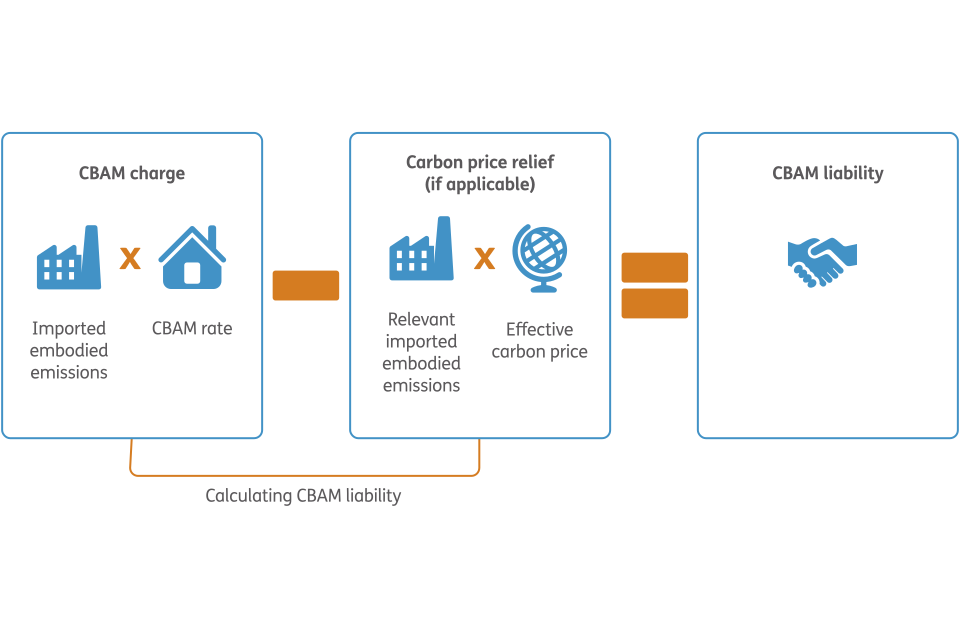
The overall approach to determining CBAM liability is set out in Figure 1.
Figure 1: Overview of CBAM liability calculation
-
CBAM charge: the CBAM charge which is calculated by multiplying the imported embodied emissions by the CBAM rate
-
Carbon Price Relief (CPR): the CPR which is calculated by multiplying the relevant imported embodied emissions by the effective carbon price
-
CBAM liability: CBAM liability which is calculated by subtracting the CPR, where applicable, from the CBAM charge.
The CBAM charge will be based on the direct emissions embodied within the imported CBAM goods. When determining the embodied emissions subject to CBAM, the liable person has 2 options available to them:
- using actual data about the emissions embodied within CBAM goods
- using default emissions values as determined by the government
The government will publish further details on default emissions values in advance of the introduction of CBAM in 2027.
Using actual emissions data
If using actual emissions data, the liable person will need to obtain the relevant verified emissions intensity data from the producer of the CBAM goods. They will need to acquire this information, expressed in tonnes of carbon dioxide equivalent (tCO2e) per tonne, from their supply chains, along with evidence that these emissions figures have been verified by a qualifying verifier. The methodologies for monitoring and verification of actual emissions data are broadly designed to support interoperability with the EU CBAM, helping to reduce administrative burdens, and recognising where there are similar characteristics across UK and EU carbon pricing.
Emissions intensity represents an amount of CO2, or CO2e, embodied within a quantity of a CBAM good, expressed per tonne or functional unit. Functional unit is referred to as ‘weight’ in the emissions and verification regulations and is defined in the System Boundaries Document.As a general rule, functional units are tonnes of good under the same commodity code. For cement and fertilisers which can be imported in different mixtures, concentrations and compositions, the functional units are defined as tonnes of clinker and tonnes of nitrogen contained in those goods respectively.
For the cement and fertiliser sectors, emissions intensity in tCO2e per functional unit must be converted to emissions intensity per tonne of the relevant composition of the good in accordance with conversion equations set out in the emissions and verification force of law notice. Multiplying the verified emissions intensity in tCO2e per tonne by the weight of the imported CBAM good gives the total embodied emissions.
Figure 2: Emissions treatment for precursor goods and complex goods
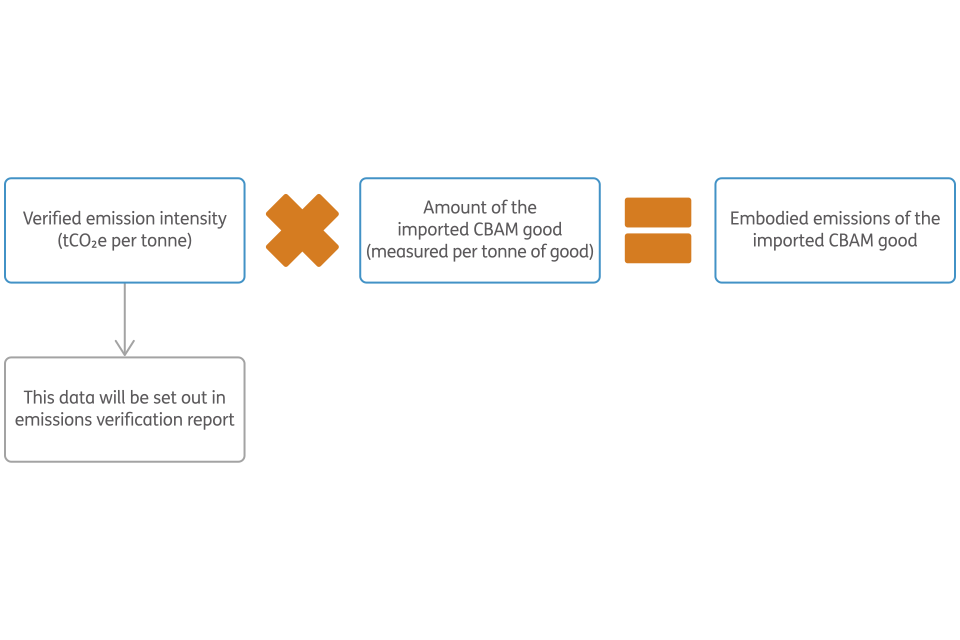
The emissions intensity and weight of the CBAM good imported into the UK needs to be reported on the tax return. While the weight of the imported good will be reported on the tax return by the liable person in kilograms (kg), HM Revenue and Customs (HMRC) will convert the reported weight to tonnes to work out the embodied emissions. The verified emissions intensity will relate to CBAM goods produced during a single calendar year monitoring period.
There are two options for reporting emissions intensity on the tax return. Liable persons may report an emissions intensity that is linked either to the date of importation (Option 1) or the date of production (Option 2) of the CBAM good.
Option 1: Report a verified emissions intensity linked to date of importation of the CBAM good
For CBAM goods imported in 2027
The liable person should use the most recently verified emissions intensity data available from either the calendar year in which the good was imported or the preceding calendar year. For example, for a CBAM good imported in May 2027 the importer must use verified emissions intensity data from the January to December 2027 monitoring period if it exists. If no verified 2027 data is available, verified emissions intensity data from the 2026 monitoring period can be used.
For CBAM goods imported from 1 January 2028
The liable person should use the most recently verified emissions intensity data in the 2 calendar years prior to year of importation. For example: for a CBAM good imported in March 2029 the importer can use emissions intensity from calendar year 2028. If a verification report does not yet exist for the calendar year 2028 then an emissions intensity can be used for the calendar year 2027.
Option 2: Report a verified emissions intensity linked to date of production of the CBAM good
The liable person should use the verified emissions intensity data from the monitoring period the CBAM good was produced. For example: if a good was produced in 2030 and imported in 2032, the importer will use emissions intensity from calendar year 2030.
The technical monitoring methodology for installations measuring emissions is set out in the emissions and verification force of law notice.
System boundaries
System boundaries define which direct emissions and production processes are relevant for CBAM goods. They determine, for example, which emissions released from the burning of natural gas to heat raw materials fall within scope. In the context of CBAM, direct emissions are only those emissions identified as relevant within the established system boundaries. CBAM system boundaries reflect UK Emissions Trading Scheme (UK ETS) system boundaries.
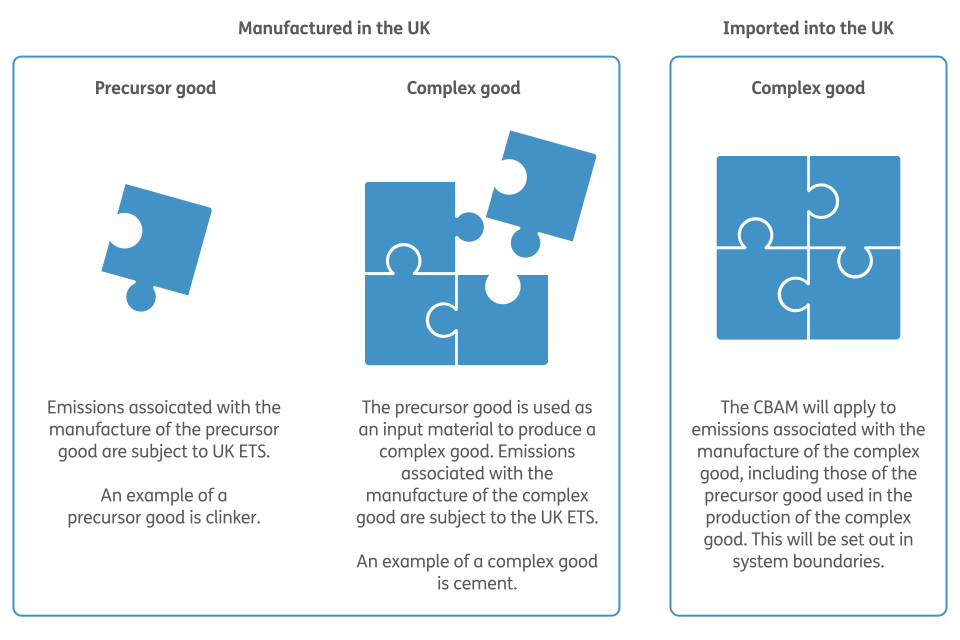
The CBAM charge will also apply to the emissions embodied in relevant precursor goods used in the production of complex CBAM goods. A relevant precursor good refers to an in-scope CBAM good which is used as an input into the production process of a complex good which is also within scope of CBAM. To measure the emissions of a complex CBAM good, it will be necessary to include the emissions embodied in relevant precursor goods.
The System Boundaries Document provides further detail, alongside identifying the precursors applicable to CBAM.
Treatment of precursor goods
As set out in the Carbon Border Adjustment Mechanism (Emissions and Verification) Regulations 2026 and the System Boundaries Document, a precursor good is a CBAM good which is used in the production of another CBAM good; a complex good is a CBAM good produced using one or more precursor goods.
Installations must identify the relevant calendar year monitoring period for a precursor good. The monitoring period for the precursor good can either be:
- the calendar year monitoring period for the complex good
- the calendar year in which the precursor good was produced
The emissions and verification force of law notice sets out how emissions from CBAM precursor goods are treated. It details the application of weighted averages where precursor goods have been sourced from multiple installations and reporting periods. They also set out where emissions from precursor goods can be isolated where they are sourced from a particular installation or subset of installations. In addition, it allows for the use of joint production processes, where a single installation produces both the precursor and complex good, and the precursor good is not transferred for sale or used in other production processes.
Figure 3: Emissions treatment for precursor goods and complex goods
How to calculate embodied emissions
Responsibilities of calculating the embodied emissions of a CBAM good:
- step 1 to step 7: this will be calculated by the installation and will need verifying
- step 8: the liable person reports the emissions intensity of the imported CBAM good to HMRC
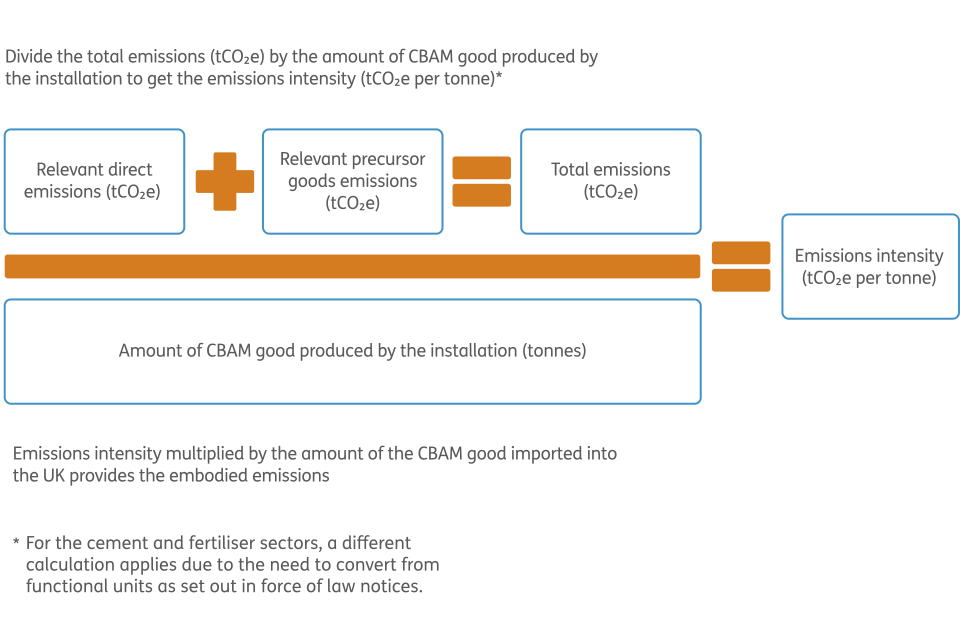
A summary of the calculation of embodied emissions step 1 to step 8 is set out in figure 4.
The steps below explain how to calculate embodied emissions for each CBAM good. In some circumstances, additional rules may apply. Where precursor goods and complex goods are produced at the same installation, the rules for joint production processes can be applied. Where a single production process produces multiple CBAM goods that differ only in size, shape or composition, the rules for multifunctional production processes may also need to be applied.
Figure 4: Illustrative calculation for determining embodied emissions
Step 1: Identify the monitoring period for the CBAM good. This monitoring period is 1 calendar year.
Step 2: Use verified emissions data from that monitoring period to identify the amount, in tonnes, of relevant emissions emitted by the installation in the production of that type of CBAM good during the monitoring period. This step requires the use of the System Boundaries Document and monitoring methodology set out in the emissions and verification force of law notice to attribute the installation’s emissions to the CBAM good.
Step 3: Where amounts of relevant emissions identified in step 2 are not amounts of carbon dioxide, convert them into an amount of carbon dioxide equivalent as set out below:
Table 1: Tonnes of CO2e per tonne of emission
| Emission | Tonnes of CO2e per tonne of emission |
|---|---|
| Nitrous oxide (N2O) | 265 |
| Tetrafluoromethane (CF4) | 6,630 |
| Hexafluoroethane (C2F6) | 11,100 |
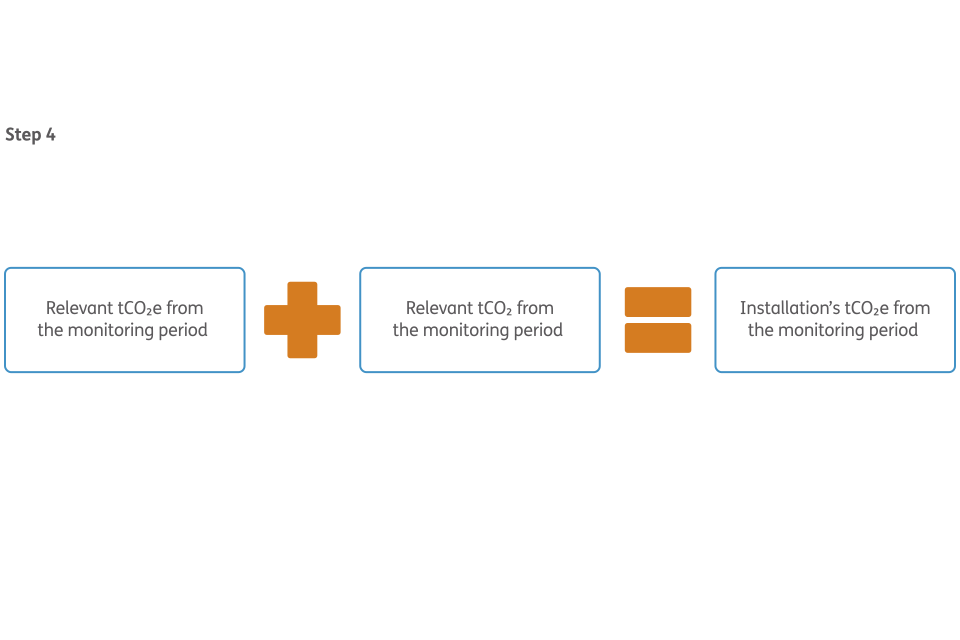
Step 4: Add together all amounts from steps 2 and 3 to produce a total amount, in tonnes, of carbon dioxide equivalent.
This means adding the CO2 and the CO2e emissions together (per step 2 and step 3).
Figure 5: Illustrative example of the calculation in step 4
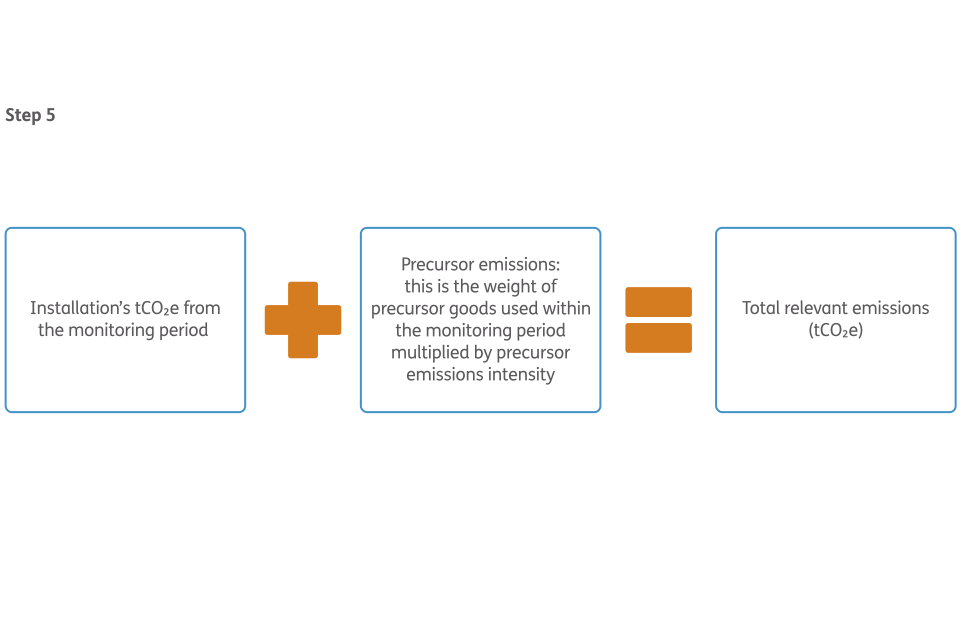
Step 5: Where the CBAM good comprises precursor goods, add precursor emissions for that CBAM good to the emissions already calculated (per step 4).
Note: The weight of the precursor goods used within the monitoring period for producing the CBAM good is multiplied by the precursor goods’ emissions intensity or default values.
Figure 6: Illustrative example of the calculation in step 5
Step 6: Identify the weight of the CBAM good produced by the installation during the monitoring period.
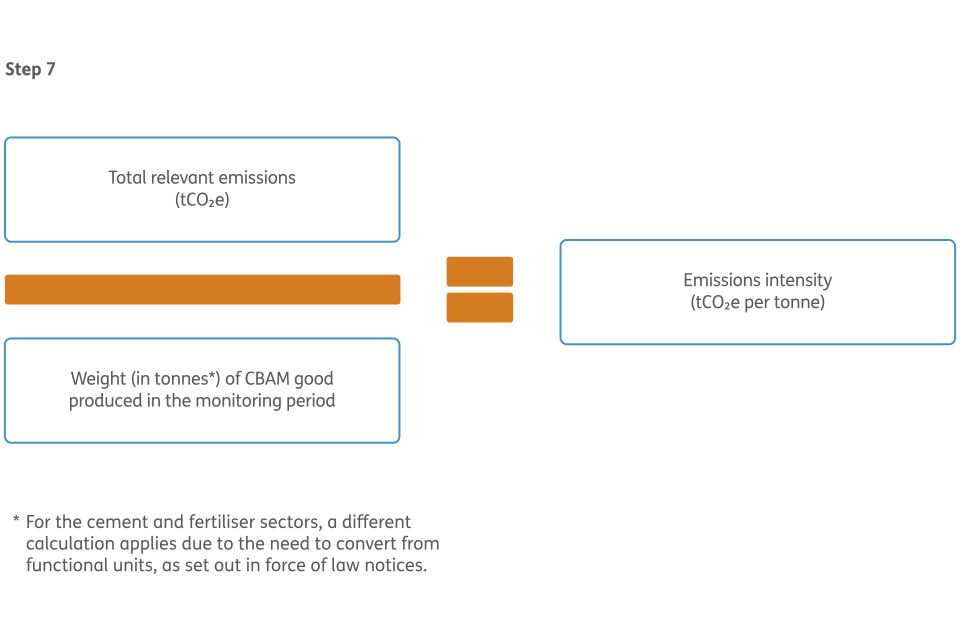
Step 7: Calculate the emissions intensity by dividing the total tCO2e (per step 5) by the weight of goods produced within a monitoring period (per step 6), rounded to 5 decimal places.
Figure 7: Illustrative example of the calculation in step 7
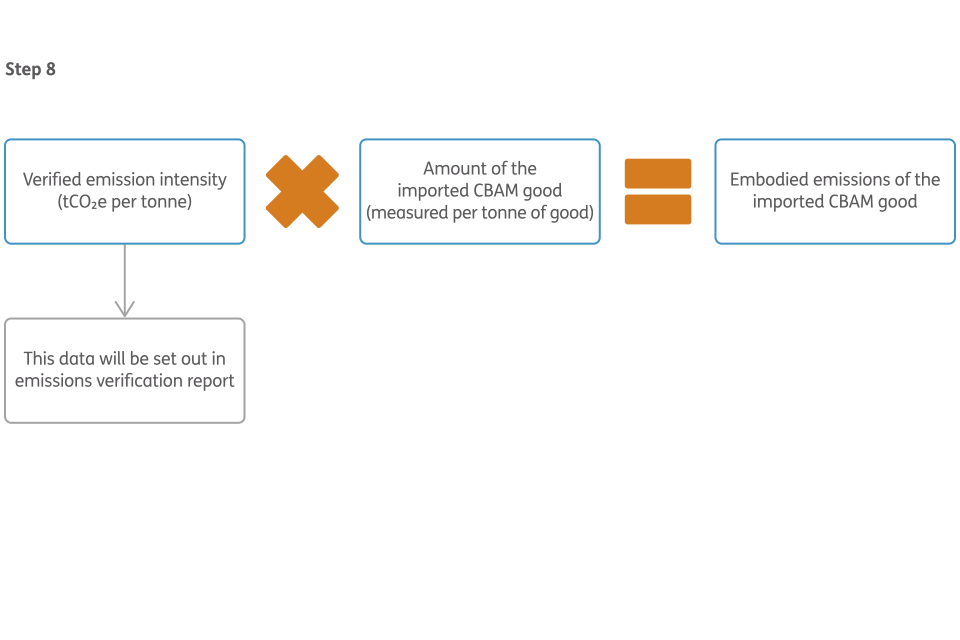
Step 8: Multiply the emissions intensity by the amount of the CBAM good imported into the UK.
Figure 8: Illustrative example of the calculation of embodied emissions within a CBAM good
Verification of actual emissions
In order for liable persons to be able to report the emissions intensity data for the imported CBAM good on their CBAM return, this data must have been verified as satisfactory. The installation producing the CBAM goods imported into the UK will appoint an appropriate verifier to verify the emissions data the installation measures and calculates.
The verifier must be independent of the installation and act impartially when performing the verification. They must be accredited by an eligible accreditation body for CBAM (see ‘accreditation’ section below) and accredited against the following international verification standards (ISO):
- ISO/IEC 17029:2019 (Conformity assessment — General principles and requirements for validation and verification bodies)
- ISO 14065:2020 (General principles and requirements for bodies validating and verifying environmental information)
Verifiers must also be accredited for the correct scope of activities. For example, a verifier who has been accredited for the activity group corresponding to the production of urea and mixed fertilisers would not automatically be eligible to verify emissions released at an installation producing iron and steel products.
Verification activities
To verify the emissions data for the purposes of CBAM and enable the liable person to report the data on their CBAM return, verifiers must confirm that the installation operator’s emissions data has been determined accurately and in accordance with the requirements set out in the Carbon Border Adjustment Mechanism (Emissions and Verification) Regulations 2026 and the emissions and verification force of law notice.
To do this, verifiers must follow requirements set out in the Carbon Border Adjustment Mechanism (Emissions and Verification) Regulations 2026 and the emissions and verification force of law notice. Before the verifier begins its verification activities, the installation operator must provide the verifier with information about the production processes carried out at the installation (including the use of any precursor goods) and the monitoring arrangements in place. The verifier must then conduct strategic and risk analyses, and prepare a verification plan setting out the verification activities they will undertake.
To implement the verification plan, verifiers must appoint a verification team consisting of at least a lead auditor, and an appropriate number of auditors and technical experts. The verifier must have processes in place to ensure the competence of the personnel appointed to conduct the verification. They must also appoint an independent reviewer, who is not part of the verification team, to review the verification activities and the verification opinion.
The verification team must analyse the data provided by the installation operator to ensure it is accurate and ensure correct methodologies for monitoring emissions have been followed. For any precursor goods, they must confirm that any actual emissions data used has been verified in accordance with the Carbon Border Adjustment Mechanism (Emissions and Verification) Regulations 2026 and the emissions and verification force of law notice and that any default values used are the correct ones. They must also confirm that any exemptions for UK produced precursors, where relevant, have been applied correctly and are appropriately evidenced. Verifiers must conduct a physical site visit to the installation at one or more appropriate points during the monitoring period, with exceptions to this requirement set out in the emissions and verification force of law notices.
If the verifier identifies any misstatements or non-compliance with the emissions data requirements set out the Carbon Border Adjustment Mechanism (Emissions and Verification) Regulations 2026 and the emissions and verification force of law notice, they must determine whether these are material (at a materiality threshold of 5% of the good’s emissions intensity), either individually or when aggregated. The verifier must raise any such issues with the installation operator to give the operator an opportunity to address the misstatements.
Verification documentation
To confirm whether or not the data has been verified in line with the requirements for CBAM, the verifier must prepare a verification report following the completion of the verification activities. The verification report must contain (among other things):
- details of the installation, its operator and the verifier
- the emissions data verified, including the emissions intensity of the CBAM goods produced at the installation
- and the verifier’s opinion on whether the data was verified as satisfactory
The verifier may only conclude that the operator’s emissions data is verified as satisfactory where it has concluded that the data is free from uncorrected material misstatements.
The report may also contain good-specific verification summaries setting out the emissions intensity of each individual CBAM good produced at the installation, as well as other relevant information, as annexes to the main verification report. The operator may choose to send a good-specific verification summary to the liable person in place of the full verification report.
Further details on the contents of verification documentation are set out in the emissions and verification force of law notice.
Accreditation
To be eligible to accredit verifiers for CBAM, an accreditation body must:
- be a full member of the Global Accreditation Cooperation Incorporated (Global ACI)
- be peer evaluated in accordance with the procedures of Global ACI for its ability to accredit verifiers for ISO 17029:2019 and ISO 14065:2020
- comply with the requirements of ISO 17011:2017 (Conformity assessment — Requirements for accreditation bodies accrediting conformity assessment bodies)
When assessing verifiers before granting accreditation, accreditation bodies must:
- review the information provided by the verifier
- visit the verifier’s premises
- witness a representative sample of verification activities being carried out
- ensure the verifier’s personnel are competent for the relevant scope of accreditation
Accreditation bodies must carry out annual surveillance of verifiers and conduct a full reassessment of the verifier’s accreditation at least every 5 years. They must also have procedures in place for handling complaints about verifiers and suspending or withdrawing their accreditation where a verifier has:
- failed to follow the legislative requirements
- failed to comply with relevant international standards
- knowingly provided false information
- concealed information
Default emissions values
Whilst it is preferable for the liable person to use independently verified actual emissions data, default emissions values will also be available to determine the embodied emissions in CBAM goods. This means the liable person can meet CBAM obligations when actual emissions data is unavailable. Default emissions values can also be used for precursor goods, even where actual emissions data is used for the final CBAM good. However, actual emissions data cannot be used for precursor goods if default emissions values are used for the final CBAM good.
From 1 January 2027, there will be one default emissions value set per CBAM good. Default emissions values will be published in a notice on GOV.UK in advance of CBAM coming into force. Where required they may be amended or updated by HM Treasury.
Weight
The weight of a CBAM good is required to determine CBAM liability, as it provides the basis for calculating the embodied emissions of an imported good, which forms the basis of the tax charge.
To work out the embodied emissions contained within an imported CBAM good, the emissions intensity of the CBAM good (expressed in tCO2e per tonne) needs to be multiplied by the weight of that good.
The liable person will therefore be required to know the weight of the CBAM good they have imported and hold records evidencing how they arrived at this figure.
This must include the weight of the good:
- excluding packing materials and packing containers of any kind
- at the time the good was imported into the UK
- expressed in kilogrammes (kgs)
Records must be kept and must show the weight of the good, along with any evidence relied on to determine that weight. This may include information or documents obtained from another person.
Where it appears that the correct weight has not been provided, or the required records have not been kept, HMRC may determine the weight for CBAM purposes. When doing so, they may make estimates or assumptions, compare the CBAM goods to similar goods, or use any relevant information or documents to help assess the weight.
CBAM rate
The CBAM rate is the tax rate that will apply to the emissions embodied in CBAM goods imported into the UK. There will be a single rate per sector in scope of CBAM.
The CBAM rates will reflect the effective carbon price in the UK. The rates will therefore be set with reference to the UK’s primary carbon pricing mechanism — the UK ETS. The headline carbon price under the UK ETS is the same for all sectors. To arrive at a rate per sector, an adjustment will be made to account for the allocation of Free Allowances (FAs) under the UK ETS: the free allocation (FA) adjustment.
This FA adjustment will be based on a sectoral average of emissions covered by FAs over a baseline period, adjusted annually by a ‘reduction factor’ to reflect the phase out of FAs under the UK ETS. The baseline period will only take into consideration years in which there were domestic emissions for that sector.
The CBAM rates will be calculated and published by the government at the beginning of each quarter from 1 January 2027. An illustrative example CBAM rate will be set out in Autumn 2026.
The relevant CBAM rate for calculating a liable person’s CBAM liability will be the rate for the relevant sector which applied when the CBAM good was imported.
The following diagram sets out the calculation for the CBAM rates, and the subsequent text provides further detail on the different elements of the calculation:
Figure 9: Illustrative example of CBAM rate calculation
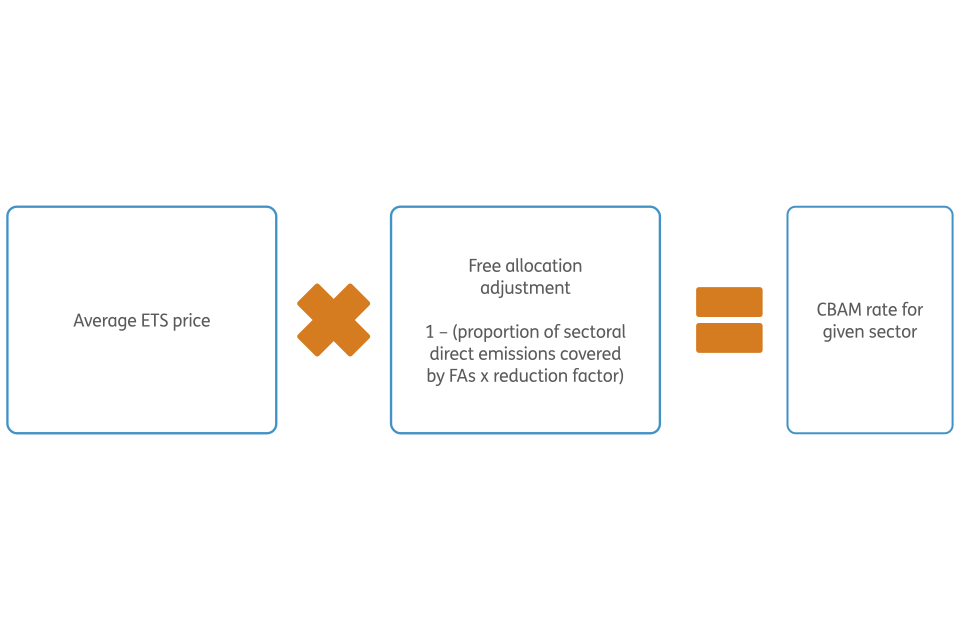
This figure shows an illustrative example of CBAM rate calculation. The calculation is comprised of 3 elements:
- The average ETS price, calculated as the mean average of all UK ETS auction clearing prices for the relevant quarter. In a scenario where all ETS auctions fail to clear in a given quarter, the last positive average ETS price will be used.
- The free allocation adjustment, which is calculated as 1 minus the average proportion of sectoral direct emissions covered by FAs, multiplied by a reduction factor. This average is determined by using UK ETS baseline data reporting data related to the average sectoral direct emissions generated in 2019, 2022 and 2023 by sub-installations producing CBAM goods, and average FAs allocated to those same sub-installations over the same period. Years will be discounted if there were no direct emissions for that sector. The reduction factors will reflect the reduction factors applied to phase out FAs under the UK ETS.
- The final output is the CBAM rate for the given sector for that quarter.
Carbon price relief
The liable person can claim carbon price relief (CPR) which will reduce their CBAM liability if the embodied emissions in the CBAM goods they have imported have been subject to a qualifying carbon pricing scheme and they have the necessary verification documents, such as the carbon pricing verification form, as well as other relevant information, to calculate the amount of CPR. This includes where a CBAM good has been subject to more than one qualifying carbon pricing scheme and produced in more than one installation within the same jurisdiction.
The total relief claimed cannot exceed the amount of CBAM liability due.
Qualifying schemes
A qualifying carbon pricing scheme must be either a carbon tax, emissions trading scheme or scheme that prices emissions embodied in imported goods, and must meet the following criteria:
- it is administered by or on behalf of a tier of government at city, national or regional level or by a supra-national organisation
- the use of the revenue collected by or on behalf of the scheme is determined by the relevant tier of government or supra-national organisation
- participation for installations that manufacture or process a CBAM good is mandated by law, including in instances where mandatory participation is after installations emit a specified amount of emissions
- the rules and scope of the scheme, as well as the headline carbon price of the scheme, are publicly available
- the scheme imposes a cost on the relevant emissions produced by participants of the scheme, in some or all instances or allows participants to fulfil their obligations in other approved ways.
- the cost imposed on emissions by the scheme is done so either directly or indirectly. In the case of the latter, the scheme must use emissions factors taken directly from or calculated using the methodology of any of the following sources:
- the Intergovernmental Panel on Climate Change
- the International Energy Agency
- the United Nationals Framework Convention on Climate Change
What is required to calculate CPR
It is the responsibility of the liable person to calculate the CPR. In order to do so, they will, as specified below, need to use a combination of verified information and publicly available information, to do so, they will need:
- a completed carbon pricing verification form, in the form of a template that will be provided by HMRC. The form will need to be acquired from the installation that manufactured or processed the CBAM good for which relief is being claimed. It will need to be completed by a suitably qualified verification body and include the following information:
- the quantity of relevant emissions (those emissions within system boundaries) produced by the installation (in which the good was produced) in tCO2e. This data must be from a calendar year that is one of the 2 calendar years prior to the calendar year importation takes place
- a breakdown showing which elements of the qualifying carbon pricing scheme are applicable. This will vary between schemes and may include a breakdown of emissions subject to the headline carbon price, FAs, thresholds, graduated carbon prices, or greenhouse gas removal schemes, where applicable
- the monetary support that the installation in which the goods were produced has received or is due in relation to the emissions emitted by the installation (if applicable)
- in instances where the qualifying carbon pricing scheme prices emissions indirectly, information on the emissions factors used
- the publicly available headline carbon price of the qualifying carbon pricing scheme the CBAM good was subject to and, if applicable, the price for greenhouse gas removals and graduated carbon prices. If such prices change, the liable person must calculate the mean average from the quarter before the quarter in which the CBAM good was imported
- data on the emissions embodied in the CBAM good for which relief is being claimed
If within a qualifying carbon pricing scheme an installation has used greenhouse gas removal credits to fulfil its obligations, the rules allowing for this and the price of such credits or similar must be publicly available. If this is not the case, the price of any greenhouse gas removal credits or similar will not be a relevant element and therefore cannot be used to generate CPR..
Compensation must be accounted for in the calculation if it is connected to the emissions emitted by the installation subject to the qualifying carbon pricing scheme and the rules of compensation are publicly set out by the jurisdiction of the qualifying carbon pricing scheme or organisations working on its behalf.
How to calculate CPR
The information above should be used by the liable person to calculate the CPR in accordance with the following steps:
- Identify the relevant emissions in tCO2e produced by the installation in a given calendar year in line with CBAM requirements.
- Identify the amount of emissions in Step 1 that were subject to different elements of the qualifying carbon pricing scheme.
- Multiply the amount of emissions attributable to each relevant element of the qualifying carbon pricing scheme (those elements that meet specified transparency criteria) by the applicable price per tonne of carbon dioxide equivalent, disregarding compensation, for those emissions and add them together.
- Divide the Step 3 total by the Step 1 emissions figure to produce an overall price per tonne of carbon dioxide equivalent — this is the effective carbon price, subject to any adjustment in accordance with step 5.
- If applicable, adjust the step 4 price to account for monetary support/compensation the installation received in relation to emissions. To do this, divide the total compensation/rebate received for the same calendar year as in Step 1 to get the effective carbon price for compensation and deduct this from the Step 4 price.
- Multiply the effective carbon price by the embodied emissions of the relevant good.
Figure 10: Illustrative example of effective carbon price calculation (steps 1 to 4)
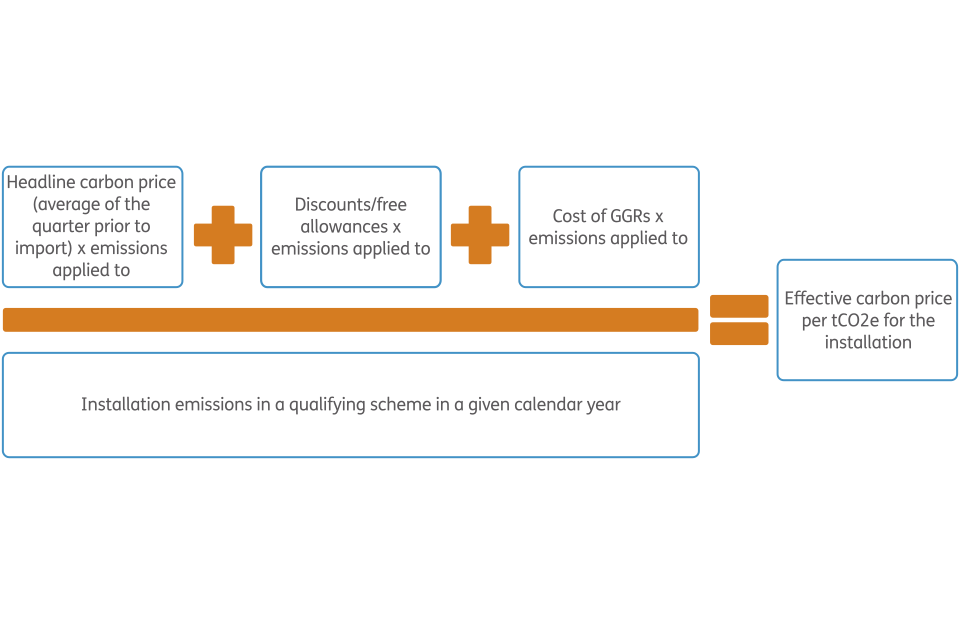
This figure shows an illustrative example of the effective carbon price calculation. It is expressed as a price per tCO2e in the currency used by the qualifying carbon pricing scheme. The calculation may vary depending on the qualifying scheme the CBAM good was subject to, and how installations interact with that scheme.
Figure 11: Step 1 — Illustrative example of adjusting the effective carbon price for compensation and rebates (step 5, if applicable)
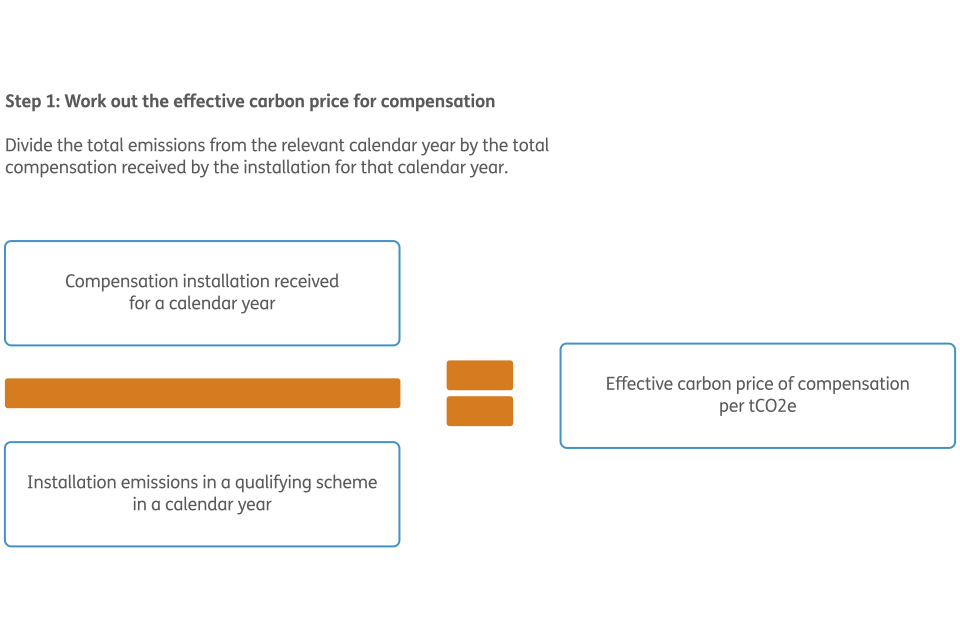
Figure 12: Step 2 — Illustrative example of adjusting the effective carbon price for compensation and rebates (step 5, if applicable)
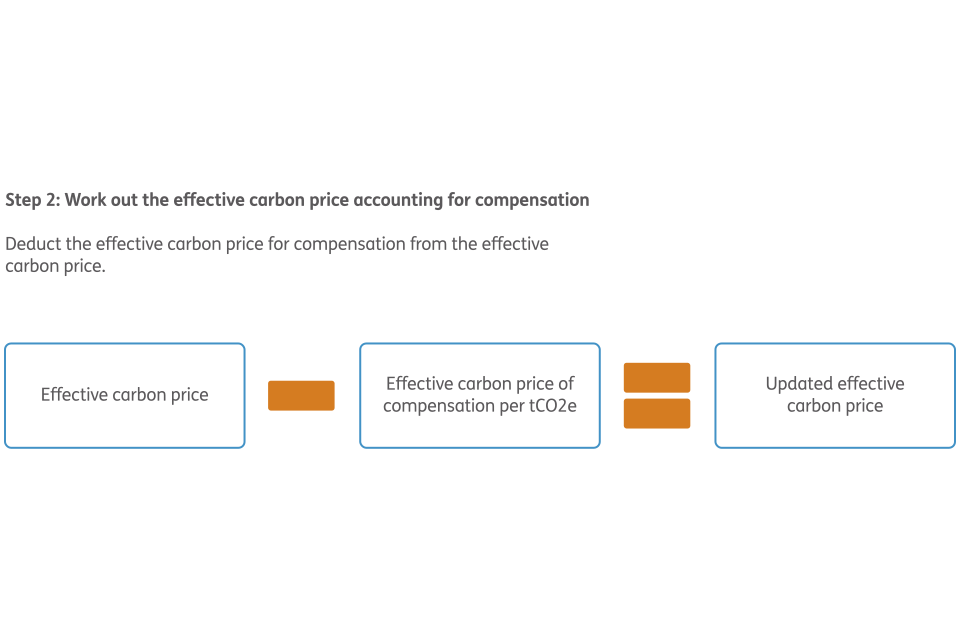
This figure shows an example of how the effective carbon price should be adjusted when an installation has received rebates and compensation linked to its emissions.
Figure 13: Illustrative example of CPR calculation (step 6)
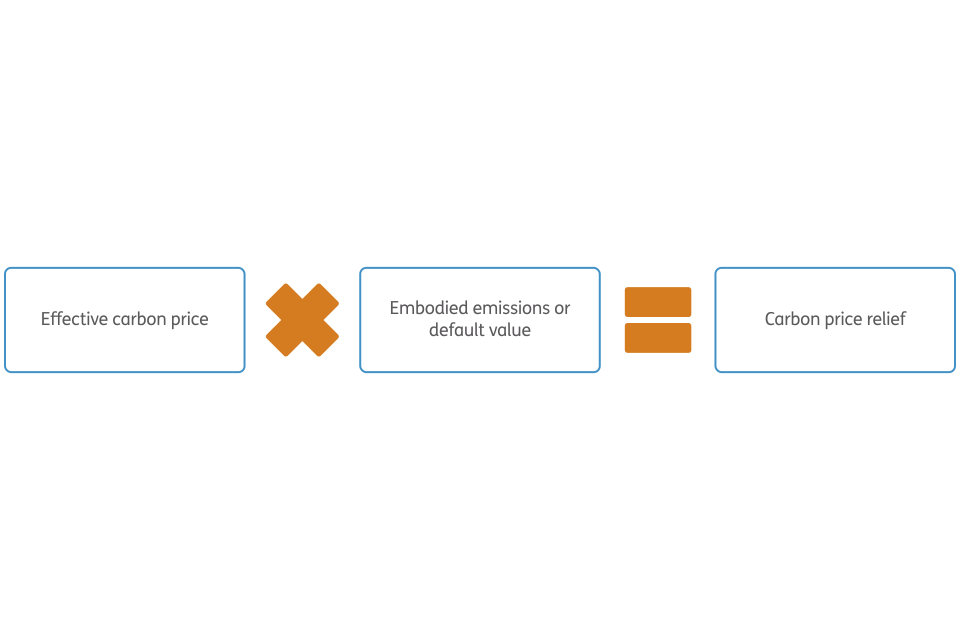
This figure shows an example of how to calculate CPR. It uses the effective carbon price from figure 3 (or 4, where applicable) and multiplies it by the embodied emissions for the CBAM good. The result is the CPR.
Where a CBAM good has been subject to more than one qualifying carbon pricing scheme, including where a CBAM good has been produced using precursor goods that were subject to different qualifying carbon pricing schemes, the CPR for each must be calculated separately
CPR can only be claimed where the relevant elements used to calculate the effective carbon price have been appropriately verified and a valid carbon pricing verification form has been used to support the calculations.
This verification must be carried out by an independent verifier who:
- is accredited to the relevant standards specified:
- ISO/IEC 17029:2019 General principles and requirements for validation and verification bodies
- ISO 14064-3:2019 Greenhouse gases — Part 3, specification with guidance for the verification and validation of greenhouse gas statements
- ISO 14065: 2020 General principles and requirements for bodies validating and verifying environmental information
- ISO 14066: Environmental information — competence requirements for teams validating and verifying environmental information
- is accredited by an accreditation body which is a full member of the Global Accreditation Cooperation Incorporated.
- is independent of the installation for which the person is verifying elements of the effective carbon price
- is independent of any government or supra-national institutions administering a qualifying carbon price or those on its behalf
Further detail on the methodology for calculating and verifying the effective carbon price will be published in guidance.
Currency conversion for CPR
For liable persons to deduct CPR from their CBAM liability, any relief amount calculated in an overseas currency must be converted into pounds sterling (GBP). To do this, the liable person must use the exchange rates published by HMRC for the calendar quarter prior to the import of the CBAM good.
For example, if a good is imported in June 2030, the liable person must use the exchange rate published by HMRC for the period covering January to March 2030.
Where a CBAM good has been subject to multiple qualifying carbon pricing schemes, including where a CBAM good has been used in the manufacture and processing of another CBAM good, the liable person must convert to GBP before entering them into the return.
International arrangements or agreements
Where appropriate, the government will consider of the use of suitable arrangements or agreements with other jurisdictions. There are currently no international arrangements or agreements in place.
Exemption for goods originating in a jurisdiction with a linked ETS
The UK can exempt goods from CBAM, where either they originate from a country or territory which has entered arrangements with the UK to link their ETS with the UK’s scheme, or a country of territory whose ETS is indirectly linked to the UK ETS.
There are currently no jurisdictions exempt from CBAM.
6. Administration
Registration
A person must register with HMRC for CBAM if they meet or exceed the minimum registration threshold. The minimum registration threshold considers the total value of CBAM goods that are imported or are expected to be imported into the UK over a given period as set out in the 2 tests below. The value is set at £50,000.
To determine when a person becomes registerable for CBAM the following liability tests must be considered in relation to imported CBAM goods which pass the tax point on or after 1 January 2027. Further detail on the tax point is set out above.
1. Forward looking test
On any given day, a person must consider whether they expect that the total value of their CBAM goods being imported into the UK and passing the tax point over the next 30 days will meet or exceed the £50,000 minimum registration threshold. Where the test is met, the person’s liability to register begins on the day the test was met.
2. Backward looking test
On the first day of the month, a person must look back over the preceding 12-month period to determine if the total value of their CBAM goods that have been imported into the UK and passed the tax point met or exceeded the £50,000 minimum registration threshold. Where the test is met, the person’s liability to register begins on the day they applied the test.
For CBAM goods imported during the first calendar year of CBAM (1 January to 31 to 31 December 2027), a person only needs to look back to 1 January 2027.
If a person meets both tests, their liability starts from the earlier of the 2 dates.
Anyone who is liable for CBAM must register with HMRC, keep records of the CBAM goods they import, submit CBAM returns and pay any tax due to HMRC.
Anyone importing CBAM goods into the UK will be required to keep under review whether they need to register with HMRC and account for CBAM.
Ordinarily, the liable person will have 30 days to register with HMRC from the day they become liable. However, during the first calendar year of CBAM, businesses will have until 31 January 2028 to register.
Between becoming liable for CBAM and completing the registration process, liable persons will need to retain all relevant records relating to their importation of CBAM goods to enable them to complete registration and submit returns when the facility becomes available. Further details on record keeping can be found below.
Anyone who needs to register for CBAM will be able to do so using their Government Gateway account. If they do not have access to the internet or are unable to use it, they must contact HMRC to explore registering via a non-digital method.
When registering for CBAM the liable person will be asked:
- their name and contact details
- their business’ address
- their business type
- their Economic Operators Registration and Identification number (EORI) number and if they are registered for Value Added Tax (VAT), their VAT registration number
- the date they triggered registration
- the estimated weight of CBAM goods that they expect to import in each CBAM sector in the coming 12 months
Further detail on registration will be published in GOV.UK guidance.
Value of CBAM goods
To determine whether the CBAM registration threshold has been met, the liable person must hold information about the value of the CBAM goods they import into the UK.
The value of a CBAM good will be the same value that is used, or would be used, to calculate any applicable customs duty due on its import into the UK.
This means, where a CBAM good is imported into the UK and:
- a charge to duty or import duty applies, the value of the goods for CBAM is the same as determined for the duty under Part 12 of the Customs (Import Duty) (EU Exit) Regulation 2018 (‘2018 Regulations’) or in line with Chapter 3 of Title III of the UCC 2013 (as the case may be)
- no charge to duty or import duty applies, the value is to be determined as if the 2018 Regulation or the UCC applies on import
Deregistration
The liable person can apply to HMRC and request to be deregistered. A person will only be deregistered where HMRC is satisfied that the person is not required to be registered and has not been liable in the previous 12 months.
HMRC may decline to deregister a person if:
- there are outstanding amounts of CBAM due from the person
- there are outstanding returns due from the person
- it is considered that the person will be registrable in the following 12 months
Death, Incapacity and Insolvency
Death and incapacity
Where a registered person dies or becomes incapacitated, another person can carry on their business for CBAM purposes.
Where this happens, the person who takes over handling the business must inform HMRC within 21 days along with information:
- showing they have authority to carry on the business
- about the death or incapacitation of the registered person, with evidence
That person will then be treated as the registered person for CBAM purposes by HMRC for 6 months, with the potential for this to be extended where appropriate.
Insolvency
Where a registered person is subject to an insolvency procedure and a person acts as an insolvency office holder in relation to that registered person, HMRC will treat the insolvency office holder as the registered person for CBAM purposes.
In this case, any CBAM liability which arose before the insolvency procedure began continues to be payable by the registered person. Any liability which arises after is treated as an expense of the procedure (unless the procedure is an equivalent procedure under the law of a country or territory outside the United Kingdom).
For CBAM purposes, ‘insolvency office holder’ means:
- an administrative receiver
- an administrator
- a liquidator
- a receiver appointed by the courts or by a mortgagee
- a trustee in bankruptcy
- a trustee (or interim trustee) in the sequestration of an estate
- a person acting in an equivalent capacity under the law of a country or territory outside the United Kingdom
And an ‘insolvency procedure means’:
- administration
- administrative receivership
- bankruptcy
- receivership
- sequestration
- winding up
- an equivalent procedure under the law of a country or territory outside the United Kingdom
7. Accounting periods, returns, payments and repayments
The liable person will need to complete and submit a tax return for CBAM following the end of each accounting period from the time they become registrable, until they satisfy the rules for deregistration.
Where the liable person has a nil liability for an accounting period (for example, because they did not import any CBAM goods, or they did but their liability was reduced to zero because the goods they imported had already been subject to a qualifying carbon pricing scheme, they will still need to complete and submit a return for that accounting period.
Accounting periods
The first accounting period for CBAM will be 12 months, from 1 January 2027 to 31 December 2027. Returns and payments will be due 5 months after the end of the first accounting period (31 May 2028). This is to provide businesses with sufficient time to obtain supporting information required to complete their first return, whilst also allowing HMRC time to develop and test necessary IT systems.
Subsequent accounting and payment periods from 1 January 2028
From 1 January 2028, CBAM accounting periods will move to a quarterly cycle and gradually transition to a 2 month return and payment window. Returns must be submitted on the last working day of the month.
After the initial annual accounting period with a 5 month return and payment deadline the subsequent accounting periods will be as follows:
Table 2:
| Accounting Period | Return and Payment Deadline |
|---|---|
| 1 January 2028 to 31 March 2028 | 31 July 2028 |
| 1 April 2028 to 30 June 2028 | 29 September 2028 |
| 1 July 2028 to 30 September 2028 | 30 November 2028 |
| 1 October 2028 to 31 December 2028 | 28 February 2029 |
Information on a return
At the end of each accounting period, the liable person, or their tax agent must complete and submit a CBAM return to HMRC.
If the liable person has imported multiple consignments of the same CBAM good, they must report each consignment separately on the return.
Where the liable person has imported different CBAM goods as part of the same shipment, these must be reported separately on the return.
The following information will be required from the liable person on their CBAM returns, and they must also keep records of this information:
- the CBAM goods imported during the relevant accounting period by reference to the relevant 8-digit commodity code in force when the good passed the tax point, including when a CBAM good is processed into a non-CBAM good in the UK while under a special customs procedure
- the net weight of those CBAM goods in kg at the time of import into the UK
- the emissions intensity in the CBAM good (where not available, a default emissions value would need to be used) in tCO2e per functional unit
- the amount of carbon price those CBAM goods were subject to in a qualifying carbon pricing scheme, if any, in GBP
- for the first accounting period, the quarter in which each CBAM good passed the tax point
- the country of origin of the CBAM good as per non-preferential rules of origin defined by customs
Payment methods
The following methods of payment will be accepted by HMRC for paying CBAM liabilities:
- Direct Debit
- BACS/CHAPS
- Payment Initiation Service Provider (PISP)
- Faster Payment
- Credit/Debit cards
- Cheques
Return amendments and repayments
The liable person will be able to amend a return to correct an error. Amendments must be made within 3 years of the end of the accounting period to which the return relates.
A repayment of CBAM liabilities will be allowed where a liable person has made an error on their return that has resulted in an overpayment.
HMRC are not liable to pay overpaid amounts of CBAM where they were paid more than 3 years before making the repayment claim.
Liable persons must retain sufficient records to substantiate any correction, and HMRC may request evidence before processing a repayment.
8. Record keeping
Importers of CBAM goods will be required to keep records relating to CBAM.
The following records will need to be held by liable persons for 6 years after the end of the accounting period the goods are attributed to.
Goods imported
Importers of CBAM goods will need to keep records of all CBAM goods imported including commodity code, date of import, value, weight etc. This can be in the form of customs declarations (C88/SAD) or other documents relating to import of goods such as:
- import entry acceptance advice
- bill of lading documents and information concerning the import, export, or declaration of goods by or on behalf of the relevant person
- documents and information concerning the discharge of a customs or export procedure (other than a temporary admission procedure)
- commercial documentation, including records concerning movement of goods within the UK where these are relevant to a customs obligation of the relevant person
- documents and information relating to the calculation of UK customs duty, including evidence of eligibility for any lower rate of duty or relief (this includes temporary admission relief and returned goods relief)
- documents and information relating to any remission or repayment of duty
- documents and information relating to evidence of UK origin that has been provided in relation to exported goods which are then reimported in a complex good to be treated as an exemption
Registration
Liable persons required to register for CBAM will need to a keep record of the information provided in the registration process along with any evidence used to support it.
This will include records relating to the value of CBAM goods imported; the dates these imports occurred and when they triggered the requirement to register; how estimates of the weight of CBAM goods expected to be imported were calculated; and can include any information obtained from a third-party.
Carbon Price Relief
To support their claim for Carbon Price Relief (CPR), liable persons will need to keep the following records:
- evidence pertaining to how the CBAM good was subject to a qualifying carbon pricing scheme
- a completed copy of the carbon pricing verification form that has been completed by a verification body that meets the necessary requirements
- the publicly available headline carbon price of a qualifying carbon pricing scheme that from the calendar quarter before the import and the same for Greenhouse Gas Removals (GGRs) and graduated carbon prices, if relevant. Where the price has been averaged out from the previous calendar quarter, evidence of how this has been done
- verified data concerning the embodied emissions of the good subject to a qualifying carbon pricing scheme
- evidence as to how the amount of CPR was calculated prior to being converted into pounds sterling
- evidence of how the CPR in an overseas currency was converted into GBP following HMRC’s requirements
- calculations to support how any of the following was used to determine the CPR claimed on the return
Further information on the required format for submitting the above information will be published within guidance.
Using actual emissions data
Where actual emissions data is reported on the return, the liable person will need to hold the verification report or good-specific verification summary confirming that the relevant emissions intensity data for the good has been verified as satisfactory.
9. Compliance and penalties
HMRC will provide comprehensive support through guidance and communications to enable businesses to meet the new CBAM requirements.
HMRC will extend the use of existing powers and penalties to enforce compliance with CBAM where appropriate. This means there will be penalties for:
- failure to notify HMRC of liability for CBAM
- failure to submit a CBAM return
- failure to pay CBAM
- errors in CBAM returns or other documents relied upon by HMRC
- failure to disclose relevant tax avoidance schemes and serial tax avoidance
- failure to comply with an information notice
In addition to the above, HMRC is introducing a general penalty for failure to comply with specific requirements relating to CBAM, such as notifying HMRC when a business address changes or that a business is being carried on by another person due to death, incapacity or in cases of insolvency. HMRC is also introducing legislation to deter the artificial separation of business activities and prevent circumvention of liability to the tax.
Criminal offences will also apply for fraudulent evasion and deliberate misstatement of CBAM.
Assessments
Where the liable person fails to register for CBAM or fails to provide a complete or accurate return, HMRC will make an assessment of the amount of CBAM that is due and notify the liable person accordingly.
Compulsory registration
Where the liable person fails to register for CBAM, HMRC will be able to compulsorily register them and if appropriate, assess for the tax due.
Annex: Commodity codes within scope of CBAM
Aluminium
| Combined Nomenclature (CN) code and description | Greenhouse gases |
|---|---|
| 7601 — Unwrought aluminium | Carbon dioxide and perfluorocarbons |
| 7603 — Aluminium powders and flakes | Carbon dioxide and perfluorocarbons |
| 7604 — Aluminium bars, rods and profiles | Carbon dioxide and perfluorocarbons |
| 7605 — Aluminium wire | Carbon dioxide and perfluorocarbons |
| 7606 — Aluminium plates, sheets and strip, of a thickness exceeding 0,2 mm | Carbon dioxide and perfluorocarbons |
| 7607 — Aluminium foil (whether or not printed or backed with paper, paper-board, plastics or similar backing materials) of a thickness (excluding any backing) not exceeding 0,2 mm | Carbon dioxide and perfluorocarbons |
| 7608 — Aluminium tubes and pipes | Carbon dioxide and perfluorocarbons |
| 7609 00 00 — Aluminium tube or pipe fittings (for example, couplings, elbows, sleeves) | Carbon dioxide and perfluorocarbons |
| 7610 — Aluminium structures (excluding prefabricated buildings of heading 9406) and parts of structures (for example, bridges and bridge-sections, towers, lattice masts, roofs, roofing frameworks, doors and windows and their frames and thresholds for doors, balustrades, pillars and columns); aluminium plates, rods, profiles, tubes and the like, prepared for use in structures | Carbon dioxide and perfluorocarbons |
| 7611 00 00 — Aluminium reservoirs, tanks, vats and similar containers, for any material (other than compressed or liquefied gas), of a capacity exceeding 300 litres, whether or not lined or heat-insulated, but not fitted with mechanical or thermal equipment | Carbon dioxide and perfluorocarbons |
| 7612 — Aluminium casks, drums, cans, boxes and similar containers (including rigid or collapsible tubular containers), for any material (other than compressed or liquefied gas), of a capacity not exceeding 300 litres, whether or not lined or heat-insulated, but not fitted with mechanical or thermal equipment | Carbon dioxide and perfluorocarbons |
| 7613 00 00 — Aluminium containers for compressed or liquefied gas | Carbon dioxide and perfluorocarbons |
| 7614 — Stranded wire, cables, plaited bands and the like, of aluminium, not electrically insulated | Carbon dioxide and perfluorocarbons |
| 7616 — Other articles of aluminium | Carbon dioxide and perfluorocarbons |
Cement
| CN code and description | Greenhouse gas |
|---|---|
| 2507 00 80 — Other kaolinic clays | Carbon dioxide |
| 2523 10 00 — Cement clinkers | Carbon dioxide |
| 2523 21 00 — White Portland cement, whether or not artificially coloured | Carbon dioxide |
| 2523 29 00 — Other Portland cement | Carbon dioxide |
| 2523 30 00 — Aluminous cement | Carbon dioxide |
| 2523 90 00 — Other hydraulic cements | Carbon dioxide |
Fertilisers
| CN code and description | Greenhouse gases |
|---|---|
| 2808 00 00 — Nitric acid; sulphonitric acids | Carbon dioxide and nitrous oxide |
| 2814 — Ammonia, anhydrous or in aqueous solution | Carbon dioxide |
| 2834 21 00 — Nitrates of potassium | Carbon dioxide and nitrous oxide |
| 3102 — Mineral or chemical fertilisers, nitrogenous | Carbon dioxide and nitrous oxide |
| 3105 — Mineral or chemical fertilisers containing 2 or 3 of the fertilising elements nitrogen, phosphorus and potassium; other fertilisers; goods of this chapter in tablets or similar forms or in packages of a gross weight not exceeding 10 kg | Carbon dioxide and nitrous oxide |
| Except: 3105 60 00 — Mineral or chemical fertilisers containing the 2 fertilising elements phosphorus and potassium | Not applicable |
Hydrogen
| CN code and description | Greenhouse gas |
|---|---|
| 2804 10 00 — Hydrogen | Carbon dioxide |
Iron and steel
| CN code and description | Greenhouse gas |
|---|---|
| 2601 12 00 – Agglomerated iron ores and concentrates, other than roasted iron pyrites | Carbon dioxide |
| 72 – Iron and steel | Carbon dioxide |
| Except: 7202 2 — Ferro-silicon | Not applicable |
| Except: 7202 30 00 — Ferro-silico-manganese | Not applicable |
| Except: 7202 50 00 — Ferro-silico-chromium | Not applicable |
| Except: 7202 70 00 — Ferro-molybdenum | Not applicable |
| Except: 7202 80 00 — Ferro-tungsten and ferro-silico-tungsten | Not applicable |
| Except: 7202 91 00 — Ferro-titanium and ferro-silico-titanium | Not applicable |
| Except: 7202 92 00 — Ferro-vanadium | Not applicable |
| Except: 7202 93 00 — Ferro-niobium | Not applicable |
| Except 7202 99 10 — Ferro-phosphorus | Not applicable |
| Except 7202 99 30 — Ferro-silico-magnesium | Not applicable |
| Except: 7202 99 80 — Other | Not applicable |
| Except: 7204 — Ferrous waste and scrap; remelting scrap ingots and steel | Not applicable |
| 7301 — Sheet piling of iron or steel, whether or not drilled, punched or made from assembled elements; welded angles, shapes and sections, of iron or steel | Carbon dioxide |
| 7302 — Railway or tramway track construction material of iron or steel, the following: rails, check-rails and rack rails, switch blades, crossing frogs, point rods and other crossing pieces, sleepers (cross-ties), fish- plates, chairs, chair wedges, sole plates (base plates), rail clips, bedplates, ties and other material specialised for jointing or fixing rails | Carbon dioxide |
| 7303 00 — Tubes, pipes and hollow profiles, of cast iron | Carbon dioxide |
| 7304 — Tubes, pipes and hollow profiles, seamless, of iron (other than cast iron) or steel | Carbon dioxide |
| 7305 — Other tubes and pipes (for example, welded, riveted or similarly closed), having circular cross-sections, the external diameter of which exceeds 406,4 mm, of iron or steel | Carbon dioxide |
| 7306 — Other tubes, pipes and hollow profiles (for example, open seam or welded, riveted or similarly closed), of iron or steel | Carbon dioxide |
| 7307 — Tube or pipe fittings (for example, couplings, elbows, sleeves), of iron or steel | Carbon dioxide |
| 7308 — Structures (excluding prefabricated buildings of heading 9406 ) and parts of structures (for example, bridges and bridge-sections, lock- gates, towers, lattice masts, roofs, roofing frameworks, doors and windows and their frames and thresholds for doors, shutters, balustrades, pillars and columns), of iron or steel; plates, rods, angles, shapes, sections, tubes and the like, prepared for use in structures, of iron or steel | Carbon dioxide |
| 7309 00 — Reservoirs, tanks, vats and similar containers for any material (other than compressed or liquefied gas), of iron or steel, of a capacity exceeding 300 l, whether or not lined or heat-insulated, but not fitted with mechanical or thermal equipment | Carbon dioxide |
| 7310 — Tanks, casks, drums, cans, boxes and similar containers, for any material (other than compressed or liquefied gas), of iron or steel, of a capacity not exceeding 300 l, whether or not lined or heat-insulated, but not fitted with mechanical or thermal equipment | Carbon dioxide |
| 7311 00 — Containers for compressed or liquefied gas, of iron or steel | Carbon dioxide |
| 7318 — Screws, bolts, nuts, coach screws, screw hooks, rivets, cotters, cotter pins, washers (including spring washers) and similar articles, of iron or steel | Carbon dioxide |
| 7326 — Other articles of iron or steel | Carbon dioxide |