Terms of reference
Published 23 September 2026

© Crown copyright 2026
This publication is licensed under the terms of the Open Government Licence v3.0 except where otherwise stated. To view this licence, visit nationalarchives.gov.uk/doc/open-government-licence/version/3 or write to the Information Policy Team, The National Archives, Kew, London TW9 4DU, or email: psi@nationalarchives.gov.uk.
Where we have identified any third party copyright information you will need to obtain permission from the copyright holders concerned.
This publication is available at https://www.gov.uk/government/publications/animals-in-science-regulation-governance-board-terms-of-reference/terms-of-reference
Introduction
1. The Animals in Science Regulation Unit Governance Board (the “Board”) will support and challenge the Animals in Science Regulation Unit (“ASRU”) to effectively deliver:
-
ASRU’s purpose to protect animals by maintaining compliance with the Animals (Scientific Procedures) Act 1986 (“ASPA”).
-
ASRU’s operational strategy/strategic objectives. As of November 2024, these are: driving compliance with the 3Rs; delivering a quality service for the science sector; facilitating performance and effective governance in the science sector; and directing activity based on evidence, risk and outcomes.
The Board will support ASRU to adopt best practice standards in regulation to achieve these aims, such as the National Audit Office’s (“NAO”) ‘principles of effective regulation’, and the statutory 2014 Regulators’ Code.
2. This Board exists to provide external non-executive scrutiny, advice and challenge to ASRU. This follows the NAO principles of effective regulation,1 which set out the importance of ‘ensuring appropriate governance processes and non-executive scrutiny’ where regulators are part of a government department rather than independent bodies. The board should have sufficient diversity to reflect different perspectives within the governance arrangements.
3. The board will help provide assurance to the Department, Ministers, the public and wider stakeholders that ASRU is effectively delivering its responsibilities under ASPA.
Objectives and Responsibilities
4. The Governance Board will provide independent scrutiny, challenge, and advice to ASRU. The board is intended not to take decisions but to support and advise ASRU in setting its strategy, improving performance and accountability, and managing risk and reputation. The board serves an advisory function to the Head of ASRU, who holds decision-making power for ASRU. ASRU is accountable to the Science Director for its performance, and the board also exists to supplement the Science Director’s oversight of ASRU.
5. The board is expected to undertake the following activities, and communicate:
-
a) Performance: review and scrutinise ASRU’s delivery of its statutory responsibilities, its delivery against an overall performance framework, and plans for addressing performance issues and/or making improvements. Where relevant/necessary, advise ASRU on how to improve its performance.
-
b) Operational strategy/business planning: review, scrutinise, and advise on ASRU’s strategic direction and business planning, for example, by inputting into strategy documents or business plans. Understand how effective changes in strategy have been and advise on adjustments as necessary.
-
c) Risks: review significant risks, including any reputational risks, faced by ASRU, and ASRU’s planned mitigating actions. Hold ASRU to account for mitigating its risks and provide advice on managing risks where required.
-
d) Prioritisation: as part of reviewing ASRU’s performance and risks, the board may support the Head of the Regulator in deciding on priority activities, such as where to allocate the most resource.
-
e) Stakeholder engagement: as part of reviewing ASRU’s performance and risks, the board may advise ASRU on how to effectively engage with and manage stakeholders, such as the regulated community and the public.
-
f) Annual report: review ASRU’s annual report to help ensure it is sufficiently clear, transparent, robust, and accessible.
6. The Board’s aims are therefore to help ensure:
-
a) ASRU delivers its statutory responsibilities and sets and delivers its strategic direction efficiently and effectively, making use of best practice regulation standards to bolster its performance.
-
b) ASRU monitors and reports on its performance (including impact and outcomes where possible), employing appropriate metrics and analysis, acting where required to make improvements.
-
c) Risks and public assurance are managed effectively.
-
d) Regulatory delivery is appropriately resourced.
-
e) Activities in ASRU are prioritised effectively.
-
f) ASRU has the opportunity to sense-check direction with diverse, experienced viewpoints.2
7. The board will not be involved in the handling of individual regulatory decisions.
Governance Board Membership
8. Board members are appointed for their expertise in, for example, the areas of regulation, strategy, animal protection, and industry.
9. Membership of the Board is unremunerated. Board members may claim all reasonable expenses for standard class travel, accommodation, and subsistence in connection with their attendance at board meetings.
10. Appraisal of Board members will be carried out on an annual basis by the Chair. Appraisal of the Chair’s performance will be completed by the Science Director on an annual basis. Appraisals will inform reappointment of members.
11. When there is the need to recruit a new chair or members, details of the role will be advertised through the appropriate channels.
Relationship to other Governance and Advisory functions
Animals in Science Committee (“ASC”)
The ASC is the Government’s independent statutory advisory committee, established under Sections 19 and 20 of ASPA.
The ASC are responsible for providing impartial, balanced and objective advice to the Home Office and to the Northern Ireland Department of Health on issues relating to ASPA and its functions under it:
-
the committee must provide advice to the Secretary of State and the Animal Welfare and Ethical Review Bodies on such matters relating to the acquisition, breeding, accommodation, care and use of protected animals as the Committee may determine or as may be referred to the committee by the Secretary of State
-
in its consideration of any matter the committee shall have regard both to the legitimate requirements of science and industry and to the protection of animals against avoidable suffering and unnecessary use in scientific procedures
-
the committee must take such steps as it considers appropriate to ensure the sharing of best practice in relation to the acquisition, breeding, accommodation, care and use of protected animals
-
the Secretary of State may provide the committee with such information as the committee requests for the purpose of enabling the committee to exercise its duties under this section
ASC advice will inform policies made under ASPA. This will sometimes result in specific changes to the ASRU’s operations and policies, such as how the regulator grants licences or communicates certain information to the public. The ASC are provided with regular updates from ASRU covering any significant operational updates, to help the ASC stay informed of the overall animals in science landscape.
The ASC are not responsible for overseeing the regulator’s performance, and do not advise on tactical matters, such as the prioritisation of ASRU’s resource or activities month-to-month. The governance board function therefore remains distinct from the ASC as it holds these functions.
Any existing ASC members seeking to join ASRU’s governance board will be required to resign their membership of the ASC. Public appointees on other boards will also be subject to the same conditions.
Periodic updates on ASRU’s performance will be provided to the ASC.
The Animals in Science Regulation Policy (ASRP) Unit lead the relationship with the ASC, and ASRU will liaise with ASRP when it requires ASC feedback.
The Head of ASRU will attend a part of the ASC plenary once per year, around the publication of the annual report, to update on progress, successes and learnings.
The chair of the governance board will attend a part of the ASC plenary at least twice a year to provide updates to the ASC. The chair of the governance board and the chair of the ASC will also meet a minimum of annually.
The below table summarises the remits of the governance board and ASC respectively in relation to ASRU. Responsibilities may be amended in the future depending on a review of the functioning of the board:
| Area of responsibility | Governance board | ASC |
|---|---|---|
| ASRU Strategy | Primary point of contact for advising on and helping ASRU decide strategy, as well as holding ASRU to account for delivering its agreed strategy. | No formal role for deciding ASRU strategy but will advise ASRP on strategic priorities for animals in science, which ASRP will feed into strategic priorities for ASRU. |
| ASRU Performance and delivery | Responsible for monitoring ASRU performance, holding ASRU to account, and advising on improvements (though decision making remains with Head of ASRU). | No responsibility for advising on ASRU month-to-month performance or holding ASRU to account for performance. Will be sighted on trends in ASRU performance where relevant and necessary. The ASC will have the opportunity to review and comment on any KPIs set for ASRU, and finalised KPIs will be circulated to ethe ASC. |
| Operational regulatory policy | No formal responsibility to advising on the development of individual regulatory policies, such as changes to ASRU’s audit, licencing or enforcement programmes. Responsible for holding ASRU to account on changes that it has committed to. | Advice from Ministerial commissions will continue to be used to steer ASRU’s policies, with ASRP working with ASRU to help determine which ASC recommendations will be adopted. For example, advice could be provided from the ASC to ASRU on how ASRU can best recognise leading practice in the regulated sector. ASRU may approach ASC for feedback on individual operational policies informally, outside of ministerial commissions, through ASRP. |
Home Office Governance
As stated at (4) above, the board exists primarily to support ASRU’s Head of Unit to make effective decisions in the running of ASRU. The Head of ASRU is responsible for taking decisions for ASRU and is accountable for these decisions.
The Science Director has oversight of ASRU and is responsible for holding the Head of ASRU to account. As such, the Regulator will report on advice received by the Board and actions taken in its performance reviews with the Science Director, and summary minutes/actions from the Board will be copied to the Science Director.
The Animals in Science Regulation Policy Unit (ASRP) have previously supported the Director in reviewing ASRU’s performance and supporting ASRU to problem-solve performance issues. The Governance Board is replacing ASRP’s function in this respect. ASRU will maintain regular communication with ASRP so that developments in ASRU’s work can be discussed and incorporated into policy making.
Practical Arrangements
12. The Governance Board will meet three times each year (provisionally March, June and October but may be subject to change) with meetings being held at various Home Office locations, potentially to include Croydon, Westminster, Sheffield and Stoke. Meetings for the coming 12 months will be scheduled at once, with a minimum of two months’ notice given for the first meeting in the period.
13. Recommendations and final advice shall be the responsibility of a quorum of five Committee members (four Committee members plus the Chair). On occasion where members are not in attendance and subsequently disagree with a decision, this will be recorded (on an anonymised basis, unless considered otherwise), and made clear in such reports or recommendations made by the Committee.
14. Secretariat, agenda management and administration of the meetings are the responsibility of ASRU, once the initial set up of the board by the Animals in Science Regulation Policy Unit (“ASRP”) is complete. A forward agenda outlook will be maintained by the Secretariat.
15. The meeting will be chaired by the Board Chair, who will be responsible for ensuring that agenda items are covered; all members are able to contribute their viewpoints, and that appropriate recommendations and actions are agreed on. The Chair will have the authority to suspend the meeting in the unlikely occurrence that discussions cannot proceed in a productive manner.
16. To ensure efficient use of attendee presence, the agenda will be distributed by the secretariat a minimum of five working days prior to the meeting (usually 10 days). Board members will typically be required to review appropriate documentation ahead of meetings, including risk logs and a performance dashboard, among other documents. Each agenda item will have a corresponding discussion objective to clarify what the discussion is required to achieve.
17. High-level/summary minutes and action points will be produced by the secretariat following each meeting and distributed amongst attendees, ASRU management and the Science Director once they have been agreed by the Head of ASRU and Chair of the Board. Where appropriate, actions will be assigned deadlines for completion and Board members kept appraised.
18. Prior to each meeting, ASRU Senior Management will undertake one of their regular reviews of the ASRU Risk Register(s) so that an update on the main risks affecting operations can be put before the Board for information and inform discussions. ASRU Senior Management will also review their performance metrics and actions arising from performance insights so that accurate, transparent performance information can be discussed with the board.
19. To facilitate open, honest discussion and problem-solving, board meetings will not be open to members of the public.
20. A summary of points discussed in board meetings will be published publicly in the interest of transparency of proceedings.
Review
21. Reviews of the Board’s effectiveness will be conducted after the first year of operation, then at 12 or 24-month intervals.
22. This Terms of Reference document is subject to review at regular intervals. If you have any comments, please send them to the address or e-mail set out on the Regulator’s Internet site at URL: www.gov.uk/government/collections/animals-in-science-regulation-unit
Visualisation of the changes to ASRU’s governance and advisory structures
Current and future recommended governance models*
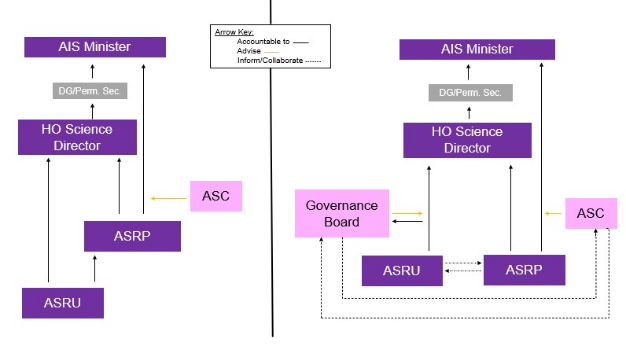
Current model
ASRU accountable to ASRP and both are accountable to the Home Office Science Director.
ASRP accountable to AIS Minister, with advice from ASC.
Home Office Science Director accountable to Director General and Permanent Secretary, who in turn is accountable to AIS Minister.
Future recommended model
Governance Board and ASC inform and collaborate with one another.
ASRU and ASRP inform and collaborate with one another
ASRU accountable to Home Office Science Director and Governance Board and receives advice from Governance Board.
ASRP accountable to Home Office Science Director and also to AIS Minister with advice from ASC.
Home Office Science Director accountable to Director General and Permanent Secretary, who in turn is accountable to AIS Minister.
* ASRP currently review ASRU performance through a monthly review of metrics, supporting the Science Director’s oversight of ASRU.