UK, Taiwan hosts Industrial Decarbonisation Workshop
Experts from both sides gathered to engage in in-depth dialogue on net-zero carbon reduction.
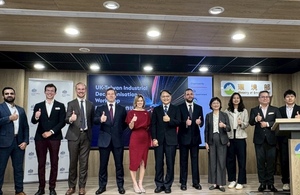
To further strengthen the UK–Taiwan climate partnership, the British Office Taipei and the Ministry of Environment jointly hosted the “2026 UK–Taiwan Industrial Decarbonisation Workshop” on 12th May.
The workshop opened by Ruth Bradley-Jones, Representative at the British Office Taipei, and Hsieh Yen-Ju, Deputy Minister of the Ministry of Environment. Discussions focused on policy frameworks, grid modernisation, decarbonisation of heavy industry and small and medium-sized enterprises (SMEs), and just transition. Through exchanging views on challenges and opportunities in industrial decarbonisation, participants aimed to build policy consensus, promote technological collaboration between industries and supply chains, and enhance industrial competitiveness.
Representative Ruth Bradley-Jones emphasized that the UK and Taiwan have highly complementary strengths in industrial decarbonisation, while also facing shared challenges. More importantly, she noted that both sides view industrial decarbonisation not merely as a climate issue, but as part of an overall economic transformation.
Deputy Minister Hsieh Yen-Ju stated that Taiwan has legislated its 2050 Net-Zero target and has strengthened its carbon reduction goals for 2030 (28±2%) and 2035 (38±2%). With the official launch of the carbon fee system in 2025, Taiwan will further combine it with a multi-billion “Green Growth Fund” to fully accelerate industrial low-carbon transformation.
The workshop also featured keynote speeches by Harley Collins, Head of Industrial Decarbonisation Strategy at the UK Department for Energy Security and Net Zero (DESNZ), and Tsai Ling-Yi, Director-General of the Climate Change Administration of the Ministry of Environment, who outlined industrial decarbonisation policy blueprints. This was followed by four key panel discussions involving experts from government, industry, and academia, focusing on building smart and flexible power grid infrastructure, scaling decarbonisation solutions for heavy industry, helping SMEs overcome barriers to carbon reduction, and advancing a just transition through workforce support mechanisms.
Through the in-depth exchanges at this workshop, both the UK and Taiwan expressed interests to continue leveraging their respective strengths to promote deeper and more substantive cooperation in carbon reduction and net-zero initiatives in the future.