UK-Japan science and technology Joint Committee: joint statement
The 13th Meeting of the United Kingdom - Japan Joint Committee (JCM) on Cooperation in Science and Technology was held in Tokyo on 9 October 2026.
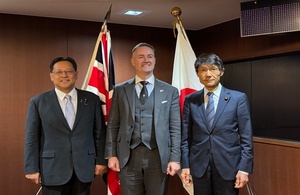
From left to right: Mr SEKI Yoshihiro, Minister of Education, Culture, Sports, Science and Technology (MEXT); Mr Chris McDonald MP, UK Minister for Science, Innovation and Investment; and Dr. FURUKAWA Toshiharu, Minister of State for Science and Technology Policy (CAO).
The 13th Meeting of the United Kingdom-Japan Joint Committee (JCM) on Cooperation in Science and Technology was held in Tokyo on October 9, 2026. This Meeting was convened in a year of significant bilateral engagement and alignment between the United Kingdom (UK) and Japan reflecting a new era of cooperation between our two countries. This JCM focused on endorsing the strong and multifaceted collaboration between the two countries in the fields of science, technology and innovation, and setting the shared strategic priorities for the next phase of bilateral partnership.
The Meeting was chaired by Professor Sir John Edmunds, Chief Scientific Adviser and Director for Research and Evidence at the Foreign, Commonwealth and Development Office (FCDO) of the UK, and co-chaired by Mr. KAWAMURA Hiroshi, Ambassador for Science and Technology Cooperation at the Ministry of Foreign Affairs of Japan.
The Meeting culminated in a high-level session that was attended by Ministers from both sides for the first time in the history of the UK-Japan JCM. Mr. Chris McDonald MP, Minister for Science, Innovation and Investment of the Department of Business, innovation, Science and Trade (BIST) and the Department of Health and Social Care (DHSC) of the UK, Dr. FURUKAWA Toshiharu, Minister of State for Science and Technology Policy (CAO) and Mr. SEKI Yoshihiro, Minister of Education, Culture, Sports, Science and Technology of Japan (MEXT), jointly received a high-level summary of the discussions, endorsing the progress to date and setting the directions for future collaboration.
Recognising the profound impact of rapid scientific and technological advancements on the existing international order, the Meeting drew upon Japan’s 7th Science, Technology and Innovation Basic Plan, the updated Free and Open Indo-Pacific (FOIP), as well as the UK’s Science and Technology Framework of 2025, wider Modern Industrial Strategy and the Frontier technologies included within its Sector Plans. Participants discussed the future direction of priority initiatives for bilateral cooperation with particular emphasis on building a reliable innovation ecosystem with the overarching goal of achieving peace and stability for the international community.
Building on the Frontier Technology Partnership (FTP), announced at the Japan-UK Summit held in London in June 2026, the Meeting reaffirmed JCM as one of the bilateral mechanisms supporting delivery of FTP, with a focus on its science, research and innovation ambitions. The Meeting confirmed that the JCM will review progress, identify new opportunities and support practical delivery of relevant elements of the FTP.
The Meeting welcomed Japan’s signing of the agreement for its association to Horizon Europe, with both sides expressing high expectations for enhanced cooperation under the framework, and reaffirming ambitions for further strengthening coordination among government agencies and National Contact Points (NCPs) to promote joint research.
The Meeting commended the existing robust cooperation in key areas such as quantum technology, artificial intelligence, computing, space, research security, collaboration between funding agencies, cybersecurity, fusion energy, Advanced Connectivity Technologies (ACT), life sciences, ocean, and engineering biology. It discussed opportunities to further deepen cooperation in these areas. The attached Fact Sheet sets out selected areas of ongoing and future cooperation and practical actions identified by both sides. The Meeting welcomed the inaugural UK-Japan roundtable on strategic and critical technologies, which focused on possible future cooperation among UK and Japanese industry, academia, and government within these domains. The two sides confirmed their intention to continue discussions in the years ahead.
Looking ahead, the UK and Japan decided to hold the next Joint Committee Meeting in the UK in 2027 to consolidate the outcomes of the 13th Meeting.
Both sides also welcomed plans to convene a meeting between their respective funding agencies in 2027 to explore practical approaches to future collaboration.
Attachment: Fact sheet
To build from the 13th JCM, the UK and Japan hereby lay out 15 areas with goals and targets, and steps towards their realisation to further strengthen cooperation in science technology and innovation.
<Focused areas>
1.Quantum
-
Building on existing cooperation frameworks, including the Memorandum of Cooperation on quantum science and technology, the UK and Japan will deepen collaboration in research and development across quantum sensing, quantum communications and networking, and quantum computing, while further strengthening implementation-oriented cooperation. In particular, both sides will promote the development of practical use cases, including hybrid quantum - High Performance Computing (HPC) applications, and advance demonstration, benchmarking, evaluation, international standardization and system integration through strengthened linkages between quantum research infrastructures in both countries, including Japanese facilities such as the National Institute of Advanced Industrial Science and Technology (AIST) Global Research and Development Centre for Business by Quantum - AI technology (G-QuAT), RIKEN and UK facilities such as The National Quantum Computing Centre (NQCC), National Physical Laboratory (NPL) as well as industry bodies in both countries, including Q-STAR and UKQuantum.
-
The two countries, including above related agencies will encourage the participation of industry, research institutions and startups to co-develop, demonstrate and evaluate quantum-enabled use cases, thereby accelerating deployment and market development.
2.AI and Compute
-
In March 2026, MEXT formulated the “Basic Strategic Policy for Promoting AI for Science.” ARiSE (AI to Redesign Scientific Exploration), one of the flagship projects leading to the specific actions outlined in this policy, will promote strategic international collaboration with world-class research institutions and researchers. Within this framework, MEXT will explore collaboration with the UK and promote joint research as well as researcher exchanges through the strategic use of advanced computing infrastructures, including HPC and AI, in both countries.
-
Building on the Memoranda of Understanding (MOUs) signed between the RIKEN Centre for Advanced Intelligence Project (AIP) and both the University of Edinburgh and University College London, collaboration between RIKEN and UK universities will be further strengthened to advance AI research. In addition, RIKEN will explore the signing of a MOU with the Edinburgh Parallel Computing Centre (EPCC).
-
Japan AI Safety Institute (AISI) and the UK AI Security Institute (AISI) have built a strong and enduring relationship that has facilitated knowledge exchange on AI safety. The UK and Japan will promote the further deepening of cooperation between Japan AISI and the UK AISI in areas such as AI model evaluation, joint work to advance the safe use and development of AI, and information sharing.
-
The two countries will strengthen cooperation and coordination, leading to the development of safe, secure and trustworthy AI ecosystem and the advancement of international discussions on AI governance, towards the successful hosting of an AI Summit in Japan.
3.Space
- The UK and Japan will drive forward shared priorities on space including space security, space sustainability, and commercial development through the UK-Japan Space Consultation, which was launched in January 2026 and is scheduled to hold its first Consultation in November of the same year, among other opportunities.
4.Research Security
-
The UK and Japan will work together to protect critical and emerging technologies through sharing effective practice on research security, recognising the need to manage risks associated with those technologies, while supporting open, secure, and trusted international research collaboration.
-
The UK-Japan commit to working bilaterally and with like-minded partners to share information on policy measures to reduce loss of critical technology.
<Other areas>
5.Advanced Connectivity
- The UK and Japan welcome the launch in July of the joint research call on advanced connectivity technologies by the National Institute of Information and Communications Technology (NICT), and the Engineering and Physical Sciences Research Council (EPSRC), part of UK Research and Innovation (UKRI). Funded projects are expected to start in 2027. This collaboration supports our shared ambition to shape future telecoms networks that are secure, resilient and responsive to the needs of our societies and economies.
6.Agriculture
- The National Agriculture and Food Research Organization (NARO) and the University of Oxford will start joint research in FY 2026 on crop production technologies that reduce environmental impact while maintaining productivity, with the aim of achieving sustainable crop production with reduced environmental impact by decreasing the use of chemical pesticides and fertilisers while increasing crop yields.
7.Batteries
- The Green Technologies of Excellence (GteX) Program and the UK’s Faraday Institution cooperate through researcher exchanges and joint UK-Japan workshops and develop this cooperation into a partnership that contributes to strengthening GX policies and industrial competitiveness in both countries.
8.Cybersecurity
-
In line with the Memorandum of Cooperation (MOC) regarding the mutual recognition between JC-STAR and the UK PSTI Act (simplification of application procedures), which was signed in November 2025, and following the commencement of the mutual recognition scheme in January 2026, both countries will continue their efforts to explore the possibility of mutual recognition for JC-STAR at its level STAR-2 and above.
-
The UK-Japan will jointly take the lead in discussions with countries seeking to introduce and promote cybersecurity certification schemes for products at multilateral forums such as GCLI (Global Cybersecurity Labelling Initiatives).
-
The two countries will continue discussions to explore the possibility of future mutual recognition between the SCS Evaluation System and Cyber Essentials. SCS Evaluation System is Japan’s cybersecurity certification program scheduled to be launched in March 2027.
9.Engineering Biology
- The UK and Japan have been jointly cooperating on advancing the field of Engineering Biology, with launched programmes between UKRI, JST and AMED. UKRI, through its Research Councils and Innovate UK, is currently exploring future collaboration in cross-cutting Engineering Biology with Japanese partners, including opportunities for multilateral cooperation.
10.Fusion energy
-
Based on the Memorandum of Cooperation to strengthen UK-Japan collaboration on fusion energy, the two countries will enhance cooperation toward the early realisation and industrialisation of fusion energy, including through the Annual Japan-UK Nuclear Dialogue.
-
The two sides welcomed the signing of a Memorandum of Cooperation (MOC) between the National Institutes for Quantum Science and Technology (QST) and the United Kingdom Atomic Energy Authority (UKAEA) in June 2026. They will continue to explore further cooperation between Japan Fusion Energy Council (J-Fusion) and the Fusion Cluster.
11.Healthcare and Life Science
-
The Japan Agency for Medical Research and Development (AMED) and the Medical Research Council (MRC) will continue their collaboration and cooperation in research and development in the biological and medical fields, based on their 2017 Memorandum of Cooperation (renewed in 2022). Specifically, collaboration and cooperation will be explored in fields such as infectious diseases, antimicrobial resistance, engineering biology, regenerative medicine, and dementia (neuroscience), through potential mechanisms including joint funding opportunities, workshops and symposia, as well as researcher exchange programmes.
-
AMED and the National Institute for Health and Care Research (NIHR) are collaborating in the field of children and young people’s (CYP) cancer. This builds on the shared priority given to health research and clinical trials in the Memorandum of Cooperation (MOC) signed in December 2024 between Department of Health and Social Care (DHSC) and Ministry of Health, Labour and Welfare (MHLW). AMED and NIHR jointly hosted a Japan-UK symposium on CYP cancer research in Tokyo in February 2026, and AMED and NIHR continue to collaborate on plans to support joint clinical trials in this important topic area.
12.Infrastructure
- STFC’s ISIS Neutron & Muon Source and Japan’s J-PARC have a long-standing collaboration in reciprocal infrastructure development which they will continue to progress over the coming year. This is in part will be supported by a Daiwa Foundation Award to help develop the relationship, and there is appetite for both parties to seek further collaborative opportunities, including in multilateral forums.
13.Nuclear
- The UK and Japanwill strengthen cooperation in the nuclear energy field, including the organisation of research and development workshops, through the Annual UK-Japan Nuclear Dialogue. Furthermore, the UK-Japan Civil Nuclear Research Programme 2026, funded by the Engineering and Physical Sciences Research Council (EPSRC), part of UK Research and Innovation (UKRI), and MEXT, was launched in June 2026. It aims to target key challenges in the decommissioning of both Fukushima Daiichi Nuclear Power Station and Sellafield nuclear power plant.
14.Ocean
- In alignment with international efforts under the Intergovernmental Oceanographic Commission (IOC) of UNESCO and the G7 Future of the Seas and Ocean Initiative (FSOI) to enhance the Global Ocean Observing System and data infrastructures, the Japan Agency for Marine-Earth Science and Technology (JAMSTEC) and the UK National Oceanography Centre (NOC) will seek opportunities to strengthen collaboration in marine and Earth sciences and technologies, including Arctic observation, with a view to signing a Memorandum of Cooperation (MOC) in 2027.
15.Research and Innovation Support
-
Based on its first comprehensive Memorandum of Cooperation (MOC) between Japan Science and Technology Agency (JST) and UK Research and Innovation (UKRI) signed in June, both agencies will further strengthen their partnership through various collaborative opportunities including joint workshops and funding in areas of mutual interest.
-
The UK and Japan will expand various efforts in both countries, including the Japan Society for the Promotion of Science (JSPS) Overseas Research Fellowships and the activities of the JSPS London Office, and further promote exchanges among arly-career researchers between the two countries.
-
Through programs such as the JSPS International Fellowships for Research in Japan, the International Joint Research Program and bilateral programmes there is collaboration with UK organisations including the Royal Society and the British Academy and UK Research and Innovation (UKRI). The two countries aim to further deepen researcher exchanges.
-
In light of the fact that the number of fellows from the UK has exceeded 2,500 since the establishment of the JSPS International Fellowships for Research in Japan, the signing of a new memorandum will be explored to further strengthen collaboration with the Royal Society, which serves as a nomination authority for the JSPS Postdoctoral Fellowships for Research in Japan.
-
JSPS will promote the further development of its bilateral collaboration by supporting joint research projects with the Royal Society and Open Partnership joint research projects and seminars open to all countries with which Japan maintains diplomatic relations (FY2025 figures: 20 joint research projects with the Royal Society and 2 joint research projects on Open Partnership).
-
Following the 4th UK-Japan Frontiers of Science Symposium held in June 2025, the JSPS, in cooperation with the Royal Society, will organise the 5th symposium in June 2028. The symposium aims to provide early-career researchers from both countries with broader academic perspectives, encourage free and innovative thinking, and promote network building.
-
Through the ASPIRE programme, both countries will connect leading researchers from STI advanced countries and regions to accelerate the international talent circulation within the research community. The two countries will proceed with discussions toward launching a new joint call for proposals in cutting-edge fields.
-
On the basis of the Memorandum of Cooperation (MOC) signed in June, by the New Energy and Industrial Technology Development Organization (NEDO), Japan External Trade Organization (JETRO), and Innovate UK to scope options for implementation of international joint research and innovation opportunities focused on priority areas of mutual interest, the three organisations will discuss and design a framework on how best to jointly support UK-Japan collaborative projects.
Enhanced Partnership in Science and Technology
- With a view to further strengthening bilateral collaboration in the fields of science, technology, and innovation, the UK-Japan Joint Committee on Cooperation in Science and Technology will follow up on this fact sheet and explore and implement new initiatives by engaging a wide range of stakeholders from industry, government, and academia, including the organisation of seminars and public events in related fields – making use of opportunities provided by the Committee’s meetings and other occasions- as well as enhanced information sharing.