The Secretary of State's speech to the British Irish Association Conference
The Secretary of State for Northern Ireland has delivered a speech to the 2026 British-Irish Association Conference in Oxford
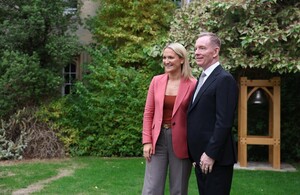
Secretary of State Chris Bryant and Minister for Foreign Affairs and Trade Helen McEntee.
Just over a year ago I was invited by the Duke of Richmond to speak at the opening of his new Art Foundation in the forest near Goodwood. And it was a beautiful affair, lots of great artworks, very beautifully done in the forest. And it was a very posh affair. I know this because there were men in purple elephant cord trousers and wearing pinky rings. So it was very posh. A man came up to me after I had spoken and he said “Mr Bryant, thank you for your words, I was absolutely dreading it. But you were actually adequate.”
And that is basically my ambition as Secretary of State. To be actually adequate. Not least because, in the words of Oscar Wilde, who was of course born in Dublin but educated in Enniskillen ‘I am not young enough to know everything’.
And also because I’ve been struck, ever since I’ve taken up this post, by the number of people who come up to me in the street in Northern Ireland and say, with a rather pained look on their face, “Good luck.”
I know being Secretary of State for Northern Ireland is a tough gig, and I’m not the only one who’s had this post. I’ve seen Paul Murphy sitting over there in the second row.
I used to be a priest, incidentally, in the Church of England, so I’ve done lots of baptisms in my life, but never actually baptisms of fire, which is what it’s felt like over the last few weeks.
Which is why I have such immense respect for my predecessor, Hilary Benn. Hilary is a wonderful gentleman. I don’t think that the word gentleman can be written more appropriately for anybody else in British politics than for Hilary. And, of course, he was an enormous supporter of this association. He and, of course, well, as Helen referred to earlier, was here a year ago to be able to announce that the framework was in place, a very significant piece of diplomacy. And he was very instrumental in, as Helen just referred to, re-establishing the relationship between our two nations, and I really do want to pay an enormous tribute to Hilary Benn. And I feel a bit sort of an impostor syndrome whenever anybody calls me Secretary of State because I think that is really Hilary still, or, for that matter, Paul.
Now, it has been a week of celebrating close ties with other countries for us. I was at the opening of the, well, not the opening, well yes, the opening ceremony for the Bayeux Tapestry with President Macron, and the King, and Andy Burnham, who made a good joke, I thought, about people coming to the South of England to to seize the crown. And I was very struck looking at the Bayeux Tapestry by lots of things. There are lots of lessons, of course, you can take from it, which, incidentally, it’s not a tapestry, it’s an embroidery. It’s a very important point, but you could take the point that history matters. It’s very striking when you stand in front of it how you feel close to something that was produced 1,000 years ago, and it’s a telling of a series of events. You could take from it that how history gets told depends on who gets to tell it or, for that matter, who actually gets to sew it together.
You could take from it that nothing is inevitable, including war. You could also take from it that if you’re going to agree something, don’t just swear on the bones of the saints, get it in writing. It’s an important context. This seems all the more important, I would argue, today. How we tell our history really does matter, especially in the fiercely contested political space of Ireland and Northern Ireland.
Of course, our two countries have, to put it mildly, a complex and disputed history. There’s not a decade in our history which hasn’t been disputed in some shape or form as to who was right and who was wrong. I don’t think anybody actually disputes that all of that is disputable.
But one other thing I believe is indisputable, and that is that our relationship has become stronger than ever in the last few years, and in particular in the last two years, as Helen herself said, and it continues to mature, and I’m very determined to make sure that that happens. We are, apart from anything else, much more at ease with each other and with ourselves.
There used to be outdated views which made it very difficult to be Irish in Great Britain and get accommodation, for instance. And that is dead. That idea in Great Britain is dead. That idea is dead, and rightly so. And we all now enjoy great cultural, sporting, and trading advantages of that closeness brings.
You’ve only got to look at the amazing Fleadh in Belfast a few weeks ago to see how that has completely been transformed. They were expecting 800,000 people; they had 1.6 million. My guess is that there’ll be even more next year, and I don’t think people would have predicted that 20 years ago.
Now, I’m keen to build on all of this, which is why I’m grateful to Helen and to Jim O’Callaghan for hosting me a few weeks ago in Dublin for what were again fruitful conversations about some of the issues that have already been raised. I know that we can be direct with each other. I think it’s important that we should be direct with each other. And we can do that without causing or claiming offense. And this is a relationship which has been tested in recent memory, of course, and the association here today alongside others have ensured that that relationship has endured and been able to become more fruitful.
You’ve created, I think, at a time of maximum tension, as Helen was laying out, an indispensable arena for honest dialogue, and you helped create a robust and deep trust between our two nations, which can only be for all of our benefits.
Now, you will have noticed I haven’t said anything about the subject that I was asked to talk about today, and that is Northern Ireland. I’m not going to say much more about the subject I was asked to talk about at all, in actual fact, but I do briefly want to say that Northern Ireland’s place in a changing world and a and in a world of crisis, that is a difficult subject to talk about at the best of times.
Especially now, because crisis no longer seems a temporary interruption. It feels like a constant feature of geopolitics. Every day seems to bring some new unimaginable challenge.
Things that felt unthinkable just a few years ago are now accepted as routine: a land war in Europe, for instance; state-sponsored cyber warfare; the closure of the Straits of Hormuz.
But it is tempting to feel that, as W.B. Yeats said, “things fall apart; the centre cannot hold… The best lack all conviction, while the worst are full of passionate intensity”.
This is, of course, true in spades in Northern Ireland, where people have lived with the utterly abnormal for so long that it has become a new form of normal. But I want to say, yes, we rightly celebrate the hard-won peace, and praise those political titans who went the extra mile to achieve it in the Good Friday Agreement in 1998, but surely, surely, surely, it is time we said, “Enough with the abnormality.” Let’s stop accommodating madness and find a better way of working.
Now that means at least some institutional reform. The majority of the Stormont parties agree, at least in theory, that we do need reform, but we need to make that reform a genuine reality. It’s one of the things I want to address with all the parties as a matter of urgency.
I say this not because institutional reform is an end in itself, but because it’s the means by which we achieve better outcomes for the people of Northern Ireland, and I would argue for the whole of Ireland as well. Indeed, instead of the vicious circle of political instability leading to a failure to set a budget, we need to create a virtuous circle, delivering transformed public services, supporting economic growth.
I am completely committed to supporting the Executive as we work together to put Northern Ireland’s finances on a long-term sustainable footing, but it is the nature of government that you need to take hard decisions, unpopular decisions sometimes, and that fact is no different for the Executive. We need to see a multi-year budget and a plan for fiscal sustainability.
But this is not, I would argue, just about Stormont. It is also about the way we do politics. What about a novel idea that elected politicians don’t just deliver speeches solely designed to shore up their base, but actually try to persuade each other of their cause and of their arguments?
I talked earlier about the power of history. Nowhere is this more evident than in Northern Ireland. Ghosts walk amongst us, people say. Or as Colm Toibin, one of my favourite writers, wrote in Testament of Mary, ‘memory fills my body as much as blood and bones’.
For all the achievements of the Good Friday Agreement, I know that many people feel, and felt then, and feel still today, that they basically had to suck up the anguish of unanswered questions in silence, and they’ve been doing it for three decades now. And the pain remains. Many feel angry, bitter, disturbed, and still grieving.
So, as we look to the 30th anniversary of the Good Friday Agreement, we need to try and finish what we started. There was a promise back then to acknowledge and address the sufferings of victims and survivors. We now need to fulfill that promise.
That will require the equal participation of both governments, as Helen herself said, to provide answers for as many families as possible across the United Kingdom and Ireland, to acknowledge with candor where our two governments may have fallen short, and to allow society in Northern Ireland to focus on the challenges of today and tomorrow, rather than always looking in the rearview mirror.
The Good Friday Agreement between our two governments provides the basis to do this, and I’m determined to deliver on the UK Government’s commitment in the framework through the Troubles Bill. If the past has taught us anything, it is surely that the UK and Ireland are strongest when we work together as equal partners, honest friends, and close allies.
Two final points.
First, I want to spend 60% of my time, at least, and of my energy on the future rather than just on solving the issues of the past. We need to capitalise, I believe, on the phenomenal air of economic possibility about the place in Northern Ireland. After all, it has the highest economic growth figures in the UK, it enjoys huge inflows of US investment in cyber, it produces enough food to feed 10 million people, exports to over 70 countries worldwide, and it has dual market access as a unique gateway both to the sixth largest economy in the world and the world’s largest trading block. What is not to celebrate?
I want to exploit those opportunities by making it easier to move goods from Great Britain to Northern Ireland, securing an SPS deal with the European Union that will remove paperwork and processes for most food and drink, and set up a new one-stop shop which will better equip businesses to navigate the Windsor Framework and sell goods in Northern Ireland.
And here’s my final, final point. I’ve heard many politicians speak and commentators write with absolute certainty about things in recent years. It’s the fashion of the day. But Oscar Wilde again, who also said, incidentally, that the trouble with socialism is that it takes up too many evenings, he also was right to say that “the truth is rarely pure and never simple.” So, I want to make a plea from a different writer, Seamus Heaney: “Walk on air against your better judgment.” Don’t just rehash your old arguments, take a risk, be bolder, find an accommodation, persuade others that it’s worth it. Because if we could all do that, we might get to be more than actually adequate.