Next-generation remote controlled artillery systems to transform British Army
British soldiers will be equipped with modern guns capable of firing eight rounds per minute at targets up to 70km away – delivering the long-term close support artillery solution for the British Army, a landmark moment in UK defence modernisation.
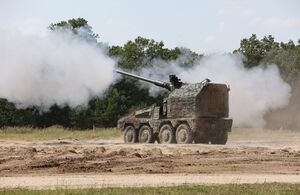
An RCH155 demonstrator on trials
- Procurement of 72 Remote Controlled Howitzers (RCH 155) for the British Army will deliver a step change in artillery capability.
- The UK’s £1 billion investment delivers on the UK-Germany Trinity House Agreement, and supports at least 500 British jobs, including at Rheinmetall’s Telford facility and KNDS Stockport.
- Rheinmetall set to use British steel through Sheffield Forgemasters, strengthening the UK’s defence industrial base and supporting the UK Steel Strategy.
72 Remote Controlled Howitzers (RCH 155) will be procured under a nearly £1 billion contract, which includes initial training and in-service support, awarded by the Organisation for Joint Armament Cooperation (OCCAR) on behalf of the British Army to ARTEC GmbH, a joint venture between KNDS and Rheinmetall.
The weapon systems – the barrel, breech, recoil system and trunnions – will be manufactured at Rheinmetall’s large-calibre production Telford facility. Rheinmetall is set to use British steel supplied by Sheffield Forgemasters, supporting the UK Steel Strategy which recognises steel is fundamental to the UK’s industry and national resilience.
The BOXER drive module – chassis, engine, drive train – that the weapon system sits on will be manufactured by KNDS UK in Stockport, sustaining critical armoured steel welding in Britain as well as supporting 100 skilled jobs in Stockport. Together, the programme is expected to support the creation of 100 new skilled jobs at Rheinmetall’s Telford facility, support 100 jobs at KNDS Stockport and back 300 jobs in the wider UK supply chain.
The programme delivers on the Trinity House Agreement by strengthening UK-German collaboration and deepening interoperability between Allied forces.
Defence Secretary John Healey MP said:
This major investment is defence delivering for the battlefield and for Britain’s economy. By securing next-generation artillery with Germany, not only are we rearming to strengthen NATO against growing Russian aggression but also creating highly skilled jobs here in Britain.
This is what we mean when we say defence is an engine for growth – investment in our security that powers new jobs across the country.
German Federal Minister of Defence, Boris Pistorius, said:
The RCH 155 will significantly enhance the artillery’s firepower, safety and flexibility. It is a vital element of modern artillery support. Together with the United Kingdom, we are demonstrating that we take interoperability within NATO seriously and are putting it into practice.
At the same time, we are underlining the close defence cooperation between Germany and the UK. My British counterpart John Healey and I are keeping our word and are implementing the Trinity House Arrangement step by step. Joint exercises and training will bring our armed forces even closer together. This will deepen military cooperation in the long term and improve our operational readiness – for greater security in Europe.
RCH 155 is mounted on a BOXER chassis and can redeploy at speeds of up to 100km/h, making it harder for adversaries to target. Advanced automation of the turret allows the platform to be operated at the push of a button from the crew compartment by just two soldiers.
First deliveries of the RCH 155 vehicles are expected in 2028 to achieve a minimum deployable capability within this decade. This contract follows the £52 million Early Capability Demonstrator contract signed in December 2025 and a £53 million Long Lead Item procurement contract earlier this year, facilitating Rheinmetall’s large calibre gun manufacturing facility in Telford.
Rheinmetall aims to use British steel supplied by Sheffield Forgemasters, which manufactures specialist steel parts used in critical defence programmes and employs 720 skilled staff. The government invested over £420 million of additional funding in Sheffield Forgemasters last year, bolstering sovereign steelmaking capability for defence, including gun barrels and nuclear submarines.
The RCH 155 replaces the AS90 artillery systems granted in kind to Ukraine in 2023. The Archer artillery system currently serves as an interim capability and will continue to do so until the RCH 155 enters service.
The RCH 155 procurement between the UK and Germany builds on the Trinity House Agreement signed in October 2024. This commitment to improve and enhance bilateral defence cooperation between both nations will exploit the combined capabilities of each nation’s test and evaluation centres, to enable faster delivery at less cost. It will deepen interoperability between Allied forces and directly strengthen NATO’s collective defence on the eastern flank. It also anchors significant industrial benefit in Britain, supporting the skilled workers who will build and maintain them.
The investment also supports the Strategic Defence Review’s ambition to make defence an engine for growth and the Army’s goal to deliver tenfold greater lethality within the next decade.
Deputy Chief of the General Staff, Lt Gen Simon Hamilton CBE said:
Britain answered the call for aid by providing artillery systems to Ukraine at the outbreak of the war. We knew the risk – the gap in our warfighting capability – that this would present. The success of bringing the RCH 155 onto contract to develop our 155mm Close Support Artillery requirement, in collaboration with Germany, marks the first significant milestone in replenishing this capability. We are grateful to the National Armaments Director, our industry partners and our own programme teams for the fantastic work which they have done to bring this to fruition and look forward to our continued work with our German allies.