Minister puts temporary block on Rare Anglo-Saxon national treasure leaving the UK
The government has temporarily blocked an Anglo-Saxon mount from being taken out of the UK permanently
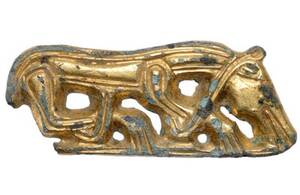
- A UK gallery or institution has been granted the opportunity to save this national treasure for the nation
The UK Government has blocked an exceptionally rare Anglo-Saxon animal depiction from being taken out of the country permanently, in the hope that a UK gallery or institution can save it for the nation.
Believed to be over 1,400 years old, the delicately crafted metal object depicts a four-legged animal. Depictions such as these are thought to have played a key role in religious and mythological traditions, meaning the mount offers an exceptional opportunity to research how culture was shared in Anglo-Saxon East Anglia.
The Government is creating the opportunity for the piece to remain in the UK because experts have determined it meets all three of the Waverley Criteria, which define whether an item is considered a national treasure. This means the piece is identified as closely connected with our history and national life, of outstanding aesthetic importance, and of outstanding significance for the study of art, learning or history.
The decision to place a temporary export ban on the mount gives museums and galleries time to raise the funds needed to acquire it, with the aim of keeping an important work in the UK and on public display.
A metal detectorist discovered the mount in 2024 in Holme Hale, Norfolk. The item features attachments on its reverse, suggesting it may be designed to be mounted on another object.
This mount is extremely rare because it presents a clear image of a four-legged animal, whilst most other surviving examples are highly stylised. It is made of copper-alloy, with added gilding, featuring impressive detailing despite being just over 3cm long and weighing only 5 grams. It is believed to have been created during the late 5th century or early 6th century.
Arts Minister, Ruth Mackenzie said:
This piece is undeniably a national treasure. It offers researchers an important window into our Anglo-Saxon past.
I hope this mount can remain in the UK where researchers and the public will have the best access to it.
RCEWA committee member, Helen Jacobsen said:
Physical artefacts play a hugely important role in enabling us to study the lives and cultural practices of the early medieval period. This object is of particular significance for research into the early Anglo-Saxon kingdoms because of its unique form and very rare imagery. Further study will shed light on its function and on the transmission of artistic styles, materials and iconography in southern Scandinavia and eastern and south-eastern England during the late 5th and 6th centuries. It will be a huge loss if it cannot be saved for the nation and I hope very much that a home can be found for it in a national museum.
The Committee made its recommendation on the basis that the mount met the first, second and third Waverley criteria for its outstanding connection with our history and national life, its outstanding aesthetic importance and its outstanding significance to the study of Anglo-Saxon material culture, and the history and culture of Eastern and Southeastern England in the early medieval period.
The decision on the export licence application for the mount will be deferred for an initial period ending on 3 November 2026 inclusive in which we welcome expressions of interest from an appropriate purchaser to try and acquire the object. At the end of the first deferral period owners will have a consideration period of 15 Business Days to consider any offer(s) to purchase the mount at the recommended price of £1,054 (plus VAT of £40.80). The second deferral period will commence following the signing of an Option Agreement and will last for three months.
When someone applies to permanently export an important cultural object from the UK, the Government can pause the export if the object is considered a national treasure. This gives a UK museum or buyer time to raise the money to keep it in the country.
Notes to editors:
- Organisations or individuals interested in purchasing the mount should contact the RCEWA on 02072680534 or rcewa@artscouncil.org.uk.
- Details of the ITEM are as follows: A late-5th to early 6th century Anglo-Saxon copper-alloy gilded chip-carved mount, by an unknown maker. It is sub-rectangular in form with one face depicting a thin-bodied and long-snouted quadruped beast. The ungilded reverse face has the pierced stubs of two lugs which are set at either end of the long axis. The mount is incomplete; when examined from the perspective of the beast it depicts, there are breaks to the tail and baseline. The gilding is preserved over the majority of the decorated face and worn in several points. Length: 33.7mm, Width: 15.1mm, Thickness: 2.1mm, Weight: 5g.
- Provenance: Found in Holme Hale, Norfolk by a metal-detectorist in 2024. Recorded with the Portable Antiquities Scheme (PAS) database reference NMS-15F391.
- The Reviewing Committee on the Export of Works of Art and Objects of Cultural Interest is an independent body, serviced by Arts Council England (ACE), which advises the Secretary of State for Culture, Media and Sport on whether a cultural object, intended for export, is of national importance under specified criteria.