Grave of missing Shropshire soldier identified in France
The grave of a lost Bridgnorth soldier of World War 1 has finally been identified in France. Corporal George Lloyd of the King’s Shropshire Light Infantry, now has a named resting place in avCommonwealth War Graves Commission (CWGC) cemetery.
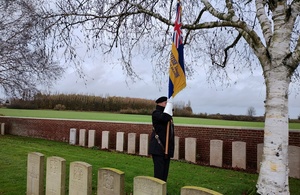
A standard bearer from the Pas-de-Calais branch of the Royal British Legion attended the service for Cpl Lloyd (Crown Copyright)
A soldier’s grave, previously marked as that of an ‘unknown’ soldier of World War 1, has finally been given a name following his identification.
A rededication service, organised by the MOD’s Joint Casualty and Compassionate Centre (JCCC), also known as the ‘MOD War Detectives’, was held at CWGC Grevillers British Cemetery today (17 November 2026).
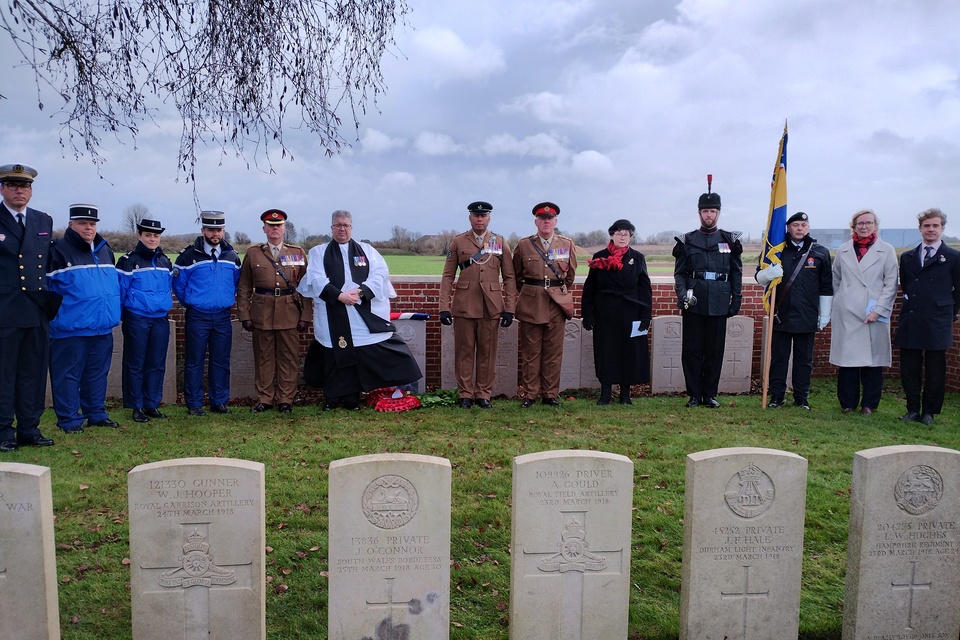
The service was lead by Padre Paul Robinson CF and supported by serving soldiers from 5th Bn The Rifles and 4th Bn Duke of Lancaster's Regiment. The local Gendarmerie also attended to pay their respects. (Crown Copyright)
Corporal George Thomas Lloyd
13 March 1896 – 26 March 1918
George Thomas Lloyd joined the territorial army in the pre-war period, and on the outbreak of war he was mobilised for action with the King’s Shropshire Light Infantry at the rank of Private.
Initially George was sent to India, arriving on 1 December 1914, before departing from there for Singapore in February 1915. Having spent the following two years in the far east, George is known to have been working as a coach to the Signalling Section of the Hong Kong Volunteer Reserves throughout the early part of 1917, before departing for France with the rest of the battalion in May of that year.
The 1/4th King’s Shropshire Light Infantry landed in France on 27 July 1917 and served initially as part of 190th Brigade – seeing action at the battle of Passchendaele in October 1917. In February 1918 they transferred to the 56th Brigade, and by March they were in the Somme region of France.
Between 21 – 26 March 1918, 1/4th Bn King’s Shropshire Light Infantry lost 57 men, 39 of whom are named on the Arras Memorial to the Missing, since their burial locations could not be determined after the war. George was one of these men.
In September 1920, a plot within the German cemetery at Grevillers, with a single cross commemorating a group of unknown British soldiers, was exhumed for the purposes of identification. The bodies were reburied in the same graves, which now form Plot XII, Row F, graves 1-34 within the re-named Grevillers British Cemetery.
Seven of the casualties were found with ID discs, and others with rank insignia, shoulder titles, trade badges and wounds stripes. It was possible to name 15 of them at the time, all of whom died 22-26 March 1918.
A further 12 were attributed to a regiment, with three of them also given a rank. 13 of the 34 were attributed to the King’s Shropshire Light Infantry, with the nine identified all being from 1/4th Bn and with a date of death of 23 - 26 March 1918. Of the four who remained unidentified, two were found with rank insignia – one being a Corporal who was also recorded as wearing a Signallers badge.
The single cross, location, and date range of the identified casualties all indicate these were burials made by the German forces as they cleared the captured battlefield shortly after their advance through Grevillers on 26 March 1918.
In 2020, two researchers approached the Commonwealth War Graves Commission with evidence suggesting that the unknown Corporal was in fact George Thomas Lloyd.
Additional research by the Commonwealth War Graves Commission, the National Army Museum and the JCCC ultimately confirmed what the researchers had suspected, that Corporal George Thomas Lloyd, had been found.
JCCC Caseworker, Alexia Clark, said:
I am grateful to the researchers who originally submitted evidence suggesting the location of this man’s grave. In rededicating his grave today, we have reunited his mortal remains with this name, ensuring that his sacrifice will not be forgotten.
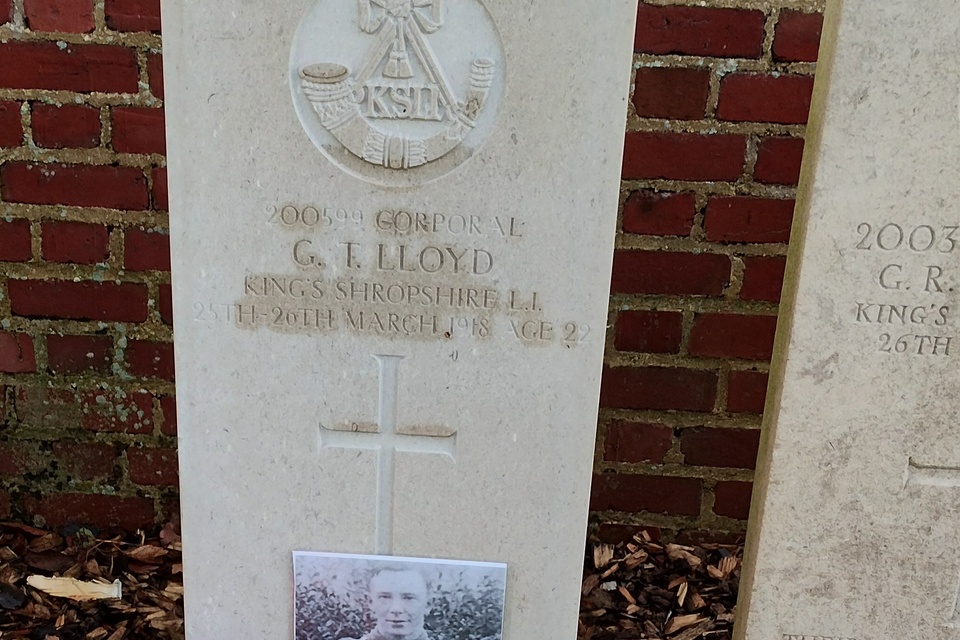
Cpl Lloyd's new headstone bearing his name (Crown Copyright)
The headstone over his grave has been replaced by CWGC who will care for it in perpetuity. Dr Daniel Seaton, Commemorations Case Officer at the CWGC, said:
Corporal Lloyd arrived on the Western Front by way of India and Hong Kong. With the identification of his grave in Grevillers, we are now able to state with certainty where this remarkable journey reached its culmination. With the ceremony taking place over the remembrance period, the identification of Corporal Lloyd’s grave is particularly poignant and serves as a reminder of the heroism and sacrifice of George and so many like him, as well as the ongoing work to identify the missing.