First World War Soldier of the West Yorkshire Regiment Buried in France more than a century after his death
An unknown soldier of the West Yorkshire Regiment, discovered near the Thiepval Memorial on the Somme, has been given a peaceful burial more than 100 years after his death.
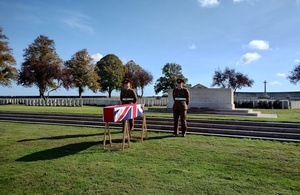
The coffin of the unknown soldier, dressed in the Union Flag, is guarded by two serving soldiers prior to the start of the service (Crown Copyright)
More than a century after his death in the First World War, the remains of a man of the West Yorkshire Regiment were laid to rest today (14 October 2026) with full military honours at the Commonwealth War Graves Commission’s (CWGC) Serre Road Cemetery No.2 in France.
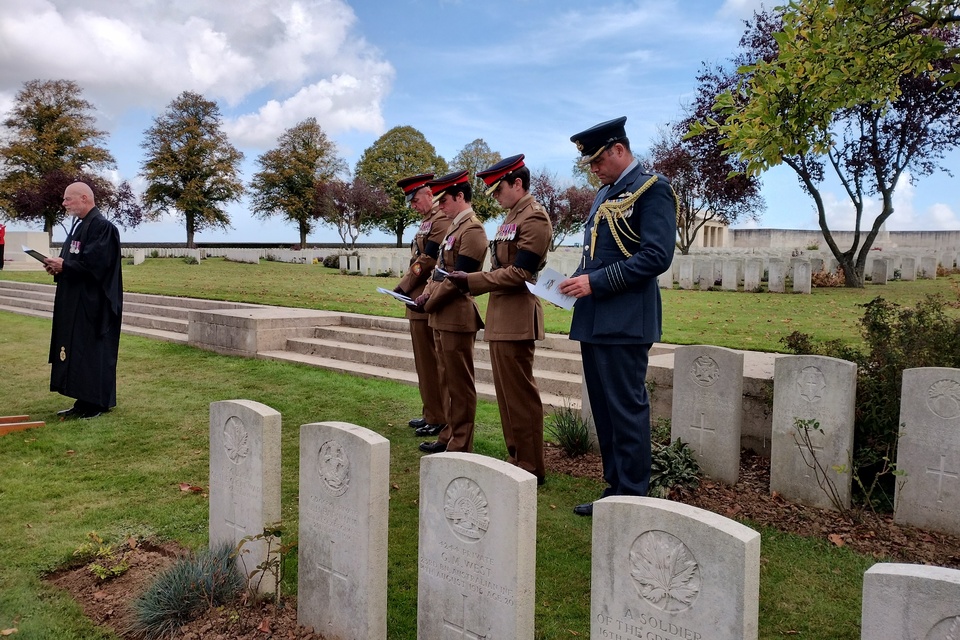
Some of the military party, including a representative from the British Embassy in France, at the service for the unknown soldier (Crown Copyright)
In the winter of 2025 – 2026 human remains were discovered on the edge of a freshly ploughed field about a kilometre south of the Thiepval Memorial. Since the remains had been disturbed by a plough, it was impossible to fully understand the context of the find and to relate the artefacts to the soldier conclusively. However, a shoulder title found near the remains indicated possible service with the West Yorkshire Regiment, and this was strengthened by the presence of a belt with the letters WYR marked on it, also found near the casualty. An entrenching tool issued prior to July 1916 and first-issue webbing gave some clues as to when this soldier might have been equipped, but there was no clue as to his personal identity.
The recovery location was immediately adjacent to the Leipzig Redoubt, and records of the West Yorkshire Regiment show that various battalions were tasked with capturing Thiepval including the Leipzig Salient on the 1st July 1916, and remained in the line in this area until 17 July, before revisiting the area again in August of the same year.
Research showed that more than 1000 men of the West Yorkshire Regiment are named on the Thiepval Memorial, having died in the period 1 July 1916 – 31 August 1916. A further 745 men of the same regiment died on other dates from September 1915 to March 1918, and also remain missing.
With such an extensive list of potential candidates, and nothing in the way of artefactual evidence to point to his identity it proved impossible to identify the man. Nonetheless, he gave his life in the service of his country, fighting for freedom and peace. Whilst his identity remains known only to God, today he was buried by a party from the Royal Yorkshire Regiment – his military family, with full military honours.
The service was organised by the JCCC and supported by serving soldiers of the Royal Yorkshire Regiment, as well as staff from the CWGC.
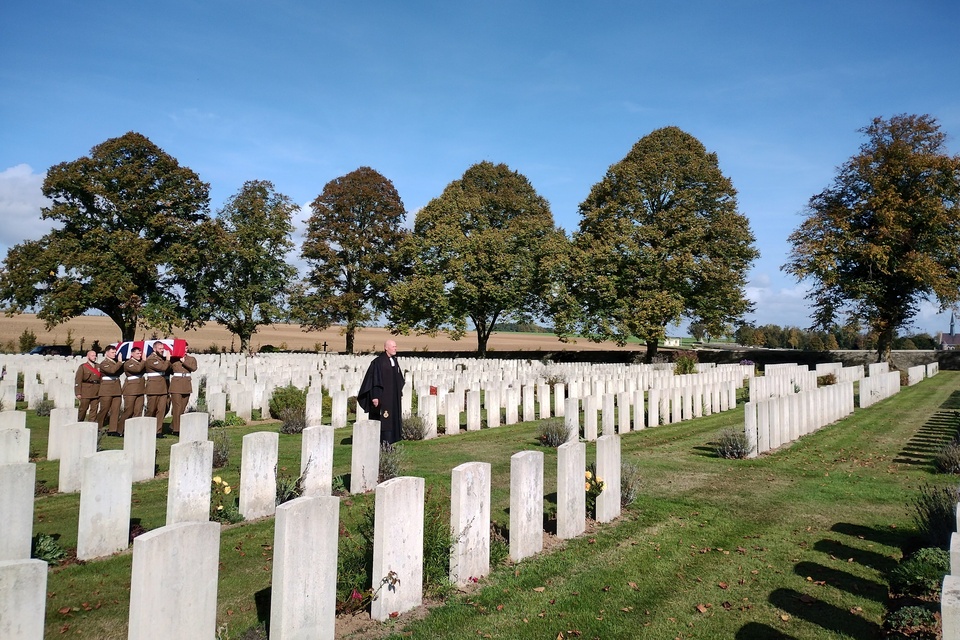
The service was led by Padre David Jeal and supported by the Royal Yorkshire Regiment (Crown Copyright)