British High Commission Honiara commemorates Remembrance Day
The solemn service brought together representatives of the Solomon Islands government, the diplomatic community, uniformed services, churches, youth organisations and the wider community.
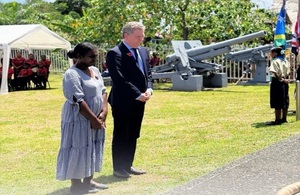
British High Commissioner Paul Turner and his Executive Personal Secretary, Genevieve Keleni paying tributes after laying a wreath at the Cenotaph in Honiara.
Remembrance Day reminds us of our shared responsibility to uphold peace, oppose injustice and work together for a safer future, British High Commissioner to Solomon Islands, Paul Turner told invited guests at this year’s Remembrance Service commemorated in Honiara on Wednesday 11 November 2026.
Held at the Cenotaph Memorial Garden next to the Central Police Station this week, the solemn service brought together representatives of the Solomon Islands government, the diplomatic community, uniformed services, churches, youth organisations and the wider community to honour the service and sacrifice of those who lost their lives in wars and conflicts.
The programme included a flag procession by the Solomon Islands Scouts and Girl Guides, prayers, hymns, the Act of Remembrance, the Last Post, a two-minute silence, national anthems and the laying of wreaths.
The St Barnabas Cathedral Choir supported the service, alongside the Royal Solomon Islands Police Band.
Among those who attended were the Governor General of Solomon Islands, His Excellency Sir David Tiva Kapu; the Honourable Speaker of the National Parliament, Patterson Oti; members of the diplomatic corps; government representatives; and members of the local community.
Delivering the welcome remarks, British High Commissioner Paul Turner drew particular attention to one of the region’s lesser-known wartime tragedies.
On Ballalae Island in the Shortland Islands, more than 500 British prisoners of war were transported by Japanese forces in late 1942. Most were Royal Artillery soldiers captured after the fall of Singapore. They were forced to build an airfield under brutal conditions, and many died from disease, starvation, overwork and bombing raids. The survivors were ultimately massacred. After the war, investigators found mass graves containing hundreds of victims. Today, we honour their memory.
Remembrance Day is observed annually on 11 November, marking the armistice that ended the First World War in 1918.
High Commissioner Turner concluded that today, headlines may change, but the consequences of war remain the same. He added:
Over a century on, the mud and blood of Flanders fields are being replayed in the villages of Eastern Ukraine. The industrial scale destruction of cities in Europe during WWII is being repeated in Gaza and the Middle East. That is why remembrance matters.
The Honiara commemoration also reflects the deep historical experience of Solomon Islands and the wider Pacific, where communities endured the direct impact of the Second World War.