Warm Home Discount (WHD): cost recovery - consultation document (accessible webpage)
Updated 2 April 2026
Applies to England, Scotland and Wales

© Crown copyright 2026
This publication is licensed under the terms of the Open Government Licence v3.0 except where otherwise stated. To view this licence, visit nationalarchives.gov.uk/doc/open-government-licence/version/3 or write to the Information Policy Team, The National Archives, Kew, London TW9 4DU, or email: psi@nationalarchives.gov.uk.
Where we have identified any third party copyright information you will need to obtain permission from the copyright holders concerned.
This publication is available at https://www.gov.uk/government/consultations/warm-home-discount-whd-cost-recovery/warm-home-discount-whd-cost-recovery-consultation-document-accessible-webpage
Introduction
The Warm Home Discount (WHD) scheme is a key policy in the government’s approach to tackling fuel poverty and reducing the energy costs of low-income and vulnerable households in Great Britain. Since its inception in 2011, the scheme has provided annual energy bill rebates to millions of households and has been expanded by around 2.7m households to an estimated 6m total households for winter 2025 - 2026. The scheme also includes Industry Initiatives, which fund activities such as energy advice, financial assistance payments and debt write-off, to provide further support to customers who are in, or at risk of, fuel poverty. Participating energy suppliers are required to deliver the scheme and recover their costs through a levy on domestic energy customers.
Currently, the costs of the WHD are recovered by suppliers through the standing charge. While this approach ensures predictable cost recovery for suppliers and reflects the fixed cost nature of scheme outputs, many consumers have raised concerns about the fairness and distributional impacts of standing charges, particularly for households with low energy consumption.
Ofgem’s 2023 Call for Input on standing charges received responses from over 30,000 individual consumers, an overwhelming number of whom called for Ofgem to take action to reduce them. Many consumers noted the cost of standing charges being fixed and not linked to consumption was unfair. It is clear that consumers’ appetite for changes to standing charges to make them fairer was and remains high.[footnote 1]
The government has a manifesto commitment to reducing standing charges, and lowering bills for consumers is a government priority. In the Budget, government announced a series of measures to remove around £150 of costs (on average) from household energy bills from April 2026. This announcement included ending the Energy Company Obligation (ECO) and funding 75% of the domestic cost of the legacy Renewables Obligation for three years; to date, both of these costs were borne by billpayers. The government is also committed to doing more to reduce electricity costs for all households and improve the price of electricity relative to gas, as we strive towards net zero.
Alongside the other actions taken by government to tackle high energy bills, there is a strong case to make standing charges fairer for consumers. Standing charges are a fixed daily fee applied to all customers regardless of energy usage for households. This consultation sets out a proposal to move the cost recovery for the WHD from standing charges to the unit rate. If this proposal is implemented, these standing charges for dual fuel households could be reduced by approximately £39. Instead, the recovery of WHD costs would be achieved via the unit rate.
Alongside this, Ofgem are doing their own work exploring how standing charges could be reduced, including through consulting on a requirement on suppliers to offer low standing charge tariffs. This is in addition to the wider Cost Allocation and Recovery Review (CARR) that Ofgem are conducting to examine costs across the energy system as a whole and determine whether other options for cost allocation and recovery are fairer and more efficient, amongst other criteria. Ofgem are working closely with DESNZ as they progress this work.
Independent research commissioned by the Committee on Fuel Poverty (CFP) highlights that standing charges are regressive: as a flat rate, they affect rich and poor households equally, irrespective of usage.[footnote 2] While moving costs between standing charges and the unit rate will benefit some consumers and others may face higher costs depending upon their usage, the research noted that standing charges place “a disproportionate burden on low-income, low-energy usage households.”
This consultation seeks views on the impacts of a proposal to move WHD cost recovery from the standing charge to the unit rate for both consumers and suppliers. We are also seeking views on the necessary changes to the WHD reconciliation regulations to account for this change.
This change would help address the more regressive nature of standing charges and align WHD cost recovery with consumption, making the system fairer for low-use households, which include many of the lowest income users and those on prepayment meters as well as those in energy-efficient homes. Households with higher energy needs, which could include those with electric storage heating, living in less efficient properties or reliant on medical equipment, tend to relatively benefit from costs being on standing charges. However, the package of measures announced at the Budget, in lowering unit rate electricity costs, will be of particular benefit to these households. Therefore, while in isolation moving WHD costs as we propose here could increase the impact of WHD cost recovery on these households, taken together with the measures announced at the Budget they will see meaningfully lower energy costs than under the status quo. For example, there would be reductions in costs by up to £395 lower for high-use households reliant on electric storage heating.
General information
Why we are consulting
We are consulting to gather views on the fairness, feasibility, and potential impacts of moving WHD cost recovery from the standing charge to the unit rate. This will help inform decisions on whether and how to implement this change.
Consultation details
Issued: 8 December 2025
Respond by: 6 January 2026
Enquiries to:
Warm Home Discount Team
Department for Energy Security and Net Zero
3rd Floor
3-8 Whitehall Place
London
SW1A 2AW
Email: whd.consultation@energysecurity.gov.uk
Consultation reference: Warm Home Discount cost recovery.
Audiences:
- Obligated electricity suppliers
- Consumers, consumer groups and charities
- Warm Home Discount recipients
Territorial extent:
The Warm Home Discount applies across Great Britain, with some differences in how the scheme operates in England and Wales, compared with Scotland. Cost recovery is a reserved power, and therefore these proposals affect England, Wales and Scotland in the same way.
The scheme is not available in Northern Ireland, where separate support is available.
How to respond
Respond online at: energygovuk.citizenspace.com/energy-security/warm-home-discount-unit-rate-cost-recovery
or
Email to: whd.consultation@energysecurity.gov.uk
Write to:
Warm Home Discount Team
Department for Energy Security and Net Zero
3rd Floor
3-8 Whitehall Place
London
SW1A 2AW
When responding, please state whether you are responding as an individual or representing the views of an organisation.
Your response will be most useful if it is framed in direct response to the questions posed, though further comments and evidence are also welcome.
Confidentiality and data protection
Information you provide in response to this consultation, including personal information, may be disclosed in accordance with UK legislation (the Freedom of Information Act 2000, the Data Protection Act 2018 and the Environmental Information Regulations 2004).
If you want the information that you provide to be treated as confidential, please tell us but be aware that we cannot guarantee confidentiality in all circumstances. An automatic confidentiality disclaimer generated by your IT system will not be regarded by us as a confidentiality request.
We will process your personal data in accordance with all applicable data protection laws. See our privacy policy.
We will summarise all responses and publish this summary on GOV.UK. The summary will include a list of names or organisations that responded, but not people’s personal names, addresses or other contact details.
Quality assurance
This consultation has been carried out in accordance with the government’s consultation principles.
If you have any complaints about the way this consultation has been conducted, please email: bru@energysecurity.gov.uk.
The proposals
The costs of the WHD (£39 on the typical dual fuel bill) are recovered by suppliers through the standing charge: a fixed daily fee applied to all domestic customers regardless of energy usage. This consultation seeks views on the impacts of a proposal to move WHD cost recovery from the standing charge to the unit rate – the per-kWh charge for electricity and gas usage – for both consumers and suppliers. Obligated energy suppliers are required to deliver the WHD scheme and recover their costs through a levy on domestic energy customers. We are seeking views from energy suppliers, WHD recipients, consumer groups and consumers on how WHD costs are recovered.
Problem statement
Standing charges recover elements of the ‘fixed’ costs of the energy system; costs that do not vary by energy use. These include energy suppliers’ fixed operational costs of serving each customer, and the cost of network upgrades and maintenance necessary to keep all consumers connected. They also currently include costs associated with the Warm Home Discount.
Lowering bills for consumers is a government priority, alongside the manifesto commitment to reduce standing charges. As part of Government’s efforts to drive down costs, every element of the energy bill has been examined, with avenues for potential reductions explored.
Standing charges are applied no matter how much energy the consumer uses so consumers who use less energy — often those in smaller homes or on lower incomes — bear a relatively larger burden.
This means that the current method of recovering WHD costs through the standing charge results in households with lower energy consumption paying a higher proportion of their total bill toward WHD policy costs compared to those with higher consumption.
By shifting WHD from standing charges to the unit rate, there is an overall reduction in the average dual-fuel bill for the average consumer. This is because more of the costs are recovered from higher consuming non dual-fuel households including those with electric heating and those households with electric vehicles. This is a more progressive approach to cost recovery compared to the status quo: a flat levy unrelated to total consumption.
On aggregate, average consumers will see bill savings if the proposal to move WHD costs from the standing charge to unit rate proceeds.
Rationale for Change
This consultation proposes linking cost recovery to a household’s level of energy consumption, so households that use more energy contribute more toward the scheme, by moving WHD cost recovery from the gas and electricity standing charges to the unit rates. There is a range of arguments in favour of this.
1) Delivering a fairer charging model
Standing charges place a disproportionate burden on lower-usage households, many of whom are on lower incomes. Reducing the fixed element of energy bills could help address this imbalance by shifting more costs into the unit rate, so that those who use less energy pay less overall. It also gives consumers greater control over their energy bills, something not possible with a flat rate standing charge.
Ofgem’s work on standing charges has also recognised that there is a case for this. Ofgem’s consumer research found that a clear majority (62%) of consumers see standing charges as unfair.[footnote 3] It also found that consumers value transparency and simplicity, with energy pricing that is easy to understand and navigate. By contrast, less than a quarter of consumers thought unit rates – which reflect consumers’ energy consumption – were unfair.
Consequently, Ofgem have consulted on introducing a requirement for suppliers to offer a lower standing charge tariff to bring more choice to consumers in how they pay for their energy bills in the competitive market. Ofgem’s work has highlighted that while lower or zero standing charge tariffs may benefit some consumers, particularly those with low usage, they may not be suitable for all. However, it is clear that there are opportunities to make charging fairer for consumers overall, even for consumers who don’t opt for potential lower standing charge tariffs in the future.
Our proposal is related to the longer-term work of the wider Cost Allocation and Recovery Review (CARR) that Ofgem are conducting to examine costs across the energy system as a whole and determine whether other options for cost allocation and recovery are fairer and more efficient. While there is a rationale for making changes to WHD cost recovery at this juncture, the government will continue to work with Ofgem on the wider CARR process and eventual proposals as it considers cost recovery more broadly.
2) Achieving greater distributional equity
As a flat rate charge on all consumers, standing charges do not vary with energy consumption: the consumer in a studio flat pays the same as one in a four-bedroom detached house. Moving WHD costs to the unit rate aligns costs more closely with usage and will be broadly more progressive since households on higher incomes are, on average, more likely to consume higher amounts of energy (and vice versa). Moving WHD costs to the unit rate could therefore reduce the disproportionate impact of standing charges on low-use low-income households.
Impact on Households
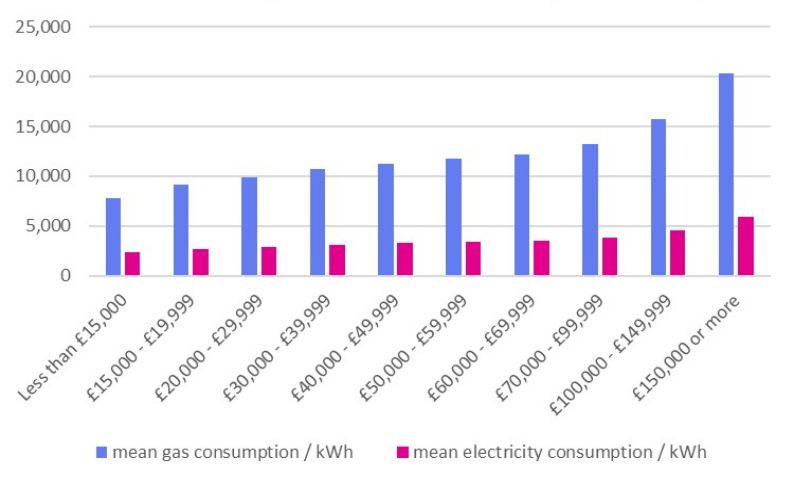
Recovering WHD costs through the unit rate would benefit many low-income households through a bill reduction. Analysis shows that more low-income households would benefit from this change than those who would not, as on average these households have lower energy consumption (as shown in the chart below). These will include single-occupancy homes, smaller properties, and many prepayment meter users.
Chart 1: Mean consumption vs income band [footnote 4] (NEED 2023)
We have included analysis which provides the distributional impacts of moving WHD costs to unit rates, with a 50:50 ratio across gas and electricity. These model the effect of transferring £39 from gas and electricity standing charges to unit rates on all households and low-income households[footnote 5].
This modelling (as set out below) indicates that more low-income households will benefit from this change than will be worse off from it. This mirrors the picture for all households, where there will similarly be more households that will benefit. This indicates that the change is progressive, improving distributional equity.
Table 1 – Illustrative distributional impacts of moving WHD costs to the unit rate in 2026/27 (£/y, nominal, inc VAT)
| Number of households better off | Average impact saving per better off household | Number of households worse off | Average bill impact per worse off household | |
|---|---|---|---|---|
| All households | 16.5m | -£16 | 12.0m | £22 |
| Low-income households | 2.8m | -£17 | 1.9m | £22 |
Source: DESNZ and Ofgem analysis based on ONS’s Living Cost and Food Survey data. Low-income defined as less than £19,500 per year.
The figures above show the proposal impacts in isolation. This therefore shows higher costs for high usage households. However, the government recently announced a package of wider measures in the Budget which will reduce bills for all consumers, taking an average of £150 of costs off people’s energy bills.[footnote 6] Factoring in the cumulative impacts of this package and these proposals, we expect the overall combined bill impact on these households to be a significant reduction in costs (see Table 2).
This is highlighted in Table 2 below, which indicates a range of households (including those with typical and high electricity usage) will benefit as a result of our proposals, and wider measures announced in the 2025 Budget. For example, a household with low energy usage would save £17 from moving WHD cost recovery onto the unit rate, and £105 across this change and the wider Budget package combined. Meanwhile, a household with typical energy consumption is estimated to save £138 on their dual fuel bill across this change and the wider Budget package combined.
Impacts on Fuel Poverty
Fuel poverty in England is assessed using the Low Income Low Energy Efficiency (LILEE) metric. Under this measure, a household is considered fuel poor if:
- it is living in a property with a Fuel Poverty Energy Efficiency Rating of band D, E, F or G, and
- its income after housing costs + energy costs would be below the poverty line.
Analysis using the English Housing Survey Fuel Poverty dataset suggests that moving WHD costs from standing charges to unit rates has a marginal effect on overall fuel poverty under the LILEE measure; the impacts are not statistically significant when compared to uncertainty in the overall modelled level of fuel poverty.
Scotland and Wales use different definitions of fuel poverty to England, in both cases using a metric based around the fraction of household income which is required to be spent on energy. While analysis has not been produced on the exact metrics used by these nations, analysis on the fraction of households whose required energy costs exceed 10% of their income (after housing costs) showed a negligible impact. While this does not precisely align with the Scottish or Welsh fuel poverty definition, it gives a broad indication of the likely effects in Scotland and Wales.
The analysis differs from that conducted by Ofgem in that it is based on a sample using the English Housing Survey and uses modelled required fuel costs – that is, the level of energy use needed for a household to heat its home to a reasonable standard. In practice, households in fuel poverty may consume less than this level by under-heating their homes.
We might expect households with low energy efficiency to be more likely to lose out as a result of this change as their properties may cost more to adequately heat (though this will also be dependent on other factors such as size and type of property). However, when combined with the changes announced in the Budget, we do not expect any adverse effects on fuel poor households.
More generally, the Budget allocates an additional £1.5bn in capital investment to the Warm Homes Plan, taking the total to almost £15bn. This is the biggest public investment to upgrade homes and tackle fuel poverty ever. Taken alongside the WHD, these interventions help to ensure that those in the greatest need benefit the most from energy bill reductions.
Impacts on high electricity users
In isolation, and before taking account of Budget measures specifically targeted at electricity unit rates, a group at risk of being worse off from this proposed WHD change is households with high electricity usage. This could include those with electric heating systems, those running medical equipment or those with electric cars. Some examples of the illustrative impacts on high gas and electricity usage households are set out in Table 2 below.
Table 2 – Illustrative impacts of moving WHD costs to the unit rate on specific household archetypes in 2026/27 (nominal, inc VAT)
| Household Archetype | Energy Consumption | Current annual Energy Bill (using Oct-Dec 25 price cap) | Bill impact from moving WHD costs to unit rates (£/year) | Overall bill impact in combination with measures at Budget 2025* |
|---|---|---|---|---|
| Low use household | 7.5MWh gas, 1.8MWh electricity | £1,266 | -£17 | -£105 |
| Typical dual fuel household | 11.5MWh gas, 2.7MWh electricity (Ofgem’s Typical Domestic Consumption Values) | £1,755 | -£4 | -£138 |
| Gas-heated house, with high demand due to medical needs | 25MWh gas, 4MWh electricity | £2,946 | £29 | -£195 |
| High demand rural household, poor energy efficiency | 30MWh gas, 3MWh electricity | £2,997 | £33 | -£172 |
| High-use electric storage heated household | 12.5MWh electricity | £3,346 | £47 | -£395 |
*Ending the Energy Company Obligation and moving 75% of domestic share of Renewables Obligation costs to the exchequer
Electric storage heated households might be on a multi-rate tariff where different unit rates are applied depending on the time of day or usage pattern which offers a lower night rate and a higher day rate. Under a unit rate recovery approach, suppliers would need to decide how to allocate WHD costs across the different rates within these tariffs. Under current WHD regulations and price cap methodologies, there is no way to mandate how suppliers can recoup WHD costs in multi-rate tariffs, and therefore it is not possible for these types of tariffs to be differentiated in any unit rate recovery approach. However, we would expect suppliers to take allocation of WHD costs into account when setting their charging structures for these types of multi-rate tariffs if a unit rate recovery approach is taken forward. This would further support electric storage heated households.
Taken alongside the wider measures to reduce energy bills recently announced in the Budget, we expect the net impact of the combined changes on typical consumers to be a reduction in costs as outlined in Table 2 above.
For instance, high-use electric storage heated households are anticipated to be the worst impacted by the proposal to move WHD costs to the unit rate. When considered in isolation, a high-use electric storage heated household could see its annual energy bill rise by around £47. However, when accounting for the wider measures announced in Budget 2025, these households are expected to see approximately £395 of costs removed from bills.
The Budget also set out that the government is committed to doing more to reduce electricity costs for all households, and to improve the price of electricity relative to gas. The government will carefully examine options for doing so, which will include consideration of a variety of costs which fall on household energy bills. It is right that the government takes a holistic approach to this, including to consider the right approach to the recovery of policy costs (including for the WHD) between electricity and gas. Further detail will be set out in the Warm Homes Plan.
In principle, it would then be possible to recover unit rate costs from electricity and gas differentially, rather than through an even split across the two fuels. While we are not proposing to make that change at this time, we are interested in any views on this topic to aid future policy design.
Consumer related questions
Q.1 Considering the impacts across all consumers, including impacts on protected groups, do you support moving WHD costs to the unit rate? (yes/no). Please explain your reasoning and provide any supporting evidence.
Q.2 Are there alternative approaches you think should be considered specifically to mitigate potential negative impacts on consumers? Please explain your reasoning.
Q.3 To support the rebalancing of costs between gas and electricity, do you think the government should consider placing greater cost recovery of the WHD onto gas? (yes/no). Please explain your reasoning
How this change would be implemented
WHD obligations are currently set out in The Warm Home Discount (England and Wales) Regulations 2022, as amended, The Warm Home Discount (Scotland) Regulations 2022, as amended and The Warm Home Discount (Reconciliation) Regulations 2022, as amended. The regulations do not make provision for how energy suppliers recover the costs of complying with their obligations under the scheme (i.e. whether through the standing charge or unit rates). They must make their own commercial decisions on how to recover these costs through the tariffs they charge consumers.
The reconciliation mechanism set out in The Warm Home Discount (Reconciliation) Regulations 2022 is based on the number of domestic customers a supplier has, rather than the amount of units consumed by those customers, which implies recovery through the standing charge. Ofgem also allow for the costs in the price cap based on them being fixed rather than volumetric.
We have recently consulted on the continuation of the scheme from 2026-2031. If it is decided to move cost recovery of the scheme to the unit rate from 2026, we would draft the reconciliation regulations that would cover this new scheme period to facilitate the proposed change. This would be done by altering the basis for the reconciliation of the scheme costs across participating energy suppliers. Ofgem would also need to consult on any changes that might be necessary to the price cap methodology to reflect this change, which, if taken forward, would allow suppliers to recover costs via the unit rate.
Impacts on energy suppliers
Ofgem are already examining the role of standing charges in the domestic retail energy market, including consulting on requiring suppliers to offer a lower standing charge tariff. In the event our proposals are taken forward, suppliers would have to recover more fixed costs through the unit rate, including WHD costs. While the proposals for lower standing charge tariffs is a matter for Ofgem, we will work with them on the interdependencies of this decision, including the impacts on energy suppliers and the retail market.
For standard variable tariffs (also known as default tariffs), the price cap includes allowances for non-commodity costs and a reasonable margin. Suppliers are unable to simply increase prices to offset risk of unit recovery as Ofgem set an Earnings Before Interest and Tax (EBIT) allowance in the price cap, currently set at 2.45%. For fixed tariffs, suppliers determine their own pricing which factors in their appetite on the pricing of risk and profitability.
The current method of recovering WHD costs through the standing charge provides energy suppliers with a high degree of predictability. The standing charge is a fixed daily amount applied to all customers so suppliers can forecast associated revenue with confidence. This allows them to align the costs they incur with the revenue they receive from consumers, within the constraints of the price cap and their chosen tariff and pricing strategies. It also provides a high degree of predictability for the total amount of WHD costs to be recovered across all energy suppliers.
Recovering WHD costs through the unit rate could introduce greater uncertainty because revenue depends on consumption patterns, which can vary significantly due to seasonal factors, weather, and consumer behaviour. This variability creates two distinct risks:
- Supplier-specific variance – some suppliers may have higher or lower consuming customers than average, leading to uneven cost recovery.
- Market-wide variance – aggregate demand may differ from assumptions (e.g., due to warm winters, energy efficiency trends), creating systemic over- or under-recovery.
We would expect suppliers to be able to manage these risks to a certain extent within their setting of fixed tariffs. However, in the same way that there is currently a reconciliation between suppliers to manage the variance between eligible customers and overall market share, we consider that it would be necessary to adjust this reconciliation mechanism to allow for suppliers that will be differently affected by the risks introduced by unit rate recovery.
Supplier related questions
Q.4 How might you take account of this change in the way you charge customers and design tariffs? Please explain your answer.
Q.5 What impact would moving WHD costs to unit rates have on the following (Positive/Somewhat Positive/Neutral/Somewhat Negative/Negative/Don’t know):
a) Your ability to recover costs associated with WHD (please explain your answer)
b) Your ability to ensure timely WHD payments to customers (please explain your answer)
Q.6 Are there any other risks to suppliers if WHD costs are recovered via unit rates?
Current position on WHD reconciliation
While energy supplier cost recovery is fixed through the standing charge, their share of eligible customers may not be proportionate to their market share. This means that a supplier with a particularly high proportion of eligible customers may under-recover their costs. While total costs of the scheme can be estimated at the beginning of the year (and this is allowed for in the price cap) the level of costs for each supplier will vary.
A reconciliation is therefore carried out that compares each supplier’s share of rebates issued to their overall customer share, with suppliers that have a lower proportion of eligible customers paying in to the mechanism and suppliers with a higher proportion of eligible customers receiving funding from the mechanism. Ofgem determines each supplier’s market share based on the December before the start of the scheme year, although this can be recalculated at a later date, if needed.
An interim reconciliation takes place during the scheme year, and a final reconciliation takes place the following autumn once the full view of scheme expenditure is known and any adjustments to obligations to reflect under delivery against obligations in a particular year has been made.
Changes to the reconciliation
To address the risk of suppliers over or under recovering due to having high or lower consuming customers, Ofgem could use relevant consumption values[footnote 7] and customer numbers (data already gathered by Ofgem to support allocation of WHD obligations) to allow for suppliers to recover the costs of the scheme via the WHD reconciliation mechanism and/or the price cap. At year-end, or at any interim reconciliation point, suppliers would report total units supplied, and reconciliation would be based on a comparison of rebates delivered to units supplied rather than customer share as it is at present.
This would ensure that actual costs recovered by suppliers to support the scheme are considered accurately in the reconciliation, reflecting real-world usage patterns and supplier specific consumption differences are corrected for.
However, this would not affect how WHD obligations for each supplier are defined or whether a customer is eligible to receive a rebate, and there would therefore still be a risk of mismatch between spend and recovery on a market wide basis if actual demand did not match the assumed consumption used in the price cap. As demand varies due to several factors including weather, energy efficiency, and economic factors, it is likely there could be over- or under-recovery of costs.
To mitigate this risk, a feedback loop could be incorporated where any market-wide over- or under-recovery (once actual demand is known) is included in future years - potentially via adjustments to target spend published by DESNZ, which could then be considered by Ofgem when setting the price cap.
This would improve alignment between revenues and costs over time but would pose cashflow challenges, as market wide over or under recovery would run across scheme years and settlement could take over 12 months. Given the downward trend in demand, any lag in accounting for variance may more often result in under-recovery, though it could move in either direction.
Other risks and challenges include:
- Tariff variability: There would be more variation across all tariff types, particularly on fixed tariffs, as they are not constrained by the price cap methodology. Suppliers are likely to price this risk into their fixed tariffs in different ways, and Ofgem could build risk factors and costs into the price cap. Any price cap changes would be for Ofgem to consider as part of a consultation process before arriving at any decision.
- Forecast accuracy: Requires robust modelling and contingency for unexpected changes (e.g., colder winters, supplier exits). This could have some impact on liquidity if the forecast is wrong.
- Consistency: Need clear rules for reconciling differences between costs at the end-of-year or else the mechanism would not be fair for different suppliers.
Supplier related questions
Q.7 Do you agree with the proposed changes to reconciliation to mitigate the risks posed by unit rate-based recovery? (Yes/No/Don’t know)
Q.8 What practical challenges do you foresee in implementing these proposals, and how might these be addressed?
Consultation questions
Consumer related questions
1. Considering the impacts across all consumers, including impacts on protected groups, do you support moving WHD costs to the unit rate? (yes/no) Please explain your reasoning and provide any supporting evidence.
2. Are there alternative approaches you think should be considered specifically to mitigate potential negative impacts on consumers? Please explain your reasoning.
3. To support the rebalancing of costs between gas and electricity, do you think the government should consider placing greater cost recovery of the WHD onto gas? (yes/no). Please explain your reasoning.
Supplier related questions
4. How might you take account of this change in the way you charge customers and design tariffs? Please explain your answer.
5. What impact would moving WHD costs to unit rates have on the following (Positive/Somewhat Positive/Neutral/Somewhat Negative/Negative/Don’t know):
a) Your ability to recover costs associated with WHD (please explain your answer)
b) Your ability to ensure timely WHD payments to customers (please explain your answer)
6. Are there any other risks to suppliers if WHD costs are recovered via unit rates?
7. Do you agree with the proposed changes to reconciliation to mitigate the risks posed by unit rate-based recovery? (Yes/No/Don’t know)
8. What practical challenges do you foresee in implementing this, and how might these be addressed?
Next steps
Following this consultation, the Department for Energy Security and Net Zero will review the responses and publish a response in due course, taking account of the feedback received. Subject to the outcome of this consultation, and the outcome of the consultation on continuing the WHD from 2026-2031, the government would include the necessary regulations to facilitate the recovery of WHD costs through the unit rate within the reconciliation regulations for the new scheme period.
Ofgem may also consult on changes to the price cap methodology to reflect any proposed changes to WHD cost recovery.
-
Note that the income analysis presented here is based on the National Energy Efficiency Data Framework, drawing on data from Experian. ↩
-
Low-income is defined as below 60% of median household disposable income, in line with the ONS definition of the poverty line. Income data is drawn from ONS’s Living Cost and Food Survey. ↩
-
Measures announced at Budget remove around £150 of costs on average from household energy bills across Great Britain from April 2026. These include through government funding 75% of the domestic cost of the legacy Renewables Obligation from 2027/27 to 2028/29, and ending the Energy Company Obligation. In addition, the government will provide an additional £1.5bn of capital investment to tackle fuel poverty through the Warm Homes Plan. ↩
-
Ofgem set various consumption values that are used in setting the price cap, any specifics as to how WHD costs are considered in the price cap are a matter for Ofgem and would be consulted on by them. ↩