Reforming the customs treatment of low value imports into the United Kingdom
Updated 9 January 2026

© Crown copyright 2026
This publication is licensed under the terms of the Open Government Licence v3.0 except where otherwise stated. To view this licence, visit nationalarchives.gov.uk/doc/open-government-licence/version/3 or write to the Information Policy Team, The National Archives, Kew, London TW9 4DU, or email: psi@nationalarchives.gov.uk.
Where we have identified any third party copyright information you will need to obtain permission from the copyright holders concerned.
This publication is available at https://www.gov.uk/government/consultations/reforming-the-customs-treatment-of-low-value-imports-into-the-united-kingdom/reforming-the-customs-treatment-of-low-value-imports-into-the-united-kingdom
Definitions
- Ad valorem – applying a UK Global Tariff rate based on a fixed percentage of the value of the good imported.
- Consignment – all goods moving from a single sender to a single recipient at one point in time, contained within one or potentially multiple packages/parcels.
- Customs Declaration System (CDS) – an online service that supports traders to make import and export declarations when moving goods into and out of the UK.
- Fiscal representative – a UK-based business – i.e. one with a permanent UK address and/or is incorporated at Companies House – that assumes joint and several liability for any debts incurred by an overseas seller. The fiscal representative may choose to take on additional responsibilities, such as submitting data and sending duty, though this is optional. A customs intermediary operating under the indirect liability model is an example of a fiscal representative.
- Low Value Imports (LVI) relief – refers to the current full relief from customs duty available for individual consignments sent from a country or territory outside of the UK to one or more recipients in the UK with a value of £135 or less (as set out in the United Kingdom Customs Tariff: Reliefs from Import Duty document).
- New LVI customs arrangements – refers to the new arrangements which will apply to imports of most LVIs once the relief has been removed.
- Non-ad valorem – applying a UK Global Tariff rate based on quantity rather than the value of the good imported. It can be based on any quantifiable unit of measurement, such as per kilogram, tonne, square metre etc.
- Seller – an actor who directly sells a good to a UK consumer. To complete the sale of an LVI, the seller, or someone on their behalf, needs to move a consignment of goods into the UK.
- UK Global Tariff (UKGT) rate – the standard rate of duty as set out in the Reference Document for The Customs Tariff (Establishment) (EU Exit Regulations 2020 - GOV.UK and applied prior to any: reductions, such as reliefs, preferences or suspensions; or increases, such as VAT, Excise and/or those applied by trade defence or sanction measures.
Foreword
The number one priority of this government is economic growth for higher living standards across the whole country. As part of this priority, we want to support UK retailers and high streets to thrive; and in my role as Exchequer Secretary I want to ensure that our tax system supports these objectives. Reforming the treatment of low value imports is an important part of that work.
In April 2025, the Chancellor announced a comprehensive review of the customs treatment of low value imports in response to concerns from high street retailers that they were being disadvantaged in comparison to online retailers.
Over the past six months, the government has listened carefully to a broad range of stakeholders to understand the impact and operation of these arrangements, following a boom in e-commerce. This engagement has made it clear that the existing low value import arrangements need to change. The nature and volume of low value trade has shifted significantly since the existing arrangements were first introduced, with volumes tripling in the period from 2021 to 2024. A growing number of imports are benefitting from a customs duty relief while being subject to less stringent data requirements simply because of the way they are imported. Now is the time to develop and introduce a new set of arrangements that better reflect the nature of low value trade today.
The UK is not alone in facing these challenges, with our international counterparts also taking action to reform their respective low value import arrangements. As part of the G7, the government made a commitment to explore ways in which we could address these risks and challenges. Our reforms will make imports declared under £135 subject to tariffs and greater control, just as goods imported in bulk by high street retailers are. These new customs arrangements will be designed to collect improved data and balance the tariff treatment of this trade, exercising appropriate control while ensuring that goods will continue to flow at the border. We intend for these reforms to take effect by March 2029 at the latest.
As set out in Autumn Budget 2025, this government is taking action to ensure tax reliefs are meeting their intended aims. This includes making changes to address unfairness within the tax system, ensuring retailers pay customs duty on the goods they sell to UK consumers regardless of how they import them, and improving controls. This is a crucial step in supporting fair competition between high street and online retailers.
The government is aware that these new arrangements will require significant adjustments for businesses engaged in low value trade. We want to work with stakeholders to gather views on the technical details that will be required to implement these changes effectively, ensuring we get it right. I welcome the views of consumers and businesses of all sizes and all levels of international trading experience – from high-volume traders to small and medium sized businesses.
Your feedback is crucial to refining these proposals and I thank you for your continued engagement.
Dan Tomlinson
Exchequer Secretary to the Treasury
1. Introduction
The customs system in the United Kingdom (UK) regulates the movement of goods being imported into or exported out of the UK. Individual consignments sent from a country or territory outside of the UK to one or more recipients in the UK with a declared value of £135 or less are referred to as Low Value Imports (LVIs). All importers of these consignments are eligible for a relief which allows them to be imported into the UK without paying customs duty.
Parcel operators and customs intermediaries declaring LVIs can be authorised to use a simplified reduced dataset customs declaration – named the Bulk Import Reduced Data Set (BIRDS). This reduces administrative requirements as one declaration can cover many LVIs being moved into GB.
Value Added Tax (VAT), at the same rate as if supplied in the UK, is due on imports of all values following changes made in 2021. VAT on LVIs is accounted for through a VAT return either by the customer, for business-to-business sales (sales to a VAT-registered business), or by the seller, or operator of an online marketplace where it facilitates the sale, for business-to-consumer sales. For non-commercial imports (those that do not involve a sale or transaction) and consignments that contain excise goods, the importer is liable for VAT on importation.
There is also a relief from customs duty and VAT for importers moving non-commercial consignments valued at £39 or less that are sent from overseas by a private individual to a private individual in the UK. This is commonly used for gift giving. Many parcel operators and customs intermediaries also use BIRDS to move these goods.
How the current LVI business model operates
LVI business models are complex and movements can occur in many ways, including but not limited to business-to-consumer (B2C), business-to-business (B2B), and between individuals. A typical business-to-consumer movement involves:
- A customer in the UK buys an LVI from a business who warehouses the stock outside of the UK. The customer is charged VAT at the point of sale, but not customs duty, which is relieved.
- The business seller packages the goods into individual parcels. This step can be complex – some own their inventory, some have relationships with manufacturers or other third parties, and some are operators of online marketplaces and facilitate sales while never physically possessing the goods.
- Some businesses, such as operators of online marketplaces, will complete a simplified declaration themselves, before potentially handing the parcel to a parcel operator to deliver once the goods are in the UK. Most commonly, businesses will give their parcels to a parcel operator or customs intermediary who completes a simplified declaration before the item is moved into the UK.
- The seller, or operator of an online marketplace where it facilitates the sale, accounts for the VAT through their VAT return, typically quarterly.
A typical business-to-business movement involves a similar process to a business-to-consumer movement. However, if the VAT registered business customer provides their UK VAT registration number to the seller or operator of an online marketplace, who can validate this using the government’s online VAT checking service, they do not charge VAT at the point of sale. If the business customer is not registered for UK VAT or does not provide their registration number, the supply is treated as business-to-consumer for VAT purposes. The business customer accounts for the VAT through their VAT return by way of a reverse charge mechanism. The business customer would usually account for and reclaim the VAT on the same VAT return (subject to the normal recovery rules), resulting in a net nil impact on the business’ cashflow.
Finally, a movement between two individuals would typically follow a similar process to a business-to-consumer movement. Any customs duty or VAT owed is typically collected from the recipient prior to delivery by the parcel operator. Neither customs duty nor VAT is owed on items valued at £39 or less where there is no financial transaction. If the sender buys goods valued at £39 or less from a business and has the goods delivered directly from the business to the recipient, that would be treated as a business-to-consumer process for VAT purposes and would not be eligible for VAT relief.
The government’s aim has always been to strike the right balance between facilitating the flow of goods across the border and taking compliance action where necessary. The LVI relief and data requirements were designed to prevent disproportionate burdens and costs falling on the government, traders and individuals. Historically, LVI volumes into the UK were low given the barriers consumers and businesses faced purchasing and importing individual low value goods. Offering a relief on these goods was possible because of the low value and low volume nature of this trade.
However, use of the LVI customs arrangements in the UK has fundamentally changed since its inception. The number of consignments bulked using BIRDS is estimated to have more than tripled in the annual period ending June 2024 when compared to the calendar year 2021, based on sample data by HMRC. HMRC analysis estimates the number of LVI consignments imported using BIRDS was approximately 600m in 2024, based on sample data, which equates to around 1.6m per day. The total trade value declared within BIRDS declarations has increased by over 50% from £3.8bn in 2023-24 to £5.9bn in 2024-25. However, HMRC has evidence that the BIRDS trade value is likely to be higher and is taking steps to quantify this.
This is a considerable departure from the infrequent use previously intended for ad hoc commercial and non-commercial imports. This growth has been driven by a range of factors, including the rapidly increasing popularity of cross-border e-commerce, new business models and changing consumer behaviour. Whilst this has brought benefits in terms of consumer choice, the LVI customs arrangements have incentivised trade through a route that was never intended to handle such significant volumes, at a scale disproportionate to the oversight of these goods by HMRC and Border Force.
Changes to the LVI customs arrangements in the UK
On 23 April 2025, the Chancellor announced a review of the customs treatment of LVIs. As part of this review, the government conducted extensive engagement with stakeholders to consider the impact and operation of the current arrangements.
In response to the increasing popularity of sellers and online marketplaces selling LVIs into the UK and evidence that some goods are not compliant with existing legislation, the government has decided it will remove the current LVI relief, making LVIs subject to tariffs. The government will replace the existing customs arrangements for LVIs with new duty payment and data requirements.
These new arrangements will be introduced from March 2029 at the latest. This will allow sufficient time for a new system for data and duty collection to be developed with industry, to handle the significant volume of LVIs which enter the UK. It will also give businesses involved in the sale and movement of LVIs time to prepare for the new arrangements.
The removal of the LVI relief will seek to ensure goods making use of the new LVI customs arrangements are subject to the tariff rates in the UK Global Tariff schedule (UKGT). Moreover, the new LVI arrangements will support improved compliance.
This consultation is the next stage in the process, setting out the government’s position on how it intends to reform the LVI customs arrangements to account for the removal of the LVI relief. The government welcomes evidence from stakeholders through this consultation and a period of co-design to inform decision-making.
Whilst the government consults on the future of its LVI customs arrangements, it is aware that the global picture on low value trade is evolving. Several trading partners, including the United States (US) and the European Union (EU), have announced or implemented reforms to their equivalent LVI customs arrangements. The government will consider ideas from, and collaborate with, its trading partners to ensure its new LVI customs arrangements work effectively with other regimes while meeting its objectives.
The government intends to define LVIs for the purposes of the new LVI arrangements as individual consignments with a value of £135 or less, sent by a business from a country or territory outside of the UK to a business or consumer recipient in the UK, with some limited exclusions (detailed in paragraph 2.4). The government will keep this value threshold, and the circumstances under which exclusions apply, under review.
This consultation relates only to reform of the UK LVI customs arrangements. The Windsor Framework applies to goods moving into Northern Ireland and is outside the scope of this consultation.
The government recognises that some goods benefitting from the LVI relief are non-commercial consignments sent by one private individual to another. The government will maintain the relief on non-commercial imported consignments sent by one private individual to another valued at £39 or less, ensuring people in the UK can continue to receive gifts from overseas friends and family without paying customs duty or VAT. Imported goods sent from a private overseas individual to another private individual or business in the UK which are valued over £39 must continue to be imported through the standard import customs arrangements.
Overview of the consultation
This consultation outlines the decisions the government has made on the following areas:
- New LVI customs arrangements: The government will remove the LVI relief, making LVIs subject to tariffs, and introduce new LVI customs arrangements from March 2029 at the latest. The government will enable sellers, and operators of online marketplaces where they facilitate the sale, to use new LVI customs arrangements for most consignments of goods valued at £135 or less. As set out in paragraph 2.4, exclusions will apply.
- Payment of customs duty: The government will require sellers, and operators of online marketplaces where they facilitate the sale, to pay customs duty on LVIs to HMRC.
- Process for making payments of customs duty to HMRC: The government will require payment from sellers, and operators of online marketplaces where they facilitate the sale, on a quarterly basis after goods enter the UK.
- Customs duty and VAT relief on imported consignments containing goods sent by one private individual to another: The government will maintain the relief on non-commercial imported consignments (e.g. gifts) sent by one private individual to another valued at £39 or less.
The consultation also covers the following areas where the government would welcome views from stakeholders:
- Fiscal representative: The government is minded to mandate that sellers, and operators of online marketplaces where they facilitate the sale, who do not have a physical presence in the UK, and wish to continue sending LVIs to the UK must have a UK-based fiscal representative that would assume joint and several liability for any debts incurred. The liability could be limited to customs debts or extend to the VAT debts of the business in supplying LVIs to the UK.
- Data requirements: The government will collect item-level data, and is considering the data that should be collected and from whom. For example, the government is considering whether it could collect goods’ descriptions and values from sellers and operators of online marketplaces where they facilitate the sale. Parcel operators, customs intermediaries and/or carriers may also need to provide specific data to enable the clearance of the goods at the border, and potentially for security purposes – for example the routing and location of the goods upon import.
- Tariff treatment: The existing UK Global Tariff schedule will apply to LVIs. The government is also considering the introduction of an optional simplified tariff bucket system to help sellers and operators of online marketplaces where they facilitate the sale who may struggle to apply tariffs using the existing tariff schedule.
- Additional fees on LVIs: The government is considering the introduction of a fee on LVIs in addition to the tariffs that LVIs will now be subject to. Sellers, and operators of online marketplaces where they facilitate the sale, would be responsible for paying this charge. Such a fee would be limited to the approximate costs of services rendered (i.e. the administrative cost of HMRC and Border Force maintaining systems, inspecting goods, verifying documents and releasing goods using the new LVI customs arrangements). Some of the UK’s trading partners have announced or implemented similar fees. Some of the UK’s trading partners have announced or implemented similar fees.
- Changes to Value Added Tax – The government is considering changes to VAT collection to reflect the changes to LVI customs arrangements and ensure alignment.
Where appropriate, the government will look to design new systems in partnership with stakeholders.
How to respond
This is a joint consultation between HM Treasury (HMT) and HM Revenue and Customs (HMRC).
To ensure it can consider a breadth of views when developing the new LVI arrangements, the government would welcome responses from any individual or organisation interested in the reform of the LVI customs arrangements, including:
- UK-based individuals with an interest in the UK LVI arrangements
- Consumer organisations
- Overseas businesses who are not established in the UK
- Operators of online marketplaces
- Businesses established in the UK regardless of whether they make use of the LVI customs arrangements
- Parcel operators, and other logistics companies
- Customs intermediaries and other companies who offer services to support businesses to navigate the customs process
This consultation will run for just over 14 weeks and close at midnight on 6 March 2026. The government would encourage respondents to use this online form. If you cannot respond via the online form, you may send your response to lowvalueimports@hmtreasury.gov.uk. If you are responding via email, please make it clear which question each comment relates to.
When responding, please state whether you are responding as an individual or representing the views of an organisation, business, or representative body. You should look to provide supporting evidence and data where possible. Further information around the government’s privacy policy for consultation responses can be found in Annex B.
You do not need to answer every question in the consultation, however the government would value responses to the questions in the “questions about the respondent” section to enable it to understand more about how respondents interact with the customs regime.
Consultation respondents are advised not to include personally identifiable information in free-text fields. Your responses will be shared with HMRC and may be shared with a third-party providers or other government departments to analyse and summarise responses. Reasonable efforts will be made to remove personally identifiable fields prior to sharing or use of supporting analysis technology, such as artificial intelligence. An anonymised version of your response may be published in a list of responses, in a summary of responses received, and in any subsequent review reports. Further information on how we handle personal data contained within consultation responses can be found at Annex B.
Questions about the respondent
1) If you are representing or responding on behalf of an organisation or trade body, what is the name of your organisation/trade body?
2) What type of organisation(s) are you representing (e.g. parcel operator, seller etc.)?
3) Which country is your organisation/trade body based in?
4) What is the size of your organisation? If you are a trade body, please state your membership size instead. - micro (0 to 9 employees) - small (10 to 49 employees) - medium (50 to 249 employees) - large (over 250 employees)
5) Do you currently import goods into the UK using the existing LVI customs arrangements? [Yes/No]
a. [If yes] What categories of goods do you import using the current LVI arrangements (e.g. footwear, clothing etc.)?
b. [If yes] What was the estimated combined value of these goods in the last financial year (2024-25)?
c. [If yes] What proportion of your total imports into the UK use the existing LVI custom arrangements annually?
d. [If yes] Which nation(s)/region(s) do you import from?
e. [If no] Do you import through the standard import customs arrangements? If so, what categories of goods do you import, what is their estimated combined value annually, and which nation(s)/region(s) do you import from?
Consultation questions
6) For sellers/online marketplaces: based on the information provided in this consultation, how long do you envisage it will take you to implement the new LVI arrangements?
7) HM Treasury and HMRC are required to have regard to international arrangements to which the government is a party that are relevant to the exercise of any functions under Part 1 of the Taxation (Cross-border Trade) Act 2018. If there are any international obligations that you consider may be relevant to the proposed changes set out in the Introduction, please identify them here.
8) The government is interested in understanding whether any particular groups might be impacted by the new LVI arrangements. Do you foresee any socio-economic impacts from the LVI changes, including the protected characteristics, as defined in the Equality Act 2010?
2. Standard import customs arrangements
Currently, LVIs are declared into the UK either using the standard import customs arrangements (i.e. the process consignments of goods valued over £135 use) or, if being moved by a trader authorised by HMRC, by submitting a simplified reduced dataset customs declaration – named the Bulk Import Reduced Data Set (BIRDS).
The standard import customs arrangements require goods to be declared and any applicable reliefs, preferential duty rates, suspensions, or other such treatments to be claimed on a full customs declaration or, if authorised by HMRC, via the use of the simplified customs declaration process. This simplified process still requires the same information (such as the type of good) but defers the required submission until after the movement. The vast majority of parcel operators and customs intermediaries currently declare LVIs using BIRDS.
As covered in the Introduction, the government is removing the LVI relief, making consignments of goods valued at £135 or less subject to tariffs. Once the relief is removed, the government will replace the existing LVI customs arrangements with a new set of LVI customs arrangements. Due to the high volumes of LVI trade, and to ensure the continued flow of goods at the border, the government believes that goods of this nature will continue to require a different approach to the standard import customs arrangements.
The government intends to define LVIs for the purposes of the new LVI arrangements as individual consignments with a value of £135 or less, sent by a business from a country or territory outside of the UK to a business or consumer recipient in the UK. To reflect current arrangements and ensure other trade policy objectives can be maintained, the government’s current view is that the following instances, even if the consignment is valued at £135 or less, will be excluded from using the new LVI arrangements and should instead use the standard import customs arrangements where applicable:
- Goods above £135 in value;
- Goods subject to non-ad valorem tariff rates;
- Goods subject to a restriction on import imposed under an enactment such as the requirement for a licence;
- Goods subject to excise duty; and
- Goods subject to trade defence measures.
This list will be kept under review.
Where sellers, online marketplaces, parcel operators and customs intermediaries working on their behalf wish to claim a preferential rate of duty, customs relief, tariff suspension or quota or use a special procedure, the standard import customs arrangements will need to be used. These customs declarations will continue to be submitted into the Customs Declaration System (CDS).
The new LVI customs arrangements will not apply to goods sent from a private individual to another private individual or business. Goods sent from a private individual to another private individual or business which are valued over £39 must continue to use the standard import customs arrangements.
For sellers, operators of online marketplaces, parcel operators and customs intermediaries moving goods that do not fall into the instances outlined in paragraphs 2.4 and 2.5, the government is replacing BIRDS with a new set of customs data requirements set out in Chapter 3. This data would be submitted into a new LVI specific system, separate from CDS.
Consultation Questions
9) Are there any goods in the proposed list of excluded goods in paragraph 2.4 that you think should be eligible to use the new LVI customs arrangements? If so, what are those goods and why?
Table 1: Comparison of potential new LVI customs arrangements and standard import customs arrangements
| Potential New LVI Customs Arrangements (≤ £135) | Standard Import Customs Arrangements | |
|---|---|---|
| Customs Data | New LVI data requirements | Full customs declaration (CDS) |
| Goods subject to a license, certificate or trade remedy (e.g., prohibited or restricted goods) | N/A | Standard import customs arrangements required (CDS) |
| Tariff Treatment | UK Global Tariff schedule, providing full 10-digit commodity code, or, Simplified tariff schedule, identifying correct tariff bucket for goods | UK Global Tariff schedule, providing full 10-digit commodity code |
| Preference | N/A | Proof of Origin required |
| Special Procedures | N/A | Standard import customs arrangements required (CDS) |
| Claiming a relief | N/A | Standard import customs arrangements required (CDS) |
3. New LVI customs arrangements
Once the LVI relief is removed, the government will replace the existing LVI customs arrangements with a new set of LVI customs arrangements.
In designing these arrangements, the government has sought to align with other LVI related processes, such as the collection and payment of VAT, and place responsibilities on the actors that hold product details on these imports. The new arrangements aim to strike the balance between facilitating low value trade whilst responding to the increasing popularity of sellers and online marketplaces selling LVIs into the UK.
This chapter covers the design of the new LVI customs arrangements, including:
- The payment of customs duty;
- The process for making payments of customs duty to HMRC;
- The potential for a fiscal representative;
- Potential LVI data requirements.
As explained below, sellers, and operators of online marketplaces where they facilitate the sale, will be responsible for payment of customs duty under the new LVI customs arrangements. This will ensure the continued flow of goods across the border and help to strengthen customs duty collection, by placing responsibility on large, well-regulated platforms that facilitate a significant proportion of low value imports. The government expects that sellers and operators of online marketplaces will need to register for the new LVI customs arrangements.
Unless an instance outlined in paragraphs 2.4 or 2.5 applies, the government is minded to make it mandatory to use the new LVI customs arrangements for consignments of goods valued at £135 or less. This will give clarity and consistency to the application of the LVI customs arrangements.
Although the LVI relief will be removed, the government will maintain the existing relief on non-commercial consignments sent by one private individual to another valued at £39 or less, ensuring people in the UK can continue to receive gifts from overseas friends and family without paying customs duty or VAT. The government is interested in understanding how the new LVI customs arrangements may impact use of this relief.
Consultation Questions
10) With respect to potentially mandating the new LVI customs arrangements, do you foresee any opportunities, challenges or impacts arising from implementing/using these arrangements?
11) If the new LVI customs arrangements are mandated, how will you meet these requirements? Are there any instances where you would want to use standard import customs arrangements for consignments of goods valued at £135 or less?
12) How do you expect the implementation of the new LVI customs arrangements to impact the use of the £39 relief for non-commercial consignments sent by one private individual to another?
Payment of customs duty
When determining responsibility for the payment of customs duty under the new LVI arrangements, the government considered where the placement of responsibility would minimise disruption at the border and align with existing processes.
Sellers, and operators of online marketplaces where they facilitate the sale, typically hold the most data on the goods they have sold, including their price and product specifications, and following reforms in 2021 are responsible for paying VAT on business to consumer LVI sales.
Making sellers and operators of online marketplaces responsible for customs duty would consolidate responsibility for the taxes arising from LVIs. This consolidation would also mean that if the duty is passed on it will be visible at the point of purchase, improving price transparency. Finally, this approach would enable duty to be collected by sellers and operators of online marketplaces away from the border, ensuring minimal disruption to the flow of goods into the UK.
Alternative actors to place responsibility on for customs duty would be parcel operators and customs intermediaries, who are in control of the consignments as they move into the UK. The government discounted this option as customs duty and VAT owed on LVIs would not be collected together, there would likely be less price transparency, and there could be an increased risk of disruption at the border.
For the reasons outlined above, the government will make sellers responsible for the payment of customs duty under the new LVI customs arrangements. Where goods are sold through an online marketplace, the government will make the operator of the online marketplace responsible instead of the seller.
Process for making payments of customs duty to HMRC
Sellers and operators of online marketplaces are legally required to pay VAT on LVIs to HMRC periodically through their VAT return, typically quarterly. In addition, traders using standard import customs arrangements have the option of applying for a duty deferment account and making one payment a month instead of paying on a consignment basis.
To enable payment of the customs duty owed on LVIs the government will require sellers and operators of online marketplaces to pay HMRC on a quarterly basis. This will ensure payments align with when VAT is paid on these goods.
In recognition of the current extensive use of software to make VAT payments and customs duty payments on consignments valued over £135, the government intends to allow sellers and operators of online marketplaces to use third-party software to transmit payment to HMRC.
The government would like to understand how stakeholders who would be required to use the new LVI customs arrangements will facilitate these payment arrangements. While the government welcomes responses from all interested stakeholders, it is particularly interested in receiving views from sellers, operators of online marketplaces and customs software providers.
Consultation Questions
13) For sellers/online marketplaces: How will you facilitate paying customs duty to HMRC on a quarterly basis? Please explain your answer.
14) For software providers/intermediaries: Would you consider providing a service to enable sellers/operators of online marketplaces to make these payments?
15). For software providers/intermediaries: Do you have any ideas for how you think any new services to make these payments would best work and/or how it would fit with the current services you offer?
Fiscal Representative
A key principle of the UK’s customs regime is that importers, directly or indirectly, have a UK presence. Having an actor with a UK presence in the LVI business model under the new LVI customs arrangements could improve HMRC’s ability to take compliance action where necessary.
The government is therefore minded to mandate that sellers and operators of online marketplaces that do not have a physical presence in the UK, and who wish to continue sending LVIs to the UK, must appoint a fiscal representative that has a physical presence in the UK that would assume joint and several liability for debts incurred by the overseas seller or operator of the online marketplace. The government is considering whether this joint and several liability should cover solely customs debts, or include VAT debts arising from LVIs too.
The fiscal representative would act as an intermediary between the non-established business and HMRC. One example of a potential fiscal representative is a customs intermediary operating under the indirect liability model as they are jointly liable for any duties.
A seller or operator of an online marketplace who has and maintains a physical presence in the UK will not need to appoint a fiscal representative to continue sending LVIs to the UK.
The government is interested in understanding how sellers and operators of online marketplaces could access potential fiscal representatives and what the potential impacts of requiring this service might be.
Consultation Questions
16) For sellers/online marketplaces without a physical presence in the UK: If having a physical presence in the UK was mandated in order to use the new LVI arrangements, how would you meet this requirement? Would you need to appoint a fiscal representative, or would you look to establish a physical presence in the UK?
17) For sellers/online marketplaces without a physical presence in the UK: How much do you estimate it would cost you to appoint a fiscal representative?
18) For businesses with a physical presence in the UK: Would you be prepared to act as a fiscal representative under the conditions set out above?
Data requirements
As set out in Chapter 2, LVIs are currently declared into the UK using the standard import customs arrangements or, if being moved by an operator authorised by HMRC, by submitting a simplified customs declaration – named the Bulk Import Reduced Data Set (BIRDS). The vast majority of parcel operators and customs intermediaries currently declare LVIs using BIRDS.
The current BIRDS declaration requirements do not enable HMRC to collect data on individual LVIs, such as the value and goods description. As one declaration can cover many LVIs, this reduces burdens in a way that is proportionate given these goods are currently eligible for a duty relief. However, once this relief is removed, HMRC will need to collect item level data on LVIs to support compliance activity, in the same way that it does for most other types of imports.
The government will therefore collect item level data on LVIs once the relief is removed, and is considering what data should be collected and from whom, while ensuring this is proportionate and deliverable. Examples of the type of item level data the government is considering collecting on LVIs are:
- Goods’ description
- Value
- Weight
- Consignor
- Consignee
Sellers and operators of online marketplaces, where they facilitate a sale, typically hold the most accurate data on LVIs. The government believes these actors are therefore best placed to submit item level data for customs purposes. Collecting data directly from the source would likely improve the quality of data HMRC receives and reduce the risk of data degradation as the consignment, and data pertaining to the consignment, moves through the supply chain.
The government recognises that placing additional data requirements on sellers and operators of online marketplaces could increase the cost and administrative burden of importing LVIs into the UK, particularly for smaller businesses. The government is interested in understanding through this consultation what item-level data is held on goods being sold by sellers and operators of online marketplaces, in what format, and how easy it would be to share with HMRC in advance of the goods being dispatched. The government envisages that a new system would be established to enable the sharing of that data.
Under this model, parcel operators, customs intermediaries and/or carriers would also need to submit certain data to the new system for LVIs to enable the clearance of the goods at the border and for security purposes. The majority of this data is currently provided to the government through safety and security declarations, or through access to anti-smuggling networks. Examples of the type of data the government is considering collecting from these actors through the new LVI system are:
- Countries of routing
- Mode of transport at the border
- Expected date and time of arrival
In combination with the item-level data, this data may be used for purposes related to national security and the prevention of criminal activity, such as stopping illicit goods, including drugs and weapons, from entering the UK.
The government recognises that industry already supplies data for a range of purposes, including customs declarations, safety and security declarations, biosecurity documentation, and access to internal systems like anti-smuggling networks, as well as through voluntary data-sharing arrangements with individual departments. The government will aim to avoid unnecessary duplication of data requirements when developing the new LVI customs arrangements.
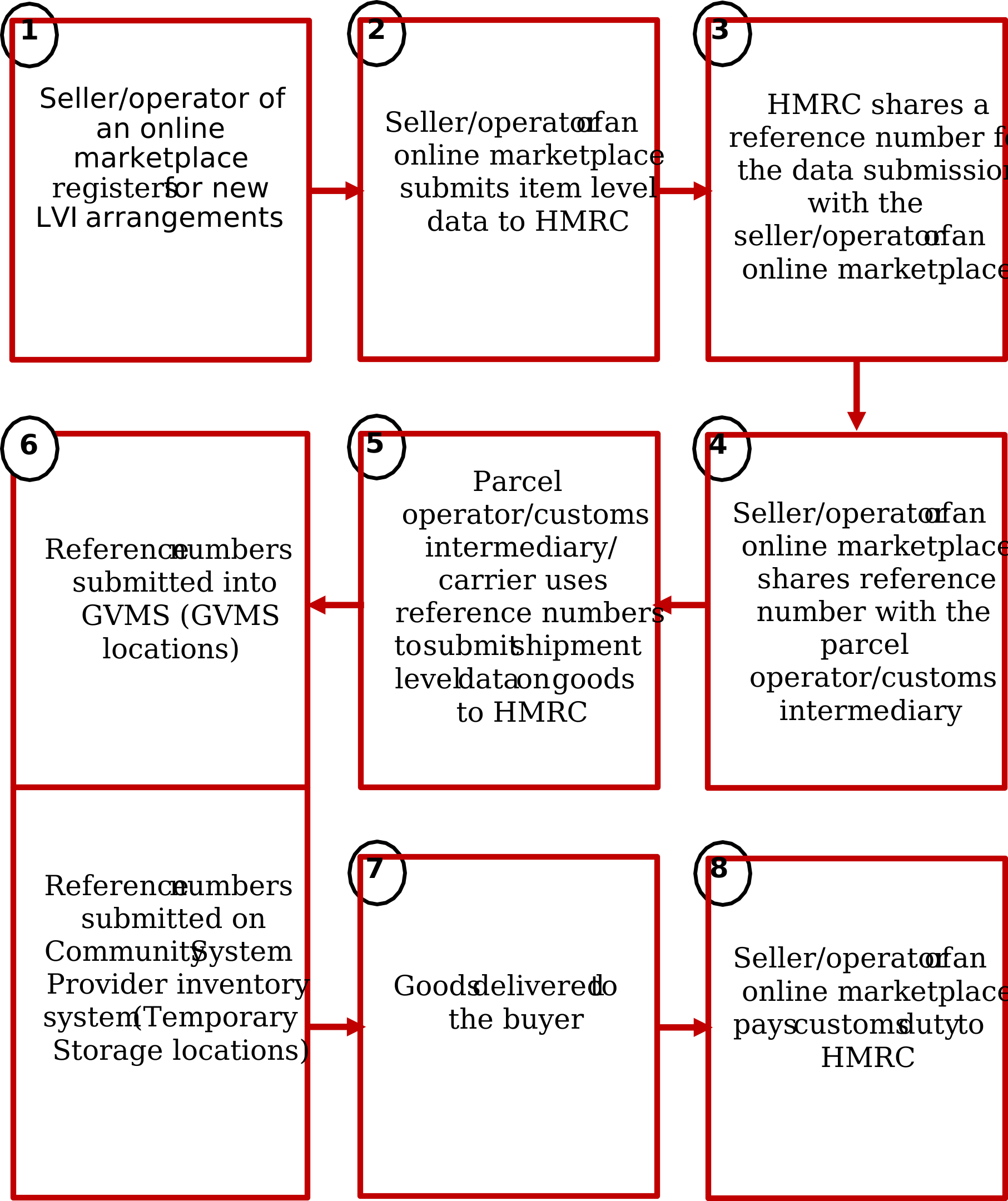
Given LVIs will no longer be declared using the standard import procedures or BIRDS, there will need to be a new mechanism for the goods to be presented to customs on import, risked and cleared. One potential solution would be for HMRC to issue a reference number to the actors submitting the data. This reference number could then be used to generate a Goods Movement Reference (GMR) on the Goods Vehicle Movement Service (GVMS) at roll-on/roll-off (RoRo) ports, or linked to an inventory record at other locations, such as airports, to facilitate the presentation of the goods to customs on import. Figure 3.A, on page 28, illustrates how this process could work.
While the government welcomes views from all stakeholders, it would especially like to hear from sellers and operators of online marketplaces on the data that is already collected and from parcel operators, customs intermediaries, carriers and community service providers on the government’s wider data collection and border clearance proposal. The government wants to co-design these requirements with stakeholders to ensure they are proportionate and deliverable, while meeting broader compliance objectives.
Consultation Questions
19) For sellers/online marketplaces: What item level data do you routinely collect or generate for low value goods? For example, value, goods’ description, buyer, weight etc.
20) For sellers/online marketplaces: What data type, format and structure is this held in?
21) For sellers/online marketplaces: How easy would it be for you to share the item level data with HMRC in advance of the goods being dispatched?
22) For sellers/online marketplaces: What are the opportunities and/or challenges with sharing reference numbers with parcel operators/customs intermediaries/carriers, as set out in Figure 3.A?
23) For parcel operators/customs intermediaries/carriers: With reference to paragraph 3.26 and Figure 3.A, do you envisage any opportunities and/or challenges with providing this data for LVIs through a new system?
24) For parcel operators/customs intermediaries/carriers: What are the opportunities and/or challenges from receiving multiple reference numbers from sellers/operators of online marketplaces and consolidating these to provide data for an entire shipment? How could these be resolved?
25) For parcel operators/customs intermediaries/carriers: Do you envisage any potential challenges with using these reference numbers to customs clear the goods by:
a. Including on the Goods Movement Reference (GMR) when using the Goods Vehicle Movement Service (GVMS) at roll-on/roll-off ports.
b. Submitting into the community service provider inventory system at inventory linked ports.
[If yes] How could these be resolved?
26) For community system providers: CSPs would need to call out directly to a new LVI system to validate reference numbers to clear goods from their inventory systems. What impact would this have on your operations?
Figure 3.A - Illustrative summary of potential new LVI arrangements - subject to stakeholder view
4. Tariff treatment
In Chapter 3, the government highlighted that it will make sellers and operators of online marketplaces liable for the payment of customs duty on LVIs. This chapter sets out the tariff options that sellers and operators of online marketplaces could use as part of the proposed new LVI arrangements.
The UK’s Global Tariff (UKGT) schedule sets the UK’s Most Favoured Nation (MFN) tariff rates. The UKGT schedule applies by default, however the amount of customs duty paid can be lower due to reductions from preferential treatment, suspensions, or reliefs; or higher due to trade defence measures and/or fiscal sanction measures.
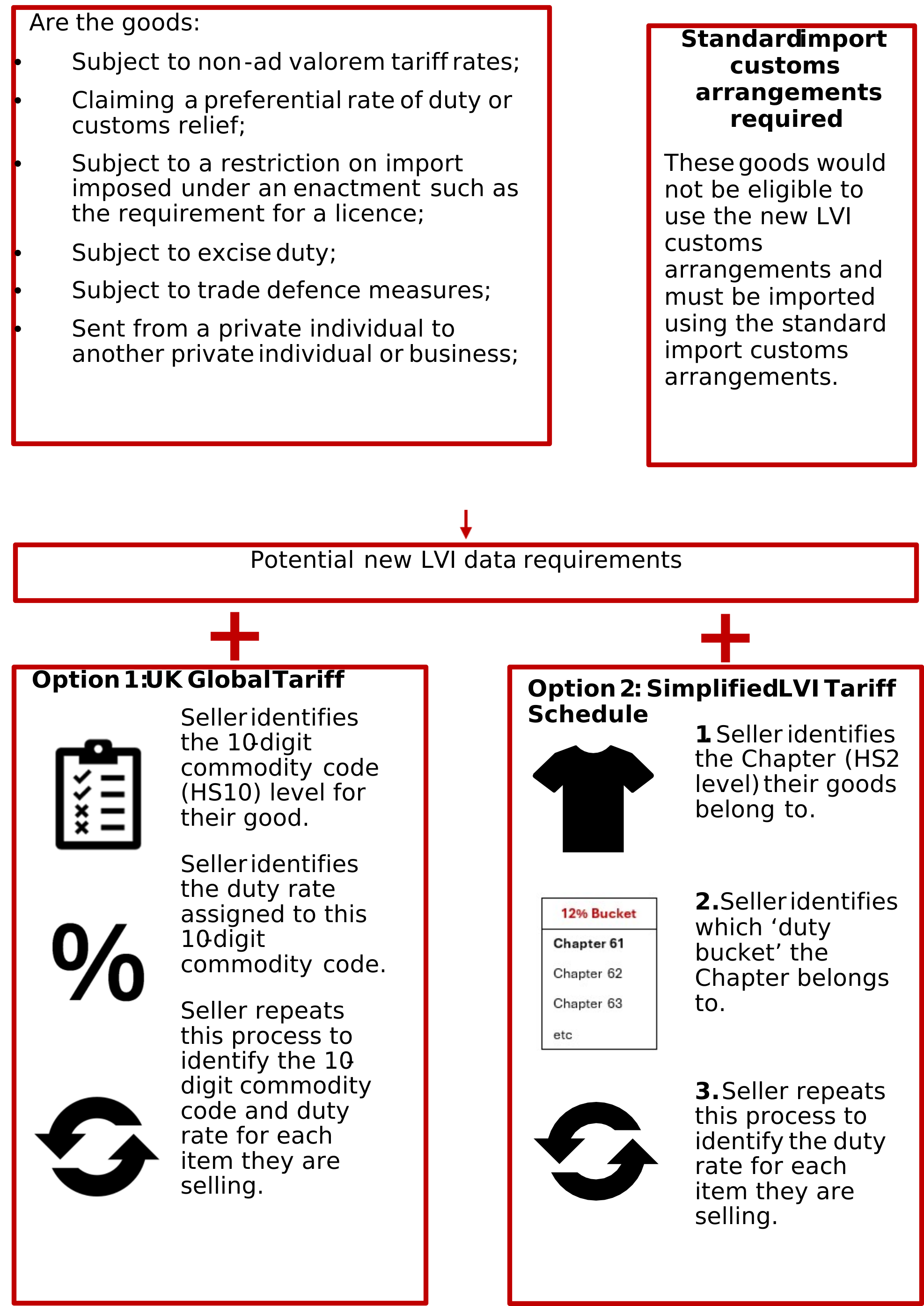
The UKGT schedule organises goods into 97 Chapters, with each Chapter containing a broad category of goods. To determine UK import liability, traders must accurately identify the 10-digit commodity code that applies to the goods.
Once the LVI relief is removed, LVIs will be subject to the tariffs set out in the UKGT schedule. These tariffs will be applied through the new LVI customs arrangements (outlined in Chapter 3) and will require traders to identify the 10-digit commodity code for their goods and apply the correct tariff rate.
Through this consultation, the government would like to understand the potential administrative burdens and costs which would arise for sellers and operators of online marketplaces from providing the full 10-digit commodity code for UKGT tariff treatment of LVIs. It is particularly interested in understanding the potential burden and costs for sellers and operators of online marketplaces of different sizes, to help the government determine whether alternative routes to calculating tariffs, for example through an optional simplified tariff schedule, should be considered.
Simplified Tariff Schedule
In recognition of the potential classification burdens for small businesses trading low value goods, as part of the new LVI customs arrangements the government is considering an optional simplified tariff schedule. This would not be available for use under the standard import customs arrangements.
Sellers and operators of online marketplaces would still be able to apply UKGT rates if they wish. Use of the simplified tariff schedule would be optional.
A simplified tariff schedule would need to condense UKGT Chapters and commodity codes under a handful of tariff rates. Those could be grouped together into several ‘buckets’ with a single tariff rate applied to each bucket. Collapsing thousands of UKGT rates into a small number of buckets would reduce the granularity of the tariff applied to a good and result in some variance between the UKGT rate for a good and the ‘bucket’ rate for a good.
The government is consulting on two illustrative ways that UKGT Chapters could be grouped into buckets. Tables 2 and 3, on pages 32 and 33, provide the illustrative tariff schedules of the buckets UKGT Chapters would be assigned to.
- Option 1 – Set bucket rates at the most frequent tariff rate in UKGT Chapters: For example, Chapters 94 and 95 have 2% as their most frequently occurring tariff rate, meaning they would be grouped together in a 2% bucket. This would enable maximum alignment with UKGT as bucket rates are set so that the majority of goods using the simplified tariff would pay the same rate as they would under UKGT. A minority of goods may pay less, while some may pay more.
- Option 2 - Set bucket rates at the highest tariff rate in UKGT Chapters: For example, Chapters 61 and 62 have 12% as their highest tariff rate, meaning they would be grouped together in a 12% bucket. This would set bucket rates so that no good using the simplified system would be subject to a lower rate than the corresponding UKGT rate. This would introduce some larger variance where low rated goods under UKGT are assigned to comparatively higher rated buckets.
The government has not assigned all UKGT Chapters to buckets in these illustrative schedules. This reflects decisions, as set out in paragraph 2.4, to exclude some goods from accessing the new LVI customs arrangements. The illustrative simplified tariff schedules include the 42 UKGT Chapters the government believes contain a large number of goods which do not fall into the exclusions. We would welcome stakeholder views on whether other UKGT Chapters should be within scope for designing buckets.
If the government did introduce the simplified tariff schedule, it is possible that there will be goods that meet the criteria to use the new LVI customs arrangements but the Chapter their goods are in has not been assigned a tariff bucket. In this instance, those goods would be expected to apply UKGT rates.
Where every good in a UKGT Chapter has a 0% tariff, that Chapter has been assigned to a 0% bucket. Goods in these 5 Chapters are the only goods that can declare into the 0% bucket.
If your good is in a bucket with a tariff rate greater than 0%, but attracts a 0% tariff on the UKGT schedule, you would be required to classify your good to its 10-digit commodity code to access the 0% rate. If you wish to use the bucket system and therefore not classify to 10-digits, you would not be able to access the 0% rate.
Table 2: Illustrative Simplified Tariff Schedule for Option 1 Most Frequently Occurring
0% Bucket
| Chapter | HS2 |
|---|---|
| Photographic or cinematographic goods | 37 |
| Cork | 45 |
| Paper and paperboard | 48 |
| Products of the printing industry | 49 |
| Art | 97 |
2% Bucket
| Chapter | HS2 |
|---|---|
| Rubber | 40 |
| Articles of leather | 42 |
| Manufactures of plaiting materials | 46 |
| Headgear | 65 |
| Feathers and down | 67 |
| Precious metals and stones | 71 |
| Articles of iron and steel | 73 |
| Metal tools and tableware | 82 |
| Miscellaneous articles of base metals | 83 |
| Electrical machinery and equipment | 85 |
| Apparatuses (optical, medical, etc.) | 90 |
| Musical instruments | 92 |
| Furniture | 94 |
| Toys | 95 |
| Miscellaneous manufactured articles | 96 |
4% Bucket
| Chapter | HS2 |
|---|---|
| Soaps, waxes, and paints | 34 |
| Wadding, felt and nonwovens | 56 |
| Impregnated, coated or laminated textile fabrics | 59 |
| Umbrellas and walking sticks | 66 |
| Ceramic products | 69 |
| Clocks | 91 |
6% Bucket
| Chapter | HS2 |
|---|---|
| Dyes, paints, inks, etc. | 32 |
| Essential oils | 33 |
| Plastics | 39 |
| Silk | 50 |
8% Bucket
| Chapter | HS2 |
|---|---|
| Wool | 51 |
| Cotton | 52 |
| Other vegetable textile fibres | 53 |
| Man-made filaments | 54 |
| Man-made staple fibres | 55 |
| Carpets | 57 |
| Special woven fabrics | 58 |
| Knitted fabrics | 60 |
| Footwear | 64 |
12% Bucket
| Chapter | HS2 |
|---|---|
| Apparel, knit | 61 |
| Apparel, not knit | 62 |
| Other made up textile articles | 63 |
| Glass and glassware | 70 |
Table 3: Illustrative Simplified Tariff Schedule for Option 2 Highest Rate
0% Bucket
| Chapter | HS2 |
|---|---|
| Photographic or cinematographic goods | 37 |
| Cork | 45 |
| Paper and paperboard | 48 |
| Products of the printing industry | 49 |
| Art | 97 |
4% Bucket
| Chapter | HS2 |
|---|---|
| Manufactured of plaiting materials | 46 |
| Headgear | 65 |
| Umbrellas and walking sticks | 66 |
| Feathers and down | 67 |
| Precious metals and stones | 71 |
| Articles of iron or steel | 73 |
| Miscellaneous articles of base metal | 83 |
| Apparatuses (optical, medical, etc.) | 90 |
| Musical instruments | 92 |
| Furniture | 94 |
| Toys | 95 |
| Miscellaneous manufactured articles | 96 |
8% Bucket
| Chapter | HS2 |
|---|---|
| Dyes, paints, inks,itc. | 32 |
| Essential oils | 33 |
| Soaps, waxes, and paints | 34 |
| Plastics | 39 |
| Rubber | 40 |
| Articles of leather | 42 |
| Silk | 50 |
| Wool | 51 |
| Cotton | 52 |
| Other vegetable textile fibres | 53 |
| Man-made filaments | 54 |
| Man-made staple fibres | 55 |
| Carpets | 57 |
| Special woven fabrics | 58 |
| Impregnated, coated or laminated textile fabrics | 59 |
| Knitted fabrics | 60 |
| Metal tools and tableware | 82 |
| Clocks | 91 |
12% Bucket
| Chapters | HS2 |
|---|---|
| Wadding, felt and nonwovens | 56 |
| Apparel, knit | 61 |
| Apparel, not knit | 62 |
| Other made up textile articles | 63 |
| Ceramic products | 69 |
| Glass and glassware | 70 |
16% Bucket
| Chapter | HS2 |
|---|---|
| Footwear | 64 |
| Apparel, not knit | 85 |
Table 4: Excluded Chapters
| Chapter | HS2 |
|---|---|
| Live animals | 1 |
| Meat | 2 |
| Fish | 3 |
| Dairy products | 5 |
| Plants | 6 |
| Vegetables | 7 |
| Fruits and nuts | 8 |
| Coffee, tea and spices | 9 |
| Cereals | 10 |
| Flours, starches and malts | 11 |
| Oil seeds and oleaginous fruits | 12 |
| Lac and other vegetable extracts | 13 |
| Other vegetable materials | 14 |
| Animal or vegetable fats, oils or waxes | 15 |
| Preparations of meat or fish | 16 |
| Sugar and candy | 17 |
| Cocoa | 18 |
| Preparations of cereals, flour, starch or milk | 19 |
| Preparations of vegetables, fruit or nuts | 20 |
| Miscellaneous edible preparations | 21 |
| Beverages | 22 |
| Food residues and animal feed | 23 |
| Tobacco | 24 |
| Salt, sulphur, lime, cement, etc. | 25 |
| Chapter | HS2 |
|---|---|
| Ores, slag and ash | 26 |
| Mineral fuels, oils and waxes | 27 |
| Inorganic chemicals | 29 |
| Pharmaceutical products | 30 |
| Fertilisers | 31 |
| Albuminoidals; modified starches; glues; enzymes | 35 |
| Explosives | 36 |
| Miscellaneous chemical products | 38 |
| Leather and skins | 41 |
| Furskins | 43 |
| Wood | 44 |
| Pulp of wood | 47 |
| Articles of stone, plaster, cement, etc. | 68 |
| Iron and steel | 72 |
| Copper | 74 |
| Nickel | 75 |
| Aluminium | 76 |
| Lead | 78 |
| Zinc | 79 |
| Tin | 80 |
| Other base metals | 81 |
| Industrial Machinery | 84 |
| Trains | 86 |
| Vehicles | 87 |
| Aircraft | 88 |
| Ships | 89 |
| Arms and ammunition | 93 |
Figure 4. - Illustrative flow chart for importing goods valued at £135 or less
The government would like to gather views on both of the illustrative simplified tariff schedules, as well as any alternative tariff schedules it should consider. It is especially keen to understand whether sellers or operators of online marketplaces would use a simplified tariff schedule and in what instances they might do so.
The government only intends to introduce a simplified tariff schedule if there is a genuine need to provide sellers and operators of online marketplaces with the option of a less burdensome route – for example, if classifying goods using the UKGT schedule would be too challenging for businesses.
If the responses to this consultation indicate that stakeholders would benefit from a simplified tariff schedule, the government may consult further on the final design of simplified tariff rates.
Consultation Questions
27) Are you familiar with the UK Global Tariff (UKGT) schedule [Yes/No]
a. [If yes] What challenges, if any, would you face if you had to classify LVI goods to a 10-digit commodity code under UKGT?
b. [If yes] What would the time and cost (one off and recurring) be for you to classify LVI goods to a 10-digit commodity code under UKGT? How significant would this time/cost be relative to your total time and costs to trade?
c. [If no] What factors would impact your ability to classify LVI goods to a 10-digit commodity code under UKGT?
d. [If no] What do you expect to be the implications of having to classify LVI goods to a 10-digit commodity code under UKGT? Please consider possible impacts on your costs, volume of LVI trade and final consumer prices.
28) If the government provided a simplified tariff schedule, would you use it? [Yes/No]
a. [If yes] What would be the drivers behind you using this instead of UKGT?
b. [If yes] What would the impact on your time and cost (one off and recurring) be of using a simplified tariff schedule instead of UKGT?
c. [If yes] Would you pay a higher rate to access a simplified tariff bucket system?
d. [If no] Why wouldn’t you use it?
29) What are your views on the illustrative simplified tariff schedule set out in Table 2? What would the specific impacts of this simplified tariff schedule be for your business?
30) What are your views on the illustrative simplified tariff schedule set out in Table 3? What would the specific impacts of this simplified tariff schedule be for your business?
31) Are there any alternative simplified tariff bucket design options that the government should consider?
32) Are there any additional Chapters that you think should be included in the simplified tariff schedule?
33) When designing a potential simplified tariff schedule the government will have regard to the following factors as set out in Section 8(5) of the Taxation (cross-border Trade) Act 2018:
a. the interests of consumers in the United Kingdom,
b. the interests of producers in the United Kingdom of the goods concerned,
c. the desirability of maintaining and promoting the external trade of the United Kingdom,
d. the desirability of maintaining and promoting productivity in the United Kingdom, and
e. the extent to which the goods concerned are subject to competition.
Are there any additional factors which you think the government should have regard to when setting the tariff rates for the optional simplified tariff schedule?
34) If there are any international obligations that you consider may be relevant to the proposed positions set out in Chapter 4, please identify them here.
5. Additional fees on LVIs
HMRC analysis estimates the number of LVI consignments imported using the Bulk Import Reduced Data Set (BIRDS) was approximately 600m in 2024, based on sample data.
In recognition of the unique administrative challenges LVI volumes may pose, the government is considering the introduction of a fee on LVIs. This fee would be in addition to the tariffs that LVIs will now be subject to. Such a fee would be limited to the approximate costs of services rendered (i.e. the administrative cost of HMRC and Border Force maintaining systems, inspecting goods, verifying documents and releasing goods using the new LVI customs arrangements).
If the government were to introduce a fee, there are a range of compliance approaches that could be considered, meaning an exact fee is yet to be determined.
There are a number of ways a fee could be designed, which include:
- A per consignment fee – Regardless of the value of the LVI consignment, or the number of items in the consignment, the same fee amount would apply.
- A per item fee – Regardless of the value or types of items in the LVI consignment, the same fee amount would apply.
- A per “product type” fee – A fee could be applied based on the number of different products in the LVI consignment. For example, a t-shirt and pair of shorts are two product types and would attract two fees. Two t-shirts account for just one product type and would attract one fee.
Due to the international commitments the UK is party to, an ad valorem fee is not being considered.
The government is aware that some of our trading partners, including the EU, are considering implementing an additional fee for LVIs as part of changes to their own LVI arrangements.
As they will be responsible for the payment of customs duty, and are already responsible for the payment of VAT, the government envisage that any fee would be charged to the seller, or operator of an online marketplace if they facilitated the transaction, and paid to HMRC alongside the LVI customs duty.
The government is interested in understanding the potential impacts of introducing an additional fee on LVIs. The government recognises that it cannot make decisions on whether to introduce a fee, and what the fee amount should be, in the absence of understanding stakeholder views and behavioural impacts. It is particularly interested in understanding the impact on smaller businesses who may be disproportionately impacted by a fee.
The government is keen to understand any impacts a fee on LVIs may have on the customs procedures and business models sellers and operators of online marketplaces decide to use.
Consultation Questions
35) What are your views on the concept and implementation of a handling fee on LVIs?
36) Whether you import LVIs or not, what impact would a per consignment fee of £0.50, £2 or £5 (as illustrative costs) have on your existing business operations?
37) Would the impact change if it was a per item or per “product type” fee?
38) What (if any) changes would this approach lead you to make to your business operations?
39) Are there other ways you believe this fee could be designed?
40) Are there any other international obligations that you consider relevant to the proposed introduction of a fee on LVIs?
6. Value Added Tax
The LVI arrangements in the UK constitute both the VAT and customs treatment of consignments with a value of £135 or less, with VAT already due on imported goods of any value. The coherence of the two taxes is an important feature of the import tax regime in the UK. Complementary VAT and customs processes can simplify administration for importing businesses and facilitate trade.
The VAT collection processes in place for LVIs differ from processes for imports valued over £135, to take account of the specific nature, and customs treatment, of LVI trade. As the government progresses reforms to the customs arrangements for LVIs in the UK, it is considering how new processes would interact with the VAT system and whether any changes should be made. Changes to LVI VAT collection would enable continued alignment with customs policy, and could provide opportunities to strengthen protections against non-compliance.
This section of the consultation will cover the current VAT treatment of LVIs before exploring possible reforms in light of customs policy changes.
While the new customs LVI arrangements will allow for the movement of both business-to-business (B2B) and business-to-consumer (B2C) supplies, this section will focus on the VAT treatment of B2C imports which represent the majority of LVIs; other imports are being separately considered. For VAT purposes, B2B supplies are to a VAT-registered customer and B2C supplies are to a non-VAT-registered customer.
Background on the current VAT treatment of Low Value Imports
Since January 2021, imported consignments valued at £135 or less have broadly been subject to a point-of-sale VAT model. Under this model VAT on B2C sales is collected from the consumer at the time of sale by the seller, rather than being applied at the border when the goods enter the UK.
Where an operator of an online marketplace facilitates the sale, the operator is responsible for collecting and accounting for the VAT, ensuring that liability sits with entities best placed to comply.
The seller or operator of an online marketplace is required to be registered for UK VAT and account for it after the point of sale through their VAT return, typically quarterly.
The system was designed to reduce administrative requirements at the border, ensuring the continued flow of goods following the UK leaving the EU. The marketplace liability model also helps to strengthen VAT compliance, by placing responsibility on large, well-regulated platforms that facilitate a significant proportion of low value imports. Consumers also benefit from improved price transparency and customer experience by paying a VAT-inclusive price upfront instead of paying at the border.
Consideration of changes to VAT LVI processes
Reforms to align the VAT treatment of LVIs could see the integration of VAT into the design of the new LVI customs arrangements covered in Chapter 3, providing the benefit that importers can remit both taxes via a single payment process. Separately, the government is considering alignment where customs duty on LVIs is collected at the border via standard import customs arrangements (as outlined in Chapter 2).
VAT integration with new LVI arrangements
Integration of the VAT collection mechanism with the new LVI customs arrangements would involve a single registration for importers, rather than a requirement to register separately for UK VAT. Importers would then account for both customs duty and VAT together, creating a single, coherent payment process, reducing duplication and making it easier for business and operators to comply. Businesses would still need to maintain a VAT registration to account for their other VAT liabilities.
Where operators of online marketplaces facilitate the sales and are made responsible for collecting customs duty, their existing liability for VAT would continue to apply, ensuring consistency with the current system and supporting high levels of compliance.
Under the current VAT model, VAT on LVIs is not currently charged on top of any customs duty as these goods are not subject to customs duty. With the new LVI arrangements, VAT would be charged on the value of the supply of the goods, including the amount of customs duty. This is in line with how VAT is applied to goods chargeable to customs duty.
As set out in Chapter 3, the government is minded to make use of the new LVI arrangements for non-UK-established businesses conditional on appointing a fiscal representative, who would be held jointly and severally liable for the customs debts of the business. The government is considering whether the fiscal representative should also be held jointly and severally liable for the VAT debts of the business arising from LVIs.
Consultation Questions
41) What impact would a unified system for accounting for customs duty and VAT on LVIs have on your business?
42) Where customs duty and VAT collection on LVIs are integrated within a single new system, would your business still need to maintain a UK VAT registration (e.g. to account for other VAT liabilities), and if so, what impact would accounting for VAT separately through two different systems have on your business?
43) Where VAT is chargeable on the value of the supply of goods, including the amount of customs duty, how feasible would it be to calculate that VAT at the point of sale (taking into account that the customs duty would also be calculated and collected at the point of sale by the same business)?
44) For non-UK-established businesses: In order to use the new LVI customs arrangements, how would a requirement to appoint a fiscal representative who is jointly and severally liable for your customs and VAT debts arising from LVIs impact your business?
45) For UK-established businesses: Would you be prepared to act as a fiscal representative of a business if that means being held jointly and severally liable for the VAT debts of that business arising from LVIs?
VAT alignment with customs changes to the standard declaration route
The government is considering how far alignment may be appropriate where customs duty is collected at the border on LVIs cleared through standard import customs arrangements.
At present, VAT on LVIs is broadly collected at the point of sale whether the goods are cleared into the UK using a Bulk Import Reduced Data Set (BIRDS) declaration or standard import customs arrangements. This VAT treatment is possible because there is currently no customs duty on LVIs.
While the government is minded to make the new LVI arrangements mandatory, certain types of goods will in any case be excluded from using these arrangements and will be required to use standard import customs arrangements (as set out in paragraph 2.4). When the LVI relief is removed and LVIs are cleared into the UK through standard import customs arrangements instead of the new LVI arrangements, customs duty would be collected at the point of importation, with the importer liable, instead of at the point of sale. This could reduce the benefit of VAT collection at the point of sale, and introduce challenges for calculating VAT if both taxes were collected separately, as VAT is generally due on the value of the goods including the customs duty. Closer alignment of VAT processes with the standard import customs arrangements, by collecting both customs duty and VAT at the point of importation, could help to streamline compliance for importers by reducing duplication in data entry and payment flows. Alignment could also ensure greater consistency across all import channels, supporting businesses that deal with both low value and higher value consignments.
At this stage the government is keen to understand whether businesses would welcome closer integration of VAT with standard import customs arrangements, and what benefits or challenges they believe they might create.
Consultation Questions
46) Where goods are cleared into the UK using standard import customs arrangements and subject to customs duty collection at the point of importation:
a. What impacts on your business would there be if the UK maintained a model where VAT collection takes place at the point of sale?
b. What impacts on your business would there be if the UK moved to a model where import VAT collection takes place at the border?
c. How do you think the VAT due should be collected and accounted for?
Annex A: List of consultation questions
Introduction
1) If you are representing or responding on behalf of an organisation or trade body, what is the name of your organisation/trade body?
2) What type of organisation(s) are you representing (e.g. parcel operator, seller etc.)?
3) Which country is your organisation/trade body based in?
4) What is the size of your organisation? If you are a trade body, please state your membership size instead.
- micro (0 to 9 employees)
- small (10 to 49 employees)
- medium (50 to 249 employees)
- large (over 250 employees)
5) Do you currently import goods into the UK using the existing LVI customs arrangements? [Yes/No]
a. [If yes] What categories of goods do you import using the current LVI arrangements (e.g. footwear, clothing etc.)?
b. [If yes] What was the estimated combined value of these goods in the last financial year (2024-25)?
c. [If yes] What proportion of your total imports into the UK use the existing LVI custom arrangements annually?
d. [If yes] Which nation(s)/region(s) do you import from?
e. [If no] Do you import through the standard import customs arrangements? If so, what categories of goods do you import, what is their estimated combined value annually, and which nation(s)/region(s) do you import from?
6) For sellers/online marketplaces: based on the information provided in this consultation, how long do you envisage it will take you to implement the new LVI arrangements?
7) HM Treasury and HMRC are required to have regard to international arrangements to which the government is a party that are relevant to the exercise of any functions under Part 1 of the Taxation (Cross-border Trade) Act 2018. If there are any international obligations that you consider may be relevant to the proposed changes set out in the Introduction, please identify them here.
8) The government is interested in understanding whether any particular groups might be impacted by the new LVI arrangements. Do you foresee any socio-economic impacts from the LVI changes, including the protected characteristics, as defined in the Equality Act 2010?
Chapter 2
9) Are there any goods in the proposed list of excluded goods in paragraph 2.4 that you think should be eligible to use the new LVI customs arrangements? If so, what are those goods and why?
Chapter 3
10) With respect to potentially mandating the new LVI customs arrangements, do you foresee any opportunities, challenges or impacts arising from implementing/using these arrangements?
11) If the new LVI customs arrangements are mandated, how will you meet these requirements? Are there any instances where you would want to use standard import customs arrangements for consignments of goods valued at £135 or less?
12) How do you expect the implementation of the new LVI customs arrangements to impact the use of the £39 relief for non-commercial consignments sent by one private individual to another?
13) For sellers/online marketplaces: How will you facilitate paying customs duty to HMRC on a quarterly basis? Please explain your answer.
14) For software providers/intermediaries: Would you consider providing a service to enable sellers/operators of online marketplaces to make these payments?
15) For software providers/intermediaries: Do you have any ideas for how you think any new services to make these payments would best work and/or how it would fit with the current services you offer?
16) For sellers/online marketplaces without a physical presence in the UK: If having a physical presence in the UK was mandated in order to use the new LVI arrangements, how would you meet this requirement? Would you need to appoint a fiscal representative, or would you look to establish a physical presence in the UK?
17) For sellers/online marketplaces without a physical presence in the UK: How much do you estimate it would cost you to appoint a fiscal representative?
18) For businesses with a physical presence in the UK: Would you be prepared to act as a fiscal representative under the conditions set out above?
19) For sellers/online marketplaces: What item level data do you routinely collect or generate for low value goods? For example, value, goods’ description, buyer, weight etc.
20) For sellers/online marketplaces: What data type, format and structure is this held in?
21) For sellers/online marketplaces: How easy would it be for you to share the item level data with HMRC in advance of the goods being dispatched?
22) For sellers/online marketplaces: What are the opportunities and/or challenges with sharing reference numbers with parcel operators/customs intermediaries/carriers, as set out in Figure 3.A?
23) For parcel operators/customs intermediaries/carriers: With reference to paragraph 3.26 and Figure 3.A, do you envisage any opportunities and/or challenges with providing this data for LVIs through a new system?
24) For parcel operators/customs intermediaries/carriers: What are the opportunities and/or challenges from receiving multiple reference numbers from sellers/operators of online marketplaces and consolidating these to provide data for an entire shipment? How could these be resolved?
25) For parcel operators/customs intermediaries/carriers: Do you envisage any potential challenges with using these reference numbers to customs clear the goods by:
a. Including on the Goods Movement Reference (GMR) when using the Goods Vehicle Movement Service (GVMS) at roll-on/roll-off ports.
b. Submitting into the community service provider inventory system at inventory linked ports.
[If yes] How could these be resolved?
26) For community system providers: CSPs would need to call out directly to a new LVI system to validate reference numbers to clear goods from their inventory systems. What impact would this have on your operations?
Chapter 4
27) Are you familiar with the UK Global Tariff (UKGT) schedule [Yes/No]
a. [If yes] What challenges, if any, would you face if you had to classify LVI goods to a 10-digit commodity code under UKGT?
b. [If yes] What would the time and cost (one off and recurring) be for you to classify LVI goods to a 10-digit commodity code under UKGT? How significant would this time/cost be relative to your total time and costs to trade?
c. [If no] What factors would impact your ability to classify LVI goods to a 10-digit commodity code under UKGT?
d. [If no] What do you expect to be the implications of having to classify LVI goods to a 10-digit commodity code under UKGT? Please consider possible impacts on your costs, volume of LVI trade and final consumer prices.
28) If the government provided a simplified tariff schedule, would you use it? [Yes/No]
a. [If yes] What would be the drivers behind you using this instead of UKGT?
b. [If yes] What would the impact on your time and cost (one off and recurring) be of using a simplified tariff schedule instead of UKGT?
c. [If yes] Would you pay a higher rate to access a simplified tariff bucket system?
d. [If no] Why wouldn’t you use it?
29) What are your views on the illustrative simplified tariff schedule set out in Table 2? What would the specific impacts of this simplified tariff schedule be for your business?
30) What are your views on the illustrative simplified tariff schedule set out in Table 3? What would the specific impacts of this simplified tariff schedule be for your business?
31) Are there any alternative simplified tariff bucket design options that the government should consider?
32) Are there any additional Chapters that you think should be included in the simplified tariff schedule?
33) When designing a potential simplified tariff schedule the government will have regard to the following factors as set out in Section 8(5) of the Taxation (cross-border Trade) Act 2018:
a. the interests of consumers in the United Kingdom,
b. the interests of producers in the United Kingdom of the goods concerned,
c. the desirability of maintaining and promoting the external trade of the United Kingdom,
d. the desirability of maintaining and promoting productivity in the United Kingdom, and
e. the extent to which the goods concerned are subject to competition.
Are there any additional factors which you think the government should have regard to when setting the tariff rates for the optional simplified tariff schedule?
34) If there are any international obligations that you consider may be relevant to the proposed positions set out in Chapter 4, please identify them here.
Chapter 5
35) What are your views on the concept and implementation of a handling fee on LVIs?
36) Whether you import LVIs or not, what impact would a per consignment fee of £0.50, £2 or £5 (as illustrative costs) have on your existing business operations?
37) Would the impact change if it was a per item or per “product type” fee?
38) What (if any) changes would this approach lead you to make to your business operations?
39) Are there other ways you believe this fee could be designed?
40) Are there any other international obligations that you consider relevant to the proposed introduction of a fee on LVIs?
Chapter 6
41) What impact would a unified system for accounting for customs duty and VAT on LVIs have on your business?
42) Where customs duty and VAT collection on LVIs are integrated within a single new system, would your business still need to maintain a UK VAT registration (e.g. to account for other VAT liabilities), and if so, what impact would accounting for VAT separately through two different systems have on your business?
43) Where VAT is chargeable on the value of the supply of goods, including the amount of customs duty, how feasible would it be to calculate that VAT at the point of sale (taking into account that the customs duty would also be calculated and collected at the point of sale by the same business)?
44) For non-UK-established businesses: In order to use the new LVI customs arrangements, how would a requirement to appoint a fiscal representative who is jointly and severally liable for your customs and VAT debts arising from LVIs impact your business?
45) For UK-established businesses: Would you be prepared to act as a fiscal representative of a business if that means being held jointly and severally liable for the VAT debts of that business arising from LVIs?
46) Where goods are cleared into the UK using standard import customs arrangements and subject to customs duty collection at the point of importation:
a. What impacts on your business would there be if the UK maintained a model where VAT collection takes place at the point of sale?
b. What impacts on your business would there be if the UK moved to a model where import VAT collection takes place at the border?
c. How do you think the VAT due should be collected and accounted for?
Annex B: Processing of personal data
Introduction
This Privacy Notice should be read alongside HM Treasury’s (HMT’s) Personal Information Charter. The Charter sets out:
- the standards you can expect from HMT when we use your personal information;
- the contact details for our Data Protection Officer;
- how to exercise your Data Protection Information Rights (including access);
- how to exercise your right to complain to the Information Commissioner’s Office.
This Privacy Notice supplements the Personal Information Charter and outlines additional information in relation to Consultation responses from all interested parties and stakeholders.
This section sets out how we will use your personal data and explains your relevant rights under the UK General Data Protection Regulation (UK GDPR). For the purposes of the UK GDPR, HM Treasury are the data controller for any personal data you provide in response to this consultation.
Data subjects
The personal data we will collect relates to individuals responding to this consultation though we note that most respondents will be acting as a representative of an organisation rather than in a personal capacity. These responses will come from a wide group of stakeholders with knowledge of a particular issue.
The personal data we collect
The personal data will be collected directly from you through voluntary email submissions, or the digital form provided, in response to this consultation and are likely to include your name(where provided), email address, employer and job title (where you are representing an organisation in your response), and your opinions.
We do not intend to collect special categories of personal data, respondents are advised not to include sensitive information in free-text fields.
How we will use the personal data
This personal data will only be processed for the purpose of obtaining opinions about government policies, proposals, or an issue of public interest.
Processing of this personal data is necessary to help us understand who has responded to this consultation and, in some cases, contact respondents to discuss their response.
HM Treasury will not include any personal data when publishing their response to this consultation.
Artificial Intelligence (AI) may be used to support the analysis and summarisation of responses; where this occurs, reasonable efforts will be made to remove personal data (such as email addresses and telephone numbers) before analysis takes place. AI tools are securely hosted; AI is used to assist staff and does not replace human judgement or make automated decisions.
This activity does not involve automated decision making or profiling. This means that decisions which may affect you are not made solely by automated means without human involvement, and your data is not subject to analysis intended to evaluate or predict aspects such as your behaviour, preferences, or interests.
Lawful basis for processing the personal data
We will process your personal data for the following purpose using the specified lawful basis below:
| Purpose | Lawful Basis | Further Information |
| Obtaining opinions about government policies, proposals, or an issue of public interest | Article 6(1)(e) of the UK GDPR - Public task | To help HMT understand who has responded to this consultation and, in some cases, contact respondents to discuss their response. |
Who will have access to the personal data
The personal data will only be made available to those with a legitimate business need to see it as part of consultation process.
This consultation is being run jointly by HM Treasury and HM Revenue and Customs. Personal data received in responses will be shared with HM Revenue and Customs in order for them to also understand who responded to the consultation.
We will share your personal data with the following types of recipients:
- HMT and HMRC staff and Ministers - who have a business need to access the data as part of the consultation process
- Other government departments – who have policy functions relevant to the consultation topic. Sharing in this context will ordinarily be anonymised unless information about the respondent is necessary to inform policy.
An anonymised version or a summary of your response may be published, or otherwise shared with third parties, during the consultation, in subsequent review reports, and where otherwise required by law (e.g. in response to a Freedom of Information Act 2000 request). As such, consultation respondents are advised not to include personally identifiable information in any free-text fields. If you elect to complete the digital form, this will be conducted using SmartSurvey, an industry-leading online survey provider with the highest standards of data security. As with other organisations processing personal data, SmartSurvey is subject to data protection compliance requirements.
Although SmartSurvey uses an automated system, the responses you give will not lead to any decisions being made about you and they will not have a direct impact upon you. In this context, SmartSurvey acts solely as a data processor under instruction from HMT and will not use your personal data for any purposes other than to provide the service to HMT. For more information on how SmartSurvey handles respondents’ data, please refer to their privacy policy here - https://www.smartsurvey.co.uk/company/privacy-policy As the personal data is stored on our IT infrastructure, it will be accessible to our IT service providers. They will only process this personal data for our purposes and in fulfilment with the contractual obligations they have with us.
Please be aware that if we receive correspondence or communication which we consider threatening in nature or suggests a possible risk to you or a third party, we may share this correspondence (along with your personal data) with relevant law enforcement / safeguarding authorities.
How long we hold the personal data for
We will retain the personal data until work on the consultation is complete and no longer needed.
Responses submitted via the Smart Survey digital form will be kept by Smart Survey for as long as we need them. Once the deadline for completion of the survey has passed, all responses will be transferred from SmartSurvey to HMT/HMRC.
International Transfers
Your personal data will not be transferred to an international recipient during this activity.
Your data protection rights
Relevant rights, in relation to this activity are to:
- request information about how we process your personal data and request a copy of it
- object to the processing of your personal data
- request that any inaccuracies in your personal data are rectified without delay
- request that your personal data are erased if there is no longer a justification for them to be processed
- complain to the Information Commissioner’s Office if you are unhappy with the way in which we have processed your personal data
How to submit a data subject access request (DSAR)
To request access to your personal data that HM Treasury holds, please email: dsar@hmtreasury.gov.uk
Complaints
If you have concerns about Treasury’s use of your personal data, please contact our Data Protection Officer (DPO) in the first instance at: privacy@hmtreasury.gov.uk
If we are unable to address your concerns to your satisfaction, you can make a complaint to the Information Commissioner at casework@ico.org.uk or via this website: https://ico.org.uk/make-a-complaint.