Raising standards for household tumble dryers: government response (accessible webpage)
Updated 24 March 2026

© Crown copyright 2026
This publication is licensed under the terms of the Open Government Licence v3.0 except where otherwise stated. To view this licence, visit nationalarchives.gov.uk/doc/open-government-licence/version/3 or write to the Information Policy Team, The National Archives, Kew, London TW9 4DU, or email: psi@nationalarchives.gov.uk.
Where we have identified any third party copyright information you will need to obtain permission from the copyright holders concerned.
This publication is available at https://www.gov.uk/government/consultations/raising-product-standards-for-household-tumble-dryers/outcome/raising-standards-for-household-tumble-dryers-government-response-accessible-webpage
Introduction
Ecodesign legislation enables the government to set minimum energy performance standards, removing the least efficient products from the market. This protects consumers from high running costs and incentives manufacturers to improve product efficiency. Energy labelling provides clear information to help consumers choose the most energy-efficient options and supports competition.
These policies have delivered significant benefits, reducing electricity demand by an estimated 245 TWh and saving 59 MtCO₂e since 2010. They remain among the most cost-effective measures to cut emissions and bills, with minimal impact on consumers and businesses. Innovation driven by these regulations has improved tumble dryer efficiency, lowering carbon emissions and household energy costs.
The government consulted, from 17 July to 14 August 2025, on proposals to update the ecodesign and energy labelling rules for household tumble dryers.
This document sets out the government’s response to the consultation on raising standards for household tumble dryers and confirms the final policy decisions. It outlines our intention to introduce a statutory instrument (SI) which will both raise minimum energy performance standards and reform energy labelling requirements for household tumble dryers sold in Great Britain (GB).
Overview
The consultation was open for 4 weeks. We accepted responses through an online survey and by email. We received 12 responses in total. Table 1 shows the types of respondents and the organisations they represent.
Table 1. Types of consultation respondent
| Types of respondents | Number of responses | Organisation names |
|---|---|---|
| Private individuals | 3 | – |
| Manufacturer | 2 | – Beko Europe – Anglian Windows |
| Retailer | 2 | – John Lewis – The Very Group |
| Manufacturers trade association | 1 | Association of Manufacturers of Domestic Appliances (AMDEA) |
| Retailers trade association | 2 | – British Retail Consortium (BRC) – British Independent Retailers Association (BIRA) |
| University | 1 | Edinburgh Napier University |
| Consultancy | 1 | Guidehouse |
This document summarises the feedback we received. It gives a high-level overview of stakeholder views and sets out the government’s final decisions based on the evidence and consultation responses received.
We have not included every comment, and we have excluded feedback on issues that were outside the scope of the consultation.
The final regulations
Following consultation, the government will repeal and replace the current ecodesign and energy labelling standards for household tumble dryers in GB with new regulations that will bring in requirements in line with the European Union (EU) Regulations 2023/2533 and 2023/2534. Stakeholder feedback showed strong support for our proposals, with broad agreement on the technical requirements and policy intent.
Except for the changes listed below, we have decided to introduce the regulations as originally proposed:
- The updated ecodesign requirements will now come into force after a 10 month transitional period instead of a 6 month transitional period, aligning with the new energy labelling requirements. This change responds to stakeholder feedback and supports a smoother transition for manufacturers and retailers.
- After the current energy labelling requirements are replaced (10 months after the SI is laid), the energy labels supplied by suppliers must be the rescaled energy label, with the repairability class
- We have added a post-implementation review date of 9 December 2032. This will allow us to assess the impact of the regulations and consider any future updates.
- Corrections have been made to the final SI to ensure that it is in line with the EU regulations. This includes the addition of the formulae for calculating average moisture content, disassembly depth score and fastener type score. Formatting issues in the SI have also been addressed.
The final regulations confirm the government’s commitment to raising standards for household tumble dryers. The measures set out below will deliver significant improvements in energy efficiency, product durability, consumer information, and market alignment.
To improve the efficiency of household tumble dryers, the final regulations introduce a new minimum performance standard that phases out inefficient gas-fired, air-vented, and condenser models. Only tumble dryers with an Energy Efficiency Index (EEI) less than 85 will remain on the market, all products must feature an eco-programme as the default or directly selectable cycle, achieve at least 80% condensation efficiency, and meet strict limits on energy use in off-mode, standby, and networked standby settings.
To support a circular economy, the final regulations improve product durability, reparability and end-of-life management. Manufacturers must make critical spare parts such as drums, seals and motors, available for at least 10 years after a model is discontinued. They are also required to provide detailed repair and maintenance documentation to professional repairers and end-users. Products must be designed so that key components can be removed using standard tools, making repairs and recycling easier. Clear instructions for end-of-life processing must be included to ensure components are properly recycled and environmental impact is minimised.
The final regulations will make it easier for consumers to compare and choose the most efficient tumble dryers. The energy label will move to a clear A to G scale, replacing the A+++ to D system. Labels will now display key information such as energy use per cycle, noise levels, condensation efficiency, and new details on acoustic noise and repairability, helping consumers make informed decisions.
By introducing ecodesign and energy labelling requirements that are in line with the EU, the regulations will reduce compliance costs for manufacturers and prevent unnecessary trade barriers. This approach ensures that consumers in GB continue to have access to a wide range of efficient products, while supporting smooth trade within the UK internal market. The 10 month transition period for both ecodesign and energy labelling changes will help industry manage the transition effectively.
These reforms will contribute significantly to the Clean Power 2030 Mission, saving an estimated 0.29 MtCO₂e during CB5, 0.15 MtCO₂e during CB6, and 0.56 MtCO₂e by 2050. They are expected to deliver energy savings of 30,710 GWh by 2050.
In ensuring that only the most efficient heat pump tumble dryers are available for purchase on the market, these changes will save consumers money on their energy bills, reducing cost-ofliving pressures. On average, a heat pump tumble dryer owner could save £200 over 12 years compared to a condenser model, and up to £910 over a 20-year lifetime.
Ecodesign requirements
This section provides guidance on the supplier obligations regarding the ecodesign requirements:
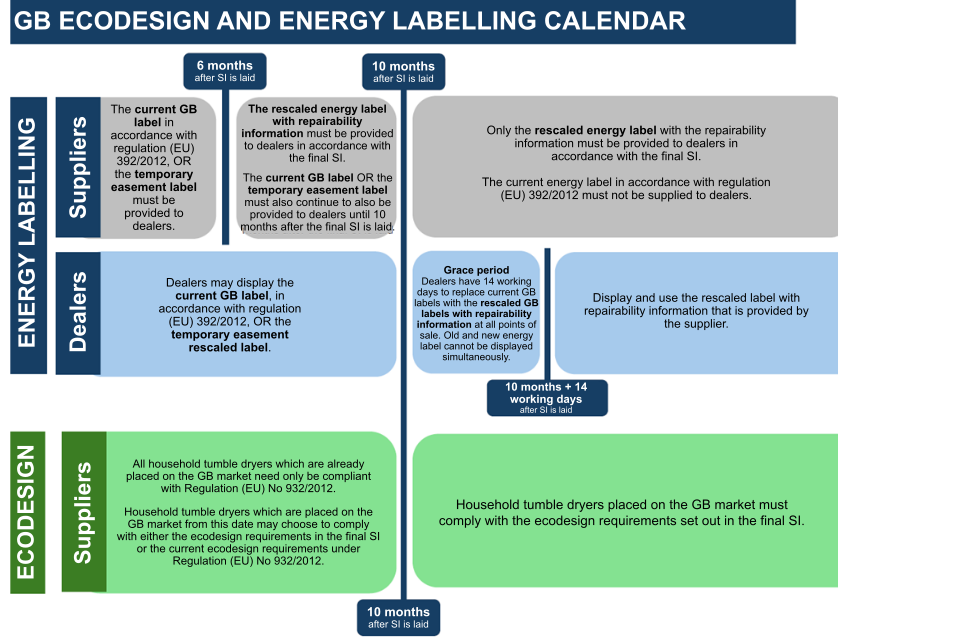
From 22 days after the SI is laid:
- Suppliers must comply with the new GB ecodesign requirements or the old Regulation (EU) No 932/2012 requirements
From 10 months after the SI is laid:
- All household tumble dryers placed on the GB market after this date must comply with the new ecodesign requirements set out in the final SI
Energy labelling requirements
This section provides guidance for suppliers1 and dealers2 regarding the energy labelling requirements. We have implemented a temporary enforcement easement on energy labelling requirements for household tumble dryers in GB. This easement confirms that enforcement action will not be taken against the supply of easement energy labels and new product information sheets (aligned with EU equivalents), in place of the current energy labels and product fiche required under Regulation (EU) No 392/2012.
Suppliers – energy labelling
From the date the SI is laid:
- Each household tumble dryer will continue to be supplied to dealers with the current energy label in accordance with regulation (EU) 392/2012, or the temporary easement label instead
From 6 months after the SI is laid:
- Each household tumble dryer will be supplied to dealers with both the current energy label in accordance with regulation (EU) 392/2012, or the temporary easement label, and the rescaled energy label with or without the repairability class in accordance with the SI
- The rescaled energy label with or without the repairability class must be provided to dealers
From 10 months after the SI is laid:
- The current energy label in accordance with regulation (EU) 392/2012, and the temporary easement label, must not be supplied to dealers from 10 months after the SI is laid
- Each household tumble dryer must be supplied to dealers with the rescaled energy label with the repairability class
Dealers – energy labelling
The obligations detailed below apply to energy labels displayed at all points of sale, including in physical stores and online. Dealers are never permitted to display 2 energy labels to consumers at once.
From the SI laying date:
- Dealers will display the current energy label in accordance with regulation (EU) 392/2012, or the temporary easement label
From 6 months after the SI is laid:
-
Suppliers will provide dealers with 2 labels: 1) the current energy label in accordance with regulation (EU) 392/2012, or the temporary easement label, and 2) the rescaled energy label with or without the repairability class in accordance with the SI
-
Dealers will display the current energy label in accordance with regulation (EU) 392/2012, or the temporary easement label
From 10 months after the SI is laid:
- Dealers will replace the current energy label, or the temporary easement label, with the rescaled energy label they have received from the supplier in accordance with the SI within 14 working days (from 10 months post laying) at all points of sale
- Dealers must ensure that the rescaled label with the repairability class provided by the
supplier in accordance with the SI is displayed
Part 1: Enhance efficiency
Chapter 1: Eco-programme requirement
Question 1: Do you agree with the proposed change of name to ‘eco programme’?
Most respondents supported renaming the cycle to ‘eco-programme’, with 8 out of 12 agreeing. Manufacturers and retailers welcomed the change, noting it aligns GB with EU Regulations 2023/2533 and 2023/2534 and improves consistency across household appliances. Several stakeholders also appreciated the flexibility to include terms like ‘eco cotton’, which could enhance consumer understanding. Only 1 individual opposed the change without providing justification.
Chapter 2: Minimum energy performance standards
Question 2: Do you agree with our proposed requirements on eco-programme –default/easily identifiable/to be used in testing?
Question 3: Do you agree with the proposed changes to the formula for calculating EEI? Yes/No/Don’t know. Please provide evidence to support your answer.
Question 4: Do you agree that the EEI should be set at 85? Yes/No/Don’t know. Please provide evidence to support your answer.
There was strong support for making the eco-programme the default or most easily identifiable cycle used in testing. Eight respondents agreed, including manufacturers, retailers, and a consultancy, highlighting the behavioural benefits of nudging consumers toward energy efficient choices. Again, only 1 individual disagreed without explanation.
On the proposed changes to the formula for calculating the Energy Efficiency Index (EEI), responses were more mixed. Six agreed, 1 disagreed, and 4 were unsure. Trade bodies supported the change, citing improved consistency across GB and NI. Others emphasised the need to update GB designated standards in line with EU harmonised standards. They also flagged the omission of the average moisture content formula in the draft SI. A consultancy noted that the revised formula better reflects real world usage, correcting overstatements in current efficiency ratings.
The proposal to set the EEI threshold at 85 received broad support, with 8 respondents in favour. Stakeholders noted this would effectively phase out inefficient gas-fired, air-vented and condenser models and accelerate the shift to heat pump technology. Some respondents highlighted the consumer and environmental benefits of this transition. One individual opposed the proposal without providing evidence.
Chapter 3: Condensation efficiency standards
Question 5: Do you agree with our proposal to set a minimum condensation efficiency of condenser tumble dryers of 80%? Yes/No/Don’t know. Please provide evidence to support your answer.
The proposal to set a minimum condensation efficiency of 80% for condenser tumble dryers was well received, with 9 respondents in agreement. Stakeholders noted that this would reduce the risk of mould and dampness, improve indoor air quality, and support the phase-out of non-heat pump models. A consultancy added that this threshold would help prevent structural damage and respiratory health risks. One individual disagreed without explanation.
Chapter 4: Off-mode and standby mode requirements
Question 6: Do you agree with our proposal to require household tumble dryers to have an off-mode, a standby-mode, or both? Do you agree with the associated requirement that the power must not exceed 0.50 W when on these modes? Yes/No/Don’t know. Please provide evidence to support your answer.
Question 7: Do you agree with the proposal to decrease the standby and off mode power consumption limit to 0.3W from 9 May 2027?
There was strong consensus on requiring tumble dryers to include off-mode and/or standby mode functionality, with power consumption capped at 0.50 W. Ten respondents supported the proposal, citing alignment with EU regulations. One individual suggested a stricter limit of 0.00 W, while another opposed the change without qualification.
The proposal to reduce the off-mode power limit to 0.30 W from 9 May 2027 also received support from 10 respondents. However, some stakeholders flagged that there would be divergence with EU regulations if the standby limit was also reduced to 0.30 W. One manufacturer opposed the change on this basis, and 1 individual disagreed without providing reasoning.
Government response for Part 1: Enhance efficiency
As we received strong support from stakeholders for all our proposals to enhance energy efficiency, we will proceed with the majority of proposals set out in the consultation. Manufacturers, retailers, trade bodies and other respondents agreed that aligning GB’s rules with the latest EU regulations will make it easier for industry to comply, help consumers understand product labels, and encourage innovation in energy-saving technologies.
Most respondents supported changing the name to ‘eco-programme’ and making it the default setting for testing. They said this would keep tumble dryers consistent with other appliances and help consumers make informed choices. Accordingly, we will continue with this proposal.
There was broad agreement on updating the formula for the Energy Efficiency Index (EEI) and setting the threshold at 85. Stakeholders said this would phase out inefficient vented and condenser models and encourage the use of heat pump technology, saving energy and money for consumers. On this basis, we have decided to continue with this proposal.
Most respondents supported setting a minimum condensation efficiency of 80% for condenser tumble dryers. They said this would reduce the risk of mould and damp, protect buildings, and improve health. We will therefore be continuing with this proposal.
The omission of the average moisture content formula will be corrected in the final SI.
Most respondents agreed with requiring tumble dryers to have an off-mode, a standby mode, or both, with a maximum power consumption of 0.50 W, and we will therefore continue as originally proposed. In the final SI, we will be reducing the off-mode power limit to 0.30 W from 9 May 2027 only.to improve energy efficiency and maintain alignment with EU ecodesign requirements.
Finally, we will work with the Office for Product Safety and Standards (OPSS) to update the UK designated standards in line with the new EU harmonised standards prior to the implementation of the final SI.
Part 2: Support a circular economy
Chapter 5: Availability of spare parts
Question 8: Do you agree with our proposed requirements on manufacturers, importers and authorised representatives regarding the availability of spare parts? Yes/No/Don’t Know. Please provide evidence to support your answer.
There was overwhelming support for the proposed requirements on spare parts, with 11 out of 12 respondents agreeing. Manufacturers and retailers endorsed the alignment with EU Regulations 2023/2533 and 2023/2534, recognising that ensuring spare parts are available for a reasonable period is critical for sustainability and extending product lifespans.
One respondent recommended that the government promote the availability and use of spare parts to the public and continue monitoring EU developments to help retailers plan for sourcing spare parts. One manufacturer highlighted the complexity of repairing heat pump tumble dryers and called for a clear definition of ‘professional repairer’ to ensure only qualified individuals undertake certain repairs.
Chapter 6: Repair and maintenance documentation
Question 9: Do you agree with our proposed requirements regarding software and firmware updates? Yes/No/Don’t know. Please provide evidence to support your answer.
Support for the requirements on software and firmware updates was similarly strong, with 11 out of 12 respondents agreeing. Stakeholders, including manufacturers and retailers, welcomed the alignment with EU regulations. One trade association emphasised that making updates available is essential for consumer trust and product longevity, while a consultancy highlighted the importance of these requirements for maintaining safety, functionality, and cybersecurity.
Chapter 7: Design for repairability and end of life processing
Question 10: Do you agree with our draft SI’s proposed new information requirement for refrigerant gases used in heat pump tumble dryers? Yes/No/Don’t know. Please provide evidence to support your answer.
10 out of 12 respondents supported the new information requirement for refrigerant gases. Manufacturers and retailers agreed that this measure aligns with EU standards and will improve safety during repair, recycling, and disposal by reducing environmental contamination risks. Two respondents specifically noted the benefits of clear labelling for safe handling. One private individual disagreed but did not provide further reasoning.
Government response for Part 2: Support a circular economy
As we received strong support for all our proposals to improve the repairability, longevity and sustainability of household tumble dryers, we have decided to proceed with these regulations with no further changes to the proposals in the consultation. Respondents, including manufacturers, retailers, trade bodies and consultancies, agreed that these measures will help reduce waste, extend product lifespans and support the transition to a circular economy.
Considering that the majority of respondents supported the proposed requirements for the spare parts availability requirements, the repair and maintenance documentation requirements and the informational requirements on refrigerant gases, we will be continuing with these proposals in our final SI with no changes. The final SI will also contain the proposed requirements to support software and firmware updates for an extended period of time with no further changes, following support from respondents.
We agree that complex repairs should only be attempted by those who are qualified to undertake them. It is our view that the definition of ‘professional repairer’, and our proposed requirement that spare parts required for these complex repairs will only be available to these professional repairers, is sufficient to ensure that this happens. As such, we have decided to continue as proposed in the consultation.
We agree that information and guidance on the availability of spare parts may be beneficial to consumers. We will note this feedback and will keep the suggestion under review.
Part 3: Improve consumer information
Chapter 8: Rescaling the energy efficiency classes
Question 11: Do you agree with our proposal to replace and rescale the energy efficiency classes to an A to G scale? Yes/No/Don’t know. Please provide evidence to support your answer.
9 out of 12 respondents supported the proposal to replace the existing A+++ to D scale with a clearer A to G scale. Manufacturers and retailers welcomed the alignment with EU Regulations 2023/2533 and 2023/2534, noting that consistent labelling across the UK would reduce consumer confusion and simplify compliance.
If we did not introduce the proposed regulations, 1 respondent highlighted that misalignment would continue market disruption for NI. Another respondent noted that stock segregation due to the differing labels between GB and NI has increased costs for manufacturers.
Two private individuals disagreed 1 suggested a numerical scale (1 to 7) would better communicate relative efficiency, while the other provided no justification.
Chapter 9: Rescaling the condensation efficiency classes
Question 12: Do you agree with our proposal to replace and rescale the condensation efficiency classes to an A to D scale? Yes/No/Don’t know. Please provide evidence to support your answer.
Nine respondents agreed with the proposal to rescale condensation efficiency classes to an A to D scale. Stakeholders supported the move as it aligns with EU regulations and ensures labels reflect the new minimum performance standards.
One respondent noted that the current labelling system accommodates values below the proposed minimum standards, reinforcing the need for rescaling.
Two private individuals disagreed - 1 proposed a numerical scale for clarity, while the other did not provide a reason.
Chapter 10: Introducing acoustic airborne noise emission classes
Question 13: Do you agree with our proposal to introduce an acoustic airborne noise emission classification system? Yes/No/Don’t know. Please provide evidence to support your answer.
Ten respondents supported the introduction of a noise emission classification system. Manufacturers and retailers agreed that this aligns with EU regulations and addresses a key consumer concern.
Six respondents highlighted that noise levels are an important factor in purchasing decisions, and 5 stated that clearer labelling would help consumers compare products more effectively. One private individual opposed the proposal without explanation.
Chapter 11: Introducing repairability index
Question 14: Do you agree with our proposal to introduce a repairability score and classification system? Yes/No/Don’t know. Please provide evidence to support your answer
Ten respondents agreed with the proposal to introduce a repairability index, while 1 disagreed and 1 was unsure. Stakeholders welcomed the alignment with EU regulations and emphasised that this proposal would empower consumers to choose longer-lasting products and make more sustainable choices. Some suggested that businesses should be given tools to help communicate the repairability index to consumers.
One respondent noted that the index would help consumers choose longer-lasting products and recommended that businesses be given tools to communicate the system effectively to consumers.
One private individual disagreed without providing justification.
Question 15: Do you agree with how the repairability score would be calculated? Yes/No/Don’t know. Please provide evidence to support your answer.
Eight respondents supported the proposed calculation method, while 1 disagreed and 3 were unsure.
Stakeholders stressed the importance of full alignment with the EU’s methodology. One manufacturer called for identical calculation methods and clear guidance documents for suppliers to calculate the repairability score.
A trade association highlighted that the draft SI lacks complete equations for disassembly depth and fastener type scores, which are necessary for full alignment.
Another respondent reiterated the need for tools to help businesses communicate the index. One private individual opposed the proposal without explanation.
Question 16: Do you agree with the proposed transitional provisions for the introduction of repairability classes on energy labels? Yes/No/Don’t know. Please provide evidence to support your answer.
Eight respondents agreed with the proposed transitional arrangements, while 3 were unsure and 1 disagreed. Manufacturers and retailers supported the timeline, noting that it mirrors the EU’s Regulation 2023/2534 and will ease implementation.
One private individual disagreed without providing further comment.
Government response for Part 3: Improve consumer information
Considering that we received strong support for our proposals to improve the information available to consumers when buying household tumble dryers, we will be proceeding with the proposals as set out in the consultation. Respondents—including manufacturers, retailers, trade bodies and others—agreed that these measures will help consumers make better choices, encourage competition, and support the transition to more sustainable products. Stakeholders also welcomed alignment with EU Regulations 2023/2533 and 2023/2534.
The proposals that will remain unchanged for the final SI include replacing and rescaling the energy efficiency classes to an A to G scale, the introduction of the noise emission classification system, and the introduction of a repairability score and classification system.
Although most respondents agreed with the proposed method for calculating the repairability score, 1 stakeholder stated that the calculations were incomplete. In response to this, we have included the calculations for the complete equations for disassembly depth and fastener type scores in the final SI, and we have ensured that the calculation method is identical with the EU regulations.
We agree that improving the guidance for consumers on the meaning and significance of the repairability score would improve its effectiveness. We also agree that providing guidance to suppliers on how to calculate the repairability score would be beneficial. We note this feedback, and we will keep these suggestions under review.
Most respondents supported the proposed transitional arrangements for the repairability score, noting that they match the EU’s timeline and will make implementation easier. We will proceed with the transitional provisions as proposed.
We have decided against introducing a numerical scale for the energy label, as suggested by 1 respondent. This is because it would mean that the energy efficiency scale would differ from the alphabetical scale that is standard for energy labels for white goods and other energy related products. Our view is that this would cause consumer confusion.
Part 4: Support the UK internal market and facilitating trade
Chapter 13: Internal market and transitional period
Question 17: Do you agree that it would be beneficial for GB’s ecodesign and energy labelling requirements for household tumble dryers to keep pace/be consistent with EU regulations 2023/2533 and 2023/2534?
9 out of 12 respondents agreed that maintaining alignment with EU regulations would be beneficial, while 1 disagreed and 2 were unsure. Manufacturers and retailers highlighted that alignment reduces compliance costs, streamlines product development, and avoids duplication of testing and certification. Several respondents warned that continued misalignment could lead to industry withdrawing products from the GB or NI markets due to increased costs. One respondent noted that similar issues could arise for other household appliances if regulatory divergence continues. Two respondents also emphasised that alignment would reduce consumer confusion. One private individual who disagreed, and the 2 respondents who were unsure, provided no further comments to explain their response.
Question 18: Do you agree with the proposed 6-month transition period for the new ecodesign requirements, or do you think it should be longer? If the latter, what alternative duration would you suggest and why?
Seven respondents supported the proposed 6 month transition period, with some recommending that the government issue guidance to support implementation. One trade association suggested monitoring industry readiness ahead of the mandatory date.
A trade association and 1 manufacturer argued for a longer transition, proposing that the period should extend to 31 December 2026 so that ecodesign and the mandatory full, rescaled energy labels with the repairability index take effect simultaneously. They stated that it would cause a period where suppliers could provide the energy label in the new A to G format without the repairability index on the label, only to have to provide the A to G energy label with the repairability index shortly thereafter. They argued that making the ecodesign requirements mandatory at the same time as these labelling changes would avoid unnecessary administrative costs, reduce logistical burdens, and prevent consumer confusion.
One private individual also called for a longer period so that any existing air vent installations, which are used in air-vented household tumble dryers, in consumers’ households do not go to waste until the end of the installations’ lifetime. They implied that some may not have a suitable location for other types of household tumble dryers, such as condenser tumble dryers. Another disagreed without further explanation.
Question 19: Do you agree with the proposed additional 4-month period for the new energy labels (A-G scale) to become mandatory, resulting in a total transition period of 10 months or do you think it should be longer? If the latter, what alternative duration would you suggest and why?
Six respondents agreed with the proposed 10 month transition period, including 4 retailers who felt it provided sufficient time to adapt stock. One consultancy noted that the period also allows for consumer education and marketing adjustments.
As stated in their responses to question 18, a trade association and 1 manufacturer again argued for a longer transition, aligning the start dates for the ecodesign requirements with the requirements for the rescaled energy labels which have the repairability index, to avoid additional burdens and confusion for industry. One private individual disagreed without providing a reason.
Question 20: Do you have any concerns or comments regarding the mandatory implementation of the new energy labelling requirements after the 10-month transition period?
Most respondents did not raise concerns. Two agreed with the proposal.
As in their responses to questions 18 and 19, the same trade association and manufacturer reiterated their preference for a longer transition period. One private individual suggested using a numerical scale for energy efficiency classes.
A consultancy described the 10 month period as pragmatic but stressed the need for early publication of final label formats and enforcement guidance.
One respondent noted that divergence has led to market disruption in NI, and they have suggested a digital easement to allow new GB labels to be displayed online as soon as possible.
Another respondent highlighted the need for clarity on which labels should be displayed during the transition, warning that dual labelling would increase costs for retailers.
Question 21: Do you support the proposal to allow suppliers to voluntarily provide rescaled labels with a repairability score starting from 10 April 2026? Please explain your reasoning.
Seven respondents supported the proposal, with manufacturers and retailers noting that it aligns with EU regulations. Two trade associations recommended that the government issue guidance to ensure the voluntary option is implemented clearly and avoids consumer confusion.
Two respondents disagreed, and 3 were unsure.
Question 22: Do you have any concerns or comments regarding the mandatory implementation of the new rescaled energy labels with the repairability score from 1 January 2027?
Nine respondents agreed with the proposed timeline. Retailers and manufacturers supported the implementation date.
A trade association noted that Radio Electrical and Television Retailers Association members will need training and updated materials.
A consultancy stressed the importance of finalising and publishing the repairability scoring methodology and test protocols well in advance and called for a UK equivalent to the European Product Registry for Energy Labelling (EPREL) database for digital product information.
One private individual suggested a longer transition period, and another disagreed without further comment.
Government response for Part 4: Support the UK Internal Market and facilitating trade
We received strong support for aligning GB’s ecodesign and energy labelling requirements for household tumble dryers with EU Regulations 2023/2533 and 2023/2534. Respondents highlighted that alignment would reduce compliance costs, avoid duplication in testing and certification, maintain consistent product standards across markets, and reduce consumer confusion supporting smoother trade between GB and NI.
Based on feedback we have made 2 key adjustments:
- The proposed transitional period for ecodesign requirements will be extended from 6 months to 10 months so that the current ecodesign requirements and energy labelling requirements are replaced at the same time
- The energy label provided by suppliers from 10 months post laying must be the rescaled label with the repairability class
While most respondents supported the original proposal of a 6 month transition for ecodesign and an additional 4-month period for energy labels (total 10 months), a trade association and 1 manufacturer requested a longer transition until 31 December 2026. They argued that both ecodesign and full energy labelling requirements should come into effect together to avoid supplying different versions of the rescaled label.
Most respondents supported allowing suppliers to voluntarily provide rescaled labels with a repairability class from 10 April 2026. However, this date is no longer feasible given the later SI lay date. Instead, both ecodesign requirements and mandatory rescaled energy labels with the repairability icon will come into force together, 10 months after the SI is laid.
On balance, considering feedback from retailers and manufacturers, we have decided to implement a single 10 month transition period for the replacement of the current ecodesign and labelling regimes. This approach addresses concerns about multiple label versions and simplifies compliance.
We will replace the current ecodesign and energy labelling requirements mandatory 10 months after the SI is laid and specifically, the energy label to be provided by the supplier at this point rescaled energy label, which includes the repairability class.
Additional proposals
Question 23
Question 23: Are there any additional details in the draft SI that are not covered by the other questions in this consultation document that you would like to raise or discuss? Please provide evidence or reasoning to support your answer.
Post-Implementation Review date:
A trade association and 1 manufacturer recommended including a post-implementation review date in the SI, specifically suggesting 12 December 2029, to ensure ongoing alignment with EU Regulations 2023/2533 and 2023/2534. Another respondent also supported a review date to coincide with the EU’s review schedule (12 December 2029 for Regulation 2023/2533 and 1 January 2030 for Regulation 2023/2534).
Definition of professional repairer:
One manufacturer called for a clearer definition of ‘professional repairer’ to ensure only qualified individuals undertake complex repairs, particularly for heat pump tumble dryers.
Technical and accessibility clarifications:
A consultancy suggested clarifying technical definitions and accessibility-related aspects in the SI, including the need for test tolerances. This would support consistent interpretation and enforcement and help prevent disputes with market surveillance authorities.
Product-specific concerns:
One private individual requested that standards for the effectiveness of filters in household tumble dryers be considered. Another noted that the need to empty the condensed water container could pose an extra burden for elderly people. A further respondent suggested that requirements should address vibration caused by household tumble dryers.
Government response to additional proposals
We will implement the regulations as proposed, with the addition of a post-implementation review on 9 December 2032.
We have decided on an implementation date that is later than those suggested by industry stakeholders, because it will allow sufficient time to gather meaningful data to inform an assessment of the impact of these regulations. Setting a date later than 2030 will also enable us to evaluate any future updates to the EU’s regulatory regime for household tumble dryers as part of the post-implementation review. This will be the latest date by which the postimplementation review report must be published. It does not prevent the government from conducting the review earlier if appropriate.
We have decided not to make any changes to the technical definitions that we proposed in our draft SI. Our view is that aligning the definitions used in these regulations with those used in the EU will reduce confusion. We are willing to engage with stakeholders to ensure that the definitions are interpreted consistently across industry.
We do not have evidence to suggest that air-vented household tumble dryers are more easily operable for elderly individuals. While we acknowledge the concern raised, we have decided not to make changes because the evidence is insufficient and the policy benefits of phasing out air-vented tumble dryers such as improved energy efficiency, reduced carbon emissions, and lower consumer bills outweigh the potential drawbacks.
We considered the suggestion to introduce vibration standards but decided against it to maintain GB regulations in line with the EU and because there is insufficient evidence that such requirements would deliver significant consumer benefits.
We will also keep the other suggestions under review and consider them in future updates or supporting guidance to ensure the regulations remain effective, inclusive, and aligned with evolving consumer and industry needs.
Equality Act 2010
Question 24
Question 24: Do you have views on whether, and to what extent, the policy proposals here might disproportionately impact upon certain types of consumer, with a particular focus on those in groups with protected characteristics? Please provide evidence to support your answer.
A total of 6 respondents answered this question.
Accessibility and consistency:
One respondent emphasised that the final regulations should remain consistent with the EU Accessibility Act. They recommended that guidance be provided to help retailers in Northern Ireland understand how to align with the EU’s ecodesign and energy labelling requirements.
Impact on elderly consumers:
One respondent suggested further consideration for elderly users. They suggested that air vented tumble dryers were more easily operable for these users.
Positive outcomes for protected groups:
A consultancy stated that the proposals are likely to deliver positive outcomes. They suggested that clearer labelling could assist those with cognitive or sensory impairments, and that improved condensation efficiency and noise emission standards could benefit those sensitive to environmental conditions. Lower energy consumption and better repairability were seen as supporting consumers at risk of fuel poverty. The consultancy recommended integrating accessibility features into labelling and documentation, such as high-contrast QR codes, alt text for digital displays, and user manuals in accessible formats.
Communal facilities:
One private individual suggested that more consideration should be given to tumble dryers used in communal facilities.
Opposition to equality policies:
One private individual suggested that equality policies should be cancelled.
Government response for Question 24
We have considered the feedback, and our view is that the proposed regulations do not introduce any disproportionate impact on individuals with protected characteristics. We have therefore decided to make no changes on this basis.
Regarding the protected characteristic of age, we do not have strong evidence to suggest that air-vented household tumble dryers are more easily operable for elderly individuals, so we will not be making changes based on this suggestion from a respondent.
We have not received any evidence to suggest that the proposals will negatively impact those with the protected characteristic of disability, but we note the suggestion to introduce additional accessibility features into labelling and documentation. We encourage NI businesses to engage with the EU Commission to ensure compliance with their requirements under the EU Accessibility Act.
The suggestion that more consideration should be given to household tumble dryers in communal facilities is not related to any specific protected characteristic, so we have not made any changes from this.
Consideration of the impacts of the proposed regulations on individuals with a protected characteristic is a legal requirement under the Equality Act 2010. Revoking the Equality Act 2010 is beyond the scope of this consultation.
Question 25
Question 25: Do you have any further views on the proposals detailed in this consultation that are not already captured in your responses to the previous consultation questions? Please provide evidence to support your answer.
Labelling implementation and divergence:
A trade association urged the government to update the GB energy label generator promptly to support a smooth transition to the new labels. They requested clarity on when the new labels should be displayed and noted that divergence from EU labelling rules has led to market disruption in NI.
The same respondent also recommended allowing EU versions of labels to be used in GB and flagged a point of divergence in the draft SI regarding the energy icon used in nested displays.
They also raised concerns about inconsistent refrigerant gas requirements between the ecodesign and energy labelling provisions. However, they noted this is unlikely to cause market disruption because the proposed energy labelling requirements for the product fiche align with EU legislation. They clarified that products already on the market after the 6-month ecodesign transition would not require physical relabelling, but the 10-month energy labelling transition will require updates to the product fiche when those requirements take effect.
Concerns about regulatory divergence:
One manufacturer stressed the need for continued alignment between GB and EU regulations, warning that divergence has increased costs for manufacturers and consumers. While they acknowledged the benefits of heat pump tumble dryers (for example, energy savings, lower fire risk), they also noted challenges such as:
- heavier weight (increasing transport emissions)
- greater difficulty in recycling and repair
- need for collaboration with Defra and the Environment Agency to ensure proper end-of-life treatment
One retailer echoed concerns about divergence, stating it has already led to market disruption.
Other stakeholder comments:
One private individual called for the standards to be made mandatory as soon as possible.
Another suggested that the transitional period should be extended to several years.
One respondent proposed that vibration standards be introduced for household tumble dryers.
One private individual stated that the entire consultation should be scrapped.
One manufacturer suggested raising tariffs on all imports to the UK.
A consultancy offered technical assistance on ecodesign delegated acts, regulatory design for distributed energy resources, and support in developing digital infrastructure such as a UK equivalent to the EPREL product database and repairability scoring systems.
Government response for Question 25
The government has considered all additional feedback. Except for minor technical clarifications, no substantive changes have been made to the proposals. We remain committed to supporting the market and ensuring that these regulations deliver benefits for consumers, industry, and the environment. All suggestions will be keptunder review for future updates or guidance.
In response to feedback from a trade association, the final SI confirms that the nested energy efficiency label icon must face left, in line with EU regulations. The ‘Create an Energy Label’ service on GOV.UK has been updated to reflect this requirement prior to publication.
We note the potential inconsistency highlighted regarding refrigerant gases, but we have decided to make no changes. This is both because the respondent stated that this is not expected to cause market disruption, and because the ecodesign and energy labelling transitional periods now end simultaneously 10 months after the final SI is laid.
We have rejected the respondent’s recommendation to allow EU versions of labels to be used in GB as this could potentially cause confusion for GB consumers.
We note the challenges regarding recycling, repair and end of life disposal. Our view is that the repairability requirements and the requirements placed on manufacturers that tumble dryers must be designed to facilitate material recovery and recycling at the end of their life cycle will improve product durability, reparability, and end-of-life management, ensuring long-term benefits for consumers and the environment.
Our response to Part 4 addresses the feedback received regarding the length of the transitional period for these regulations.
Our response to Question 23 addresses the suggestion for vibration standards.
The suggestion to raise tariffs on all imports is beyond the scope of this consultation.
Next steps
The government would like to thank everyone who contributed to this consultation. Your views have informed the decisions set out in this response.
We intend to lay the SI as soon as parliamentary time allows. We will continue to work with stakeholders to support implementation and provide guidance where needed.