Plastic Packaging Tax: potential certification for mechanically recycled plastic packaging
Updated 19 May 2026

© Crown copyright 2026
This publication is licensed under the terms of the Open Government Licence v3.0 except where otherwise stated. To view this licence, visit nationalarchives.gov.uk/doc/open-government-licence/version/3 or write to the Information Policy Team, The National Archives, Kew, London TW9 4DU, or email: psi@nationalarchives.gov.uk.
Where we have identified any third party copyright information you will need to obtain permission from the copyright holders concerned.
This publication is available at https://www.gov.uk/government/consultations/plastic-packaging-tax-mechanically-recycled-plastic-packaging/plastic-packaging-tax-potential-certification-for-mechanically-recycled-plastic-packaging
Summary
Subject of this consultation
This consultation explores the risks and industry concerns around recycled plastic claims and the potential introduction of a certification requirement for UK manufacturers and importers of plastic packaging that contains mechanically recycled plastic. This consultation seeks views on possible changes to the evidential requirements for claiming an exemption from Plastic Packaging Tax (PPT) on the basis the packaging contains at least 30% recycled plastic.
Scope of this consultation
The government is consulting on a proposed change that would mandate certification for mechanically recycled plastic in packaging. The objectives of this proposal are to mitigate the risk of fraudulent or erroneous claims of recycled plastic content in packaging, standardise evidentiary requirements, strengthen compliance activity and ensure alignment with wider PPT changes.
This consultation is specifically looking for views on the prevalence of fraud, impacts on businesses to which this requirement would apply, how the requirement should operate in practice and potential timings for implementation.
Who should read this
The government would like to hear from businesses within the plastics supply chain including mechanical plastic recyclers, tax advisers, trade and professional bodies, waste management companies and local authorities, and other interested parties.
Duration
The consultation will run for 12 weeks from 18 May 2026 to 10 August 2026.
How to respond or enquire about this consultation
The preferred method of responding to this consultation is to complete the online response form.
Responses or enquiries can also be sent by email to teamindirecttaxdesign@hmrc.gov.uk.
Additional ways to be involved
The government will be arranging meetings with key stakeholders and interested parties who may be affected by the proposals in this consultation. If you would like to be included in a consultative meeting, please contact us using the email above.
After the consultation
The government will analyse responses to this consultation and publish a formal response in due course.
Getting to this stage
At Autumn Budget 2024, the government announced that, to support use of and investment in advanced chemical recycling technologies, businesses will be permitted to use a mass balance approach (MBA) to account for chemically recycled plastic used to make plastic packaging for the purposes of PPT. The majority of responses from a previous PPT consultation agreed that it was necessary to accompany this change with a mandatory certification requirement for chemically recycled plastic as a means to prevent fraud and maintain consumer confidence. As announced at Budget 2025, a MBA will be permitted for use by businesses from 1 April 2027.
Following representations from industry, the government also announced at Budget 2025 to launch a consultation to gather stakeholder views on the potential introduction of a new requirement for mechanically recycled plastic packaging to be subject to mandatory certification in order for businesses to claim an exemption from PPT.
Previous engagement
Previous consultations conducted for PPT include:
- Plastic Packaging Tax: Call for Evidence (March 2018)
- Plastic Packaging Tax: consultation (February 2019)
- Plastic Packaging Tax: policy design consultation (March 2020)
- Plastic Packaging Tax: chemical recycling and adoption of a mass balance approach (July 2023)
1. Introduction
PPT was introduced on 1 April 2022, with the aim of providing an economic incentive for businesses to use recycled plastic in plastic packaging manufactured in or imported into the UK. By increasing the demand for recycled material, the tax is intended to stimulate higher recycling rates and divert more plastic waste away from landfill or incineration.
The tax complements other government reforms on packaging and waste, including Extended Producer Responsibility for packaging, Simpler Recycling, and the Deposit Return Scheme for drinks containers. Together, these measures are designed to support the UK’s transition to a circular economy and drive investment in modern recycling infrastructure, supporting growth and jobs across the UK.
PPT is not chargeable on plastic packaging containing 30% or more recycled plastic. Businesses must hold clear evidence to prove any recycled content they claim. Since PPT was introduced, UK businesses and trade organisations have raised concerns about the validity of some recycled plastic claims, especially for imported packaging. This has led to some businesses calling for the introduction of mandatory certification to improve compliance and promote fairness and transparency. Acknowledging the complexities of global supply chains, the government recognises the need for robust and consistent standards to ensure the traceability of recycled plastic.
To address industry concerns and provide clarity around evidential requirements for PPT, the government is exploring the risks and industry concerns associated with recycled plastic claims. The government is also considering whether to introduce a certification requirement for UK manufacturers and importers of plastic packaging containing mechanically recycled plastic as a potential solution. This consultation seeks views on this potential change to the evidential requirements, including how it would operate and timings that could be workable for impacted businesses
The government recognises that some businesses already use existing certification schemes on a voluntary basis. If the proposed change were to be introduced, impacted businesses would need to ensure that their chosen certification scheme met the minimum requirements, which would be set out in future legislation.
The government has already announced mandatory certification will be introduced for chemically recycled plastic when using a MBA for the purposes of the tax. This will include minimum requirements to be set out by government in future legislation and follows a previous consultation, Plastic Packaging Tax: chemical recycling and adoption of a mass balance approach.
Additionally, pre-consumer waste will no longer be classified as recycled plastic for the purposes of PPT and only reprocessed post-consumer plastic waste will be accepted. Certification will aid in the introduction of this change by reliably evidencing the source of recycled material used within the chemically recycled plastic packaging. At Budget 2025, it was confirmed that these changes will take effect from 1 April 2027. The proposal covered within this consultation considers the potential introduction of a certification requirement for mechanically recycled plastic, similar to that being introduced with the changes for chemically recycled plastic.
Subject of this consultation
The consultation seeks views on the potential introduction of a certification requirement to verify the use of mechanically recycled plastic in plastic packaging components.
The government specifically welcomes feedback on:
- assessment of the potential problem of fraudulent recycled content claims
- whether mandatory certification is an effective and proportionate response
- impacted businesses and the plastic packaging supply chain
- who this requirement would potentially apply to
- how the requirement would potentially operate
- when this change could be introduced
During the consultation period, HM Treasury (HMT) and HMRC officials will actively engage with industry representatives and professional bodies to gather insights that will inform the government’s decision on whether to proceed with the proposal.
2. Overview of mechanically recycled plastic and PPT
This chapter provides background on mechanically recycled plastic, the operation of PPT, and the current evidence requirements for demonstrating recycled content.
Mechanically recycled plastic
Mechanical recycling is the simplest and most energy efficient method of recycling plastic and is widely used in the plastics industry. When plastic is mechanically recycled it is cleaned, then ground into small pieces before being melted to produce pellets or film. The recycled plastic may then be used by itself or is combined with virgin plastic to produce plastic packaging components.
Mechanical recycling is currently the dominant method of recycling plastic in the UK and globally, accounting for the majority of recycled plastic used in packaging. Most post-consumer plastic collected through household and commercial recycling systems is mechanically reprocessed and returned to the market as recycled polymer.
Background on PPT
Businesses are required to register for PPT if they manufacture or import at least 10 tonnes of finished plastic packaging components into the UK within a 12-month period. For the purposes of the tax, a packaging component is classed as finished once it has undergone its last substantial modification. A substantial modification is a manufacturing process that changes the features of a packaging component.
The tax is charged on plastic packaging which contains less than 30% recycled plastic, currently at the rate of £228.82 per tonne.
Recycled content and current evidence requirements
Currently, businesses claiming an exemption from PPT on the basis of recycled plastic content typically rely on mechanically recycled plastic. While permitted by current PPT legislation, the nature of most chemical recycling processes means that businesses who use chemically recycled plastic have been unable to claim this exemption as they are not able to account for its use in the manufacture of their plastic packaging components. The introduction of a MBA will address this issue.
As such, any uncertainty, inconsistency, or difficulty in evidencing mechanically recycled content has the potential to affect a large proportion of businesses across the plastics supply chain, including recyclers, packaging manufacturers, brand owners and importers.
For the purposes of PPT, all plastic packaging is assumed to be made of virgin plastic unless there is sufficient evidence to demonstrate that it contains at least 30% recycled plastic. There is no test available to verify recycled plastic content in a material, so verification depends on chain of custody evidence showing the source and inclusion of recycled plastic.
PPT force of law (FoL) guidance stipulates what evidence is required to demonstrate that plastic packaging contains at least 30% recycled plastic but it does not prescribe exactly what documents a business must hold. In accordance with the FoL guidance, businesses must keep records that show:
- the origin and content of the recycled material
- when the plastic packaging components were made or imported
- the proportion of recycled plastic contained in the output materials of the recycling process
HMRC guidance provides examples of types of evidence that may be used to support recycled plastic claims, but the list is not exhaustive. Businesses therefore have the flexibility to provide suitable evidence according to their individual commercial practices and supply chains. Commonly accepted forms of documentation include product specifications, production certificates and certificates of conformity, accreditations, audits and invoices. Some businesses also already use certificates from existing certification schemes to evidence plastic traceability, which are accepted where they are from a legitimate scheme and meet all the requirements set out in the FoL guidance.
Businesses are also required to keep records and accounts if they claim this exemption and details of any due diligence checks carried out, that may be requested by HMRC compliance officers during checks. These records must show:
- how the percentage of recycled plastic has been calculated and the packaging the percentage relates to
- sufficient evidence that recycled plastic was used and the source of the recycled plastic
- relevant dates the evidence relates to
- an accurate reflection of the proportion of recycled plastic contained in the output materials of that recycling process
Since the introduction of the tax, businesses have continued to approach HMRC seeking further guidance on what documentation would be sufficient and have raised concerns around the difficulties in obtaining evidence to satisfy these requirements.
Question 1: Which forms of recycling does your business currently rely on to meet the PPT recycled content threshold (mechanical, chemical, or a mix of both)? Please provide details.
Question 2: To what extent does your business use mechanically recycled plastic in plastic packaging that is manufactured in or imported into the UK? Please indicate whether this represents a significant, moderate or small proportion of your total packaging volumes and, where possible, provide approximate percentages or tonnages.
3. Assessment of the potential problem and supporting evidence
Feedback from industry has highlighted concerns regarding the recycled content evidential requirements. This chapter aims to provide context on the potential prevalence and nature of fraudulent mechanically recycled plastic packaging claims for the purposes of the tax. The government is seeking to understand whether there is a material problem to be addressed, how widespread it may be, and where within the supply chain it most commonly arises. The chapter also explores views of certification in other jurisdictions and sectors.
Industry feedback
Some UK plastic recyclers and industry trade bodies have raised concerns regarding the validity of some recycled plastic claims and suggested a third-party certification scheme should be introduced to address this issue. For example:
December 2022: British Plastics Federation
In December 2022, the British Plastics Federation (BPF), a trade association for the plastics industry representing over 80% of the sector by turnover and RECOUP, an independent authority with a network of over 170 members, published a report titled Recycled Content Verification Systems: Verification Solutions to Support Delivery of Recycled Content in Plastic Packaging. This report outlines how such a scheme could support the keeping of accounts as required by HMRC and provide confidence to customers that recycled content has been independently verified. BPF and RECOUP recommend a well-designed recycled content verification framework for providing evidence of recycled content.
September 2025: RECOUP
In September 2025, RECOUP published a further report titled, Incorrect and fraudulent claims of recycled content in plastic packaging — challenges and solutions. This raised concerns about fraudulent claims made regarding recycled content of imported plastic packaging. To address these concerns, the report proposes the introduction of a certification scheme or third-party verification to ensure claims meet the 30% recycled content threshold for the tax.
Similar concerns were also raised in a Westminster Hall debate in October 2023 on HMRC’s enforcement of the tax on imported plastic packaging, indicating a consensus across the UK recycling sector that issues around imports are creating an uneven playing field and undermining the competitiveness of compliant domestic businesses. Stronger enforcement and certification schemes were suggested to address these concerns.
Question 3: Without disclosing any specific business information or details, are you able to provide any general insight that supports the concerns raised around the prevalence of fraudulent claims or the number of businesses involved, including where these concerns come from, meaning UK manufactured or imported plastic packaging?
HMRC encourages anyone with concerns that a specific business or businesses may be fraudulently claiming that its plastic packaging contains at least 30% recycled plastic to report this using the designated GOV.UK form. Respondents to this consultation should not use this consultation to report specific incidences of fraud, avoidance or personal data.
Data and evidence
As illustrated in HMRC’s PPT statistical release published in August 2025, out of the total recorded tonnage of plastic packaging manufactured in and imported into the UK in 2024 to 2025 which was not taxable, 51% was declared exempt from the tax on the basis that it contained at least 30% recycled plastic. Analysis based on 2024 to 2025 PPT returns has shown that, despite an even split between total imported and manufactured tonnages, less than half of the plastic tonnages, exceeding 30% recycled content, came from imported plastic packaging.
At present, HMRC holds very little evidence to substantiate concerns that there is widespread fraud in respect of PPT recycled plastic claims. HMRC does not track which evidence is most often used for recycled content claims. However, businesses claiming this exemption, must retain records that sufficiently evidence their claims and conduct due diligence checks where required.
Question 4: For importers of plastic packaging, what documentation do you currently use to evidence recycled plastic in packaging and are there types of evidence that are difficult to obtain or verify from overseas suppliers?
Question 5: For UK manufacturers of plastic packaging, what documentation do you currently use to evidence recycled plastic in packaging and are there types of evidence that are difficult to obtain?
International approaches and comparators
Several countries have introduced or are considering taxes on plastic packaging, each adopting different approaches. Some countries are exploring more robust verification requirements for recycled content, while others specify documentation standards.
Spain introduced its plastic tax on 1 January 2023. Under their system, plastic produced from mechanical or chemical recycling processes is exempt from the tax provided taxpayers hold a certificate issued by an official certifying body confirming that it is recycled.
We are now seeking industry views on relevant international experiences and approaches.
Question 6: Do you know what other countries require evidence of recycled plastic content for tax, regulatory, or environmental purposes? If yes, please describe the approach, whether it includes certification, standardised documentation, or alternative assurance methods and your views on this approach.
Certification in other sectors
Third-party certification is used in other sectors, such as sustainable forestry, paper and biofuels, to verify claims where physical testing of the final product is not feasible and where robust supply-chain traceability is required. The government is therefore interested in whether these cross-sector examples offer useful lessons for the proposed introduction of mandatory certification for recycled plastic content in packaging for PPT.
Question 7: To what extent does the use of third-party certification in other sectors provide a useful model for introducing mandatory certification of mechanically recycled plastic content in packaging? Please explain your reasoning and outline any risks, challenges, or benefits you foresee.
4. Potential benefits of certification for mechanically recycled plastic
This chapter outlines the government’s objectives in exploring a potential certification requirement for mechanically recycled plastic, including whether such a change could:
- provide greater certainty for businesses by clarifying and standardising the evidence they must hold to claim this exemption
- address the risk of fraudulent or erroneous claims
- support compliance activity
- align with the approach being introduced for chemically recycled plastic packaging under a MBA
Provide certainty for businesses by clarifying and standardising evidential requirements
Businesses have approached HMRC seeking further guidance on the evidential requirements for demonstrating recycled plastic content in packaging, voicing uncertainties about which forms of documentation would be deemed sufficient. Many have highlighted the difficulty of obtaining sufficient evidence, particularly for importers operating within long and complex supply chains. These difficulties are particularly pronounced for imported filled packaging where the importer has no direct relationship with the packaging manufacturer, and when there are multiple manufacturers and businesses involved in the supply chain. The government acknowledges that these challenges may be preventing some businesses from obtaining valid exemptions from PPT. Introducing mandatory certification could therefore help businesses demonstrate that their packaging contains recycled plastic, and where applicable, enable them to claim the relevant tax exemption.
The government is committed to supporting economic growth by providing greater certainty and clarity for businesses. Introducing a standardised evidentiary framework for demonstrating recycled content may therefore help deliver on this commitment. The proposed change could provide clearer rules for businesses when evidencing their recycled plastic claims, thereby reducing uncertainty, improving transparency and making PPT obligations easier to interpret and comply with.
Question 8: Do you agree that mandating certification and standardising the evidential requirements could provide more certainty for businesses when seeking to claim an exemption from PPT when using mechanically recycled plastic? Please explain your reasoning.
Addressing the risk of fraud and error
As noted in the previous chapter, industry stakeholders and trade body representatives have raised concerns regarding the validity of recycled plastic claims, particularly in respect of imported packaging.
UK importers rely on evidence provided by their overseas suppliers to demonstrate the recycled plastic in their packaging. However, the quality and consistency of this evidence can vary considerably and can fail to include the minimum information required. Importers also face difficulties in evidencing how they have undertaken due diligence checks to verify claims made by their overseas suppliers, particularly where complex global supply chains are involved. These factors increase the risk of error.
The government recognises that fraudulent or inaccurate claims undermine fair competition and put compliant businesses at a disadvantage. Introducing a mandatory certification requirement could mitigate this risk by standardising the documentation used to evidence recycled plastic content and requiring independent verification from a third-party certification body from both UK manufacturers and importers.
Question 9: For importers of plastic packaging, what challenges do you face when obtaining evidence of recycled plastic content?
Question 10: For UK manufacturers of plastic packaging, what challenges do you face when obtaining evidence of recycled plastic content?
HMRC enforcement and compliance activity
While PPT is a relatively new tax, experience to date indicates that the current approach to evidencing recycled content presents challenges for both businesses and HMRC.
HMRC faces difficulty in verifying large volumes of documentation supporting claims for the recycled content exemption, especially where evidence is obtained from complex international supply chains and overseas suppliers. Variability in the quality, format and reliability of evidence makes assurance resource intensive and limits HMRC’s ability to identify and address non-compliance.
These challenges are compounded by ongoing uncertainty among businesses about what constitutes acceptable evidence. HMRC continues to receive regular queries seeking clarification on evidential requirements, indicating that the current framework does not provide sufficient certainty or consistency. This creates compliance risk, increases administrative burdens for compliant businesses, and raises the potential for an uneven playing field where incorrect or unsupported claims go undetected.
While HMRC applies a risk and data-led approach to compliance and enforcement for PPT, informed by registration and return data alongside wider intelligence, the effectiveness of this approach is constrained by the underlying evidence base. In this context, the introduction of mandatory certification for mechanically recycled plastic claims could improve HMRC’s ability to identify and address non-compliance more efficiently, reduce uncertainty for businesses, and support a more robust and sustainable compliance regime over the longer term.
Alignment with the approach for chemically recycled plastic
The government announced at Autumn Budget 2024 that businesses will be permitted to use a MBA to account for chemically recycled plastic in their packaging for the purposes of the tax, provided this is accompanied by certification that includes requirements that will be set out in legislation. Mandatory certification for chemically recycled plastic has been established as necessary to prevent fraud and maintain consumer confidence, as a part of an earlier consultation.
Building on this rationale, the government is now keen to explore whether there is a case for extending mandatory certification to mechanically recycled plastic packaging for the purposes of the tax and its role in ensuring the integrity of related claims.
Question 11: For importers of plastic packaging, do you foresee any barriers to implementing mandatory certification for mechanically recycled plastic packaging? Please provide specific examples or evidence of any barrier that may arise.
Question 12: For UK manufacturers of plastic packaging, do you foresee any barriers to implementing mandatory certification for mechanically recycled plastic packaging? Please provide specific examples or evidence of any barrier that may arise.
Question 13: Do you currently use certification to support your claims for an exemption from PPT? If so, please provide any details of the costs, benefits and any drawbacks of doing so, including any associated burdens on your business.
5. Business impact
To inform any future policy changes, this chapter invites evidence on the potential business impacts of introducing mandatory certification for mechanically recycled plastic.
Any proposed changes to PPT would need to be carefully weighed up against the potential impact on businesses.
If a certification requirement were introduced it would affect the whole supply chain, such as UK recyclers, packaging manufacturers, and importers of plastic packaging who rely on evidence from overseas supply chains. In practice, this would mean all businesses within the supply chain, from the recycler up to and including the manufacture of the finished plastic packaging component, would need to be certified. Importers of finished plastic packaging would need to obtain a valid certificate from their supplier. The government is aware this would lead to additional administrative burdens for businesses.
While the impacts associated with the proposed change may fall unevenly across different businesses and supply chains, certification could also bring benefits. It could enhance transparency and trust in recycled content claims, support a level playing field, and align with the approach being developed for chemically recycled plastic. Certification may also strengthen supply chain integrity by improving traceability, from sorting through to final product manufacture, as seen in other sectors.
Views are sought on both the potential burdens, costs and potential benefits, including whether impacts would be uneven across sectors or supply chains. We are also keen to gain insight on the extent to which costs would be absorbed or passed on, and how any burdens might be minimised through design choices or implementation timelines.
Question 14: If certification for mechanically recycled plastic packaging were to be introduced, should it apply to all businesses claiming exemption from PPT to ensure a level playing field of evidential requirements? Please explain your reasoning for any suggestions provided.
Question 15: Do you have any alternative suggestions, outside of certification, that could provide a robust and more efficient way of ensuring all recycled content claims are true and accurate?
Question 16: Taking into account the risks and challenges associated with the current evidence requirements, do you support the introduction of mandatory certification for mechanically recycled plastic packaging? Please explain your answer and provide reasoning.
Question 17: If not addressed elsewhere in your responses, please outline how mandatory certification for mechanically recycled plastic might affect your business if introduced. Please include detail on potential administrative burdens, operational adjustments and cost implications.
Question 18: If the proposed certification requirement were to be introduced, to what extent would this affect your pricing for customers, for example, would you pass on the cost of gaining certification to the customer, or would it reduce your costs if it enabled you to claim an exemption from PPT where applicable?
6. How certification would potentially operate
As set out previously, if there is a strong case for change, this chapter sets out how mandatory certification would potentially operate if introduced and welcomes industry feedback on certain details of this requirement.
If introduced, mandatory certification would operate via independent third-party certification schemes that meet minimum requirements set out in future legislation. The government does not propose to prescribe a single certification scheme.
Key features under consideration include:
- flexibility for businesses to choose a scheme that meets the minimum standards
- recognition of credible, existing schemes where they meet the minimum standards
- independent audits conducted by accredited certification bodies
- certification focused on chain‑of‑custody and traceability of recycled plastic
To increase certainty for businesses operating across multiple recycling processes, the government’s preference would be to adopt an approach that is broadly similar to the certification model being developed for chemically recycled plastic using a MBA. This would mean minimum requirements would be set out in legislation ensuring robust and consistent standards. The supply chain for any plastic packaging claiming exemption made by businesses would need to be covered by certification schemes that meet these objective requirements.
The government is aware there are several certification schemes in operation that offer credibility, traceability, and transparency in the use of recycled plastic. While these schemes share some requirements, there is no unified approach to standard setting.
Some businesses already use these schemes to evidence recycled plastic packaging within their supply chains for the purposes of PPT, however, there is no legal obligation to do so.
The standards for a mandatory certification would therefore build on existing best practice in the industry and would not seek to add significant new burdens on businesses who already use certification. The focus would be on robust evidencing of the chain of custody for the recycled material, overseen by accredited certification bodies who would undertake audits to ensure continued compliance. HMRC would work with the industry to develop the detail of the minimum standards.
To assist the development of the minimum requirements for the proposed introduction of mandatory certification, HMRC would engage with existing schemes to evaluate how they could be used or adapted for PPT purposes ahead of making this potential change.
Certification schemes and certification bodies
For UK manufacturers of plastic packaging, they would need to use an appropriate certification scheme to support claims relating to the proportion of mechanically recycled plastic contained in plastic packaging components. For businesses importing plastic packaging into the UK, they would need to ensure they hold valid certificates evidencing that their overseas suppliers are appropriately certified. This chapter outlines the potential role of certification schemes and bodies and how they interact.
Certification scheme
A certification scheme is a third-party framework that defines clear and measurable criteria for businesses to comply with if they wish to make specific claims about their products. Scheme requirements are developed and set by various entities, including government departments, businesses, certification bodies, non-profit organisations, and national standard bodies such as the British Standards Institution. The scheme owner is responsible for managing and maintaining the scheme to ensure it remains fit for purpose.
Certification body
A certification body is an independent third-party organisation that oversees the certification process, conducts audits and issues certification to businesses that demonstrate compliance with a certification scheme’s requirements. During audits, the certification body evaluates a business’s processes, quality management systems and documentation against the scheme’s criteria. Once a business has demonstrated their compliance with all requirements, the certification body issues a certificate and authorises the business to display the certification scheme logo or badge on its products as a mark of verification.
The interaction between certification schemes and certification bodies can vary depending on the scheme. Some certification schemes provide training to certification bodies and only allow them to conduct audits after successful completion. Widely used certification schemes often include processes for quality checking the audits performed by certification bodies.
The certification process
If the proposed mandatory certification was introduced, UK manufacturers of plastic packaging, from the recycling of plastic up to and including the point that finished packaging components are produced, would need to follow the requirements to obtain certification. In the case of importers of plastic packaging, they would need to ensure that the certification is from a certification scheme that includes the requirements set out in legislation and that it is valid. The remainder of this chapter outlines the typical process for certification, based on standard best practices commonly used by existing schemes.
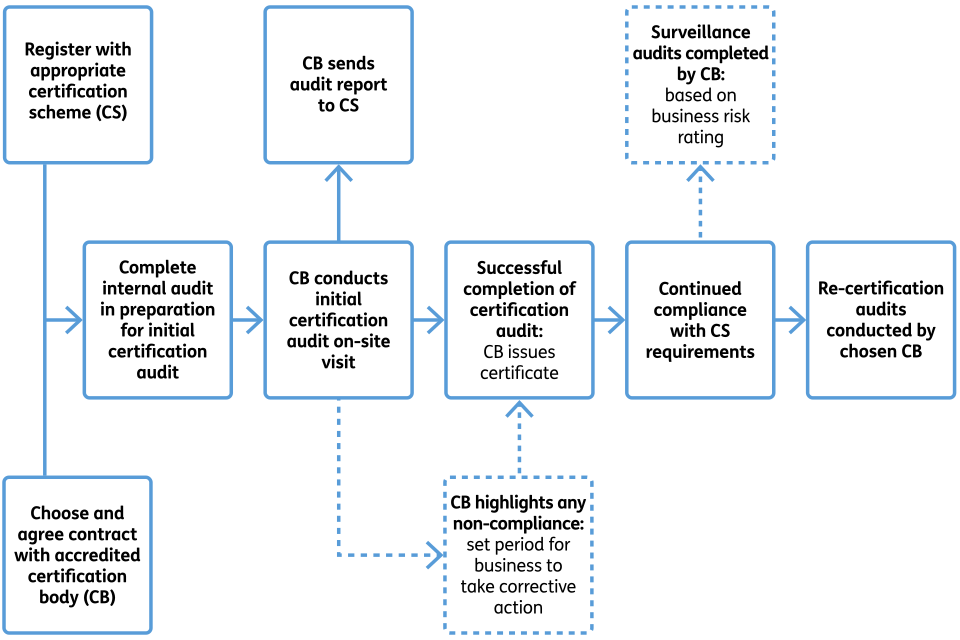
Businesses involved in manufacturing recycled plastic packaging would first need to select and become registered with an appropriate certification scheme. They would also need to engage a competent certification body to complete audits to check they meet the requirements of the scheme.
Some existing certification schemes publish a list of certification bodies that are accredited to the required International Organization for Standardization (ISO) standards. Businesses seeking certification would be required to internally audit their own processes and documentation to evaluate their operations and determine levels of compliance with their chosen scheme’s requirements. Following this, they would need to have an initial on-site visit conducted by the certification body where businesses would be interviewed, and processes and documentation would be assessed.
If during the initial audit the certification body identifies any areas of non-compliance with the scheme’s requirements, it would document them in the audit report which they would send to the relevant certification scheme. The business would then have a set period to take corrective actions to ensure it is fully compliant with the scheme requirements.
Where a business has successfully passed the initial audit, or where sufficient corrective action has been taken, the certification body would issue their certification and notify the certification scheme. Businesses must then ensure they continue to comply with the requirements of the scheme to maintain their certification to continue to claim exemption from PPT for mechanically recycled plastic.
Businesses would need to pay required fees, maintain correct documentation and have re-certification audits conducted to maintain their certification. Certification bodies would also conduct surveillance audits as they deem appropriate based on businesses’ risk ratings, which would be completed between the re-certification audits. Figure 1 illustrates the outlined typical process for certification from initial registration through to re-certification audits.
Figure 1: Certification process
Frequency and nature of audits
Existing certification schemes may vary in their requirements for audits. While all schemes require re-certification audits, some use a risk rating to decide the length of time a certificate is valid. This means that in some cases, a re-certification audit can be conducted between 12 months to 5 years after the initial audit.
Risk ratings are also used by some certification schemes to decide the nature and frequency of subsequent audits. A business’s risk rating is assessed against the standards and requirements of the scheme. Businesses assessed as low risk are audited less frequently than higher risk businesses. They may also only require desk-based audits or compliance checks against a limited number of standards and requirements. Some certification schemes currently require audit reports to be submitted to them to ensure consistency of approach.
The minimum requirements that are being developed for certification schemes used in relation to chemical recycling will specify how often, and what kind of audits should happen. Although the details are still being worked out, we welcome suggestions for what these requirements should be, if similar requirements were to be introduced for mechanically recycled plastic. The government recognises that there would be additional administrative burdens and costs associated with this process and seeks views on the proportionality of this proposal and how these costs could be minimised.
Question 19: Do you have any suggestions for the minimum requirements that should be included for audits? Please explain your reasoning for any suggestions provided.
Question 20: In what circumstances and at what frequency should a certification scheme check the quality of audits conducted by certification bodies? Please provide reasons for your response.
Question 21: Acknowledging there are administrative burdens and costs associated with the certification process and audits, is there anything the government could do to minimise these? Please explain any suggestions fully.
Status of certification
A certification body would suspend or withdraw a business’s certification under several circumstances. These include:
- failure to comply with the scheme’s requirements
- identification of issues with a business’s processes or documentation during an audit
- a business’s failure to take the necessary corrective action to resolve issues within the specified timeframe
If a business’s certification is suspended or withdrawn, they would no longer be permitted to claim that their products contain recycled material certified under that scheme and therefore would not be able to claim exemptions from PPT.
Businesses who have entered into contracts with others must verify the certification status of their suppliers to ensure the recycled materials they receive remain compliant. Some existing certification schemes mandate that every business within a supply chain up to and including the point of manufacture be certified under the same scheme, otherwise they are unable to participate. Other schemes may accept certification from alternative schemes, but only those that meet equivalent standards.
In the consultation on certification for chemically recycled plastic, the government sought views on whether all businesses within a supply chain, up to and including the point of packaging manufacture, should be certified under the same certification scheme to enable recycled material to be taken into account for the purposes of PPT. While over a third of respondents who expressed a view on this topic supported a single scheme, citing enhanced fraud protection, others raised concerns about the financial burden on small businesses and the risk of creating a monopoly amongst certification providers.
Building on these insights, the government decided that all businesses within the same supply chain would not be required to be certified under the same certification scheme. This approach addresses industry concerns by allowing flexibility in scheme selection, while still ensuring consistency, credibility and traceability across the supply chain. If the proposal for mechanically recycled plastic is taken forward, the government is interested in views on whether the same approach should be adopted.
Role of accreditation bodies
The minimum requirements for certification schemes would need to ensure that certification bodies demonstrate the necessary competence, technical expertise, integrity, and impartiality to conduct audits and issue certifications.
To ensure these requirements are applied consistently across the plastics supply chain, the government would propose that any certification scheme would need to verify that certification bodies meet these requirements. An effective way to achieve this would be to require certification bodies to be accredited by a recognised accreditation body, who would assess their competence against certification scheme requirements. Figure 2 illustrates how the recognised accreditation body, certification bodies and businesses may interact with the proposed certification requirement.
Figure 2: Accreditation and certification
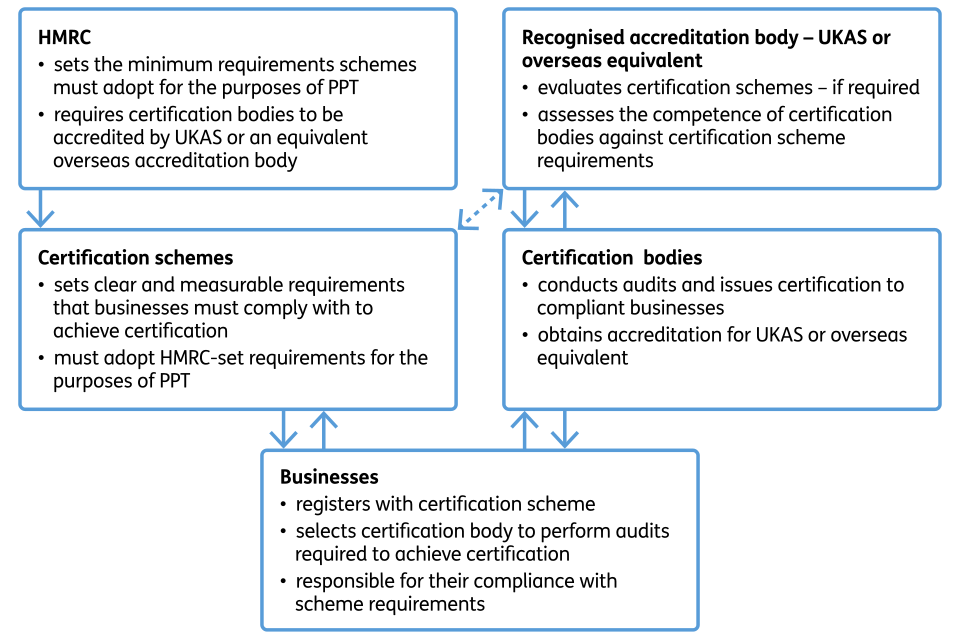
To be a recognised accreditation body for the purposes of PPT, the accreditation body would need to be a signatory to the Global Accreditation Cooperation Incorporated multilateral recognition agreement (GACI MRA). This requirement would ensure adequate assessment against international standards. The government’s proposed approach is designed to enhance the traceability of recycled plastic by aligning with global standards and international best practices. Where there are complex and interconnected global supply chains, recycled plastic may pass through multiple jurisdictions, manufacturers and supply chain systems. Without a common set of standards, it becomes difficult to verify recycled plastic, increasing the potential risk of fraudulent and inconsistent reporting.
The United Kingdom Accreditation Service (UKAS) is the national accreditation body for the UK and is a signatory to the GACI MRA. This means that reports and certificates issued by UKAS-accredited certification bodies are internationally recognised as technically equivalent to those issued by certification bodies accredited by other GACI MRA signatories. This would be relevant to UK manufacturers and for importers and associated global supply chains. UKAS may also accredit overseas certification bodies in line with international agreements and in collaboration with the relevant recognised accreditation bodies.
To ensure the integrity and consistency of certification, the government’s preferred approach would be to include a requirement that all certification bodies must be accredited by a recognised accreditation body before they can issue certificates of conformity. This proposal is informed by feedback from the previous consultation on mandating certification for chemical recycling, where most of the respondents to this question were in favour of an accreditation requirement. Respondents highlighted that accreditation would ensure transparency, build trust throughout the plastics supply chain and ensure the consistency and quality of audits. In response, the government has been working with UKAS to establish the process for accreditation.
To promote transparency and build trust across the plastics supply chain, certification bodies would need to be accredited by UKAS or an overseas equivalent. Some existing certification schemes already publish lists of certification bodies that are accredited by recognised accreditation bodies. However, responsibility would remain with each business seeking certification, including those involved in each part of a long, global supply chain, to ensure that the certification body they choose is accredited in line with HMRC’s set requirements, which will be set out in future legislation.
Question 22: Do you agree that certification bodies conducting audits under a certification scheme should be accredited by a recognised accreditation body? If not, can you suggest an alternative method that would ensure standards are consistently maintained?
Chain of custody overview
A chain of custody is a process which ensures inputs, outputs and associated information are transferred, monitored and controlled as they move through the supply chain. This system enables businesses to trace the origin of input materials, product components, and final product, as well as the conditions under which they are produced. For plastic manufacturers seeking to claim their plastic packaging contains recycled plastic, understanding and applying the chain of custody principles would be essential.
Permitted models for mechanical recycling
For mechanically recycled plastic packaging, manufacturers would be allowed to use the segregated or the controlled blending chain of custody models. Both these chain of custody models enable businesses to evidence the actual amount of recycled plastic contained in their plastic packaging components.
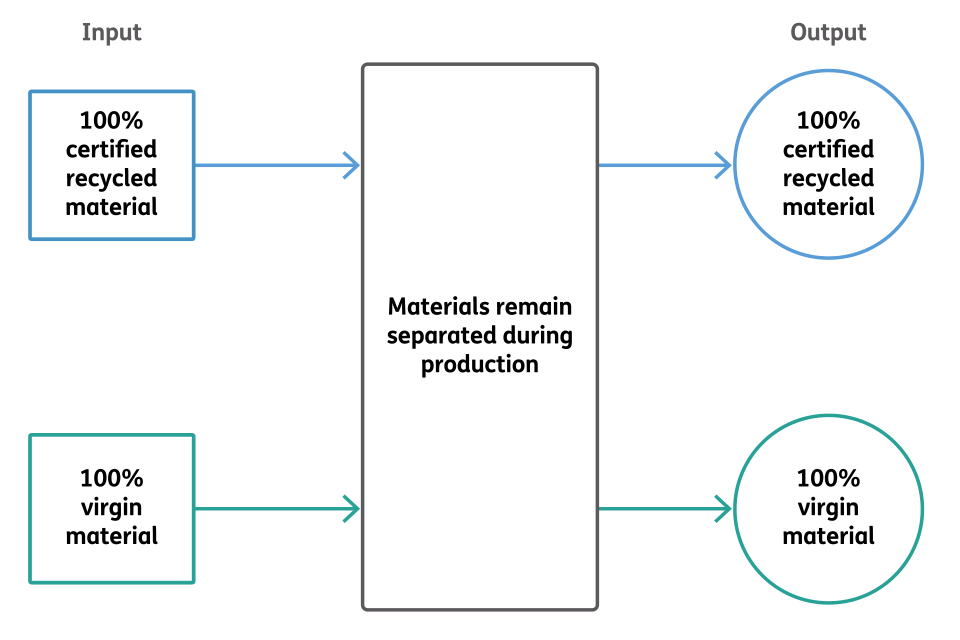
The segregated model requires that certified recycled materials are kept separate from non-certified materials throughout the entire production process. This model guarantees that the product produced is composed solely of certified materials. For example, a manufacturer may follow this model to produce one hundred percent recycled plastic bottles by avoiding the mixing of recycled and virgin material. Figure 3 provides a visual representation of this model.
Figure 3: Segregated model
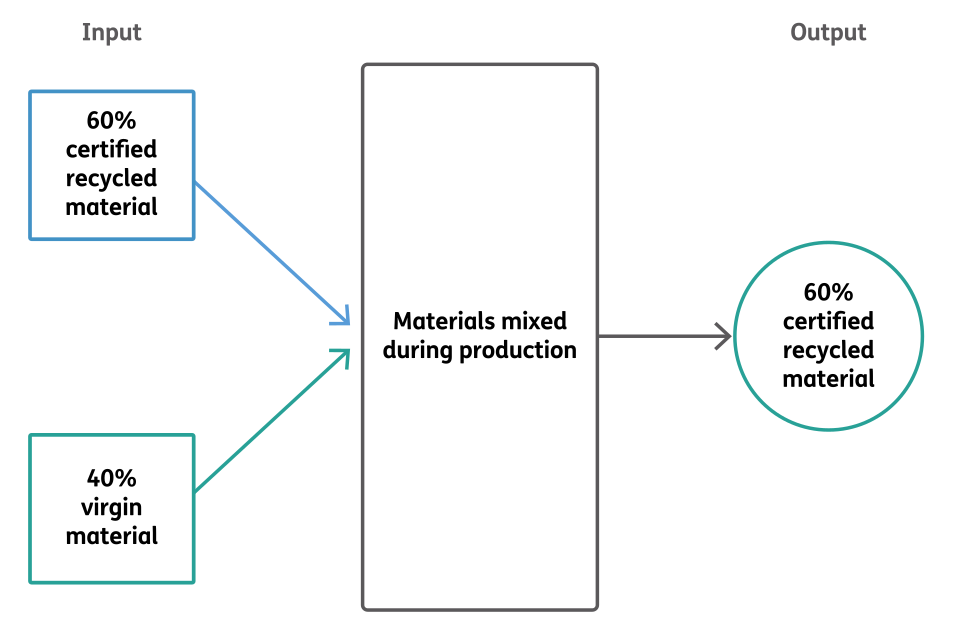
The controlled blending model allows certified recycled and non-certified virgin materials to be mixed where proportions are known. This model offers flexibility in sourcing material, while maintaining the credibility of recycled plastic claims. For example, a manufacturer may blend post-consumer recycled plastic with virgin plastic, carefully controlling the ratio of both inputs to ensure a minimum recycled plastic percentage in the output product. Figure 4 illustrates this model.
Figure 4: Controlled blending model
7. Timing
This chapter seeks views on when mandatory certification for mechanically recycled plastic could be implemented, should a strong case for introducing this proposal be established. In considering timing, the government is mindful of:
- interaction with wider PPT changes taking effect from 1 April 2027
- the need to provide businesses with adequate lead in time
- the importance of aligning implementation with accounting periods where possible
The government welcomes views on whether aligning where possible the evidential standards for mechanically recycled plastics with the certification framework being introduced for a MBA for chemical recycling would help businesses consolidate processes and controls, even if the implementation dates for each framework differ.
Given these considerations, the government is seeking views on how long the industry would need to prepare for mandatory certification for mechanically recycled plastic packaging if it is introduced.
Question 23: Do you agree with the government’s proposal on implementing mandatory certification for mechanically recycled plastic? Please provide reasoning for your response.
Question 24: If the government were to proceed with mandating certification for mechanically recycled plastic, when do you think this change could be implemented from? Please include views on the time required for businesses to comply with the proposed change, providing specific examples or evidence where possible.
Question 25: What steps could the government take to help businesses prepare for the implementation of a mandatory certification requirement for mechanically recycled plastic? We welcome suggestions that address practical implementation, industry readiness and transitional support.
8. Assessment of impacts
Summary of impacts
There is currently a limited amount of data and evidence to estimate impact of the potential measures covered in this document. Any future estimates will be informed by this consultation.
Exchequer impact assessment
Any Exchequer impact will be estimated following the final design of the measure and will be subject to scrutiny by the Office for Budget Responsibility.
| Impacts | Comment |
|---|---|
| Economic impact | The proposal outlined in this consultation would not be expected to have any significant macroeconomic impacts. |
| Impact on individuals, households and families | This consultation welcomes views on how individuals may be impacted by the proposed changes outlined in this document and responses will be examined to understand this aspect. Any impacts identified through responses will be detailed. The proposed changes are not expected to impact family formation, stability or breakdown. |
| Equalities impacts | This consultation welcomes views on how individuals may be impacted, and responses will be examined to understand any disproportionate impacts on those in groups sharing protected characteristics. |
| Impact on businesses and Civil Society Organisations | While there are no impacts at present, there may be some administrative burden associated with the proposed change outlined in this consultation, as businesses would need to obtain certification by implementation date, that will be decided subject to the outcome of this consultation. Any future impacts will be fully examined and detailed. This consultation also welcomes views on how any associated burdens can be kept to a minimum. |
| Impact on HMRC or other public sector delivery organisations | The proposed changes may require changes to HMRC’s compliance approach. The full impacts of this aspect are currently being assessed. |
| Other impacts | Other impacts will be considered through this consultation. |
Question 26: Do you have any comments on the assessment of impacts in the Tax impact assessment?
9. Summary of consultation questions
Question 1: Which forms of recycling does your business currently rely on to meet the PPT recycled content threshold (mechanical, chemical, or a mix of both)? Please provide details.
Question 2: To what extent does your business use mechanically recycled plastic in plastic packaging that is manufactured in or imported into the UK? Please indicate whether this represents a significant, moderate or small proportion of your total packaging volumes and, where possible, provide approximate percentages or tonnages.
Question 3: Without disclosing any specific business information or details, are you able to provide any general insight that supports the concerns raised around the prevalence of fraudulent claims or the number of businesses involved, including where these concerns come from, meaning UK manufactured or imported plastic packaging?
Question 4: For importers of plastic packaging, what documentation do you currently use to evidence recycled plastic in packaging and are there types of evidence that are difficult to obtain or verify from overseas suppliers?
Question 5: For UK manufacturers of plastic packaging, what documentation do you currently use to evidence recycled plastic in packaging and are there types of evidence that are difficult to obtain?
Question 6: Do you know what other countries require evidence of recycled plastic content for tax, regulatory, or environmental purposes? If yes, please describe the approach, whether it includes certification, standardised documentation, or alternative assurance methods and your views on this approach.
Question 7: To what extent does the use of third-party certification in other sectors provide a useful model for introducing mandatory certification of mechanically recycled plastic content in packaging? Please explain your reasoning and outline any risks, challenges, or benefits you foresee.
Question 8: Do you agree that mandating certification and standardising the evidential requirements could provide more certainty for businesses when seeking to claim an exemption from PPT when using mechanically recycled plastic? Please explain your reasoning.
Question 9: For importers of plastic packaging, what challenges do you face when obtaining evidence of recycled plastic content?
Question 10: For UK manufacturers of plastic packaging, what challenges do you face when obtaining evidence of recycled plastic content?
Question 11: For importers of plastic packaging, do you foresee any barriers to implementing mandatory certification for mechanically recycled plastic packaging? Please provide specific examples or evidence of any barrier that may arise.
Question 12: For UK manufacturers of plastic packaging, do you foresee any barriers to implementing mandatory certification for mechanically recycled plastic packaging? Please provide specific examples or evidence of any barrier that may arise.
Question 13: Do you currently use certification to support your claims for an exemption from PPT? If so, please provide any details of the costs, benefits and any drawbacks of doing so, including any associated burdens on your business.
Question 14: If certification for mechanically recycled plastic packaging were to be introduced, should it apply to all businesses claiming exemption from PPT to ensure a level playing field of evidential requirements? Please explain your reasoning for any suggestions provided.
Question 15: Do you have any alternative suggestions, outside of certification, that could provide a robust and more efficient way of ensuring all recycled content claims are true and accurate?
Question 16: Taking into account the risks and challenges associated with the current evidence requirements, do you support the introduction of mandatory certification for mechanically recycled plastic packaging? Please explain your answer and provide reasoning.
Question 17: If not addressed elsewhere in your responses, please outline how mandatory certification for mechanically recycled plastic might affect your business if introduced. Please include detail on potential administrative burdens, operational adjustments and cost implications.
Question 18: If the proposed certification requirement were to be introduced, to what extent would this affect your pricing for customers, for example, would you pass on the cost of gaining certification to the customer, or would it reduce your costs if it enabled you to claim an exemption from PPT where applicable?
Question 19: Do you have any suggestions for the minimum requirements that should be included for audits? Please explain your reasoning for any suggestions provided.
Question 20: In what circumstances and at what frequency should a certification scheme check the quality of audits conducted by certification bodies? Please provide reasons for your response.
Question 21: Acknowledging there are administrative burdens and costs associated with the certification process and audits, is there anything the government could do to minimise these? Please explain any suggestions fully.
Question 22: Do you agree that certification bodies conducting audits under a certification scheme should be accredited by a recognised accreditation body? If not, can you suggest an alternative method that would ensure standards are consistently maintained?
Question 23: Do you agree with the government’s proposal on implementing mandatory certification for mechanically recycled plastic? Please provide reasoning for your response.
Question 24: If the government were to proceed with mandating certification for mechanically recycled plastic, when do you think this change could be implemented from? Please include views on the time required for businesses to comply with the proposed change, providing specific examples or evidence where possible.
Question 25: What steps could the government take to help businesses prepare for the implementation of a mandatory certification requirement for mechanically recycled plastic? We welcome suggestions that address practical implementation, industry readiness and transitional support.
Question 26: Do you have any comments on the assessment of impacts in the Tax Impact Assessment?
10. The consultation process
This consultation is being conducted in line with the Tax Consultation Framework. There are 5 stages to tax policy development:
Stage 1: Setting out objectives and identifying options.
Stage 2: Determining the best option and developing a framework for implementation including detailed policy design.
Stage 3: Drafting legislation to effect the proposed change.
Stage 4: Implementing and monitoring the change.
Stage 5: Reviewing and evaluating the change.
This consultation is taking place during stage 1 of the process. The purpose of the consultation is to seek views on the policy design and any suitable possible alternatives, before consulting later on a specific proposal for reform.
How to respond
A summary of the questions in this consultation is included at chapter 9.
Responses should be submitted online by 10 August 2026, or sent by email to teamindirecttaxdesign@hmrc.gov.uk.
Please do not send consultation responses to the Consultation Coordinator.
Paper copies of this document in Welsh may be obtained free of charge from the above address.
When responding please say if you are a business, individual or representative body. In the case of representative bodies please provide information on the number and nature of people you represent.
Confidentiality
HMRC is committed to protecting the privacy and security of your personal information. This privacy notice describes how we collect and use personal information about you in accordance with data protection law, including the UK GDPR and the Data Protection Act (DPA) 2018.
Information provided in response to this consultation, including personal information, may be published or disclosed in accordance with the access to information regimes. These are primarily the Freedom of Information Act 2000 (FOIA), the DPA 2018, UK GDPR and the Environmental Information Regulations 2004.
If you want the information that you provide to be treated as confidential, please be aware that, under the Freedom of Information Act 2000, there is a statutory Code of Practice with which public authorities must comply and which deals with, amongst other things, obligations of confidence. In view of this it would be helpful if you could explain to us why you regard the information you have provided as confidential. If we receive a request for disclosure of the information we will take full account of your explanation, but we cannot give an assurance that confidentiality can be maintained in all circumstances. An automatic confidentiality disclaimer generated by your IT system will not, of itself, be regarded as binding on HM Revenue and Customs.
Consultation Privacy Notice
This notice sets out how we will use your personal data, and your rights. It is made under Articles 13 and 14 of the UK GDPR.
Your data
We will process the following personal data:
Name
Email address
Postal address
Phone number
Job title
Purpose
The purposes for which we are processing your personal data is: Plastic Packaging Tax: potential certification for mechanically recycled plastic packaging.
Where provided, your name and contact information may be used to contact you about your response to this consultation. If you do not wish to be further contacted, please let us know.
Legal basis of processing
The legal basis for processing your personal data is that the processing is necessary for the exercise of a function of a government department.
Recipients
Your personal data will be shared by us with HM Treasury.
Retention
Your personal data will be kept by us for 6 years and will then be deleted.
Your rights
You have the right to request information about how your personal data are processed, and to request a copy of that personal data.
You have the right to request that any inaccuracies in your personal data are rectified without delay.
You have the right to request that any incomplete personal data are completed, including by means of a supplementary statement.
You have the right to request that your personal data are erased if there is no longer a justification for them to be processed.
You have the right in certain circumstances (for example, where accuracy is contested) to request that the processing of your personal data is restricted.
Complaints
If you consider that your personal data has been misused or mishandled, you may make a complaint to the Information Commissioner, who is an independent regulator. The Information Commissioner can be contacted at:
Information Commissioner’s Office
Wycliffe House
Water Lane
Wilmslow
Cheshire
SK9 5AF
0303 123 1113 casework@ico.org.uk
Any complaint to the Information Commissioner is without prejudice to your right to seek redress through the courts.
Contact details
The data controller for your personal data is HMRC. The contact details for the data controller are:
HMRC
100 Parliament Street
Westminster
London
SW1A 2BQ
The contact details for HMRC’s Data Protection Officer are:
The Data Protection Officer
HMRC
14 Westfield Avenue
Stratford
London
E20 1HZ
Consultation principles
This consultation is being run in accordance with the government’s Consultation Principles.
The Consultation Principles are available on the Cabinet Office website.
If you have any comments or complaints about the consultation process, please contact the Consultation Coordinator.
Please do not send responses to the consultation to this link.
Annex: Relevant (current) legislation
| Finance Act 2021 s.42-85 |
| The Plastic Packaging Tax (Descriptions of Products) Regulations 2021 |
| The Plastic Packaging Tax (General) Regulations 2022 |