Modified proposals for local government reorganisation in West Sussex
Published 12 May 2026
Applies to England

© Crown copyright 2026
This publication is licensed under the terms of the Open Government Licence v3.0 except where otherwise stated. To view this licence, visit nationalarchives.gov.uk/doc/open-government-licence/version/3 or write to the Information Policy Team, The National Archives, Kew, London TW9 4DU, or email: psi@nationalarchives.gov.uk.
Where we have identified any third party copyright information you will need to obtain permission from the copyright holders concerned.
This publication is available at https://www.gov.uk/government/consultations/modified-proposals-for-local-government-reorganisation-in-west-sussex/modified-proposals-for-local-government-reorganisation-in-west-sussex
This consultation seeks views on a potential modification to the proposal that the Ministry of Housing Communities and Local Government (MHCLG) received from:
- Adur District Council
- Arun District Council
- Chichester District Council
- Crawley Borough Council
- Horsham District Council
- Mid-Sussex District Council
- Worthing Borough Councils
The relevant proposal for 2 unitary councils was made on 26 September 2025, following the Secretary of State’s invitation to councils in West Sussex to submit proposals for unitary local government for their areas. This consultation asks questions about the potential modification to the proposal to help inform further assessment. The responses will be considered in addition to those received for the first the statutory consultation undertaken between 19 November 2025 and 11 January 2026 on all reorganisation proposals received from councils in West Sussex.
Scope of this consultation
This consultation is about the structure of local government in the West Sussex area.
Geographical scope
These proposals relate to England only.
Impact assessment
An impact assessment has not been prepared for this consultation as it will only affect local government in the West Sussex area and so there will be no direct regulatory, economic, or social impacts.
Body responsible for the consultation
This consultation is conducted by MHCLG.
Duration
This consultation will last for 5 weeks from 12 May 2025 to 15 June 2026.
Enquiries
For any enquiries about the consultation please contact: LGRconsultationresponse@communities.gov.uk
How to respond
You may respond by completing the online survey.
If you are responding in writing, please make it clear which proposal you are responding to. You can email your response to the questions in this consultation to LGRconsultationresponse@communities.gov.uk
Alternatively written responses should be sent to:
LGR Consultation
Ministry of Housing, Communities and Local Government
Fry Building 2NE
2 Marsham Street
London
SW1P 4DF
When replying please include your name and indicate whether your home or organisation address is located in:
- West Sussex
- not in West Sussex
We would also like you to confirm whether you are replying as a named consultee, submitting an official response on behalf of an organisation that is not on the list of named consultees, or replying as an individual.
Named consultees
If you are a named consultee, please also include:
- the name of the organisation
- your position in the organisation
- an email address that can be used to contact you
Responses from organisations that are not named consultees
If you are a submitting a response on behalf of an organisation that is not on the list of named consultees, please indicate the type of organisation as below:
- business
- education
- local government - neighbouring principal council
- local government - parish/town council
- local government - other
- police
- fire
- health
- other
Background
As set out in our previous consultation, Proposals for local government reorganisation in East Sussex and Brighton and Hove, and West Sussex, residents and businesses in East Sussex, Brigton and Hove and West Sussex are currently served by a two-tier system of local government.
On 5 February 2025, the then Minister of State for Local Government and English Devolution issued a statutory invitation to all councils in two-tier areas and small neighbouring unitary authorities to develop proposals for unitary local government for the whole area.
In West Sussex the invitation went to:
- Adur District Council
- Arun District Council
- Chichester District Council
- Crawley Borough Council
- Horsham District Council
- Mid Sussex District Council
- West Sussex County Council
- Worthing Borough Council
The invitation was issued under Part 1 of the Local Government and Public Involvement in Health Act 2007 (the 2007 Act) and set out 6 criteria for unitary local government and other matters that should be taken into account when formulating a proposal. That guidance is at Annex A.
Two proposals were received from councils across the West Sussex invitation areas on 26 September 2025 and a 7-week statutory consultation was undertaken between19 November 2025 and 11 January 2026. 3,828 responses were received in response to this consultation and were carefully considered alongside the proposals and all other information received. In addition, Brighton and Hove City Council, which was within the adjoining invitation area, proposed 5 unitary councils across the whole of the area of East Sussex, West Sussex, and Brighton and Hove. This proposal includes a request to split existing district council areas between the proposed new councils.
The Secretary of State announced on 25 March 2026 that, after carefully considering the two proposals received across the area, he had not yet made a decision, due to concerns regarding all four of the proposals received from across West Sussex and East Sussex, Brighton and Hove. These included a concern about community and identity, while maintaining balance under the Mayoral Combined Authority in the West Sussex proposals. These concerns are set out in detail in his update letter to council leaders.
For West Sussex, a potential modification to the 2 unitary proposal submitted by the West Sussex district councils would see a coastal unitary comprising Adur, Arun and Worthing (as set out as part of the proposal from Brighton and Hove) and a second unitary covering Chichester, Crawley, Horsham and Mid Sussex. The Secretary of State wishes to explore whether this modification would ensure that new West Sussex councils reflect distinct communities and rural/coastal identities in the area while maintaining balance under the Mayoral Combined Authority.
This is illustrated in the map below:
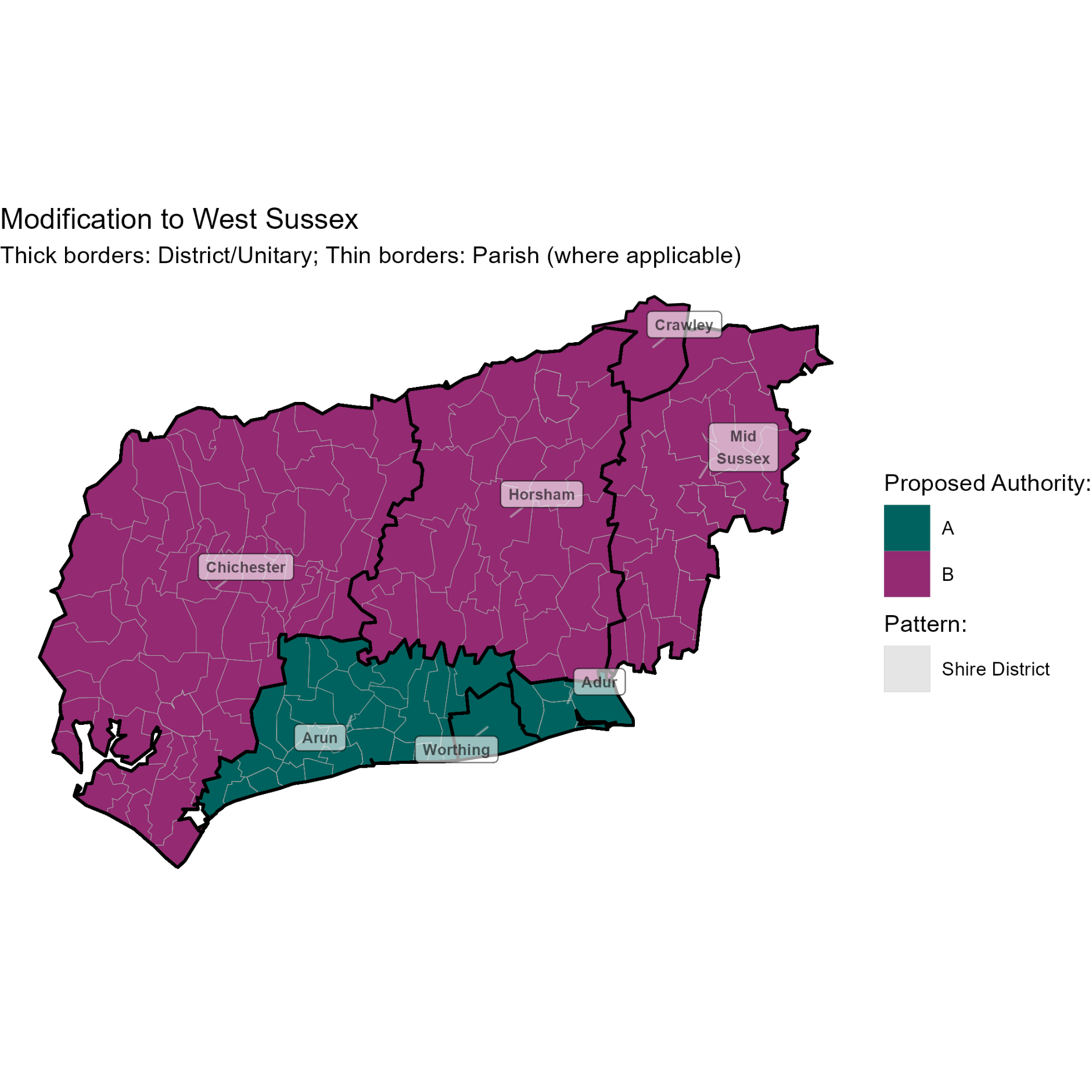
West Sussex
- Authority A: Arun, Adur, Worthing (pop: around 349,000)
- Authority B: Crawley, Chichester, Horsham, Mid Sussex (pop: around 566,000)
Original submissions from councils
The proposals received by MHCLG by the deadline of 26 September are set out above. The detailed information and supporting analysis within the original proposals can be found in the links below:
- Adur District Council, Arun District Council, Chichester District Council, Crawley Borough Council, Horsham District Council, Mid-Sussex District Council and Worthing Borough Councils have proposed 2 unitary councils
- Brighton and Hove City Council proposed 5 unitary councils
This consultation
The 2007 Act required that, before a proposal for local government reorganisation can be implemented, there must first be a consultation with any council affected that has not submitted the proposal, as well as any other persons considered appropriate.
On 19 November 2025, HMG launched a consultation on all proposals received and has carefully considered all responses. This consultation is a further consultation seeking views on a potential modification to the proposal received from the West Sussex district councils for there to be 2 unitary authorities in West Sussex which if made would use the power to modify a proposal provided in the Local Government and Public Involvement in Health Act 2007.
All councils which fall within the West Sussex invitation area are being invited to respond to this further consultation, on a potential modification to a particular proposals received from councils in West Sussex. We also consider it appropriate to consult public service providers, including health providers and the police, and certain other business, voluntary and community sector, and educational bodies. A full list of named bodies being consulted on each potential modification is at Annex C.
This will be a shorter additional consultation exercise, focused on the views of the affected local authorities to a potential modification to the proposal for 2 unitaries in West Sussex and the criteria. We also welcome the views of any other persons or bodies interested in these proposals, including local residents, town and parish councils, businesses.
The responses to this consultation will help to inform the Secretary of State’s assessment of whether, and to what extent, the proposals with or without the potential modification meet the criteria set out in the invitation. All previous consultation responses have been considered and will be considered again, alongside any responses to this consultation, when a decision is taken, so respondees do not need to restate any previous response already given.
Consultation questions
Having considered the proposals at the links above, please respond to the following questions:
Question 1
To what extent do you agree or disagree that the potential modification to the two unitary proposal will deliver better unitary local government in West Sussex than the original proposal received as judged against the criteria?
For question 1 you can provide the following answers:
- strongly agree
- agree
- neither agree nor disagree
- disagree
- strongly disagree
- don’t know
Question 2
If you would like to, please use the free text box to tell us about whether the potential modification will deliver new council(s) that:
- are based on sensible geographies and economic areas
- will be able to deliver the outcomes described in the original proposal
- are the right size to be efficient, improve capacity and withstand financial shocks
- will put local government in the area as a whole on a firmer footing,
- will deliver high quality, sustainable public services
- will meet local needs
- will support devolution arrangements
- enable stronger community engagement and give the opportunity for neighbourhood empowerment
You may also use the box to provide any other comments you have on this potential modification or any other matters.
What happens next
The consultation will close at 11:59pm on 15 June 2026.
This consultation will inform an assessment by the Secretary of State of the merits of the proposals and the potential modification.
All proposals received from councils have been considered carefully against initial consultation responses, and will be considered again, including with potential modifications, alongside all responses to this consultation, all responses to the previous consultation, and any other relevant information, before a decision is taken on how to proceed, including whether or not to implement a proposal, with or without modification. In deciding which proposal, if any, to implement in an area, subject to Parliamentary approval, the Secretary of State will assess the proposals against the criteria set out in the statutory guidance accompanying the invitation, as well as having regard to all representations received, including responses to this consultation, and to all other relevant information available.
The Secretary of State may decide, subject to Parliamentary approval, to implement a proposal with or without modification, or to not implement any proposal for an area, and may also seek advice from the Local Government Boundary Commission for England.
If any proposals are to be implemented, we would expect new unitary councils to take on full council roles from April 2028, with transitional arrangements in 2027-28 to support a smooth implementation.
The final decisions will be communicated to the councils as soon as practicable.
About this consultation
This consultation document and consultation process have been planned to adhere to the Consultation Principles issued by the Cabinet Office.
Representative groups are asked to give a summary of the people and organisations they represent, and where relevant who else they have consulted in reaching their conclusions when they respond.
Information provided in response to this consultation may be published or disclosed in accordance with the access to information regimes (these are primarily the Freedom of Information Act 2000 (FOIA), the Environmental Information Regulations 2004 and UK data protection legislation. In certain circumstances this may therefore include personal data when required by law.
If you want the information that you provide to be treated as confidential, please be aware that, as a public authority, the Department is bound by the information access regimes and may therefore be obliged to disclose all or some of the information you provide. In view of this it would be helpful if you could explain to us why you regard the information you have provided as confidential. If we receive a request for disclosure of the information we will take full account of your explanation, but we cannot give an assurance that confidentiality can be maintained in all circumstances. An automatic confidentiality disclaimer generated by your IT system will not, of itself, be regarded as binding on the Department.
The Ministry of Housing, Communities and Local Government will at all times process your personal data in accordance with UK data protection legislation and in the majority of circumstances this will mean that your personal data will not be disclosed to third parties. A full privacy notice is included below.
Individual responses will not be acknowledged unless specifically requested.
Your opinions are valuable to us. Thank you for taking the time to read this document and respond.
Are you satisfied that this consultation has followed the Consultation Principles? If not or you have any other observations about how we can improve the process, please contact us via the complaints procedure.
Annex A: Guidance from the Secretary of State for proposals for unitary local government
Criteria for unitary local government
1) A proposal should seek to achieve for the whole of the area concerned the establishment of a single tier of local government.
- a) Proposals should be for sensible economic areas, with an appropriate tax base which does not create an undue advantage or disadvantage for one part of the area.
- b) Proposals should be for a sensible geography which will help to increase housing supply and meet local needs.
- c) Proposals should be supported by robust evidence and analysis and include an explanation of the outcomes it is expected to achieve, including evidence of estimated costs/benefits and local engagement.
- d) Proposals should clearly describe the single tier local government structures it is putting forward for the whole of the area, and explain how, if implemented, these are expected to achieve the outcomes described.
2) Unitary local government must be the right size to achieve efficiencies, improve capacity, and withstand financial shocks.
- a) As a guiding principle, new councils should aim for a population of 500,000 or more.
- b) There may be certain scenarios in which this 500,000 figure does not make sense for an area, including on devolution, and this rationale should be set out in a proposal.
- c) Efficiencies should be identified to help improve councils’ finances and make sure that council taxpayers are getting the best possible value for their money.
- d) Proposals should set out how an area will seek to manage transition costs, including planning for future service transformation opportunities from existing budgets, including from the flexible use of capital receipts that can support authorities in taking forward transformation and invest-to-save projects.
- e) For areas covering councils that are in Best Value intervention and/or in receipt of Exceptional Financial Support, proposals must additionally demonstrate how reorganisation may contribute to putting local government in the area as a whole on a firmer footing and what area-specific arrangements may be necessary to make new structures viable.
- f) In general, as with previous restructures, there is no proposal for council debt to be addressed centrally or written off as part of reorganisation. For areas where there are exceptional circumstances where there has been failure linked to capital practices, proposals should reflect the extent to which the implications of this can be managed locally, including as part of efficiencies possible through reorganisation.
3) Unitary structures must prioritise the delivery of high quality and sustainable public services to citizens.
- a) Proposals should show how new structures will improve local government and service delivery and should avoid unnecessary fragmentation of services.
- b) Opportunities to deliver public service reform should be identified, including where they will lead to better value for money.
- c) Consideration should be given to the impacts for crucial services such as social care, children’s services, SEND and homelessness, and for wider public services including for public safety.
4) Proposals should show how councils in the area have sought to work together in coming to a view that meets local needs and is informed by local views.
- a) It is for councils to decide how best to engage locally in a meaningful and constructive way and this engagement activity should be evidenced in your proposal.
- b) Proposals should consider issues of local identity and cultural and historic importance.
- c) Proposals should include evidence of local engagement, an explanation of the views that have been put forward and how concerns will be addressed.
5) New unitary structures must support devolution arrangements.
- a) Proposals will need to consider and set out for areas where there is already a Combined Authority (CA) or a Combined County Authority (CCA) established or a decision has been taken by government to work with the area to establish one, how that institution and its governance arrangements will need to change to continue to function effectively; and set out clearly (where applicable) whether this proposal is supported by the CA/CCA /Mayor.
- b) Where no CA or CCA is already established or agreed then the proposal should set out how it will help unlock devolution.
- c) Proposals should ensure there are sensible population size ratios between local authorities and any strategic authority, with timelines that work for both priorities.
6) New unitary structures should enable stronger community engagement and deliver genuine opportunity for neighbourhood empowerment.
- a) Proposals will need to explain plans to make sure that communities are engaged.
- b) Where there are already arrangements in place it should be explained how these will enable strong community engagement.
Developing proposals for unitary local government
The following matters should be taken into account in formulating a proposal:
Boundary changes
a) Existing district areas should be considered the building blocks for your proposals, but where there is a strong justification more complex boundary changes will be considered.
b) There will need to be a strong public services and financial sustainability related justification for any proposals that involve boundary changes, or that affect wider public services, such as fire and rescue authorities, due to the likely additional costs and complexities of implementation.
Engagement and consultation on reorganisation
a) We expect local leaders to work collaboratively and proactively, including by sharing information, to develop robust and sustainable unitary proposals that are in the best interests of the whole area to which this invitation is issued, rather than developing competing proposals.
b) For those areas where Commissioners have been appointed by the Secretary of State as part of the Best Value Intervention, their input will be important in the development of robust unitary proposals.
c) We also expect local leaders to engage their Members of Parliament, and to ensure there is wide engagement with local partners and stakeholders, residents, workforce and their representatives, and businesses on a proposal.
d) The engagement that is undertaken should both inform the development of robust proposals and should also build a shared understanding of the improvements you expect to deliver through reorganisation.
e) The views of other public sector providers will be crucial to understanding the best way to structure local government in your area. This will include the relevant Mayor (if you already have one), Integrated Care Board, Police (Fire) and Crime Commissioner, Fire and Rescue Authority, local Higher Education and Further Education providers, National Park Authorities, and the voluntary and third sector.
f) Once a proposal has been submitted it will be for the government to decide on taking a proposal forward and to consult as required by statute. This will be a completely separate process to any consultation undertaken on mayoral devolution in an area, which will be undertaken in some areas early this year, in parallel with this invitation.
Annex B: Personal data
The following is to explain your rights and give you the information you are entitled to under UK data protection legislation.
Note that this section only refers to personal data (your name, contact details and any other information that relates to you or another identified or identifiable individual personally) not the content otherwise of your response to the consultation.
1. The identity of the data controller and contact details of our Data Protection Officer
The Ministry of Housing, Communities and Local Government (MHCLG) is the data controller.
The Data Protection Officer can be contacted at dataprotection@communities.gov.uk or by writing to the following address:
Data Protection Officer
Ministry of Housing, Communities and Local Government
Fry Building
2 Marsham Street
London
SW1P 4DF
2. Why we are collecting your personal data
Your personal data is being collected as an essential part of the consultation process, so that we can contact you to respond to the consultation, and we may also contact you regarding your response and for statistical purposes or use it to contact you about related matters.
We will collect your IP address if you complete a consultation online. We may use this to ensure that each person only completes a survey once. We will not use this data for any other purpose.
For named consultees listed in Annex C, who MHCLG is emailing directly to inform them of the consultation, names and email addresses of relevant persons have either been taken from existing MHCLG systems, provided by other government departments or local authorities, or found on public websites.
Sensitive types of personal data
Please do not share special category personal data or criminal offence data* as we have not asked for this. By ‘special category personal data’, we mean information about living individuals:
- race
- ethnic origin
- political opinions
- religious or philosophical beliefs
- trade union membership
- genetics
- biometrics
- health (including disability-related information)
- sex life
- sexual orientation.
*By ‘criminal offence data,’ we mean information relating to a living individual’s criminal convictions or offences or related security measures.
3. Our legal basis for processing your personal data
The collection of your personal data is lawful under article 6(1)(e) of the UK General Data Protection Regulation as it is necessary for the performance by MHCLG of a task in the public interest/in the exercise of official authority vested in the data controller. Section 8(d) of the Data Protection Act 2018 states that this will include processing of personal data that is necessary for the exercise of a function of the Crown, a Minister of the Crown, or a government department i.e. in this case a consultation.
There is also a statutory duty to consult. The 2007 Act requires that, before a proposal for establishing unitary local government can be implemented, the Secretary of State must first consult any local authority that is affected by a proposal (but which has not submitted it), and any such other persons as she considers appropriate.
4. With whom we will be sharing your personal data
MHCLG may appoint a ‘data processor’, acting on behalf of the Department and under our instruction, to help analyse the responses to this consultation. Where we do, we will ensure that the processing of your personal data remains in strict accordance with the requirements of the data protection legislation.
5. For how long we will keep your personal data, or criteria used to determine the retention period
Your personal data will be held for 2 years from the closure of the consultation, unless we identify that its continued retention is unnecessary before that point.
6. Your rights, e.g. access, rectification, restriction, objection
The data we are collecting is your personal data, and you have considerable say over what happens to it. You have the right:
a. to see what data we have about you
b. to ask us to stop using your data, but keep it on record
c. to ask to have your data corrected if it is incorrect or incomplete
d. to object to our use of your personal data in certain circumstances
e. to lodge a complaint with the independent Information Commissioner (ICO) if you think we are not handling your data fairly or in accordance with the law. You can contact the ICO at https://ico.org.uk/, or telephone 0303 123 1113.
Please contact us at the following address if you wish to exercise the rights listed above, except the right to lodge a complaint with the ICO: dataprotection@communities.gov.uk or:
Knowledge and Information Access Team
Ministry of Housing, Communities and Local Government
Fry Building
2 Marsham Street
London
SW1P 4DF
7. Your personal data may be processed in the EU. The EU is covered by UK adequacy regulations
8. Your personal data will not be used for any automated decision making
9. Your personal data will be stored in a secure government IT system
We use a third-party system, Citizen Space, to collect consultation responses. In the first instance your personal data will be stored on their secure UK-based server. Your personal data will be transferred to our secure government IT system as soon as possible, and it will be stored there for 2 years before it is deleted.
Annex C: Named consultees
We welcome the views of all those interested in the proposals, including local residents, town and parish councils, businesses, and the voluntary sector. In this annex we list for information those who are specifically named consultees.
Before implementing a proposal, there is a statutory requirement to consult any local authority that is affected by the proposal (but which has not submitted it), and any such other persons as considered appropriate. This consultation is specifically inviting comments from the following councils and other named bodies:
West Sussex principal authorities
- Adur District Council
- Arun District Council
- Chichester District Council
- Crawley Borough Council
- Horsham District Council
- Mid Sussex District Council
- West Sussex County Council
- Worthing Borough Council
West Sussex health bodies
- NHS Sussex Integrated Care Board / Sussex Health and Care Partnership ICB
- South Central Ambulance Service NHS Foundation Trust
- South East Coast Ambulance Service NHS Foundation Trust
- Surrey and Sussex Healthcare NHS Trust
- Sussex Community NHS Foundation Trust
- Sussex Partnership NHS Foundation Trust
- University Hospitals Sussex NHS Foundation Trust
- Queen Victoria Hospital NHS Foundation Trust
West Sussex police and fire bodies
- Chief Constable of Sussex Police
- West Sussex Fire and Rescue Service Chief Fire Officer
- Sussex Police and Crime Commissioner
- Sussex Resilience Forum
West Sussex other public sector
- Chair and Independent Scrutineer of the West Sussex Safeguarding Children Partnership
- West Sussex Association of Local Councils
- High Weald National Landscape
- Independent Chair of the West Sussex Safeguarding Adults Board
- South Downs National Park Authority
- Transport for the South East
- High Weald National Landscape
West Sussex business organisations
- Federation of Small Business (South East and South Central)
- Sussex Chamber of Commerce
- Sussex Institute of Directors
- Sussex Federation of small businesses
- Gatwick Airport
- Shoreham Port Authority
- Chichester Harbour Conservancy
- Littlehampton Harbour Board
West Sussex education organisations
- University of Brighton
- University of Sussex
- University of Chichester
West Sussex voluntary and community organisations
- Sussex VCSE Leaders Alliance
West Sussex other
- Lord-Lieutenant of West Sussex
- Visit England
- East Sussex, Brighton & Hove, and West Sussex Local Visitor Economy Partnership
- The Sussex Inshore Fisheries and Conservation Authority
National bodies
- Environment Agency
- Local Government Association
- Unite the Union
- Unison
- GMB Union
- National Association of Local Councils
- National Highways
- National Housing Federation
- UK Health Security Agency